Five days after the halls in Frankfurt cleared, the Formnext 2026 news cycle is still running at full tilt. That’s partly because Mesago Messe Frankfurt treats its flagship trade show as a year-round content and directory engine rather than a four-day sprint, and partly because the hardware announced on the floor takes weeks to unpack once the booth lighting turns off.
Behind the glossy show-floor prints sits a much sharper story about where 3D printing is headed. Sub-$1,500 multi-toolhead printers and $5,000 desktop metal systems are pushing industrial capabilities onto maker benches, yet early pre-production units still stumble when they leave staff-tuned booths. At the same time, the event’s Asian counterweight in Shenzhen is growing at a pace that forces anyone tracking additive manufacturing to watch two hubs instead of one, and next year’s Frankfurt calendar shifted out of its usual November slot.
Key Takeaways
Formnext 2026 ran 17-20 November 2026 in Frankfurt am Main, while Formnext Asia Shenzhen 2026 closed 28 August 2026 with 34,202 visitors, a 65% jump over 2025 and a 157% surge in international attendance.
Desktop toolchangers dropped into a $309 to $1,499 price war led by the Axiloop MC8 and Elegoo Centauri X Ultra, though pre-production desktop UV units like the HeyGears G1X exposed a gap between tuned booth samples and creator test units.
Formnext 2027 moves earlier to October 26 to 29, 2027 in Frankfurt am Main; exhibitor registration for Formnext 2027 is reported as already open, while elsewhere only the call for papers is described as already open.
Table of contents
Table of Contents
Formnext 2026: dates, venue, and what the show is
Formnext 2026 was the flagship international trade show for additive manufacturing and industrial 3D printing, held 17-20 November 2026 at Messe Frankfurt in Frankfurt am Main and organized by Mesago Messe Frankfurt. The exhibition covers the entire additive manufacturing process chain under one roof, bringing together specialists in materials, pre-processing, production hardware, and post-processing. Formnext organizes its floor around the workflow from digital file to certified part rather than splitting software, printers, and finishing gear into separate events. In post-event messaging at formnext.mesago.com, the organizer stated that Formnext 2026 “once again exceeded our expectations” and pointed visitors to its press release and photo gallery for key figures.
Detailed attendance and exhibitor counts for the Frankfurt 2026 edition aren’t public in the available post-show record, leaving the qualitative organizer assessment as the primary official summary. Even without a published Frankfurt headcount, the breadth of hardware, materials, and industrial announcements tied to the November 2026 window shows why Formnext remains the central benchmark for European and global additive manufacturing.
More than four days: Formnext as a year-round AM hub
Formnext operates as a 365-day information and networking hub for industrial 3D printing professionals, pairing the physical Frankfurt exhibition with continuous digital publishing and partner events. The goal is keeping engineers, buyers, and suppliers connected across the whole process chain between annual shows.
On the digital side, the platform runs Industry Insights, which packages whitepapers, special features, Formnext Magazin, Formnext. TV, the AM Field Guide, and a dedicated newsroom. It also maintains the AM Directory for year-round provider and exhibitor discovery alongside an Industry Events calendar tracking seminars and partner gatherings.
In the run-up to the November 2026 Frankfurt doors opening, the newsroom published four targeted preview briefings that telegraphed the show’s technical priorities:
- New materials (11 November): Material innovations aimed at unlocking harder industrial applications.
- Process-chain innovations (11 November): Developments spanning magnetic and ceramic printing through formal additive manufacturing training.
- Metal AM systems (10 November): New wire-based systems, adapted powder bed fusion machines, and higher machine autonomy.
- New applications (1 November): End-use parts such as rocket engines and custom lattice structures.
Formnext Asia Shenzhen 2026: the record-growth edition
If Frankfurt sets the European engineering agenda, Formnext Asia Shenzhen is where additive manufacturing meets high-volume Asian end-user production. Notably, there’s no US edition in the Formnext show lineup, making Frankfurt and Shenzhen the two primary hubs in the organizer’s global footprint.
Record attendance
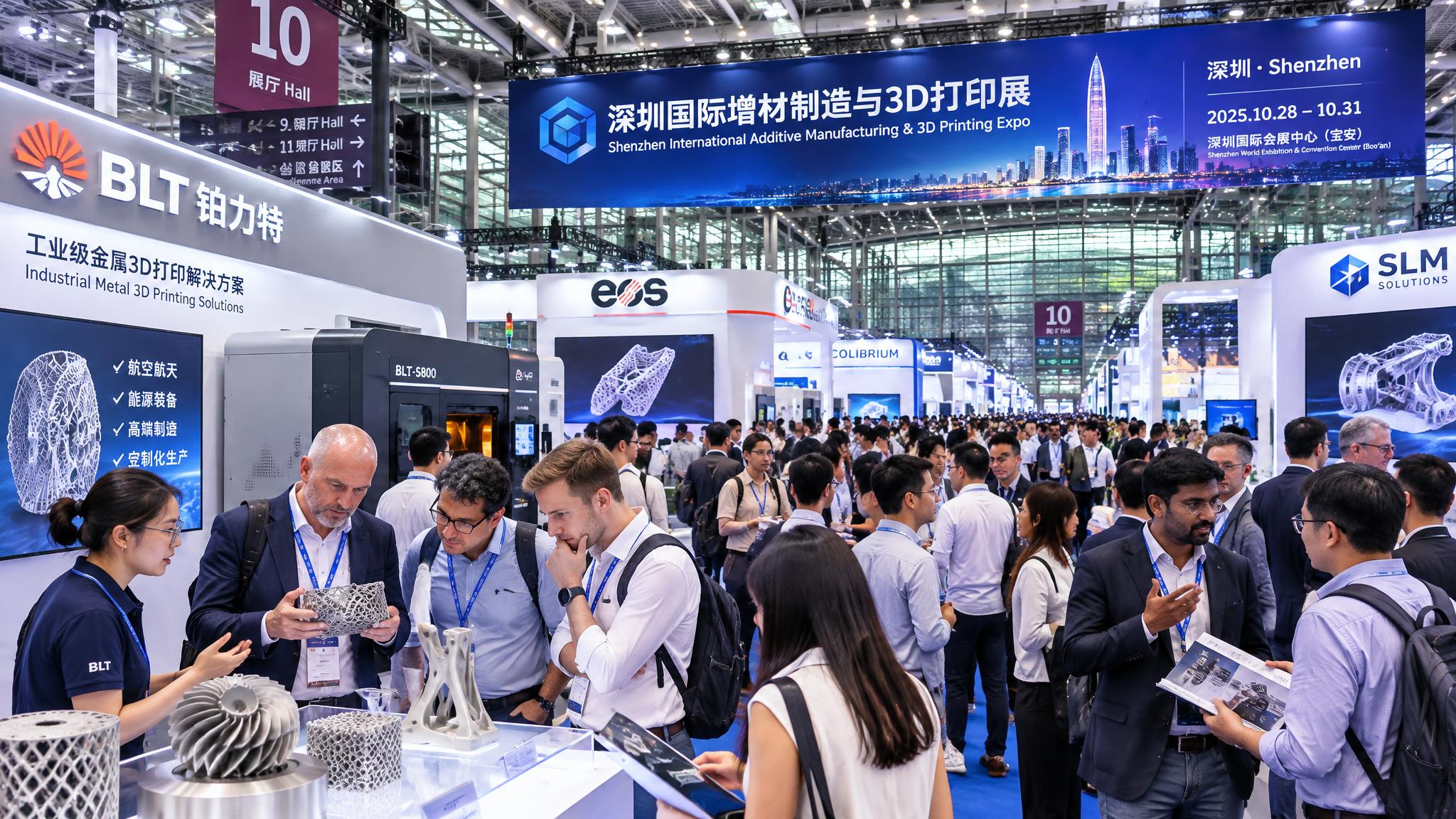
Formnext Asia Shenzhen 2026 closed on 28 August 2026 with 34,202 visitors, representing 65% growth over 2025 alongside a 157% rise in international attendance. Organizers reported a visibly broader international mix on the floor compared with prior editions. The next edition will run September 1 to 3, 2027 at the Shenzhen World Exhibition & Convention Center, with visitor registration and booth applications already open.
Industrial debuts
Major hardware makers used Shenzhen for regional and global product rollouts tied directly to factory-floor feedback. HP debuted the MJF 1200 in Asia Pacific to open Multi Jet Fusion to a wider pool of enterprises, in-house facilities, and universities, according to Hua Zhao, Head of Greater China Market at HP Additive Manufacturing Solutions. TPM 3D introduced the CF-250, engineered from user feedback on the CF-200 shown previously in Frankfurt, per application engineer Hanbo Wang, who also presented humanoid robotics work at the forum.
Metal and desktop booths reported heavy buyer traffic too. Han’s Matrix3D launched the dual-laser M420G for mass production of copper and thermal-management parts, with general manager Jinglong Tang reporting sharply higher booth traffic than in 2025. On the desktop side, Makera Marketing Director Monica Wurina reported a busy booth for the Z1 desktop CNC and its interactive materials display. At the SUNLU and Inslogic booth, brand specialist Xinhong Chen observed a clear split in buyer intent: domestic visitors focused on aesthetic and engineering materials, while overseas visitors hunted for drying equipment and FGF pellets, alongside future material concepts like pet prosthetics and home education.
End-user ecosystems
The Shenzhen fringe programme leaned hard into commercial verticals rather than general tech demos. Sessions spanned embodied intelligence and robotics, AI infrastructure and data centre cooling, 3D printed footwear, thermal management, lasers, channel-partner matching, print farms, mouldmaking, Maker Day, and metal AM for 3C electronics and smartphones.
That proximity to real manufacturing clusters drew industry-specific buyers:
- Footwear: Footwearology’s founder and CEO called Shenzhen the most relevant AM show for footwear thanks to local print farms, equipment makers, and nearby Dongguan’s footwear industry, chairing the first International 3D Printed Footwear Design Awards and presenting on the EU’s forthcoming Digital Product Passport.
- Mouldmaking: Korean Mould Industry Association first-time visitor Choi Myoung Jong praised China’s mature AM supply chain at the mouldmaking summit, pushing Korea-China cooperation pairing AM with traditional tooling, backed by the co-located Asiamold Select zone covering injection moulding, die-casting, stamping, and AM.
- Medical and cross-sector visitors: FullMedical sales manager Nick Shevko explored dental polymer systems for dentures and dental photography, while first-time visitor Weiran Chen, deputy GM at Shenzhen Shenjia Grid, highlighted high-standard exhibitors including Bambu Lab Creative Award entries.
Elsewhere in China, Messe Frankfurt also exhibited at CIIE 2026 with a 300-square-meter booth in Hall 2.2.
Formnext Awards 2026: the six winners and what they signal
On 19 November 2026 in Frankfurt, the Formnext Awards 2026 named six winners across six categories, spotlighting e-waste recycling, inline filament conditioning, and industrial education. As Paloma Duran, who writes at 3dprintingindustry.com, covered from the ceremony, the 2026 roster favors practical resource recovery and process stability over flashy aesthetic prints:
- Sustainability (backed by Renishaw): FlexCycle Solutions earned the prize for a strictly mechanical method converting e-waste into copper powder for AM and powder metallurgy without melting, producing a spherical-rough particle shape that improves laser absorption in laser powder bed fusion.
- (R)Evolution: Malta-based Thought3D won for Drywise, an inline filament conditioning system that treats filament right before extrusion to maintain target moisture levels, cutting drying time and energy while improving mechanical performance in materials like nylon.
- Rookie: Pre-founding Munich team cAIclone won for AI-optimized 3D printed hydrocyclones combining CFD simulation, Bayesian optimization, and AM to separate 1-50 µm particles for battery recycling.
- Start-up: Swiss company sallea won for 3D printed wash-out tooling and cores designed for lightweight, complex thermoset CFRP parts in motorsport and sporting goods.
- Design: Maya Kaplan won for her Technion Industrial Design M.Sc. Computational Bra, printed entirely in a single TPU on a desktop FDM printer using computational textile structures for elasticity, support, and compression.
- AMbassador: Dr. Michael Kraemer of TU Darmstadt’s Additive Manufacturing Center won for supporting roughly 50-60 students annually, overseeing ten PhD theses in three years, and building AM apprentice training programs with IHK Rhein-Main.
Reading the list as a forecast
Since Mesago Messe Frankfurt restructured the awards into six categories in 2024 and rebranded the Start-up Challenge into the Start-up Award, recycling and material efficiency have dominated three consecutive editions. Finalists are introduced online before the show, and public on-site and online votes carry the weight of one extra jury member, with prizes backed by Renishaw and Fomas Group while Sutosuto designed the 3D printed trophies manufactured by FKM Sintertechnik.
Jury member Arno Held of Held Holding summed up why investors track the roster closely:
“For me as an investor, it is a highly important tool to identify the future winners very early and before many others”
For context, Formnext 2025’s tenth-anniversary winners included PERFI Technologies, IAM3DHUB (“3DMyMask”), Laempe Mössner Sinto, and EOS GmbH. Outside the show floor, the same material-recovery thread appeared in a 24 November 2026 report on a University of Maine technique that separates cross-contaminated metal powders without melting and reprocessing.
Industrial metal AM: scaling platforms and aerospace repair
Industrial metal announcements around Formnext 2026 centered on production throughput, robotic large-format printing, and automated quality metrology rather than raw machine spec sheets, while aerospace teams pushed into high-value part repair and propulsion.
Production-scaling launches
Nikon SLM Solutions unveiled MACHX on 9 November 2026 as a metal AM platform built specifically for scaling production. On the same day, CMS gave a live debut to the Krearob, a six-axis robotic system for large-format AM, alongside its gantry-based Kreator A3. On the quality-control side, Plastometrex launched the PLX-AutoStage on 10 November 2026 to automate PIP testing on its PLX-Benchtop, mapping yield strength and ultimate tensile strength across parts and welds. Research partnerships moved in lockstep, with DEVCOM Army Research Laboratory signing a CRADA with Trusted Metal focused on laser powder bed fusion print quality.
Aerospace repair and propulsion
Aerospace development leaned into extending the life of certified hardware and qualifying flight propulsion. Fraunhofer ILT is developing extreme high-speed laser material deposition (EHLA) paired with roller burnishing to repair high-strength aircraft landing gear components. Meanwhile, Pratt & Whitney, an RTX business, confirmed it’s using metal AM in developing its Valox jet engines.
New desktop printers: the multi-toolhead price war
Multi-toolhead desktop printers dropped into a $309 to $1,499 price war at Formnext 2026, led by the Elegoo Centauri X Ultra and Axiloop MC8. Elegoo’s Centauri X Ultra pairs a 256 mm cube build volume with four tool changers, pre-feeders, 65°C filament drying, 350°C hot ends, active chamber heating, and expansion up to 20 colors, though pricing remains unannounced.
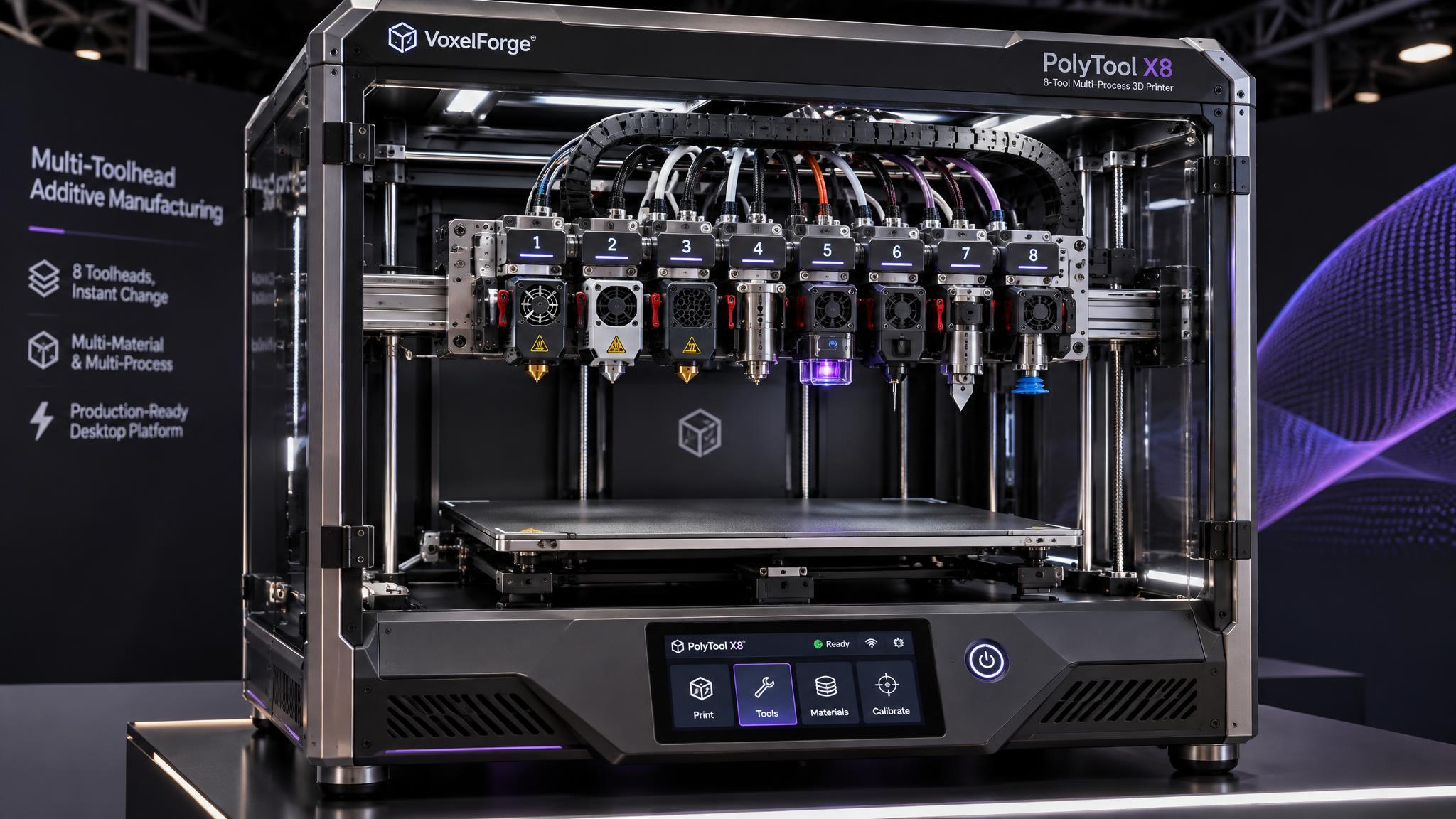
Axiloop stepped directly into the sub-$1,500 bracket with the $1,099 MC8 and $1,499 MC8 Pro, packing eight toolheads, Klipper firmware, a 300 mm cube build volume, and four-second tool changes. Beneath them, budget challengers including the Infimech MX ($309 after rebates), Infimech MX Pro ($589), QIDI Q3D ($599 without AMS), and Co Print Quadro ($659 on Kickstarter) brought multi-toolhead hardware into entry-level territory within a single show cycle. Carolyn Schwaar at all3dp.com walked the Frankfurt booths and flagged the aggressive spec sheets alongside a reality check on buying unproven hardware at these prices.
| Printer | Price | Verified specs |
|---|---|---|
| Infimech MX | $309 (after rebates) | Multi-toolhead, 300-350°C hot end |
| Infimech MX Pro | $589 | Multi-toolhead, 300-350°C hot end |
| QIDI Q3D | $599 (without AMS) | 350°C hot end |
| Co Print Quadro | $659 (Kickstarter) | 300 × 300 mm build volume |
| Axiloop MC8 | $1,099 | 8 toolheads, 300 mm cube, Klipper, 4-second tool changes |
| Axiloop MC8 Pro | $1,499 | 8 toolheads, 300 mm cube, Klipper, 4-second tool changes |
The Elegoo Centauri X Ultra and Phaetus Hydra don’t have announced pricing.
Elegoo Centauri X Ultra
Schwaar presented the Elegoo Centauri X Ultra as the standout consumer announcement of the show. Beyond its 256 mm cube, four tool changers with pre-feeders, 65°C drying, 350°C hot ends, and active chamber heat, Elegoo used a cable-chain top design that sidesteps the tall-printer top-hat clearance headaches common on enclosed multi-material machines. Support for up to 20 colors gives it serious expansion room once Elegoo finally puts a price tag on it.
The sub-$1,500 field
At the Axiloop booth, Schwaar assessed the $1,099 MC8 and $1,499 MC8 Pro as more capable than the Prusa Core One L+ INDX at roughly half the price. Eight toolheads switching in four seconds on a 300 mm cube Klipper frame is a wild spec sheet for the money. Still, those low prices mean early buyers have to weigh raw paper specs against unproven long-term reliability and customer support on a first-generation machine.
Incumbents and the rest
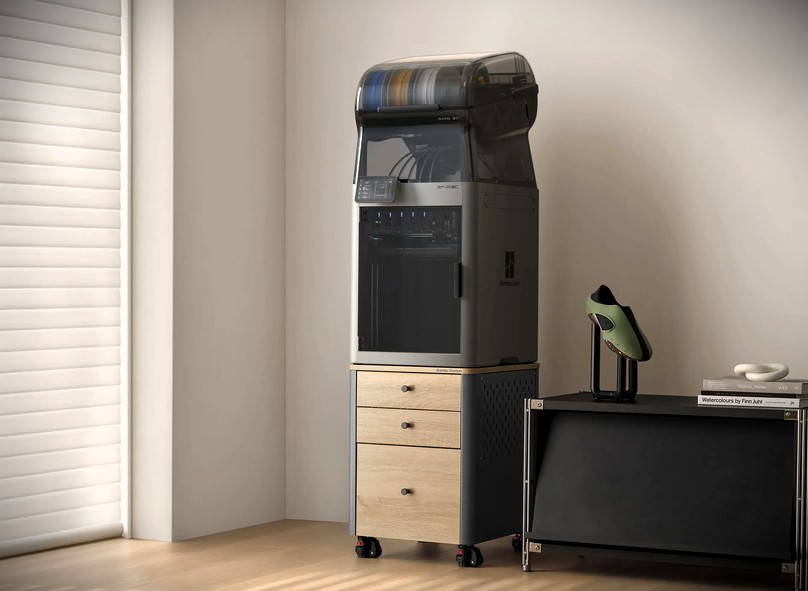
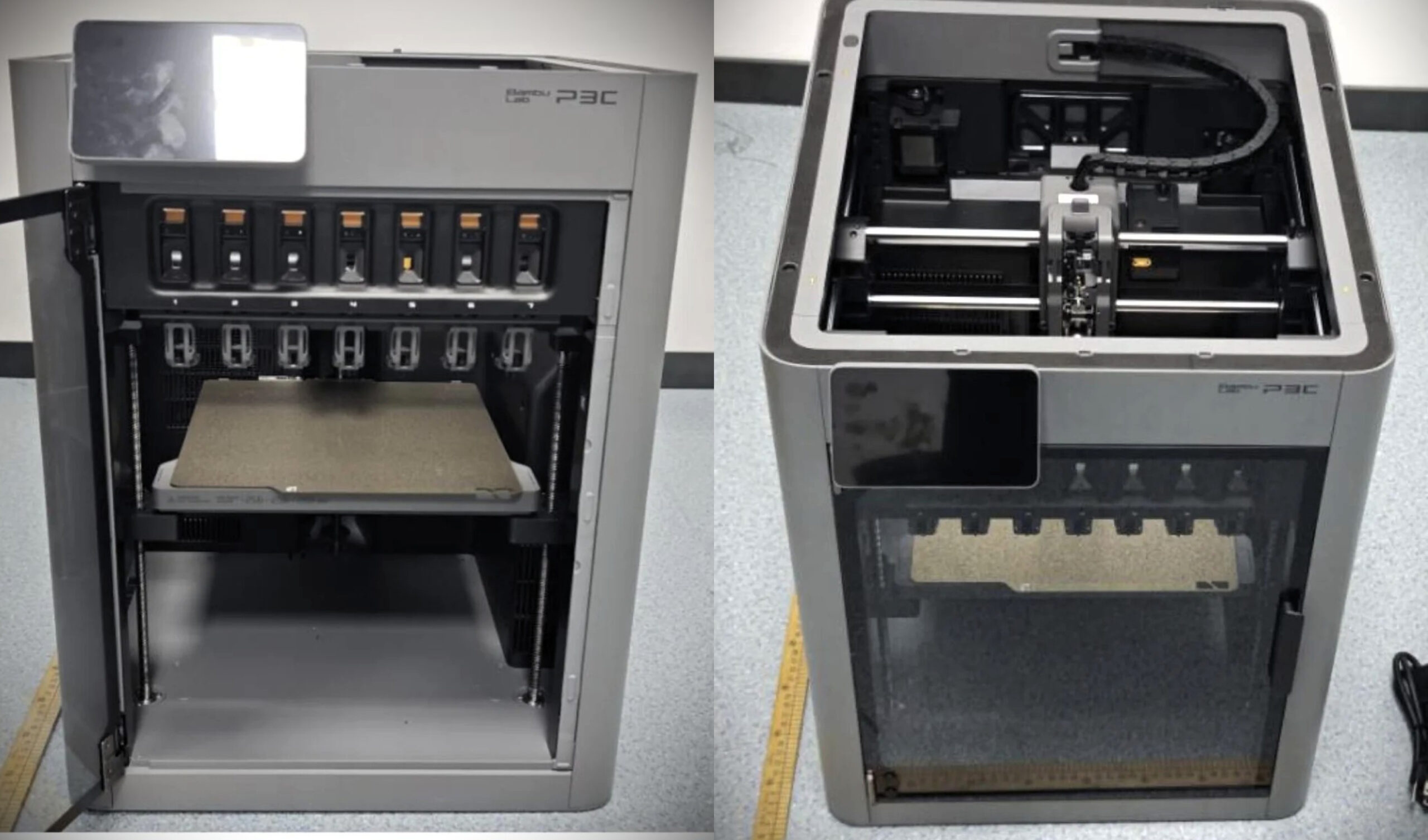
Established brands took a more segmented approach. Bambu Lab launched the more affordable P3C multi-tool, multi-material printer right after its H3C commercial release earlier in November, and showed the R1 and H3C at its booth. Prusa skipped consumer hype for niche, industrial-leaning releases. On the hardware side, it showed the CORE One L+ Rugged Edition with outer panels and rubber shock absorbers, plus the CORE One Zero-Trace, which wipes G-code immediately with zero onboard memory. It also introduced Connect Local Farm, an open-source farm software package with scheduling, job management, and OpenPrintTag integration.
Snapmaker brought no new hardware, focusing on community projects and its Space multi-material library amid unconfirmed rumors about an interesting year ahead for the U1. Elsewhere on the floor, Phaetus showed the Hydra hobbyist tool-head swapping system using inductive heating and a gear mechanism similar to INDX, handling 2.85 mm flexible filament with an optional continuous carbon fiber nozzle, though without pricing or a release date. The Inkera C1, Longer ePrint, and Lightmake L4 were also named at the show with no further specs available.
Desktop metal and UV printing: the consumer-industrial blur
Industrial capabilities are commoditizing onto desktop benches, yet every headline-grabbing machine at Formnext 2026 carried a real-world constraint that polished booth samples tend to hide.
SnowX SnowPod
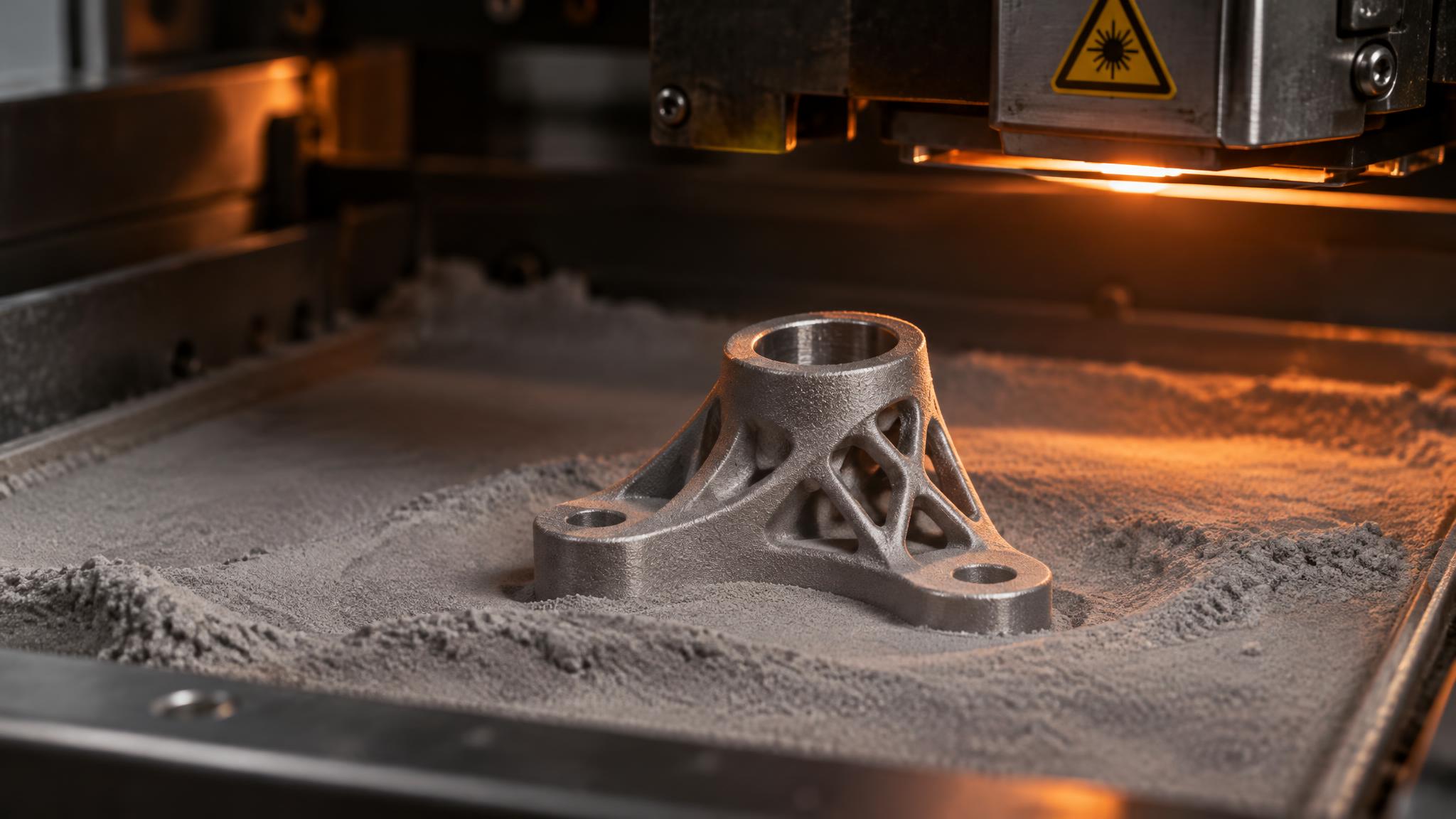
The SnowX SnowPod puts desktop metal selective laser sintering in a 360 × 360 mm footprint for $4,999, or $5,599 with the NitroPod. Schwaar described its stainless steel sample prints as beating industrial metal prints from four years earlier. The catch sits right in the spec sheet: an 80 × 80 × 100 mm build volume sharply restricts what parts you can fit inside.
Inslogic 17-4 PH filament
Inslogic’s 17-4 PH steel filament packs 70% steel powder into a 1.75 mm spool, letting makers print stainless steel parts at home with a hardened nozzle. Unlike rival manufacturers of similar metal-filled filaments, Inslogic sells directly to consumers. Even so, printing is only half the job: you still need access to a sintering autoclave to turn green prints into solid steel.
UV printing and the credibility test
HeyGears showed the G1X 2.5D/3D UV printer with a 420 × 300 × 150 mm build area at $3,299 to $5,199 for late pledges, and its booth samples outclassed competing consumer desktop brands. Yet Schwaar reported that every creator who received a pre-production G1X unit couldn’t get it working. Alongside it, the xTool Omni O1 entered at a $2,249 starting price, with a dual UV configuration around $5,000, claiming support for more than 3,000 materials.
New filaments and the print-farm accessory economy
Materials and add-ons at Formnext 2026 chased engineering performance and hands-off farm automation over hobbyist trinkets.
Engineering polymers replace hobby plastics
- Polymaker: Brought zero PLA to its stand, launching G-Flex PETG (a rigid-when-thick, flexible-when-thin PETG/TPU blend) and TPU95A Matte.
- Inslogic and SUNLU: SUNLU’s premium Inslogic brand added ASA-CF, PET-CF, PAHT-CF, PPS-CF, and PPA-CF, while SUNLU showed PLA Metal and PLA+ 2.0 Silk.
- Siraya Tech: Launched ASA-CF Core (wrapping carbon fiber in ASA for skin safety), PC Glass Fiber, and dedicated support filaments for PPAs, nylon, and PET.
- Spectrum Filaments: Released child-safe PLA, 40A foaming TPU for footwear, UV color-changing PLA, plus industrial and silk lines.
The accessory cluster print farms buy
Accessory makers targeted print-farm bottlenecks with $259 to $1,100 upgrades. FOXLT’s $259 Infinity Bed converts select Bambu Lab printers into auto-ejecting conveyors without stuck brims or prime towers. Meanwhile, BIQU’s Panda Vault (~$400, expandable to 196 spools) combines scales, RFID reading/writing, and two dry box lines. For high-temp materials, Tyson Buildplates showed the $400 to $1,100 Tyson Top Hat, which heats Bambu Lab and Prusa chambers to 85°C for PEEK. E3D demonstrated its K3 Fuse System at 60 mm³/s with Creality as its first partner, alongside hardened nozzles for the Bondtech INDX and Elegoo Centauri Carbon.
Market data and capital signals behind the show floor
Behind the hardware demos, market reports and capital raises pointed to steady expansion in metal powders and additive services. VoxelMatters released its Metal AM Market 2026 study on 10 November 2026 covering revenue and unit shipments, while AM Research published its AM Services Market Report 2026-2035 at a $2,750 pre-purchase price that rises on 1 December 2026, noting Powder Bed Fusion leads North American services growth.
On the corporate side, Pittsburgh-based Metal Powder Works committed to raise A$7.5 million (US$5 million) via placement to expand metal powder production. Meanwhile, Mountain View’s Hawk Ridge Systems formed a strategic sales and support alliance with Wisconsin-based M5D (formerly MasterGraphics), and Carpenter Technology appointed Marshall Akins as Chief Operating Officer amid broader operational and commercial shifts.
Formnext 2027: October dates, open registration, and planning ahead
Formnext 2027 runs October 26 to 29, 2027 in Frankfurt am Main, moving the flagship trade show earlier in the calendar than its traditional November slot. Organizers issued save-the-date messaging immediately following the November 2026 edition confirming the 26 October opening at Messe Frankfurt. Moving out of November changes annual budgeting, travel, and booth-build timelines for exhibitors and engineering teams that have long treated mid-November as fixed.
Exhibitor registration for Formnext 2027 is already open. Because habitual November schedules no longer apply, teams planning a booth or product launch will want to engage Mesago Messe Frankfurt early rather than waiting for a late-spring push and risking preferred floor positions.
For teams splitting travel across hubs, Formnext Asia Shenzhen 2027 runs September 1 to 3, 2027 at the Shenzhen World Exhibition & Convention Center, where visitor registration and booth applications are already open. Ticket pricing and pass types for Frankfurt aren’t public in the available material, so anyone budgeting travel needs to check the official portal directly for pass costs. Whether Formnext is worth the trip for evaluating industrial 3D printing comes down to consolidation: while attendance return on investment isn’t quantified, it remains the single venue where you can inspect the full additive manufacturing process chain in person alongside its year-round directory and insights platform.
Frequently Asked Questions
When and where is Formnext 2026 in Frankfurt?
Formnext 2026 took place from November 17 to 20, 2026, at Messe Frankfurt in Frankfurt am Main. Organized by Mesago Messe Frankfurt, the four-day flagship trade show brought together additive manufacturing hardware, materials, software, and post-processing specialists under one roof.
What does Formnext Frankfurt cover for additive manufacturing?
Rather than splitting software, printers, and finishing gear into separate venues, the Frankfurt show maps its floor around the entire production workflow from digital file to certified end-use part. Between annual exhibitions, Mesago Messe Frankfurt also runs a year-round digital hub featuring Industry Insights, Formnext Magazin, Formnext.TV, and the AM Directory to keep engineers and buyers connected.
What were the key figures and highlights of Formnext 2026?
Mesago Messe Frankfurt has not released public headcount or exhibitor numbers for the Frankfurt 2026 edition, offering only a qualitative assessment that the show “once again exceeded our expectations.” Meanwhile, its Asian counterpart, Formnext Asia Shenzhen 2026, closed on August 28, 2026, with 34,202 visitors—a 65% jump over 2025 and a 157% surge in international attendance. On the Frankfurt show floor, the biggest storylines were a $309-to-$1,499 desktop multi-toolhead price war, $5,000 desktop metal hardware, and production-scaling industrial metal systems.
When and where will Formnext 2027 take place?
Formnext 2027 will move out of its usual November slot to run from October 26 to 29, 2027, at Messe Frankfurt in Frankfurt am Main. That earlier calendar shift forces exhibitors and engineering teams to pull forward their annual budgeting, travel, and booth-build schedules. For teams tracking the Asian market, Formnext Asia Shenzhen 2027 will run earlier in the fall from September 1 to 3, 2027, at the Shenzhen World Exhibition & Convention Center.
How do I register as an exhibitor for Formnext 2027?
You should verify registration availability directly with Mesago Messe Frankfurt through the official Formnext portal. Published post-show summaries conflict on whether full exhibitor registration for 2027 is already open or if only the call for papers is currently accepting submissions. Either way, because the show moved up to October, waiting until late spring could cost your team preferred floor space.