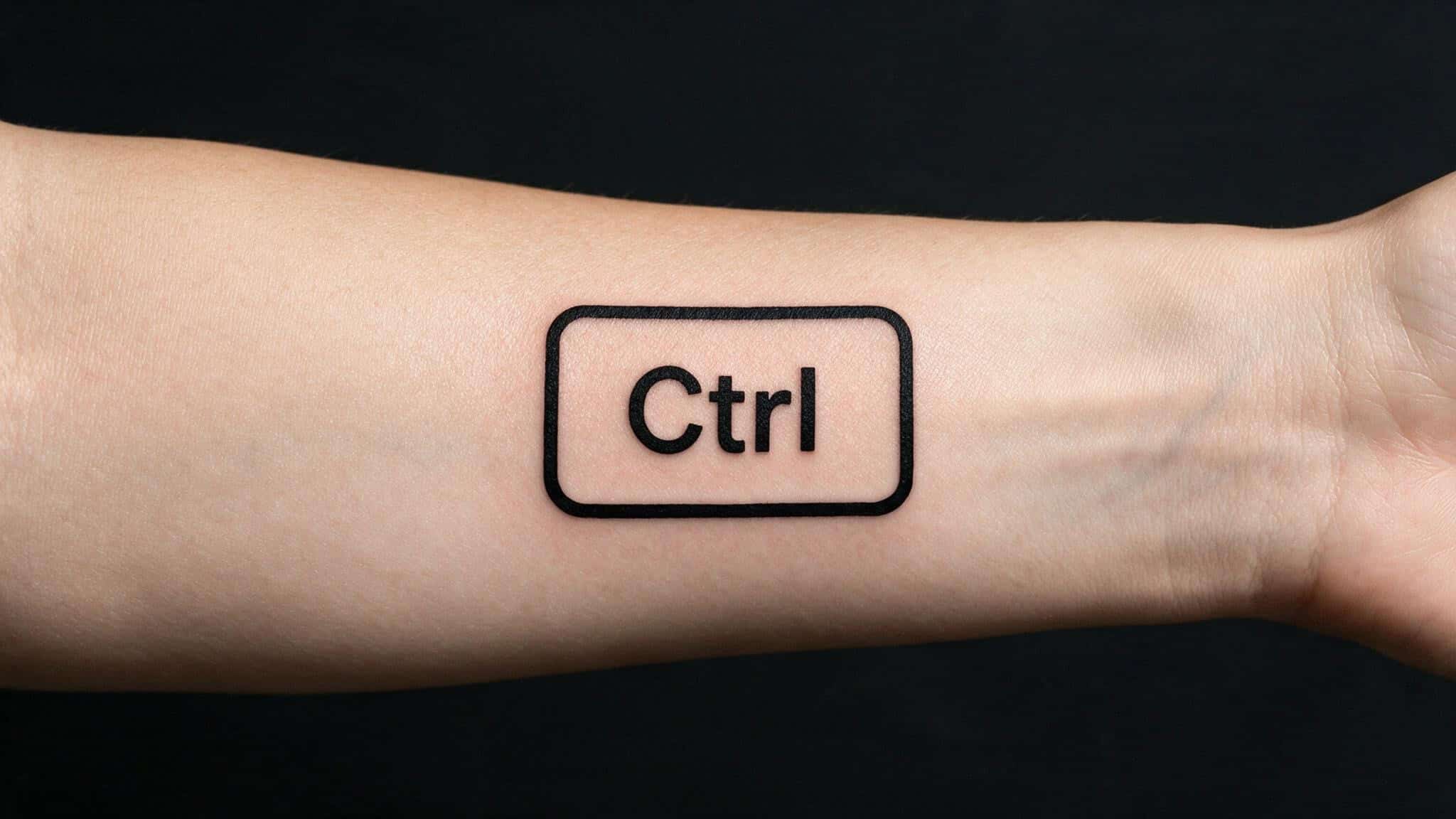
You’ve saved up $600 for that perfect Ctrl key tattoo—clean lines, maybe a subtle command-key glow, exactly where you want it. You get the quote, you budget the cash, and then the question hits: How much do I tip?
Is $100 enough? Too much? Do you tip per session or at the end? And what does the artist actually take home anyway?
I looked at the 15-25% standard tipping range, the 40-50% shop commission, and the US norms so you don’t have to guess. Here’s the math, the etiquette, and the straight answer to that specific “$100 on $600” question.
Key Takeaways
Tip 20% as your baseline—on a $600 tattoo that’s $120. $100 (16.7%) is within the standard range but on the low end; bump it if the work was complex or the artist went above and beyond.
40–50% of the tattoo price goes straight to the shop (commission or booth rent). Your tip is often the only part the artist actually takes home—cash preferred, because credit card processors eat 2–3%.
For multi-session projects like a sleeve, tip after each session, not just the final one. A free touch-up still deserves $20–$50 or 15–20% of the original session cost.
Table of Contents
Why tipping matters (and why it’s different from a restaurant)
Most people treat tattoo tipping like they treat tipping at a salon: a polite bonus for good service. But the economics are fundamentally different: 40–50% of the price goes to the shop before the artist sees a cent.
They either pay the shop a commission on every tattoo (often 40–50% of the price) or rent a booth by the day. That means when you pay $600 for your Ctrl design, the shop takes somewhere between $240 and $300 right off the top. The artist keeps the rest—but they also buy their own needles, ink, gloves, and stencil supplies.
Now the kicker: artists keep 100% of their tips. No split, no shop cut, no processing fee (if you pay cash). That $100 tip? It goes into their pocket, tax implications aside.
A $120 tip? Same deal.
This is why skipping the tip in a US tattoo shop isn’t just cheap—it means the artist paid to work on you. Multiple sources agree: it’s considered very rude in most shops. Don’t be that person.
The tipping table: how much for a $600 Ctrl tattoo (and every other common price)
Let’s get the specific answer out of the way first.
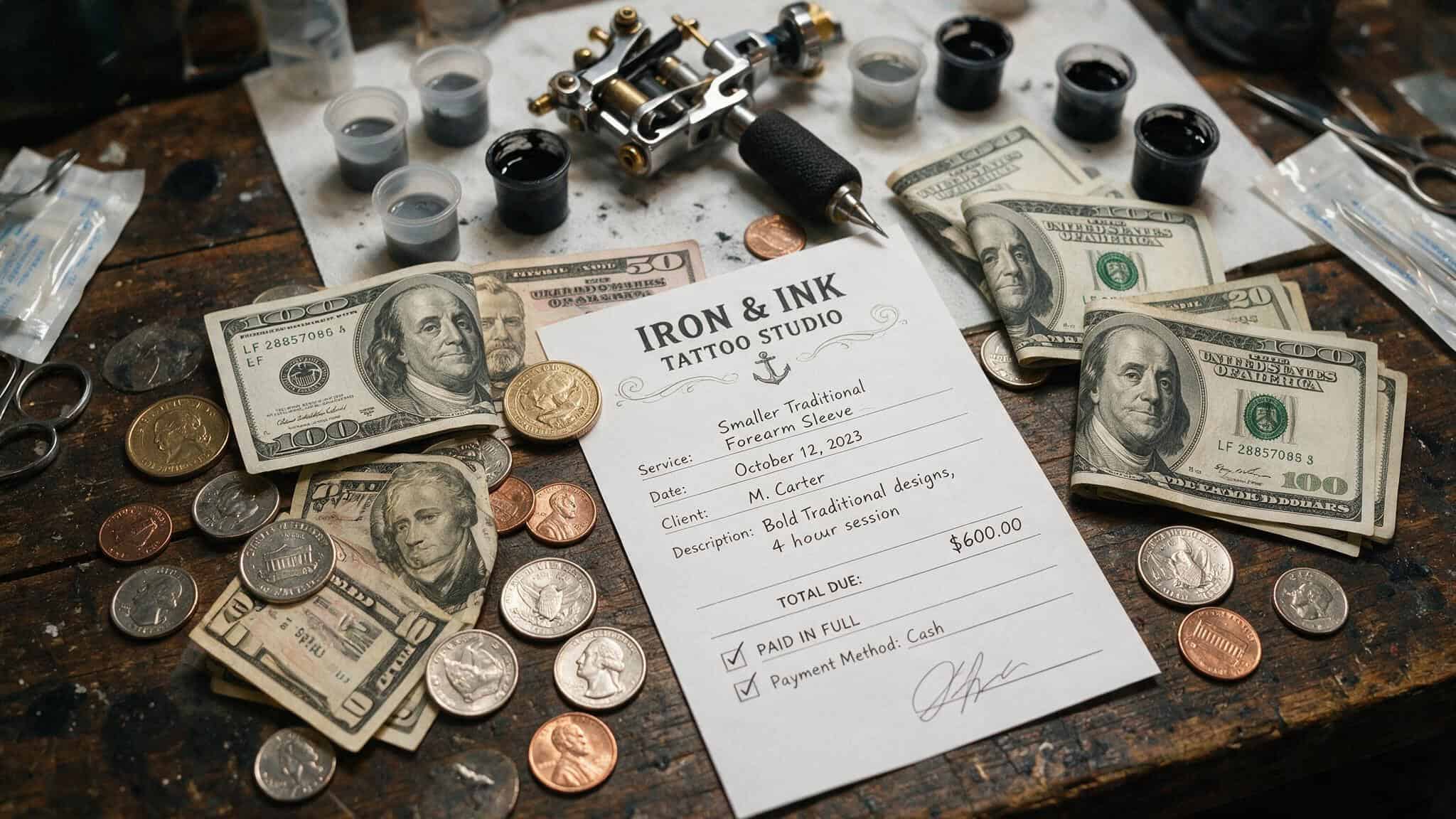
Is $100 a good tip for a $600 tattoo?
At 16.7%, $100 falls within the standard 15–25% range. For competent, straightforward work, it’s acceptable. But the baseline expectation in the industry is 20%—that’s $120. If the design required custom mockups, extra shading, or the artist was dialed in on the linework, you should be looking at $120–$150 (20–25%). $100 is the floor, not the target.
Here’s the full range at a glance:
| Tattoo cost | 15% | 20% (baseline) | 25% | 30% (complex work) | Best practice |
|---|---|---|---|---|---|
| $50 | $7.50 | $10 | $12.50 | $15 | At least $10–$20 |
| $100 | $15 | $20 | $25 | $30 | $20 (flat minimum) |
| $200 | $30 | $40 | $50 | $60 | $40–$60 |
| $300 | $45 | $60 | $75 | $90 | $60–$90 |
| $500 | $75 | $100 | $125 | $150 | $100–$150 |
| $600 | $90 | $120 | $150 | $180 | $120–$180 |
| $1,000 | $150 | $200 | $250 | $300 | $200–$300 |
| $2,000 | $300 | $400 | $500 | $600 | $400–$600 |
What about small tattoos? For anything under $100, the percentage math breaks down. A $60 flash piece at 20% is only $12, which barely covers the artist’s setup time. The standard move is a flat $20 minimum. For really tiny stuff like a Ctrl tattoo small, $10–$15 still shows respect.
Factors that nudge your tip up (or let you stay at baseline)
Twenty percent is the default for “good work, normal experience.” But not all tattoos are the same, and neither are the tips.
When to tip 25–30%:
- Custom artwork where the artist drew something original from scratch
- Multi-session projects (sleeves, back pieces, full-color elaborate designs)
- Extended chair time—those six-hour marathon sessions where your artist barely stands up
- B&G realism or fine-line shading that demands serious skill and concentration
- Artist’s experience and reputation — a master artist with 20 years of work may command a higher tip percentage than an apprentice, even for similar work.
A full sleeve typically runs $2,000–$4,000 and takes multiple sessions. The recommended tip there is $400–$600—that’s 20–25% on the lower end of cost, or around $150 per session if you split it up. If you’re going big with a Ctrl tattoo sleeve, integrating the key with other symbols, text, and album art, you’ll want to budget for the extra design and placement time. A half sleeve ($500–$1,500) falls in the $200–$300 range.
When you can stay at 15–18%:
- Simple, quick linework (think a small symbol or text)
- Already-tweaked flash designs that took minimal prep
- The artist rushed, bounced between clients, or the vibe was off
Location matters too. In San Antonio, 20% is the local norm, and tattoo prices tend to be lower than in cities like Los Angeles or New York. A $300 piece in Texas might run $500 in Brooklyn, so the same percentage becomes a very different dollar amount. If your area has higher baseline rates, tipping 20% is still fine—no need to inflate the percentage just because the sticker price is higher.
When and how to hand over the cash (without the awkwardness)
The biggest source of anxiety is the moment itself. Here’s how to handle it smoothly.
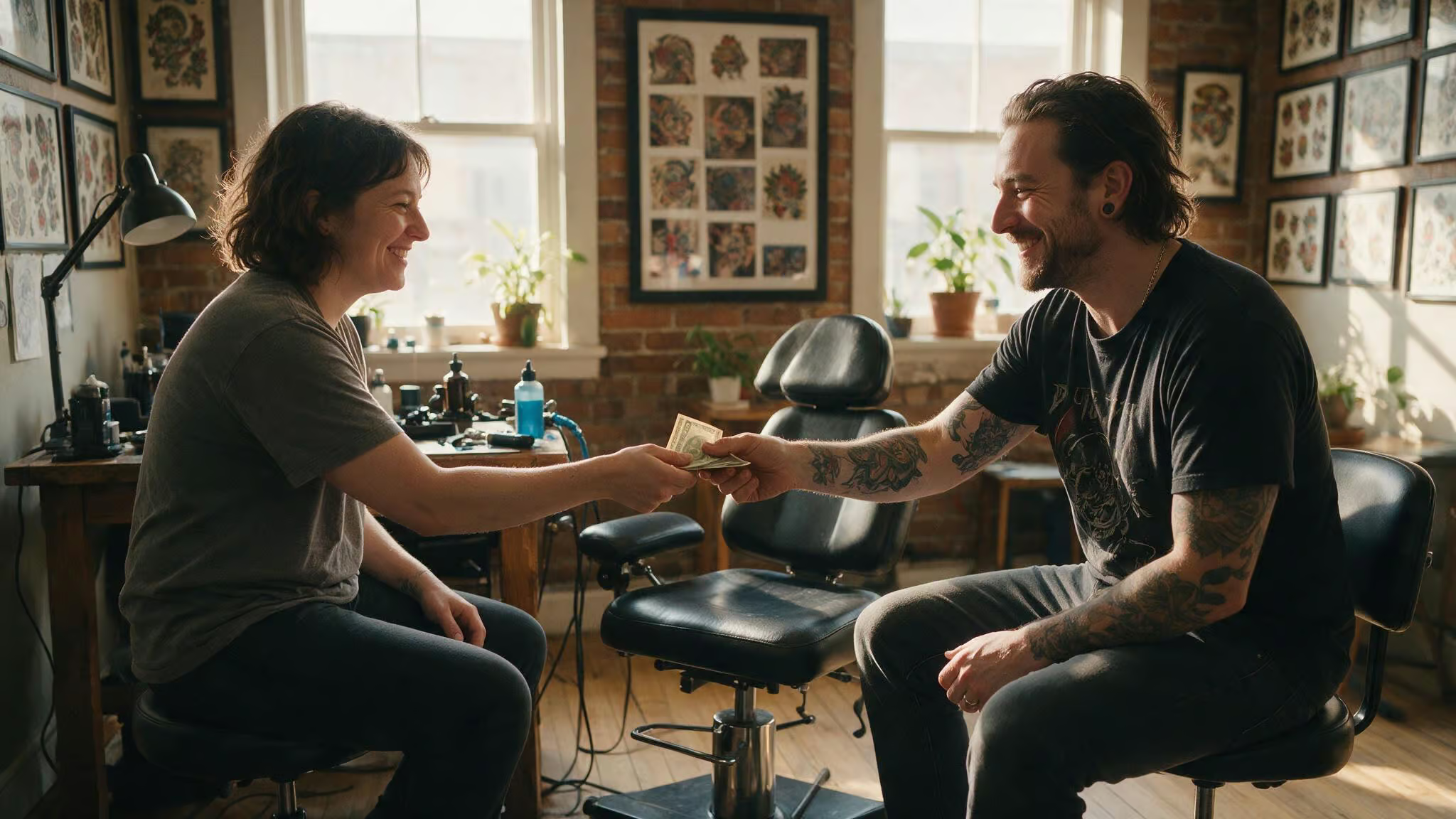
Timing: Tip right after the session, whether before or after you pay at the front desk. Don’t wait until the next appointment—the social contract is immediate.
Cash is king. This isn’t just about tradition. Credit card machines charge the shop 2–3% per transaction, and if you add a tip to the card, the artist loses that slice. A $120 tip on a card becomes roughly $117.
Cash goes in their pocket at full value. Plus, some artists don’t have the option to add a tip to a card at all—especially if they’re renting a booth and running their own payment.
Backup plan: Some artists accept Venmo or PayPal. Ask beforehand if you’re worried. But don’t assume card tipping works, and don’t show up without a way to tip.
One pro tip: If you see your artist looking at their phone or checking the time after they finish, just pull out the cash, hand it to them directly, and say “thanks.” That’s all it takes. You don’t need a speech.
Multi-session projects and touch-ups—don’t make this common mistake
This is the biggest failure point I see in tipping discussions. Someone books a $2,000 sleeve, does four sessions, and tips $200 at the end. That’s 10%—well under the standard. And the artist just spent months working on it.
The rule: tip after every session.
If your $2,000 sleeve takes four $500 sessions, tip $50–$75 per session. That’s $200–$300 total, same range as a lump sum, but it shows your appreciation at each stage. The artist has already invested hours of design and needle time before the final piece comes together. Treat each session like its own service.
Touch-ups are not free. If the shop offers a free touch-up session (common for new pieces), they’re occupying the artist’s chair time, supplies, and studio space. Tip $20–$50 or 15–20% of the original session cost. If you’re paying for the touch-up (say a color boost two years later), treat it like any other tattoo and tip 15–25% of that touch-up price.
Additional tips for a great experience
On a tight budget? Tip as close to 20% as you can. Even 15% is better than skipping. If you can only afford $80 on that $600 tattoo (13.3%), that’s not ideal, but it’s something. For larger detailed work, aim for at least $50 if you can’t hit the 20% mark.
The artist will appreciate the gesture more than nothing. But the 20% is your goal, not the floor.
Reviews, referrals, and social media shares are nice extras—they can bring the artist future clients. But they don’t pay the power bill. Never offer “exposure” as a substitute for cash. Same goes for physical gifts: a gift card or bottle of whiskey is a thoughtful bonus, not a replacement.
If you don’t like the tattoo: Talk to the artist immediately. Don’t withhold the tip as a protest—that’s a nuclear option reserved for genuinely terrible experiences or significant unaddressed flaws. Most artists will offer a touch-up or correction. Communicate first.
For the artist-readers: If you’re still building your kit, the INKSOUL T08FS Wireless Stencil Printer has been a game-changer for over 2,000 artists. It prints A4 thermal stencils with Bluetooth or USB, handles shading and line images, and runs at 13–15 mm/s. Not a bad piece of gear if you’re tired of hand-tracing flash under a stencil machine.
The bottom line on tipping your Ctrl tattoo artist
Two numbers to remember:
- 20% baseline on the total cost
- Cash per session for multi-session work
That $600 Ctrl tattoo? Budget $120 for the tip. If you bring $100, you’re still in the acceptable zone—but you’re leaving a few bucks on the table that could’ve built a great rapport. The artist remembers good tippers.
Now you know the math. Go get that ink, and tip like you mean it.