
The worst thing about buying a hardware wallet isn’t the price. It’s the moment the envelope lands on your doorstep and you think: what if this thing was already someone else’s wallet before it was mine? Sixty-plus dollars for a card that’s supposed to guard your crypto, and you’re trusting a box you didn’t open under lab conditions. That’s the actual question behind “where to buy tangem wallet,” and the honest answer has two halves.
First, there are exactly three channels Tangem itself says are safe, and I’ll name all three. Second, and this is the part most articles bury: where you buy sets the baseline risk, but the five-minute app check the first time you tap the card is what actually settles it. Verification is precisely what neutralizes tampering somewhere upstream, which is a rare case of a security promise you can personally test.
Key Takeaways
The only channels Tangem designates are Tangem.com, the official Tangem storefront on Amazon, and resellers and distributors that Tangem authorizes; anything else is off-book.
Expect to pay roughly $60+ for a two-card pack, with no monthly fee, and the physical cards themselves are the backup in the seedless route, which is why the 2-3 card set exists.
The first-use check is decisive: cards ship with no private key at all, the official app cryptographically verifies each card was made by Tangem and hasn’t been tampered with, and mis-shipped or suspicious cards get replaced free.
Table of Contents
The official places to buy a Tangem wallet
Where to buy a Tangem wallet: the safe list is Tangem.com, Tangem’s official storefront on Amazon, and resellers and distributors the company authorizes. That’s the complete roster, straight from Tangem’s own authenticity guide, and Tangem is explicit that buying only through these channels is what guarantees you get a real, untouched card. Not corporate policy language, just the practical point: those channels keep a shorter, cleaner chain of custody between the factory and your desk.
So, ranked by how confident I’d feel handing one of these my life savings:
- Tangem.com. Fewest hands on the device, no question of who the seller is. The honest cost is that direct shipping can run a bit slower than Prime. That’s a trade I’d make every time for a card that’s supposed to hold the keys to everything; a couple of extra days is cheap insurance against an unauthorized seller you can’t vet.
- The official Tangem Amazon e-shop. Same price, next-day shipping, and it’s Tangem’s own storefront. The catch is that Amazon also hosts plenty of unauthorized sellers on similar-looking listings, so you have to land on the official e-shop specifically, not whatever listing ranks first. Glance at the seller name before you tap Buy: if it isn’t Tangem, you’re gambling on a card that’s been tampered with or preconfigured by someone else. The “which seller is the real one” question answers itself: it’s the storefront Tangem operates.
- Authorized resellers and distributors. Legit, though it puts one more party in the middle. Tangem claims resellers in 54 countries, so for a lot of readers outside easy shipping range, this is the practical route.
One detail that makes the whole purchase make sense: the sets come with 2 or 3 cards because in Tangem’s seedless setup, the cards are the backup. There’s no paper phrase to file away by default; the spares in the box are the recovery plan. Once that clicks, “why is it a multi-pack” stops being a mystery.
If you want the deeper teardown of the card itself before committing, I’ve got a full Tangem wallet review that covers what holds up and what doesn’t.
Should you buy from the official website or Amazon instead?
Buy direct from Tangem.com when you want the lowest supply-chain risk: it sidesteps tampered devices, unauthorized sellers, and the nightmare scenario of a card that arrives preconfigured with someone else’s keys. Amazon’s official storefront is a reasonable backup option, and it costs the same. That’s the whole verdict, and here’s the reasoning behind it.
The risk vectors genuinely differ between the two. Buying direct, the only parties are Tangem and whatever courier they hand off to. On Amazon, the platform mixes authorized and unauthorized sellers side by side on listing pages that look nearly identical, which is how sketchy cards end up in real-looking boxes. Finance Nuggs walked through the specific scenarios worth knowing about: interception in transit, packaging tampering, preconfigured wallets, man-in-the-middle swaps. Small but nonzero, and mostly avoidable by clicking the right storefront.
The honest tradeoff is speed. Direct shipping can be a bit slower, and I’m not going to pretend that’s nothing when Amazon exists. But this is a $60+ security device, not a phone charger; the delta between “here tomorrow” and “here in a week” buys you chain of custody you can actually reason about.
Here’s the quick comparison:
| Tangem.com | Official Amazon e-shop | |
|---|---|---|
| Price | Around $60+ for a two-card pack, prices vary with set size and promos | Same |
| Supply-chain risk | Lowest, no third parties | Low, but only from the official storefront |
| Unauthorized-seller risk | No | Yes, on other listings sharing the platform |
| Shipping | Can be slower | Usually faster |
Either way, there’s no monthly fee, and the channel doesn’t change what the wallet stores: buying for bitcoin or XRP storage works through exactly the same channels. If you’re price-comparing tiers, the Tangem wallet price breakdown covers the pack sizes and where discount codes are legit.
Is it safe to buy a Tangem wallet on Amazon?
Yes, it’s safe to buy a Tangem wallet through Amazon when you buy from the official Tangem e-shop storefront and verify the card in the Tangem app on first use, the app’s cryptographic check that the private key was generated on the card’s secure element is the decisive layer, and it’s the same diligence that makes hardware wallets the safest bet when you take profits from crypto without selling. Platform risk on Amazon is still real, since authorized and unauthorized sellers sit side by side on near-identical listings, and interception, packaging tampering, preconfigured wallets, and man-in-the-middle swaps are all small-but-nonzero possibilities. That’s why the app check outweighs everything else: torn security seals aren’t a security breach by themselves. Tangem acknowledges packaging errors occur and is improving its seals, so seal inspection stays secondary while app verification is what actually confirms the wallet is genuine.
- Only buy from the official Tangem e-shop storefront, not whichever listing sorts first.
- Read seller reputation and reviews skeptically. Fake reviews exist, on this category especially.
- Inspect the tamper-evident packaging when it arrives before you get comfortable.
Can you trust a Tangem wallet from eBay, Best Buy, or Walmart?
Same three questions apply to any listing, anywhere: is this an authorized reseller channel, does the seller’s reputation actually hold up under skeptical reading, and does app verification cover whatever gap is left. Brutal Reviews puts it more bluntly, arguing that buying from Amazon, eBay, or Best Buy carries real risk, since cards could already be registered or compromised. That’s one reviewer’s strong framing, not a measured statistic, but it’s a fair statement of what’s at stake on unvetted third-party channels.
What I can’t tell you is store-by-store stocking status: the sources here don’t confirm Tangem is stocked at Best Buy or Walmart either way, so I’m not going to rule on it. For the “near me” and USA questions, same answer: what’s confirmed are the online channels above, and the three-question framework is how you’d evaluate any local or big-box listing you stumble across. If the seller can’t claim an authorized-reseller relationship, the verification step carries all the weight.
Why where you buy matters less than verifying the card
Here’s the part I find genuinely elegant about this hardware, and why the whole channel anxiety has a floor under it. Tangem cards ship with no private key at all. Nothing to steal in transit, nothing preloaded to leak. During setup with the official app, the key gets generated inside the card’s chip, drawing entropy from the chip’s own physical sensors, and it never leaves the card. The phone stores nothing sensitive; it’s basically a display with NFC.
Physically, the card is monolithic: one sealed piece, and the chip can’t be popped out or modified without wrecking what it protects. Tangem makes the boldest possible version of this claim, saying its end-to-end certification means even a card bought from a street vendor should verify in the app. I raise an eyebrow at that phrasing, and reviewers at Nordic Crypto have said they wouldn’t personally bet on it either. The claim is aggressive, sure. The mechanism behind it, attestation at first tap, is exactly what neutralizes upstream tampering, aggressive claim or not.
How to verify your Tangem wallet is genuine on first use
The verification is a four-step flow, and the app does the hard part for you:
- Download the official Tangem app from the App Store or Google Play. Not a sideloaded APK, not a lookalike.
- Tap the card to your phone’s NFC reader.
- Expect one of two things: either a prompt to create a wallet, or an alert flagging a problem. What the app is doing in that moment is cryptographically checking that the card was actually produced by Tangem and hasn’t been tampered with. If you get the creation prompt, you’re done; the card is real.
- If you get neither, reset the cards to factory settings and start over.
That’s the entire ritual, and it’s tiny wizardry the first time it works: tap, wait a beat, green light. It also connects to how the wallet actually works day to day; the Tangem app handles staking, swaps, dApps, and price tracking beyond the card itself.
What a legitimate Tangem box looks like
A security seal that arrives torn or absent isn’t proof your wallet was tampered with. Tangem acknowledges packaging errors happen and says it’s working on better seals, so the app check is the decisive test and the seal is secondary. That ordering matters, because a lot of buyers spiral over the wrong thing.
Quick test: Seal condition is a hint, not a verdict. The app’s cryptographic check on first tap is what actually confirms the card is genuine.
Inside a legit box you should find:
- Two or three cards
- An introductory leaflet
- A specifications sheet
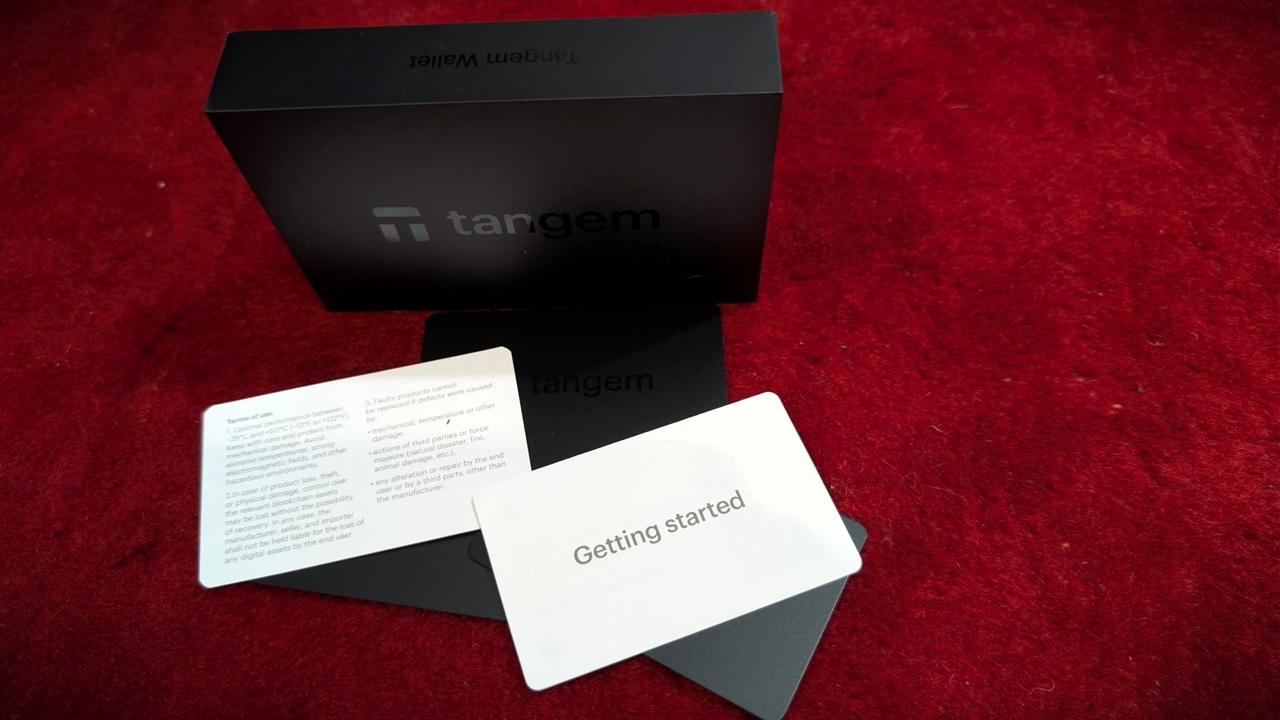
The counterintuitive bit: sticker placement varies. There’s no standard position, so don’t panic because the label sits somewhere unexpected. Compare it against the example on Tangem’s website instead. The box and leaflet should show the card count, the production month, and terms of use. Nerd aside: first-gen cards weigh 5 grams, the Tangem 2.0 card is 6.
The torn-seal panic, resolved
A common pattern buyers report: the box arrives sealed, the security seal is already torn, and the panic sets in. It’s frequent enough that Tangem has publicly said torn seals are a packaging error, not a breach, and that improved seals are in the works. Finance Nuggs still treats seal inconsistencies as an Amazon red flag, and that’s a fair caution. Both can be true. Seal inspection is a hint; the app’s cryptographic verification is the verdict.
If your Tangem card fails the authenticity check
An unexpected app message may mean a rare mis-shipped card rather than a counterfeit, and mis-shipped cards get replaced free. There are three documented types, and the pop-up strings are your fastest tell. Production cards trigger: Authenticity check failed. This card might be a production sample or a counterfeit.
Testnet cards can’t process transactions, since they’re built for testing only. Developer cards say “Not for users!” out loud, which is honestly my favorite error message in consumer hardware. All three are very rare but documented, and none of them should ever hold crypto.
The practical tip: contact Tangem support before you torch them in a review. They replace mis-shipped cards at no extra cost, and that works better than a one-star screed will.
Reporting a suspected counterfeit to Tangem
If something smells genuinely fake, report it through the official Tangem help page. Describe what’s off in detail, the distinguishing features specifically, and attach clear photos or video. Support investigates from there. What’s promised is the free-replacement policy for mis-shipped cards; don’t expect more than that, and you won’t be disappointed. Honestly, this is where the reporting is its own reward: every documented counterfeit helps Tangem tighten the channel list the rest of us rely on.
Want certainty? Factory-reset your cards for a virgin key
For the paranoid, there’s an optional extra: after creating and backing up your wallet, factory-reset all your cards so you’re guaranteed a private key no one has ever touched. Back up first, because reset deletes the wallet permanently and order matters here. Then it’s settings, card settings, scan, reset to factory settings, on every card. Especially worth doing if your card came from anywhere off the official channels.
Tangem wallet cost, fees, and what you’re actually buying
Quick note before the numbers: nothing here is financial advice, this is informational only, and crypto products and NFTs are unregulated and highly risky, so weigh that before spending anything. Expect to pay roughly $60+ for a two-card pack, with no monthly fee, though price varies with set size and promotions, so check live pricing on Tangem.com rather than trusting any number in an article, including this one. Discount codes do circulate: 10% via Finance Nuggs, NORDIC for 10-20% off, and Crypto U.P.‘s AKASHKUNDA invite link. Full disclosure: these are all affiliate incentives, and referral links are included for convenience only, not as an endorsement, which is exactly why you should discount the reviewer consensus accordingly. And the channel doesn’t gate the coins; bitcoin and XRP storage work through the same purchase channels as everything else.
Cost check: Codes from Finance Nuggs, NORDIC, and Crypto U.P. are affiliate incentives, so weigh reviewer enthusiasm accordingly before using any of them.
What you get, and what reviewers ding it for
The strengths are real. The card carries an IP69K rating, which means waterproof, dustproof, and surviving extreme temperatures and X-rays. That’s genuinely better odds than a paper seed in a drawer. The seedless backup is beginner-friendly in a way that matters: by one commonly attributed claim, 80-90% of crypto losses trace back to complicated wallets and seed-phrase scams, and a wallet where the cards are the backup is an answer to that. Store them separately, since losing all of them means the crypto’s gone.
The criticism, per Brutal Reviews‘ seven drawbacks: clunky UX with long-press issues, poor platform compatibility, flaky high-fee fiat portals like Simplex and Mercurio with bank-card rejections, and an alleged $5,000 hack loss without biometrics enabled, which is unverified and reported as such, not established fact. Older cards like the Shiba card lacked seed export; current versions added it optionally. Everything runs on phone NFC with no desktop management, so check your phone has NFC before ordering.
One honest framing: app verification protects against tampering. It does nothing about UX, support, or fee shortcomings. In-app swaps cost more than exchanges, so the workaround is transferring out, trading, and sending back. And the crypto ring is functionally identical to the cards, though Nordic Crypto skipped it because a ring visibly announces “I own crypto,” which is a fair call.
Closing: the one check that settles it
Buy from an official channel when it’s convenient, run any other listing through the three-question framework, and treat the first-tap app verification as the decisive step either way. That check, backed by an EAL6+ certified chip with protection against invasive attacks, is what actually settles whether the card in your hand is yours alone. Five minutes, one tap. Go run it.
People Also Ask
Is there a monthly fee for Tangem Wallet?
No, there’s no monthly fee or subscription. You pay once for the card set — roughly $60+ for a two-card pack, though prices vary with set size and promotions. After that, the wallet is yours with no recurring costs.
What is the safest cold wallet for XRP?
The safest option is any cold wallet that keeps private keys fully offline — and channel matters as much as hardware. Tangem supports XRP storage through the same official channels as everything else: Tangem.com, Tangem’s official Amazon storefront, and authorized resellers. Whichever wallet you choose, buy from an official channel and verify the device on first use.
Where can I buy a Tangem wallet?
There are exactly three channels Tangem designates as safe: Tangem.com, the official Tangem storefront on Amazon, and resellers and distributors Tangem authorizes (it claims resellers in 54 countries). Anything else is off-book. Tangem.com is the top pick because it has the fewest hands on the device, though direct shipping can run a bit slower than Prime.
Is it safe to buy Tangem wallet on Amazon?
Yes, when you buy through the official Tangem e-shop storefront specifically — not whichever listing sorts first, since Amazon mixes authorized and unauthorized sellers on near-identical pages. Inspect the tamper-evident packaging when it arrives, and treat the app’s cryptographic verification on first tap as the decisive safety layer. Read seller reviews skeptically; fake reviews are common in this category.
