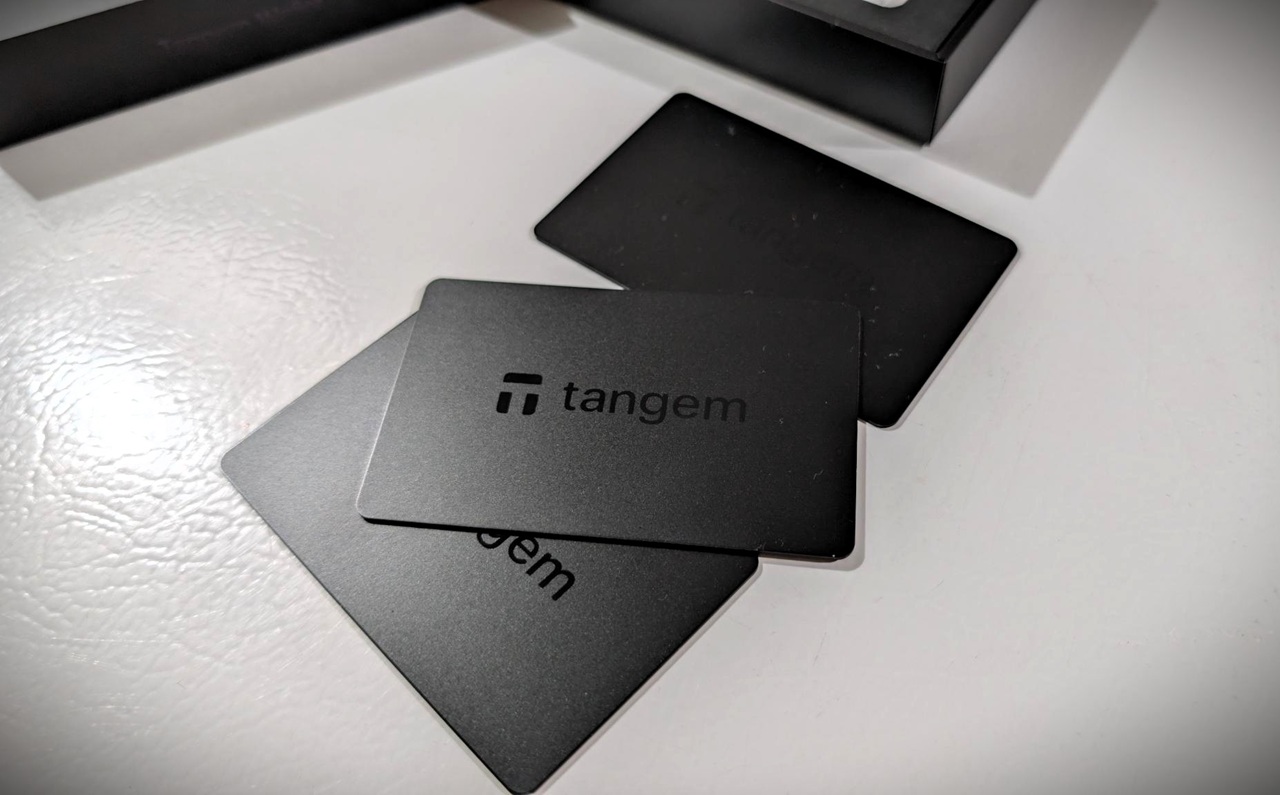
I went down this rabbit hole because how much does a Tangem wallet actually cost should be a thirty-second answer, and instead the search results were a swamp of coupon-site spam and five-year-old forum posts. So here’s the actual math. A Tangem wallet is a one-time purchase: the 2-card set runs about $54.90, the 3-card set is $69.90 (the most popular tier), the 6-card Family Pack is $139.80, and the Ring Set is around $160. No subscription, no activation fees, nothing recurring.
But sticker price is the boring part of this story. What I actually want to show you is what a fair price looks like, based on 969 days of tracked Amazon pricing data, plus what each extra card actually buys you in recovery options. One note up front: prices vary by location, so treat these as the reference numbers.
Key Takeaways
Tangem packs cost $54.90 (2 cards), $69.90 (3 cards), $139.80 (Family Pack, 6 cards), and roughly $160 (Ring Set) as a one-time purchase with no subscription.
The tracked 3-card Amazon price averaged $64.84 over 969 days, with a historical low offer of $46.74 via stacked coupons: sub-$55 is a good deal.
The real cost risk isn’t the wallet; in-app swaps route through third-party providers charging up to ~10%, so one $1,000 BTC swap could cost more than the hardware.
Table of Contents
Tangem wallet price: what each pack costs
A Tangem wallet costs between roughly $55 and $160 depending on which pack you pick, per the official Tangem pricing page. The ladder breaks down like this: the 2-card set is about $54.90 (one primary card plus one backup), the 3-card set is $69.90 (two backups), the Family Pack gives you 6 cards for $139.80, and the Ring Set runs around $160 for a ring plus two cards.
| Pack | Cards | Price | Per-card cost |
|---|---|---|---|
| 2-card set | 2 | ~$54.90 | ~$27.45 |
| 3-card set | 3 | $69.90 | ~$23.30 |
| Family Pack | 6 | $139.80 | ~$23.30 |
| Ring Set | Ring + 2 cards | ~$160 | n/a |
Prices from the official Tangem pricing page; check current listings since pricing varies over time and by region.
The per-card math is where it gets interesting: you’re paying ~$27.45 per card on the 2-pack, but only ~$23.30 per card on the 3-pack and the Family Pack. That flat per-card rate between the 3-pack and 6-pack is a nice bit of pricing design. Tangem isn’t charging you a premium for redundancy, just for silicon. Think of it as redundancy pricing rather than sticker shock: each extra card is a literal clone of your wallet that functions as a distributed backup.
Every tier is a one-time purchase. No subscription, no activation fee, buy it once and it’s yours. The box includes the branded packaging, a step-by-step setup guide, and access to the all-in-one app, which handles the wallets, swaps, and everything else. The Family Pack’s use case is pretty self-evident: more family members or more spread-around cards equals more redundancy at the same per-card cost as the 3-pack.
Tangem 2-card vs 3-card: which should you buy?
The 3-card pack is the better buy for most people, and the reason has nothing to do with vague “more security” marketing. It’s a $15 gap that buys a specific, concrete recovery path.
Here’s the failure-mode analysis, which is honestly the most interesting part of this whole product:
- 2-card pack: Lose one card and forget your access code, and your wallet is unrecoverable. Full stop. There’s no customer service line that can help you, because the whole design means nobody holds your keys.
- 3-card pack: Lose one card, two remain, and either one restores full access to your wallet. The $15 gap literally buys you the difference between “annoying” and “catastrophic” in the lost-card-plus-forgotten-code scenario.
- Any tier: Lose all cards with no seed phrase, and it’s a total loss. No pack size prevents this. Anyone who tells you otherwise is selling you something.
The backup model is what makes this work, and it’s honestly kind of elegant. When you activate the wallet, all your cards are synchronized clones created at the same moment, the cards are the backup, replacing the traditional seed phrase entirely. Seed mode is optional: Tangem recommends letting the card generate the key on-board using its true random number generator, but you can also generate or import a standard 12/24-word phrase, with an optional passphrase if you want it. (If you want the deeper security teardown, our piece on how safe a Tangem wallet actually is covers the chip architecture.)
The documented buyer pattern worth avoiding: people grab the 2-pack to save $15, then store both cards together in the same drawer. That completely defeats the redundancy model, you’ve built a single point of failure out of two cards. One card in the safe, one in a drawer across the house, or the whole backup scheme is theater.
Buyer rule: Two cards in one drawer is one wallet with extra steps. Separate them physically or the redundancy doesn’t exist.
What the price physically gets you
What you’re buying is a credit-card-sized NFC smart card (or a ring, in the Ring Set’s case) that signs transactions by tapping against your phone within 0-5 cm, using ISO 14443 Type A. No batteries, no cables, no charging, ever. That’s the part that feels like tiny wizardry: the crypto key lives in the card, and your phone is just the interface.
One pre-purchase check: it’s NFC-only, so you need a compatible phone, iPhone 7 or newer, Pixel, Galaxy A3 or newer, and some Xiaomi models. Older iPhones and some budget Androids won’t work, so verify your phone before you order. Setup is quick: install the app, scan the card, set an access code, optionally add biometrics. Lose your phone and you’re back up in minutes with the replacement, install the app, tap a card, done.
Tangem price history: what a fair price actually looks like
The 3-card pack on Amazon has averaged $64.84 over 969 days of tracked pricing. That average is the anchor for judging any deal you see.
| Data point | Value |
|---|---|
| Tracked current price | $66.40 (vs $69.90 MRP, 5% off) |
| Listing | ASIN B0CL9TGD85, model 001 |
| Rating | 9/10 from 2,696 reviews |
| 969-day average | $64.84 |
| Historical high | $70.00 (2 Jul 2024) |
| Historical low | $53.90 (21 Jan 2024) |
| Lowest-ever offer | $46.74 (2 Dec 2025, stacked coupons) |
Documented price drops: 4 Dec 2024 (-20%), 19 Nov 2025 (-14.99%), 24 Dec 2025 (-21.33%, to $54.99), and 20 Jul 2026 (-10%, to $62.91).
The buy thresholds: below ~$55 is a good price, and near $47 with stacked coupons is the historical floor. Fair warning: discount timing is documented history, not a schedule. The price tracker itself labels its predictions theoretical, and I’m not going to pretend 969 days of data turns into a crystal ball. It’s the kind of boring diligence that actually answers “is this a sale?” without needing one.
Are Tangem discount codes legit?
Mostly yes, but the real discounts don’t come from coupon sites. Tangem runs its own documented promos: price-drop banners hitting 20% off, coupon drops at 10/15/25%, windows with up to 50% off, and a 10% lifetime discount mention. The free-BTC offers ($5, $20 per purchase) come with a 14-day anti-abuse wait before payout, which is a structured safeguard, not a scam tell. There was also a giveaway running May 5 through Jul 5 with a $5,000 BTC top prize, a time-bound past example, not something currently active.
The pattern in the tracker data: third-party “discount codes” usually just mirror Tangem’s official promos or route you to marked-up resellers. The biggest verified discount, that $46.74 floor, came from Tangem’s own banners and stacked Amazon coupons. Not from a code site.
Fees beyond the sticker: what Tangem actually costs to own
There’s no monthly fee for a Tangem wallet. No subscription, no activation charge, no service fees, ever. The only mandatory cost is blockchain network gas fees, which go to the network, not to Tangem.
Here’s the twist that makes this section worth your time: the in-app buying and swapping runs through third-party providers. Tangem Express aggregates services like 1inch, ChangeNOW, Changelly, ChangeHero, OKX DEX, Simpleswap, and Unlimit, while fiat purchases route through Mercuryo, Simplex, and MoonPay. Those providers charge roughly 3-4% for buys and up to ~10% for swaps. A $1,000 BTC swap could cost $50+ in fees, which is more than the wallet itself cost you.
Those fees belong to the providers, not Tangem, but they’re the number that matters. There are occasional 0% stablecoin swap promos if you catch them.
Cost check: One in-app swap at ~10% on $1,000 costs more than the 3-card pack. Check the provider’s fee before confirming, not after.
KYC only enters the picture through those third parties, above their purchase thresholds. The “MoonPay/Changelly held my crypto” complaints you’ll find trace to uncompleted KYC with the provider, not anything Tangem did. One careless swap costing more than the wallet is exactly the kind of thing this section exists to prevent.
Is Tangem worth it vs Ledger and Trezor?
For the money, yes, and the per-year math is the argument. A $69.90 3-card pack with a 25-year warranty works out to roughly $2.80 per year of cold storage, no rival’s 1-2 year warranty touches that framing.
| Tangem | Ledger Nano X | Trezor Model T | CoolWallet S | |
|---|---|---|---|---|
| Warranty | Yes (25-yr) | Yes (1-yr) | Yes (2-yr) | Yes (1-yr) |
| Asset support | Yes (16,000+) | Yes (5,500+) | Yes (thousands) | Yes (10,000+) |
| Seedless | Yes | No | No | No |
| Connection | Yes (NFC tap) | Yes (Bluetooth) | Yes (USB) | Yes (NFC) |
As you can see in our hands-on 2025 Tangem review, Tangem’s seedless multi-card architecture and NFC tap setup are what set it apart from the competition.
The honest ledger: no onboard screen (blind-signing risk, partially mitigated by Blockaid scam scanning via WalletConnect), no desktop client, no multiple receiving addresses, and it’s not the tool for frequent traders. DEX spend approvals carry some theoretical long-term risk; using a CEX for swaps or a burner wallet for DeFi sessions are the standard mitigations.
The security justifying the price is solid: a Samsung EAL6+ secure element (same certification class as a biometric passport), keys generated on-card by a true random number generator and never leaving the chip. Kudelski Security audited it in 2018 and Riscure in 2023, finding no backdoors. Firmware is immutable, the apps are open source, and across millions of cards sold since 2017 there are zero known remote hacks. Ratings sit at 4.9 on the App Store and 4.1 on Trustpilot, and the company is headquartered in Zug, Switzerland.
It’s non-custodial: no Tangem servers touch your transactions, they can’t lock or ban you, and the wallet keeps working even if the company disappeared tomorrow. Physically the cards are IP69K-rated and rated for -25°C to +50°C, so they shrug off weather, laundry cycles, and gloveboxes alike.
Where to buy: official store, Amazon, or resellers
Two channels have real evidence behind them: the official Tangem store, which is the recommended route for current pricing, bundles, and the full warranty, and the legitimate first-party Amazon listing, which was tracked at $66.40 against the $69.90 official price with a 9/10 rating from 2,696 reviews.
Reseller listings are where I’d be careful. Tangem’s own guidance flags the pattern: third-party marketplaces can add markups, ship older batches, carry tampering exposure, and limit warranty coverage. A “cheap” marketplace deal can cost more once you count who actually stands behind the card. (Our full where to buy a Tangem wallet guide covers verification steps.)
On “near me”: the sources don’t show verified brick-and-mortar stock, so I’m not going to guess about Best Buy or Walmart availability. Tangem ships in the US and 150+ countries, with restrictions in sanctioned regions including Cuba, Iran, North Korea, Syria, Crimea, Russia, Belarus, and Venezuela.
Ownership costs the price doesn’t advertise
The hidden cost of seedless design is storage discipline. Backup cards have to live in separate places, because anyone holding a card plus the access code can spend your funds. And if all cards are lost with no seed phrase, it’s unrecoverable, no pack tier changes that math. This is the failure scenario nobody prices in at checkout.
The documented community pattern for managing this: split your holdings across a seedless wallet and a seed-based one. The 20/80 split gets cited as an illustration, but there’s no single right ratio, the point is that a revealed seed phrase is one of the top causes of crypto losses, and total seedless loss is the mirror-image risk. Balance them against each other.
On the roadmap, with appropriate skepticism: multi-address Bitcoin support is expected in coming updates (team-sourced, no date, low confidence), a Tangem Visa debit card is in development, and app v5.38 added Tangem Pay features like reissue, renaming, and daily spending limits. None of that should drive when you buy.
Tangem pricing FAQ
How much does a Tangem Wallet cost? The 2-card set is ~$54.90, the 3-card set is $69.90, the 6-card Family Pack is $139.80, and the Ring Set is around $160. All one-time purchases.
Is there a monthly fee? Nope. The only recurring cost is blockchain gas fees, and those go to the network, not Tangem. In-app buys and swaps route through third-party providers (ChangeNOW, MoonPay, and others) charging roughly 3-4% to 10%, their fees, not Tangem’s.
Is Tangem worth it? Yes for most people: ~$2.80/year of cold storage over the 25-year warranty, EAL6+ security, and zero known hacks since 2017, provided you can live with no screen and phone-only use.
What do you get in the box? The branded packaging, a step-by-step setup guide, and the all-in-one app.
Why does pack size matter? Cards are synchronized clones made at activation. Lose one of two cards plus your access code and the wallet is gone; with three cards, two remain and either restores access.
What are the disadvantages? No onboard screen, no desktop client, no multiple receiving addresses. At $69.90 those are reasonable tradeoffs; they’re what keeps the price down and the attack surface small.
The fair-price verdict
Buy the 3-card pack at its ~$69.90 list price, wait for below ~$55 if you can, and treat ~$47 with stacked coupons as the ceiling of a great deal. Purchase from the official store or the first-party Amazon listing, nowhere sketchier. And the bigger financial decision isn’t which pack you pick, it’s which third-party providers you route your trades through, because one bad swap fee costs more than the hardware ever will.
People Also Ask
How much does a Tangem Wallet cost?
The 2-card set runs about $54.90, the 3-card set is $69.90, the 6-card Family Pack is $139.80, and the Ring Set is around $160. Every tier is a one-time purchase with no subscription or activation fees. Prices vary by region, so treat these as reference numbers.
What are the disadvantages of Tangem Wallet?
The main drawbacks are no onboard screen (which creates blind-signing risk, partially mitigated by Blockaid scam scanning), no desktop client, and no multiple receiving addresses. It’s also NFC-only, so you need a compatible phone like an iPhone 7 or newer, and it’s not the tool for frequent traders. At $69.90, those tradeoffs are what keep the price down.
What are the top 3 crypto wallets?
For hardware wallets, the usual shortlist is Tangem, Ledger, and Trezor. Tangem stands out with a seedless multi-card design, NFC tap-to-sign, a 25-year warranty, and 16,000+ supported assets, while Ledger (Nano X) and Trezor (Model T) offer screens and desktop clients but only 1-2 year warranties and seed-phrase-dependent backups.