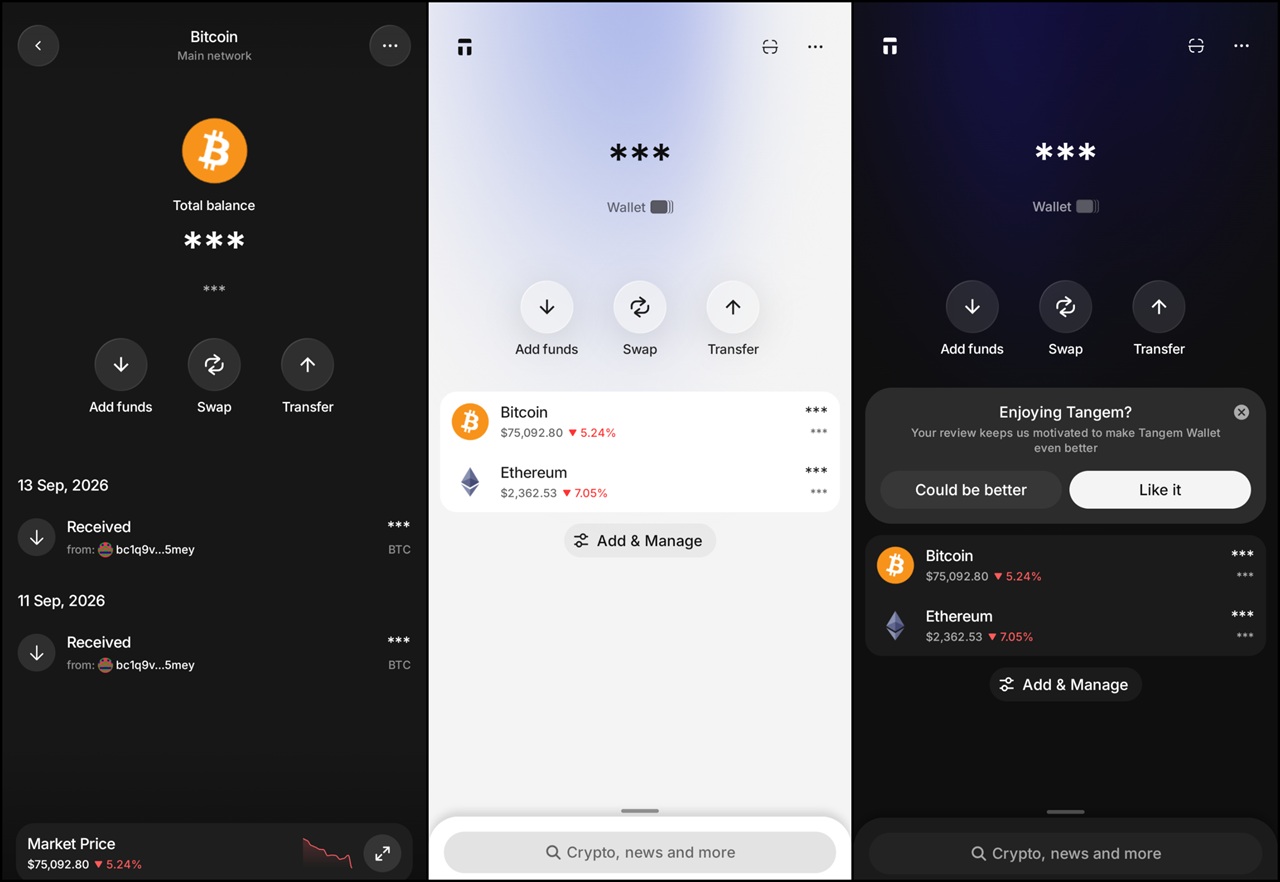
I sat down to fact-check one claim about the Tangem wallet app and came up two hours later having read 32 changelogs. That’s not a review blurb; that’s a warning about what happens when a wallet company actually ships in public. The Tangem app is a free self-custody crypto wallet for iOS and Android covering storage, swaps, staking, WalletConnect, and Tangem Pay, a spending account that taps real ATMs. It works with or without Tangem’s famous NFC cards. And that’s the thing nobody tells you upfront: the free app and the $50, $90 card are two different custody products, and the release notes from v5.9 (May 2, 2024) through 6.2 (August 27, 2026) tell you more about which one you’re getting than any app store listing will.
Key Takeaways
The app is free either way, but the custody model changes: with NFC cards the vault is the card; the app-only Mobile Wallet stores keys in your phone’s secure hardware and isn’t backed up by default.
Tangem Pay’s math is concrete: ATM withdrawals cost 2% on Plus or 4% on Basic, so roughly $725/month in withdrawals is where the $29/month Plus plan starts paying for itself.
Support numbers conflict by source (10,000+ tokens vs ~2,840 listed assets vs 90+ networks), and Cure53’s SDK audit found no Critical or High issues but only covers a scoped snapshot, not the product forever.
Table of Contents
Two products, one download
You download the Tangem wallet app from the App Store or Google Play, and it’s free whether or not you own a card. Fine print for the “will it run” crowd: 672.3 MB, iOS 16.4 or later, 11 languages. And if you’re hunting for a tangem wallet APK on some random mirror, don’t. The official stores are the safe route, full stop.
Here’s the disambiguation that matters. With the NFC card system (an EAL6+ certified chip, sets running $50, $90, up to three cards acting as mutual recovery), the vault is the card. With the app-only Mobile Wallet, the vault is your phone: your keys are held in iOS Keychain/Secure Enclave or Android Keystore/StrongBox, and it is not backed up by default. Same download, very different blast radius if you lose the device. There’s also an upgrade path, “spend hot, save cold,” if you start app-only and add cards later. For the record, Tangem the company has been around since 2017, headquartered in Zug, Switzerland.
Setup, backup, and the one irreversible step
Setup is short: install the app, scan a hardware card or tap “Start with Mobile Wallet,” set an access code or biometrics, then make the backup decision.
That last step is the one people skip. The Mobile Wallet doesn’t back itself up, so if your phone dies, your only recovery is a completed Recovery Phrase backup or an upgrade to the NFC cards. How real is this gap? Version 5.38 shipped nothing more than a survey button gauging interest in Google Drive/iCloud backup.
Cloud backup is still an idea, not a feature. On the nicer side, importing a seed phrase auto-discovers the tokens you hold, so restoration isn’t a manual token-adding marathon.
The pattern that repeats in wallet support discussions goes like this: new user installs, everything works, backup feels optional, and they revisit the question weeks later, usually from a different phone. Treat the backup as part of the install, not an errand for future-you.
Red flag: App-only keys live in your phone’s secure hardware with no default backup. If you skip the Recovery Phrase step, a dead phone means gone coins.
What’s new: v5.9 through 6.2
The release trail explains the current app fastest. v5.9 (May 2, 2024) added eight networks plus 24-word seed support; 5.30/5.31 brought Aave Yield Mode and the Tangem Pay launch (December 12, 2025); 5.33 shipped Multi-Accounts and Smart Gas (February 11, 2026); 6.0 (July 17, 2026) redesigned the UI and added no-KYC BTC DEX swaps; 6.1 brought Address Book, a bank on-ramp, and tiers; 6.2 (August 27, 2026) delivered ATM withdrawals and TRC20/UTXO DEX swaps. Prestige tier, physical Tangem Pay cards, and cloud backup are announced but not live.
Can you swap and stake without an exchange?
Yes, the Tangem app lets you swap and stake crypto without an exchange, and as of Tangem 6.2 (August 27, 2026) almost entirely so. The big one: TRC20 tokens, which mostly means USDT on Tron, now route through DEXs instead of centralized providers, and the wallet never holds your funds mid-swap. Why care? Tron carries $87B+ in circulating USDT and processed $2.1T in USDT transfers in Q2 2026, nearly half of all USDT. That’s not a niche chain.
The nerdier milestone in 6.2 is DEX routing for UTXO chains like Bitcoin Cash, Dash, and Litecoin. Unlike tokens, those chains have no native hook into EVM DEX infrastructure, so this is genuine engineering work, not a checkbox, and it removes the custodial handoff. The supporting cast: BTC swaps via LiFi and SwapKit (since 6.0), a combined approval-plus-swap confirmation, a Best DEX Rate badge, fixed-rate swap locks, and large-discrepancy warnings. For earning, there’s native TON staking where keys and rewards stay self-custodial, Aave Yield Mode (an audited Tangem contract auto-supplies eligible stablecoins to Aave on arrival), and an Earn block in Markets.
Supported coins and networks: the numbers don’t agree
The Tangem app supports a huge asset range, but the headline figures conflict depending on who’s counting: 10,000+ tokens across 100+ networks per Tangem’s own promo, roughly 2,840 listed assets per the support docs, and 90+ networks per VentureBurn. Those count different things (promotional token totals vs listed assets vs networks), so don’t average them into one fake number, and if you’re still buying the wallet itself, verify it’s genuine before trusting it with anything. The useful move is opening the app and checking what you actually hold. NFTs, for scoping purposes, span 92 networks.
The newest chains are worth a spec-sheet glance. Robinhood Chain is an Ethereum L2 on Arbitrum Orbit with ETH gas, live July 1, 2026, launched with Uniswap v2 through v4 plus UniswapX, Chainlink oracles, Morpho lending, and 24/7 Stock Tokens (tokenized Nvidia and Apple). It pulled $450M+ in TVL and 95M+ transactions in its first three weeks, so yes, people used it. Igra is an EVM-compatible L2 built on Kaspa’s proof-of-work BlockDAG, public mainnet since March 2026. Recent additions run rapid-fire: Monad, Scroll, Arbitrum Nova, Linea, Plasma, Quai, Hedera ERC-20, ADI, Solana transaction history.
Transaction details most reviews skip
Funding goes through the Add Funds flow, which replaced the old Buy button in 5.39: one entry point combining Buy, Swap, and Receive. On iOS you can buy with Apple Pay via Mercuryo; MoonPay Trade is among the providers; and since 6.2, Plus subscribers onramp for free.
Now the fun part. Smart Gas: you’re holding 100 USDT and zero ETH, you send 50 USDT, and the ~$0.80 fee comes out of your USDT. Shipped in 5.33, extended to DEX swap gas in 5.37. ENS means you can send to tangem.eth instead of a 42-character hex string. Send via Swap lets you send someone a token you don’t even hold, optionally with a fixed-rate lock.
The guard stack is really a story about one thing: destination details are where self-custody money dies. Missing memos on XRP/XLM can strand funds, and Tangem added warnings in 5.22/5.25 after learning that the hard way. The Sality botnet infected 15,000+ devices and stole $150,000+ by exploiting copied clipboard addresses. Address Book (6.1, long requested by users) ends the copy-paste risk with nicknames and one-tap fill.
Opt-in fresh UTXO addresses per transaction break on-chain linking, and long-press signing stops fat-finger confirmations. The recurring support theme is the same every time: a repeat transfer where muscle memory beat verification. And these safeguards matter all the more once you weigh Tangem’s honest drawbacks, self-custody mistakes don’t have an undo button.
Tangem Pay: the real fee math
Tangem Pay is a non-custodial spending account inside the app: fund it with USDC on Polygon, spend through a virtual Visa via Apple Pay or Google Pay. It launched virtual-only in v5.31 (December 12, 2025), and physical cards still aren’t available, so don’t wait for plastic in the mail. For a wider view of how the card setup fits into the ecosystem, my hands-on Tangem wallet review covers the hardware and seedless multi-card architecture in depth.
The part that made me sit up: verified users get actual US bank details, routing and account numbers, inside a self-custody app. Incoming funds land as USDC on Polygon, with ACH at $1 flat and FedWire at $11 flat and no transfer limit. Flat fees flip the usual percentage model: $100 costs 1% effective, $10,000 costs 0.01%. And as of the week of August 21, 2026, you can tap your phone at a contactless ATM and withdraw cash, balance deducted in USDC. Your wallet app talks to ATMs now. We live in the future, minus the flying cars.
Tangem Pay comes in three plans. Basic, Plus, and Prestige. The numbers, as documented in the 6.1-6.2 release notes:
| Basic | Plus | Prestige | |
|---|---|---|---|
| Cost | Free | $29/mo | $83/mo or $999/yr |
| Visa level | Platinum (lounge access, travel insurance, concierge) | Signature (Luxury Hotel Collection, 900+ hotels), waitlist | Infinite, not live yet |
| ATM fee | 4% | 2% | |
| Onramp | Standard fee | Free (since 6.2) |
ATM limits: $250 max per withdrawal, three per 24 hours. The fee comes off the balance, so a $100 withdrawal deducts $102 on Plus or $104 on Basic. One plain line so nobody discovers it at the machine: withdrawals are blocked in Syria, Iran, Cuba, North Korea, Russia, Ukraine, and Venezuela. Cashback is tiered too, but it hasn’t arrived, so I’m not modeling it.
Here’s the break-even: at Basic’s 4% ATM fee, roughly $725/month in withdrawals generates enough in fees to cover Plus on its own. If you rarely hit an ATM, Basic is fine. If you treat it like a debit card, run the math. Card controls arrived too: reissue, rename, and a daily spending limit since 5.38, up to two cards since 6.0, plus a Card Linked banner that disables top-ups when keys are tied to a backup setup. Annoying in the good way.
Cost check: At Basic’s 4% ATM fee, about $725/month in withdrawals is where paying $29/month for Plus starts beating the higher per-fee cut.
Is the Tangem app safe?
Yes, with two conditions: complete the backup and read the audit’s actual scope. As for hacks, the sources I dug through show no reported Tangem breach, and the company’s own changelog admits its fixes rather than burying them.
Three layers. Hardware: the card chip is Common Criteria EAL6+ certified, which is a formal evaluation level for how rigorously the chip’s security was tested, not a “military-grade” adjective. Software: Cure53’s white-box review of the Android and iOS SDKs (work in November 2025, summary published February 10, 2026) found no Critical or High-severity issues, and identified issues were addressed. That’s a scoped snapshot of the SDK at a point in time, not a lifetime guarantee on the whole product, and Blockaid powers the scam detection and transaction simulation underneath. Disclosed fixes: v5.18.3 (November 28, 2024) patched an Android offline attestation flaw where first-scan verification results were ignored; exploitation was deemed infeasible in practice, which I’ll report right alongside the flaw itself.
Context against peers: Trust Wallet’s Chrome extension was hacked in December 2025 (the mobile app was unaffected), and Ledger disclosed a late-August signing flaw, patched via Ledger Live. Two honest gaps: these sources contain no Reddit or Trustpilot-style community sentiment data, and no real-world bug-frequency numbers, so I won’t manufacture a vibe. And the tradeoff that comes with “not your keys, not your coins”: wallet crypto carries no FDIC or SIPC insurance.
Where Tangem sits in the 2026 field, and what it costs
The competitive picture depends entirely on your use case. Third-party rankings didn’t put Tangem in the top overall slots, but it won its form-factor category outright, and both facts are worth stating plainly.
Money.com’s September 2026 ranking, built from 46 data points across 58 wallets (28 hot, 30 cold), picked OKX Wallet best overall (CertiK Skynet 91.31, grade AA), Base best for beginners, Trust Wallet best mobile, Sparrow best Bitcoin, MetaMask best Ethereum (with a 0.875% swap fee), and Trezor Safe 5 best cold. Tangem isn’t in those slots. Other CertiK scores on the bench: Trust 90.51, MetaMask 88.57, Base 87.77, Bitget 87.40, Phantom 82.37. VentureBurn’s 2026 guide, meanwhile, names Tangem best card-shaped cold wallet: $50, $90 sets, NFC, EAL-certified chip, 90+ networks.
So, when does it fit?
- Best fit: card-form-factor cold storage on a budget. $50, $90 against NGRAVE ZERO at ~$400, Ledger Nano Flex at $249, Trezor Safe 5 at $129. One shopping caveat: sources disagree on the Trezor Safe 3, $59 per Money.com versus $79 per VentureBurn.
- Fine fit: app-only mobile self-custody. Mind the backup gap from earlier, and know MetaMask and Trust compete hard here; MetaMask’s 0.875% swap fee is the sort of number that adds up.
- Not the fit: if you want a seed-phrase-free key-management philosophy, MPC and multi-share backup (Trezor among them) attack the problem differently. Competing approaches, no declared winner.
Total cost of ownership is card price plus optional $29/month Plus plus per-transaction fees, not the sticker price. And the promo fine print, disclosed because hidden gotchas are the enemy: the referral offer (~$5 free BTC, 20% off) emails often land in spam, and the BTC arrives 14 days after activation, per Cyber Scrilla, medium confidence. One promoter profiled runs nine or more card sets just to split holdings. That’s the changelog way of reading a wallet, which is how we tend to do things here at GeekExtreme: press releases are marketing; release notes are a track record.
Verdict: judged by what it shipped
Thirty-two releases in two-plus years, admitted fixes included, is the strongest evidence you can ask for about a trajectory, so judge Prestige and the physical cards by whether they follow the same pattern. The decision rule: complete the backup if you’re app-only, run the Plus math if you hit ATMs, verify support counts in the app. Residual unknowns stand: no community sentiment data, cashback still unmodeled.