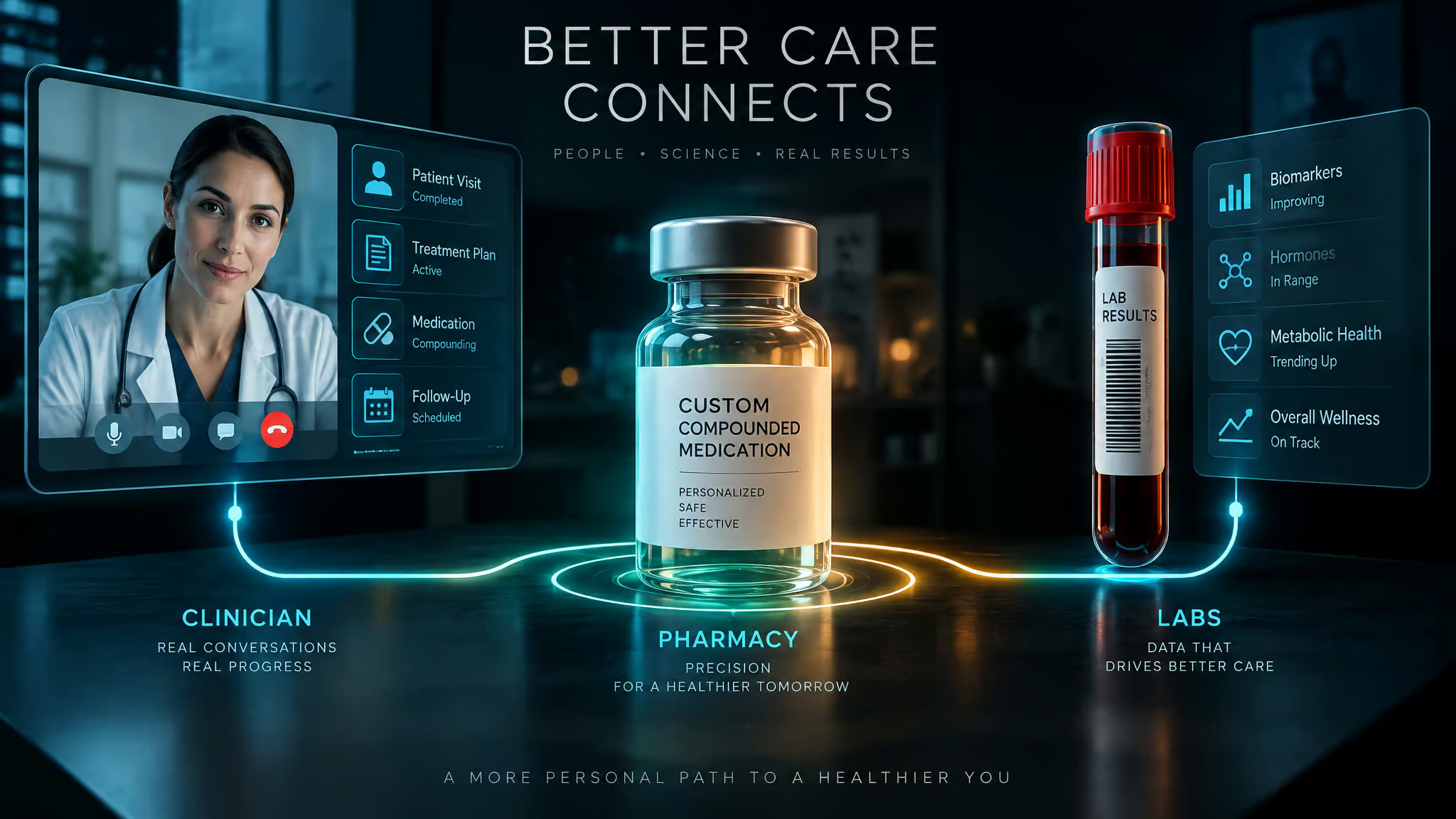
Two peptide websites can run the exact same sleek storefront template, show the same glass vials, and promise fast shipping, while one routes your intake to a licensed physician and the other ships unregulated lab powder with a disclaimer sticker. Trying to rank the top five peptide companies on a single flat scoreboard misses how the architecture actually works.
The U.S. peptide landscape splits into three non-interchangeable regulatory lanes: licensed telehealth clinics prescribing through Section 503A and 503B compounding pharmacies, gray-market research-use-only (RUO) sellers, and industrial Good Manufacturing Practice (GMP) contract manufacturers that only supply pharmaceutical companies and clinical labs. The two compounds people search for most, BPC-157 and TB-500, can’t be legally dispensed by any licensed provider right now.
If a site lets you toss either one into a shopping cart without a prescription, you’re looking at a gray-market vendor. A peptide is only as good as the data behind the dose. The highest-rated legal providers pair currently legal prescriptions like sermorelin, PT-141, and gonadorelin, plus non-peptide therapies like NAD+ and glutathione, with real bloodwork. Picking the right clinic depends on your priority: biomarker depth, catalog breadth, or total cost.
Key Takeaways
The top five legal telehealth peptide companies in the U.S. are OneTwenty (9.5/10, $499/year membership plus separate peptide costs), Celia RX (9.1/10, $179 to $899 per product plus a $55 consult), Marek Health (8.7/10, $166+/month plus $450 to $1,700/year for labs), Victory Select (8.0/10, Texas regional quote-on-consult), and Maximus (7.9/10, $199/month flat across all 50 states for sermorelin).
BPC-157 and TB-500 remain illegal to compound or buy for human use despite a favorable July 23 to 24, 2026 FDA advisory committee vote (docket FDA-2025-N-6895), because formal FDA rulemaking is still pending and can take over a year.
Every legitimate peptide supplier requires three verifiable elements before shipping: a named licensed prescriber, a disclosed 503A or 503B compounding pharmacy, and baseline bloodwork with periodic re-checks.
Table of Contents
The top 5 peptide companies, ranked on data
The top five legal peptide companies in the United States are OneTwenty, Celia RX, Marek Health, Victory Select, and Maximus, while the full seven-company U.S. clinical ranking extends to TRT Nation and Blue Sky MD. This ranking draws on the OneTwenty feature published April 19, 2026, medically reviewed by Dr. Mohammed A. Fouda, MD on July 12, 2026, and updated October 4, 2026 (the shared date anchor for all provider pricing and availability in this guide). It evaluates providers across five weighted criteria: formulary relevance, prescriber and monitoring quality, pricing and lab-cost transparency, geographic coverage, and pharmacy track record.
- #1 OneTwenty (9.5/10): National telehealth membership at $499/year ($749/year in NY and NJ), HSA/FSA eligible, with peptides billed separately. Best for quarterly comprehensive bloodwork and wearable data tracking.
- #2 Celia RX (9.1/10): National telehealth and mail-order compounding pharmacy at $179 to $899 per product plus a $55 consultation, LegitScript-certified. Best for per-product compounded prescriptions without an annual membership.
- #3 Marek Health (8.7/10): National telehealth at $166+/month plus $450 to $1,700/year for labs (HSA/FSA eligible), testing 60+ biomarkers. Best for deep functional-medicine optimization.
- #4 Victory Select (8.0/10): Texas-based online pharmacy and telehealth with regional coverage and quote-on-consult pricing. Best for rare or specialty peptides within its state footprint.
- #5 Maximus (7.9/10): Available in all 50 states at $199/month flat with labs included and the first month free, offering a sermorelin-only peptide menu. Best for sermorelin first-timers.
- #6 TRT Nation (7.6/10): $99/month flat-rate testosterone replacement therapy with no contract, unlimited consults, and gonadorelin as TRT support only. Strong TRT clinic, not a true peptide company.
- #7 Blue Sky MD (6.8/10): North Carolina in-person and telehealth hybrid for existing patients with quote-on-consult pricing. Best for NC residents.
General web searches for rated peptide companies or peptide stock companies often surface gray-market research-chemical names (such as Kovagen Research, Limitless Life Nootropics, Core Peptides, Biotech Peptides, Peptide Restore, or Cernum Biosciences) alongside industrial API manufacturers. Clinical providers like OneTwenty and Marek Health are the ones operating legally for human patients through licensed prescribers and compounding pharmacies. Certain prescription peptides in this legal tier, such as compounded GLP-1s like semaglutide and tirzepatide, are also prescribed for weight loss alongside standard wellness protocols.

| Provider | Score | Pricing Model | Lab Costs Included | Geographic Coverage | HSA/FSA Eligible |
|---|---|---|---|---|---|
| OneTwenty | 9.5/10 | $499/yr ($749/yr NY/NJ) + peptides | Yes (4 quarterly panels) | National | Yes |
| Celia RX | 9.1/10 | $179-$899/product + $55 consult | No (per-product Rx model) | National | Partial (varies by plan) |
| Marek Health | 8.7/10 | $166+/mo + labs | No ($450-$1,700/yr) | National | Yes |
| Victory Select | 8.0/10 | Quote on consult | Partial (quoted on consult) | Regional (TX-based) | Partial (varies by plan) |
| Maximus | 7.9/10 | $199/mo flat (1st month free) | Yes (at-home kits) | All 50 states | Partial (varies by plan) |
| TRT Nation | 7.6/10 | $99/mo flat | Partial (TRT support model) | National | Partial (varies by plan) |
| Blue Sky MD | 6.8/10 | Quote on consult | Partial (quoted on consult) | Regional (NC hybrid) | Partial (varies by plan) |
The five scoring weights prioritize clinical depth and real total cost over low sticker prices. A cheap monthly fee means very little if a clinic hides mandatory four-figure lab bills until after you sign up, or if it hands out growth hormone secretagogues without checking baseline blood markers. Still, these scores represent an editorial assessment of service architecture, monitoring rigor, and pricing transparency rather than proof of superior medical results, as no head-to-head clinical outcome data exists comparing these providers.
OneTwenty: data-first membership care
A full-stack telehealth peptide program at OneTwenty (#1, 9.5/10) costs $499 per year for its national membership ($749 per year in New York and New Jersey, HSA/FSA eligible, following HIPAA security standards). That fee covers four quarterly comprehensive blood panels at roughly $125 per check-in, while actual peptide prescriptions are billed separately on top of the base fee. That unbundled structure contrasts directly with per-product pharmacies like Celia RX ($179 to $899 per item), and it fits patients who want continuous biomarker telemetry rather than a one-off vial.

Instead of dropping you into an e-commerce checkout cart, OneTwenty starts with a telehealth intake and clinician prescription workflow. The platform pulls your quarterly blood panels into a central dashboard alongside data from wearables, smart scales, and blood pressure cuffs, then layers on AI coaching to track how your body actually responds. Its formulary covers currently legal peptides and bioidentical hormone replacement therapy (HRT): sermorelin, PT-141, semaglutide, and tirzepatide, plus non-peptide therapies NAD+ and glutathione. OneTwenty only adds new compounds as they clear the FDA process. The tradeoff is total cost: once you stack separate medication bills onto the annual membership, it’s expensive and can feel overbuilt if you only want a simple single-compound script.
Celia RX: pharmacy-first, per-product model
Celia RX (#2, 9.1/10) skips the annual membership entirely, combining a national telehealth clinic with its own mail-order compounding pharmacy at $179 to $899 per product plus a $55 consultation fee. For buyers who want a straightforward prescription without paying for a year of wearable integrations, that per-product layout is much cleaner.
Two verifiable credentials separate Celia RX from the research-chemical storefronts crowding search results: LegitScript certification and HIPAA privacy practices. Its catalog covers the legal-now core (in injectable, nasal, and oral formats): sermorelin, PT-141, compounded GLP-1s (semaglutide and tirzepatide), hair and skin peptides, and non-peptides NAD+ and glutathione.
More importantly, looking at what a vendor refuses to stock works as an instant credibility test. Celia RX explicitly refuses to sell peptides still under FDA review like BPC-157 and TB-500, whereas gray-market sites offering them today without a prescription, demanding crypto-only payments, or hiding their sourcing are putting your money and health at risk. The source ranking discloses an affiliate relationship with OneTwenty and a 10off promo code for Celia RX.
Marek Health: deepest biomarker panels
OneTwenty (9.5/10, $499/year including four lab check-ins) wins on cost transparency and predictable quarterly labs. Marek Health (#3, 8.7/10) wins on sheer panel size for patients willing to pay $166+ per month plus $450 to $1,700 per year for labs covering 60+ biomarkers.
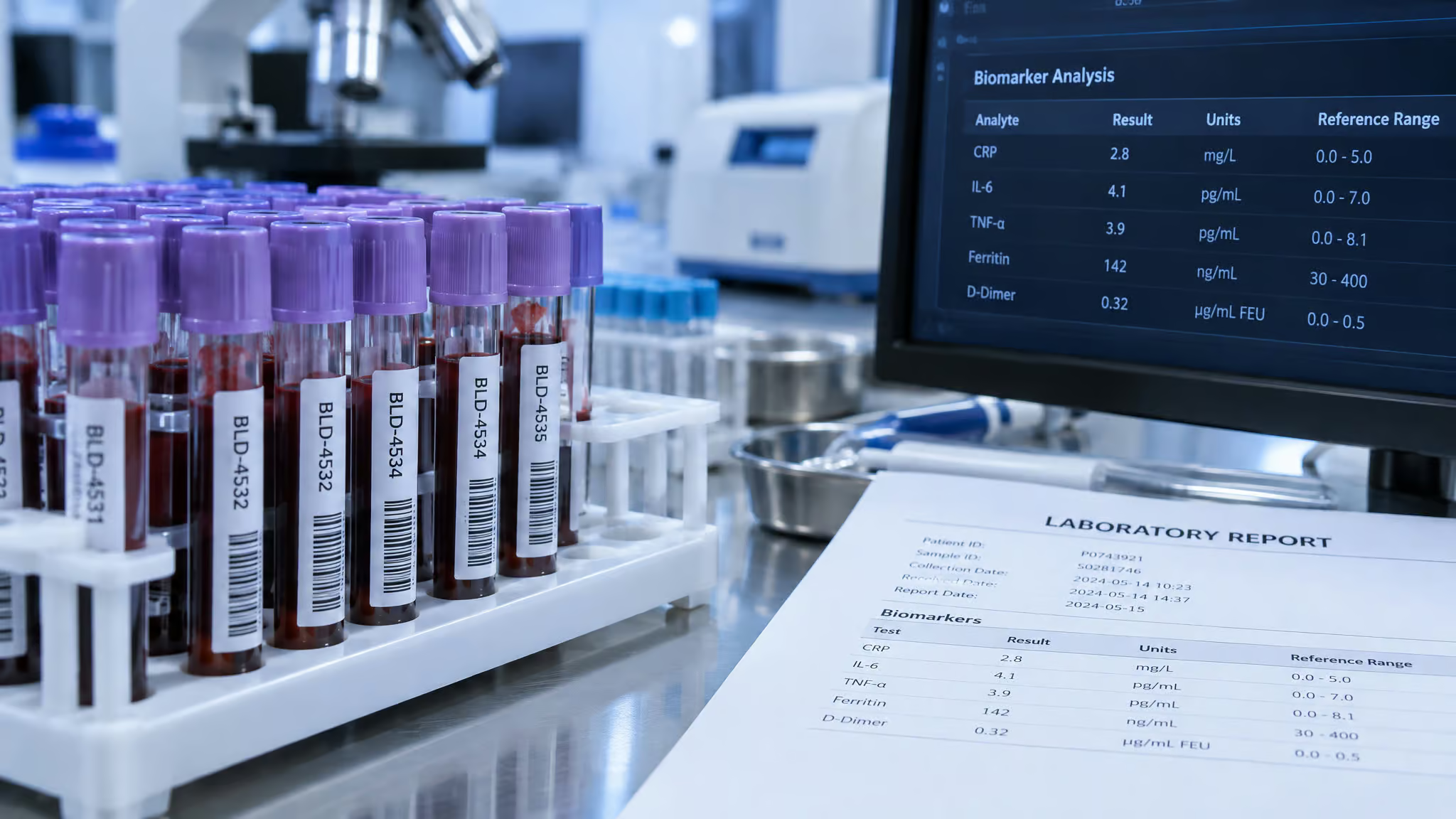
When you run both national providers through the same five ranking criteria, they tie on formulary legality, HSA/FSA eligibility, and pharmacy partnership standards. Where they diverge is how they architect clinical monitoring and pricing transparency. Marek Health takes a preventative, functional-medicine approach, building a massive diagnostic baseline before dialing in a protocol. That makes it the standout choice for full-system optimization. However, separating the $166+ monthly fee from tiered lab packages that can reach $1,700 a year makes Marek Health the most expensive option fully loaded, and way more diagnostic horsepower than you need for a basic peptide prescription.
Victory Select: Texas regional specialty catalog
Victory Select (#4, 8.0/10) operates as a Texas-based online pharmacy and telehealth provider that stands out for carrying one of the broadest rare and specialty peptide catalogs in the regional category. If you’re looking beyond the standard two or three starter compounds and live within its operating footprint, its formulary depth is tough to beat among state-level clinics.
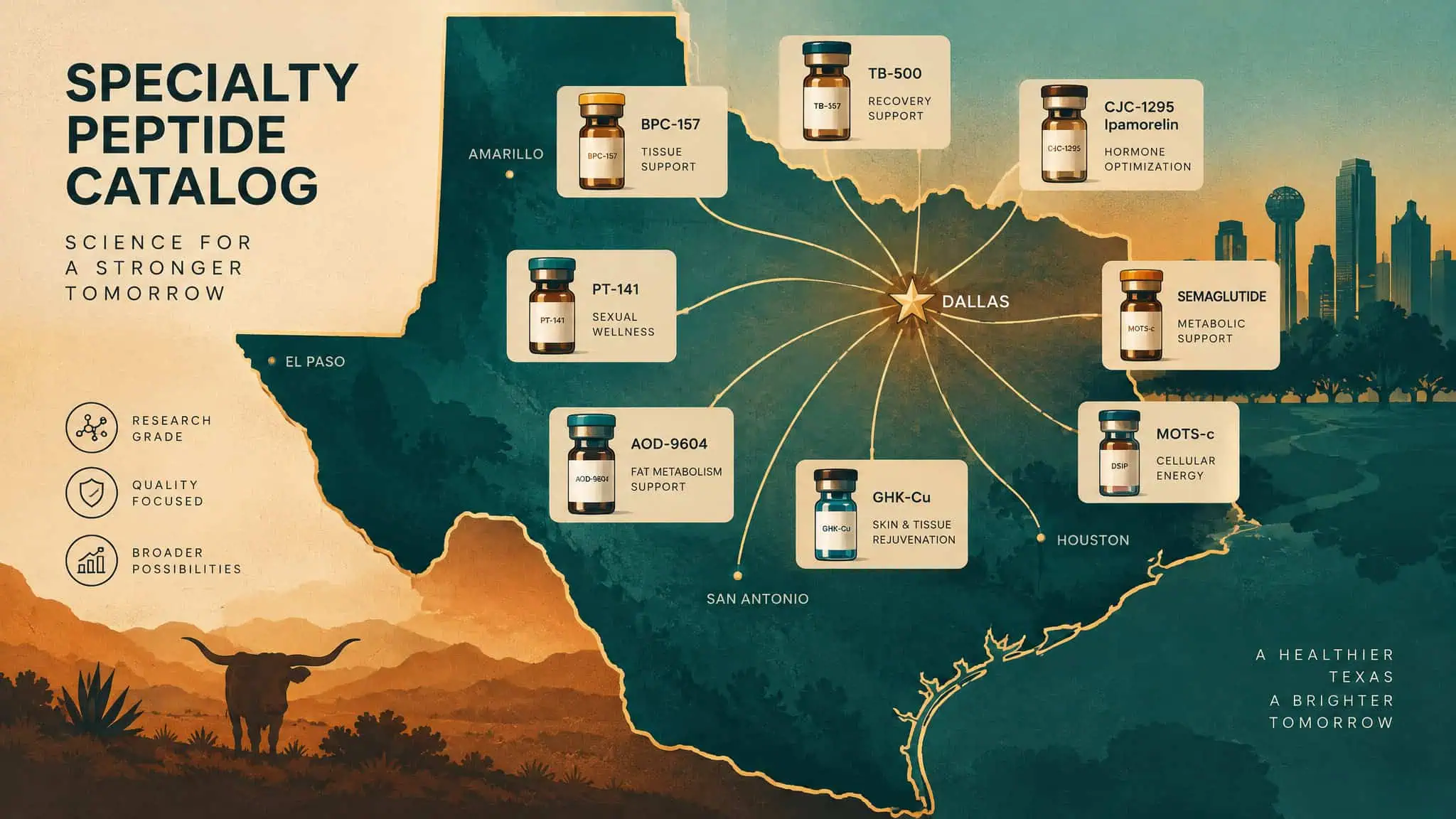
Two practical constraints keep Victory Select out of the top three. First, coverage is strictly regional rather than nationwide, so prospective patients have to verify state availability before booking an intake. Second, pricing is quote-on-consult rather than published up front on the site, which lowers its score on cost transparency compared to flat-rate or published per-product competitors. Its menu also has an unusual quirk: unlike almost every other telehealth clinic in this space, Victory Select doesn’t carry NAD+ or glutathione.
Maximus: sermorelin-only, all 50 states
Most buyers assume the best peptide company is whichever clinic flashes the longest menu of exotic compounds, but Maximus (#5, 7.9/10) earns a top-five spot across all 50 states by selling exactly one peptide: sermorelin, priced at a flat $199 per month with at-home lab kits, physician-led care, and the first month free.
In a market where bloated catalogs often signal regulatory corner-cutting, a single-compound menu is actually a discipline flex. Sermorelin is a growth hormone secretagogue with a clean legal compounding status, and Maximus wraps it in a dead-simple, bundled package. You don’t have to calculate separate lab surcharges, hunt down a local phlebotomist, or guess whether your state is supported. If you want a multi-peptide stack, look elsewhere. If you’re a sermorelin first-timer who wants nationwide access and zero surprise lab bills, this is the cleanest entry point on the board.
TRT Nation: flat-rate TRT with a thin peptide story
TRT Nation (#6, 7.6/10) charges a flat $99 per month for testosterone replacement therapy with no contract and unlimited consultations, but its peptide footprint is limited to gonadorelin prescribed strictly as hormone-axis support alongside TRT.
Putting TRT Nation on a peptide ranking highlights an important distinction between a dedicated peptide clinic and a hormone provider with a single peptide add-on. When you’re on exogenous testosterone, your body’s natural signaling loop slows down, and clinicians often pair TRT with gonadorelin to keep that pathway active. TRT Nation executes that specific protocol at a predictable, budget-friendly price with zero contract lock-in. Just don’t sign up expecting a standalone wellness peptide catalog, because gonadorelin support is the entire peptide story here.
Blue Sky MD: North Carolina hybrid care
Blue Sky MD (#7, 6.8/10) rounds out the seven-company U.S. ranking as a North Carolina bioidentical hormone and peptide clinic that runs an in-person plus telehealth hybrid model, reserving its telehealth arm for existing patients.
While national platforms like OneTwenty and Marek Health build everything around remote lab orders and digital dashboards, some patients still prefer sitting down with a local clinician before transitioning to remote check-ins. Blue Sky MD fills that niche for North Carolina residents, combining hormone optimization and legal peptide prescribing under one roof. Like Victory Select, its pricing is quote-on-consult rather than posted online, and its geographic lock means it isn’t an option for out-of-state buyers.
Which peptides can be legally prescribed right now
Only substances currently on the FDA list of bulk drug substances that may be compounded, alongside FDA-approved peptide drugs, can be legally prescribed and dispensed in 2026, which sorts every compound on a vendor’s menu into one of three regulatory buckets.
Legal now
Three core compounds can be legally compounded and prescribed today: sermorelin (a growth hormone secretagogue), PT-141 (FDA-approved for sexual health), and gonadorelin (used for hormone-axis support). You’ll also see NAD+ and glutathione on almost every clinic’s menu, and while both are legal to prescribe, neither molecule is actually a peptide.
Under FDA review
Seven peptides sat on the July 2026 review agenda: BPC-157, TB-500, KPV, MOTS-C, DSIP, Semax, and Epitalon, while GHK-Cu is slated for a second review before February 2027. None of these compounds can be legally dispensed by a compounding pharmacy until the FDA finishes formal rulemaking.
Declined and still restricted
CJC-1295 and ipamorelin were voted down by the Pharmacy Compounding Advisory Committee (PCAC) in late 2024. Both remain restricted with no active path back through this review process.
Is BPC-157 legal to buy yet?
No, BPC-157 is not yet legal to buy or compound for human use, because a favorable advisory committee vote does not legalize a substance until the FDA completes formal rulemaking, a process that can take well over a year. Vendors love to blur the line between an advisory recommendation and final federal clearance, so it helps to trace the exact regulatory changelog. In September 2023, the FDA began moving popular peptides into Category 2 of its interim 503A bulk drug substances list, creating an immediate compounding restriction. By late 2024, over a dozen peptides were restricted, including BPC-157 and TB-500.
Those restrictions triggered a 2024 to 2025 enforcement wave featuring warning letters to research-chemical vendors, an import block on tirzepatide, and gray-market shutdowns. In February 2026, HHS signaled that the FDA had been overly restrictive and was pushing patients toward the gray market. On April 22, 2026, the FDA removed twelve peptides from Category 2 for evaluation for the 503A list. The advisory committee (docket FDA-2025-N-6895) then met on July 23 to 24, 2026, to review seven peptides and voted to recommend BPC-157, KPV, TB-500, and MOTS-C for the 503A compounding list over objections from some FDA scientists.
A second advisory meeting is scheduled before February 2027 to cover remaining peptides, including GHK-Cu. Because committee votes are strictly advisory, any vendor claiming it can legally sell BPC-157 or TB-500 today is non-compliant. Waiting for rulemaking to finish saves you money and regret.
Where to buy peptides online legally
Buying peptides online legally requires going through a licensed telehealth clinic to get a clinician’s prescription filled and shipped by a Section 503A or 503B compounding pharmacy, making licensed telehealth the only compliant choice over research-chemical websites. There’s no legitimate over-the-counter peptide store in the United States. While the broader peptide market splits into three lanes (licensed telehealth with 503A/503B pharmacies, gray-market research-use-only sellers, and industrial GMP manufacturers that never sell to consumers), only the telehealth-to-compounding-pharmacy pipeline is legal for human use.
First-time buyers expecting a standard e-commerce checkout cart are often surprised when the legal onboarding flow starts with medical intake forms, a clinician review, and mandatory baseline bloodwork (like OneTwenty’s four annual panels at roughly $125 per check-in, or IGF-1 checks before starting growth hormone secretagogues) before a single vial ships. Some buyers balk at the lab requirement and wander back to gray-market sites to avoid paying for bloodwork, which is exactly where they get burned.
503A compounding pharmacies
Traditional 503A compounding pharmacies prepare medications only per a patient-specific prescription for an identified individual. They’re overseen primarily by state boards of pharmacy operating alongside federal Section 503A rules. When your telehealth doctor writes a script for sermorelin, a 503A pharmacy mixes and ships that vial with your name right on the label.
503B outsourcing facilities
Section 503B outsourcing facilities operate at a larger scale. They voluntarily register with the FDA, follow Current Good Manufacturing Practice (CGMP) standards, undergo regular FDA inspections, and are permitted to compound larger batches without patient-specific prescriptions. One crucial technical distinction to keep straight: “FDA-registered” does not mean “FDA-approved.” Compounded medications coming out of either 503A or 503B facilities are not FDA-approved drugs.
Research-use-only sellers
Any website selling peptides stamped “for research use only” with no prescription step and no named pharmacy is operating in the gray market, feeding the same unregulated supply chain behind the gray-market peptide party trend. Slapping an RUO disclaimer on a checkout page isn’t a clever legal loophole. The FDA has issued warning letters to sellers marketing RUO products for human use, including enforcement actions targeting companies selling investigational retatrutide for self-use.
What 99% purity and COA claims mean
Labels like “99% purity,” “third-party tested,” “research grade,” and “pharmaceutical grade” on peptide websites are unregulated marketing claims rather than federal classifications, and none of them equals FDA approval or licensed pharmacy dispensing.
Here’s the checkout pattern you’ll see all day on search-dominating RUO sites: you land on a product page, spot a shiny “99% purity” badge next to a downloadable Certificate of Analysis (COA) PDF, and assume the lab paperwork settles the safety question. What you don’t notice is the missing architecture: there’s no clinician intake, no prescription step, and no licensed pharmacy anywhere in the flow.
A COA only describes a single tested sample; it can’t turn an unlicensed chemical vendor into a regulated pharmacy. Even if a gray-market seller runs independent tests on every batch, selling it for human use remains illegal and unregulated. In a real lab, purity numbers require independent high-performance liquid chromatography (HPLC) and liquid chromatography-mass spectrometry (LC-MS) verification, batch-specific documentation, and full supply-chain traceability.
How to know if a peptide supplier is legit
A legitimate peptide supplier requires three verifiable elements before shipping any medication: a named licensed prescriber, a disclosed 503A or 503B compounding pharmacy, and baseline bloodwork with periodic re-checks. A company is still a major red flag even if it emails you clean lab results or batch COAs whenever any of those three clinical pillars is missing, when it lets you skip bloodwork, or when it offers restricted or investigational compounds like BPC-157, TB-500, or retatrutide for self-use.
Absence is the fastest filter you have. Because a peptide is only as good as the data behind the dose, real clinical providers tailor lab monitoring to your medical history and the specific hormone pathways that peptides affect. For example, if a clinician prescribes a growth hormone secretagogue like sermorelin, they’ll require IGF-1 baseline labs and scheduled follow-up panels to verify how your endocrine system is responding rather than letting you guess the dose in the dark.
The gray market: RUO sellers and vanishing vendors
No, research peptide websites are not safe or legal to order from for human use, because anything sold “for research use only” without a prescription step and a named pharmacy is an unregulated gray-market product carrying mislabeling, safety, and enforcement risks, and if a vendor shuts down mid-supply, you have zero clinical or pharmacy recourse while in-transit orders and stored vials are left completely unsupported.
What “research use only” actually means
Following the 2024 to 2025 wave of FDA warning letters, the tirzepatide import block, and gray-market shutdowns, sudden vendor disappearance has become a structural hazard of buying outside the prescription pathway.
The Soma Chems closure and supplier-continuity risk
On October 14, 2026, Murfreesboro, Tennessee-based RUO vendor Soma Chems announced its closure, forcing customers to scramble and redistribute among remaining suppliers. In response, another Murfreesboro RUO supplier, Nova Life Peptides (founded in 2025 by Kenneth Sabraw), positioned itself around third-party HPLC purity testing, mass-spectrometry identity verification, batch-specific COAs, and U.S.-based fulfillment consistency. While researchers increasingly weigh supplier continuity and traceability alongside testing, cleaner lab paperwork still doesn’t make an RUO supplier a legal human pharmacy.
The GLP-1 compounding case study
If you want to see how quickly compounding rules can shift under your feet, look at the compounded GLP-1 market for semaglutide and tirzepatide. Normally, compounding pharmacies aren’t allowed to crank out essential copies of commercially available, FDA-approved drugs. However, while branded Wegovy and Zepbound sat on the official FDA drug shortage list, federal rules opened a temporary pathway permitting pharmacies to prepare compounded versions to meet patient demand.
Once the FDA declared those official shortages resolved, that broad shortage-based compounding pathway narrowed significantly, though not every compounded GLP-1 prescription became illegal. The takeaway for peptide buyers is that compounding legality is conditional, not permanent. Compounded GLP-1s are never FDA-approved drugs, and the FDA has issued warning letters to telehealth companies over misleading GLP-1 marketing. It’s the exact same playbook some peptide vendors use today: pointing at yesterday’s temporary rules or an incomplete committee vote to make their catalog look broader than the law actually permits.
The GMP manufacturers behind every vial
Real GMP contract manufacturers never appear on consumer “best peptide company” lists because they synthesize bulk active pharmaceutical ingredients (APIs) for pharma companies and clinical labs rather than selling retail vials to individuals. A 2025 Vocal Media survey of 40+ synthesis companies ranked 13 operators on quality, regulatory status, technical capability, and reliability after cutting black-box vendors. At the top of that industrial tier sit Bachem (founded 1971, 5-star “Industry Gold Standard,” 20+ FDA-approved peptide APIs, 8,000L solution-phase reactors, USFDA/Swissmedic compliance, five-year batch archival), CPC Scientific (founded 2001 in Rocklin, CA, ISO 9001/13485 certified, five passed FDA inspections, 20 to 25 kg batches, launching a new U.S. facility in 2026), and PolyPeptide Group (six GMP facilities across five countries, 20+ approved compounds).
Other major synthesizers include AmbioPharm, AnaSpec, BioSynth, GenScript (95%+ synthesis success via PepPower SPPS/LPPS/microwave), Thermo Fisher Scientific, AAPPTec, Phoenix Pharmaceuticals, and the KANEKA Eurogentec network. The survey also separates out research bridges and retail-facing names like BioLongevity Labs (founded 2024, triple-lab testing via CLIA-certified SafeCert Labs), Peptide Sciences (founded 2011, online COAs, 2.5 to 4 star reviews), and Direct Peptides (2.5 stars, no FDA/GMP credentials).
How to start with a legitimate peptide provider
To start legal peptide therapy safely, pick a licensed telehealth clinic from the ranked list whose pricing structure matches your testing needs, such as OneTwenty for quarterly bloodwork, Celia RX for per-product scripts, or Maximus for flat-rate sermorelin, and consolidate any TRT and wellness peptide prescriptions under that single provider to avoid fragmented care and dangerous prescribing conflicts. Before paying any clinic, verify three non-negotiable details on the page: a named licensed prescriber, a disclosed 503A or 503B compounding pharmacy, and required baseline bloodwork.
Frequently Asked Questions
How to know if a peptide supplier is legit?
You can verify a compliant clinic by checking for three mandatory pillars before a vial ever leaves the building: a named, licensed physician writing the prescription, fulfillment through a disclosed Section 503A or 503B compounding pharmacy, and required baseline bloodwork with ongoing re-checks. If a website lets you bypass lab panels, hides its pharmacy partner, or lets you add restricted substances like BPC-157, TB-500, or retatrutide straight to a shopping cart, it is an unregulated gray-market operation. Even a clean Certificate of Analysis email cannot substitute for a real doctor-patient workflow.
What are the top 5 peptide companies?
For legal U.S. patient care, the five highest-rated telehealth providers are OneTwenty (9.5/10), Celia RX (9.1/10), Marek Health (8.7/10), Victory Select (8.0/10), and Maximus (7.9/10). OneTwenty leads with a $499/year membership ($749/year in NY and NJ) that bundles four quarterly blood panels while billing medications separately, whereas Celia RX skips membership fees to charge $179 to $899 per compounded prescription plus a $55 consult. Marek Health targets deep diagnostic optimization across 60+ biomarkers ($166+/month plus $450 to $1,700/year for labs), Victory Select serves the Texas region with a specialty catalog via quote-on-consult, and Maximus offers a flat $199/month sermorelin-only program across all 50 states.
