Peptides have become one of the most explosive, fiercely debated trends across wellness clinics, fitness TikTok, athletic recovery circles, and sports medicine forums. In gym bags and biohacking stacks, BPC-157 gets treated like a cheat code for tendon repair, joint pain, gut healing, and stubborn inflammation. Pull up the spec sheet on its potential side effects, though, and you hit a bizarre engineering gap: almost everything we think we know about what this molecule does to a human body comes from self-reported forum logs and rodent studies, because the human clinical trial record is practically empty.
When we dig into overhyped tech at GeekExtreme, the first move is separating marketing benchmarks from validated architecture. With BPC-157, that means drawing a hard line between what’s known and what’s completely unmeasured. Every side-effect list circulating online rests on unmonitored anecdotes and animal models. More importantly, surviving a few weeks of injections without a rash is a measure of short-term tolerance, while long-term biological safety is a completely different question.
Key Takeaways
BPC-157 has zero well-done randomized controlled human trials proving efficacy and only a single phase 1 trial in healthy volunteers showing no severe short-term adverse effects, leaving long-term human safety completely unmeasured.
Self-reported side effects include fatigue, brain fog, dizziness, sleep disruption, mild nausea, injection-site irritation, and paradoxically worse injury pain, alongside theoretical long-term risks from chronically stimulating angiogenesis and vascular endothelial growth factor (VEGF).
Over 80% of BPC-157 analyzed in a research review came from non-pharmaceutical-grade sources, and gray-market vials sold “for research purposes only” frequently carry bacterial lipopolysaccharide (LPS) contamination or degraded fragments.
Table of Contents
What BPC-157 is and where the research started
BPC-157 is a synthetic 15-amino-acid pentadecapeptide copied from a segment of body protection compound, a protein found naturally in human gastric juice that shields the intestinal lining from stomach acid, and people take it hoping to replicate the rapid tendon, gut, and nerve repair seen in animal models. The “157” simply marks the fragment’s sequence position inside that parent protein. What users swallow in capsules or draw into a syringe is a lab-synthesized mimic rather than a native extract from gastric juice.
Research kicked off in Croatia in the early 1990s, initially targeting inflammatory bowel disease and ulcer care, according to clinician channels Talking With Docs and Dr. Ariia Mismer via Rupa Health. Practitioner Regan Archibald notes that every studied cell type carried BPC receptors, and early experiments expanded into colitis, neuroregeneration, and rabbit Achilles tendon repair.
In the broader landscape of how peptides work as short protein chains ranging from 2 to 100 amino acids, roughly 7,000 to 8,000 peptides are known, spanning medical staples like insulin, glucagon, and vasopressin alongside consumer collagen peptides. Because BPC-157 originates as a local stomach-lining protector, every claim about athletic or tendon recovery is an extrapolation far outside its native biological context.
Why people take it: the animal evidence and the healing mechanism
People take BPC-157 because rodent studies show it accelerating the repair of tendons, ligaments, muscle, gut ulcers, and nerves by driving new blood vessel growth and fibroblast activation. Because blood flow (perfusion) limits healing across tissues, one vascular mechanism could explain its broad lab activity, though these rodent results have never been systematically replicated in larger animals or translated to humans.

What the rodent studies show
In the flagship rat gastrocnemius muscle crush injury model, untreated rats suffered severe atrophy, muscle cell loss, and pronounced swelling, while BPC-157-treated rats showed less swelling, well-regenerated muscle cells, and zero scarring. Treated rabbit Achilles tendons even regenerated potentially stronger than the original tissue.
In rats, BPC-157 also reversed the tissue-healing impairment caused by corticosteroid injections (surgeons avoid steroids within 2 to 3 weeks before surgery for that exact reason, and Archibald claims the peptide mitigates joint damage from steroid overuse). Other preclinical rat findings span neuroprotection in traumatic brain injury and spinal cord models, combating chronic-disease muscle atrophy, ethanol antagonism for potential alcoholism and liver-damage protocols (sometimes discussed in 6-weeks-on, 4-weeks-off cycles), vasodilation for erectile dysfunction, and serotonin-dopamine modulation.
How it’s supposed to work: VEGF and angiogenesis
BPC-157 upregulates vascular endothelial growth factor (VEGF) and fibroblast growth factor while modulating the extracellular signal-regulated kinase (ERK1/2) pathway and nitric oxide signaling, including endothelial nitric oxide synthase (eNOS) activation. Pairing VEGF upregulation with angiogenesis (the growth of new blood vessels), the peptide is described as orchestrating a four-step vascular healing cascade: vasoconstriction resolution, platelet plug, fibrin mesh, and clot resolution.
The human evidence accounting: what one phase 1 trial does and doesn’t tell you
Zero well-done randomized controlled human trials demonstrate that BPC-157 works, a consensus fact agreed upon by both skeptic clinicians and peptide-prescribing practitioners at the top of the evidence hierarchy. The only human safety data comes from a single phase 1 trial in healthy volunteers under physician control that found no severe short-term adverse effects, leaving zero long-term safety data. For efficacy, only a small retrospective knee study of 16 participants exists (12 received knee injections and 11 of 12 reported significant pain reduction, sometimes loosely retold as roughly 12 arthritic patients versus saline with about 7 improved), which is heavily confounded because sprains and tendons heal naturally over time.
Two registered clinical trials for oral BPC-157 in inflammatory bowel disease remain incomplete with no reported data, and the U.S. Anti-Doping Agency (USADA) notes many studies were cancelled or stopped without conclusions. Skeptics point out that nobody has ever aspirated injured human tissue to check if BPC-157 appears naturally at healing sites, or asked why the body wouldn’t already route it to tendons if it could. Meanwhile, some clinicians speculate that human trials are slow to materialize because BPC-157 may not be patentable, which cuts the financial incentive for pharmaceutical companies to fund large clinical trials.
Reported BPC-157 side effects: what people experience
The potential side effects of BPC-157 are a mix of systemic neurological complaints, mild digestive reactions, local injection-site irritation, and occasional pain flares, all distinguished by the fact that they rest on self-reported symptoms and clinical anecdotes with zero long-term human safety data. In typical unsupervised use, someone injecting daily for a tendon injury might notice lightheadedness, disrupted sleep, or an energy dip within the first weeks, but without a monitored reference safety profile, it’s impossible to know whether the peptide, a stacked compound, or the injury itself is the culprit.
The named symptom catalog
Users most commonly report fatigue, brain fog, dizziness, anxiety changes, and sleep disruption. Mild, uncommon, and transient reactions include nausea, diarrhea, appetite or digestion shifts, and local rash or irritation where the needle goes in. Dr. Ariia Mismer notes that nausea, diarrhea, and dizziness do crop up, adding that proper dosing lessens their impact.
Paradoxical pain worsening: when the healing signal backfires
Yes, BPC-157 can paradoxically make pain at the injured area worse instead of better when the peptide disrupts the timing of the body’s repair signals or sensitizes local nerves. Because the compound works through active inflammation modulation, and acute inflammation is a mandatory phase of tissue repair, stepping on that signal at the wrong time or in the wrong tissue can stall healing. The peptide may also temporarily sensitize local nerve endings, dialing up pain signals, and in one practitioner’s clinical report, a client with complex chronic inflammatory and immune conditions flared temporarily on the protocol.
Theoretical long-term risks: growth pathways, cancer, and metabolism
Whether BPC-157 increases cancer risk is unproven in either direction, because while no definitive evidence shows it causes cancer, any compound that accelerates cell proliferation and drives angiogenesis could theoretically promote carcinogenesis or feed an undiagnosed tumor. Tumors rely on the exact same VEGF upregulation and blood-vessel-building hardware that healing tendons use. If you broadcast a systemic signal to build new capillaries and speed up fibroblast migration, that signal doesn’t check whether the target tissue is a torn rotator cuff or an occult malignancy.

Yes, BPC-157 can also theoretically affect the heart, cardiovascular system, and metabolism if chronic manipulation of growth pathways like VEGF, ERK1/2, and nitric oxide/eNOS signaling triggers downstream complications, though Dr. Jeffrey Peng notes that human risks, including cardiovascular issues or metabolic dysfunction like insulin resistance, remain completely unestablished. Medicine has a long history of peptides and hormones that alter endocrine and growth signaling feeling great in the short term while serious consequences take years to surface. Short-term symptom relief never equals long-term safety.
Kidneys, heart, daily use, and stacking: answering the unknowns precisely
If you’re searching for organ-toxicity answers or protocol rules for men and women, hold on to one distinction: “untested” and “safe” are not the same answer, no matter how confident the forum post sounds. Animal experiments used controlled oral or local-injection doses, whereas real-world users routinely inject systemically for months at a time.
Is BPC-157 hard on kidneys or the heart?
Whether BPC-157 is hard on the kidneys or the heart in men or women is unknown because no human studies have tested organ-specific toxicity or established safety in either direction. Claims that it protects or damages human organs are pure extrapolation from rodent cages.
Can you take BPC-157 every day for months?
No safe human dose or chronic daily schedule has ever been established for BPC-157, meaning months-long daily protocols operate entirely in the dark. USADA states plainly that nobody knows if there is a safe dose or any safe way to use it for a specific condition, and the lone phase 1 human trial only observed short-term tolerance in healthy volunteers.
What should you not mix with BPC-157?
Anyone taking prescription medications, supplements, or other peptides should avoid assuming compatibility with BPC-157 because no human drug-interaction data exists. Preclinical rat data showed the peptide counteracted corticosteroid healing impairment, and while biohackers routinely pair BPC-157 with TB-500 in peptide stacking protocols, that combination has never been evaluated for human interactions.
The gray market: when the side effect is the vial, not the peptide
Buying BPC-157 from gray-market research chemical sellers is an unregulated supply-chain gamble that exposes users to unverified dosing, non-sterile manufacturing, and bacterial endotoxin contamination because vendors use a legal labeling loophole to bypass pharmaceutical purity and efficacy laws. When someone has a bad reaction after an injection, the culprit is often the mystery hardware in the vial rather than the 15-amino-acid sequence itself.
How the ‘research purposes only’ loophole works
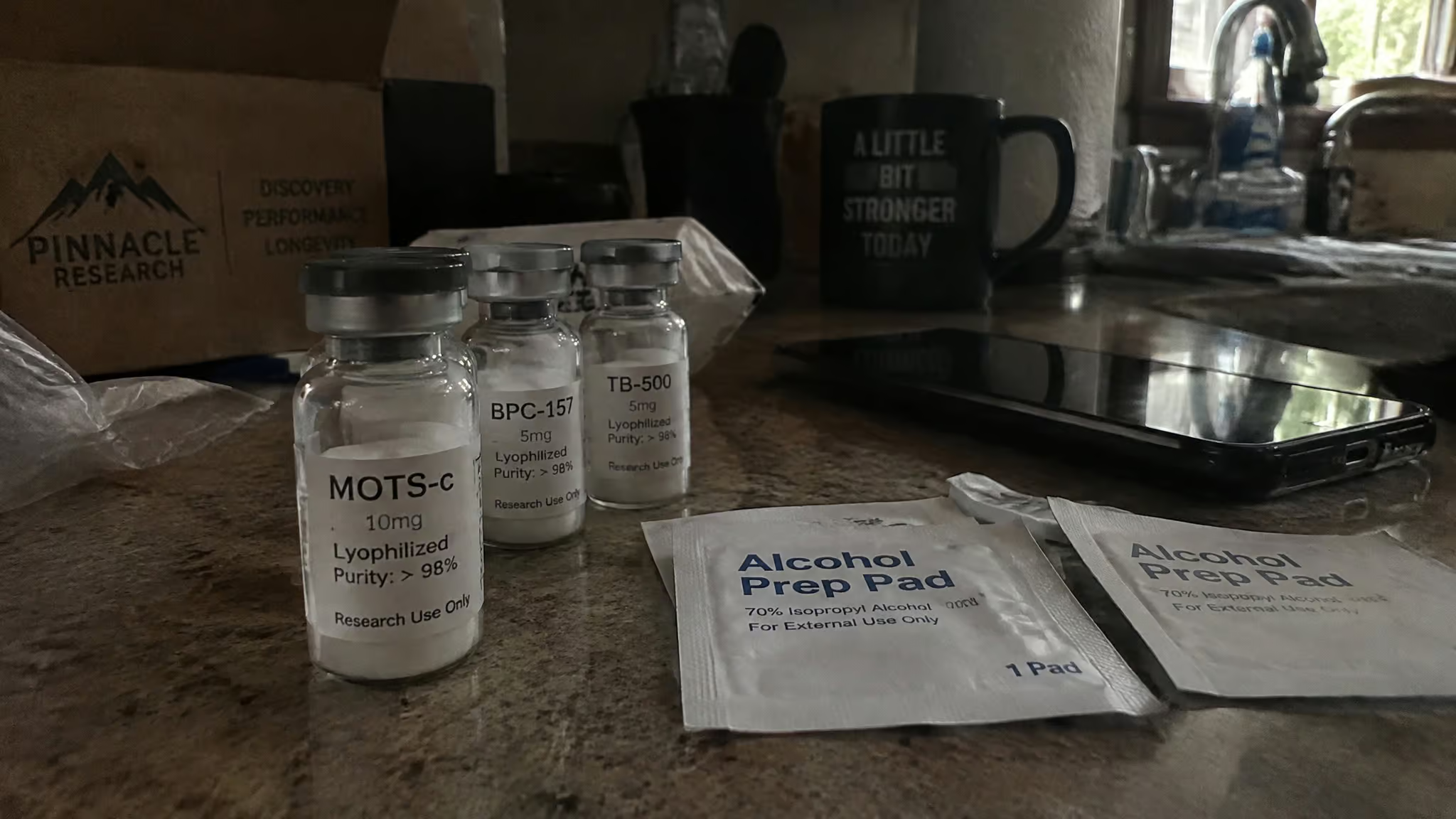
Selling BPC-157 for clinical human use is illegal. To sidestep federal oversight, online gray-market vendors slap a “for research purposes only” sticker on the bottle and require buyers at checkout to sign a waiver claiming to be a research facility. It’s the biohacking equivalent of clicking “I have read the terms and conditions” before flashing sketchy third-party firmware onto your router, except here the checkbox shifts all legal and medical liability onto the buyer. Because no regulation forces these sellers to verify purity or efficacy, they can claim whatever they want.
Even in the mainstream supplement aisle, countless studies warn that manufacturers routinely fail basic quality standards and mislabel ingredients despite printing “professional grade” or “third-party tested” on the label. In the peptide gray market, a review by Regan Archibald’s team found that over 80% of the BPC-157 used in reviewed research itself came from non-pharmaceutical-grade sources.
What’s actually in an unregulated vial
Unregulated vials vary wildly in purity, sterility, degradation, and dosing accuracy. Some bottles contain unknown quantities, zero active peptide, or degraded “BPC-157 frags” marketed as the full chain. Worse, black-market batches often aren’t cleaned of lipopolysaccharide (LPS), bacterial cell-wall debris left over from synthesis that triggers a massive immune and inflammatory response in humans.
Picture the archetypal gray-market buyer: a 24-year-old lifter with a nagging rotator cuff injury who just wants to get shredded, reconstituting lyophilized mystery powder on a kitchen counter and injecting it locally into a shoulder (or systemically into belly fat) every morning. Whether that bottle came from a bookmark on a forum or circulated at one of the social peptide parties popping up in biohacking circles, any mistake in concentration or LPS contamination will masquerade as a BPC-157 side effect.
| Risk & Evidence Factor | Studied Animal & Phase 1 Context | Real-World Gray-Market & Stacking Use |
|---|---|---|
| Verified pharmaceutical purity | Partial (over 80% of reviewed research used non-pharmaceutical-grade sources) | No (unregulated “research purposes only” vials, unknown amounts, or degraded fragments) |
| Sterility & LPS endotoxin removal | Yes (physician-controlled phase 1 setting) | No (black-market batches often uncleaned of LPS, risking immune/inflammatory flares) |
| Established safe human dose | No (0 human RCTs; USADA notes no safe dose is known) | No (users self-reconstitute and inject locally or systemically daily for months) |
| Long-term human safety data | No (1 phase 1 trial measured short-term tolerance only) | No (unmonitored self-experimentation) |
Neither BPC-157 nor TB-500 has better human safety data when users stack them together, because both peptides share the exact same evidence gap of promising animal studies and zero well-done human RCTs. Combining two unverified compounds from unregulated vials for months at a time simply multiplies the unknown variables.
Regulatory status: the 2023 flag, the 2026 reversal, and why “legal” doesn’t mean “tested”
BPC-157 is not approved for human use by the FDA or Health Canada, is banned at all times for competitive athletes, and cannot be legally sold as a drug, food, or dietary supplement, even though a contested July 2026 advisory vote moved to reopen compounding pharmacy access without a single new clinical trial. A shift in regulatory policy isn’t a scientific milestone.
FDA, Health Canada, WADA, and USADA positions
Both the FDA and Health Canada reject BPC-157 for human use, with the FDA citing safety, efficacy, and the lack of long-term human trials. For tested athletes, the World Anti-Doping Agency (WADA) ban classifies BPC-157 as a prohibited performance substance where a positive test disqualifies competitors across training periods as well as events, paired with the USADA no safe dose warning and confirmation that bone and joint healing claims remain unproven.
The contested 2026 compounding vote
In 2023, citing the lack of human safety data, the FDA formally flagged BPC-157 and several other peptides as high risk, effectively blocking compounding pharmacies from producing them. According to a single unverified report, Health and Human Services (HHS) Secretary Robert F. Kennedy Jr., acting under the Make America Healthy Again banner, announced the removal of those peptides from the high-risk list in early 2026, and in July 2026 the FDA Pharmacy Compounding Advisory Committee passed an 8-6-1 vote (8 in favor, 6 against, 1 abstention) to green-light six peptides, including BPC-157, TB-500, and KPV, for compounding pharmacies, despite reported panelist ties to the compounding and peptide industry. Chief pharmacy officer David Pope voted yes, arguing it was time to return the decision to the patient, physician, and pharmacist, while Institute for Safe Medication Practices (ISMP) president Rita Jew called the vote alarming because so few injected substances have such lacking clinical evidence.
Why doctors disagree: two verdicts on BPC-157 safety
Doctors give contradictory advice on BPC-157 because they’re looking at the exact same empty human trial record, zero RCTs, no long-term safety data, serious gray-market contamination risks, and filtering it through different risk tolerances and sourcing rules. Both sides agree on the facts; they split on what to do with the unknowns.
The skeptic verdict: the risk-benefit ratio favors risk
Physician-skeptic Dr. Jeffrey Peng doesn’t recommend BPC-157, concluding that with known theoretical risks and zero proven human benefit, the risk-benefit ratio favors risk. While he remains eager to see future clinical studies, his bottom line is that injecting an unproven signaling molecule carries unnecessary hazard when safer treatments exist.
The supervised-practice verdict: well tolerated under physician control
Practitioner Regan Archibald reports that BPC-157 is generally well tolerated with minimal adverse effects when sourced strictly from licensed 503A or 503B compounding pharmacies and administered under physician supervision, pointing to the healthy-volunteer phase 1 trial and basic sterile mitigation like alcohol wipes on the vial top and skin plus proper injection technique. In the only side-effect case Archibald reported seeing, a client with chronic inflammatory response syndrome (CIRS), Lyme disease, and multiple chemical sensitivities experienced a temporary CIRS flare on BPC-157, was pulled off the peptide and stabilized with Thymosin Alpha-1 plus exosomes and stem cell treatments, and then retried BPC-157 30 days later with improved digestion, weight gain, resolved dizziness, and strength recovery. That case underscores how strongly a patient’s underlying immune context can dictate how they react.
Anecdotes aren’t safety data, and what to do instead
Using BPC-157 is unmonitored self-experimentation rather than casual supplementation, so anyone unwilling to accept unmeasured long-term biological risk should skip the vial. While a lack of FDA approval doesn’t automatically make a molecule dangerous or useless, zero well-done human RCTs and a single short-term phase 1 safety trial mean that every user is acting as their own test subject.
BPC-157’s popularity blew up over the last 5 to 6 years as part of a broader 5-to-10-year peptide boom driven by social media, wellness centers, and biohacking culture, letting consumer hype outrun clinical science. When friends at the tennis club or country club swear by life-changing before-and-after healing, it helps to remember the math on anecdotal benefit: the clinical placebo effect sits at roughly 30% (and gets jokingly estimated at 50%+ on social media). Compelling personal stories easily manufacture perceived healing that controlled trials don’t back up.
That exact same unmonitored anecdote engine also generates the internet’s loudest safety reassurance (I ran two vials and had zero side effects). Without baseline bloodwork or long-term follow-up, feeling fine for a month tells you nothing about silent vascular or metabolic shifts. As physician William Osler observed, in medicine there are always two cures: one for the disease and one for the treatment of the disease.
Unlike over-the-counter staples such as magnesium or vitamin D, or familiar small-molecule drugs like aspirin, BPC-157 is a potent bioactive peptide that actively manipulates cellular signaling pathways. Using it to shortcut rehab or push through an injury that shouldn’t be loaded is a major clinical red flag.
For tendon, ligament, and soft-tissue injuries, proven recovery protocols beat an untested signaling peptide because they carry established safety profiles and measurable outcomes:
- Medical evaluation and physiotherapy: Seeing a healthcare provider for an accurate diagnosis, followed by targeted physiotherapy and progressive loading that mechanically remodels tendon fibers.
- Acute management: Structured rest, bracing when appropriate, and standard anti-inflammatories managed around the healing window.
- Evidence-backed biologics: Platelet-rich plasma (PRP), which carries growing clinical evidence for soft-tissue repair without the gray-market purity gamble.
- The foundational biological stack: Dialed-in nutrition, targeted collagen synthesis support, deep sleep, and the one variable biohackers hate most: time.
Frequently Asked Questions
Does BPC-157 increase cancer risk?
No human study proves that BPC-157 causes cancer, nor does any data clear it of that risk. The theoretical concern comes down to basic hardware: the peptide stimulates vascular endothelial growth factor (VEGF) and drives angiogenesis to build new blood vessels. Because undiagnosed tumors hijack those exact same vascular and cell-proliferation pathways to grow, broadcasting a systemic blood-vessel-building signal carries an unmeasured oncogenic question mark.
Is BPC-157 hard on kidneys?
Whether the peptide stresses or protects human kidneys in men or women is a total blind spot. Zero human trials have evaluated organ-specific toxicity for BPC-157, meaning any sweeping claims about kidney safety or damage are pulled purely from animal models rather than human bloodwork.
What should you not mix with BPC-157?
You shouldn’t assume BPC-157 plays nicely with any prescription drug, supplement, or other peptide, because human drug-interaction studies simply don’t exist. While rat models showed it counteracting the healing impairment of corticosteroid injections, popular real-world biohacking stacks—like combining BPC-157 with TB-500—have never been clinically tested for human safety.
What are the risks of buying BPC-157 from gray market research chemical sellers?
Online vendors dodge pharmaceutical oversight by slapping a “for research purposes only” sticker on the bottle and making buyers click a checkout waiver, leaving you with zero purity or sterility guarantees. Over 80% of BPC-157 analyzed in a research review by Regan Archibald’s team came from non-pharmaceutical-grade sources, and unregulated vials frequently contain mystery dosing, degraded peptide fragments, or bacterial lipopolysaccharide (LPS) endotoxins that trigger severe inflammatory flares.
Why do some doctors say BPC-157 is safe while others warn against it?
Clinicians are looking at the exact same empty human trial record—zero randomized controlled trials and no long-term safety tracking—and filtering it through different risk tolerances. Skeptics like Dr. Jeffrey Peng argue that injecting an unproven signaling molecule with theoretical growth-pathway hazards skews the risk-benefit ratio toward unnecessary risk, while practitioners like Regan Archibald report that the peptide is generally well tolerated when strictly sourced from licensed 503A or 503B compounding pharmacies and monitored by a physician.
