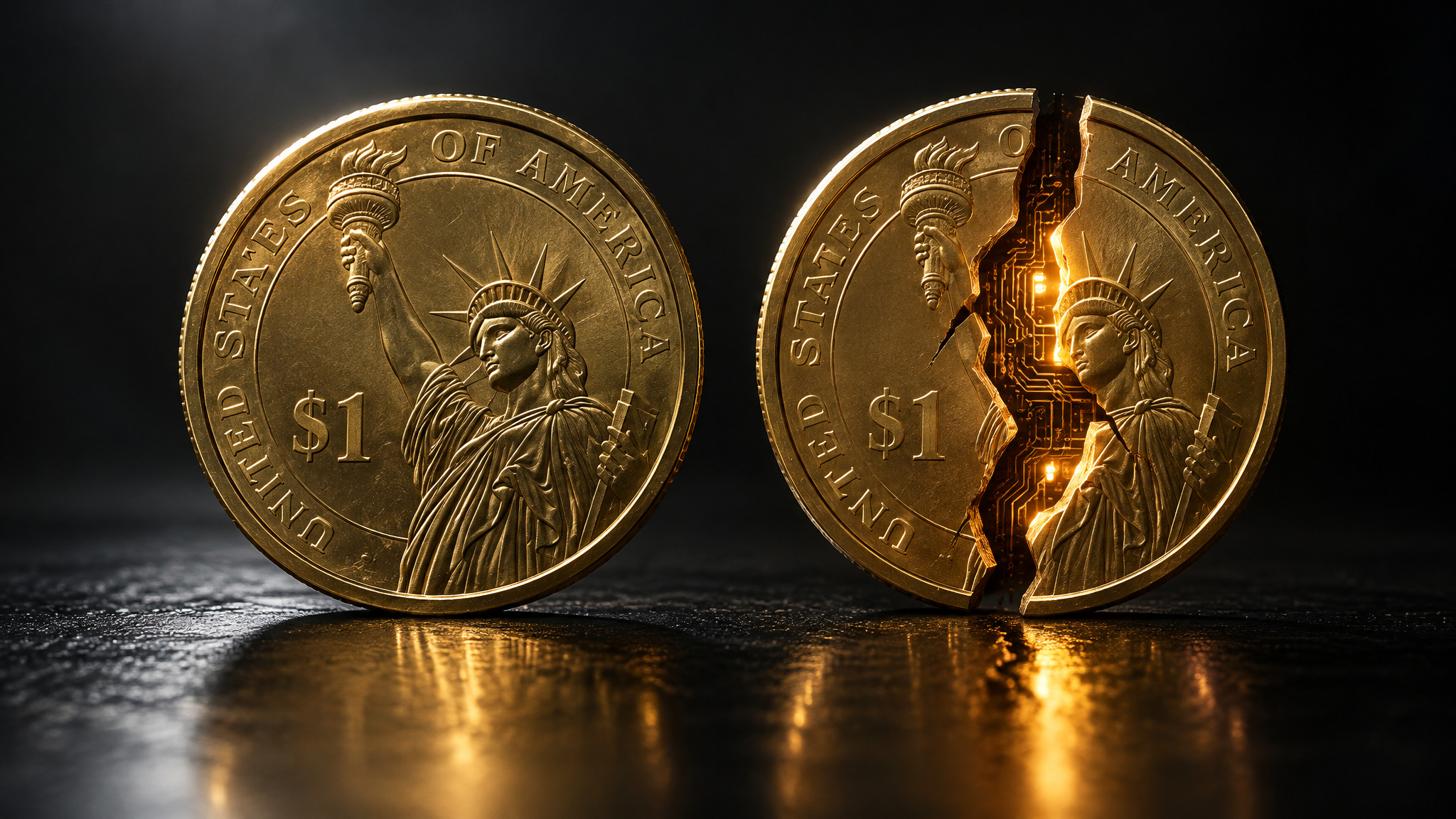
Two tokens, both worth exactly $1.00, both called stablecoins, both sitting in every exchange wallet on the planet. I went into this comparison expecting to write two paragraphs and a shrug. What I found instead was two different architectures of digital money wearing the same price tag, and a 2026 stat that most coverage still hasn’t caught up to. USDT vs USDC is a fork in how dollar money gets built, and with the two of them holding over 90% of the stablecoin market, this head-to-head amounts to the market casting its own vote on what digital dollars look like.
The interesting parts: USDC quietly out-transacted USDT this year, and neither issuer publishes an actual audit, despite headlines that misread attestations as audits. According to usdtcasinos.io, stablecoins have accounted for roughly 70% of all blockchain-based gambling since 2022, with USDT making up the bulk of that flow. Let’s open it up.
Key Takeaways
USDC out-transacted USDT in 2026 year to date ($2.55 trillion vs $1.49 trillion as of March 25, 2026), even though USDT kept the larger market cap ($184B vs $79B). Market cap measures stored money; transaction volume measures moving money.
Neither issuer publishes a full independent audit. USDC’s real advantage is disclosure cadence (monthly Deloitte attestations plus weekly ones) and regulatory visibility, not audited proof. “Monthly audits” is a common misread.
The right pick depends on where you are and what you’re doing: USDT for trading liquidity and emerging markets, USDC for US/EU users, DeFi, and compliance priority.
Table of Contents
USDT vs USDC at a glance
USDT and USDC are both stablecoins pegged 1:1 to the US dollar. Every meaningful difference between them lives underneath that shared price: who issues them, what backs them, how regulators treat them, and where the liquidity sits. A stablecoin, for the uninitiated, is a token engineered to hold stable value, pegged 1:1 to the dollar and backed by centralized assets. It’s the bridge between crypto and fiat. Boring is the feature, and honestly that’s the fun part for this audience.
Everything else in crypto swings wildly; this layer holds still so the rest of the machine can run. You give up decentralization to get a number that stays put, which is an interesting tradeoff if you let it be.
Here’s the whole comparison in one table. All figures are as of March 25, 2026 (sourced from CoinGecko, Circle, Tether, and Visa):
| USDT (Tether) | USDC (USD Coin) | |
|---|---|---|
| Issuer | Tether Limited | Circle (with Coinbase) |
| Launch year | 2014 (first stablecoin) | 2018 |
| Peg | Yes, 1:1 to USD | Yes, 1:1 to USD |
| Market cap | $184B | $79B |
| Market share | ~62-65% | ~25% |
| Reserve backing | Partial (roughly 75% cash and short-term Treasuries, plus Bitcoin, gold, secured loans) | Yes (cash and short-term Treasuries held in a fund managed by BlackRock under regulation) |
| Disclosure cadence | Partial (quarterly BDO Italia attestations only) | Partial (monthly Deloitte attestations plus weekly; attestations, not audits) |
| Chains | 13+ including Ethereum, Tron, Solana, Polygon, Avalanche | Ethereum (ERC-20) |
| 2026 YTD transaction volume | $1.49T | $2.55T |
That last row is the one to watch. Seven core differences, one table, one date stamp. Now the layers underneath.
Who issues USDT and USDC: offshore vs onshore
USDC is USD Coin, launched in 2018 by Circle and Coinbase as the compliance-first alternative to the incumbent. Circle went public on the NYSE in 2025, pricing its IPO at $31 per share, above the expected $27, $28 range. The stock nearly tripled on debut, valuing the company at $60 billion. That makes Circle the only publicly investable issuer of the two, public companies answer to markets and regulators in ways private ones don’t.

USDT came first. Tether Limited launched it in 2014, making it the first stablecoin, which predates most of today’s crypto ecosystem. Tether is headquartered offshore, in the British Virgin Islands and later El Salvador. It remains the largest stablecoin by market cap and liquidity. USDT is the primary currency for buying Bitcoin on exchanges. It’s the ecosystem’s default setting.
This is the fork everything else traces back to. Offshore private company versus onshore public one.
Reserves and transparency: attestations vs audits
Tether’s reserves are holding roughly three-quarters in cash and short-term US Treasuries, including nearly $100 billion in T-bills, with the rest of the basket in Bitcoin, gold and precious metals, and secured loans. The cash-and-Treasuries core is the boring-safe part. The remainder is where it gets interesting, because Bitcoin, gold, and secured loans are assets whose value can move, which matters when the whole point of the token is to not move.
USDC’s mirror is cleaner by design, and it comes down to three plain facts: reserves held in cash and short-term US Treasuries, a BlackRock-managed fund operating under regulation, and the dollar assets parked in regulated bank accounts. Together they explain why institutions are comfortable here.
An attestation certifies reserves only as of a single snapshot date. A full audit instead verifies solvency on a continuous basis. They are different assurance levels, and neither issuer currently publishes a full independent audit.
USDC publishes monthly attestations from Deloitte plus weekly attestations on top. Tether publishes only quarterly attestations, from BDO Italia. So USDC’s advantage is cadence and regulatory visibility, not audited proof. A common reader mistake is treating any reserve report as an audit; the tell is headlines saying “monthly audits” when the underlying documents are attestations.
Red flag: Headlines saying “monthly audits” describe attestations, not audits. Neither issuer currently publishes a full independent audit — check the document type, not the headline.
The live thread: on March 24, 2026, Tether said it engaged a major accounting firm for a full audit, without naming the firm, framed as helping meet US and EU stablecoin requirements. An audit engagement announced with no auditor named is worth watching with a raised eyebrow. It’s an open development, not a completed audit.
Regulation: the CFTC fine, MiCA, and the Genius Act
As of 2026, Tether remains restricted under MiCA in the EU (since 2025), historically operated offshore, settled a $41 million CFTC action in 2021, and now has a US compliance pathway via the Genius Act. The documented enforcement record: the Commodity Futures Trading Commission (not the SEC) fined Tether $41 million in 2021 over false claims about its USD backing. At least one source incorrectly attributes that fine to the SEC. Circle and Paxos obtained state licenses with strict reserve requirements while Tether operated offshore. That divergence explains most of what followed.

Then the rules changed and the positions moved. Since 2025, EU regulations under MiCA favor USDC while restricting Tether. In the US, the Senate passed the Genius Act 68-30, creating the first framework for dollar-pegged stablecoins and a legal pathway for issuers, with critics’ consumer-protection warnings attached. Regulation is the force actively redrawing this comparison: it turns a philosophical difference into a legal one, and that legal line decides which coin you can practically hold depending on where you live.
Market cap vs transaction volume: two scoreboards
Okay, so check this out. USDT leads stored money: $184 billion market cap versus USDC’s $79 billion (an earlier snapshot cited USDT at over $120 billion, so the current figure reads as growth over time, not a contradiction). USDT also leads exchange activity: it’s the most traded cryptocurrency in the world, exceeding Bitcoin, with over $1.23 trillion in monthly trading volume against USDC’s $142 billion.

And USDC leads moving money. Since the start of January 2026, USDC’s transaction volume hit $2.55 trillion versus USDT’s $1.49 trillion. The challenger out-transacted the incumbent on actual usage, while losing on both other scoreboards.
Three metrics, three different stories: market cap measures stored money, trading volume measures exchange activity, transaction volume measures real usage. Whether transaction volume turns out to matter more than market cap as a long-term usage indicator is an open analytical question, and one quarter’s crossover doesn’t resolve it. Meanwhile, the composite trader pattern holds: desks go where the deepest pair is, transparency preferences aside, because moving size in a thin pair costs more than anyone’s principles. USDT keeps the trading-liquidity crown; USDC is winning the payment-usage race. Both are true at once.
Blockchains, speed, and fees
Speed and fees are chain-dependent, not coin-dependent, so “which is faster” is “which chain are you on.” USDC is an ERC-20 token on Ethereum; USDT is issued on over 13 blockchains including Ethereum, Tron, Solana, Polygon, and Avalanche, a strategy of deliberately spreading across chains. USDT on Tron or Solana is described as lightning fast and cheap; USDC is quick on Solana, Avalanche, and Algorand. Pick the chain per transaction, then the coin follows your use case.
Who uses which: the green zone and grey zone
USDC is the better fit for DeFi and regulated payments; USDT dominates exchange trading and emerging-market payment corridors. DeFi protocols like Uniswap and Aave prefer USDC for lending and borrowing, and BlackRock uses it to settle transactions. The source material maps this as two zones. By 2025, the market had split into a “Green Zone” (USDC in the US, Europe, and regulated banking) and a “Grey Zone” (USDT across Asia, Latin America, and Africa). In the grey zone, users in Turkey, Argentina, and Nigeria save in USDT where local fiat currencies fail, trusting it more than local banks.
These users are making an available choice, not a worse one, and the same token that a US regulator would flag for opacity is what keeps an Argentine saver afloat. Both readings hold up.
On the USDC side: DeFi protocols Uniswap and Aave prefer USDC for lending and borrowing, and BlackRock uses USDC to settle transactions, while also managing USDC’s reserve fund. Wall Street firms and fintechs prefer it. Traders on Binance and Bybit favor USDT for the deepest liquidity, and P2P trading runs on it.
Worth knowing: more than 75% of crypto users hold stablecoins. These are default infrastructure, not niche instruments. A pattern that shows up repeatedly: newer users keep whatever coin their first exchange paid out, and only run into the mismatch later when a DeFi protocol rejects their USDT or an EU platform delists it.
Is USDC safer than USDT?
Yes, USDC is considered safer than USDT on transparency and regulatory grounds, but the risk gap is about disclosure, not demonstrated solvency. USDC’s monthly and weekly attestations plus its regulated, BlackRock-managed reserve structure make it the lower-risk pick for holders, and Motley Fool advises sticking with USDC as lower risk. That’s one publication’s take, not industry consensus.
Calibration, both directions. Tether’s peg machinery is a mint-and-burn loop: a fiat deposit triggers minting of new USDT, a redemption triggers burning, and the peg holds. That machine survived market stress with only brief minor de-pegs, which is an honest track record. USDC is described as using a “capital control” system with bank-account backing.
The documented criticism of Tether is opacity and the 2021 misrepresentation settlement, not proven under-backing. And the incentive analysis is interesting: Tether reported 2025 profits exceeding $10 billion, driven by investing reserves in US Treasury bills and gold. The float itself is the business, which partly explains why opacity is rational strategy rather than mere negligence.
The systemic stakes stay conditional: if the reserve questions are justified, a Tether failure could deal a blow to the whole crypto industry, given stablecoins’ roughly 12-13% share of crypto market cap. If.
Which stablecoin should you use?
If trading and deep liquidity are what you need, USDT is the pick. If you’re a US/EU user with DeFi or compliance priority, USDC is the pick. Locate yourself in one of these two lists:
Choose USDT when:
- You’re trading on international exchanges and need the deepest liquidity
- You’re doing arbitrage and need to move size cheaply
- You’re in a developing country or using P2P markets
- Speed on Tron or Solana fits your corridor
Choose USDC when:
- You’re a US or EU resident, where regulation decides what platforms can offer you
- You’re using DeFi on Ethereum or Solana (Uniswap and Aave prefer it)
- Safety, disclosure cadence, and compliance are your priority
- You’re holding large corporate or institutional capital long term
One framing credited to the source material: Tether behaves like cash: universal, private, fast, and the kind of instrument that keeps regulators uneasy. USDC behaves like a digital check: clean, traceable, trusted by banks, and wrapped in more rules. The tradeoff is built into the metaphor on both sides.
The “safer” coin is often the wrong coin. A trader moving size needs USDT’s liquidity regardless of transparency preferences, because slippage in a thin pair costs real money. As MiCA and the Genius Act narrow the grey zone, this choice may matter less over time, because regulation will increasingly pick for you.
For beginners, both tokens are generally regarded as safe. Still, do the usual due diligence: read the docs, check the failure modes, assess your own risks, then choose.
How to convert USDT to USDC
Yes, USDT converts to USDC on any exchange that lists both, through a standard trading pair. The flow runs in order, since each step gates the next:
- Sign up on an exchange offering both tokens, such as Bitget or BingX.
- Complete KYC and verify your identity.
- Fund your account by bank transfer or card.
- Execute the swap through the USDT/USDC trading pair.
Because both tokens are pegged 1:1, $100 converts to roughly 100 of either token, minus fees. The conversion is about access and compliance posture, not price. Watch for promotional framing (welcome packs and signup bonuses are marketing, not neutral information) and pick based on the steps above.
The stablecoin market beyond the duopoly
The 2026 comparison table is a snapshot, not a permanent structure. Projections put the stablecoin market on a path from roughly $315 billion today toward as much as $4 trillion within five years. As of March 2025, stablecoins were roughly 12-13% of total crypto market cap with $250 billion combined, nearly double since early 2024. New entrants PayPal PYUSD and Ripple RLUSD are challenging the duopoly, Tether is diversifying into Emirati Dirham-backed and gold-backed tokens for markets where it says they provide tangible value, and stablecoins are gaining traction in mainstream finance with implications for the global remittance market.
Circle stock (CRCL) remains the prime retail vehicle for stablecoin-market exposure, since Tether is private. The durable takeaway is how you choose, not which coin happens to be ahead this year.
Frequently Asked Questions
Is USDT a stablecoin?
Yes, USDT is a stablecoin pegged 1:1 to the US dollar, launched by Tether Limited in 2014 as the first stablecoin. It remains the largest by market cap at $184 billion and is the most traded cryptocurrency in the world, exceeding even Bitcoin.
What is the difference between USDT and USDC?
Both are dollar-pegged stablecoins, but they’re built on different architectures. USDT is issued by offshore, private Tether Limited, spreads across 13+ blockchains, and dominates trading liquidity and emerging markets. USDC is issued by the publicly listed Circle, holds reserves in a BlackRock-managed regulated fund, publishes monthly Deloitte attestations, and is the preferred coin for US/EU users, DeFi, and compliance.
Is USDC safer than USDT?
USDC is considered safer on transparency and regulatory grounds: its reserves sit in a regulated, BlackRock-managed fund, and it publishes monthly plus weekly attestations. But the risk gap is about disclosure, not demonstrated solvency — neither issuer publishes a full independent audit, and Tether’s peg machinery has held through market stress with only brief minor de-pegs.
Which stablecoin should I use for trading, USDT or USDC?
For trading, USDT is the pick — it has the deepest liquidity on international exchanges like Binance and Bybit, and desks go where the deepest pair is because slippage in a thin pair costs real money. USDC is the better choice if you’re a US or EU resident where regulation decides what platforms can offer you, or if compliance and disclosure cadence are your priority.
Is USDT or USDC faster and cheaper to transfer?
Speed and fees are chain-dependent, not coin-dependent. USDT runs on over 13 blockchains including Ethereum, Tron, Solana, Polygon, and Avalanche, and is described as lightning fast and cheap on Tron or Solana. USDC is an ERC-20 token on Ethereum but is quick on Solana, Avalanche, and Algorand — pick the chain per transaction, then the coin follows.