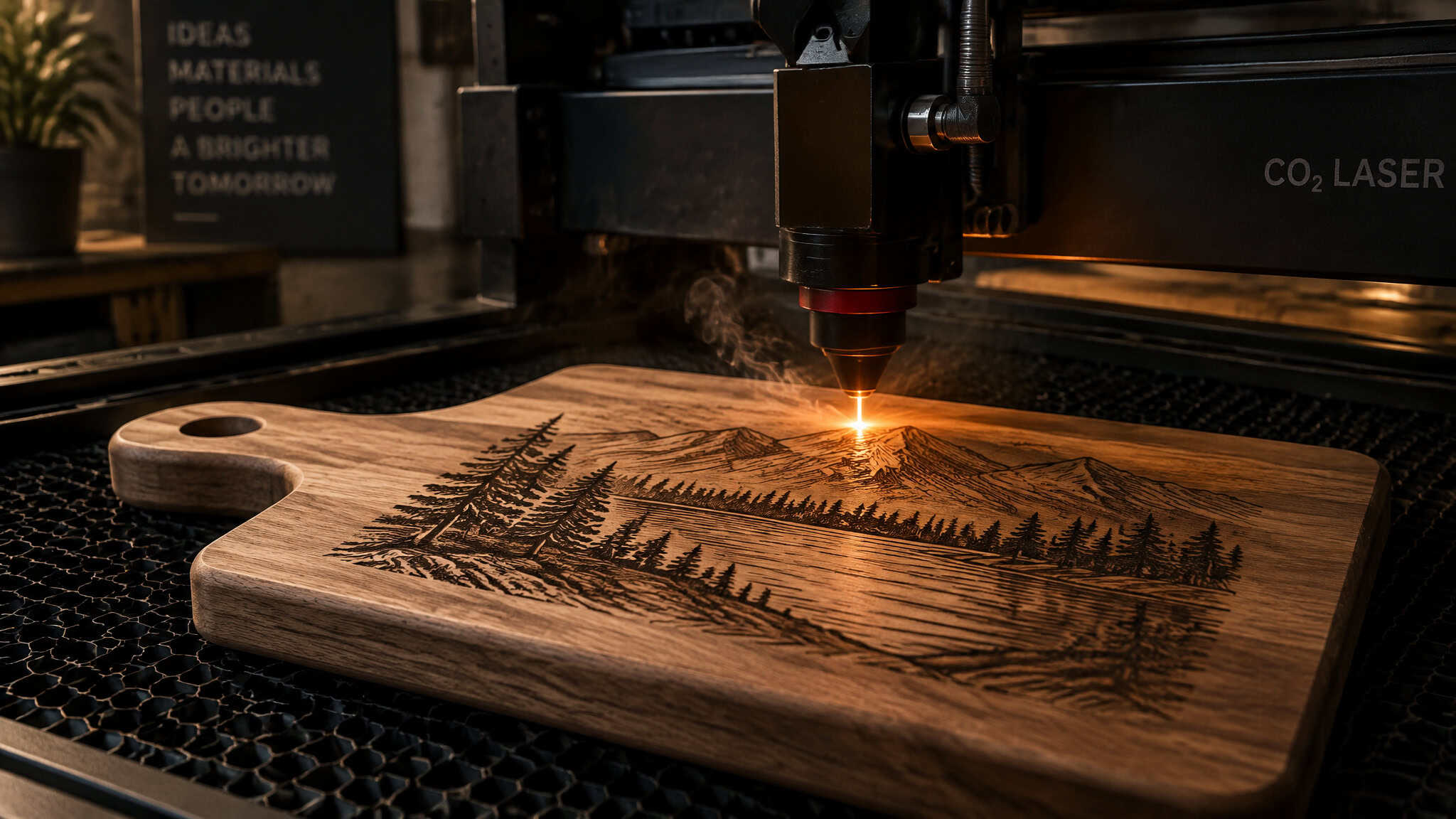
Laser engraving is profitable. Shops that survive typically run 15 to 30% blended business margins, and that number is the whole story of this article, because it’s not the one you’ve seen screenshotted. The 50 to 60% per-item margin floating around every beginner forum is real, but it’s not the business margin. A $6 tumbler blank sold at $25 really does clear 50 to 60%, that’s after materials, electricity, and machine wear.
The gap between that and the 15 to 30% reality is everything the screenshot leaves out: design time, machine time, finishing, packaging, platform fees, marketing, failed pieces, and a catalog weighted toward the wrong products. I got curious about where exactly that margin goes, so I pulled apart the unit economics the way we’d tear down any other piece of hardware, line by line. And the consensus underneath it all actually checks out: the whole model rests on cheap blanks transforming into high-value personalized items. That part isn’t hype. The rest of the margin math is where the interesting stuff hides.
Here’s the roadmap: what this actually costs to start, how to price a single job end to end, why one-off custom work is a trap, what the payback math looks like, which products earn their shelf space, and where the whole thing usually falls apart. Then you can run your own numbers instead of trusting anyone’s.
Key Takeaways
Shops that survive report 15 to 30% blended business margins, well below the 50 to 60% per-item margin on a $6 tumbler sold at $25.
The worked 4x formula: $1.50 material + $4.00 labour + $0.83 overhead = $6.33 COGS, doubled to $12.66 wholesale, doubled again to $25.32 retail.
A documented husband-and-wife shop cleared $7,000 in its first Christmas season on a $5,000 CO2 laser, nearly paying off the machine in one holiday run.
Table of Contents
The startup bill: the machine was the cheap part
Start with the machine tiers, because they’re basically a spec sheet:
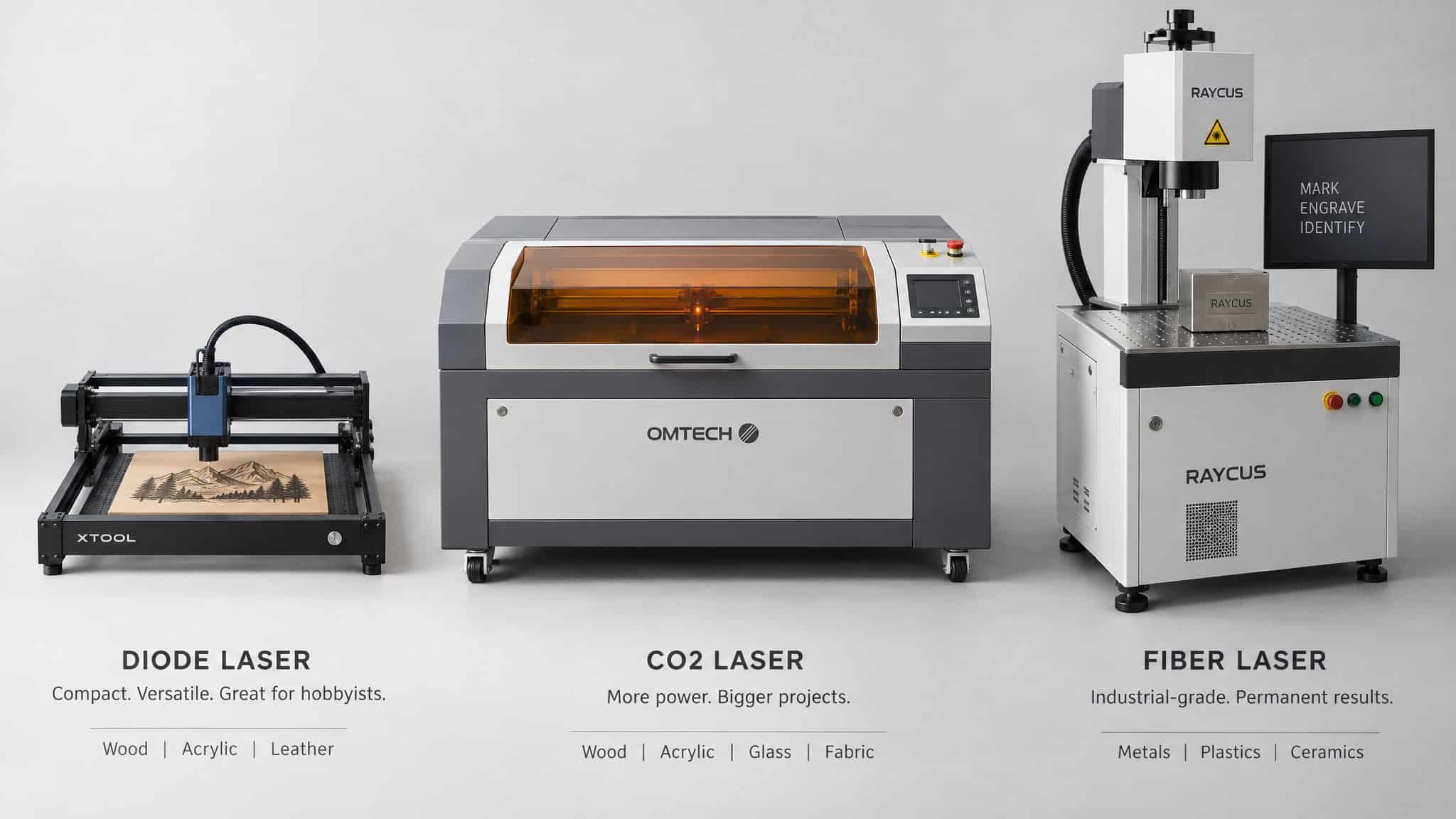
- Diode laser: $300 to $1,500. Handles wood, leather, slate, coated metals, and some acrylic. Won’t touch bare metal without marking sprays.
- CO2 laser: $2,000 to $10,000. The most versatile starting point: wood, acrylic, leather, glass, stone. Faster, cuts thicker. This is Glowforge and OMTech territory.
- Fiber laser: $5,000 to $30,000+. The required tool for metal: jewelry, tools, industrial marking. The specialist tier you earn your way into.
(If you want the wavelength-level version of why these three machines behave so differently, that’s covered in our diode vs CO2 vs fiber comparison. Short version: it’s physics, not marketing.)
Now the moment every maker knows. The printer was the cheap part. Beyond the machine: $500 to $1,000 for starting materials (blanks, acrylic, leather, metal blanks), $50 to $300 for software (LightBurn, Adobe Illustrator), $200 to $1,000 for workspace including fume extraction, ventilation, workbench, and goggles, and $500 to $1,000 for a website or marketplace presence. That fume extraction line isn’t optional gear, by the way. It protects your lungs and your neighbors’ patience, which is a feature of a good build, not a chore.
Totals: roughly $1,500 on the low end, $5,000 to $15,000 for a production-ready shop. Think of it as minimum spec versus comfortable build.
The single most important purchasing rule is to match the machine to your product line, not your budget. A common pattern shows up again and again in buyer questions: someone buys a diode on price, then discovers the stainless tumblers the market actually asked for can’t be marked without a rotary setup and different technology. Switching laser types later means buying twice, and that’s the biggest financial mistake in this space. The flip side is genuinely encouraging: a diode is a fine beta test. Prove people buy your stuff cheap, then upgrade.
And buy one multifunction machine first, not a fleet. A believable progression a real shop walked: plaques and signs on a CO2, then ornaments and keychains, then fiber only when jewelry demand justifies it.
For materials, start with Baltic Birch plywood or basswood. They’re the starter-filament equivalent: cheap, everywhere, and they behave. They machine cleanly, with fewer knots than pine, and char to that high-contrast dark engraving on both diode and CO2 machines. Skip melting plastics, anything producing noxious fumes, and brittle slate until you’ve got reps in.
One home-lab aside, since I know some of you were already wondering: yes, budgeting a spare machine early is defensible. If the laser is down during peak season, you’re not selling. Downtime during your best weeks is the expensive kind.
Industry context, labeled as such: xTool held 42.8% of the laser engraver and cutter market in 2024 per CIC, running roughly 20% cheaper than Glowforge’s flagship CO2 line ($3,319 to $6,499 versus $4,499 to $7,999) with free software. That last bit matters more than it sounds when your software budget is $50 to $300 to begin with.
Pricing one job end to end
Pricing a laser engraving job starts with a cost floor: materials + consumables + machine time + your own hourly labour + fees + packaging + a failed-piece allowance. Flag that last one, because it’s the line everyone skips. You will ruin a blank. Price it in.
The category baselines first, so you can price-check instantly:
- Tumblers: $15 to $25 for simple text, $30 to $50 for detailed or full-wrap work. Wholesale blanks run $5 to $6. And note the spec footnote that actually matters: you need a rotary attachment. That’s a hardware line item before you quote a single job.
- Cutting boards: $50 to $70 personalized, from a $10 board plus roughly 15 minutes of design and machine time. A $10 commodity becomes a $60 gift because the buyer’s name is on it. That transformation is the entire business in miniature.
- Plaques: $40 to $100 flat.
- Jewelry: $40 to $200+.
Now the worked example. I ran the keychain math three times because it seemed too clean. It’s a documented practitioner example, not my bench, and it’s worth walking like a benchmark table:
- $1.50 material
- $4.00 labour (12 minutes at $20/hr), and this covers design time, run time, and finishing and packaging. Pay yourself. That’s the whole point of the line.
- $0.83 overhead (15%; the rule of thumb is 10 to 20% of material plus labour)
- = $6.33 COGS
Then the 4x formula, which is worth saving like a config snippet:
(Material + Labour + Overhead) × 2 = wholesale. Wholesale × 2 = retail.
So $6.33 doubles to $12.66 wholesale, doubles again to $25.32 retail. A good price has four jobs: cover expenses, pay the owner, fund reinvestment, and absorb mistakes. This formula does all four.
Here’s my favorite part, the ceiling side of the equation. A memorial piece and a plain engraved keyring can take nearly identical machine time and price radically differently, because buyers purchase meaning, not laser minutes. Honestly kind of elegant. The laser is a commodity; the sentiment isn’t. So don’t quote anything until you’ve found both numbers: the cost floor and the buyer’s value ceiling.
A few field tricks from practitioners who run real jobs, attributed as such. One prices handling at $1/minute plus run time scaled to machine investment, on the logic that an $80,000 industrial laser justifies a dollar a minute, which makes a ~$1,000 diode worth about 2 cents a minute. Add roughly a 20% fee buffer. And the free-shipping threshold trick: price at $34.95 under a $35 free-shipping bar, which works until a returning customer named Lenny asks for free shipping on an order five cents short and gets refused. These are real people running real numbers.
Buyer rule: Price the failed-piece allowance, the fee buffer, and your own labour before quoting — the lines everyone skips are the ones that eat the margin.
Finally, rush and complexity surcharges aren’t greed; they honestly price disrupted workflow and error risk. And small upsells, like a coaster set with a cutting board or a display stand with a memorial plaque, lift order value for almost nothing.
Where per-item margin dies: the one-off custom trap
So is laser engraving worth it? The honest practitioner-level evidence, the closest thing to what you’d get reading years of forum testimony, says: not on one-off custom work. That’s the hardest lane in the business, and almost nobody should start there.
The erosion model makes it visceral. Take a slate coaster: a $2 blank selling at around $12. Looks like a 500% markup. Now subtract 20 minutes of artwork, one failed attempt, packaging, fees, and the email chain where the customer works through their font options.
(The font-approval email chain is a real phenomenon and it will find you.) That markup doesn’t survive contact with reality.
The structural rule underneath: setup cost is per job, not per unit. Twenty minutes of artwork on a single $10 item wipes out the margin. The same twenty minutes across a batch of fifty is negligible arithmetic. It doesn’t amortize unless you batch, which is why a batch of twenty coasters with one setup is genuinely good margin. The fix exists, and it works.
The practitioner anecdotes all rhyme: customers pushing back on raised prices, the free-shipping standoff above, and the long view that low-priced competitors come and go over the years. The unsustainable pricing exits the market on its own schedule, calmly. The worked example is the slate coaster: a $2 blank selling at around $12, with the markup slowly eroded by twenty minutes of artwork, a failed attempt, packaging, fees, and font-choice emails. And here’s the unwinnable lane, stated plainly: one-off consumer custom work competes against sellers who costed their labour at zero. You cannot out-cheap someone giving their time away.
Compete on niche, quality, or speed instead, and charge separately for design. Free iteration trains customers and compounds lost revenue, one friendly email at a time.
Payback period and what the money actually looks like
Verdict first: yes, a laser engraver can pay for itself within 12 months when you’re focused on a high-demand niche, this is the core of how to make money with a laser engraver. Part-time, expect around 18 months. Those aren’t contradictory numbers; they’re two operating modes, and focus plus demand are the variables, not luck.
The formula is a spreadsheet you should build before buying anything:
Startup cost ÷ true contribution per unit = units to break even. Units ÷ realistic monthly units = months.
Run it honestly and you’ll know your number instead of borrowing someone else’s.
Earnings by stage, conditions attached, no promises: $500 to $5,000 per month part-time once the product mix works (the phrase “once the mix works” is doing real work in that sentence). Established shops with repeat B2B relationships hit $10,000+ per month. Some dedicated full-time sellers exceed six figures annually, which is a real outlier, not the expected outcome.
And the ROI anchor story, told like a great build log I found: a husband-and-wife shop cleared $7,000 in their first Christmas season on a $5,000 CO2 laser, selling ornaments, cutting boards, and mugs, the real advantages of laser engraving earning their keep. Nearly paid off the machine in one holiday. It’s a documented result, it’s motivating, and it is not a promise that your December will look like theirs.
Which products actually make money
Not all engraved products are created equal, and the differences are reasons, not vibes.
Tumblers: the volume workhorse
Cheap blanks, fast engraves, boring reason, great result, the same logic that makes a reliable filament the default. $15 to $25 simple, $30 to $50 detailed, against $5 to $6 wholesale, with the rotary attachment caveat. Tumblers really shine on bulk orders: sports teams, schools, corporate gifting. This is where the batch run pays off.
Plaques: the unsexy category keeping the lights on
$40 to $100 flat, with predictable year-round demand from schools, corporations, and award ceremonies. Steady demand you can literally calendar around. Corporate and award buyers care about the thing being right, not the invoice, which is a quiet but real pricing advantage. Plaques are the revenue floor, the home-lab service that just never goes down.
Custom jewelry: small item, big margin
$40 for simple initials up to $200+ for intricate or precious-metal work, and it carries the highest margins in the lineup because buyers pay for sentiment, not metal weight. It also has the widest pricing range, and design skill plus presentation directly move the price. Your craft shows up in your pricing power here, more than anywhere else.
Wedding and event décor
Unique, time-sensitive, emotionally loaded work carries significant markups, and wedding buyers are notably less price-sensitive. When it’s their one big day, people prioritize getting it right. High stakes make honest premiums easy to justify.
Business branding products
Bulk corporate orders mean bigger order sizes, and the buyer is spending company budget rather than their own. Delivered with a knowing grin.
The triage rule
Pick 3 to 5 products in one or two niches and become “the engraver for X.” Better to be known for the best custom cutting boards in your region than to sell 50 mediocre things, and since how does laser engraving work comes down to spot size and the power/speed/DPI trade-off, specialization also lets you dial in settings that deliver consistently superior results. Industrial engraving, tool marking, serial numbers, barcodes, is lucrative and less crowded with far less price drama. Pet memorials, wedding keepsakes, and outdoor signage share a useful property: buyers search locally, so local SEO and reputation beat price competition.
Some demand context, since citations beat vibes: the personalized gift market was projected to grow $11.23 billion from 2023 to 2028 (Technavio), and Deloitte’s 2024 survey found 80% of US consumers more likely to buy from brands offering personalization. Honest caveat: that’s personalization-market data, not laser-specific. It supports the timing; it isn’t the story. And the honest tradeoff on personalized products generally: high margins and emotional connection on one side, proofing overhead and crowded marketplaces on the other.
The 30-product menu
A menu, not a checklist. Filter every idea through three filters: setup time, buyer price-sensitivity, and B2B reorder potential.
Home décor
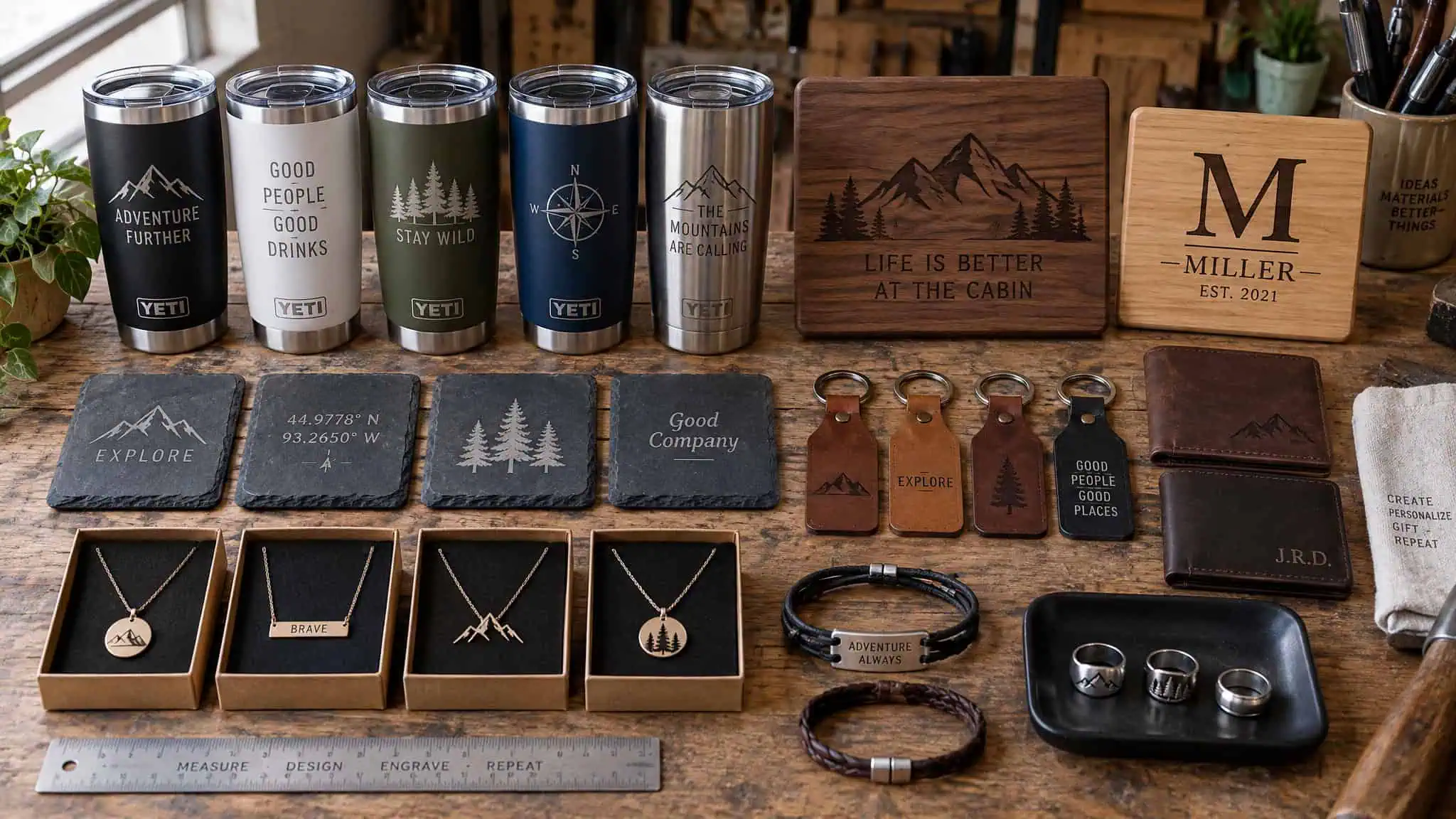
Custom cutting boards, slate coaster sets of 4 to 6, layered wood wall art, personalized recipe boxes, photo engraving on wood, house number signs, picture frames, door hangers, acrylic LED night lights, garden markers.
Personalized gifts
Tumblers and Yeti cups, wedding items (table numbers, keepsakes), custom jewelry, leather goods, pet memorials and ID tags, phone cases, watch bands, keychains, whiskey and wine glass engraving (CO2 plus rotary), baby milestone items.
Niche and B2B
Small-business signage including logo signs and QR payment displays, restaurant and café supplies (branded coasters, menu boards, reserved signs, flight paddles), architectural model cutting, jigs and templates, trophies and awards, hobbyist parts for drones, RC, and railroading, cake toppers, board game upgrades, rubber stamps, QR code products.
The niche tier connects directly back to the B2B advantages we’ll get to: less price competition, more reorders.
Validate before you buy
Calculate your break-even point before buying a laser engraver by modeling one realistic job end to end and finding three local buyers who already purchase engraved items. Then run the payback formula. Two concrete steps you can do this week:
- Pick your actual product and price it fully. Materials, minutes, fees, packaging. The dry run. If the math is ugly on paper, it’ll be ugly at the bench.
- Identify three local businesses or schools already buying engraved items. If you can’t find them, that’s the answer, and it cost you an afternoon instead of $5,000.
And the honest caveat, said directly: a laser engraver is not passive income. It’s manufacturing equipment you operate. The real investment is learning the software, mastering materials, and building a brand; the machine is the entry-level item on the skill tree. Positive ROI depends on product selection, pricing, and marketing, which are the same three things that decide whether you fail.

B2B, repeat clients, and the channel fee ladder
Fees, setup time, and customer mix aren’t three separate topics. They’re one margin argument.
Why B2B changes the math
Business customers reorder, buy in quantity, are less price-sensitive, and pay on terms. Four advantages, no fluff. On a run of fifty, setup time per unit collapses, which is the biggest single margin lever available to you. And there’s a boring-but-real behavioral reason repeat B2B work sticks: a buyer purchasing twenty awards compares suppliers on switching hassle, not on the cheapest marketplace listing. The target to chase is three or four local recurring accounts, businesses, schools, clubs.
That’s the fastest route to sustainability. It’s also why the jump from $1,000 to $5,000 a month to $10,000+ tracks B2B mix, not hours worked.
One gate to note: business registration is what makes you eligible for corporate B2B work. It’s the unlock for the lucrative tier.
The platform ladder, with fee math
- Etsy: built-in audience and easy setup, but fees start around 10% (20¢ listing plus 6.5% transaction) and can hit ~25% with off-site ads, on top of heavy price competition. A 25% fee on a low-ticket item can erase the entire labour line we just built in the keychain math.
- Shopify: $29/month Basic, you own the brand and the customer list, no marketplace fees, but you generate your own traffic. The power-user option.
- Amazon Handmade: massive audience and Prime, strict application, ~15% fees. The big-league gate.
- Facebook Marketplace and local fairs: instant cash, direct feedback, referrals, no shipping. A craft fair is the highest-bandwidth feedback loop there is; you watch people react to your work in real time.
The combined play: Etsy for validation and visibility, Shopify as home base, fairs for networking.
Cost check: A ~25% marketplace fee on a low-ticket item can erase the entire $4.00 labour line from the keychain math — price fees in before listing.
Marketing: the machine doesn’t sell; the video of the machine does
Marketing is one of the top three causes of failure, right beside pricing and product mix. Treat it as a required function, not an afterthought.
The good news is that this is the easiest content in any maker niche, because the laser itself is the asset. A time-lapse of the beam doing its thing is genuinely satisfying video, and that’s a real marketing advantage on Instagram, TikTok, and Pinterest. Show the whole arc: the engraving, the finishing, the packaging, the beauty shot. Let the craft speak; the journey is the content. Hashtags and craft/gift/décor communities are distribution, table stakes rather than strategy. And local collaborations work: a custom sign for a boutique in exchange for social sharing converts into word-of-mouth and corporate referrals, which is exactly the pipeline you want.
Failure modes and the second-machine trap
Most laser engraving side hustles fail to make money because of pricing, product mix, or marketing, not machine capability. When the business isn’t working, check the spreadsheet before blaming the hardware.
The anti-pattern catalogue, grounded in what multiple independent practitioners report:
- Material-cost-plus pricing with free labour. The single most common costing mistake, flagged independently by more than one practitioner. Everyone ships this bug at least once. The consequence is a busy-but-unprofitable hobby business, and eventually burnout and financial loss. The patch is the labour line in Section 3, and using it.
- Free design iteration. Every free round of edits sets the expectation for the next one, and the lost revenue compounds. Charge for design.
- Over-accepting one-off custom work. See the coaster erosion model.
- Over-spreading across categories. Ten half-finished things, zero finished things. A narrow line is easier to market and produce.
- Over-buying materials before validation. Resist the giant blanks order until something sells. Small quantities of a few materials, bulk-buy only the proven sellers.
- Skipping fume extraction, ignoring business registration. Brisk checklist items, both fixable in a week.
- Ignoring seasonality. This one deserves its own paragraph.
Seasonality is a survival constraint, not a marketing note: some shops earn nearly half their annual revenue in the six weeks before Christmas. Let that number sit for a second. It means market early, ornaments in the fall, Valentine’s jewelry, graduation plaques during the planning window, and it means quiet months go to B2B relationship-building and stocking repeatable products. Fail to plan inventory and you’ll turn away orders in the most profitable window of your year, which is failing in the most expensive possible way.
Now the contrarian kicker: when the business strains, the instinct is to buy a second machine. Fix pricing first. A second machine just doubles your capacity to produce unprofitable work. Capacity amplifies whatever economics already exist, good or bad. There’s peer data behind the caution too: a 2025 survey of 500 Shopify merchants found 79% self-fund their growth, and 20% regretted scaling too early. When scaling is justified, you’ll know: repeat B2B relationships, faster machines cutting per-unit time on batches like 50 coins or 100 tumblers, corporate reorders, graduation seasons, wedding-vendor referrals building a predictable base.
The hardware landscape, briefly
Two bits of industry context, labeled as such.
The consumer laser market is consolidating. xTool, launched by Makeblock’s pivot out of STEAM education around 2020 and 2021 and since filed for a Hong Kong IPO, held that 42.8% share in 2024 (CIC), with challengers like Bambu Lab pushing into laser and multi-tool machines with roughly 56% gross margins, selling about 20% under Glowforge with free software, 55% of it in the US and over 80% online. Per 36Kr-reported figures, though, growth is slowing: 1.777 billion yuan of revenue across the first three quarters of 2025, up 18.57% after 70% growth in 2024, with unit sales down from 85,900 to 71,900 as average selling price rose to about 21,000 yuan and inventory doubled. Translation for you: hardware is consolidating and getting cheaper per capability, which means the constraint on your business stays pricing, mix, and marketing. The tooling is not the bottleneck.
3D printing is the sibling maker business, worth a glance rather than a pivot, the same desktop-manufacturing wave that pulled camera-maker Insta360-adjacent brands and others into the space. Comparable economics: 30 to 70% gross margins on premium customized goods with no minimum order quantities, startup costs of $2,000 to $10,000 lean (many start on a single sub-$500 FDM printer), and materials matched to function, PLA at $20 to $30/kg for decorative work, TPU for flexible parts, PETG for outdoor and food use, SLA resin at $50 to $149/L for finish quality. Same margin lesson as lasers: personalization plus problem-solving, like obsolete replacement parts or dental models, clears the most. The pure-margin corner is digital design files, which scale at zero per-unit cost; Cults3D pays designers 80%, and Etsy’s June 2025 policy requires sellers to use their own original designs. As attributed color: 3D-printed footwear is projected at $5.38 billion by 2030, jewelry at $2.97 billion by 2030, and the cosplay market at $42.25 billion by 2035. Enjoy that last number without assuming you capture any of it.
So, run your numbers
Laser engraving is profitable, with conditions that are actually actionable: 15 to 30% blended margins for shops that price whole jobs including their own labour, specialize in 3 to 5 products, and build repeat B2B relationships. The deciding variables are pricing, product mix, and marketing. The machine is almost never the constraint.
Before you spend anything, do the two things: model one realistic job end to end with your own numbers, and find three local buyers already purchasing engraved work. Then budget $1,500 to $15,000 depending on your product line. The arithmetic in this piece came from practitioners who ran it first, and it’s all reproducible on your own spreadsheet. That’s the whole pitch: calculator in hand, numbers attached, no promises except that the math is knowable before you commit.
People Also Ask
Is there a demand for laser engraving?
Yes, and the timing data supports it: the personalized gift market was projected to grow $11.23 billion from 2023 to 2028 (Technavio), and Deloitte’s 2024 survey found 80% of US consumers are more likely to buy from brands offering personalization. That said, this is personalization-market data rather than laser-specific, and demand only converts to profit if you nail pricing, product mix, and marketing.
How much does it cost to start a laser engraving business?
Roughly $1,500 on the low end, or $5,000 to $15,000 for a production-ready shop. Machines tier out at $300–$1,500 for a diode, $2,000–$10,000 for CO2, and $5,000–$30,000+ for fiber, and the machine is actually the cheap part. Budget another $500–$1,000 for materials, $50–$300 for software, $200–$1,000 for workspace with fume extraction, and $500–$1,000 for a website or marketplace presence.
How much money can you make with a laser engraving business part time?
Part-time shops report $500 to $5,000 per month once the product mix works — and that phrase is doing real work, since mix is a deciding variable. Expect roughly 18 months to pay off the machine part-time versus about 12 months when focused on a high-demand niche. Established shops with repeat B2B relationships reach $10,000+ per month, and a few full-time sellers exceed six figures annually, though that’s an outlier, not the expected outcome.
What profit margin does a laser engraving business actually make after fees and time?
Shops that survive typically run 15 to 30% blended business margins, well below the 50 to 60% per-item margin beginners cite. The famous per-item number is real — a $6 tumbler blank sold at $25 genuinely clears it after materials — but the gap comes from design time, machine time, finishing, packaging, platform fees, marketing, and failed pieces. Platform fees matter especially: Etsy fees start around 10% and can hit ~25% with off-site ads, which can erase an entire labour line on low-ticket items.
Why do most laser engraving side hustles fail to make money?
Pricing, product mix, and marketing — not machine capability. The most common costing mistake is material-cost-plus pricing with free labour, which produces a busy-but-unprofitable hobby business and eventual burnout. Other failure modes include free design iteration, over-accepting one-off custom work, spreading across too many categories, and ignoring seasonality — some shops earn nearly half their annual revenue in the six weeks before Christmas, so failing to stock for that window is the most expensive way to fail.