
Most comparisons treat these like competing products: “I2P is slower but more private,” or “VPNs are faster but less anonymous.”
I2P and VPNs aren’t speed-differentiated versions of the same thing. They’re different classes of network. Asking which is better is like asking whether a submarine or a helicopter is better. The answer depends entirely on what environment you’re operating in.
Key Takeaways
I2P is a darknet for internal-only services (eepsites, anonymous messaging, P2P) with no exit nodes; VPNs are clearnet privacy tunnels for everyday browsing, streaming, and banking
I2P’s garlic routing bundles multiple encrypted messages into single “bulbs” for different recipients, making traffic analysis harder than Tor’s onion routing or a VPN’s single-tunnel design
Combining I2P with a VPN creates a trust bottleneck — the VPN provider sees both your real IP and your I2P metadata, which may violate your threat model
Table of Contents
Is I2P better than VPN? The question itself needs rethinking
I2P is its own network. It’s a decentralized overlay network designed for internal services — eepsites, secure messaging, P2P file sharing, anonymous hosting. It was never meant to visit regular internet websites. In fact, I2P has no exit nodes. You can’t just fire it up and browse Reddit.
A VPN, on the other hand, is an encrypted tunnel through the existing internet. You connect to one of their servers, and your traffic emerges at that server’s IP address. It’s built for clearnet access — streaming, banking, everyday browsing, torrenting on public trackers.
I2P vs VPN: Architecture & Design
I2P and VPNs take fundamentally different approaches to routing traffic, which directly impacts their privacy properties and performance characteristics.
I2P’s unidirectional tunnels — the key architectural flex
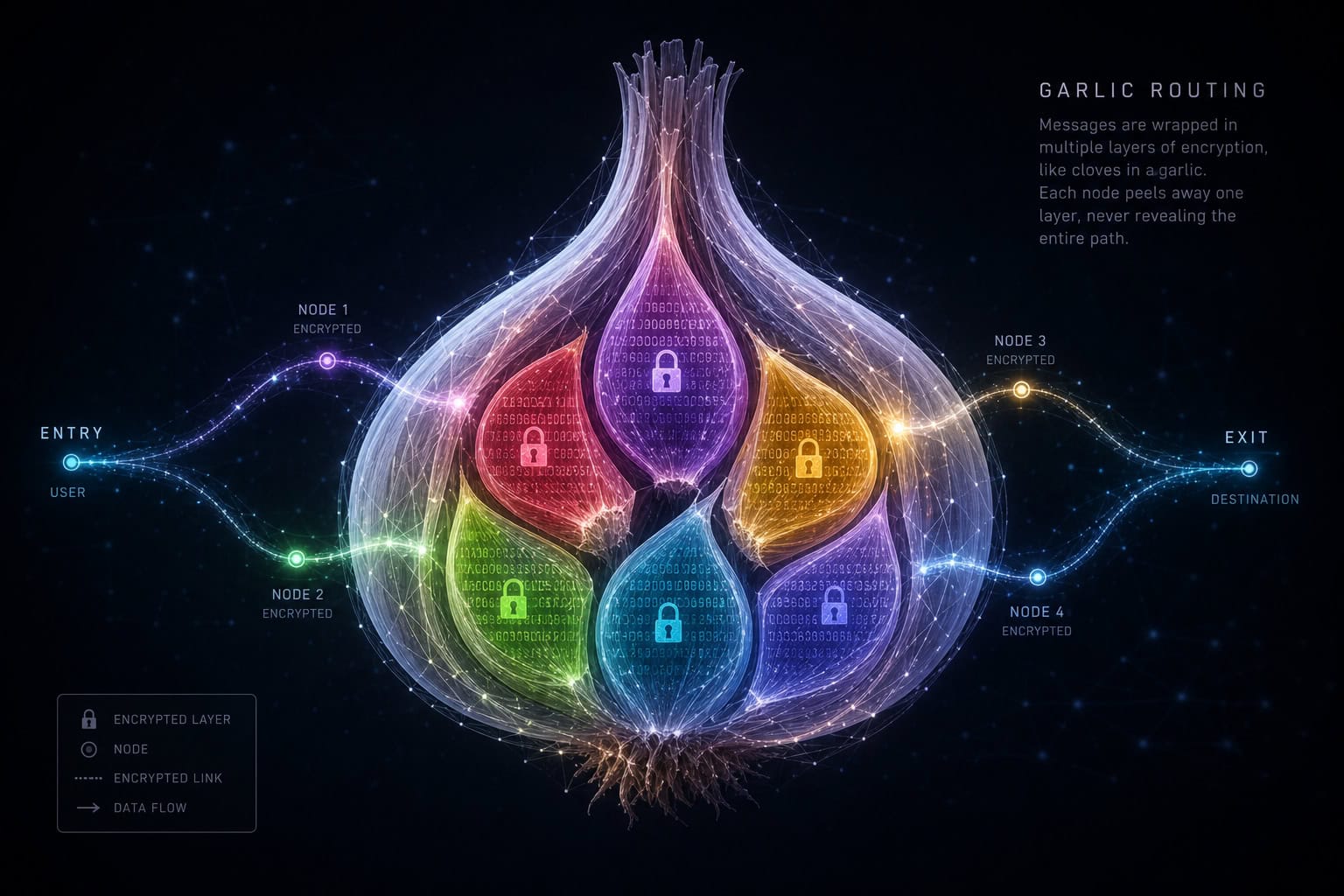
Every I2P user runs a router that makes temporary, encrypted, one-way connections with other routers. I2P uses unidirectional tunnels (inbound/outbound) to separate traffic, making timing correlation attacks harder. When you send data, it travels through an outbound tunnel to other routers. When you receive data, it comes through a completely different inbound tunnel using different nodes.
This means any single node only sees half the communication flow. An attacker who wants to correlate what you send with what you receive needs to compromise both your inbound and outbound paths — that’s double the nodes required in Tor to obtain the same information.
The tunnels are also packet-switched, which means messages travel across multiple concurrent paths rather than a single fixed circuit. I2P automatically routes around congestion, which gives it better resilience for long-lived internal services.
You control the length of your own tunnels — more hops for stronger anonymity, fewer hops for better speed. The destination owner controls theirs. Both sides have a say in the connection’s privacy level.
How VPNs handle routing
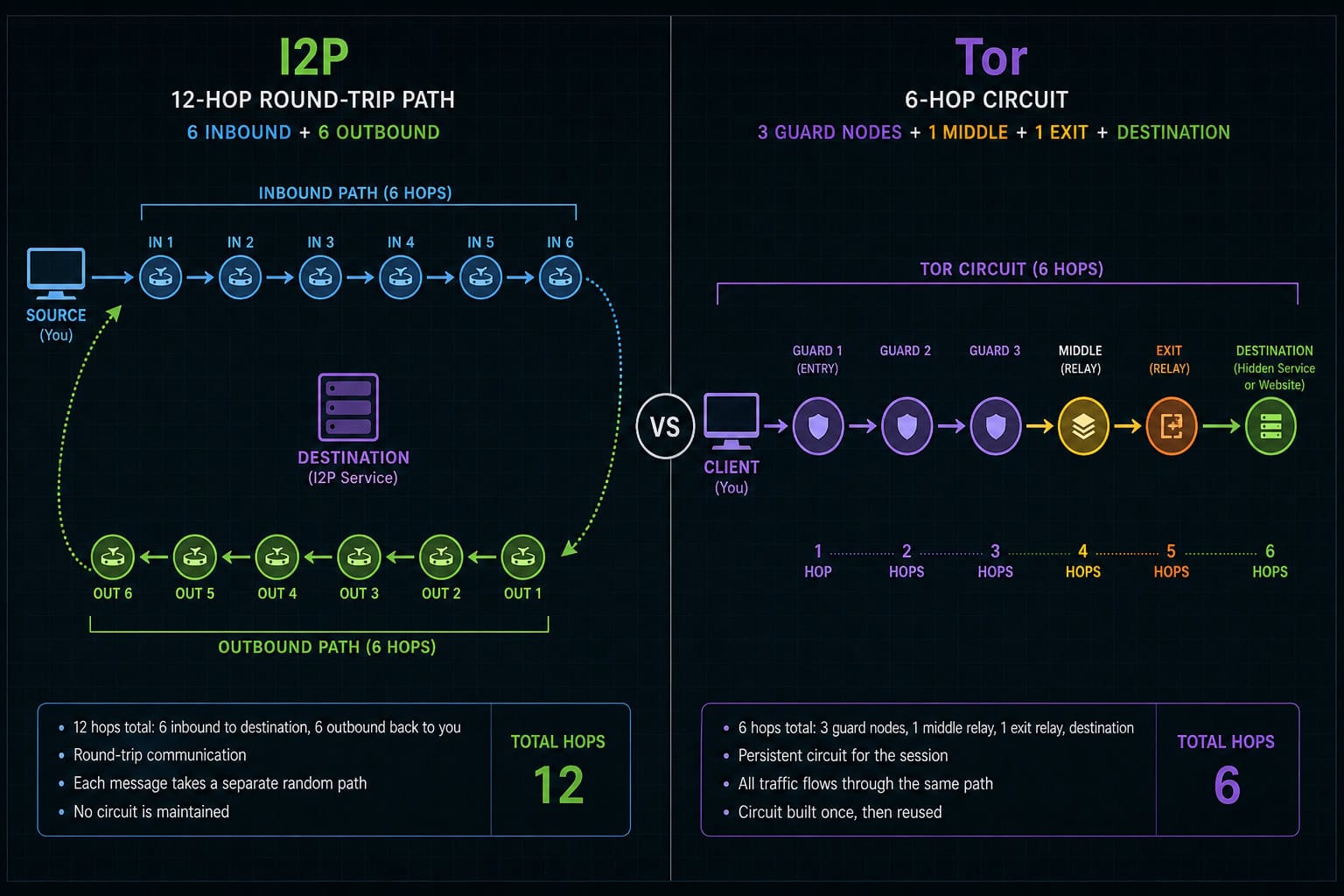
A VPN is much simpler. It creates a single encrypted tunnel between your computer and one of their servers. All your traffic goes through that one connection. There’s always one VPN server between you and the clearnet. That’s it.
The VPN provider sees everything — your real IP, every site you visit, every service you use. They can’t read the content (assuming HTTPS), but they have a complete metadata picture.
This is simpler and faster, but it creates a single point where your privacy can fail.
| Feature | I2P | VPN |
|---|---|---|
| Tunnel direction | Separate inbound/outbound (unidirectional) | Single bidirectional tunnel |
| Routing | Packet-switched, multiple concurrent paths | Circuit-switched, fixed single-hop |
| Exit nodes | None (internal network only) | Yes (traffic emerges at VPN server) |
| Hop control | Variable, user-configurable | Fixed single hop |
| Path redundancy | Automatically routes around congestion | Single point of failure |
Trust & Anonymity — Where does each tool put your data?
Understanding where your trust is placed reveals the fundamental difference between I2P’s decentralized approach and a VPN’s centralized model.
I2P’s distributed trust model
I2P’s network database (netDB) uses a distributed Kademlia DHT with rotating floodfill routers. There are no central directory authorities to attack. Every I2P router routes traffic for others — there are no dedicated relay operators. How much routing you do is determined automatically by your bandwidth and reliability.
This means trust is distributed across all 55,000 or so active routers. No single entity can log your traffic, hand over your metadata, or be compelled to reveal your identity. The system is designed so that no central point of failure exists.
The downside? That trust is spread across a much smaller network than Tor’s millions of daily users. The anonymity set is smaller, which matters for certain threat models.
VPN’s centralized trust problem
A VPN provider is a single company. They can observe your traffic. That data is a profitable asset. Some VPNs have been caught logging despite promising they don’t — HideMyAss famously handed logs to authorities despite claiming a no-log policy.
Now, the top VPN services are more trustworthy than most ISPs. But that’s a low bar. You’re trading trust for speed and ease of use. You’re betting that a for-profit company will protect your privacy better than a decentralized system designed from the ground up for anonymity.
For hidden services specifically, I2P’s 55,000 routers provide stronger unlinkability than a VPN’s single server. For hidden services, the relevant anonymity set is the number of routers, not users — I2P’s 55k routers all route traffic, providing a more robust set than a VPN’s single server. But for clearnet browsing, a VPN’s larger infrastructure and simpler design deliver better speed and reliability.
The tradeoff: I2P sacrifices convenience for decentralization; VPNs trade trust for speed.
Anonymity Comparison — I2P vs VPN vs Tor
Each tool uses a distinct routing mechanism that determines how well it resists traffic analysis and correlation attacks.
Garlic routing — the fun-sounding mechanic that matters
I2P uses something called garlic routing. The naming is playful — ‘garlic bulb’ and ‘cloves’.
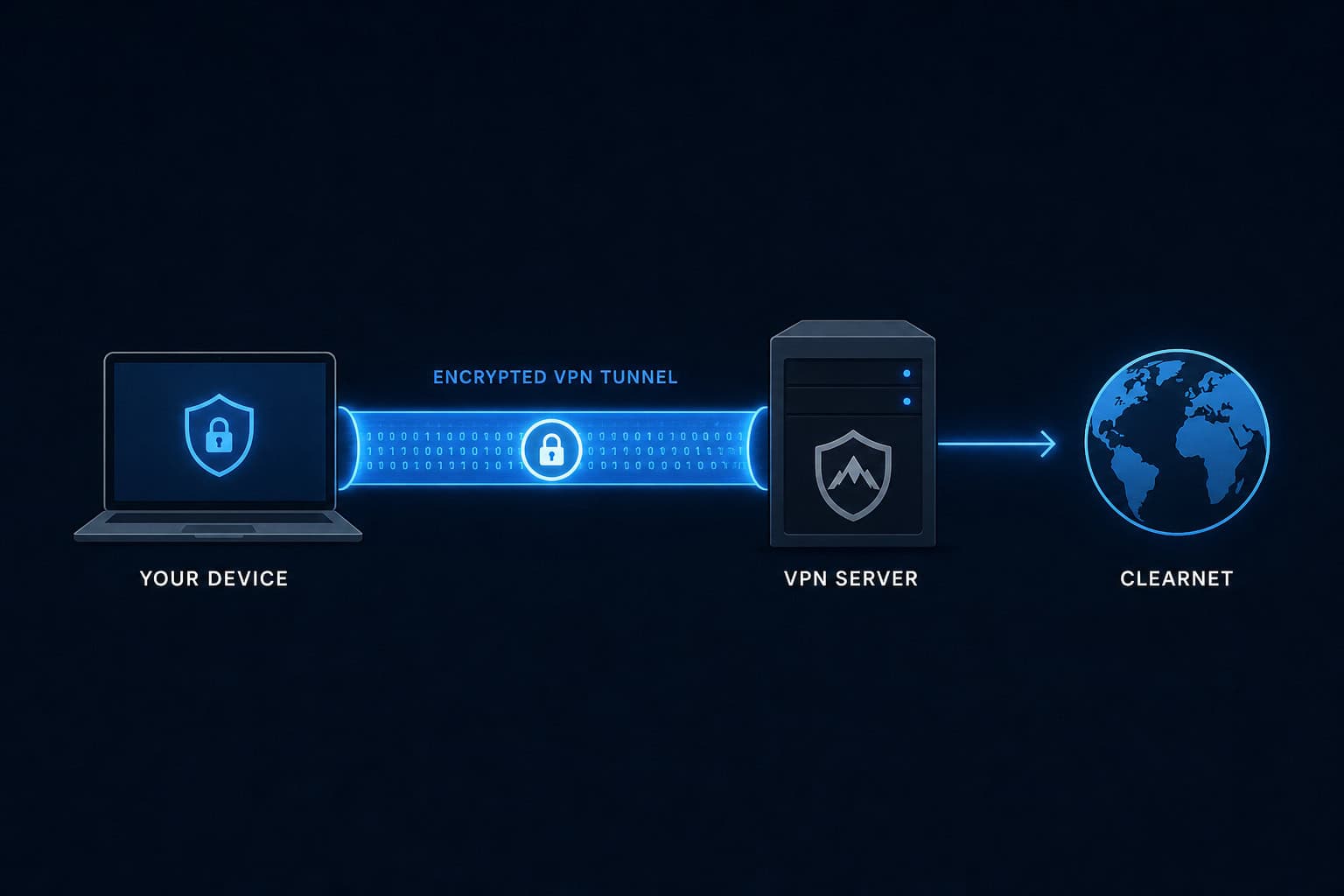
Instead of sending one message at a time like Tor’s onion routing, I2P bundles multiple encrypted messages together into a single “garlic bulb.” Each bulb contains multiple “cloves” — individual encrypted messages, that can be for different recipients. When someone intercepts a bulb, they can’t easily tell who’s talking to whom.
This does two things. First, it reduces metadata leakage because you’re sending fewer, larger packets instead of many small ones. Second, it makes timing attacks harder — an attacker can’t easily correlate when a message was sent with when it was received because the message is bundled with other traffic going to different destinations.
Unidirectional tunnels vs Tor’s circuits
Combine garlic routing with I2P’s unidirectional tunnels, and the result is serious correlation resistance. An attacker who wants to trace your traffic needs to compromise both your inbound and outbound paths. An attacker must compromise double the nodes in I2P vs Tor Android compared to Tor to obtain the same amount of information.
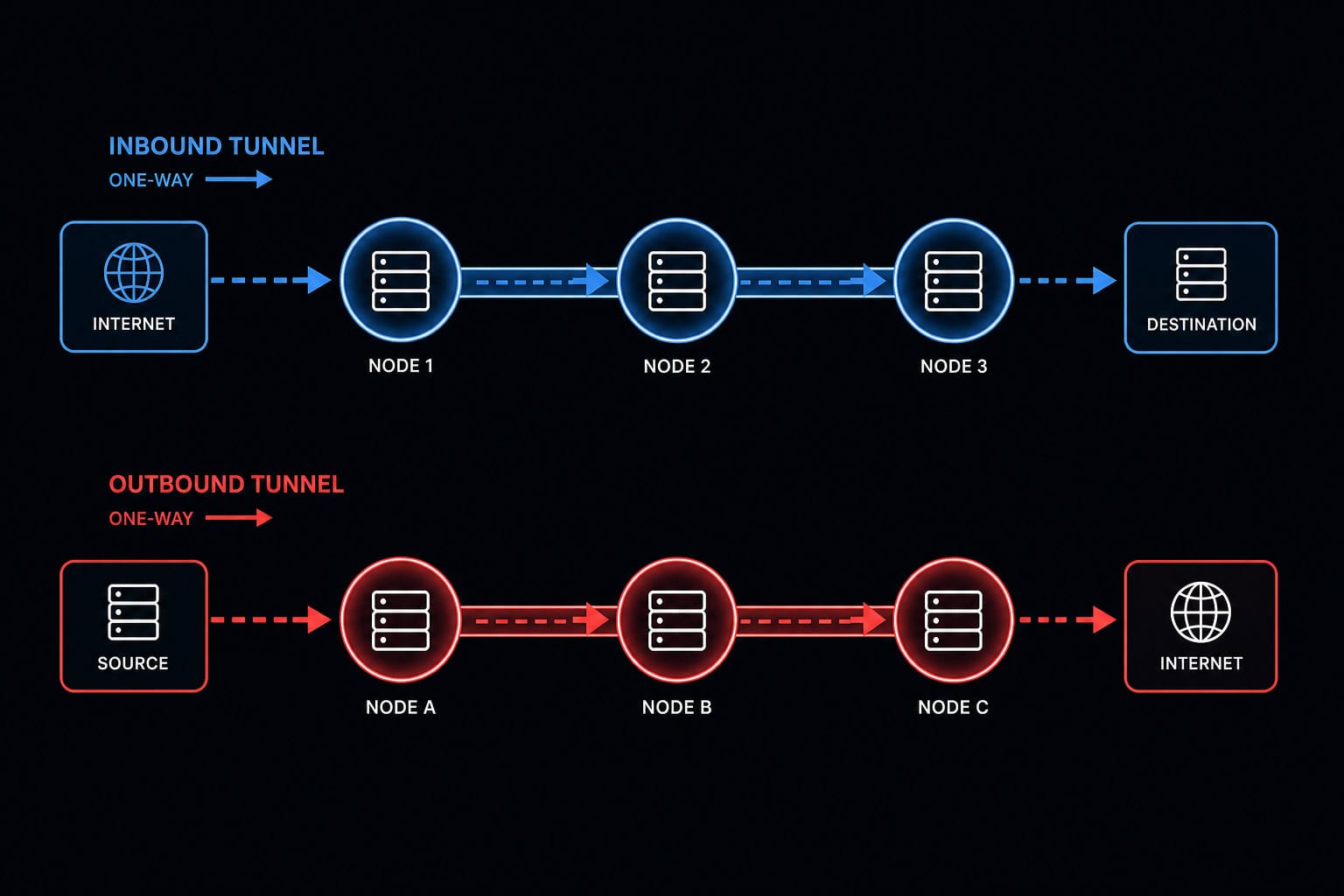
Tor uses circuit-switched, bidirectional connections — three relays in a fixed path. Each relay knows its immediate neighbors. It works well, but it’s more vulnerable to timing correlation attacks.
Cryptography comparison
I2P’s recent cryptographic rewrite uses ECIES-X25519-AEAD-Ratchet with ChaCha20/Poly1305. That’s a mouthful, but the short version is: it’s modern and similar to WireGuard. Tor relies on TLS plus AES/RSA/ECDH — a more traditional crypto stack.
For hidden services specifically, I2P uses a 12-hop round-trip (6 inbound + 6 outbound) compared to Tor’s 6-hop circuits. More hops mean stronger unlinkability but also more latency, which is why the question of Is I2P a darknet? hinges on the deliberate tradeoff for the use case I2P prioritizes.

VPNs, by comparison, offer no traffic mixing at all. Your traffic goes through a single encrypted tunnel to one server. Against a sufficiently motivated adversary doing traffic analysis, a VPN provides the weakest protection.
When to Use I2P vs VPN — A Decision Matrix
The right tool depends entirely on what you’re trying to accomplish and what threats you’re protecting against.
When I2P is the right choice
- Anonymous hosting — If you need to run an eepsite (a hidden service accessible only via I2P), I2P is the only correct choice. Eepsites use .i2p domains and don’t rely on DNS servers, making them more difficult to track or block.
- P2P file sharing — I2PSnark lets you stream and share files via BitTorrent over I2P without exposing your real IP. That matters if you care about who sees what you’re seeding.
- Secure messaging — I2P-Bote (anonymous email, around since 2004) and I2P Chat (encrypted instant messaging) work entirely inside the I2P network with no central servers.
- Cryptocurrency transactions — Wallets can send and receive payments without exposing your real IP address. Some DeFi platforms use I2P for transaction privacy.
- Dark web hidden services — If you need to operate or access services that shouldn’t touch the clearnet at all, I2P is built for this.
When a VPN is the right choice
- Everyday clearnet browsing — This is what VPNs were designed for. Fast, simple, works with every website.
- Streaming — Netflix, YouTube, BBC iPlayer. VPNs are optimized for media delivery with low latency.
- Banking and shopping — Quick connections, reliable uptime, predictable performance.
- Torrenting on public trackers — VPNs are fine here, especially if speed matters more than anonymity set size.
- Geoblock bypass — VPNs are the standard tool for accessing region-locked content.
When Tor is a better alternative to both
- Anonymous clearnet browsing — Tor’s millions of daily users provide a larger anonymity set than I2P, and its exit nodes let you access regular websites.
- Accessing .onion services — Tor’s hidden services ecosystem is larger and more mature.
- Whistleblowing — SecureDrop and similar tools use Tor for a reason.
| Use Case | I2P | VPN | Tor |
|---|---|---|---|
| Anonymous hosting | ? Best choice | ? | ? |
| P2P file sharing | ? Strong privacy | ? Fine for public trackers | ? Slow |
| Everyday browsing | ? Not designed for it | ? Fast and simple | ? Anonymous |
| Streaming | ? Too slow | ? Best choice | ? Too slow |
| Secure messaging | ? Native apps | ? No anonymity | ? Onion services |
| Cryptocurrency privacy | ? Good choice | ? Provider sees IP | ? Good choice |
For a deep-dive comparison of I2P and Tor as anonymity networks — how they differ in architecture, use cases, performance, and threat models, you can read more about i2p vs tor.
Performance — Speed, Reliability, and What Causes the Difference
I2P’s internal services typically have a round-trip time of 1 to 3 seconds. That’s slow by clearnet standards, but it’s the cost of doing business differently — multi-hop encryption, a smaller network of 55,000 routers, and universal participation where every user routes traffic for others.
Tor’s latency is around 200 to 500 milliseconds for exit traffic. Faster than I2P, but with a catch: Tor’s exit nodes can be bottlenecks because they handle all the clearnet-bound traffic.
A regional VPN server? Under 100 milliseconds. That’s the speed of a single encrypted hop to one server.
I2P’s packet-switched design means it automatically routes around congestion. For long-lived internal services — a forum, a file share, a messaging server. I2P can actually be more reliable than a VPN. Your VPN connection is a single tunnel. If that server goes down or gets congested, you’re stuck. I2P spreads connections across multiple paths.

The speed gap is a structural tradeoff. I2P trades raw speed for correlation resistance and resilience. VPNs trade those for bursty page loads and predictable latency.
Ease of Use — I2P vs VPN Setup Comparison
The setup process for each tool reflects their underlying design philosophies — one prioritizes decentralization, the other convenience.
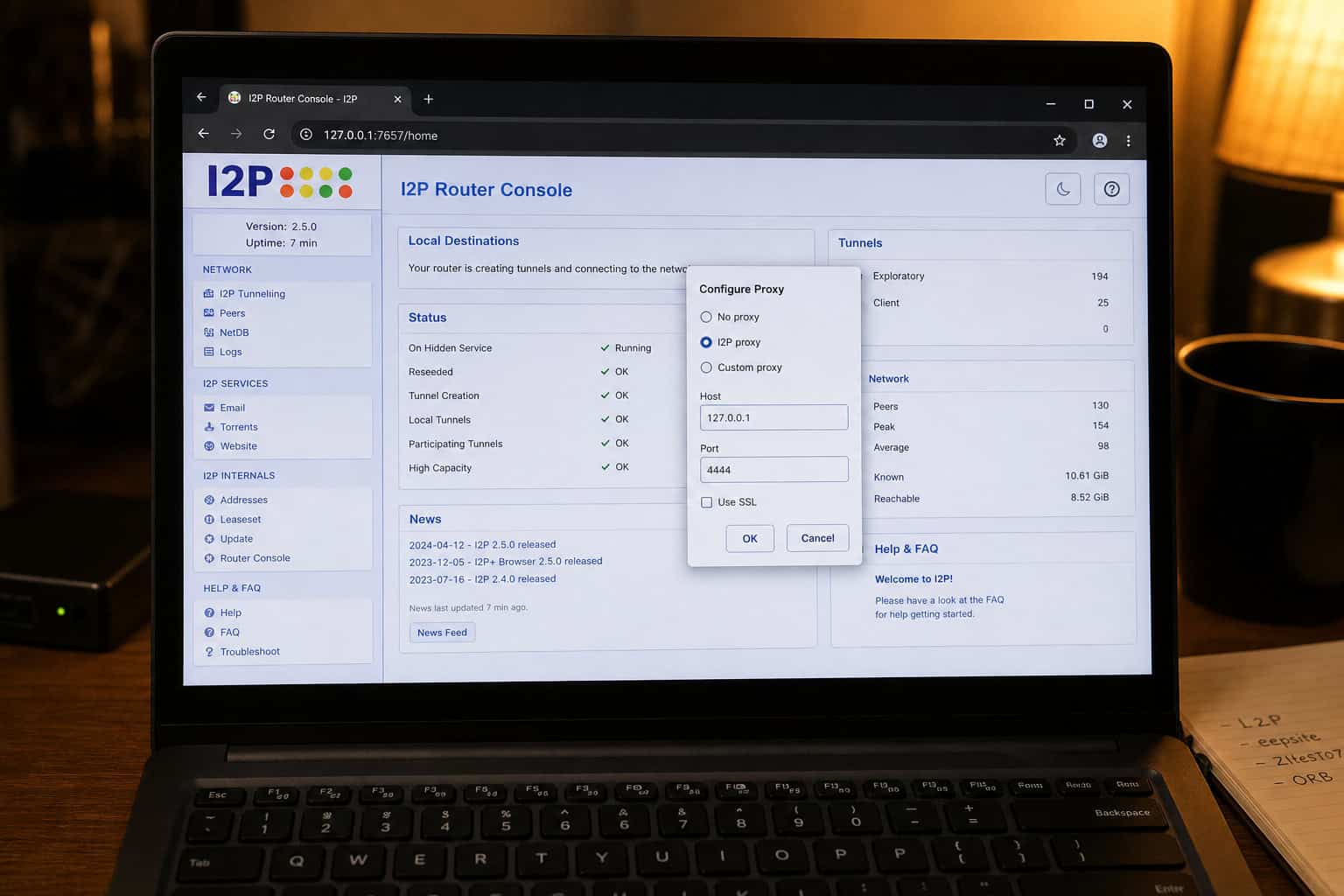
Setting up I2P
- Install Java (I2P is written in Java, so this is required)
- Download the I2P Router and verify the SHA256 signature
- Launch the router — it takes 10 to 20 minutes to establish optimal connectivity
- Configure your browser’s HTTP proxy to
127.0.0.1:4444and HTTPS proxy to127.0.0.1:4445 - Access the router console at
http://127.0.0.1:7657/
The documentation for specific browsers is out of date. Firefox is generally recommended for privacy, but you’ll be doing some manual configuration work.
Setting up a VPN
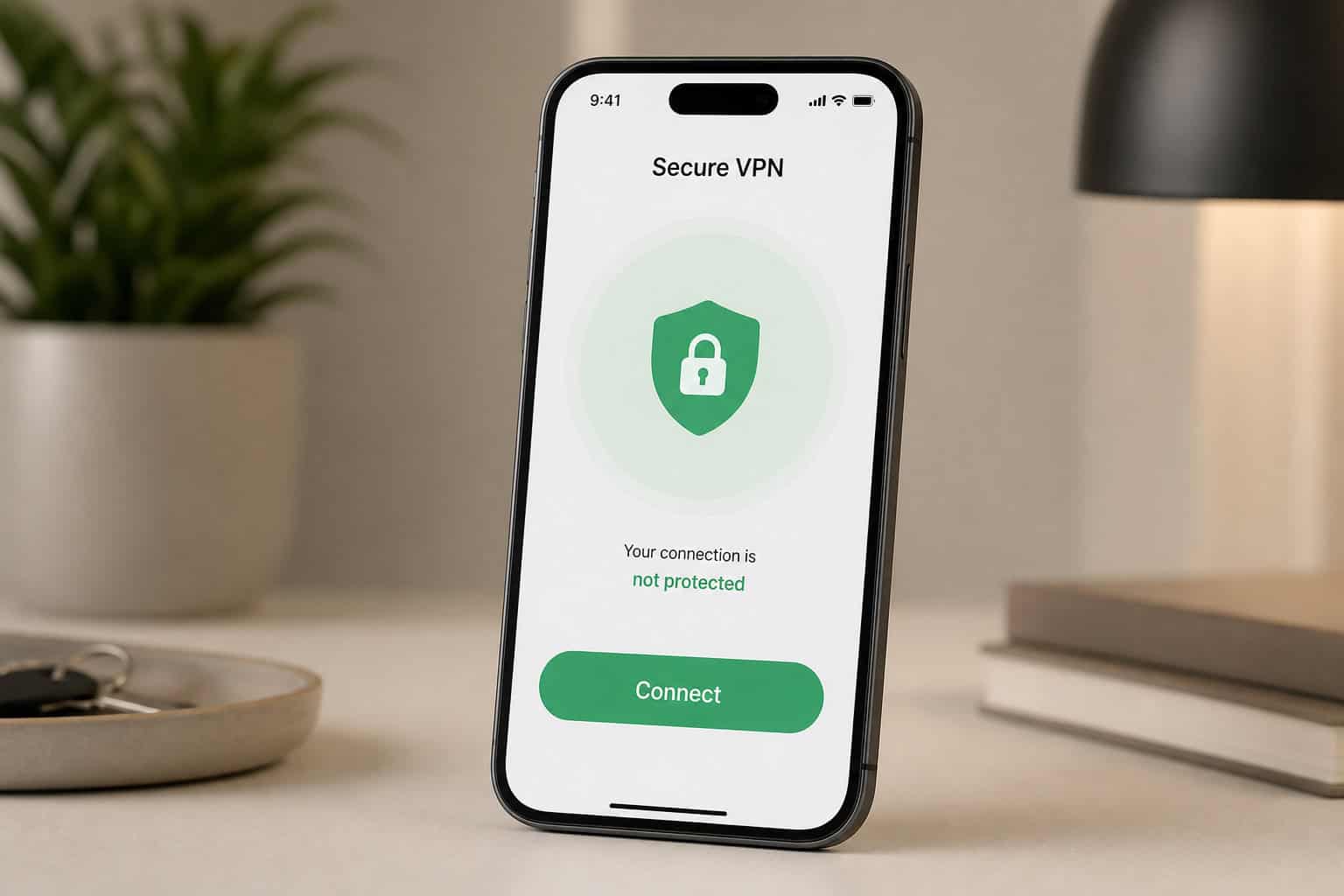
Download the app. Install it. Click connect. Two to five minutes, no specialized skills required.
I2P’s complexity exists because of its decentralized architecture. Every user is also a router. There’s no central server to handle configuration. You get stronger decentralization, but you have to earn it with setup effort.
Can You Combine I2P and a VPN? The Trust Bottleneck Paradox
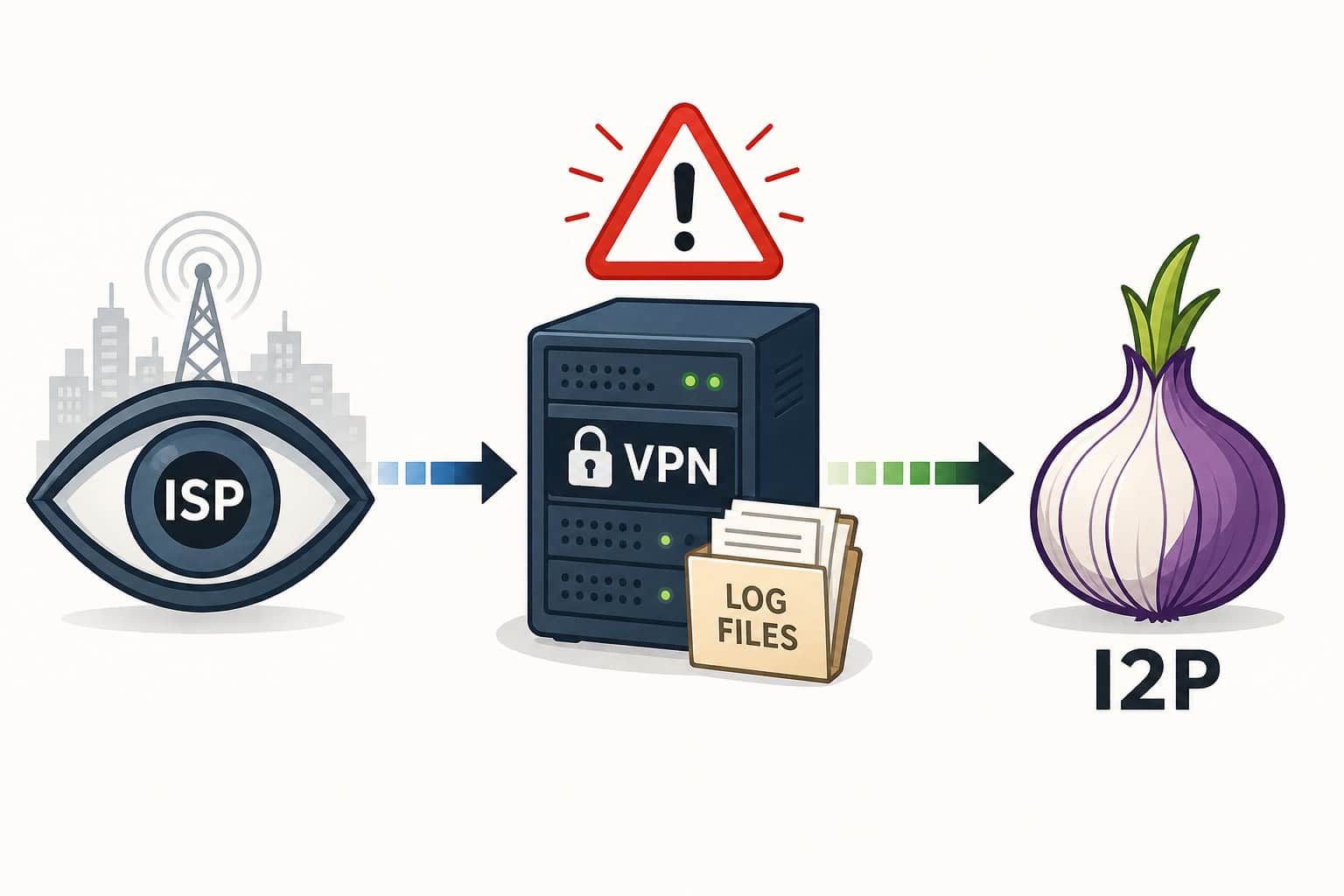
Here’s the logic for combining them: ISPs can identify I2P traffic patterns even if they can’t read the content. Deep packet inspection can identify the protocol signature. Using a VPN before I2P hides the I2P connection from your ISP — they only see an encrypted connection to the VPN server.
The VPN provider now sees both your real IP and your I2P connection metadata — a single point of exposure.
This recentralizes trust. The very thing I2P was designed to avoid — a central point that can observe your traffic, you’ve recreated at the VPN level.
The HideMyAss incident is the classic example: a VPN provider that claimed not to log handed over logs to authorities. If you’re combining I2P with a VPN, you’re betting that your VPN provider won’t do the same.
When to combine, when not to
Combine if: Your threat model is hiding I2P from your ISP. Maybe you’re in a jurisdiction where I2P use is monitored or blocked. The VPN adds ISP-level protection.
Don’t combine if: Your threat model includes the VPN provider. If you’re worried about targeted surveillance, data breaches, or legal compulsion against the VPN company, you’re better off with I2P alone.
Alternative approach: Use a bridge or obfuscation proxy with I2P directly, without introducing a corporate middleman.
Combining tools doesn’t always add security. Sometimes it moves the trust problem somewhere else.
Cryptography and Privacy Mechanisms Deep Dive
I2P’s privacy guarantees rest on several interlocking cryptographic and routing mechanisms that work together to obscure communication patterns.
Garlic routing mechanics
Each garlic bulb is a bundle of encrypted messages (cloves). Cloves can be for different recipients, and each clove is individually encrypted. When a router receives a bulb, it opens the outer layer, finds the cloves addressed to it, and forwards the rest.
Each bundle, or ‘garlic bulb,’ holds multiple encrypted messages called ‘cloves’ that may be intended for different recipients, making it harder to identify the sender and receiver.
Unidirectional tunnel separation
Your outbound tunnel uses one set of nodes. Your inbound tunnel uses a completely different set. No single node sees both sides of any conversation. To reconstruct a full communication flow, an attacker would need to compromise nodes on both the inbound and outbound paths — twice the work.
Cryptographic stack
- I2P (current): ECIES-X25519-AEAD-Ratchet with ChaCha20/Poly1305 — modern, similar to WireGuard
- Tor: AES + RSA/ECDH, reliant on TLS — a more established but more traditional stack
- VPNs: Varies by provider, typically AES-256
I2P’s crypto is well-regarded, but nothing is unbreakable. I2P is susceptible to Sybil attacks, traffic analysis, DoS, and compromised routers — just like any other anonymity network.
Ecosystem Maturity and Sustainability
The long-term viability of each tool depends on its community support, funding model, and ongoing development activity.
I2P’s ecosystem
I2P is volunteer-driven nonprofit. There are about 55,000 active routers. The code is open source (Java/C++/Go) and reviewed by coders worldwide, but the developers are mostly anonymous.
The I2P Supported Applications page lists a lot of services, but many are no longer maintained. I2P Messenger is no longer supported (code is still available). Some cryptocurrency projects have explored I2P integration — Monero considered it and developed Kovri, which is still in Alpha and not used for transactions. Verge (XVG) claims to use I2P, but that’s unconfirmed.
You get strong privacy and no profit motive to log data, but you also get outdated documentation and abandoned projects.
VPN ecosystem
The VPN market is predicted to be worth $135 billion by 2030. Hundreds of providers compete for users. Servers are online 24/7. Customer support exists. Documentation is current.
But that profit motive cuts both ways — your data is a valuable asset, and not all providers are equally trustworthy.
I2P vs VPN — Which Should You Choose?
Choose I2P if you need anonymous hosting, P2P file sharing inside a darknet, secure messaging without central servers, or cryptocurrency privacy. I2P is optimized for these jobs.
Choose a VPN if you need fast clearnet browsing, streaming, banking, or geo-block bypass. VPNs are consumer-grade tools built for these use cases.
Choose Tor if you need anonymous clearnet browsing or access to .onion services. Tor’s larger anonymity set and exit node infrastructure make it the best choice here.
If you’re thinking about combining I2P and a VPN, think carefully about where your trust bottleneck ends up. For some threat models, the combination helps. For others, it makes things worse.
People Also Ask
Is I2P safer than Tor?
It depends on your threat model. I2P offers stronger correlation resistance than Tor due to its unidirectional tunnels and garlic routing, requiring an attacker to compromise twice as many nodes. However, Tor has a much larger anonymity set with millions of daily users, and its exit nodes allow anonymous clearnet browsing — something I2P can’t do at all.
What’s the difference between I2P and a VPN?
I2P is a decentralized darknet for internal-only services like eepsites and anonymous messaging, with no exit nodes to the regular internet. A VPN is a centralized encrypted tunnel to a single server that lets you access the clearnet for streaming, banking, and everyday browsing. They’re different classes of network designed for completely different use cases.
How does I2P’s garlic routing work?
Garlic routing bundles multiple encrypted messages called ‘cloves’ into a single ‘garlic bulb,’ where each clove can be for a different recipient and is individually encrypted. When a router receives a bulb, it opens the outer layer, finds the cloves addressed to it, and forwards the rest — making it harder for an attacker to identify who is talking to whom or correlate send and receive times.