
When headlines scream “dark web,” they almost always mean Tor. Silk Road, AlphaBay, FBI takedowns — Tor is the network that got a reputation. But dig into the architecture, and a quieter project called I2P actually fits the technical definition of a darknet more strictly. The Invisible Internet Project is a peer-to-peer overlay network designed for anonymous hidden services, not clearnet access. It uses garlic routing, a fully distributed node database, and ships with its own suite of built-in applications. So why does the “darknet” label rarely stick to I2P? Because the term tells us more about media perception than about the technology.
This perception gap is worth unpacking before we dive into the technical details. The key takeaways below sum up how Tor and I2P differ in architecture, public image, and real-world attention from agencies like the NSA.
Key Takeaways
Tor’s “dark web” stigma got bad enough that the Tor Project hired Thomson Communications in October 2014 specifically to fight the label — while I2P never needed that PR campaign.
I2P’s architecture is more purely a darknet than Tor: no exit nodes by default, fully peer-to-peer node discovery via Kademlia netDB, and built-in apps like I2PSnark (BitTorrent), I2PTunnel, SusiMail, and I2PBote.
The NSA’s leaked slides describe Tor as “the king of high-secure, low-latency Internet anonymity” but never mention I2P at all — the network simply flies under the radar.
Table of Contents
What Actually Makes Something a Darknet?
Before comparing networks, it helps to pin down what “darknet” actually means in a technical sense. The definition is simpler than most people assume.
Technical definition
The technical definition of a darknet is pretty straightforward: it’s an overlay network that requires special client software, runs on top of the public internet, and isn’t indexed by standard search engines like Google or Bing. By that definition, corporate VPNs and private gaming servers are technically darknets too — the term is broader than most people realize. But when we talk about anonymity networks, we’re usually referring to systems like Tor and I2P that are designed specifically to hide who you are and where you’re going.
Media conflation
The media didn’t adopt “dark web” because of architecture. They adopted it because of Silk Road. From 2011 to 2013, the Silk Road marketplace made Tor synonymous with illegal drug sales in the public imagination. The media ran with “dark web” as a catch-all for anything criminal and anonymous online — and Tor was the network that powered it.

The Tor Project saw the problem early: they hired Thomson Communications in October 2014 to improve their image around “Dark Net” and “hidden services.” That PR move is the single best evidence that the label itself was causing real damage. Meanwhile, I2P sailed along without that headache because it never had a Silk Road moment.
I2P’s Architecture — Garlic Routing and the Fully Distributed netDB
Here’s where the geek fascination kicks in. I2P’s design choices aren’t just implementation details — they define what the network is for.
Garlic routing vs. onion routing
Tor uses onion routing: your traffic gets wrapped in three layers (entry, middle, exit) and sent through a fixed circuit. Each layer is peeled off as the data passes through a relay. Elegant, but each circuit carries traffic from a single user’s application for a few minutes. I2P uses garlic routing instead.

It bundles multiple messages — called “cloves”, into a single “garlic” packet. That packet is sent through inbound and outbound tunnels, not a fixed circuit. The bundling makes traffic correlation harder for an adversary because they can’t easily match individual messages going in and out. The tradeoff is higher latency, but that’s a deliberate choice for a network built for hidden services, not fast page loads.
Directory authorities vs. Kademlia netDB
Tor relies on nine hardcoded directory authority nodes. These nine servers vote every hour on the network consensus — which relays are up, what their capacities are, and so on. It’s semi-centralized. Compromise the authorities and you compromise trust in the network.
I2P takes the opposite approach: a fully distributed Kademlia-based database called netDB, using floodfill routers to propagate information. There are no central servers. The upside is no single point of failure. The downside is that I2P’s smaller network makes it more vulnerable to Sybil attacks — an adversary could spin up lots of fake nodes to gain influence. Still, the design philosophy is pure peer-to-peer.

Encryption details
Tor uses TLS for link encryption and RSA/ECDH for circuit setup. I2P goes further: it uses ECIES-X25519-AEAD-Ratchet (ChaCha20/Poly1305) for end-to-end encryption, AES for tunnel encryption, and Ed25519/Curve25519 for identity. The ratchet mechanism means forward secrecy is built in — if an adversary steals a key later, they can’t decrypt past traffic. These are different threat models, but I2P’s stack is arguably more paranoid about long-term key compromise.
What Each Network Is Actually Built For
Tor and I2P were designed with fundamentally different goals in mind. Understanding those goals explains most of their architectural differences.
Tor’s primary use case
Tor Browser is the flagship product. Most people install Tor to browse the clearnet anonymously — read Wikipedia, check news sites, use DuckDuckGo. Onion services are an add-on that you’d use if you want to host a site or access a hidden service. The network optimizes for low-latency clearnet access, which is why exit nodes exist and why they’re a common attack point.

I2P’s primary use case
I2P is the opposite: it’s designed for anonymous hosting and peer-to-peer applications within the overlay. The default experience is not browsing the clearnet — it’s accessing eepsites (.i2p addresses). I2P ships with built-in apps that make it a self-contained darknet environment: I2PSnark for anonymous BitTorrent, I2PTunnel for port forwarding, SusiMail for email, and I2PBote for messaging. If you want to run an anonymous blog, share files, or send encrypted mail without ever leaving the overlay, I2P has you covered out of the box.
Tor doesn’t bundle any of that — you need separate tools like OnionShare or Briar. So, is I2P better than VPN? That depends on your goals, but a head-to-head comparison shows key differences in privacy, anonymity, speed, and use cases — and combining them can be dangerous. This is a common mistake: new I2P users install the router, see the console, and can’t figure out why they can’t load google.com. That’s by design.
Security Tradeoffs — Is One Safer Than the Other?
This is the question that always comes up, and the answer depends entirely on your threat model.
Exit node risks vs. no exit nodes
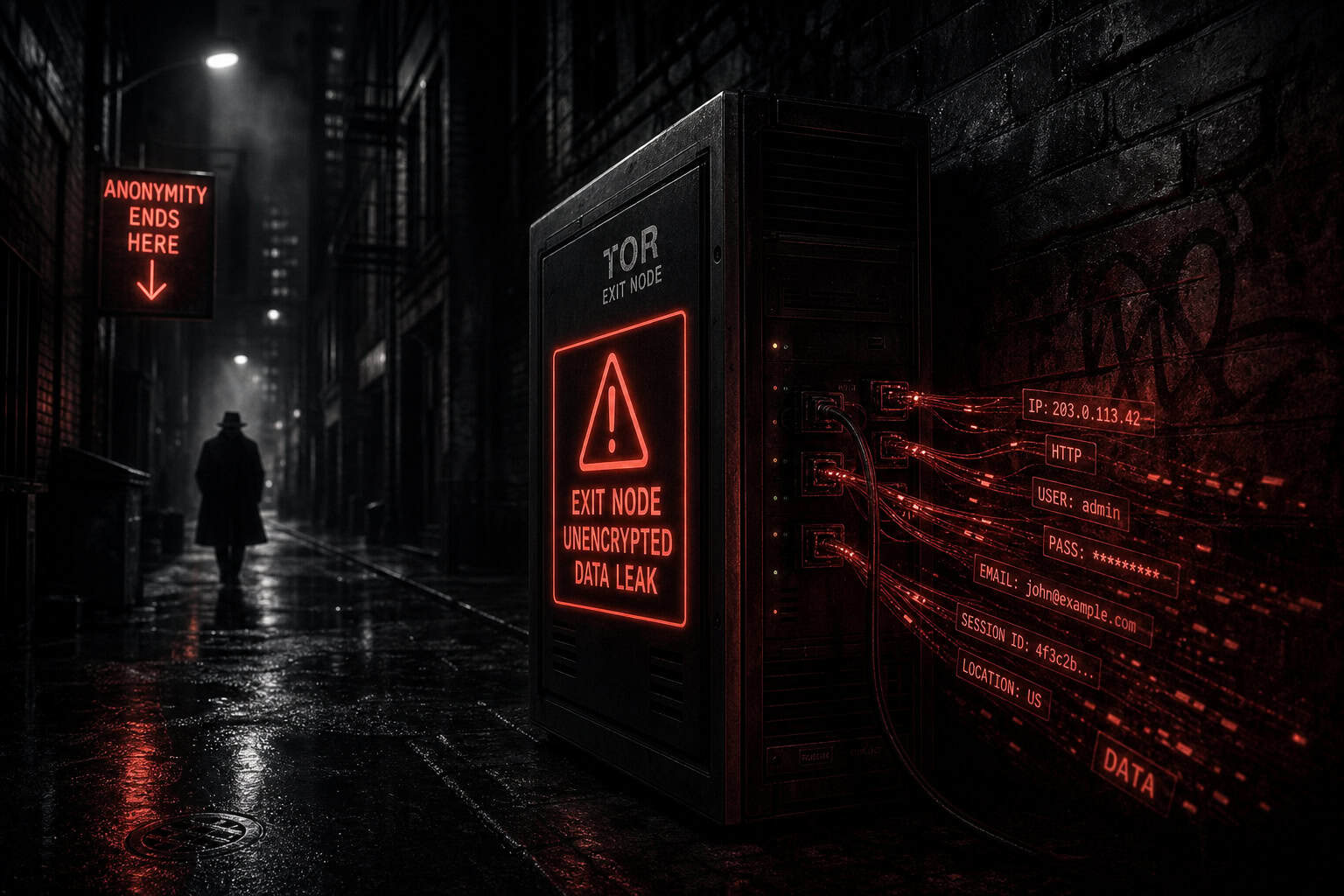
Tor’s exit nodes are a well-known risk. An adversary controlling an exit node can capture unencrypted traffic, SSL-strip connections, or log activity. That risk simply doesn’t exist inside the I2P network because there are no exit nodes by default. Use an outproxy to reach the clearnet? Then you’ve reintroduced the same risk.
Traffic correlation and timing attacks
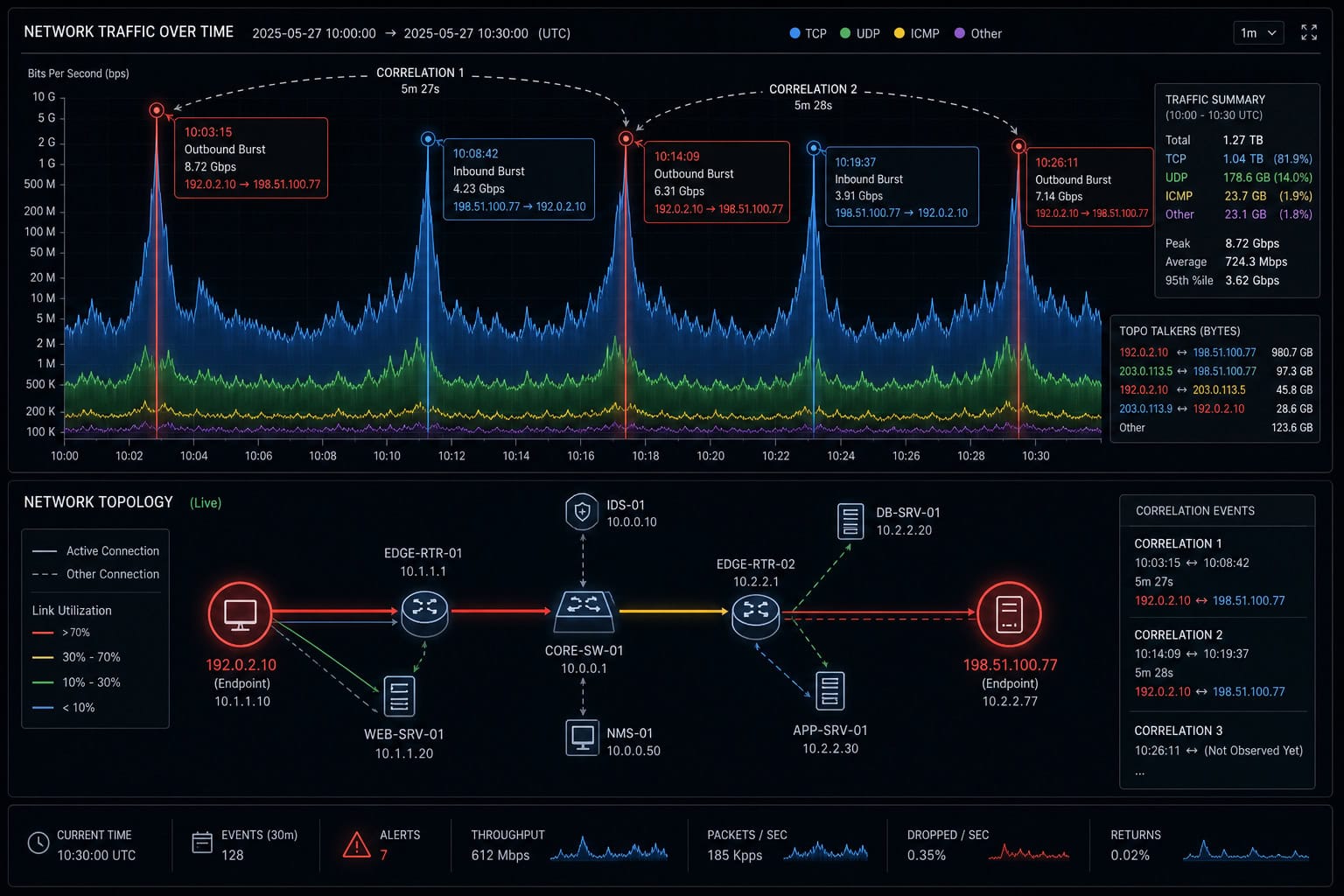
Both networks are vulnerable if an adversary can monitor traffic entering and leaving the network. For Tor, the relay early traffic confirmation attack (disclosed July 2014) compromised about 6.4% of guard relay capacity — a specific, documented attack that required controlling many nodes. I2P’s garlic routing makes traffic analysis harder because messages are bundled and tunnels are paired, but it’s not immune. If someone can watch both ends, timing patterns still leak.
Network size and Sybil attacks
Tor’s larger network and directory authority system make mass Sybil attacks more expensive. The probability of a single adversary controlling both entry and exit nodes was roughly 1 in 2,000,000 in 2016. I2P’s smaller, fully distributed network is easier to infiltrate with fake nodes, but the Kademlia-based design makes it harder to target specific users. The adversary needs to position nodes in the right part of the DHT to deanonymize a particular eepsite operator. It’s a different attack surface.
Where I2P Fits in the Broader Ecosystem
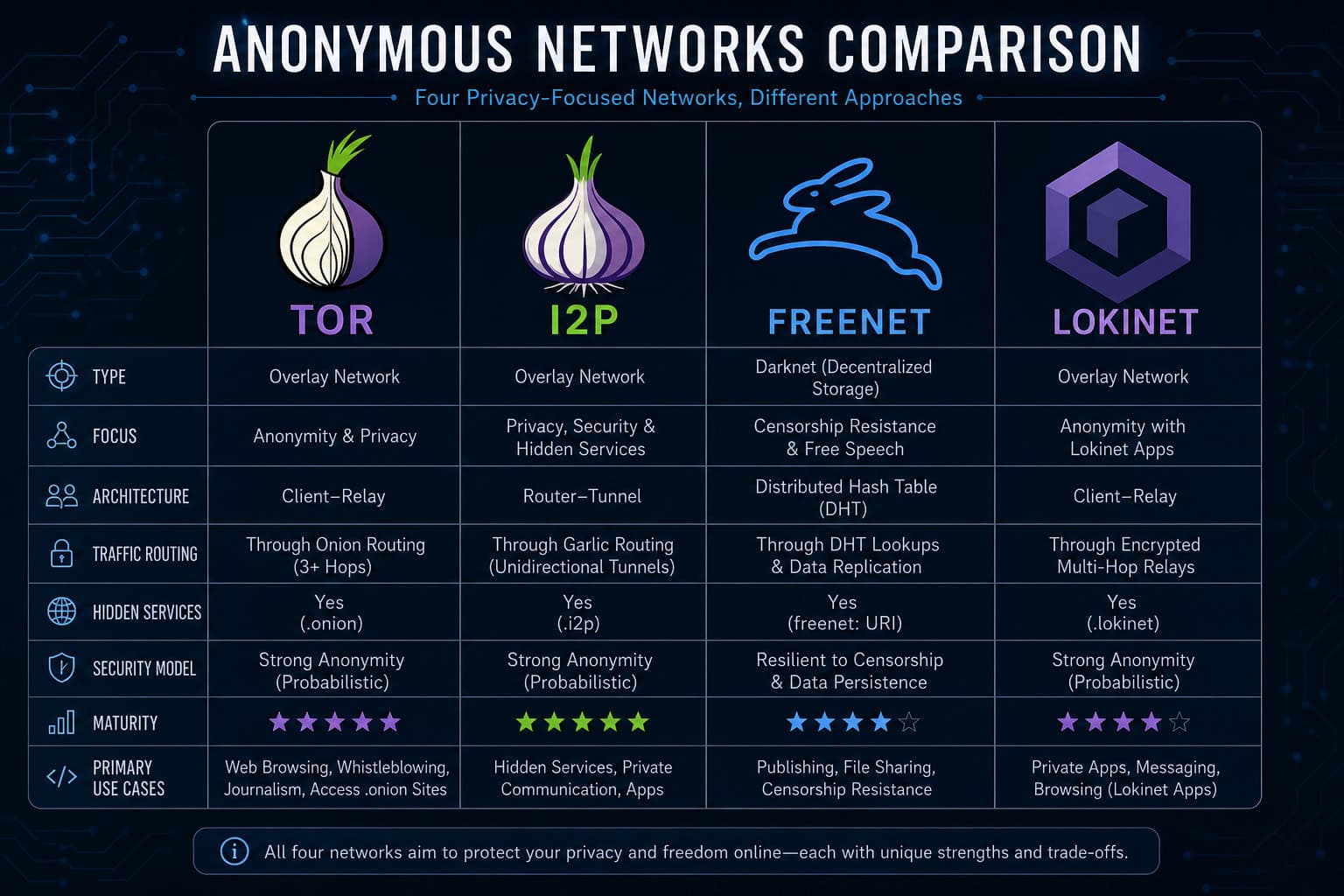
It helps to map the landscape. Each anonymity network makes different tradeoffs:
- Tor is low-latency, semi-centralized, and clearnet-first. Onion services are a second-class citizen, but they work.
- I2P is low-latency, fully distributed, and hidden-services-first. The clearnet is optional and discouraged.
- Freenet (now Hyphanet) is high-latency, peer-to-peer, and optimized for distributed data storage and censorship-resistant publishing. It’s not for real-time communication.
- Lokinet provides anonymous IPv6 networking via LLARP, aiming to make any network service work anonymously — still niche but interesting.
- GNUnet, RetroShare, Yggdrasil fill other niches: decentralized networking, friend-to-friend sharing, IPv6 meshes.
I2P sits as the middle ground between Tor’s clearnet focus and Freenet’s high-latency storage. It’s the only one that ships a fully self-contained application ecosystem out of the box. If you want to understand the differences at a deeper level, our I2P vs Tor comparison covers the architecture tradeoffs in detail. And if you’re wondering about legal risk, check our piece on whether Tor is illegal in the USA — the same principles largely apply to I2P.
The Label Gap — Perception vs. Technology
The NSA, for all its powerful capabilities, never once mentions I2P in any leaked slide. They called Tor “the king of high-secure, low-latency Internet anonymity.” That tells you everything about the asymmetry of attention.
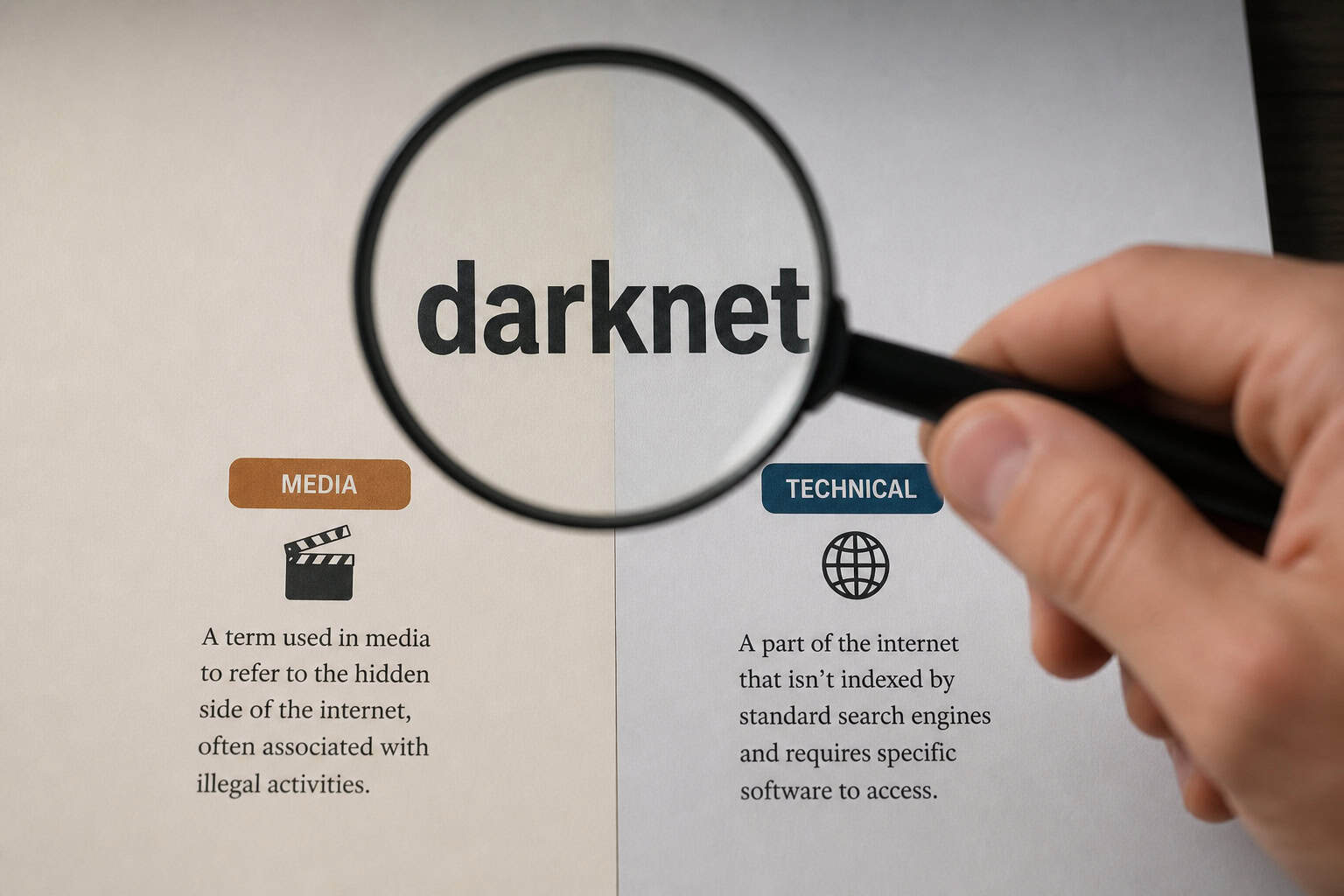
I2P fits the technical darknet definition more strictly than Tor does: it’s a peer-to-peer overlay network with no built-in clearnet access, requiring special client software, and not indexed by standard search engines. That’s the textbook definition. Yet go read any mainstream article about the “dark web” — it’s almost exclusively about Tor. Security researchers tend to call I2P an “anonymous overlay network” rather than a darknet, because the word “darknet” in their circles implies hidden services with no exit nodes.
By that definition, I2P is the purer example. I2P’s smaller network also means less community oversight and fewer reported vulnerabilities, but that same low profile reduces its attractiveness as a target for mass surveillance.
The gap isn’t technical — it’s cultural. The media attaches “dark web” to crime stories, and crime happened on Tor. Geeks attach “darknet” to architecture, and I2P fits the architecture. Two classification systems talking past each other.
Conclusion — Yes, But Not the Kind You Think
So is I2P a darknet? Yes, technically. It’s a peer-to-peer overlay network designed for anonymous hidden services with no built-in clearnet access. That’s the purest definition of a darknet there is, and I2P meets it more strictly than Tor does. As the I2P project’s official documentation states, the network is designed for hidden services, not clearnet access.
But “darknet” in popular usage means “the bad internet where criminals operate.” I2P doesn’t fit that any more than Tor does — both are tools with legitimate and illegitimate uses. The label reveals more about the person using it than the network itself.
The next time someone asks “Is I2P a darknet?” you can say yes, hand them a technical reference, and then explain that the real question is what they mean by “darknet.” The answer says more about them than about I2P.
People Also ask
What is I2P used for?
I2P is built for anonymous hosting and peer-to-peer applications within its own overlay network. It ships with built-in tools like I2PSnark for anonymous BitTorrent, SusiMail for encrypted email, I2PBote for messaging, and I2PTunnel for port forwarding — all without ever leaving the darknet.
Why does the media call Tor a darknet but not I2P?
The media attached the term ‘dark web’ to Tor because of high-profile crime stories like Silk Road, not because of technical architecture. I2P never had a Silk Road moment, so it flew under the media’s radar — even though it technically fits the definition of a darknet more strictly than Tor does, with no built-in clearnet access and a fully peer-to-peer design.