
Step away from your screen for a single weekend, and Monday morning feels like walking into a server room where every status light has flipped to blinking red. You’re suddenly behind on daily model launches, benchmark claims, research breakthroughs, and startup announcements. As the creator behind easybiteai points out, staying informed without burning out requires building a personal filtering system rather than trying to read everything.
Here at GeekExtreme, we mostly stick to a handful of authority sources like The AI Daily Brief while trying to follow the X.com firehose, and we still find it hard to keep up.
Key Takeaways
Read primary AI company blogs like Google, OpenAI, and Anthropic for benchmark descriptions and release intent, and separate X and Threads for real-time speed from LinkedIn for business context.
Automate daily collection using Google Gemini scheduled actions, API-wired custom GPTs, or staged open-source pipelines like Cole Medin’s content engine, which filtered 864 posts for about 3 cents in a single run.
Keep your daily routine sustainable by pairing 10 to 30 minutes of algorithm-free RSS reading in Feedly with an equal 10 to 30 minutes of thinking time, and triangulate across the four AI narrative factions instead of hunting for a single unbiased outlet.
Table of contents
Table of Contents
Why AI news moves faster than you can read
AI news is hard to keep up with because the pace itself is the problem: daily model launches, benchmark claims, and startup releases pile on top of an unbroken cycle of existential hype. Instead of a normal software release cadence, the AI beat generates constant daily catch-up pressure, so staying current requires a balanced filtering system anchored in primary sources rather than third-hand commentary or raw social feeds. Analyst Walter Pasquarelli notes that separating genuine breakthroughs from hype ranks among the toughest filtering problems in modern business right now, especially when every single week delivers a fresh world-ending or work-ending prediction.
That weekly prediction treadmill follows a familiar script: artificial general intelligence (AGI) will arrive in two years, most white-collar jobs will vanish in five, and AI might end humanity in ten. When every minor point release or startup seed round gets framed against the end of human labor, your brain treats a product changelog like an emergency broadcast. Burnout is the natural result of trying to process high-velocity technical updates through an apocalyptic megaphone.
The funniest part of this panic is how old the script actually is. As Pasquarelli points out, a website has tracked wild AI predictions all the way back to the 1950s. Decades of bold timelines and sweeping forecasts show that the hype cycle is a permanent feature of the field rather than a recent fluke. You’re not failing to read fast enough. You’re looking at a seventy-year-old prediction engine running at modern social-media clock speeds.
Once you recognize that overwhelm is built into the structure of the AI cycle, you can stop trying to brute-force your reading list with willpower. If you’ve never felt overwhelmed by AI news, as the easybiteai creator jokes, you should probably start a YouTube channel and teach the rest of us your ways. For everyone else, the fix is treating your information diet like an engineering stack: separate real-time signals from business analysis, read primary lab blogs at the base, and let deterministic filters do the heavy lifting.
LinkedIn for context, X and Threads for speed
LinkedIn and X are different instruments for tracking AI: X and Threads deliver real-time speed when announcements drop, while LinkedIn provides the business and engineering context a few days later. Both platforms need ruthless feed curation. In our daily tracking at GeekExtreme, most AI news breaks on X.com days before it reaches press outlets, newsletters, or LinkedIn.
LinkedIn: the context layer
LinkedIn works as an interpreter for what a launch actually means in production. Operators, engineers, consultants, and founders use it to break down real-world applications with much less hype than the breaking-news feed. To build your roster, search “artificial intelligence” or a specific AI tool on LinkedIn to surface popular posts and find practitioners worth following.
X and Threads: the speed layer
X and Threads act like a live seismograph where researchers and founders, including Sam Altman, Elon Musk, and OpenAI researchers, react in real time. The raw feed is chaotic and overwhelming, which is why the easybiteai creator uses Threads instead of X. On either app, creator Tiff In Tech recommends picking your focus, educational info, tech news, or comedy, and muting anyone whose posts don’t fit, friends included.
Press outlets and the questions they answer
The best AI news sources to follow daily are matched to the question you’re asking, pairing primary company blogs and curated digests like The AI Daily Brief with specific press outlets like The New York Times, The Verge, TechCrunch, and The Economist. Instead of hunting for one publication to cover the entire beat, route your reading by analytical job: use legacy press for policy and macro depth, tech press for product translation, and venture coverage to follow the money.
| Publication | Primary analytical lens | Best used when you want to track |
|---|---|---|
| The New York Times AI section | Social impact, politics, global competition, ethics | The bigger picture beyond the technology itself |
| The Verge | Accessible technical translation | Depth between quick headlines and full papers |
| TechCrunch | Startups, funding rounds, acquisitions, product builds | Where capital and builder momentum are gathering |
| The Economist / MIT Technology Review | Legacy-media institutional depth | Macro analysis that resists press-release spin |
The New York Times AI section
The New York Times AI section focuses on social impact, politics, global competition, and ethics. It’s the right stop when you want the bigger picture beyond the model weights and benchmark tables.
The Verge
The Verge translates complex technical matters into understandable coverage without dumbing them down. It sits in the sweet spot between skimming quick headlines and committing to full longform papers; the easybiteai creator doesn’t have a subscription yet, though they’re considering one.
TechCrunch
TechCrunch tracks startups, funding rounds, acquisitions, and product development. Following the money tells you where real momentum is building before consumer products even ship.
The Economist and other legacy outlets
The Economist is an occasional source for the easybiteai creator and is independently recommended by Pasquarelli for legacy-media depth. Pasquarelli also recommends The Atlantic, the Financial Times, and his personal favorite, MIT Technology Review.
Every layer of the media stack carries a structural trade-off. Social algorithms optimize for engagement over nuance, while traditional media has to balance publication pressure against deep expertise. Because AI only went mainstream roughly three to four years ago, deep AI experts are scarce across every industry. Some outlets end up mirroring the press releases of incumbent tech firms, which makes the outlets that have built real analytical depth worth bookmarking.
AI company blogs: read the primary source
AI company blogs are the primary source every other outlet is paraphrasing, so reading OpenAI, Google, and Anthropic directly strips away third-hand hype and shows you how a lab actually frames its frontier models and alignment updates. When a model drops, the company’s own press blog carries the raw technical details, the exact wording around benchmark claims, and the stated release intent behind the launch.
If forced to pick only a single source to follow, the easybiteai creator recommends AI company blogs for exactly that reason: they are the origin point from which all other media coverage spreads. Even if you don’t parse every technical line in a system card or research post, reading the primary source sharpens your intuition for what changed versus what got exaggerated in the quote-tweets. As a personal preference, the easybiteai creator favors Anthropic’s blog for its balanced coverage of ethics, safety, and technical advancements, noting that it reads like a genuine effort to stay transparent and informative.
Automated digests: scheduled prompts and newsletters
AI newsletters and scheduled prompts cut through raw social noise on a daily timer. You can follow an authority source like The AI Daily Brief or build a custom digest in Google Gemini or ChatGPT. Every good digest runs on the same basic pattern: a scheduled trigger pulls from multiple sources, filters by your criteria, and hands you a single summary.

Google Gemini scheduled actions
Creator Njasi Chiabuotu uses Google Gemini scheduled actions to run a daily prompt at 6:45 or 8:00 a.m. that researches the top trending AI tools from the last 24 hours and summarizes them into bullet points with benchmark comparisons. To set it up, open Gemini, tap the top-left corner, select Schedule Actions, tap New Action, name it, write your prompt, and choose a daily or weekly frequency. Your digest arrives as a Gemini app notification, replacing the need to doomscroll Telegram, Instagram, or X, and you can tailor the prompt to business owners, virtual assistants, automation, or YouTube topics.

A custom GPT plugged into news APIs
In ChatGPT, Tiff In Tech builds a custom GPT wired with specific actions connected to news APIs, filtering daily trending updates for product-focused launches rather than softer news.
Newsletters: the low-tech digest
If you prefer zero setup, subscribe to a few newsletters like TLDR AI (a five-minute daily read over coffee) or weekly deeper dives like Azeem Azhar’s Exponential View and Ethan Mollick’s newsletter, skim your inbox, and dive deeper only into subjects you care about. In our own routine at GeekExtreme, we listen to The AI Daily Brief as one of our core authority sources.
Build a full pipeline: data layer, filters, and cost
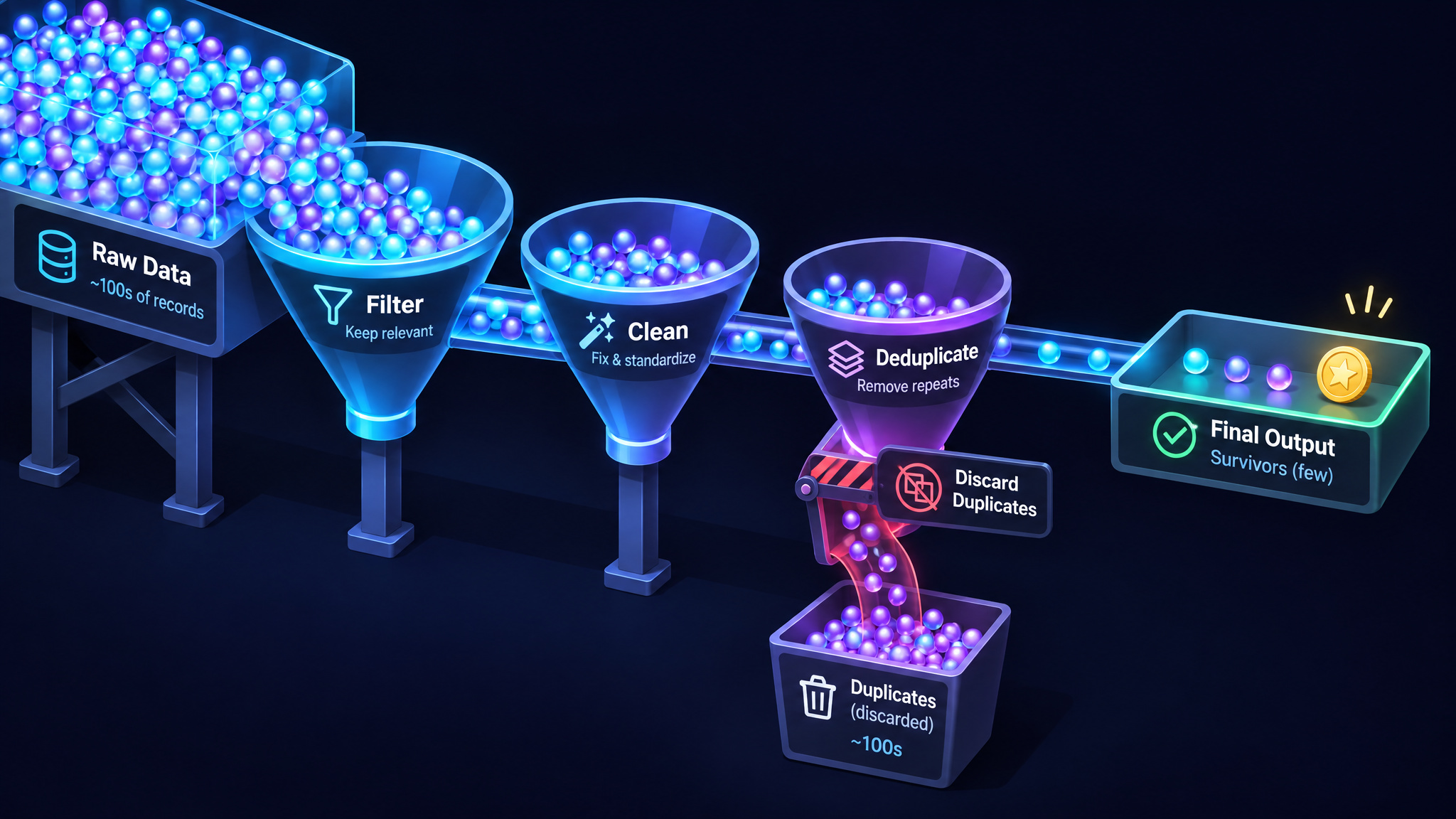
Building an automated AI news pipeline with large language models (LLMs) and custom agents follows a core setup sequence: connect feeds via API, CLI, or MCP server into a central database on an hourly, four-hour, or daily pull schedule, run deterministic code pruning to drop duplicates, stale posts, and low-engagement items, use Jev for obvious keep-or-drop decisions before routing uncertain items to a cheap reasoning model like Haiku 5.5, and pass the survivors to curator and writer agents to generate a concise daily briefing. Developer Cole Medin refined his open-source AI content engine over more than six months of daily use to save hours per week, shipping it as a public GitHub skill that interrogates your coding agent on sources, fetching, and filtering.
The data layer: connecting your sources
Medin’s data layer ingests hundreds of daily posts from Reddit, YouTube, RSS feeds, Hacker News, GitHub repositories, and platform changelogs like Claude Code via API, CLI tool, or Model Context Protocol (MCP) server, using Apify where platform APIs like YouTube and Reddit are locked down.
Deduplication and deterministic filtering
Everything lands in a central database that tracks already-seen items so duplicates never burn tokens. Deterministic code filters drop stale posts and low-engagement items, like a Hacker News post or YouTube video with only a couple hundred views, before any LLM call happens. Next, a lightweight layer named Jev makes the obvious keep-or-drop calls, and a cheap reasoning-capable model like Haiku (Haiku 5.5) evaluates the uncertain leftovers. Removing the LLM entirely dropped accuracy significantly in Medin’s testing, while this staged setup filtered 864 posts for about 3 cents in a single run.
Curator and writer agents
Builder Olle runs a public open-source variant on local cron jobs every 1, 4, or 24 hours across GitHub, YouTube, Reddit, Hugging Face Daily Papers, arXiv, and X. A curator agent (curator.md) picks 1 to 10 posts daily and passes them to a writer agent (writer.md) to generate a three-minute briefing; one sample run merged seven sources across five feeds, grouping an X post, a Hugging Face paper, and an arXiv paper on self-modifying harnesses.
Daily habits that make AI news sustainable
A sustainable daily AI news routine pairs algorithm-free RSS feeds in Feedly with a strict 10-to-30-minute daily reading window and an equal 10 to 30 minutes of digestion time. Instead of checking ten separate websites or letting an algorithm decide what you see, you pull structured updates from subscribed sites and spend your reflection window asking why a release matters, who benefits, what changes the AI service brings, and what comes next. To fit deeper context into the day without burnout, use Speechify (or a similar AI text-to-speech tool) to listen to full articles while driving, riding the train, or walking, and book LinkedIn coffee chats with people in AI strategy, safety, and engineering to compare how they think about the work.
- Centralize chosen blogs in an RSS reader so you never tab-hop across ten websites.
- Match every minute of reading with a minute of structured reflection.
- Swap notes with working engineers and strategists through LinkedIn coffee chats.
RSS feeds with Feedly
The easybiteai creator uses Feedly (not sponsored) to pull chosen sites into one clean RSS feed with no algorithms and no distractions.
Balance reading with thinking
After 10 to 30 minutes of reading, spend an equal 10 to 30 minutes digesting what you read by asking four questions: why it matters, who benefits, what changes this AI service will bring, and what the likely next step is. The creator tests ideas by jotting down open questions and posting on Threads, admitting that the digestion habit is still tough to maintain every day.
Coffee chats and audio on the move
Cold-message people in AI strategy, AI safety, or AI engineering on LinkedIn for casual coffee chats to hear what part of AI they handle and swap useful info. When you’re driving, walking, or riding the train, Tiff In Tech recommends using a text-to-speech app like Speechify (not sponsored, and plenty of alternatives exist) to listen to full articles rather than summaries so you keep the bigger-picture context.
The four factions behind every AI headline
Filtering AI news overload when you can’t read everything starts with mapping every voice to one of Pasquarelli’s four overlapping narrative factions and triangulating across their mental maps (paradigms). Story is a product in AI, and every paradigm carries an ethical cost:
The hype machine
Figures like Elon Musk, Sam Altman, and Andreessen Horowitz push a paradigm of infinite future abundance, selling what could be to justify billion-dollar funding asks while sometimes glossing over technical bottlenecks and short-term safety.
The industry faction
Big tech firms and consultants push a transformation paradigm because they profit from the transition itself, billing companies to help them adapt.
The critics
Long-time tech watchdogs view AI as a set of flawed mathematical models, spotlighting risk sometimes at the expense of genuine breakthroughs.
The analysts
Researchers and academics like Azeem Azhar, Ethan Mollick, Shipra Jain, and Pasquarelli himself try to map what’s actually happening, though upbringing and worldview shape everyone’s bias.
Triangulate instead of finding a perfect source
All-hype ignores real risks, while all-slowdown denies breakthroughs in AI drug discovery and cancer treatment, so triangulate across factions instead of hunting for one unbiased source.
Momentum signals and knowing what to skip
Developers and curious readers tracking AI tools, model updates, and community-recommended builds should watch leading builder channels like GitHub trending repositories, platform changelogs, and filtered Reddit opinion feeds rather than waiting for mainstream press. Watching what engineers star, ship, and fund tells you what the rest of the internet will argue about next month.
Even if you aren’t writing code, Tiff In Tech points out that checking GitHub trending repositories gives you a live view of what builders are actually putting into daily workflows; in one single-day snapshot from her demo, AWS Labs sat at number one with 1,300 stars. Pair that with Medin’s and Olle’s developer signal sources: Claude Code changelogs, Hacker News front-page discussions, Hugging Face Daily Papers, arXiv, and Reddit threads pruned for real tool opinions, alongside TechCrunch funding rounds and acquisitions that show where capital is gathering.
Then give yourself permission to ignore the rest. Tiff In Tech cheerfully admits there are whole areas of tech she knows nothing about. Aim for surface-level awareness across the broad field, go deep only on the niche that touches your actual work, check builder momentum once a week, and close your tabs without guilt.
Frequently Asked Questions
How can I keep up with AI news without burning out?
Stop trying to read everything with sheer willpower and build a personal filtering stack instead. We stick to a narrow roster of authority sources like The AI Daily Brief alongside primary lab blogs, rather than letting algorithmic feeds dictate our attention. Pair that curated intake with automated digests or an algorithm-free RSS reader like Feedly so you can close your tabs without guilt.
Why is it so hard to keep up with AI news and new model releases?
The AI beat mixes relentless daily drops—model weights, benchmark tables, and startup funding—with an exhausting loop of existential hype. Because every minor update gets framed against predictions of artificial general intelligence arriving in two years or white-collar jobs vanishing in five, your brain processes ordinary product changelogs like emergency broadcasts. Once you realize this panic script dates back to the 1950s, it gets much easier to tune out the noise.