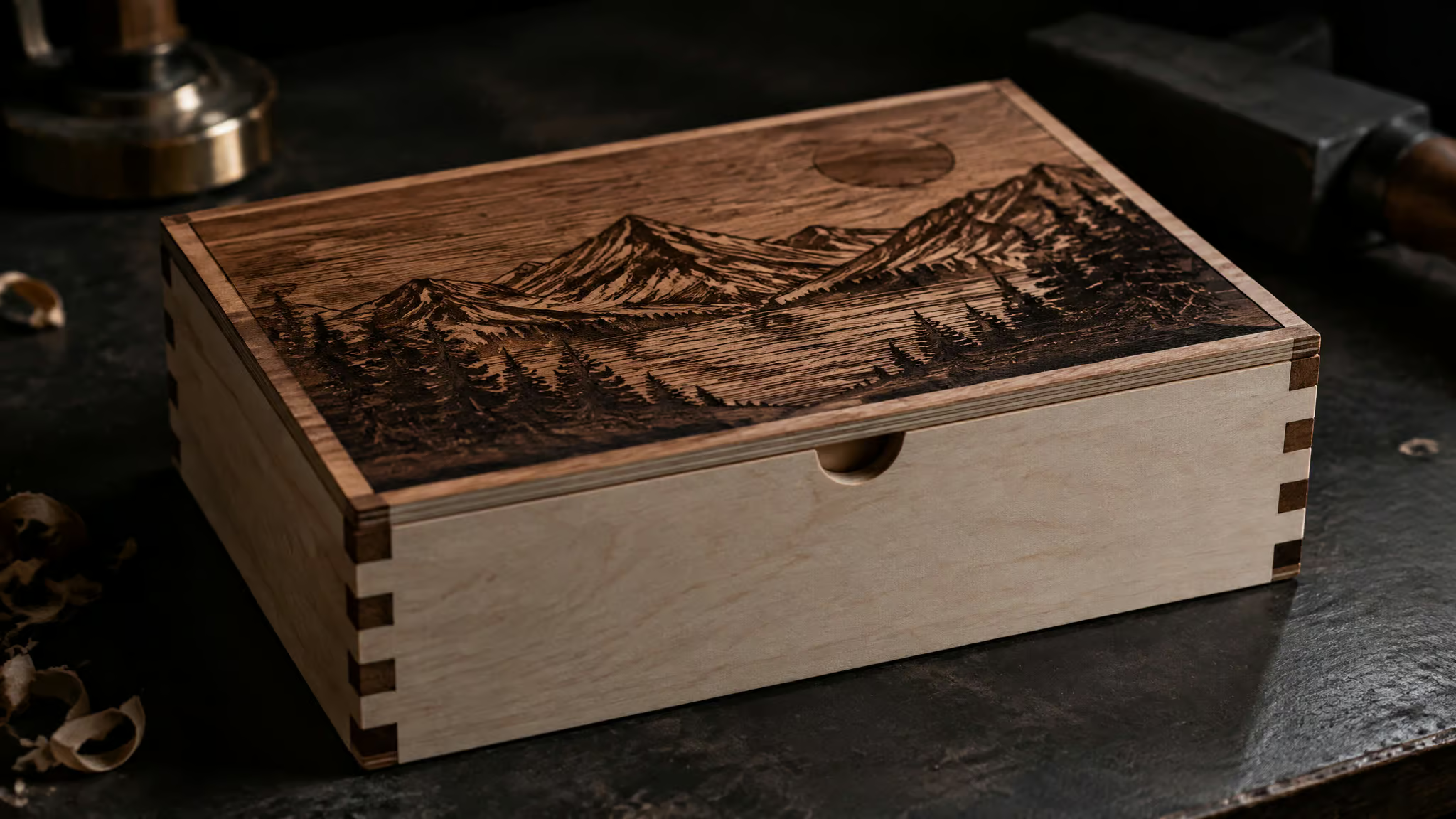
A flat laser-engraved coaster can hide a multitude of material sins on its back side, but a three-dimensional box exposes every millimeter of the sheet you feed into the bed. Every finger joint turns the laser-cut kerf into a visible exterior trim line, the lid has to sit dead flat without cupping, and the side walls need enough structural backbone to survive actual handling. Finding the best wood for laser engraved boxes means auditing three mechanical demands at once: crisp engraving contrast on the lid, clean uncharred faces on exposed joint edges, and structural rigidity in the walls.
When you build a laser-engraved wooden box from raw sheet stock, picking the wrong substrate hits production margins, fume compliance, and client trust simultaneously. One commercial distributor lost a 500-unit repeat order after charred Baltic birch edges failed the client’s incoming quality control. A 15-minute material audit before starting the batch would have caught the issue before a single box shipped.
Key Takeaways
Certified Baltic birch plywood (650 to 700 kg/m³) is the production benchmark for structural boxes, cutting up to 18 mm deep on a 100W CO2 laser with void-free layered edges and lowering net per-part costs by $0.40 to $0.80 over cheap commodity sheets once reject rates and lens cleaning are factored in.
Pick 3 mm (1/8 in.) plywood for decorative boxes, lids, and 10W diode setups (70% to 80% power at 100 to 150 mm/s), and step up to 6 mm (1/4 in.) stock on a CO2 laser (85% power at 1,080 mm/min in 1 pass) when larger box walls need structural rigidity.
Keep wood moisture between 6% and 8% MC to prevent kerf drift and edge browning, and only cut CARB Phase 2, E1, or NAF-certified sheets under mandatory HEPA and activated carbon filtration to control Group 1 carcinogenic formaldehyde fumes.
Table of Contents
| Category | Option | Observed price (Oct 30, 2026) | Why it stands out |
|---|---|---|---|
| N/A | Baltic birch plywood | $0.40 | Gold standard for production laser cutting: void-free core, consistent density, and 5-star edge quality for clean enclosure and signage work. |
| N/A | Basswood | $800 | Lowest-density commercial hardwood, cutting with minimal power and almost no char; delivers sharper mid-tones than birch in grayscale photo engraving. |
| N/A | Alder | Not published | Tightest engraving alternative to Baltic birch, with consistent tight grain suited to branded merch and plaques. |
| premium contrast at a premium price | Hard Maple | $800 | Premium engraving wood for awards and precision OEM parts; maple plywood offers lighter, more uniform color than birch. |
| N/A | Cherry | Not published | Luxury look for premium décor and gift products; aging darkens contrast, so engraving results improve over time. |
| N/A | Oak plywood | Not published | Oak Plywood Good for a more dramatic grain Oak plywood has a more prominent grain pattern that can look great for certain projects. |
Prices are observed prices on the linked pages as of Oct 30, 2026 and change with promotions; the linked product page is always the current source.
What makes a wood good for an engraved box
Engineered birch plywood and tight-grained hardwoods like basswood, alder, hard maple, and cherry dominate laser cutting because their internal density directly sets your machine power and feed speeds. In CO2 laser manufacturer KASU’s material rankings, low-density basswood vaporizes with minimal power, while denser premium engraving woods like hard maple and cherry demand higher wattage and slower travel rates.
For three-dimensional enclosures, cross-laminated plywood holds a massive mechanical advantage over solid lumber. It warps and shrinks far less, resists splitting along the grain, and sells in large, affordable sheets, keeping tight-fitting laser-cut finger joints dimensionally accurate. Because the laser beam is non-contact and vaporizes wood fibers directly, the heat seals the cut edge against splintering or fraying.
You pull parts off the bed with zero tool marks and minimal sanding required. Storage can still ruin a good sheet. When moisture drifts across an unsealed board, lids and walls cut from the very same sheet engrave at different depths and slip out of joint tolerance.
Baltic birch: the production benchmark
Uniform, tight-grained pale veneers like Baltic birch produce dark, high-contrast engravings, whereas solid softwoods with alternating hard and soft grain bands such as Douglas fir, larch, and construction pine burn unevenly across the lid. That optical consistency, paired with a 650 to 700 kg/m³ density and a void-free core, makes Baltic birch the production benchmark for laser-cut boxes.
Why the construction matters
True Baltic birch uses an all-birch veneer core laminated with exterior-grade adhesive under tight veneer thickness tolerances. Because there are almost no internal gaps, the beam cuts cleanly without blowing out, leaving a pale face that pops against dark engravings and a striped, layered edge profile that turns exposed box corners into a deliberate design feature.
Real-world test results and sourcing
Wholesale supplier Thomes North America, the first-to-market and largest North American importer of Baltic birch for the automotive, furniture, aircraft, and construction industries, imports its stock from Finland and Latvia in plain, film-face, and melamine-coated finishes. These globally standardized panels ship flat and stay flat.
Suppliers carry sizes from 1,525 x 1,525 mm to 1,830 x 3,660 mm, thicknesses from 3 mm (1/8 in.) to 30 mm (1 3/16 in.), and face grades B, BB, CP, and C. On a 100W CO2 laser, Baltic birch cuts up to 18 mm deep and holds a 5-star clean edge profile from 3 mm to 18 mm at a mid-tier ($$) cost index. That reliability makes 3 mm stock a shop staple for boxes, puzzles, board game components, model airplanes, jewelry, ornaments, photo frames, wall art, coasters, and personalized signs.
Basswood: easiest cut, weakest walls
At 320 to 450 kg/m³, basswood is the lowest-density commercial hardwood on the market, pairing a budget ($) cost tier with 5-star edge quality and a 15 mm maximum cut depth on a 100W CO2 laser. It needs almost no laser power, leaves near-zero char, and comes in pre-dimensioned sheets that slash prep time for crafts, rapid prototypes, and high-margin gift lines.
Where basswood earns its keep on a box is the lid. In side-by-side tests of grayscale photo engravings and dithered box lid artwork against birch, basswood’s uniform, low-resin grain resolves noticeably sharper mid-tones that customers can immediately spot on memorial or gift pieces. The catch is physical softness. Low surface hardness means basswood dents and scratches if you look at it sideways, making it a poor choice for structural box walls that take handling. On a 60W CO2 machine, 6 mm basswood cuts cleanly in a single pass at 70% power and 1,200 mm/min, while 10 mm stock takes 2 passes at 85% power and 720 mm/min.
Alder: the closest engraving rival to birch
Sitting at 400 to 500 kg/m³ in the mid-tier ($$) price bracket, alder delivers 5-star edge quality and a 12 mm maximum cut depth on a 100W CO2 laser while allowingshops to lock in highly repeatable parameter sets. When you want a box that skips the striped plywood edge look without sacrificing engraving reliability, alder is the closest solid-wood engraving alternative to Baltic birch.
Because the grain stays tight and consistent, you don’t have to babysit power tweaks from board to board. Once you dial in your raster and vector settings, they hold steady across production runs of branded merch, awards, plaques, and decorative box lids. Under controlled conditions where wood laser tolerances hold within ±0.005 in. (0.127 mm), a 100W CO2 laser slices 6 mm alder in 1 pass at 90% power and 840 mm/min, and steps through 10 mm stock in 2 passes at 95% power and 540 mm/min.
Hard maple: premium contrast at a premium price
Hard maple is a heavyweight 700 to 820 kg/m³ hardwood in the top ($$$) price tier, retailing at 2 to 3 times the price of basswood while capping out at a 10 mm maximum cut depth and 4-star edge quality on a 100W CO2 laser. You pay for hard maple twice: once at the lumberyard, and again on the laser bed.
Because that dense fiber structure resists vaporization, hard maple demands higher laser power and slower feed rates, stretching out machine cycle times on precision OEM parts, awards, cutting boards, and high-end gift boxes. On a 100W CO2 system, a 6 mm cut takes 90% power at 840 mm/min in a single pass, while pushing to 10 mm requires 95% power at 540 mm/min across 2 passes. If you want that creamy, upscale aesthetic without wrestling solid-hardwood feed speeds on every wall cut, maple plywood splits the difference. It offers a lighter, more uniform natural face color than birch while still cutting cleanly and engraving with crisp detail.
Cherry: luxury look, slower feed
Baltic birch ($$, 650 to 700 kg/m³) handles flat, void-free structural boxes that need fast single-pass cuts and high-contrast pale lids. Step up to cherry ($$$, 550 to 630 kg/m³) when a luxury gift box calls for rich solid-wood color and your project margin covers higher laser power and slower feed rates. While we break down how different wood species score on pure engraving contrast in our dedicated material guide, building a three-dimensional cherry box introduces unique machine-time and maintenance tradeoffs.
Cherry achieves 4-star edge quality and a 10 mm maximum cut depth on a 100W CO2 laser, and its engraved contrast actually darkens and improves as the wood ages in ambient light. In KASU’s CO2 tests on masked cherry, 6 mm stock cut in 1 pass at 75% power and 1,080 mm/min with a roughly 0.3 to 0.4 mm kerf.
Stepping up to 10 mm stock required 2 passes at 86% power and 660 mm/min, widening the kerf to 0.4 to 0.6 mm. Plan your maintenance schedule accordingly: running cherry at high duty cycles pitches up laser optics faster, meaning you will wipe the lens down about 30% more often than you would when cutting alder under the same workload.
Oak plywood: grain as a design choice
Oak plywood carries a heavy, prominent grain pattern that stays completely visible inside raster engravings, turning box lids and sides into a textured, rustic design statement rather than a flat tonal fill. If you’re building a vintage-style chest, whiskey box, or tabletop gaming case, that coarse cathedral grain adds tactile character that smooth birch or maple can’t fake.
From a laser physics standpoint, oak plywood is denser than Baltic birch (which sits at 650-700 kg/m³ and reaches an 18 mm max cut depth on a 100W CO2 laser), and its pronounced earlywood and latewood rings absorb heat at slightly different rates. To get clean cut edges and even pocket bottoms without lingering char, you have to nudge your laser power slightly up or drop your travel speed down compared to that baseline birch profile.
Pine and resinous softwoods: practice wood, not box wood
Solid lumber and softwood sheets fail for finished laser-cut boxes when warping, heavy knots, and alternating grain bands wreck dimensional accuracy and edge quality, whereas cross-laminated hardwood plywood stays flat and uniform across batches. Pine plywood is soft, cheap, and slices easily on a 10W diode laser, making it handy for quick kerf tests or throwaway mockups, but its wild knot and density swings make it a gamble for final enclosures.
Pitch combustion in high-resin softwoods also leaves a darker, heavier char that drops laser lens-cleaning intervals from every 8 hours down to every 3 hours. Resinous species with alternating hard and soft grain bands, specifically Douglas fir, larch, and cheap construction pine, lock you into a no-win parameter trap. Tune your power for the soft grain and the beam leaves the hard bands uncut; crank the power to punch through the hard rings and you char or blow out the soft grain right next to it.
MDF: uniform engraving, compliance risk
Medium-density fiberboard (MDF, 700 to 800 kg/m³, $ cost tier) has zero grain, knots, or internal voids for uniform engraving and 4-star cut edges up to 12 mm on a 100W CO2 laser, but its adhesive off-gassing makes it a severe compliance risk unless you specify CARB Phase 2, E0/E1-rated, or NAF sheets in your supplier contract and run industrial extraction. On an 80W CO2 laser, 6 mm MDF cuts in 1 pass at 80% power and 1,500 mm/min, while 10 mm stock takes 1 to 2 passes at 90% power and 900 mm/min, throwing fine dust that requires heavy filtration.
What the grade letters mean, and what’s hiding inside the sheet
Internal air pockets (voids), hidden knots, and uneven adhesive patches in cheap hardware-store plywood interrupt the laser beam, causing incomplete cuts, ugly blowouts, and glue scorching. Baltic birch avoids this with a solid, void-free all-birch veneer core. Before you slide a sheet onto the honeycomb bed, the two-letter stamp on the edge tells you what the faces look like, and a quick edge check tells you what’s hiding in the middle.
Decoding the A-D letter pairs
Suppliers stamp plywood veneers from A (best) to D (lowest) as a front-face and back-face pair:
- Grade A: Smooth, paintable, free of knots or defects, and the most expensive tier.
- Grade B: Smooth surface with minor defects.
- Grade C: Contains knots, patches, and a rougher face texture.
- Grade D: Heavy defects and knots, suited strictly for hidden back-side use.
Map those letter pairs directly to your box anatomy. Buy A/A or A/B (which also carries far fewer internal voids) for visible box lids and exterior walls. Save B/B or A/C for prototypes, shop jigs, or hidden interior tray bottoms, and skip C and D grades entirely on any visible surface where defects ruin engraving contrast.
Voids, knots, and glue pockets
Lower-grade C and D veneers pack in knots, patches, and internal voids, far more than higher grades like A/B birch, so when a laser beam hits a hidden air pocket inside commodity plywood, the beam loses focus, causes blowouts, and scorches the layer underneath instead of slicing cleanly through, ruining multi-pass settings and leaving ragged craters along exposed finger joints. Internal knots are just as destructive because their localized density spikes higher than the surrounding veneer, leaving uncut tabs that force you to scrap the part. Always eyeball the raw edges of a sheet for visible gaps before buying.
mm or 6 mm: thickness for box walls and lids
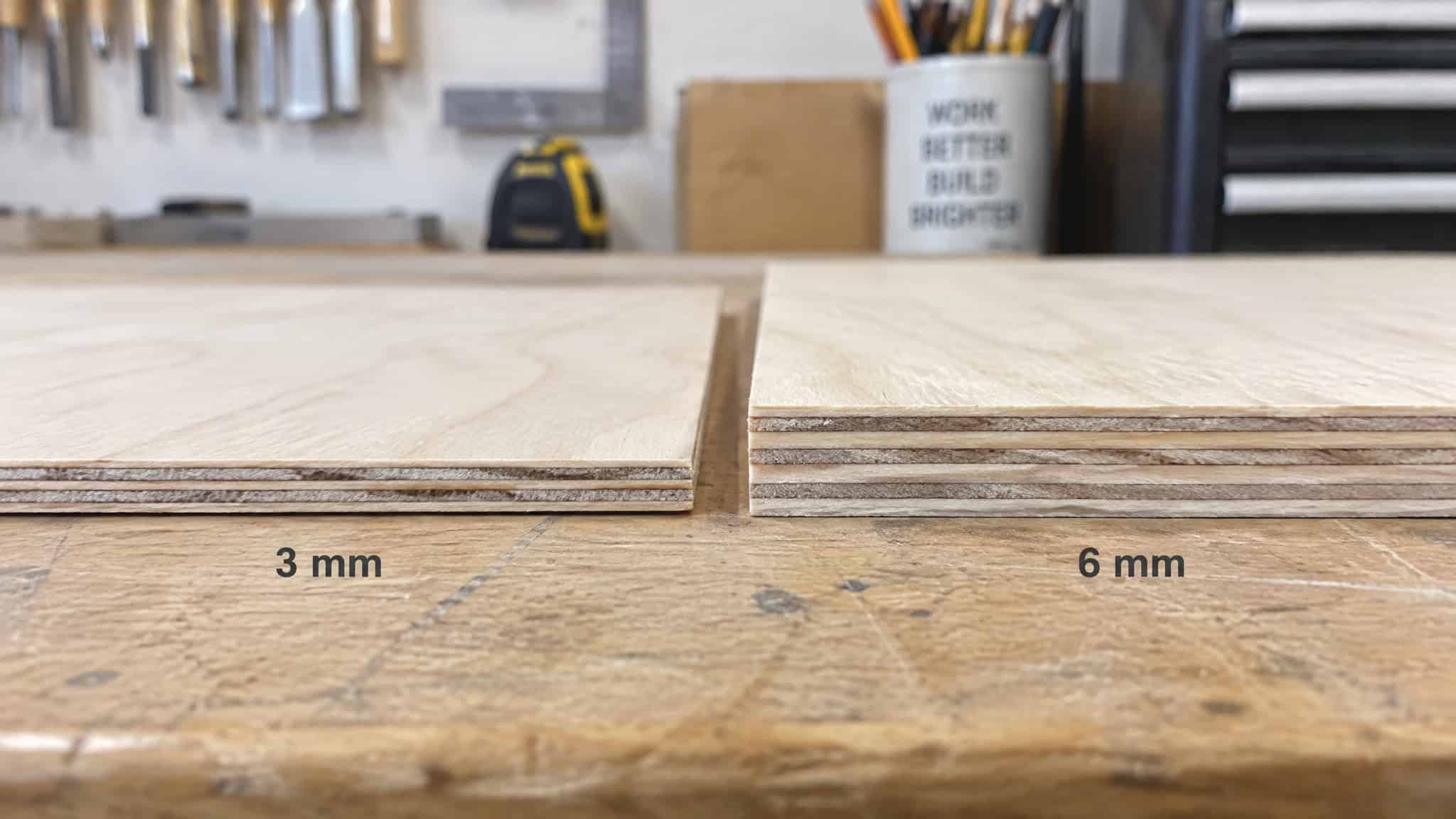
Pick 3 mm (1/8 in.) plywood for decorative boxes, jewelry cases, lids, and 10W diode setups where single-pass cutting speed matters, and step up to 6 mm (1/4 in.) plywood when larger box walls, signs, or furniture-grade joinery demand structural rigidity and you have a CO2 laser (or the patience for multi-pass diode cuts). And yes, a 10W diode laser is plenty powerful enough to cut and engrave 3 mm plywood boxes in 1 to 2 passes, making 1/8 in. stock the sweet spot for desktop makers.
Matching thickness to the box’s job
Baltic birch panels come in thicknesses from 3 mm up to 30 mm (1 3/16 in.), but nearly all enclosure designs use 3 mm or 6 mm stock. At 3 mm, the stock is light, nimble, and ideal for small enclosures, puzzles, and decorative lids. The physical catch with 3 mm sheets is heat-induced warping or cupping. You have to pin thin sheets dead flat against the bed with hold-down jigs or tape before firing the laser, then let plywood’s cross-laminated grain keep the cut finger joints straight.
Once a box scales up to hold heavy contents or act as a structural organizer, 3 mm walls flex too much. Stepping up to 6 mm (1/4 in.) doubles the glue surface area on every finger joint and gives the walls real mechanical stiffness. If you push into heavy 12 mm stock for structural chests or shop fixtures, source Eastern European Baltic birch, which holds the tightest veneer thickness tolerances and delivers the most predictable multi-pass behavior at 12 mm and above.
What your machine can actually cut
On a 10W diode laser, 3 mm plywood cuts cleanly in 1 to 2 passes, 6 mm takes 2 to 3 passes, and 12 mm becomes a slow, multi-pass marathon. A CO2 laser blasts through 6 mm plywood in a single pass and handles 12 mm to 18 mm Baltic birch without breaking a sweat.
| Material & Thickness | Laser Type | Power | Speed | Passes |
|---|---|---|---|---|
| 3 mm Plywood (Cut) | 10W Diode | 70%, 80% | 100-150 mm/s | 1-2 |
| 3 mm Baltic Birch (Maker Stock test cut) | Diode (xTool) | 90% | 6 mm/s | 1 |
| 6 mm Plywood (Cut) | 10W Diode | 80%, 100% | 80-100 mm/s | 2-3 |
| 6 mm Baltic Birch (Maker Stock test cut) | Diode (xTool) | 90% | 6 mm/s | 2 |
| Plywood Baseline (Engrave) | 10W Diode / CO2 | 20%, 40% | 200-300 mm/s (300-340 DPI) | 1 |
| Baltic Birch (Maker Stock test engrave) | Diode (xTool) | 80% | 150 mm/s | 1 |
| 6 mm Plywood / Baltic Birch (Cut) | 100W CO2 | 85% | 1,080 mm/min | 1 |
| 12 mm Baltic Birch (Cut) | 100W CO2 | 95% | 600 mm/min | 2 |
| 6 mm Basswood (Cut) | 60W CO2 | 70% | 1,200 mm/min | 1 |
| 10 mm Basswood (Cut) | 60W CO2 | 85% | 720 mm/min | 2 |
| 6 mm Alder (Cut) | 100W CO2 | 90% | 840 mm/min | 1 |
| 10 mm Alder (Cut) | 100W CO2 | 95% | 540 mm/min | 2 |
| 6 mm Cherry (Masked cut) | 100W CO2 | 75% | 1,080 mm/min | 1 |
| 10 mm Cherry (Masked cut) | 100W CO2 | 86% | 660 mm/min | 2 |
| 6 mm MDF (CARB-compliant cut) | 80W CO2 | 80% | 1,500 mm/min | 1 |
| 10 mm MDF (CARB-compliant cut) | 80W CO2 | 90% | 900 mm/min | 1-2 |
The glue inside the sheet: fumes, certifications, and plywood to never cut
Yes, MDF and standard plywood are safe to laser-cut only when you buy CARB Phase 2, E1, or NAF-certified sheets and run mandatory HEPA plus activated carbon fume extraction, because standard sheets bond with urea-formaldehyde (UF) resin that vaporizes into formaldehyde, a gas classified by the IARC as a Group 1 human carcinogen. Makers who cut MDF or resinous pine before setting up proper filtration usually notice sticky residue fouling their machine’s lens first, and only then look up what the adhesive plume actually contains.
Urea-formaldehyde and what vaporizing it means
OSHA’s Formaldehyde Standard sets strict workplace exposure ceilings at 0.75 ppm for an 8-hour time-weighted average (TWA) and 2 ppm for a 15-minute short-term exposure limit (STEL), while EU Directive 2004/37/EC governs exposure in European jurisdictions. Cutting standard MDF without industrial extraction breaches those limits during sustained runs, and one commercial distributor lost a major procurement contract after an EHS audit flagged inadequate fume extraction.
Certifications to check before buying
Require CARB Phase 2 (California Air Resources Board standards), E0/E1-rated, or NAF (No Added Formaldehyde) certification from your supplier before ordering composite wood or plywood. Pair that certified stock with an exhaust fan running both a HEPA particulate stage and an activated carbon chemical filter.
Plywood to avoid entirely
Stick to interior-grade plywood from known manufacturers and never put these four sheets under a laser beam:
- Pressure-treated plywood: Vaporizes toxic preservative chemicals into the exhaust stream.
- Exterior-grade plywood: Uses heavy waterproof adhesives that release dense chemical fumes (use interior-grade stock indoors).
- Pre-painted or heavily coated plywood: Releases toxic fumes and gums up laser optics; always paint your box after cutting.
- Unknown no-name bargain plywood: Frequently uses unverified, low-grade adhesives that char and off-gas unpredictably.
Why your test cut passed but the batch failed: moisture and vetting
Wood must stay between 6% and 8% moisture content (MC) before laser cutting or engraving, because stock above 12% MC forces the beam to waste energy boiling trapped water, widening the heat-affected zone (HAZ), destabilizing kerf width, and leaving muddy edge browning instead of a dark, high-contrast engraving on a pale veneer face.
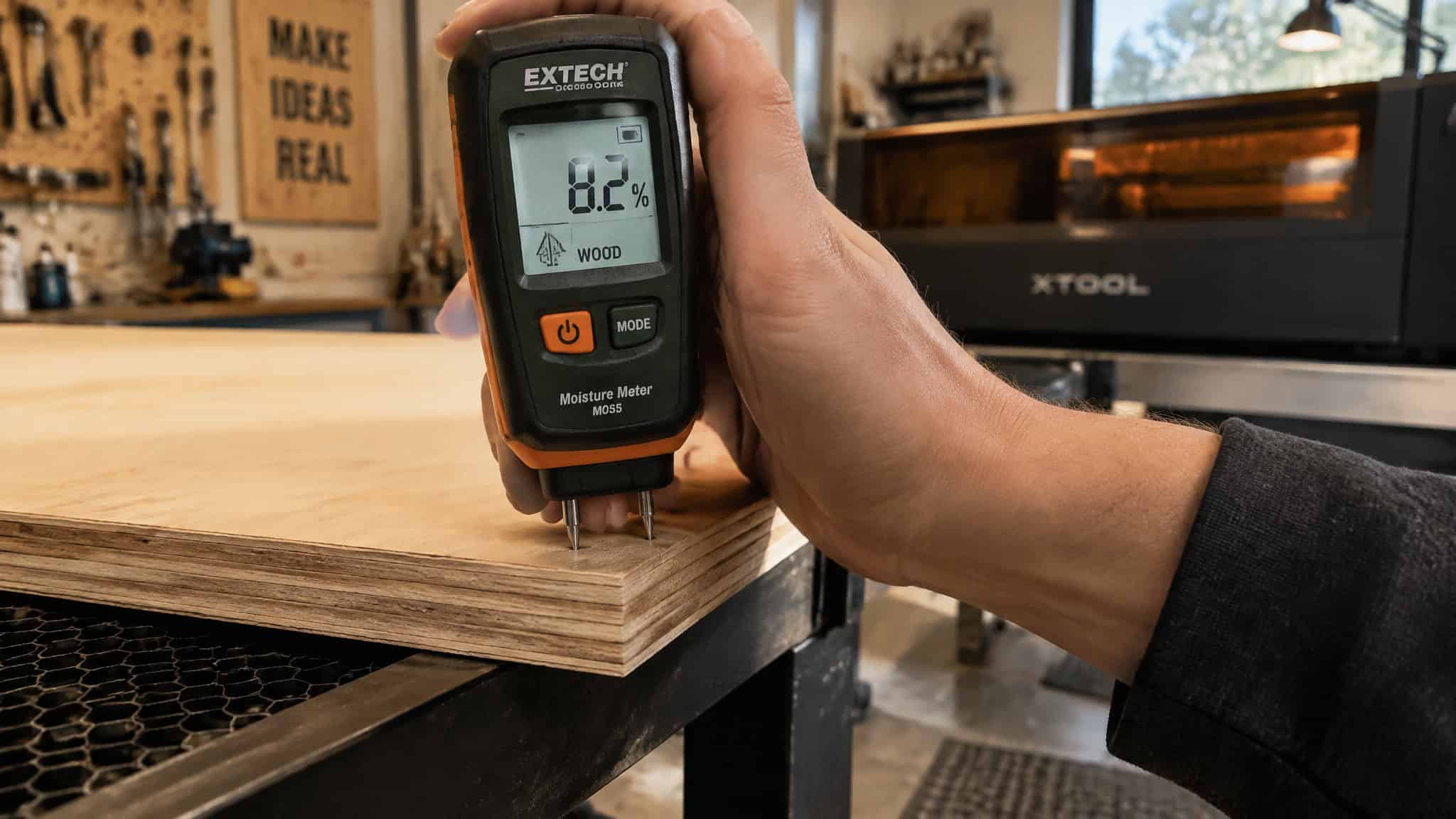
Moisture content and cut consistency
Uncontrolled warehouse or garage storage can drift a plywood sheet right out of that 6% to 8% MC window in just two weeks. That explains why a quick test cut on the corner of a fresh sheet snaps together nicely, while box walls cut two weeks later from the same stack burn pale and refuse to mate. Always ask suppliers for moisture certification when ordering volume stock.
A batch-vetting protocol before you commit a sheet
At GeekExtreme, we care far more about repeatable shop math than brochure promises, which is why we recommend adapting KASU’s 5-step batch qualification protocol before committing a stack of wood to a box run: run moisture meter checks, perform density spot-checks, and execute 5-cut parameter sweeps to lock settings and prevent optics contamination. Skipping that check gets expensive fast. In one 300-sheet commercial pine run, progressive beam degradation widened the cut kerf by 0.3 mm and pushed parts out of dimensional tolerance after sheet 180, forcing a 120-sheet re-run and costing the shop the client’s reorder.
Diode or CO2: matching the laser to the material
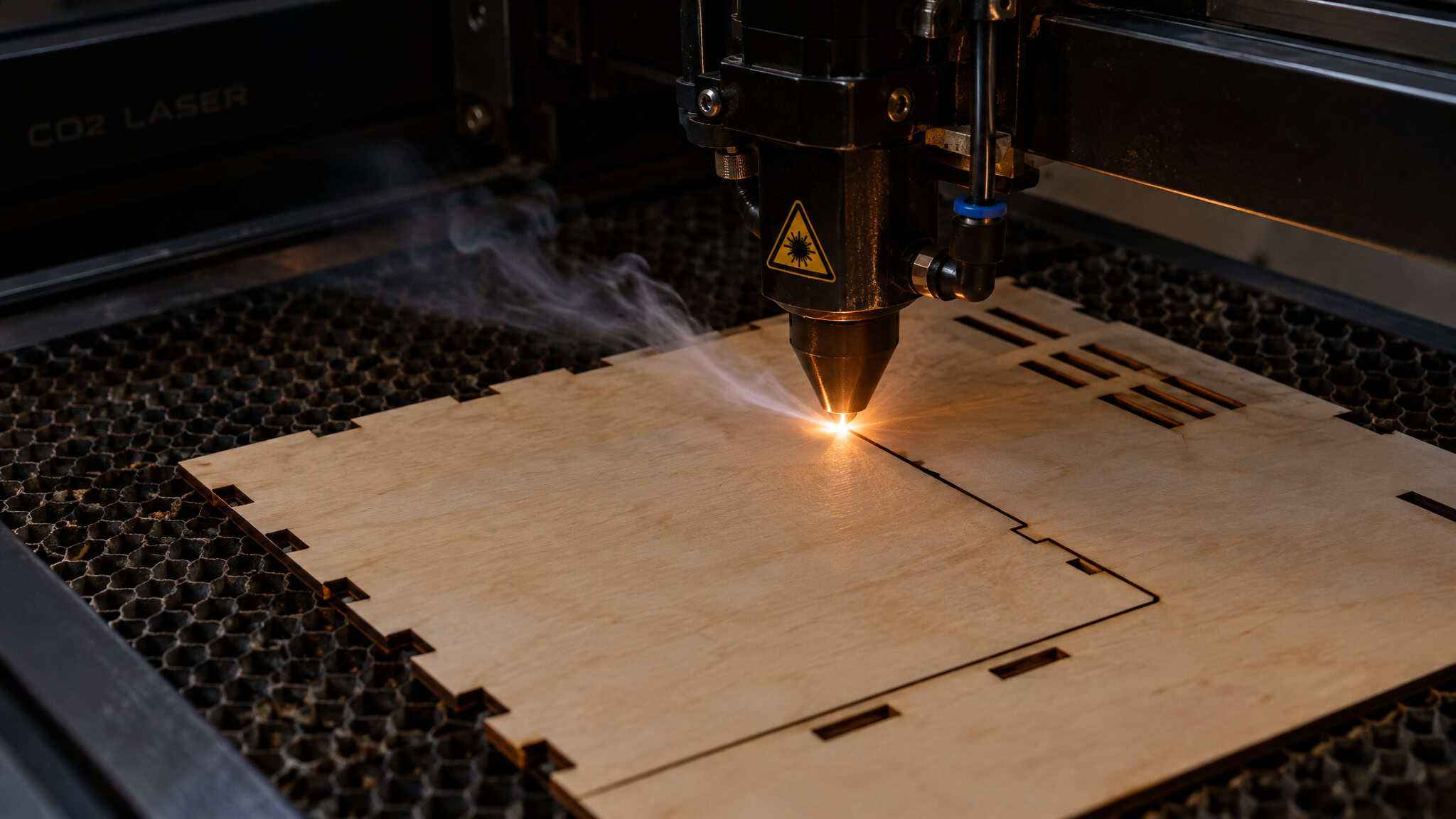
Choose a 60W to 100W CO2 laser (whose 10.6 µm wavelength wood absorbs with high efficiency) for fast, single-pass cutting on 3 mm to 6 mm box walls with heavy fume extraction, or use a 10W diode laser when you’re cutting thin 3 mm box stock in 1 to 2 passes and want crisper, thinner engraved lines with less surface charring.
Capability comparison
In side-by-side maker testing, diode lasers actually edge out CO2 tubes on fine engraving crispness, producing tighter lines and less surrounding char on box lids. However, CO2 dominates production throughput and outperforms fiber lasers across non-metal wood substrates. For CO2 production sizing, plan on 40W to 60W for ?3 mm stock in 1 pass, 60W to 100W for 3 mm to 6 mm in 1 pass, roughly 100W for 10 mm to 12 mm in 1 to 2 passes, and 100W for 18 mm Baltic birch in 3 passes.
Starting settings and edge-quality techniques
To keep exposed finger joints clean without rounding over sharp box corners, combine dialed-in speeds with four bench habits:
- Run air assist: Blows smoke and flaming resin clear of the cut path, protecting both the top veneer and the laser head’s electronics.
- Elevate on a honeycomb table: Lets exhaust smoke escape underneath the board so flashback doesn’t char the bottom face.
- Mask with blue painter’s tape: Apply flat across the face before cutting and peel afterward to trap surface smoke rings.
- Sand lightly with 220 to 320 grit: A quick pass with fine sandpaper strips minor edge soot without dubbing over crisp finger joints.
Is the cheap sheet cheaper? Cost as total cost of ownership
Certified Baltic birch (650 to 700 kg/m³, $$ tier) is worth the extra upfront cost over cheap commodity plywood and MDF (700 to 800 kg/m³, $ tier) whenever you build three-dimensional boxes or run production batches, because lower reject rates, cleaner edges, and fewer lens-cleaning stops can swing total cost of ownership (TCO) by $800 to $1,200 per month in Baltic birch’s favor.
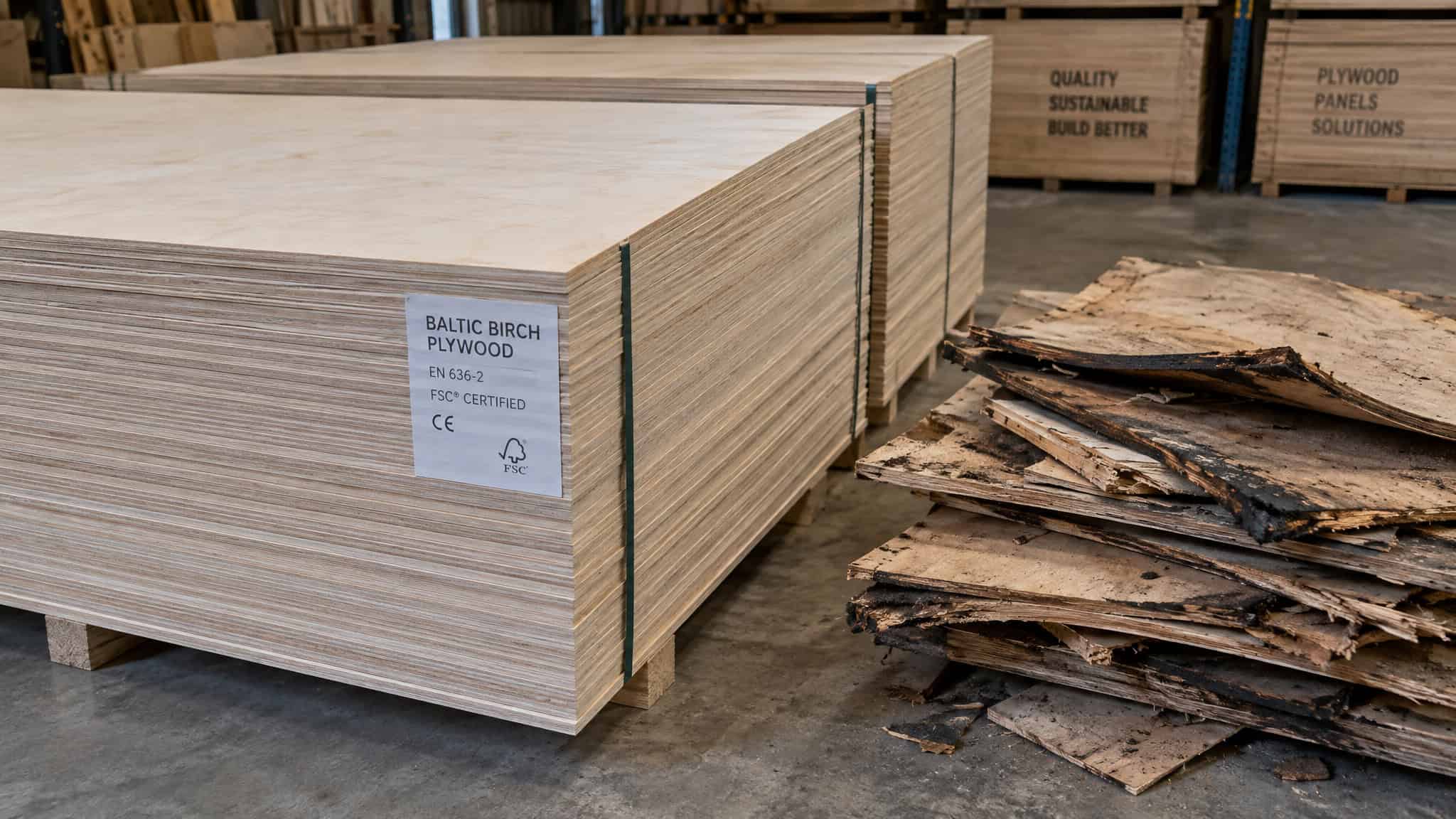
When you price out a box build by looking only at the per-sheet sticker price, low-grade hardware-store plywood and $ tier MDF look tempting, while $$$ tier hard maple (at 2 to 3 times the price of $ tier basswood) looks steep. Once the laser starts running, hidden flaws flip the math. A single internal void or density knot that leaves an uncut tab doesn’t just ruin a 10-cent scrap of wood; it scraps an entire multi-part box wall and eats the machine time spent engraving it.
In KASU’s production analysis, cheap commodity wood averaged a 12% reject rate and forced two extra 45-minute lens-cleaning maintenance stops every week. Certified Baltic birch ran at a 3% reject rate with predictable E1-or-better adhesive chemistry. Across a 1,000-part production run, that reliability inverted the sticker price, landing Baltic birch roughly $0.40 to $0.80 lower in effective net cost per finished part.
| Material Option | Density (kg/m³) | Max Cut Depth (100W CO2) | Edge Quality | Cost Tier | Production & Box Verdict |
|---|---|---|---|---|---|
| Certified Baltic Birch | 650-700 | 18 mm | 5-Star | $$ | Yes (3% reject rate; $0.40-$0.80 lower net cost/part at volume) |
| Basswood | 320-450 | 15 mm | 5-Star | $ | Partial (sharp photo lids and crafts, too soft for structural walls) |
| Alder | 400-500 | 12 mm | 5-Star | $$ | Yes (closest solid-wood engraving rival to birch for lids/plaques) |
| Hard Maple | 700-820 | 10 mm | 4-Star | $$$ | Partial (2-3x basswood price; slower feed for luxury gift boxes) |
| Cherry | 550-630 | 10 mm | 4-Star | $$$ | Partial (warm aging contrast; 30% more lens cleaning than alder) |
| CARB-Compliant MDF | 700-800 | 12 mm | 4-Star | $ | Partial (uniform flat panels; requires CARB Phase 2/NAF and heavy filtration) |
| Commodity / Pine Ply | Varies (high knot swing) | Varies by resin | Low (heavy char) | $ | No (12% reject rate; 8-hr lens cleaning drops to 3 hrs on resinous stock) |
Sheet prices vary by supplier and order volume. If you’re scaling up box production, buying from verified Asian suppliers at minimum order quantities (MOQ) above 50 sheets typically cuts material cost by 20% to 35%, while container-volume Baltic birch from Eastern European or Chinese suppliers runs a 2 to 4 week lead time. Always buy the highest veneer grade your project budget allows (A/A or A/B for visible box faces) and factor reject rates and filtration compliance into your math before quoting a fixed-rate contract.
The quality ceiling: when even the best commodity plywood isn’t enough
Even top-grade commodity plywood hits a quality ceiling on dense, intricate cut layouts like interlocking jigsaw puzzles or complex box joinery, where a single unseen internal knot or glue anomaly leaves an uncut piece that ruins the entire sheet and cranking up laser power only scorches the surrounding wood. After spending four years testing off-the-shelf and specialty plywoods (as documented via Hackaday), design studio Nervous System commissioned its own custom-milled 3-ply sheet combining a high-quality basswood core, birch outer veneers, and melamine-based glue, which cut cleaner and more reliably than any commercial plywood on the market.
Where to buy sheets, and what evidence to trust
Rather than gambling on unverified Amazon marketplace listings where technical quality data is nonexistent, buy small pre-cut packs from specialty laser suppliers like Maker Stock or full wholesale panels (1,525 x 1,525 mm up to 1,830 x 3,660 mm) from importers like Thomes North America, and cross-check species verdicts against peer maker forums and Reddit community test logs since most published wood guides come from laser or material vendors.
Independent multi-machine testing shows why specialty laser stock beats mystery retail bundles. When an assortment of Maker Stock’s 3 mm to 19 mm Baltic birch was run across both an xTool diode laser and a Zuwit Cloud Pro CO2 laser, every sheet cut cleanly through with zero glue pockets, internal knots, or core anomalies. Do keep a tape measure handy at the bench: those advertised 12 x 12 in. sheets measured between 11 3/4 in. and 12 3/16 in. out of the box, so leave a small margin around your cut layout or order one size up when tight box joinery is on the line.
Frequently Asked Questions
What type of wood is best for laser cutting?
Certified Baltic birch plywood (650 to 700 kg/m³) is the overall production benchmark for three-dimensional enclosures because its cross-laminated, all-birch core resists warping and cuts cleanly up to 18 mm deep on a 100W CO2 machine. For solid hardwoods, low-density basswood (320 to 450 kg/m³) slices with minimal wattage for sharp photo lids, while alder (400 to 500 kg/m³) delivers repeatable settings for solid walls without the striped plywood edge. Denser options like cherry and hard maple work well for luxury boxes if your margins can absorb slower travel speeds and higher power demands.
Which type of laser is best suited for engraving?
A 10W diode laser actually beats a CO2 tube on pure engraving crispness, producing tighter lines and less surrounding surface char on box lids. However, when you need to cut out the structural box walls, a 60W to 100W CO2 laser (operating at a 10.6 µm wavelength) dominates production throughput and outperforms fiber lasers across wood substrates. Many makers rely on 10W diodes for 3 mm decorative projects and step up to CO2 machines for single-pass cutting on 6 mm to 18 mm stock.
Is a diode laser powerful enough to cut and engrave 3mm plywood boxes?
Yes, a 10W diode machine easily handles 3 mm (1/8 in.) plywood enclosures, making that thickness the sweet spot for desktop setups. At 70% to 80% power and 100 to 150 mm/s, a 10W diode cuts 3 mm plywood in 1 to 2 passes, while an xTool diode slices 3 mm Baltic birch in a single pass at 90% power and 6 mm/s. You can also push a 10W diode to cut 6 mm stock in 2 to 3 passes (80% to 100% power at 80 to 100 mm/s), though 12 mm sheets turn into a slow marathon.
Is MDF safe to laser engrave boxes or does it release toxic fumes?
Standard MDF and composite plywood bond fibers with urea-formaldehyde resin, which vaporizes under a laser beam into formaldehyde—a Group 1 human carcinogen governed by strict OSHA exposure ceilings (0.75 ppm 8-hour TWA and 2 ppm 15-minute STEL). It is only safe when you explicitly source CARB Phase 2, E0/E1-rated, or NAF (No Added Formaldehyde) sheets and run an industrial exhaust system combining HEPA particulate filtration with an activated carbon chemical stage. Also avoid pressure-treated, exterior-grade, or pre-painted sheets, as their chemical preservatives and waterproof glues release toxic plumes and foul optics.
How does wood grain affect laser engraving contrast on boxes?
Tight, uniform, pale woods like Baltic birch, basswood, and alder vaporize evenly across the lid, producing dark, high-contrast engravings and sharp grayscale mid-tones. In contrast, oak plywood’s heavy cathedral grain stays completely visible inside raster pockets because its pronounced earlywood and latewood rings absorb heat at different rates, creating a textured, rustic look. Resinous softwoods with alternating hard and soft grain bands—like Douglas fir, larch, and construction pine—create a parameter trap where power tuned for the soft bands leaves hard rings uncut, while higher power chars and blows out the softer fibers.
What’s the difference between Baltic birch and cherry for laser engraved boxes?
Baltic birch (650 to 700 kg/m³, $$ tier) is an engineered, void-free plywood built for fast single-pass structural cuts (85% power at 1,080 mm/min for 6 mm on a 100W CO2) with a pale face and striped layered edges. Cherry (550 to 630 kg/m³, $$$ tier) is a luxury solid hardwood whose warm, rich color and engraved contrast naturally darken as the box ages in ambient light. The tradeoff with cherry is a 10 mm max cut depth (versus 18 mm on birch), slower multi-pass speeds on thicker stock, and resin buildup that forces you to wipe your laser lens about 30% more often than when cutting alder.
