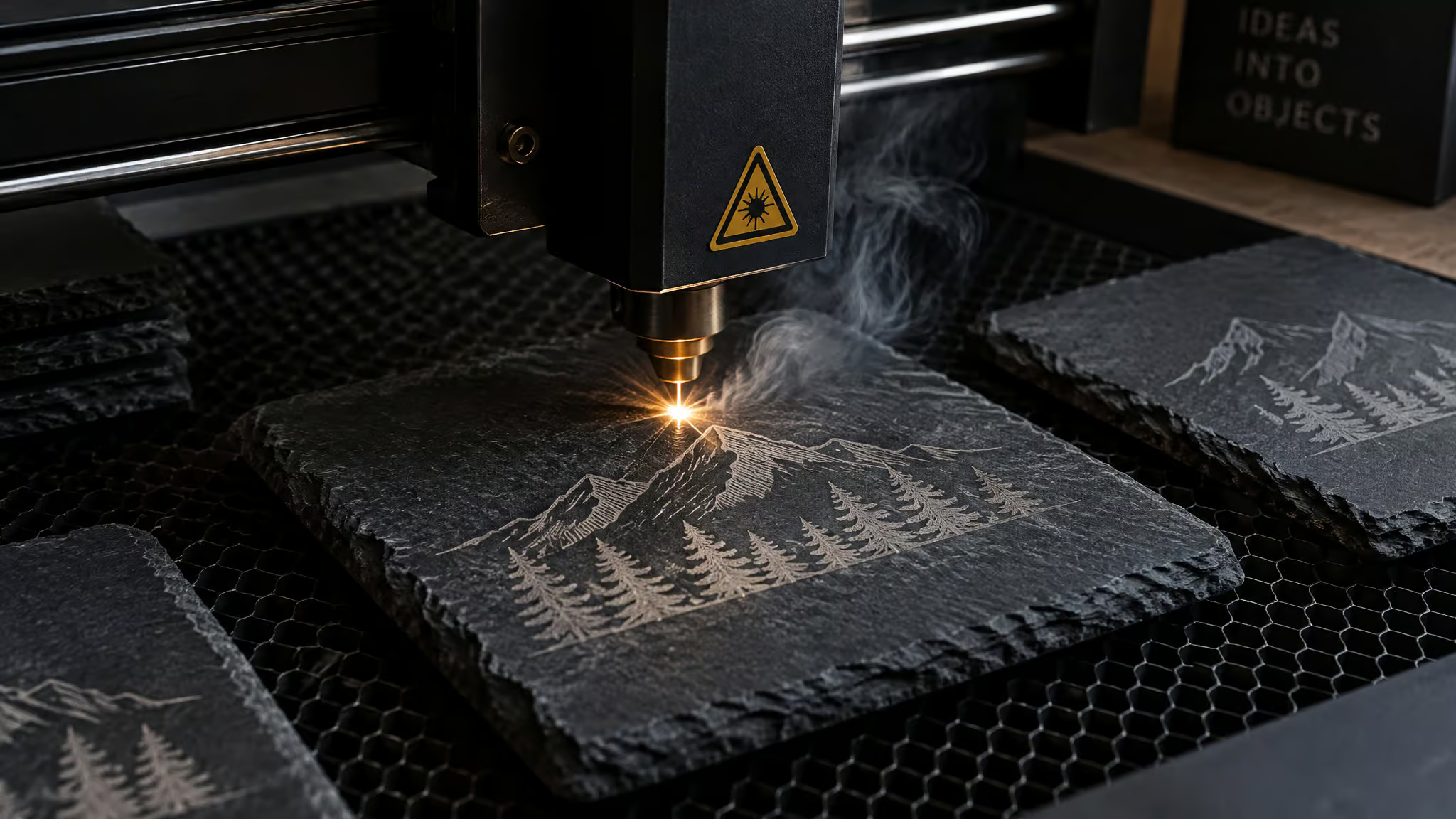
Match your coaster blank to your laser’s wavelength (diode, infrared, UV, CO2, or galvo) instead of copying an online settings list built for a different machine class. A wavelength mismatch is behind almost every coaster failure across slate, granite, marble, wood, cork, MDF, acrylic, metal, leather, ceramic tile, and glass, causing faint metal lines, ruined clear acrylic, cracked wood cookies, and non-absorbent lacquered stone. Backed by Severna Builds’ 1,000+ coasters across 15+ mostly Amazon-sourced blank varieties alongside Smedley Works, MakeUseOf, and How-To Geek testing, these mechanics hold across LightBurn, LaserGRBL, and proprietary software.
Key Takeaways
Raw slate beat lacquered slate in Smedley Works’ two-week ice-water durability test, cleaning up with zero marks because spray lacquer seals the stone’s pores and blocks moisture absorption.
Wavelength dictates material compatibility: 445nm blue diodes cut 3mm dark acrylic and engrave wood or slate, but clear acrylic requires CO2 or UV, and bare stainless steel (where Grade 304 gives the best colors) requires an infrared module.
Commercial wood cookies ship wet with center pith and split as they dry, a flaw that cracked quite a few pieces in a ~1,000-ornament order from Severna Builds, while solid acacia hardwood needs an oil-wax finish like beeswax or Walrus Oil.
Table of Contents
Stone coasters: slate, granite, and marble
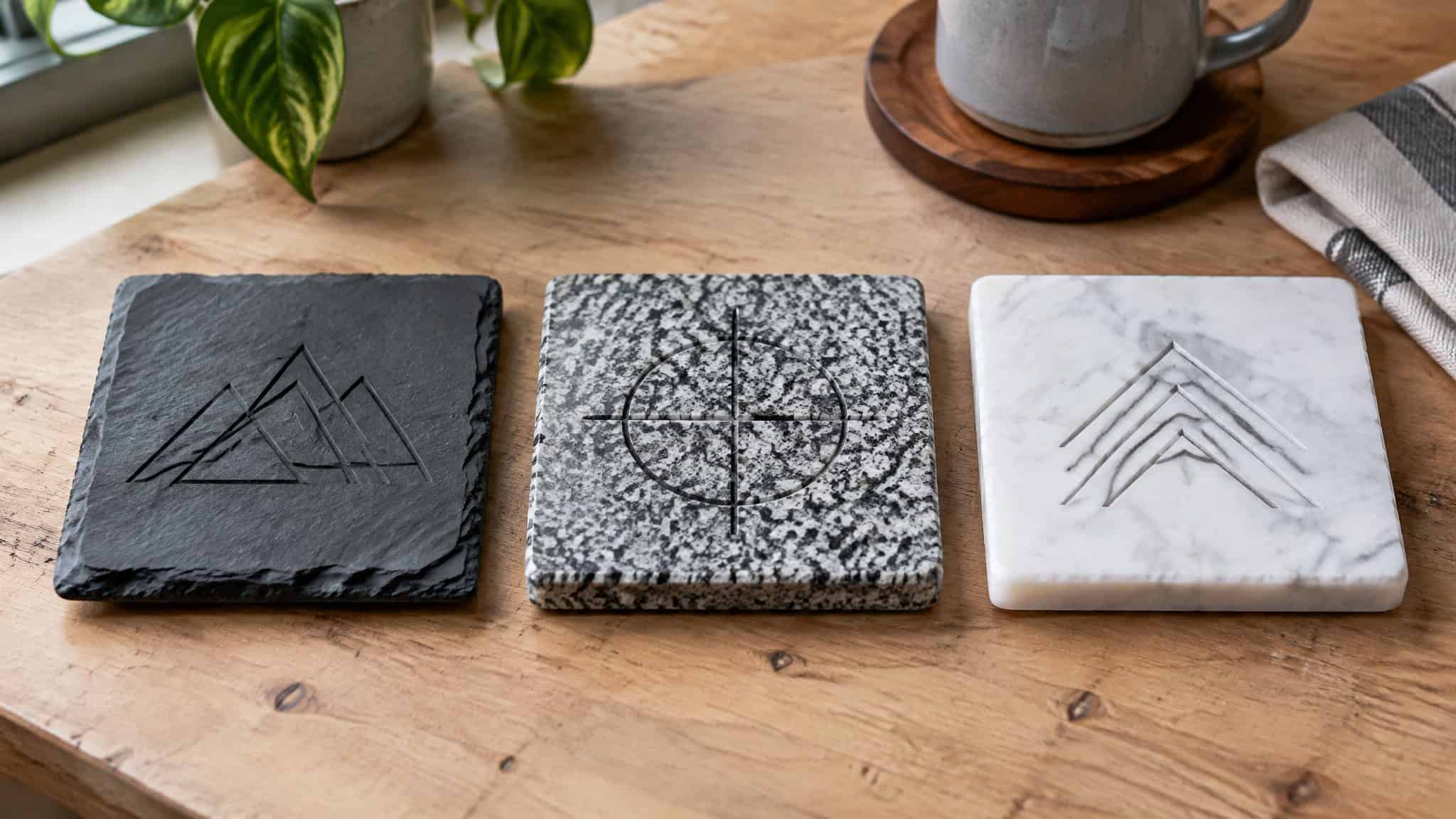
Stone is the heavyweight category of laser coasters, led by slate as the most popular coaster material on the maker bench, alongside higher-end granite, marble, and specialty absorbent stone.
Why slate is the default workhorse
Slate ablates quickly with high dark-to-light contrast, even on low-power blue diodes like the 10W xTool F1 (F1G) or the 5.5W Sculpfun S9 tested by MakeUseOf. Because the surface is dark, you have to invert the design file before firing, and varying speed and power parameters produces silver or gold tonal shifts on any laser type.
Batch thickness variability
Cheap slate coaster packs vary in thickness, size, and squareness across batches and even inside the same box, so some blanks arrive visibly smaller or out of square. Measure, focus, and frame every single coaster individually.
Reclaiming ruined slate blanks
When Smedley Works nearly ran out of stock mid-project, sanding off old engravings with 80-grit sandpaper took about 5 minutes per coaster and recovered usable test blanks, though it thinned and smoothed the stone (120 grit was too slow).
Tested 3D photo engraving parameters
Tested 3D slate photo engraving works at 13 power, 240 speed, 160 LPC (lines per cm), grayscale bitmap mode, and -1.5mm defocus once you invert the file on dark stone and master vectors before bitmap photos. Smedley Works confirmed these numbers using a consistent xTool AI Make Leo zodiac lion vector to close a follow-up from an earlier 3D zoo animal coaster video, finding -1.5mm beat -1mm defocus and 160 LPC sufficed over 180 on raw, lacquered, or paint-foundation slate.
Granite, marble, and Datamasius stone
In Severna Builds’ testing, granite and marble deliver high-contrast engravings that support tuned photo work and command higher resale prices; most lasers handle them, including the 5W infrared xTool F2 and CO2 xTool P3, while the xTool F2 Ultra UV cleanly engraves marble-and-wood hybrids. For pure utility, Datamasius stone absorbs condensation from a cold glass and evaporates it with no puddle left behind.
Raw slate vs lacquer clear coat on slate coasters
Yes, raw slate coasters outperform lacquered ones for everyday drink use: in a two-week ice-water test, raw slate cleaned up with no marks while lacquered slate did not, because lacquer blocks the moisture absorption that makes a coaster work. Many makers apply mineral oil or a spray lacquer clear coat to slate coasters so the dark stone and bright engraving pop. When Smedley Works ran a two-week home durability test under glasses of ice water, the raw slate coaster looked cleaner and stayed unmarked after cleanup compared to the sealed stone.
The physics comes down to surface pores. Raw slate is the practical baseline for making laser engraved coasters because it introduces the fewest variables: no coating, no paint foundation, just stone, settings, and the laser. When you spray clear lacquer over the stone before engraving, you get a glossy or satin sheen that boosts visual contrast, and the laser can still punch through the film to ablate the rock underneath. Once a cold glass sits on that glossy surface, however, condensation has nowhere to go. The lacquer seals the natural stone, preventing moisture absorption and pooling water right under the glass.
That doesn’t mean coatings are useless, only that they belong in a different bucket. Treat spray lacquer, black paint foundations, and mineral oil (which Smedley Works noted wasn’t fully tested in that run) as optional style choices rather than required prep steps. Also keep workshop setup and health concerns in mind, since not everyone has the ventilation to spray lacquer indoors.
| Slate Finish Approach | Visual Contrast | Moisture Absorption | Two-Week Ice-Water Test Outcome | Best Use Case |
|---|---|---|---|---|
| Raw slate (uncoated baseline) | High natural matte contrast | Yes (unsealed stone pores) | Yes (cleaned up with zero marks) | Everyday functional drink coasters |
| Spray lacquer / clear coat | Partial (glossy or satin pop) | No (blocks absorption) | No (did not clean up as well as raw) | Decorative display pieces |
| Black paint foundation | High (uniform dark base for photos) | Partial (depends on topcoat) | Partial (tested for photo prep, not ice-water) | Tuned grayscale photo engraving |
| Mineral oil finish | Partial (darkens stone tone) | Partial (untested in ice-water run) | Partial (style option, not fully tested) | Optional cosmetic conditioning |
Leave drink-facing slate raw so the coaster can actually do its job, and save the glossy clear coats for display stands or wall art.
Wood coasters: basswood, hardwood, and wood cookies
The best wood to make coasters with for laser engraving depends on your project: plywood or basswood (including 3mm, 6mm, and 12mm Baltic Birch) is the cheapest starter material for cutting custom shapes and bulk corporate orders on any laser, while solid hardwood like acacia delivers deep, detailed engraving. Because wood coasters are a timeless, warm staple, conditioning single-piece solid hardwood with an oil-wax finish like beeswax or Walrus Oil (applied like a cutting board conditioner) prevents warping and over-absorption. Avoid taking large custom orders on commercial wood cookies without testing first: they’re usually still wet with center pith and will split or crack, as a 1,000-piece church ornament run demonstrated when quite a few cracked.
Plywood, basswood, and Baltic birch
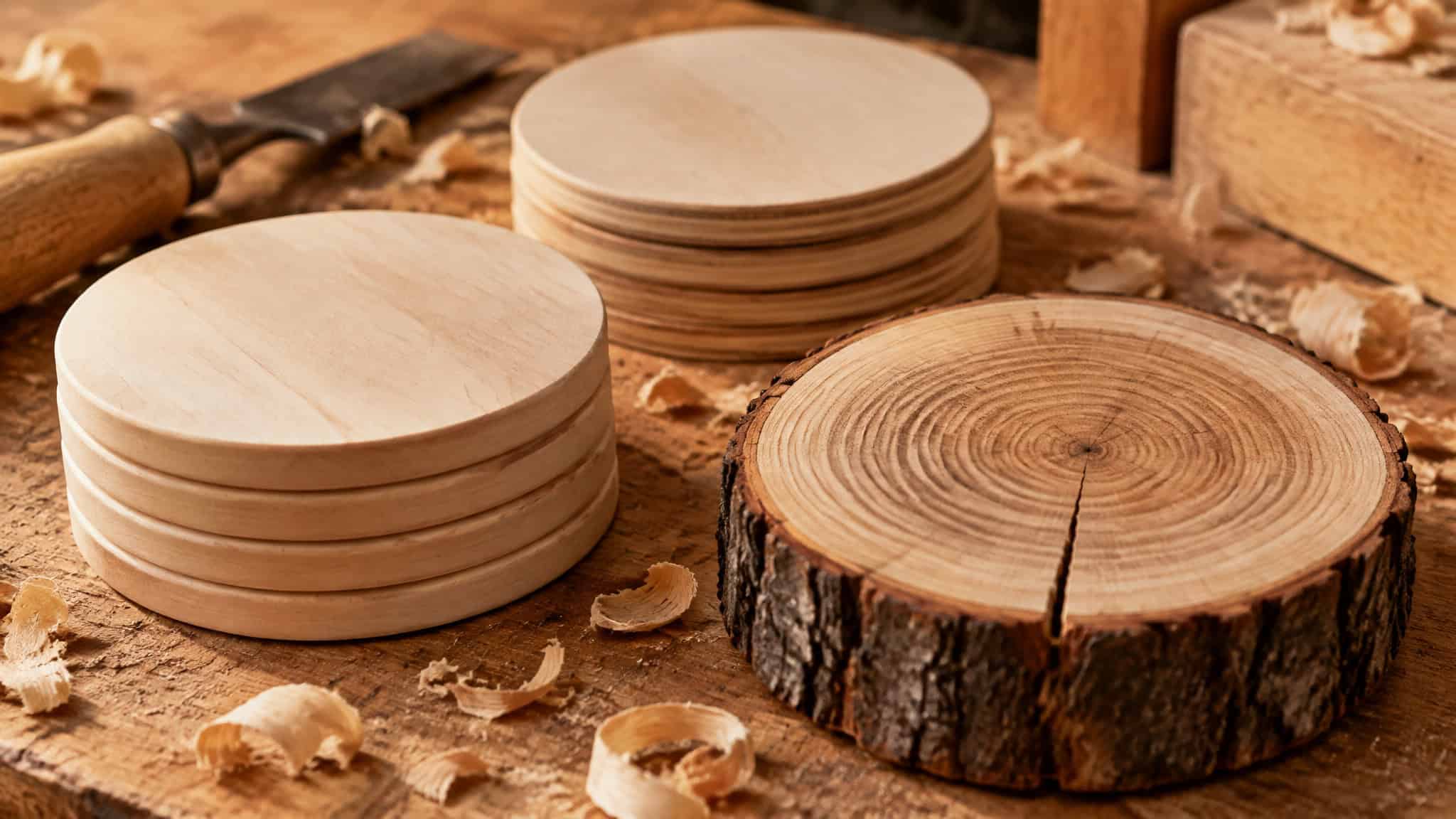
Plywood and basswood are the cheapest starter materials on the bench. They look plain on their own, which is why makers call them the boring option, but any laser, even an underpowered diode, engraves them cleanly and cuts them into custom shapes for bulk corporate orders. A home business depends on Baltic Birch 3mm, 6mm, & 12mm, where 12mm is 4x 3mm, and the 20W diode cuts through thicker materials faster compared with the 10W diode that’s built for detailed engraving.
Solid acacia hardwood and oil-wax conditioning
Stepping up to pre-made solid hardwood blanks like acacia unlocks deep, detailed engraving that sells as a timeless gift set. On the xTool F2 Ultra UV, acacia took extreme engraving depth. Because solid wood drinks condensation and moves with humidity, you have to condition hardwood coasters just like a kitchen cutting board. Rub in an oil-wax finish like beeswax or Walrus Oil (a cutting-board finish brand, not actual walrus oil) to stop the wood from soaking up water and warping.
Why wood cookies crack and how to prevent it
Commercial wood cookie coasters crack after laser engraving because commercial wood cookies usually ship still wet with the center pith intact and split as they dry, and you prevent costly batch failures by testing your blanks first, refusing large custom orders on untested slices, and conditioning solid wood coasters with an oil-wax finish like beeswax or Walrus Oil to prevent moisture warping. Severna Builds learned this the hard way during a custom order of roughly 1,000 church ornaments on raw wood cookies, where quite a few pieces cracked as the wet slices dried out. Never trust a fresh crate of wood slices until test pieces sit out without splitting.
Cork, MDF, and ceramic tile: the cheap tiers
Cork coasters are the cheaper, more moisture-functional choice, while slate coasters cost more, look premium, and vary in thickness batch to batch. Budget coaster blanks split between absorbent cork that engraves fast with a dark black finish and heavy slate that ablates with bright contrast, and cork’s pre-cut quarter-inch blanks need no bottom adhesive pads while slate requires per-piece focus checks.
Cork blanks and batch speed
Available in pre-cut quarter-inch rounds, squares, and custom shapes, cork absorbs drink sweat naturally and runs fast on conveyor galvo systems like the xTool F2 Ultra or CO2 batch beds like the xTool P3 and P2S. Keep the laser tuned for light surface engraving, which comes out clean and black; trying to laser-cut cork sheets produces a black, sooty mess.
MDF vs plywood for promotional orders
For cheap promotional laser-engraved coasters, plywood and basswood beat MDF on bulk corporate orders because they’re the lowest-cost starter sheets and cut cleanly into custom shapes on any diode, while MDF is better when you need a moisture-absorbing promotional blank. With MDF, quarter-inch stock adds durability, whereas eighth-inch stock cuts faster for less money, and neither cork nor MDF requires stick-on bottom pads.
Hardware-store ceramic tiles
Standard 4×4 glazed ceramic tiles from any hardware store are dirt cheap and engrave reasonably well, though slower than wood or cork, and their rough, bumpy bottoms need stick-on adhesive pads. Spraying glazed tiles with white paint, especially over pre-painted or primed tile, yields a crisp white tile engraving effect on CO2 machines like the xTool P2 and P2S.
Acrylic coasters: wavelength decides everything
Acrylic makes a sharp, modern coaster only when you match the sheet color to your laser’s wavelength and engrave the reversed design on the bottom face so the top drink surface stays smooth.
Blue diode vs CO2 and UV on clear acrylic
A 445nm blue diode like the 5.5W Sculpfun S9 cuts and engraves dark-colored 3mm acrylic quickly, but the beam passes straight through clear and light-colored acrylic without marking properly. For eighth-inch clear acrylic or heavy sheet cutting, you need a CO2 laser like the xTool P3 or a UV laser. Always run active fume ventilation, because vaporizing any acrylic releases toxic fumes.
Bottom-face engraving and clear bumper dots
Engraving the underside of clear acrylic gives the design depth through the glass-like top, provided you mirror the artwork in your coaster design software workflow first. Skip standard foam or felt adhesive pads, which show right through clear plastic and ruin the look; stick tiny clear cabinet-bumper dots or clear adhesive pads to the corners to prevent skidding.
Two-tone spray-paint fill and holographic sheets
For a multi-color pop on clear acrylic, Smedley Works left the protective paper mask on the blank, engraved the reversed design on the bottom face, dusted the grooves with yellowish spray paint followed by light green spray paint, and peeled the mask. The result looked great, even if picking tiny mask islands out of small details took ages. Specialty holographic acrylic also shines on demo builds, like Severna Builds’ Seattle skyline and non-commercial Kraken logo coasters.
Metal coasters: stainless grades and the IR requirement
You can laser engrave stainless steel and titanium coasters, and Grade 304 stainless steel is the best pick for rust-free color marking, provided you use an infrared (IR) laser module rather than a blue diode.
Stainless 304 vs 420 and titanium color
Coasters live under wet glasses, so stainless steel is mandatory to stop rust. In Severna Builds’ testing on the xTool F2 Ultra, Grade 304 stainless steel produced the best engraving colors, while Grade 420 was only run once. Aluminum is also viable, and titanium blanks produce vibrant oxide colors.
The multi-hour deep-black tax
While surface annealing and color play look slick on bare metal, chasing a rich, deep black engraving on metal takes hours of laser time per piece, which quickly eats into production schedules.
The painted-metal acetone trap
Blue diode owners sometimes think they’re engraving metal when they aren’t. In MakeUseOf’s test on the 5.5W Sculpfun S9, engraving painted metal looked crisp while the coating remained, but wiping the paint off with acetone revealed only faint lines on the bare metal underneath, even at slower speeds and multiple passes. True metal marking requires an IR source like the xTool M2’s 3W IR module, the 5W IR xTool F2 (which also engraves silicone coasters on a large bed), or the F2 Ultra.
Leather, leatherette, rope, and glass coasters
Real top-grain leather and polyurethane (PU) leatherette serve different gift markets. Top-grain leather gives buyers a classic natural material that cuts and marks cleanly on a UV laser, while leatherette lets you run fast, multi-color metallic reveals.
Top-grain leather and leatherette color reveals
Pre-made top-grain leather blanks are easy to source on Amazon and cut and engrave cleanly, with UV lasers offering the sharpest control. Faux leatherette coaster sets are the secret upsell weapon: dialing in your speed and power strips the top layer to expose black-to-gold or black-to-silver color-reveal effects in a single pass.
Why braided rope fails on diodes
Severna Builds tested an 8-pack of braided rope coasters from Amazon for boho-style sets and found they engraved inconsistently across settings. Diode lasers rely on heat that chars and burns fabric fibers unevenly, whereas UV lasers mark fabric cleanly without burning.
Prepping glass with tempera paint or spray
Uncoated glass lets most laser beams pass straight through, so you must prep bare glass coasters with a coat of black tempera paint or laser marking spray before firing. The exact same prep lets you engrave the undersides of four whiskey glasses to bundle with coasters as a high-end gift set.
Matching laser type to coaster material
Diode, infrared, UV, CO2, and galvo lasers divide coaster substrates by how each wavelength absorbs into the surface: a blue diode handles organic wood, cork, dark slate, and dark acrylic, whereas bare metal requires an infrared module and clear acrylic requires CO2 or UV. Modular machines bridge these gaps by swapping heads, such as trading a 10W or 20W diode for a 2W or 3W IR module to move beyond wood into metal coasters.
| Laser Class / Wavelength | Wood, Cork & MDF | Slate, Granite & Marble | Clear Acrylic | Dark Acrylic (3mm) | Bare Stainless & Titanium | Leather & Leatherette | Braided Rope & Fabric | Glazed Tile & Prepped Glass |
|---|---|---|---|---|---|---|---|---|
| Blue Diode (445nm, e.g., 5.5W S9, 10W F1G) | Yes | Yes | No (beam passes through) | Yes | No (faint lines after acetone wipe) | Yes | Partial (burns fibers inconsistently) | Partial (requires paint or spray prep) |
| Infrared / IR (e.g., 2W, 3W M2, 5W F2) | No (built for metal/stone/silicone) | Yes | No (wrong wavelength) | Partial (surface dependent) | Yes ( plus silicone on 5W F2) | Partial (not primary wavelength) | No (not suited for fabric) | Partial (stone/coated surfaces only) |
| UV Laser (e.g., F2 Ultra UV) | Yes (extreme depth on acacia) | Yes (including marble/wood hybrids) | Yes | Yes | Partial (F2 Ultra dual-source handles metal) | Yes (cleanest top-grain cut/mark) | Yes (marks without burning) | Partial (with surface prep) |
| CO2 Laser (e.g., P2/P2S, P3) | Yes (fast batch cutting) | Yes | Yes (P3 best for heavy cutting) | Yes | No (requires marking spray) | Yes | Partial (thermal mark) | Yes (crisp white-painted tile on P2/P2S) |
| Galvo / Conveyor (e.g., F-S series, F2 Ultra) | Yes (high-speed batching) | Yes | Partial (depends on UV/CO2/IR source) | Yes | Yes (with IR/Ultra source) | Yes | Partial (best with UV source) | Partial (with prep) |
Specific MOPA and dedicated fiber laser parameters across non-metal coaster blanks aren’t established in the bench tests behind this guide.
Beginner materials to avoid
Skip five unforgiving substrates until you have the right wavelength and prep workflow. On a blue diode, avoid clear or light acrylic, bare or painted metal, and braided rope. Hold off on bare glass unless you prep it with black tempera paint or marking spray, and never run commercial wood cookies before testing whether the wet slices crack.
Running a test grid before you burn a batch
To run a single-variable test grid before burning a batch, wipe down a raw, uncoated sacrifice coaster from your actual pack with alcohol, engrave the grid without coatings or paint layers, and clean off the slate dust with alcohol again before picking a repeatable setting. Smedley Works breaks coaster prep into three buckets: worth-doing-every-time steps (cleaning before engraving, running a test grid on your actual slate, and cleaning before judging results), optional style choices (like lacquer, black paint, or mineral oil), and a waste of time. Copying a random settings file from the internet or tweaking multiple variables at once lands squarely in the waste-of-time bucket because slate and wood vary too much inside a single box.
Instead, follow the worth-doing-every-time sequence on raw slate:
- Wipe the slate coaster down with rubbing alcohol before engraving (alcohol evaporates almost instantly).
- Measure the blank’s thickness, focus the laser for that specific piece, and frame the boundary so out-of-square stone doesn’t clip your art.
- Burn a test grid on the actual slate, changing one variable at a time to find repeatable contrast rather than maxed-out power.
- Wipe the engraved slate coasters a second time with rubbing alcohol before judging the burn.
Smedley Works ran a side-by-side A/B test of cleaned versus uncleaned slate that proved the post-burn alcohol wipe is essential: pulverized slate dust sits in the fresh grooves and makes a crisp engraving look chalky and weak until you wipe it clean.
Which coaster materials make money
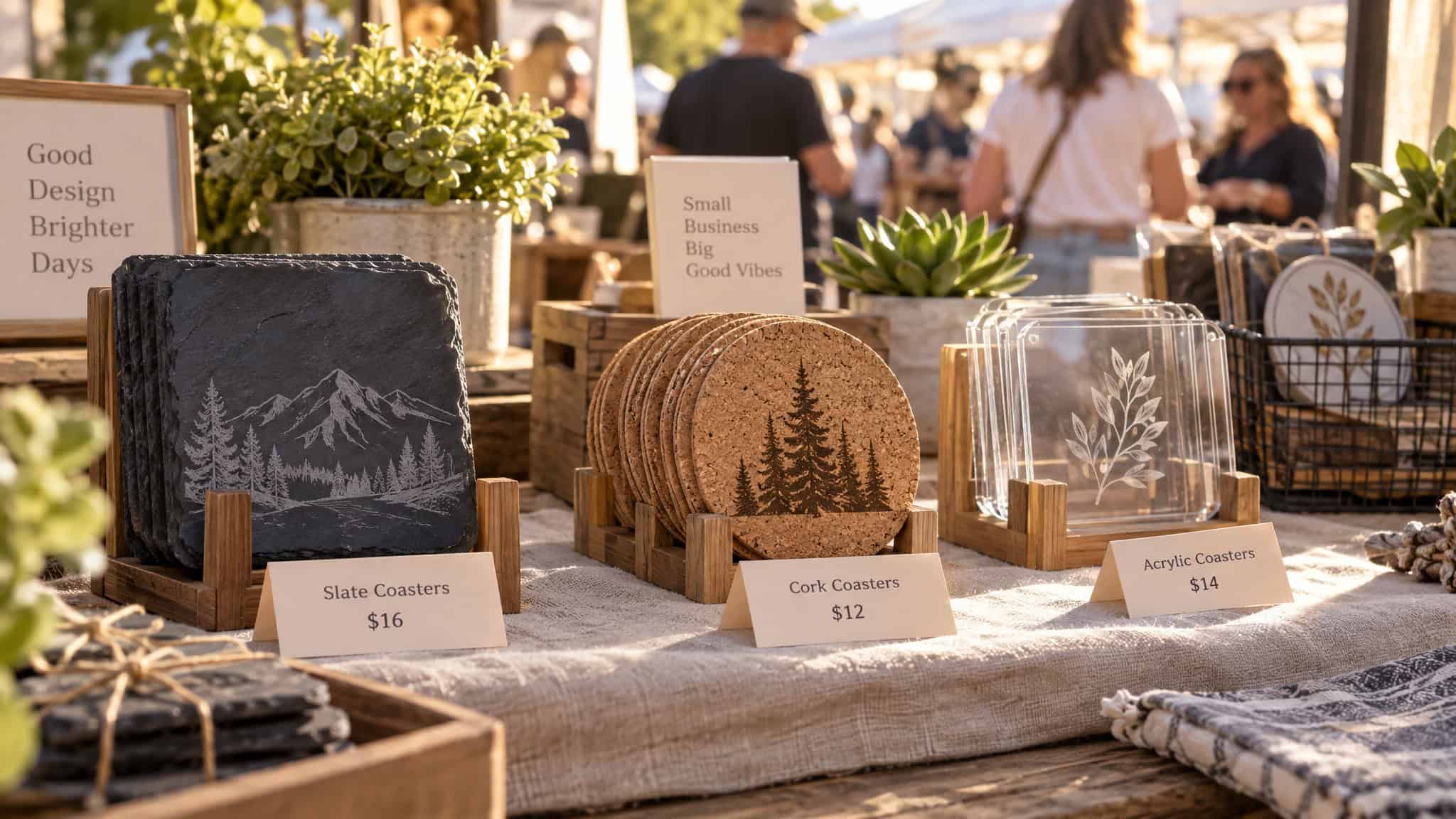
Finished slate is the fastest coaster to ship but carries the thinnest margin, while self-manufactured acrylic blanks eat the most laser time and keep the most profit, with cork and MDF anchoring the cheap promotional tier. Coasters are a staple for making money with a laser engraver at craft shows because they’re giftable and fast to produce, and Smedley Works’ five-coaster roundup benchmarked every set at a flat $9.99 just to keep comparisons consistent (though granite, marble, and solid hardwood price higher and bulk promos lower).
The five-coaster production spectrum
- Finished slate blanks: Arrive with pre-applied adhesive pads and need zero blank prep, making them the fastest to ship, though high blank cost and slower engraving compress your margin.
- DIY tier (4×4 glazed ceramic tiles and quarter-inch cork): Hardware-store tiles are dirt cheap but engrave slowly and need stick-on pads for their rough bottoms; pre-cut cork is inexpensive, needs no pads, and engraves fast.
- Full self-manufacture (eighth-inch clear acrylic and quarter-inch or eighth-inch MDF): Cutting and engraving blanks from sheet stock demands the most laser time and fume ventilation, but delivers the highest profit margin per set.
Batch hardware and paint-fill upsells
Bulk cork and plywood corporate orders turn high-margin when you batch them on conveyor galvo systems like the xTool F2 Ultra or CO2 beds like the xTool P3, P2S, and F-S series. For retail sets across slate, tile, acrylic, and MDF, split-monogram personalization and oil-paint fills add easy perceived value: work oil paint into the engraved grooves using a squeegee or gloved fingers, then buff off the excess with a paper towel or rag.
Sourcing design files without eating your margin
Buying individual SVGs on Etsy at $2 to $3 a pop adds up fast when testing new coaster themes; Creative Fabrica runs $4 a month for unlimited downloads and lets you grab 10 free files before paying.
Machine choice: matching the laser to your materials
Your laser’s frame and optical source dictate which coaster blanks you can mark and whether the machine is safe to run in a spare room.
Enclosed modular hybrids: xTool M2
Reviewed by How-To Geek, the Class 1 enclosed xTool M2 ($599 Laser / $749 Color Print and Cut, with a $50 early-buyer discount that ran through June 2; alongside the xTool S1 and F1 Ultra) combines dual-camera ACS Lite positioning, built-in CMYK printing on wood, paper, and felt (topping craft cutters like the Cricut Maker 3), RA3 Lite rotary support, xTool Studio with AI Make, the 60,000+ file Atomm community, and swappable 10W diode, 20W diode, and 3W IR modules.
Budget open-frame diodes: Sculpfun S9
Reviewed by MakeUseOf, the open-frame 5.5W 445nm Sculpfun S9 ($282.95 at GeekBuying.com with code NNNDBVOLTS9; all reviewed prices and codes may vary) offers a 410x420mm bed, 45-minute setup, USB-only LightBurn/LaserGRBL control, and 15mm cutting depth for wood dice towers, slate, and dark 3mm acrylic.
Workshop safety and source disclosures
If you’re planning on using this in a domestic home rather than in a private workshop or something, then you’ll need to buy extra goggles for anyone who’s planning on walking in. Also weigh Smedley Works’ praise for xTool software and US/Germany/Europe support against their disclosed exclusive xTool sponsorship and affiliate ties, alongside How-To Geek’s independent testing.
Frequently Asked Questions
What kind of laser is used for engraving?
You match the laser class to the coaster substrate by wavelength across blue diode, infrared (IR), UV, CO2, and galvo systems. A 445nm blue diode handles wood, cork, dark slate, and dark 3mm acrylic, whereas bare metal requires an infrared module and clear acrylic demands a CO2 or UV laser. Modular machines like the xTool M2 let you swap between 10W diode, 20W diode, and 3W IR heads as your materials change.
What is the best wood to make coasters with for laser engraving?
Plywood, basswood, and Baltic birch are the most practical choices for low-cost bulk orders because any diode can cut and engrave them cleanly into custom shapes. For premium gift sets that take deep, detailed engraving, solid acacia hardwood is the standout pick. Just be sure to treat solid hardwood like a cutting board by rubbing in an oil-wax finish such as beeswax or Walrus Oil so it resists moisture and warping.
Are slate coasters better engraved raw or with a lacquer clear coat?
Raw slate is better for functional drink coasters because unsealed stone pores naturally absorb condensation from a cold glass. In Smedley Works’ two-week ice-water durability test, uncoated slate wiped clean with zero marks, while spray-lacquered slate blocked moisture absorption and did not clean up as well. Save glossy lacquer coats for decorative display pieces rather than everyday drink use.
Cork vs slate coasters for laser engraving: which is cheaper and more durable?
Pre-cut quarter-inch cork is cheaper, naturally absorbs drink sweat, engraves quickly with a clean black mark, and needs no bottom pads. Slate costs more and offers a heavy, high-contrast stone finish that holds up to ice water when left raw, though cheap slate packs vary in thickness and squareness. That means slate requires measuring and focusing every piece individually, whereas cork can run straight through fast batch setups.
Can you laser engrave stainless steel or titanium coasters and what laser do you need?
Yes, both metals can be laser engraved if you use an infrared (IR) laser module like a 3W or 5W IR head or the xTool F2 Ultra, since a 445nm blue diode only leaves faint lines on bare metal once any paint is wiped off with acetone. Grade 304 stainless steel is the best rust-free choice for rich color marking, and titanium blanks also produce vibrant oxide colors. Keep in mind that chasing a deep black mark on bare metal can take hours of laser time per piece.
Why do wood cookie coasters crack after laser engraving and how do you prevent it?
Commercial wood cookies usually ship while still wet with the center pith intact, causing the slices to split as they dry out—a flaw that cracked quite a few pieces during Severna Builds’ ~1,000-ornament order. To prevent ruining a full batch, never run a fresh crate of slices right away; test-burn a sample batch first and let the pieces sit out to age and dry before committing to a large custom job.
