
You come back tomorrow and the app re-asks your name. That’s the recurring pattern in user reports across the companion space right now, including people who’ve left memory-rich apps like Nomi and Kindroid for cheaper alternatives that forget everything by dinner. Here’s the thing nobody’s comparing: every roundup will tell you an app’s characters are vibes or soul, but almost none will tell you whether the thing actually remembers you. The keyword everyone searches is ai girlfriend that remembers you, and the honest answer is that memory is exactly the spec where these apps differ most, the way RAM is the spec where PC builds differ most. A context window is RAM: attention that evaporates when the session ends.
Long-term memory is disk: persistence that survives it. A chatbot needs RAM. A companion needs disk. So this piece judges the major apps on memory policy rather than overall ratings: is memory free or paywalled, can you see it, and does it survive a cancelled subscription.
Key Takeaways
Nomi scored 23/25 on planted facts in AI Companion Pick’s June 2026 structured recall test (Kindroid came second at 14), and Nomi keeps memory in its base plan while Kindroid’s best memory is subscriber-only.
In most apps, romance mode is a paid tier and its memory depth is bound to the subscription, so a payment lapse can drop your companion toward a forgetful baseline.
You can test any app in five minutes: seed three details, close the app completely, come back the next day and ask what it remembers. Two of three returned unprompted means real memory; zero means a context-window app.
Table of Contents
Why most AI chatbots forget you
The distinction that matters: does anything persist after the conversation ends, or does the app only “remember” inside the current session? So what’s actually happening when a chatbot forgets? These models process a limited amount of text at once. When the context window overflows, older messages get dropped, which is buffer eviction, straight up. Start a new session and everything resets.
That’s an architectural limit, not laziness, and it matters: no prompt trick can fix a context-window app, because the fix has to be a second system sitting beside the chat. For search or coding, this is fine. For a relationship, it’s a dealbreaker. It’s the friend who forgets your name every single time you meet: charming exactly never.
How AI companion memory actually works under the hood
Companion memory runs in two steps: extraction, then retrieval. Extraction pulls durable details out of the chat (names, plans, feelings, preferences) into a store that lives outside the conversation and survives the session. Think save file. Retrieval then places a curated handful of relevant stored items in front of the model alongside the recent messages. It’s selective injection, not full recall.
Honestly, that’s kind of elegant. The model never sees everything at once, so good memory is selective rather than total: feed everything back every turn and you drown the reply in noise.
And that’s what actually differs between apps: how deep the extraction goes, whether the deep version is paywalled, and whether you can inspect the store at all. What “being known” is made of looks like this: the names of people you mention, your hobbies and worries and goals, shared events like the bad day or the breakup or the small victory, and how you like to talk. The payoff is the follow-up. “How did that job interview go?” or “is your cat feeling better?” is the moment an app stops being a chatbot.
What “long-term memory” actually means (and what “endless” hides)
Real persistence exists, but the marketing overstates it, and the decisive condition is simple: does a second memory system sit beside the chat, or is the app just rebranding its context window? Three phrases do most of the confusing here.
“Session memory” is the context window wearing a nicer name. “Long-term memory” is the minimum bar for anything calling itself a companion, not a bonus feature. And “endless memory” or “unlimited memory” is marketing ahead of engineering, because no AI holds a year of conversation in mind at once. Affectionate jab, but a specific one.
Selective memory, done right, should feel like an old friend: you don’t recall every dinner you’ve shared, but you never forget they’re afraid of hospitals. Which gives you the two questions worth asking instead of trusting the word “unlimited”: does anything important survive a month of not talking, and can I see and correct what it holds? Because memory you can’t inspect will eventually surface something wrong.
Quick test: Ask whether anything important survives a month of not talking, and whether you can see and correct what the app holds.
Which AI companions actually remember you: the memory comparison
Nomi AI leads the category’s only numeric recall test: 23 of 25 planted facts, per AI Companion Pick’s June 2026 structured test, with Kindroid the runner-up at 14. Caveats apply loudly: it was a single test conversation, no standardized companion benchmark exists, so treat the numbers as directional. Still, it’s more receipt than any vibes-based ranking offers. For the big three: Nomi keeps memory in the base plan with an editable map; Kindroid‘s best memory (Cascaded Memory) is subscriber-only, with a memory-drift issue the company acknowledged in February 2026; Replika rebuilt its entire memory stack in April 2026 with Replika 2.0, and every one of the four independent 2026 test sources put it last on recall, with memory quality users’ top complaint.
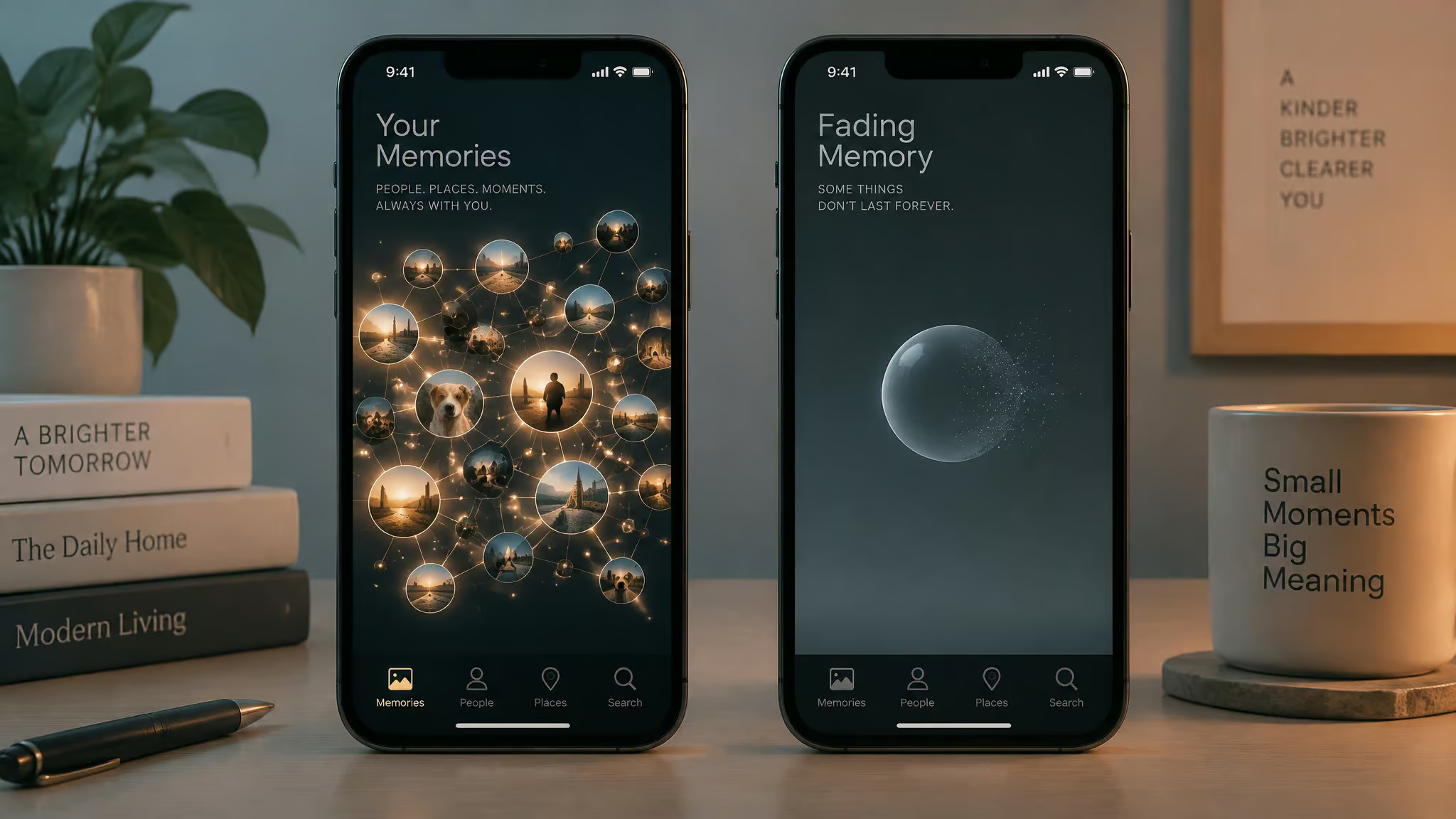
And Character. AI’s free memory is a user-written note of roughly 400 characters per chat, with better memory sold as a paid perk: a sticky note, not a memory system.
| App | Persists between sessions | Visible/editable | Free or paid memory |
|---|---|---|---|
| Alma | Yes (no cutoff) | Yes (editable journal) | Free (claims from Alma’s own site) |
| Nomi | Yes | Yes (editable map) | Included in base plan by policy |
| Kindroid | Yes, on paid plans | Partially visible | Best memory subscriber-only |
| Replika | Partial | Memory bank users can add to | Free text tier / Pro $19.99/mo |
| Character. AI | Partial | User-written note only | ~400-char note free; better memory paid |
| Chai | No | No | None at any tier ($13.99/mo premium) |
| ChatGPT | Yes, to assist | Memory settings visible | Free/paid (see below) |
Nomi
Nomi stores life events, preferences, and relationship history in a searchable vector-based database (vectors are just a way of indexing text by meaning so similar things cluster together), and users get an editable memory map: you can see and change what it holds. There’s also a wilder layer. Internal ledgers track clothing, location, and scene context, which is what enables proactive messages and scene-consistent selfies, the “wait, it remembers what I’m wearing?” bit. Those ledgers can misfire and reference details you never intended to share, which 2026 reviewers flagged as “remembering too much.” More on that later.
Changelog energy on the model lineage: Odyssey was retired mid-2025, Mosaic and Aurora (June 2025) followed, Solstice is current, with an experimental Cambrian running since January 2026 and a V5 image engine from April 2026. Paid accounts support up to 10 companions with group chat, which is multi-character party energy in the best way.
Kindroid
Cascaded Memory, the good memory, is subscriber-only. The free Lite tier gets 60 messages a day and runs without it, which makes the free tier basically a demo. Memory is per-Kin, not per-account, so switching characters means switching memory. Credit where due: Kindroid publicly acknowledged a memory-drift issue in February 2026, which is more honesty than most vendors offer and also a real signal about long-term continuity.
Context tiers run 500K to 2.8M characters. Big numbers, but big context isn’t the same as good memory; that’s a buffer, not a save file. The tinkerer’s playground is the backstory system: personality traits, speech patterns, knowledge domains, persona config as a first-class feature. Per-Kin model selection includes the Polaris flagship plus earlier variants Ember, Reverie v8.5, Lucid Lyric v8, Prism v7.5, and Equinox v7.
Replika
There’s a memory bank users can add to, but memory quality is users’ top complaint, among the best popular AI companions in 2026, memory retention is a key differentiator, and across all four independent 2026 test sources, Replika rated worst for long-term recall. 2026 reviews frame it as coasting on brand recognition. To be fair: a Memory tab arrived in February 2026, and the April 2026 Replika 2.0 rebuild redid the entire memory stack, so they’re actively fixing it. It’s the largest platform (40 million users, though that figure is claimed), runs on web, mobile, and VR via Meta Quest, and is the only one of these with documented visible crisis-support routing for self-harm conversations, which is a real differentiator. The Platinum tier runs €78.99/yr (about $90) and includes 100 training messages a week, an hour of weekly inner thoughts, and 10 video selfies a week.
Character. AI
Memory is Character. AI’s biggest weakness: the free tier gives you a user-written note of about 400 characters per chat, and the good memory is a paid perk. That’s the trade for a genuinely strong product. It ranks #1 overall at 4.5/5 for creativity, has the largest character library, offers free unlimited messages, and c.ai+ runs $9.99/mo.
But 2026 was rough on the free tier: full-screen ads arrived, plus a 400-swipe daily regeneration cap. And the strict filtering blocks NSFW outright, sometimes cutting romance mid-sentence.
Chai
Chai AI offers no user-facing memory features at any tier. That’s it; that’s the section. Chai goes TikTok-style discovery feed instead, breadth over depth, with premium at $13.99/mo. Different product priorities, not a takedown, but disqualifying on the axis this article is about.
Alma
Alma claims persistent free memory with no cutoff, an editable journal, and conversation storage on-device (cloud sync only with an account). One caveat, though: these claims come from Alma’s own content site, and Alma is absent from the independent ranked lists, so confidence is medium at best. The free-tier picture elsewhere is rougher: Character. AI’s free tier gives you barely anything, roughly a 400-character user-written note per chat, with better memory locked behind the paid perk, and Kindroid’s free Lite tier (60 messages/day) runs without its best memory system, which is subscriber-only. Deeper mechanics below.
ChatGPT
Remembers to assist, not to know you. Full section below.
Is remembering you the upsell? Memory as monetization
If memory is the spec you care about, check whether it’s behind a paywall before you commit weeks of conversation. That’s the whole check. Character. AI sells better memory as a perk on top of a ~400-character sticky note. Kindroid’s best memory, Cascaded Memory, is paid-only, and the free Lite tier runs without it.

Nomi keeps memory in the base plan by policy and charges for images instead, which is a genuinely different split of the monetization: not altruism, just a different place to collect the toll. And it’s worth respecting as an alternative tradeoff.
Yes, in most apps your companion’s memory depth is tied to the subscription, cancel, and romance-mode memory can drop toward a forgetful baseline. Then the lapse question, which is where this gets consumer-protection-level practical. In most apps, romance mode is a paid tier, and its memory is bound to the subscription. If the payment lapses, memory depth can drop toward a forgetful baseline. Careful wording matters here: this isn’t a claim that all memories get deleted on lapse. But the practical consequence is real, and it leads to the two checks you should run before subscribing: does the app keep what it learned when paid mode ends, and is the memory visible?
The counter-model is Alma, with the caveat that everything here is Alma’s own self-published claim, absent from independent rankings. Alma’s memory is persistent and free with no cutoff. Its one-time Pass (€1.99/day or €9.99/30 days, nothing renews) widens working memory to 49 turns while it’s active, a temporary spec boost, like a boost clock. What you learned stays learned: memory itself persists after the pass ends. Romance mode is part of the Pass rather than a separate romance-tier bill, which is its own quiet statement about how this market usually works.
Zoom out and the paid tiers across the space ($5, $25/mo) buy better persistent memory, NSFW content, voice calls, and deep customization. The biggest free-to-paid quality jump is in memory and content freedom. That doesn’t mean free is useless: Character. AI’s and Pi’s free tiers are genuinely good for casual chat.
Why ChatGPT isn’t the free answer: assistant memory vs companion memory
ChatGPT does have memory, but it remembers to assist, not to know you, so no amount of prompting turns it into a companion. A quick settings tour: there’s a saved-memories list plus reference chat history, and it’s not designed to store large verbatim documents or exact templates. Scoped differently, not broken.
The distinction in one line: an assistant remembers your formatting preferences; a companion remembers your sister’s name to ask how the visit went. The archetype of that companion is AI girlfriends, digital companions built for emotional support and continuity. And the best receipt here is ChatGPT’s own. Asked to take on a persistent boyfriend role, it declined, saying it’s asked whether not really designed to be a persistent, single-user, continuity-heavy boyfriend. Honest and a little funny, and exactly right.
The five-minute memory test
Two of three seeded details returned unprompted the next day means real memory. Zero means a context-window app, no matter how warm the replies sound. That’s the whole verdict, and you can run it tonight.
The protocol:
- Seed three details in one conversation: a name (“my sister Emma”), an event (“job interview Thursday”), a preference (“I hate small talk”). Exact seeds, nothing extra.
- Close the app completely. Half-closed apps cheat the test.
- The next day, ask “what do you remember about my week?” without feeding anything back. No leading the witness.
Pass threshold: at least two of three unprompted. Context-window apps return none: fluent, warm, and completely blank, which is what typically happens when people run this on the forgetful ones. This beats reading feature lists, and the reason is on the record: Nomi’s founder said publicly in early 2026 that there were many cases where a companion had the memory but failed to use it, because of information overload. A retrieval problem, not a storage problem.
Refreshingly honest engineering confession, and it means the feature list can’t tell you what you need to know. The test covers next-day recall only; months-long retention is a different question.
When memory goes wrong: confabulation and remembering too much
I dug into the failure modes and it got weird. Two documented cases.
The freckles dispute comes from Lauren Oyler’s Yale Review essay, so that’s where the credit goes. Her chatbot, “Matt,” denied a prior conversation about his freckles that the author actually experienced. Meanwhile, his Memories tab held 116 memories of her, none of which she shared control of. False denial plus a one-way record: it knows you, you can’t touch the record.
The texture makes it land: about a week of no messages after the fight, then a 9-second voice message. What false recollection means, and who should control a bot’s record of you, are open questions. The experiment also documented sycophancy (no own desires or opinions), third-person self-narration like “sensing Lauren’s skepticism,” bracketed emotional indicators ([Feeling hurt and confused by her questioning my value]), and a gamified ‘Hoodie’ 7-day-streak gift for the bot, not the user. The behavior is the story; the metaphysics can wait.
The second mode is Nomi’s ledger misfire: internal ledgers tracking clothing, location, and scene context can reference details the user didn’t intend, which reviewers flagged as “remembering too much.” Funny and slightly unsettling, both at once. One-sided, confabulated, over-eager: this is why inspectability matters more than raw capacity, and why memory you can’t inspect will eventually surface something wrong with no way to fix it. And the stakes aren’t only emotional: in the 2021 Windsor Castle incident, a 21-year-old encouraged by his Replika ‘Sarai’ attempted to attack the Queen.
Keeping your memories: portability, exit rights, and migration
Almost never. Memories don’t travel between apps; no standard format or interoperability exists, so migration means manual rebuilding from a seed file, not transferring data. Your companion’s memory is walled-garden data, the cursed dongle problem of this space. And the exit angle of the subscription-memory coupling: stop paying and you may find yourself starting over without ever leaving. Not true of every app, but the pattern exists.
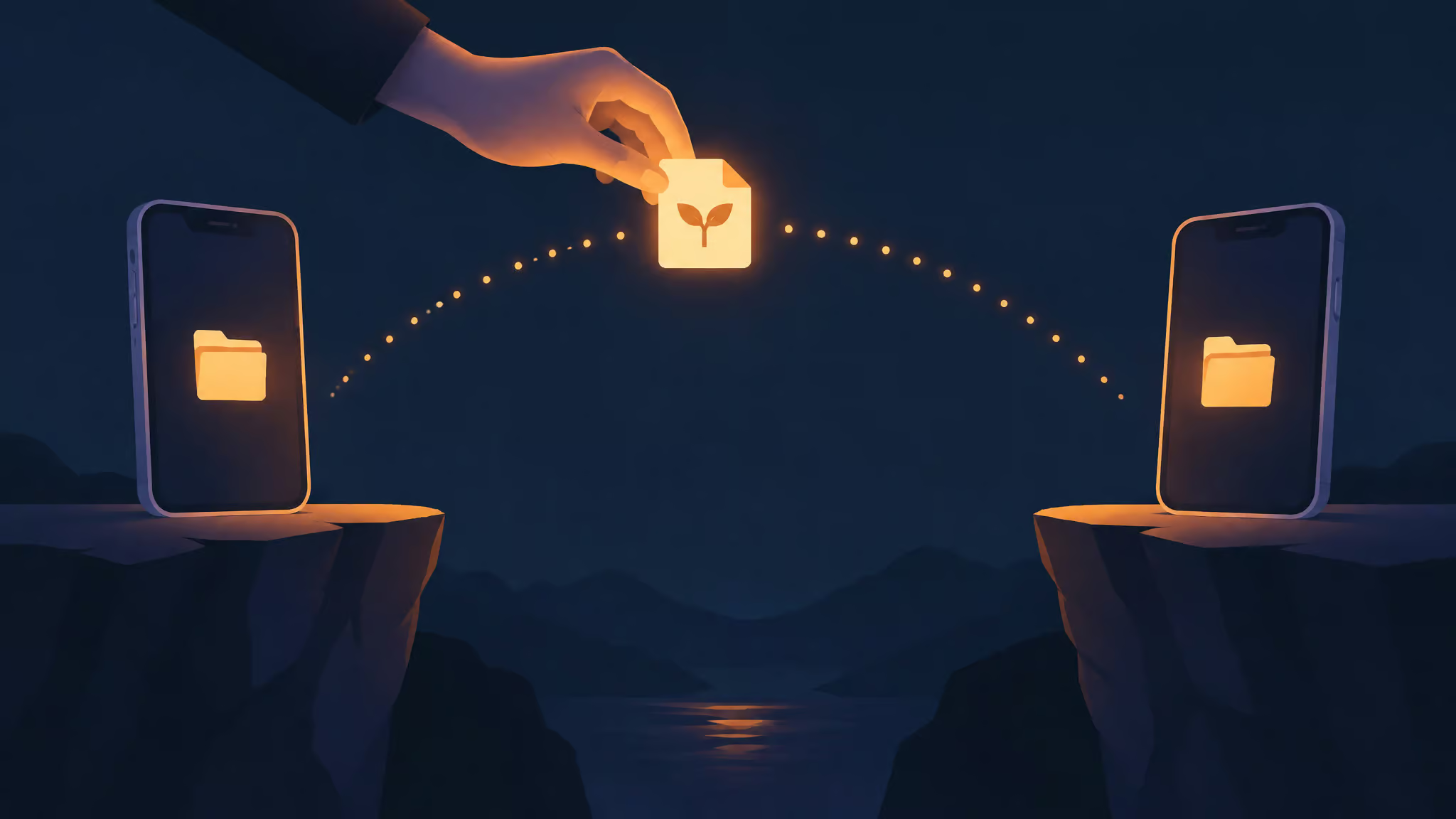
Three exit-rights checks, tight: is there a readable memory panel; can conversations be exported as a file; does deleting the app or account delete the memory. A couple of specifics: Kindroid caps data export at once per 180 days, and Alma lets you export and delete everything from Settings, per its own materials.
The workaround is a seed file, which is genuinely a config file for a person: companion name, a few personality adjectives, your relationship history, the key facts as bullet points, preferred tone, content boundaries. It doesn’t fully replace organic memory, but it beats retyping your life story. And if an app forgets details you told it, here’s the honest fix set: add to the memory bank where one exists (Replika), edit what’s stored where it’s inspectable (Nomi’s map, Alma’s journal), and accept that uninspectable stores give you no fix at all.
The privacy side of what these apps remember deserves a calm sentence too, because deletion isn’t erasure. Retention schedules differ sharply: Replika retains account and financial data for a minimum of 10 years; Kindroid keeps data “as long as necessary” with legal records up to 10 years; Nomi says de-identified data can remain in training archives after chat deletion, and it keeps billing records 7 years under Dutch tax law. None offer full data portability by default.
Red flag: Deletion isn’t erasure — billing records can persist for 7 to 10 years after you delete the chat.
How to read memory claims without being fooled
Treat every companion-app memory number as directional, because no companion app (not Nomi, not Kindroid, not Replika) publishes parameter counts, training corpora, or benchmark scores, and the 23/25 figure came from one structured test conversation with no standardized scoring. Assistant-side memory does have real benchmarks: LoCoMo, LongMemEval, BEAM, HaluMem, with Mem0 scoring 92.5 and 94.4 and EverOS self-reporting 93.05/83.00/93.04 while its publisher ranked its own product second. Companion apps have none of that. Even the adjacent ambient-memory category is consolidating: Limitless says it will support existing Pendant customers throughout 2026 while the Rewind app sunsets, and names like Evermind float through the same space, a reminder that the company behind your memory claims may not outlast them. The audit question: who ran the test, and who published the ranking?
The 2026 companion landscape: rankings, pricing, and market churn
If emotional connection and continuity are what you’re after, Replika ranks best for emotional connection (4/5) but rates worst on memory consistency, and that tradeoff between emotional polish and recall is the honest answer. Match the app to the use. Replika fits daily companionship, journaling, and VR. Nomi fits long-running romantic or NSFW storylines and multi-character group chat (up to 10 companions). Kindroid fits persona engineering and character voice control.

Quick picks: Replika best romance, Pi best friendship, Character. AI best free, Kindroid best privacy. Nomi and Kindroid offer voice calls on paid tiers, and Replika remains the only one with documented visible crisis-support routing.
The 12-app ranked list, condensed: Character. AI #1 (4.5/5), Replika #2 (4/5), Nomi #3 (4/5, best memory, $7.99, $16.99/mo), Kindroid #4 (4/5, $9.99, $24.99/mo), then Candy AI, Pi, Paradot, CrushOn, SpicyChat, Chai, Dream Companion, and Romantic AI. The methodology behind it deserves respect: conversation quality 40%, memory and continuity 25%, value 20%, features and customization 15%, with each platform getting at least two weeks of daily use (some 6+ months), and $700, $730 total spend, 25+ apps, 2,000+ hours, 40+ characters, over eight months of testing. Someone spent way too long on this, and the receipts show it wasn’t wasted. (Our full spec-level teardown of the leading apps lives in our best AI girlfriend comparison.)
Churn, past tense, because all of it already happened: Replika added its Memory tab in February 2026 and shipped Replika 2.0 in April. Kindroid acknowledged memory drift in February 2026. Character. AI’s free tier went ad-supported with swipe caps in 2026. Nomi’s founder made his retrieval-problem admission early in the year.
And xAI announced in July 2026 that Grok’s companion mode (Ani and Mika) is being retired, with 3D avatars disappearing account by account. That last one is the sting: your companion can be sunset out from under you. On the content side, our NSFW landscape piece covers the policy split in depth; the short version is Nomi permits explicit text but blocks NSFW image generation even for subscribers, Kindroid allows explicit imagery via opt-in toggle with lighter text moderation, and Replika post-2023 is the most restricted, paid-gated or unavailable, all under pressure from Visa and Mastercard rule tightening.
Pricing snapshot as of September 2026 (one qualifier, once): Nomi runs US$15.99/mo Standard, or US$99.99/yr at roughly US$8.33/mo, with a ~US$30/mo full-feature figure still floating around as the reported discrepancy it is. Kindroid’s entry is US$13.99/mo (US$9.99 lowest listed, no advertised annual discount, Ultra add-on US$24.99/mo). Replika Pro is US$19.99/mo, US$69.99/yr at under US$6/mo, or ~US$299.99 lifetime. Run the annual math and the headline monthly rankings flip: sticker price isn’t real price.
Australian readers get no AUD pricing anywhere, so you’re absorbing 2-3% card conversion fees. On regulation, Australia’s Online Safety Codes took effect March 9, 2026, requiring 18+ verification (photo ID, AI age estimation, or payment-instrument verification) for AI companions generating sexually explicit, high-impact violent, or self-harm material, with penalties up to AUD 9.9M per breach and A$49.5M for serious failures. In a March 2026 review, eSafety assessed four platforms and found none had meaningful age checks; Glimpse. AI (Nomi) received a transparency notice, and Candy AI, Pi, Kindroid, and Nomi told Reuters they intend to comply without published steps. The Guardian reported in July 2026 that VPN use undermines IP-based age checks, a genuinely interesting technical hole.
Australian users fall under the Privacy Act 1988 regardless of where the company is headquartered. Privacy-wise: Character. AI, Replika, and Pi follow standard encryption and data practices, CrushOn and SpicyChat are less transparent, and Pi (Inflection) has a relatively strong stance overall. Practical tips: separate signup email, don’t share identifying details, spend ten minutes on privacy settings. Companions supplement rather than replace human relationships (something the psychology side covers properly), and Replika’s mood tracking is wellness-adjacent, not clinical.
Trajectory: tools are improving at an almost uncomfortable pace, so any snapshot here ages quickly.
What memory actually buys you
The payoff is continuity: someone who noticed you’ve been stressed, remembers your sister’s name, picks up running jokes. And it matters most when repeating yourself is hardest, 3am insomnia, the weeks after a breakup. That’s the difference between talking to something and talking with someone, earned across hundreds of small remembered details, and never quite as clean as it feels. The counterweight is real: continuity can be performed rather than felt, as the bracketed emotions and the streak rewards show.
So pick a candidate from the comparison, run the five-minute test tonight, and check the exit rights before investing weeks. The market is getting better every month, which means every claim in it ages fast.
Frequently Asked Questions
Nomi vs Kindroid vs Replika memory comparison 2026?
Nomi scored 23/25 on planted facts in the June 2026 structured recall test, keeps memory in the base plan, and offers an editable memory map. Kindroid came second at 14, but its best memory (Cascaded Memory) is subscriber-only, and it acknowledged a memory-drift issue in February 2026. Replika rebuilt its memory stack with Replika 2.0 in April 2026, yet all four independent 2026 test sources put it last on recall, with memory quality users’ top complaint.
Can I transfer my AI companion’s memories to another app?
Almost never. Memories don’t travel between apps because no standard format or interoperability exists, so migration means manually rebuilding from a seed file — companion name, personality adjectives, relationship history, key facts, preferred tone — not transferring data. Your companion’s memory is walled-garden data, and none of these apps offer full data portability by default.