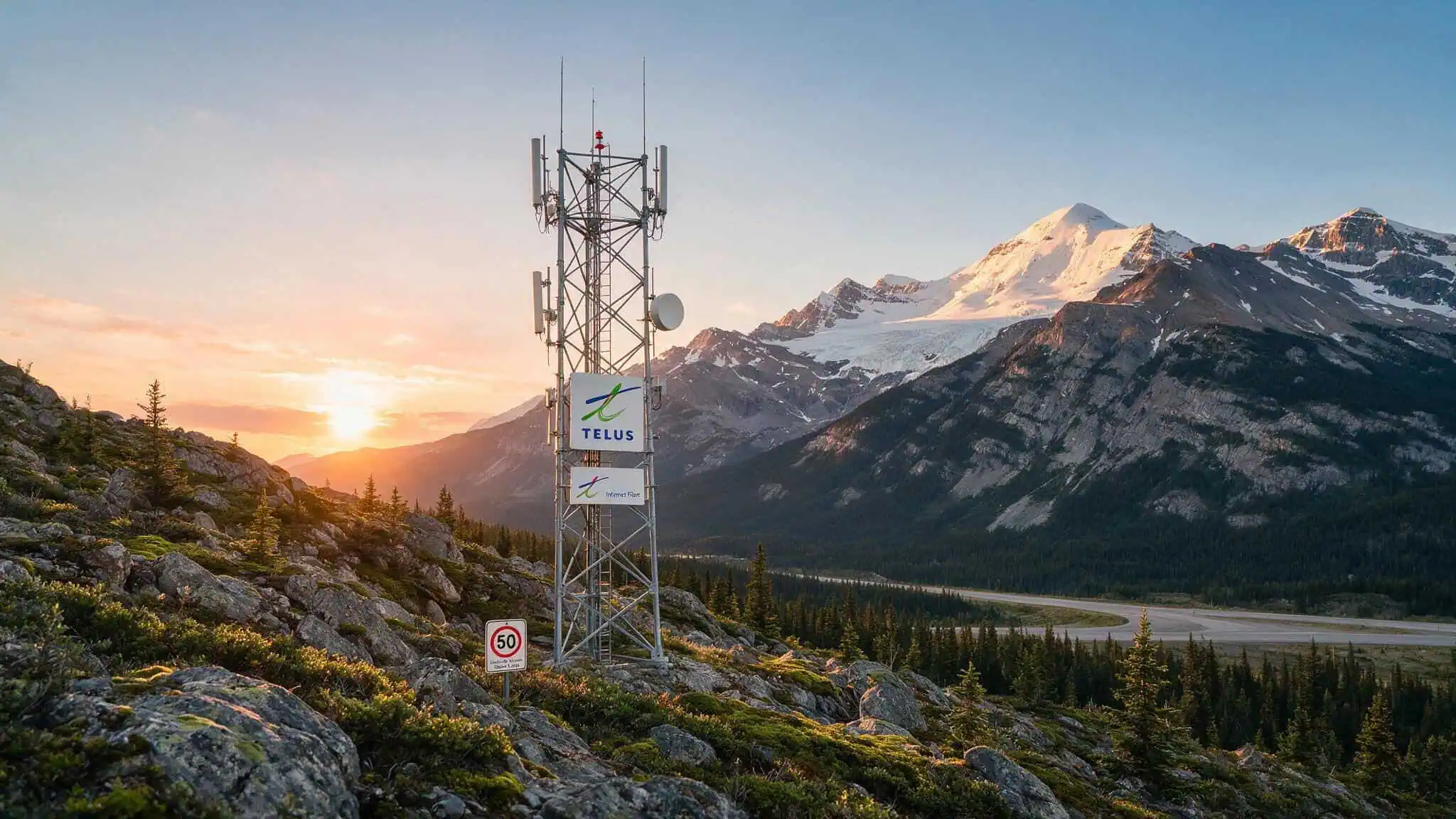
The shortest way to answer “Which carrier does Public Mobile use?” is: it’s Telus—and by extension, Bell, thanks to their network-sharing arrangement dating to the early 2010s. The value of Public Mobile lives in the trade-offs: the 250 Mbps speed cap, the roaming exclusions that catch people off guard, the self-serve support model, and the CDMA history that explains why this MVNO exists in the first place. I’ve spent a while digging through the forums, the coverage data, and the fine print to map out what you get and what you give up.
Key Takeaways
Public Mobile is an MVNO that runs entirely on the Telus Mobility network, sharing the combined Telus/Bell tower footprint of roughly 59,500 cell sites across most of Canada, with SaskTel in Saskatchewan and BellMTS/Rogers in Manitoba handling regional coverage.
The data experience is deliberately different from Telus postpaid: 5G speeds are capped at 250 Mbps, LTE runs between 25–220 Mbps, and you don’t get access to the extended Rogers roaming that fills coverage gaps in rural and remote areas.
The trade-offs are tangible—no phone support, BYOD-only, data bonuses that expire after 150 days, and a community forum that serves as the primary support channel—but the savings run nearly $20/month less than Koodo and save $42 to $70 per US trip compared to Koodo’s $14/day roaming pass.
Table of Contents
The Direct Answer
Public Mobile is a Telus-owned MVNO—it doesn’t own a single tower itself. Instead, it taps into the Telus Mobility network, and because Telus and Bell share their radio access infrastructure, a Public Mobile phone can connect to Bell towers just as readily as Telus ones.
In fringe areas where a Telus postpaid phone would silently roam onto Rogers to fill a gap, a Public Mobile phone doesn’t because the extended network roaming agreements are reserved for postpaid Bellus customers. The underlying hardware is the same, but the roaming permission set is different.
The Network Arrangement — Telus, Bell, and Who Public Mobile Actually Uses
Telus and Bell have been sharing their radio access networks for HSPA+ and LTE since the early 2010s. Combined, they operate roughly 59,500 cell sites: about 23,748 Telus towers and 35,745 Bell towers. In most provinces, this shared infrastructure is the backbone of Public Mobile’s coverage. The network supports VoLTE for HD voice calls, so call quality is on par with Telus postpaid.
Saskatchewan runs on SaskTel. Manitoba splits between BellMTS and Rogers. But everywhere else, you’re riding the same Telus/Bell RAN that Telus’s own postpaid subscribers use.
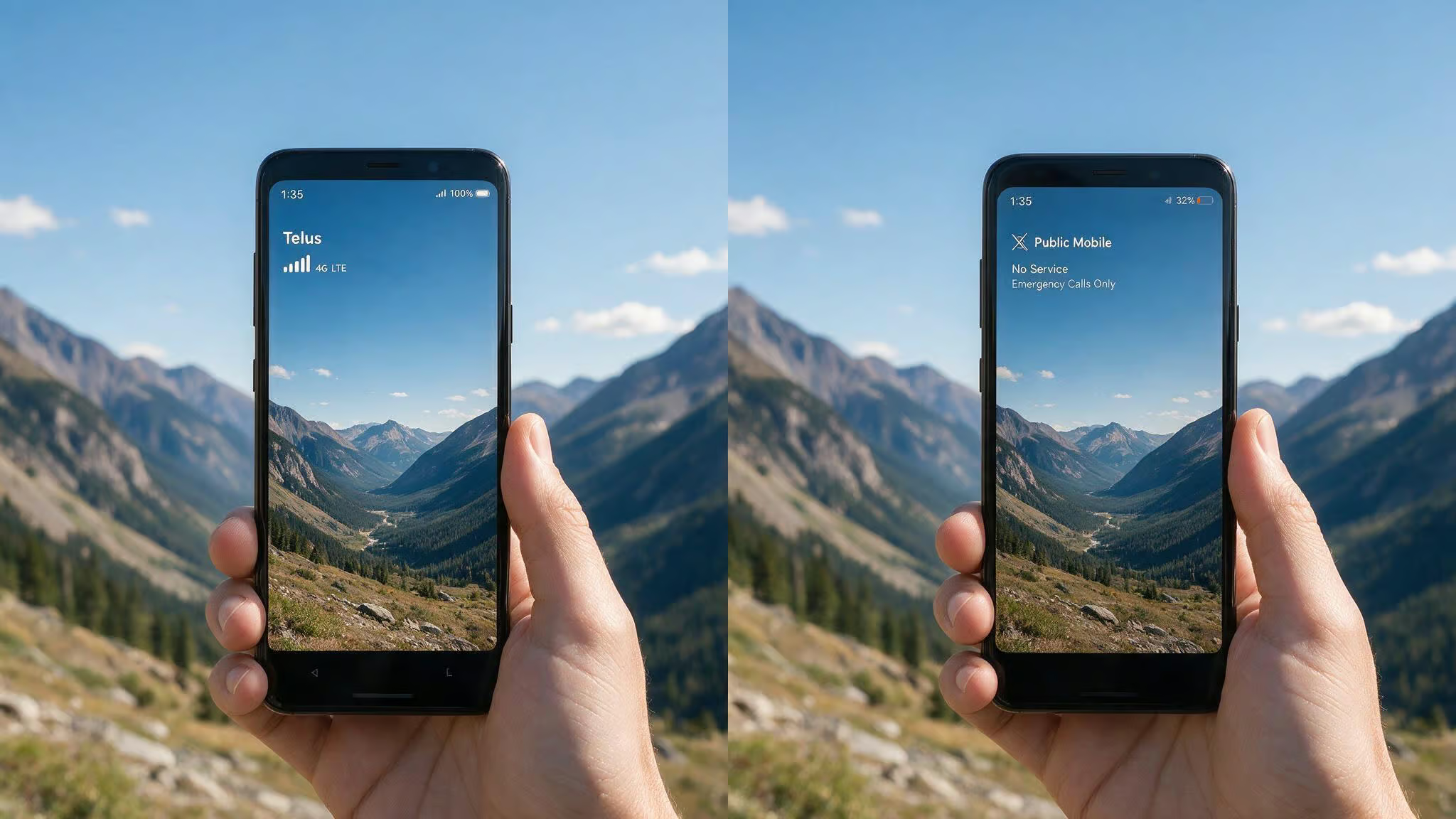
Here’s the critical limitation: the shared RAN doesn’t include the extended network roaming agreements. Those are reserved for postpaid Bellus customers. Forum user Dunkgirl spelled this out: Public Mobile customers don’t get access to the Rogers roaming that Telus postpaid phones fall back on in low-coverage zones. In practical terms, your phone might show a signal on a Telus postpaid SIM in a remote valley where Public Mobile shows nothing.
Coverage — What You Actually Get
Telus advertises 99% population coverage. But that’s a population metric, not a landmass metric. Geographically, Telus’s native network covers about 37% of Canada. For the remaining 63%, Telus relies on roaming agreements that Public Mobile doesn’t inherit.
Telus has the largest nationwide coverage and best LTE network among Canadian carriers, which makes the extended-network gap frustrating for Public Mobile users. To see if your address is covered, use Public Mobile’s coverage check tool on their website, but note that it shows the native Telus/Bell footprint, not the extended Rogers roaming.
Forum user lemew07 illustrated this perfectly with a specific observation: in mountainous BC, the ratio of Telus cell sites to Rogers sites is roughly 4:1. In areas where Telus has a native tower, Public Mobile works great. In the gaps where Telus depends on Rogers to fill in coverage, a Public Mobile phone registers nothing. The extended network exclusion is a direct consequence of that 4:1 density gap, which has led many frustrated users to look up how to cancel Public Mobile and switch providers entirely.
The Canada-US-Mexico roaming is the bright spot here. Plans include built-in roaming on AT&T and T-Mobile with no overage charges. Compared to Koodo’s $14/day US roaming pass, you’re saving $42 to $70 per trip. For anyone who crosses the border regularly, that benefit can offset the coverage trade-offs.
Speed — The 250 Mbps Cap and Why It Exists
Public Mobile’s 5G speeds are capped at 250 Mbps. This is a business policy, not a network limitation. Telus postpaid can comfortably exceed 500 Mbps.
Does it matter? Real-world 5G speeds on Public Mobile often sit above 150 Mbps. LTE swings between 25 and 220 Mbps. For streaming, video calls, maps, and browsing, the cap is invisible, as detailed in our Public Mobile review. You’ll only notice it in a speed test or a large download over cellular.
What you might notice is deprioritization during congestion. It’s not explicitly documented in the fine print, but the architecture matters: Telus postpaid subscribers get priority on the tower. When a cell site is loaded, Public Mobile traffic gets pushed down the queue. For power users who benchmark everything, the gap between a capped 250 Mbps and uncapped 500+ Mbps is a differentiator, and tracking recent developments via What is happening with Public Mobile can provide context on plan restructuring, 5G rollout, and Telus integration moves.
The Self-Serve Trade-Offs
You get a lower monthly bill, but you’re also buying a self-serve product.
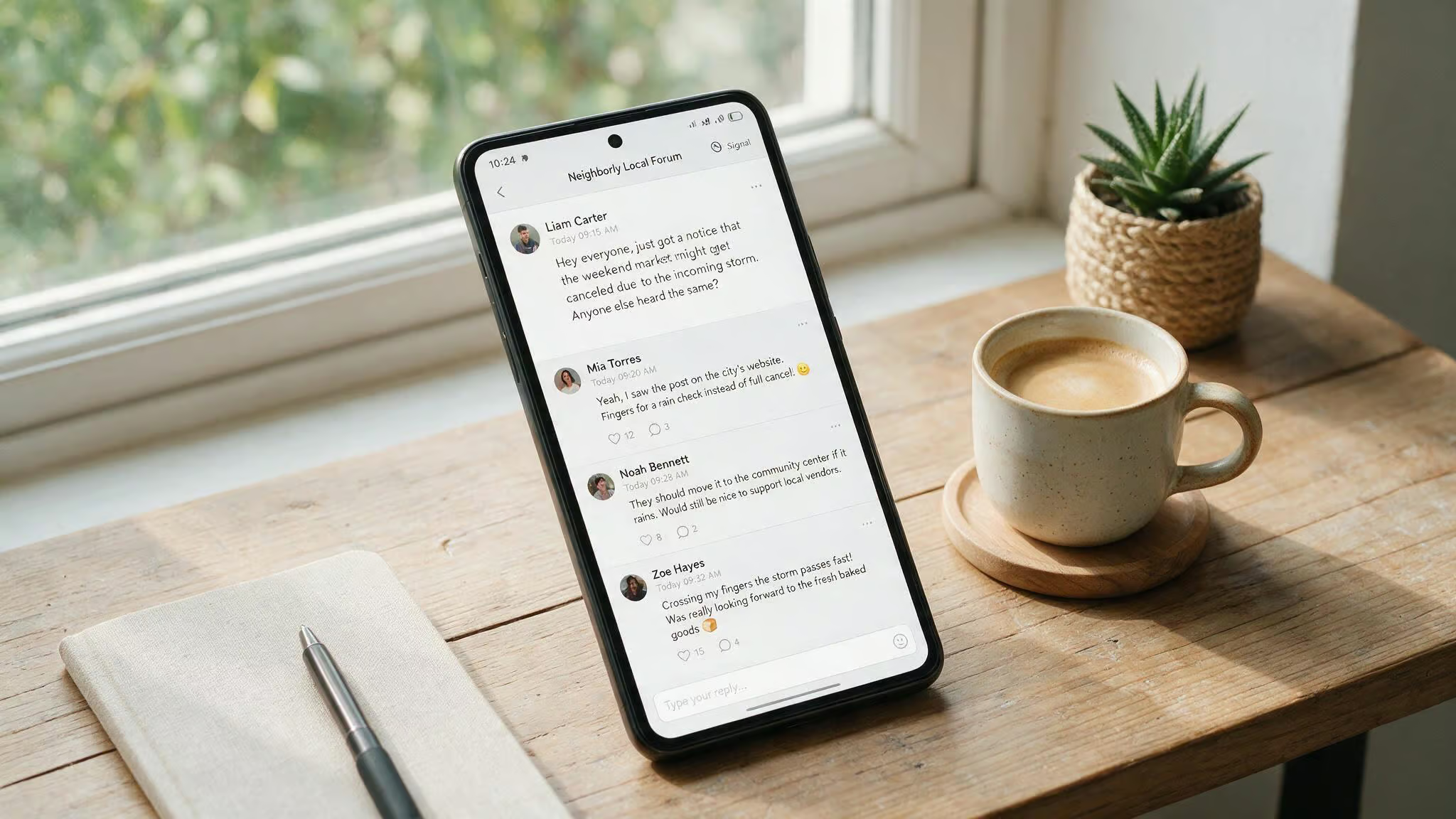
Customer support runs through a self-serve app, community forums, chat, and service tickets. There’s no phone number to call. If something breaks, you’re digging through threads or waiting on a ticket.
Device options are BYOD-only. There’s no carrier financing. If your phone breaks, you can buy a refurbished device through Public Mobile’s partnership with Orchard, but there’s no upgrade subsidy built into your plan.
The rewards program changed in March 2024 and long-time customers are still frustrated. Data bonuses now expire after 150 days. The current structure gives 240 GB for plans $29/month and up, 50 GB or 5 GB for lower tiers. It’s a decent deal if you join today, but the changes stung for people who’d been stacking rewards for years. The 150-day data bonus expiry period is a key detail to track when managing your account.
RCS reliability is a known hiccup on the Android side. Switching from Koodo caused RCS messages to fail intermittently, as documented in a detailed review. The hard fix—clearing the Messages app data—resolved the total breakage, but intermittent issues lingered afterward. If you’re an Android user messaging iPhones, this is a specific pain point worth testing during your first week.
The April 2026 system update outage caused data and call problems across the board. The recommended fix was a hard restart or an Airplane Mode toggle. It got resolved, but that kind of event is the price of a self-serve support model.
Brief History — From CDMA Startup to Telus MVNO
Public Mobile launched on March 18, 2010 as an independent CDMA carrier, born from a federal government push to encourage competition. In 2008, it paid $52 million for PCS G band spectrum—a frequency band so niche that Public Mobile was the only carrier in the world to deploy it commercially. ZTE built their CDMA network. By Q3 2011, the carrier had added 40,000 new lines, bringing total active subscriptions to 154,000. In Q4 2011, it added another 45,000 new subscriptions, ending the year with 199,000 active customers.
Telus acquired the company in October 2013, and the CDMA network shut down on August 8, 2014. By September 2014, Public Mobile had transitioned to a digital-only self-serve brand running entirely on Telus’s infrastructure. It reorganized as a BYOD value brand in February 2015.
In 2018, Telus tried to raise the price on the old 12GB/$120 plan from $40 to $50/month. The backlash was ferocious enough that the company canceled the increase. The 2023 rebrand brought 5G plans and eSIM support. The 2024 rewards changes brought another wave of user frustration.
What Users Actually Experience — Forum Insights
On the Public Mobile Community forum, users confirm that the network uses Telus and Bell towers, but the extended network exclusion is a frequent point of confusion.
User lil-twerp asked a straightforward question about the towers Public Mobile uses. The community confirmed the full Telus/Bell RAN share. User EdmondY reported a Fido family member roaming on Telus half the time, illustrating the cross-carrier density dynamics that make the big three’s coverage maps so tangled. User lemew07’s 4:1 Telus-to-Rogers observation in mountainous BC is the kind of concrete detail that makes the extended-network gap visceral rather than theoretical.
User Dunkgirl flatly explained the extended network exclusion. User sheytoon and User MoreYummy both broke down the provincial infrastructure, confirming that Public Mobile taps into the same Telus towers and frequencies—just not the extended roaming. A forum thread edited on 2022-01-05 further clarified these network boundaries.
The outage threads are equally instructive. When the April 2026 system update hit, the forum filled with workarounds. One user reported trying a hard shutdown with no success. Another switched to a competing carrier with more data for $15 less.
The recommended fix settled on a hard restart or Airplane Mode toggle.
Is Public Mobile Right for You?
Switching from Koodo saves almost $20/month. US roaming saves $42 to $70 per trip compared to daily passes. The Black Friday 2024 deal—$35 for 50GB of 5G with Canada/US/Mexico roaming, later bumped to 60GB—shows exactly how aggressive the pricing can get.
The 250 Mbps speed cap, the missing extended network, the self-serve support model, the RCS quirks—these are not bugs. They’re the boundaries that keep the price low.
Good fit if you:
- Want Telus/Bell network quality at a lower price
- Own an unlocked, compatible phone
- Are comfortable with self-serve support
- Stay mainly in urban and suburban areas
- Travel frequently to the US or Mexico
Think twice if you:
- Frequently travel to rural or remote areas
- Need phone support for setup or troubleshooting
- Want to finance a new phone through your carrier
- Depend on flawless RCS messaging between Android and iPhone
The network answer is Telus, but the real answer depends on where you go and how much hand-holding you expect.
Frequently Asked Questions
What phones will work with Public Mobile?
Any unlocked, compatible phone that works on Telus and Bell frequencies will work. Public Mobile is BYOD-only — there’s no carrier financing. You can buy a refurbished device through their Orchard partnership, but you’re expected to bring your own device.