I started noticing a number showing up where it had no business being. A professor muttering about an AI-detection score on a paper. A team lead in a planning meeting walking through a 70/30 split between automation and human review. Someone in a budget conversation arguing that a third of the AI money should go to data quality before anyone even picked a model.
Three different rooms, three different meanings, the same number, nobody thought they were quoting the same rule. So I went digging.
Key Takeaways
The “30% rule” isn’t a single official rule; it’s three separate interpretations that share a number: a ceiling on AI content in education tied to Turnitin, a 70/30 productivity split in the workforce, and a data-quality budget line in enterprise AI.
Turnitin defines no 30% threshold; its AI score is a statistical estimate of how much text resembles machine patterns, and instructors use the number as a review trigger, not a verdict.
In a Boston Senate simulation, 98 teens from all 50 states drafted a K-12 AI policy bill (passed 82-16) that adds human double-checks on AI detector flags, since the checker software can be unreliable.
Table of Contents
One number, three different jobs
Here’s what I found: there is no single 30% rule. No regulator wrote it. No platform policy enforces it. It’s a number that picked up three separate jobs, and people keep conflating them because the digits line up.
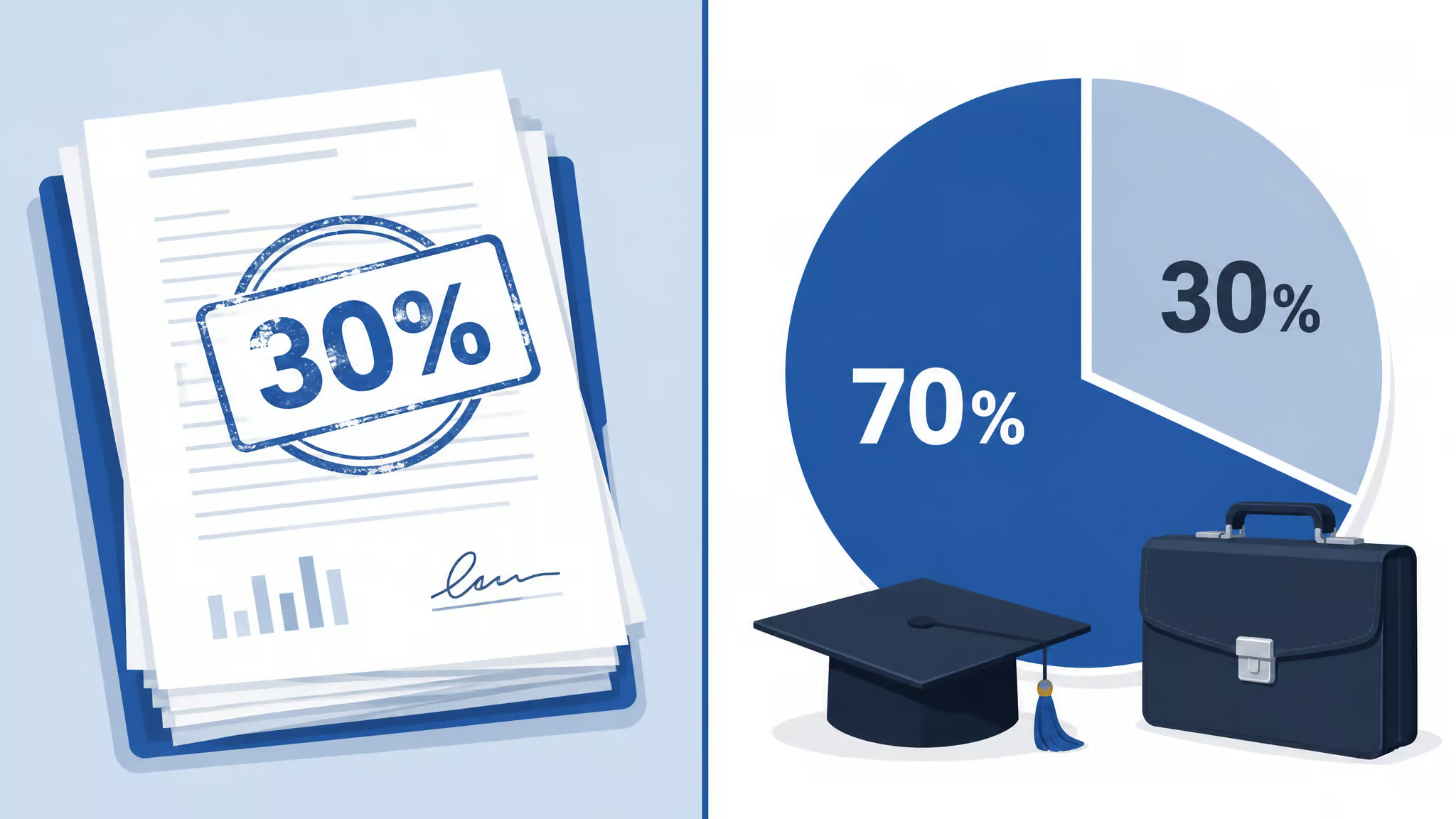
The education version is the one that made the number famous. It’s tied to Turnitin, the originality-checking tool, and it reads as a ceiling: no more than 30% of a submission should look machine-generated, with at least 70% clearly human. But the idea didn’t start with Turnitin, and Turnitin never defined it. The broader concept grew out of productivity theory, design ethics, and early AI operations practices, often boiled down to “automate a third, amplify the rest.” From there it splintered.
K-12 and higher-ed policies use one reading. Enterprise workflows that keep a human in the loop use another. AI-assisted software teams have their own. And because 30 and 70 keep appearing in different ratios, the 30% rule gets tangled up with the 70/30 AI productivity model, which is a related but separate thing.
Education: the Turnitin threshold
Say you’re grading and you watch a week of assignments roll through. Scores trickle in at 2%, 8%, 14%, then a paper lands at 31%. That’s the moment the informal rule kicks in, and it’s worth understanding how the tool actually got there.
What the score actually measures
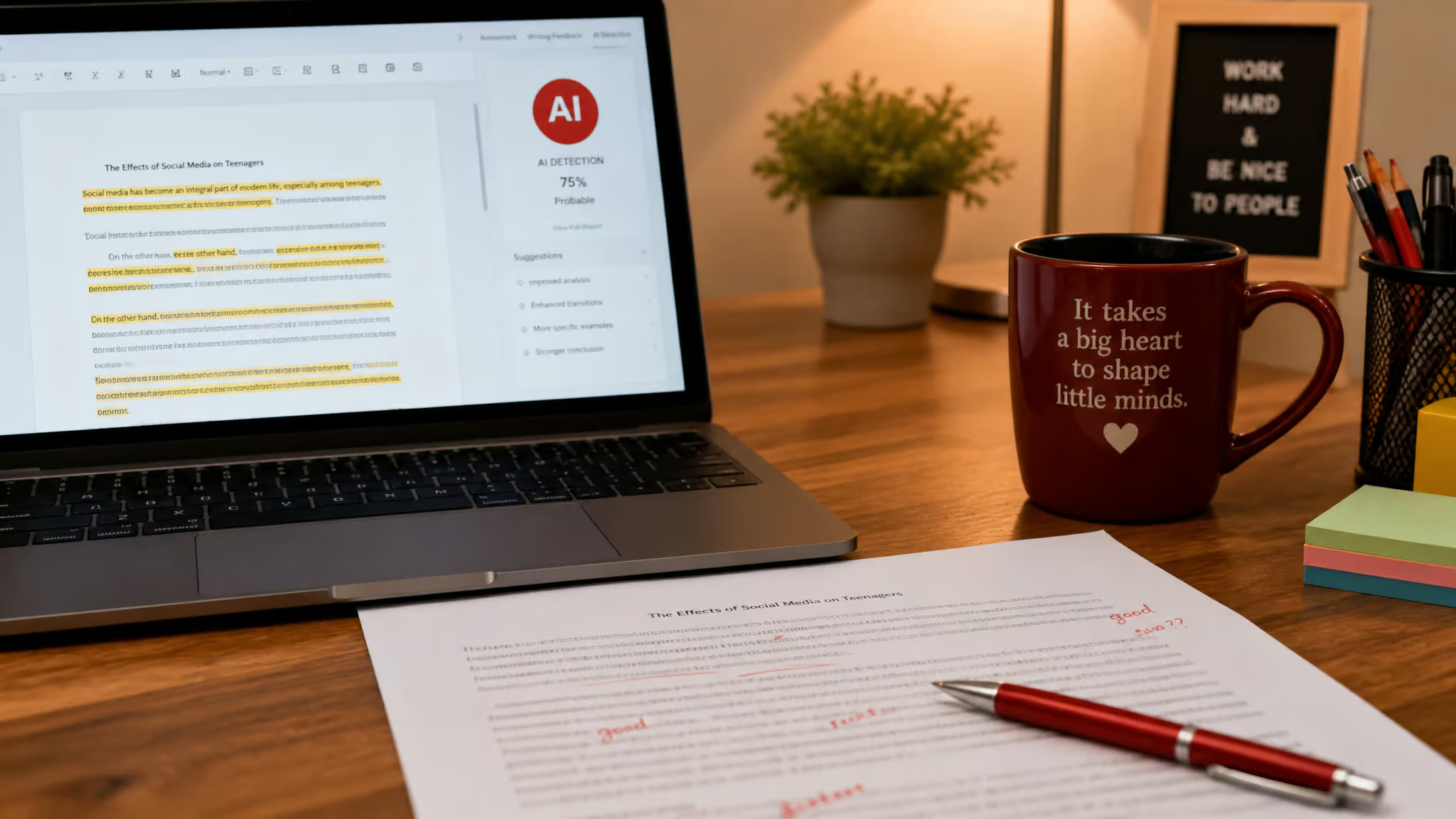
Turnitin’s AI detector doesn’t read an essay the way a professor would. It’s a pattern matcher, not a reader. It doesn’t weigh argument, evidence, or insight. It runs statistical properties: predictable word order, very regular sentence lengths, an even paragraph rhythm, generic transitions, and little structural variation.
Those are the kinds of AI-tell words and filler phrases machine writing leans on. Based on those patterns, it produces a score estimating how much of the text resembles machine output.
That’s an estimate, not a declaration of fact. The tool won’t tell you that an exact percentage “was definitely written by AI.” A score reads more like a statement that a portion of the writing resembles the kinds of patterns its model associates with AI generation. Useful signal. Not courtroom evidence.
No official threshold
Here’s the part that surprises most people: Turnitin does not define a 30% pass/fail line. It reports a score, and institutions decide what to do with it. The 30% idea came from three places at once: instructor internal guidelines, confusion between what a school practices and what the platform actually enforces, and the simple intuitive feel of the number. Thirty feels like a reasonable cap, so people treated it like one.
The gray zone
A score near 30% sits in the most interpretable spot on the whole spectrum. Not clearly clean, not overwhelming. Under 30% doesn’t always mean safe; some instructors review manually regardless of the number. Over 30% doesn’t mean guilt; it’s a signal inviting review, not proof of anything.
Papers land in the 20-40% range for very different reasons. Sometimes it’s lightly edited AI output: a draft generated in ChatGPT with a few sentences changed and some words swapped, while the underlying structure stays machine-made. Sometimes it’s formulaic academic prose, that five-paragraph essay or templated reflection that happens to read like a bot wrote it. And sometimes it’s a mixed-origin document, where a student writes most of it themselves but uses AI for the intro, topic sentences, or a conclusion rewrite. Those sections can disproportionately move the score because they live in the parts detectors focus on.
Not every professor uses the same number either. Some set review bands at 20%, 25%, or 30%, and plenty don’t use a threshold at all. When a score does cross whatever line a teacher picked, the review looks the way you’d hope: reading the highlighted sections, comparing style against earlier work, checking whether the intro and conclusion are suspiciously polished, asking about the drafting process. A human talking to a human. For the full forensic side of spotting machine prose, our geek’s guide to detecting AI writing walks through the tells in detail.
The workforce reading: AI does the heavy lifting
The workplace version flips the whole thing. Here, AI handles roughly 70% of the repetitive, data-heavy work, and humans keep 30% for oversight, creativity, and judgment. Quality control, contextual judgment, ethical oversight, values-driven decisions, communication, iteration. That’s the human slice.
People call both readings the 30% rule. The key difference: the workforce version describes task division, not job elimination. AI takes the boring, repeatable load. Humans keep the parts that need judgment.
Why 30% and not something else? The figure keeps getting described as a comfort zone that is both psychological and operational. Too little human involvement and people disengage from the work entirely. Too much, and you eat into the productivity gains the AI was supposed to buy.
Thirty percent is the slice a team hangs onto to stay alert. Teams like Golabs, which runs AI-assisted nearshore development, describe building their workflow around that kind of 70/30 balance. It’s a guideline, not a fixed ratio.
One caution worth carrying: push automation to something like 90% without a real review culture, and that’s the danger zone. That’s where quality slips and nobody notices until it’s expensive.
The enterprise version: a budget for data quality
The third reading has nothing to do with essays or workflows. In enterprise AI, some suggest roughly 30% of a company’s AI budget should go to data quality and governance, with the remaining 70% going to modeling, infrastructure, and deployment.
The rationale is pure risk management. Poor data quality is what breeds bias, model drift, and hallucinations. Spend everything on the shiny model and starve the data layer, and the model quietly degrades. It’s a budgeting heuristic, and it shares nothing with the classroom or workforce readings except the digits.
Where the number gets over-literal
Across all three readings, two misunderstandings keep coming up. First, people treat the rule like a hard cap: AI must never exceed 30% of the work. That’s not how any version of this works. AI can handle far more than 30% and still be fine, as long as the outcome stays clearly human-owned. The rule is about ownership, not a numeric ceiling.
Second, people treat the number as if it’s enforceable and measurable to the decimal place. It isn’t. It’s a guideline, a design principle, a tripwire. Not a legal standard, not an algorithmic constraint.
Turnitin has no official pass/fail line, and the figure isn’t scientifically proven; it’s a comfort zone that happens to feel right. If your school or team treats it as a law, that’s a choice, not a requirement.
If you want the full picture of how these tools relate to the plagiarism checkers schools already run, we’ve got a separate piece on how AI detection and plagiarism checkers overlap.
A student-written bill tries to answer the hard questions
The abstract stuff gets concrete fast when real people try to act on it. In Boston, at the Edward M. Kennedy Institute, 98 teens from all 50 states ran a Senate simulation and wrote an actual AI-use policy bill for K-12 schools. There’s no national policy for AI use in schools, so states and districts are inventing their own rules as they go. These students decided to draft one. After closing debate and one-minute addresses from the floor, the bill passed 82-16.
It’s called the Students First Act. It’s a student draft from a simulation, not law, but it shows how the accountability questions behind the 30% number get worked out when people stop gesturing and start writing.
What the bill says
The students split into subcommittees covering students, educators, administrators, and families, and the final bill is genuinely dense. The student-focused section runs 15 provisions, with another 10 under parents and guardians. Students get AI literacy as soon as they have classroom devices, covering misinformation, plagiarism, bias in AI design, privacy, appropriate academic use, and AI’s environmental impact. AI is banned on graded tests.
Students shouldn’t use AI to write, but editing, brainstorming, and studying with AI would be allowed after eighth grade. When students do use AI, they’d have to cite it and prove mastery through discussions, handwritten tests, or oral defenses.
The detection side gets its own safeguards. If a student is suspected of inappropriate AI use, two school officials would review the work on top of the AI checker software, in part because that software can be unreliable. Teachers must personally investigate flagged work before reporting anyone, and they can ask a suspected student to orally defend any project. They’d also post a written AI policy each semester, and they could use AI for lesson planning, practice materials, feedback, and instruction.
The debates were the interesting part
The bill’s own backstory is where it gets good. An early version let parents completely veto their students’ AI access; that got dropped after people pointed out that many adults don’t know what AI is, and full parental say could end up limiting students. Isabella Stringer from New Hampshire put it bluntly: “We cannot legislate parenthood.”
The chatbot provision drew the sharpest defense. When a school chatbot detects a student needing emotional support, it should alert school officials rather than just fulfill the request. When students are in crisis or having suicidal thoughts, the technology must alert a human. Dylan Dornack from Iowa called it “This could be lifesaving.”
Not everyone was sold. Jadelynn Petitjean of Alabama opposed the bill, calling it an “unstable foundation.” Ethan Liu of West Virginia initially opposed it too, pointing out the contradictions in restricting students’ AI access while handing teachers wide discretion. After last-minute amendments fixed some of the inconsistencies, he switched his vote. Leena Jain of Louisiana took the floor ahead of the final vote, and Kendall Terao-Toma of Hawaii endorsed the bill as a matter of the future of education, workforce, economy, and communities.
There were real practical concerns in the room too. Teachers are already under-resourced. Underprivileged schools may struggle to fund new AI literacy instruction. The students’ proposed answer: federal funding for AI literacy.
The idea could spread. The School Superintendents Association plans to send the bill text to its roughly 10,000 school leaders. Not adopted policy, just a strong head start.
What to actually do with the number
Strip all three readings down and one thread holds them together: keep a human in a position to check. The 30% number is the excuse. The check is the point.
In classrooms, that instinct has produced genuinely useful habits. Color-coded drafts that distinguish AI-assisted text from student-authored work make the split visible, so nobody is guessing where the line fell. And the right framing is the calculator one: AI is a supporting tool, not a replacement for thinking. Used well it can spark creativity, save time, support learning, and build confidence.
For students writing coursework: use AI for brainstorming, editing, and studying, never for writing the thing itself. If you use it, show the work and be ready to defend it. That’s the whole deal.
In development teams, the split is already familiar. AI tools like the ones GitHub ships will cheerfully generate boilerplate and repetitive code. The human owns architecture, security judgment, and review. Same division, different building. And coding schools like Coco Coders are already building AI into lessons, so the next generation hits these questions earlier than we did.
Don’t audit a percentage. Ask whether a human actually owns the outcome. When something crosses the line you’ve chosen, that’s your cue to read more carefully, not to press a button and call it done.
Frequently Asked Questions
What is AI not allowed to do?
AI isn’t inherently ‘allowed’ or ‘not allowed’ to do anything—it depends on the rules humans set. In education, for example, the student-drafted Students First Act proposes banning AI on graded tests and requiring human review of AI detector flags. In the workforce, the guideline is that AI shouldn’t fully own outcomes; a human must remain in the loop for oversight and judgment.
What’s the difference between the 30% rule and the 70/30 AI productivity model?
The 30% rule in education is a ceiling on AI content in a submission, while the 70/30 productivity model describes how work is divided: AI handles about 70% of repetitive tasks, and humans keep 30% for oversight and judgment. They’re related but separate—the education version is about content ownership, while the workforce version is about task division.