The number that should make you sit up: recent research that parsed 1,600 websites puts the web’s authorship split near 50/50. Roughly half of everything published online is now primarily AI-generated, and the other half is written by actual humans. That split has quietly turned “who wrote this?” into the most interesting question on the internet.
Which is why people keep searching for phrases like “AI checker free” and “AI detection plagiarism checker,” hoping one tool will settle it. Here’s the uncomfortable truth: that tool doesn’t exist, because you’re asking for two different machines. A plagiarism checker searches for copies, hunting for matching text in indexed sources. An AI detector is a statistical reader, guessing whether a machine wrote the words in front of it. They run on different mechanics and fail in different ways, yet people keep treating them as one.
The University of Chicago’s Academic and Technology Solutions unit ran a real battery of five popular detectors against text from ChatGPT, Claude, Copilot, and PhoenixAI. Their verdict: no tool is infallible, and every one of them had an embarrassing miss, including one that flagged a fully human paragraph as 100% AI% AI.
So this is a straight dig through the test data: what these tools actually do, where they fail, where they genuinely help, and where the industry is headed.
Key Takeaways
The UChicago ATS test had no clean sheets. GPTZero caught nearly everything but wobbled on Copilot; ZeroGPT called a fully human paragraph 100% AI; Originality.ai nailed every AI sample while charging human text with a 97% false-positive rate.
The AIMultiple ten-tool benchmark is a mixed bag. Copyleaks caught 100% of AI text with an 11% false-positive rate; Writer AI detected only 10% of AI text; QuillBot missed every Gemini sample.
The best current practice is a three-step loop: run a plagiarism check, run an AI screen, then read the text like a human. In high-stakes settings, check the edit history. The detector is a supporting tool, not a verdict.
Table of Contents
Plagiarism checkers vs. AI detectors: two different threats
A plagiarism checker has one job: tell you whether text was copied from somewhere. It breaks your document into chunks, compares those chunks against massive indexes of web pages and academic databases, and returns a similarity score, a percentage that points you toward matching sources.
An AI detector has a different job: tell you whether a machine wrote the text. It doesn’t look for matches at all. It reads the statistical texture of the prose, sentence-length rhythm, word-choice predictability, how “even” the writing feels, and returns a probability that the text was machine-generated.
Those are two different threats. Copying is theft; outsourced generation is a shortcut of a different kind. They require different responses, which is why you keep seeing phrases like “the dynamic duo” attached to running both checks together. If you test for only one, you’re flying with one wing.
| Question | Plagiarism checker | AI detector |
|---|---|---|
| What does it look for? | Matching text in indexed sources | Statistical patterns in the writing |
| How does it work? | Breaks text into chunks, compares against databases | Scores perplexity, burstiness, sentence rhythm |
| What does it return? | Similarity score (%) and source links | AI probability score (%) |
| What does a positive result mean? | Text appears in another indexed source | Text statistically resembles machine writing |
| What can fool it? | Paraphrasing, obscure sources | Heavy editing, humanizers, unusual writing styles |
The weird part: a document can score beautifully on both checks in opposite directions. You can run a piece that finds zero copied text in any database, and then the AI detector flags it at 95% AI. Or a completely original human essay trips every AI heuristic because the writer’s style is unusually uniform.
That’s why the phrase “AI detection plagiarism checkers” is such a trap. It makes people think they bought one tool when they actually bought two, and the second one is a lot less reliable than it looks.
How plagiarism checkers work (and why they miss AI text)
To understand why these tools fail at AI detection, you first need to see what they actually do. The mechanics are straightforward, and the blind spot follows directly from them.
The core mechanic: a search for copies
Every plagiarism checker tokenizes your document, breaks it into small chunks of a few words each, then runs those chunks against huge corpora of indexed web pages and academic databases. That’s the core mechanic: the search for copies. When chunks match something on the other side, the checker tallies it up and produces a similarity score: the percentage of your document that appears verbatim (or near-verbatim) in another indexed source.
That score is a pointer, not a verdict. It tells you where to look, not what the person intended. A low score means we didn’t find much matching text in our indexes, nothing more. It doesn’t mean the work was originally written.
It doesn’t mean a machine didn’t write it. It just means the words weren’t lifted from something the checker could see.
The advanced players: Turnitin and Paperpal
The tools academics actually encounter. Turnitin on the institutional side, Paperpal and similar assistants on the writing side, layer extra features on top of that core search. Turnitin is the name most universities route submissions through, and it has bolted on AI-detection capability in recent years. Paperpal, meanwhile, packages its guidance around the forms of plagiarism rather than just the raw mechanic, walking writers through the different ways copied or misattributed text can show up.
But every layer sits on the same foundation: matching against indexed corpora. And that foundation has a structural limitation you need to understand.
Why they miss AI text entirely
Here’s the brutal part: a standard plagiarism check is nearly blind to AI-generated text.
A plagiarism checker cannot catch AI text because AI assembles novel word sequences that exist in no database. Plagiarism checkers catch text that exists somewhere else. AI text, by construction, often exists nowhere else, the model assembled it on the spot, and the specific combination of words isn’t in any corpus. A checker can index the entire web, and a fresh essay from ChatGPT can still score a perfect 0% similarity.
No copies found. Case closed? No, the essay was still written by a machine.
There’s a second problem: advanced models are extremely good at varying syntax and synonyms, which further reduces the overlap that plagiarism checks depend on.
And there’s a third problem that runs the other way: AI can also produce text that does mirror existing material. Models are trained on enormous datasets, and occasionally they reproduce something close to a sentence or passage in their training data, which then shows up in a plagiarism check. So you can get false negatives (AI text scoring 0% similar) and occasional false positives (original writing flagging high because it resembles something indexed). And there’s another layer: database lag means newly published content isn’t indexed yet, so even direct matches can slip through, and template language in rigid structures like abstracts or lab methods looks clean because it’s so standardized. The checker is a tool, but it can’t tell you what generation process created the text. That’s a different question entirely.
How AI detectors work under the hood
AI detectors are pattern readers, not copy finders. They were built on a simple observation: large language models have a tell in the statistical texture of their output.
Human writing is erratic. Sentence lengths swing around; some sentences are long, tangled, and exploratory; others are blunt fragments. Vocabulary choices reflect personality and idiosyncrasy. Machines, by contrast, tend toward the average, they optimize for predictability.
So detectors look for signals like perplexity (how predictable each word is given the words before it, machine text tends to be more predictable, because the model literally chose the highest-probability words) and burstiness (variation in sentence lengths and structures, machine output tends to be unnaturally uniform). Some detectors take a different route entirely: they’re classifiers, trained on large datasets of known human text and known AI text, that learn which patterns separate the two.
Either way, the key mechanic is the same: they don’t need to have seen the source text. They don’t check whether the essay exists somewhere else. They check whether the essay feels machine-generated.
That gives them a power plagiarism checks don’t have, but it comes with a crippling weakness. A detector’s output is a probability, not a fact. And probability can be wrong in both directions.
Your mileage will vary dramatically based on three things: which tool you’re using, what kind of text you’re testing, and which model generated the text you suspect. Different detectors perform wildly differently against different writers. And text that went through any significant editing, a human rewriting AI output, or a student smoothing out their own draft, starts to read more human, which can hide the machine entirely. The human touch can hide the machine. That’s not a bug in a few tools; it’s a structural weakness in every pattern-based detector.
Which raises the question: if the tool is a probability engine, how reliable is it really? The UChicago test is the place to look.
The UChicago test: five detectors, zero clean sheets
In April 2025, the University of Chicago’s Academic and Technology Solutions team published its AI and Plagiarism Checkers Guide, a rare thing in this space: an institutional test with named tools, named LLMs, and a clear-eyed verdict. They ran five detectors against text from ChatGPT, Claude, Microsoft Copilot, and PhoenixAI. Independent outlets like ZDNet have been running parallel examinations, and the results rhyme.
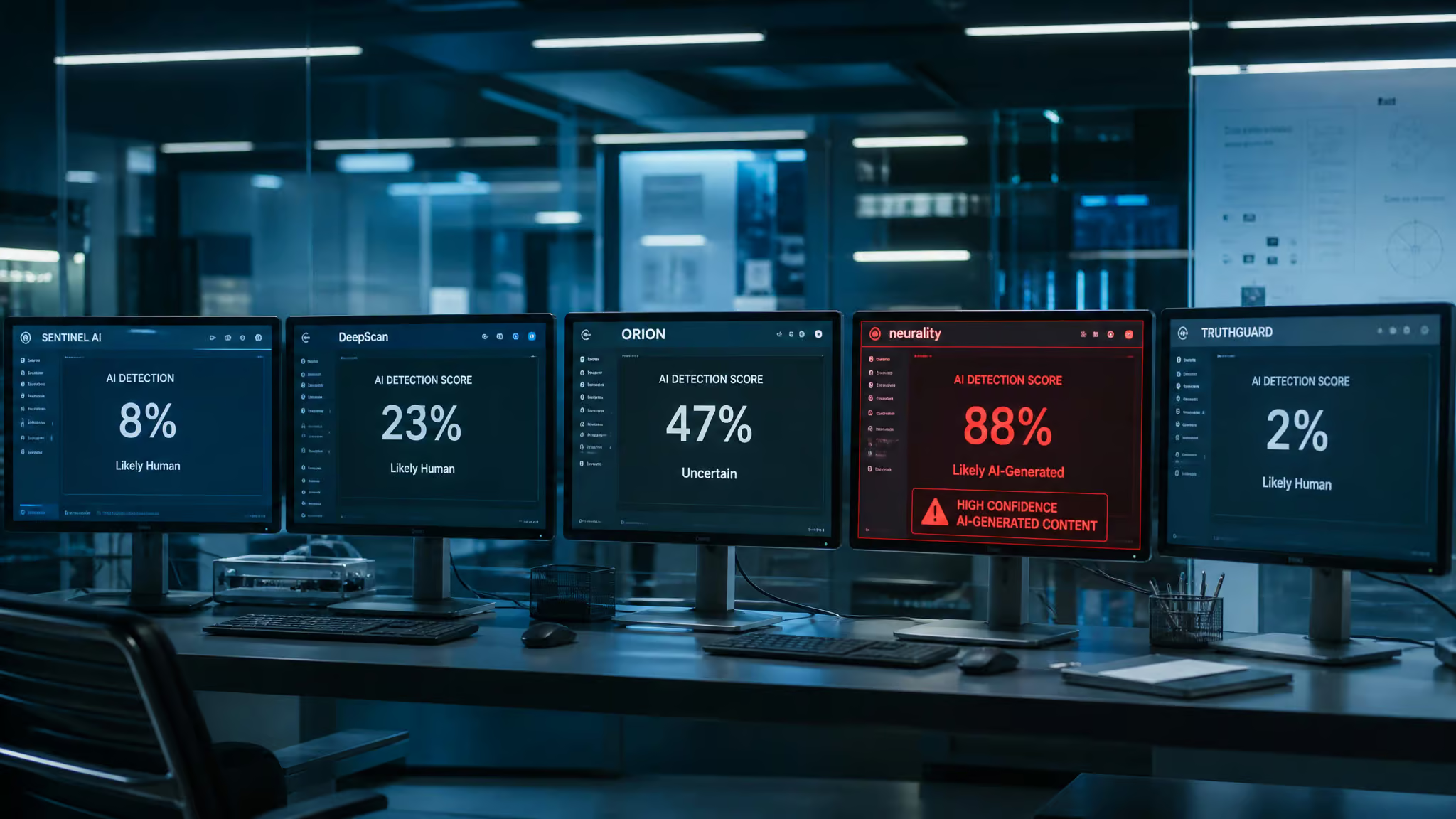
The guide’s summary line is worth quoting directly: each tool had its own strengths and shortcomings. Not one of the five was clean.
GPTZero
GPTZero was the strongest overall in the group. It caught the AI-generated samples at 100% accuracy for three of the four models, and it scored 99% accuracy on fully human text, meaning only about 1% of human writing was falsely flagged.
The asterisk: Copilot. On that sample, GPTZero only reached 63% confidence. It eventually flagged it, but weakly, the kind of borderline call that teaches you why “above 50%” should never be treated as a confident verdict on its own.
ZeroGPT
ZeroGPT gives us the cautionary tale of the battery. Give it a fully human paragraph and it will, in this test, call it 100% AI generated. A clean piece of human writing, the kind a student might draft in an afternoon, gets slammed as machine text with absolute confidence.
The guide also flagged something uncomfortable about the business itself: ZeroGPT relies heavily on Google ads to get traffic, and its site offers to make AI text “human”, an irony worth sitting with. The same brand that sells detection also sells evasion.
GPT2 Output Detector
The veteran of the batch, built on the GPT-2-era approach to pattern flagging, was included as a reminder that “old architecture” doesn’t mean “safe to ignore.” The guide’s results place it in the same box as everyone else: blind spots, and credibility issues on human text. Its own reported scores were weak enough that the guide effectively shelved it as a supporting tool at best.
Originality.ai
Originality.ai brings the most impressive raw catch rate in the battery, and the most uncomfortable tradeoff. On the AI samples, it flagged everything, 100%. The problem: its false-positive rate on fully human text was 97%. A student could feed it a completely original essay and watch it get branded machine text almost every time.
That’s the test’s clearest lesson: perfect recall on AI detection is worthless if the tool can’t tell the difference between a machine and a human. An AI detector that cries wolf at 97% on human writing isn’t a detector; it’s an accusation generator.
Grammarly
Grammarly’s built-in tool flagged most AI-generated submissions above 50% certainty, except ChatGPT, which slipped through. And on human text, it was erratic, swinging between quiet and alarmist. Grammarly itself says in its FAQ that its AI detection is best used as one signal among many, not as a scoring authority. Given the test results, that’s honest framing.
The UChicago takeaway isn’t “all detectors are useless.” It’s that these tools are diagnostics, not verdicts, and the ones that look most confident are often the ones producing the most damage.
The AIMultiple benchmark: ten detectors, one clear pattern
AIMultiple ran a different kind of study, a benchmark of ten AI detectors tested against samples from multiple models plus human-written text. The per-tool results read like a report card with no A+ students:
- Copyleaks caught 100% of AI text but flagged a human text as AI, an 11% false-positive rate.
- Pangram caught 85% of AI text with zero false positives on the human samples, the cleanest balance in the group.
- Scribbr missed three AI texts (69% detection) with a 6% false-positive rate.
- Sapling flagged four human texts, a 45% false-positive rate.
- Undetectable AI missed 29% of AI text and flagged three human texts, 34% false positives. (Yes, it also sells the humanizing tool. More on that in a minute.)
- QuillBot missed every Gemini sample, a 49% false-negative rate on one model alone, and flagged a human text at 55%.
- DeepSeek’s tool caught 72% of AI text.
- Gemini’s own detector only caught 54% of AI samples. Even Google’s flagship couldn’t reliably detect other models’ output.
- Advanced missed four AI texts (41% detection) but scored zero false positives on human text.
- Writer AI detected only 10% of AI text, effectively a coin flip that lands tails.
There’s also a separate experiment attached to the same analysis that should make you wince: detectors collectively flagged 88% of fully human text while only catching 71% of AI text.
Once you see those numbers, the “best detector” conversations rearrange themselves. Copyleaks wins on raw catch rate but cries wolf more often than the human-text score suggests. Pangram sacrifices some recall for a clean false-positive record. Writer AI is nearly decorative. And every single tool has a model blind spot somewhere.
The real pattern in this benchmark: every tool’s tradeoff lands in the same zone. None of them behave like a reliable witness. They all behave like a nervous screening tool that is useful as a first pass and dangerous as a final word.
The false positive crisis: when detectors accuse innocent writers
If you want to understand why these tools are so controversial, skip the AI stats and look at the human ones. The UChicago test nailed it with one paragraph: a detector that scores 100% on AI text while flagging 97% of human text isn’t a detector worth having. The study’s separate experiment pushes it further, 88% of fully human text getting flagged somewhere in the mix.
The damage is concentrated in specific groups. Research has repeatedly shown that AI detectors disproportionately flag non-native English writers, people whose sentence rhythm and word choice are statistically “unusual” to a pattern-reading model, and therefore “suspicious.” The same tools that are sold as objective and neutral are, in practice, far more likely to accuse a non-native speaker of cheating than a native speaker producing the same quality of work.
And the stakes are rarely neutral. A student accused of AI misuse on the strength of a detector score can carry that accusation into a disciplinary hearing. An admission essay can be rejected because a screening tool screamed wolf. A job candidate’s application can get filtered out by a threshold that no human ever scrutinized.
That’s why the industry-wide advice is becoming blunt: detector scores should never be treated as evidence of misconduct on their own. They’re a signal that something deserves a closer look, not a finding.
If you catch yourself trusting a number too hard, especially an arbitrary one like a “50% threshold” or a certain confidence percentage, stop and read the companion piece on the 30% rule and why threshold-based interpretations of these scores are so fragile. A probability has a context, and the context is doing most of the work.
The arms race: humanizers, evaders, and the tools selling both sides
Here’s the darkest part of the ecosystem: some of the tools being sold to catch AI are also in the business of evading detection.
Undetectable AI is the cleanest example. Its platform lets you paste text, runs it through multiple detectors to check whether it gets flagged, and then, if it does, offers to rewrite the text to make it “human-like” until it passes the same detectors. You can check the text with one click and launder it with the next, on the same account.
ZeroGPT, the detector that flagged a human paragraph as 100% AI in the UChicago test, also offers tools to make AI text undetectable. The hand that accuses you will happily sell you the disguise.
This is the actual arms race playing out in real time. Detectors improve their pattern recognition; humanizers rewrite text to widen the patterns again; the next iteration of detectors tries to spot the rewrite. Every cycle produces tools that are marginally better at their stated job and considerably more expensive to trust.
The practical consequence: even the best detectors are fighting a moving target. The text that comes out of a 2023 model looks different from a 2025 model’s output, which looks different after a single pass through a humanizer. A tool that’s excellent on one generation of AI becomes conflicted on the next.
Which leads to the most important insight in this entire field: if the detection side can’t keep up with the generation side, the strongest signal isn’t inside the text at all, it’s in the process that produced the text.
Process tracking: the signal that beats every score
Here’s a lesson from the UChicago guide that doesn’t get enough attention: the most reliable evidence isn’t in the paragraph, it’s in the edit history.
When a paper is drafted by hand, there’s normally a trail of versions: scattered early notes, a rough draft with halting sentences, a second pass with margin corrections, a final cleanup. The document advances in erratic chunks, with sections that were clearly reworked on a second or third run.
When an essay is generated by an AI in one sitting, that trail is empty. The document pops into existence fully formed, polished prose, uniform rhythm, no visible draft states. Then, twenty minutes before the deadline, the human does a quick cosmetic pass and submits.
That’s why platforms like Google Docs and Microsoft Word keep version histories, and why a growing number of institutions are checking the version trail instead of the word choice when an accusation arises. A short creation window followed by a sudden fully-polished document is a far stronger signal than any probability score.
Does this solve everything? No. A determined student can draft a rough outline, feed sections to an AI, and blend the output into their own scaffolding. But even those cases produce telltale patterns in the edit trail, long silences, sudden jumps in prose quality, sections that never went through a rough draft.
Run a detector screen. Run a plagiarism check. And then look at the bones: the version history, the edit cadence, the writing process itself. That’s the evidence that reads truthful.
Grammarly: the familiar tool with a complicated reputation
Because Grammarly is the most widely installed writing tool in the world, it reports roughly 3,000 academic institutions among its users and tens of millions of daily users, its AI detection feature gets outsized attention. When it added AI detection to its existing plagiarism checker, a lot of people assumed they now had everything they needed in one place. “AI detection plagiarism checker.” There’s that phrase again.
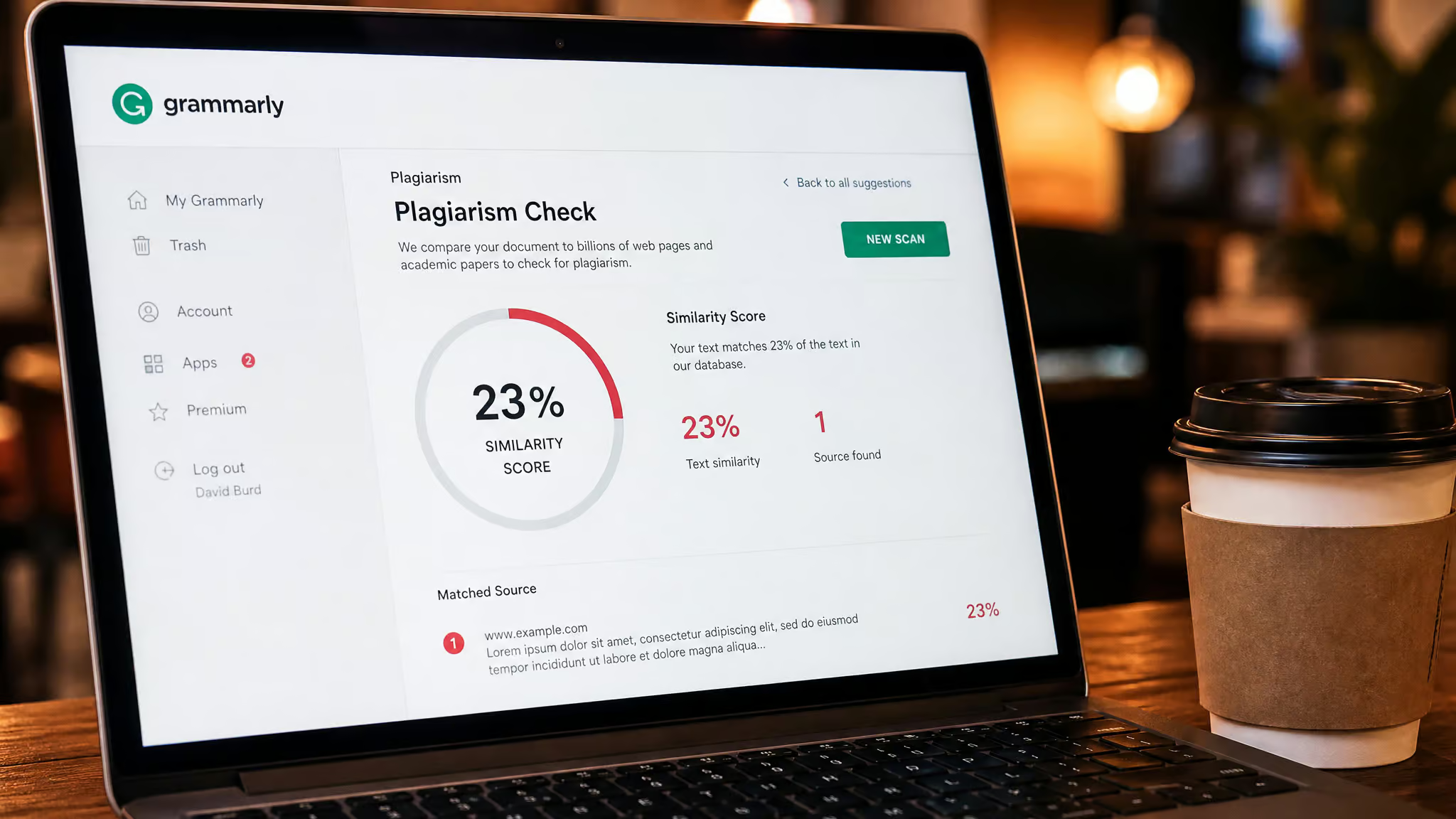
Grammarly’s plagiarism checker is the familiar mechanics described earlier: it searches a claimed index covering billions of web pages along with academic databases like ProQuest, and it returns similarity matches. That part is genuinely useful, and Grammarly’s marketing leans on real user voices, people like Brandy Cross and @chao_mgbo who live in the tool daily.
The AI detection side is a companion module with the same caveats as everything else in this guide. The UChicago test found it flagged most AI samples above 50% certainty except ChatGPT, which slipped through, and it behaved erratically on human text. Grammarly itself frames AI detection as one signal among many, never as a verdict on its own.
Use Grammarly for its original strength: finding copies. Use it as a first-pass AI screen. Just don’t mistake the integrated product for a more reliable product. Integration doesn’t improve detection quality; it just puts the two tools in the same drawer.
How to use these tools responsibly: a practical workflow
Translate all of this into a process you can actually run, and it looks like this:

Step 1. Start with a plagiarism check. This is the most mature tool in the stack. Run the document through a similarity check and review the matches. A clean similarity score tells you the work wasn’t copied from indexed sources, nothing more, nothing less.
Step 2. Run an AI screen, and read the number like a diagnostic. Get your probability score, but read it in context: which model might have generated it, which tool you’re using, whether the text went through any significant editing. A weak signal at 60% and a loud signal at 95% are different things. Both are still probabilities, not verdicts.
Step 3. Read the document with your own eyes and look for the human fingerprints. Check the edit trail if you can. Look at the creation window.
Look for the texture of actual drafting, the rough first section, the improved second pass, the occasional fragment that someone typed at 2 a.m. Machine text is eerily clean; real human work leaves marks.
Step 4. Escalate carefully. If the stakes are high, a disciplinary decision, an admissions call, a job application, never let a detector score make the call on its own. Institutional guidance is increasingly explicit: AI detectors should be used as a supporting tool, not as the sole evidence for a decision. Gather the version history.
Talk to the person. Weight the context.
Step 5. Institutionally: have a policy before you need one. The schools and employers that handle AI-text accusations well are the ones that established their procedures early, what tools they’ll run, what evidence they’ll accept, what burden of proof they’ll apply. The institutions that scramble after the first accusation get the scramble’s results: accusations built on scores, with all the false positive damage that follows.
Emerging solutions: watermarking and provenance
If pattern-based detection is fundamentally unreliable, what comes next? Two shifts are already underway.
Watermarking is the most discussed answer. The idea: AI providers embed a statistical signature into their models’ output, subtle patterns in word choice that humans can’t see but detectors can read with high confidence. Because the pattern is baked into the generation, it doesn’t depend on guesswork about whether the text “feels” machine-made. OpenAI has publicly committed to watermarking its own output, and other labs are working on similar systems.
The catch is the same one that runs through everything in this field: watermarking only works on the original output of a cooperating model. Rewrite the text, run it through a humanizer, translate it, or generate it with a different open-source model, and the watermark is gone. It’s a serious improvement on the detection side, but it doesn’t end the arms race, it just changes the battlefield.
Provenance is the second shift: rather than trying to judge whether a piece of text looks machine-made, attach metadata about how it was made. Tools like Content Credentials (the C2PA standard backed by a coalition including Adobe, Microsoft, and others) embed tamper-evident history into files, when a document was created, which applications touched it, whether an AI was involved. The browser shows provenance indicators; the metadata is cryptographically signed, so it can’t be silently stripped. If the entire creation history is visible, you don’t need a detector to guess, you can look it up.
Neither solution is frictionless. There will always be an unstamped document that needs to be evaluated on its own merits, and there will always be a tool that rewrites text to strip the history. The difference is that these systems turn the question from “what does this text statistically resemble?” into “what do we actually know about how this text was made?” That’s an upgrade worth waiting for.
Key terms, explained
- AI content, text generated by a large language model.
- AI detector / AI checker, a tool that statistically assesses how likely it is that text was machine-generated.
- AI likelihood / AI probability score, the detector’s output, usually a percentage. A probability, not a verdict.
- AI-generated, text produced primarily by an AI model.
- AI-assisted, text mixing human input with AI output, in varying proportions.
- Burstiness, variation in sentence length and structure. Human writing is “bursty”; machine output tends to be uniform.
- False positive, human text incorrectly flagged as AI.
- False negative. AI text that escapes detection.
- Humanize / AI humanizer, software that rewrites AI text to evade detection, often by reshaping rhythm and vocabulary.
- Perplexity, how predictable a given word is in context; detectors treat unusually high predictability as a machine signal.
- Plagiarism check, a search for copies against indexed sources, returning a similarity score.
- Similarity score, the percentage of a document that matches indexed sources. A pointer, not a judgment.
- Tokenization, the process of breaking text into small chunks for comparison or analysis.
- Watermarking, a technique for embedding a statistical signature into AI output that detection tools can later read.
- Provenance, metadata that records how and when a document was created and edited.
Bottom line: the human element
Here’s the honest summary of every test, every benchmark, and every institutional guide published so far:
No tool reliably detects AI text on its own. Not one.
The detectors that catch the most AI text also flag the most human text. The detectors with clean human records miss the most AI. Every single score is a probability in context, and the context includes model generation, editing, language background, and the arms race that keeps moving beneath everything.
That’s why the most reliable “AI detector” remains the one you already have: a careful human reader who understands the stakes. Run your plagiarism check. Run your AI screen. Then read the document like a person, look at the edit history, and ask the question the tools can’t answer: does this look like real work, or does it look like a machine did the heavy lifting and a human collected the credit?
The tools will keep improving. Watermarking and provenance will eventually shift the ground. But sensible use of these tools will always come down to the same principle: treat each score as a warning light, not a verdict. Then make the call with the evidence that actually holds up.
Frequently Asked Questions
Do plagiarism checkers detect AI?
No, not reliably. Plagiarism checkers search for copied text in indexed databases, while AI detectors analyze statistical patterns like perplexity and burstiness. They are fundamentally different tools, and a standard plagiarism check will often miss AI-generated text entirely because that text is newly assembled and doesn’t exist elsewhere.
What is the most accurate AI plagiarism checker?
There is no single most accurate tool. Independent tests show every detector has trade-offs: Copyleaks caught 100% of AI text but had an 11% false-positive rate, while Pangram caught 85% with zero false positives. The best approach is to use multiple tools and treat scores as diagnostics, not verdicts.
What’s the difference between a plagiarism checker and an AI detector?
A plagiarism checker searches for matching text in indexed sources and returns a similarity score. An AI detector analyzes statistical patterns like perplexity and burstiness to guess whether a machine wrote the text. They address different threats: copying versus outsourced generation.
Why do AI detectors flag non-native English speakers as AI?
AI detectors look for statistical patterns in writing, and non-native speakers often have sentence rhythms and word choices that differ from native speakers. This makes their writing appear ‘unusual’ to pattern-reading models, leading to disproportionately high false-positive rates for non-native English writers.
How can I tell if text was written by AI?
The most reliable signal isn’t in the text itself but in the process. Check the edit history: human writing shows a trail of drafts and revisions, while AI-generated text appears fully formed. Run a plagiarism check and an AI screen, then read the document for human fingerprints like rough sections and erratic edits.