
There’s a moment every security engineer knows. You’re scanning through the patch queue and there it is: a CVSS 9.0 vulnerability, screaming for attention. You drop everything to fix it. Then, three weeks later, you find out the box that actually got breached was a medium-severity issue on an internet-facing VM with an over-privileged service account. The 9.0 was sitting in a segmented test environment that nobody could reach from the outside.
That’s the failure mode of traditional vulnerability management. And it’s exactly the problem exposure management is built to solve.
So what is it, actually? Exposure management is a strategic, continuous discipline that identifies, validates, and prioritizes cyber risk across your entire attack surface. It shifts the question from “what’s vulnerable?” to “what’s exploitable, given reachability and context?” Instead of treating every CVE as an isolated incident, it looks at how assets, identities, and misconfigurations combine into real, business-impacting exposures.
Key Takeaways
Exposure management goes beyond vulnerability management by considering context: a known flaw on an externally accessible VM with elevated privileges outweighs a higher-severity issue in a segmented test environment.
The stakes are real: the average successful cyberattack costs $5 million, and Gartner predicts organizations that prioritize exposure management will reduce breaches by 90% by 2026.
It’s a continuous program, not a quarterly scan, built around discovery, validation, risk-based prioritization, and automated remediation.
Table of Contents
What Exposure Management Actually Is
Let’s be precise about the shift. Vulnerability management asks “what’s broken?” Exposure management asks “what’s broken and actually at risk right now?”
That distinction matters because most organizations have thousands of vulnerabilities, but only a fraction represent genuine exposure. A CVE in a library you use in production is different from a CVE in a library you patched last month. A misconfigured security group on a public cloud instance is different from a misconfiguration on an internal network segment.
Exposure management unifies vulnerabilities, misconfigurations, excessive permissions, exploitable attack paths, and business-logic flaws into a single, risk-based framework. It pulls data from your internal systems, threat intelligence feeds, and even attack simulations to get the full picture. The goal isn’t to patch everything; it’s to reduce the quality of opportunities for attackers.
The category is newer than you might think. Tenable pioneered it back in October 2017 and shipped the first exposure management platform in 2018. That’s barely a few years of real-world practice. The discipline is still taking shape.
Why This Shift Matters Now
The conditions that made exposure management necessary have been building for a while.

First, there’s the volume problem. Security teams are drowning in alerts with almost no context about which ones actually matter. A scanner flags 5,000 findings and says “good luck.” The team spends weeks triaging, and the one thing that gets exploited was never prioritized.
Second, the attack surface has sprawled. It’s not just servers and laptops anymore. It’s cloud, containers, Kubernetes, microservices, cyber-physical systems, and AI workloads. Each of these brings its own tools, its own telemetry, and its own blind spots. Domain-specific security tools create silos: the cloud team sees their misconfigurations, the identity team sees their permissions, but nobody sees how they chain together.
Third, adversaries have gotten better. Sophisticated threat actors are using AI and ransomware-as-a-service to scale their operations. The playbook of “scan, patch, repeat” doesn’t cut it when attackers are chaining multiple weaknesses across your environment.
And finally, there’s the communication problem. Security teams can’t explain cyber risk to executives in terms they care about. “We have 3,000 critical CVEs” doesn’t land. Our most critical business application has an exploitable path from the internet does.
Exposure management addresses all four pressures by providing a central, risk-based framework that makes sense of the chaos.
Exposure Management vs. Vulnerability Management
Here’s the honest comparison: vulnerability management is a subset of exposure management. It’s necessary but not sufficient.
Vulnerability management focuses on individual findings. A CVE on a specific box, a missing patch, a version that’s out of date. It uses static scores like CVSS to assign severity, which is a starting point, but it lacks the context of your environment. A CVSS 9.0 in a sandboxed test environment isn’t the same as a CVSS 7.0 on your public-facing application server, and any system that treats them equally is lying to you.
Exposure management looks across the entire attack surface, considering how assets, identities, and risks are connected. It includes the gaps traditional vulnerability scans miss: misconfigurations, end-of-life systems, weak credentials, control gaps, and identity risks. It’s about understanding that attackers chain weaknesses.
| Vulnerability Management | Exposure Management | |
|---|---|---|
| Scope | Individual CVEs on individual assets | The entire attack surface, including relationships between assets and identities |
| Focus | “What’s broken?” | “What’s broken and actually at risk right now?” |
| Prioritization | Static severity scores (CVSS) | Contextual risk: exploitability, accessibility, blast radius, business criticality |
| Cadence | Periodic scans and patch cycles | Continuous discovery, validation, and feedback |
| What gets measured | Patch compliance, scan coverage | Detection-to-closure, exposure lifespan, recurrence rates |
The classic example: a known vulnerability on an externally accessible VM with elevated privileges is a bigger deal than a higher-severity issue in a segmented test environment. The first is reachable and gives an attacker a foothold. The second is theoretical. Exposure management knows the difference.
And that’s not just about CVEs. Open storage buckets, overly permissive security groups, inadvertently leaked metadata or debugging information, and excessive identity permissions are all exposures. So are Active Directory misconfigurations that have been sitting there for years, quietly granting more access than anyone intended.
The shift is from treating each CVE as an isolated event to understanding that attackers chain weaknesses. A low-severity issue here, a misconfigured permission there, and they’ve moved from the edge of your network to the crown jewels.
The Core Components of an Exposure Management Program
Think of exposure management as a continuous loop, not a checklist. There are five core components.
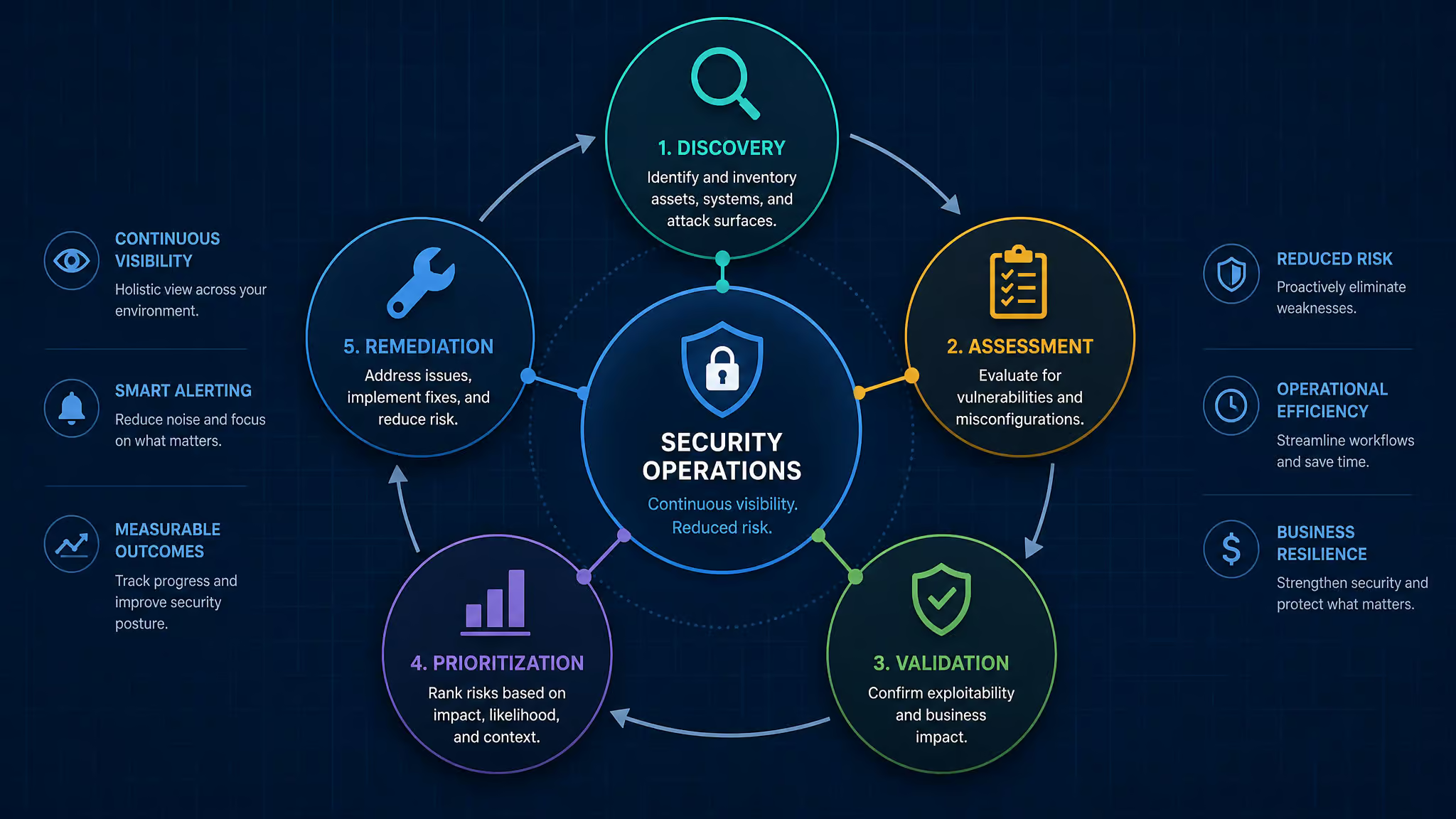
Discovery comes first because you can’t protect what you can’t see. This isn’t a quarterly scan; your environment changes daily. Continuous asset discovery needs to account for ephemeral instances, unmanaged APIs, federated identities, and third-party integrations. If it’s not in your inventory, it doesn’t exist from a security perspective, which is exactly why attackers look for it.
Assessment combines asset data with exploitability, business sensitivity, and the reliability of your existing defenses. It’s not just “this is vulnerable” but that it’s business-critical, and the controls you think are protecting it might not be working.
Validation is where you test whether exposures are actually exploitable, not just theoretically dangerous. This includes testing your security controls and mapping out attack paths. Breach and attack simulation (BAS) tools and attack path analysis show you what actually works, not what you hope works. A vulnerability you can’t exploit might as well not exist for prioritization purposes.
Prioritization is the heart of the matter. Effective exposure management ranks issues by contextual risk: exploitability, accessibility, exposure duration, business criticality, blast radius, and potential for chaining. Static scoring frameworks like uncontextualized CVSS ratings are insufficient, which is why the shift toward exposure management vs vulnerability management matters, it moves beyond simply patching known CVEs to focus on what actually reduces risk. Risk scoring must adjust continuously as conditions evolve. A dormant system’s vulnerability becomes critical the moment external actors start targeting that service class, or when workload scaling makes it reachable.
Remediation is where the rubber meets the road. It’s not just about finding problems; it’s about fixing them. This requires integration with your existing tools, ITSM, SOAR, CI/CD, to be effective. Automate the high-confidence stuff: permission revocations, firewall rule adjustments, configuration changes. But make sure remediations are tied to validated exposures and have clear ownership, so nothing falls through the cracks.
And continuous monitoring feeds back into the loop. That’s what makes it a cycle, not a one-way street.
The CTEM Lifecycle
Gartner formalized the Continuous Threat Exposure Management (CTEM) framework in 2022, giving this discipline a structured, repeatable shape. It’s not a new buzzword; it’s a way of making exposure management in cybersecurity a continuous process rather than a one-and-done project.

The CTEM lifecycle has five stages:
Scoping is where you define what you’re trying to solve and what success looks like. You need to know which business processes matter most, what your crown jewels are, and what your risk appetite is. Without this, you’re just scanning everything and praying.
Discovery is about cataloging everything: cloud services, on-premises workloads, APIs, identities. You pull data from cloud provider APIs, endpoint telemetry, network data, even your infrastructure-as-code repositories. The goal is to build a complete inventory that accounts for ephemeral assets and shadow IT.
Validation is where you test if those exposures are actually exploitable. It’s not enough to know something is vulnerable; you need to know if it can be exploited. Control testing, attack path analysis, and attacker-centric modeling separate the real threats from the theoretical ones.
Prioritization is about correlating with threat intelligence and knowing what’s actually important to your business. This is where you factor in active exploit campaigns, adversary TTPs, and asset criticality to focus your team’s effort where it matters.
Mobilization is where you actually fix things. Integrate with your existing tools, automate remediation where possible, and ensure findings flow into the platforms your team already uses.
The key thing about CTEM is that it’s iterative. Continuous monitoring feeds back into re-scoping. This isn’t a linear path; it’s a spiral where each cycle makes the next one smarter.
The Technology Stack
Here’s the core insight: exposure management is an orchestration problem, not a tool problem. No single product covers everything. Instead, you need a stack of specialized tools that feed into a central platform, and an exposure management example helps illustrate how that stack identifies, prioritizes, and mitigates risks before they become breaches.
EASM (External Attack Surface Management) extends visibility beyond your enterprise boundary to detect forgotten infrastructure and shadow IT. It’s how you find that old development server that’s been publicly accessible for years.
CSPM (Cloud Security Posture Management) catches misconfigurations in your cloud resource configurations. Open storage buckets, overly permissive security groups, those are its domain.
CIEM (Cloud Infrastructure Entitlement Management) identifies overprovisioned identities and privilege escalation paths. Too many permissions are a classic exposure that traditional scanners miss.
BAS (Breach and Attack Simulation) continuously tests your defenses with simulated attacks. It shows you what actually holds up, not what you hope holds up.
CAASM (Cyber Asset Attack Surface Management) helps you manage your cyber assets and see your attack surface.
And at the center, CTEM platforms act as the central nervous system. They ingest signals from all these tools, validate exploitability, and orchestrate remediation. Integration is where the value lives. A platform must ingest and reconcile asset data from cloud APIs, identity providers, container registries, CMDBs, and IaC sources without losing fidelity, which is exactly where the Exposure management Gartner framework clarifies the boundaries of what should be tracked and scored.
One thing I’ve been impressed by: the AI-native tools emerging in this space. Tools like BIX assistant let you ask natural-language questions about your security posture. “What’s my biggest risk right now?” and get a straight answer. That’s genuinely useful, not just hype.
Turning Findings Into Fixes
Detection without resolution is just a more expensive scanner. The operational bottleneck in most security programs isn’t finding problems; it’s fixing them.
What does integration actually look like? Findings flow into ITSM for ticketing, SOAR for playbook automation, and CI/CD pipelines for infrastructure changes. Cloud control planes let you make configuration changes directly. IAM tools handle permission adjustments. IaC pipelines can remediate infrastructure drift automatically.
The trick is automating the high-confidence stuff only. Permission revocations for overprovisioned identities, firewall rule adjustments, configuration changes, resource quarantines. These are safe, reversible, and have clear ownership. But only where the change is preapproved and won’t break operations.
Manual ticketing for everything overwhelms responders. You need clear ownership models for different exposure types. Who owns the fix for a misconfigured security group? The cloud team.
Who owns the fix for an overprovisioned identity? The IAM team. Who owns the fix for an end-of-life server? The application owner. If ownership is splintered, nothing gets done.
Remediations must tie to validated exposures, carry ownership metadata, and preserve operational continuity. Otherwise, you’re just trading security incidents for availability incidents.
Measuring What Matters
Most teams measure scan coverage and patch-SLA compliance. These metrics look good on paper but don’t predict breaches. You can have 100% patch compliance and still get breached because you missed an exposed misconfiguration.
Exposure management measures outcomes. Detection-to-closure timelines measure how long from discovery to fix. Exposure lifespan: how long was the vulnerability actually exploitable. Mean-time-to-resolve: are you fixing things faster over time?
Validation-to-remediation cycles: how long between confirming a control gap and closing it. Recurrence rates: did the exposure come back after you thought you fixed it?
Break metrics down by environment, business unit, or exposure type to find where the real problems are. If your cloud misconfigurations keep resurfacing, your IaC pipeline isn’t actually enforcing security as code. If detection-to-closure is slow in one business unit, ownership isn’t clear there.
The point of measuring this way: how long was the exposure actually exploitable, and did it come back? That’s the feedback loop that makes the program smarter.
Implementation Challenges
Let’s be honest about the hard truths. Most exposure management implementations fail for organizational reasons, not technical ones.
Fragmented visibility is the first hurdle. Ephemeral resources, shadow IT, and unmanaged APIs can slip through the cracks. If you can’t see your full environment, you can’t expose it.
Misaligned prioritization is next. Vulnerability management often prioritizes based on severity scores, ignoring business function and real-world exploitability. Programs that fail to integrate contextual signals misjudge where attackers will focus.
Unvalidated controls are a silent killer. Many implementations assume security controls function correctly without continuous validation. Drift, misconfigurations, and privilege creep erode protections over time. Without live control testing, you’re overestimating your defense posture.
Remediation bottlenecks become a problem when you identify exposures faster than you can fix them. Manual ticketing overwhelms responders, and the queue just grows.
Lack of feedback loops is the final issue. Cloud-native architectures introduce constant drift, code changes, and identity sprawl. Programs without feedback loops struggle to sustain improvements, and risk posture degrades silently.
Exposure management is as much a change-management problem as a technical one.
The Expanding Frontier: AI and Emerging Risks
Exposure management’s scope is growing beyond traditional IT. The AI boom brings a whole new set of attack surfaces.
There’s shadow AI: employees using unsanctioned AI tools that no one knows about. There’s AI model governance: how do you manage the risk of a model that makes decisions in production? There’s agentic asset governance: what happens when AI agents have access to your systems and can take actions? And there are AI-specific attacks like prompt injection and data leakage.
The same capabilities that make AI powerful also make it an under-managed risk. Exposure management must evolve to address it: visibility into AI usage, governance controls, and insight into how AI exposures combine with other exposures across the attack surface.
There’s also post-quantum cryptography (PQC) on the horizon. When quantum computers break current encryption, every system that uses it becomes an exposure overnight. Exposure management must evolve to handle that transition.
The attack surface now includes SaaS integrations, shared cloud resources, and privileged identities beyond traditional IT. It’s not just servers and workstations anymore.
Getting Started
Here’s the practical on-ramp. Start small, but start.
First, establish a continuous discovery cadence. Inventory everything, including ephemeral assets. You can’t protect what you can’t see, and quarterly snapshots aren’t enough.
Second, build validation into your routine. Test whether your security controls actually work. BAS tools and attack path analysis aren’t luxuries; they’re how you separate real risks from theoretical ones.
Third, enhance prioritization with threat intelligence and dynamic risk scoring. Static severity scores aren’t enough. Correlate with active exploit campaigns and adversary TTPs.
Fourth, push remediation into platforms your teams already use. Integrate with ITSM, SOAR, CI/CD, and cloud control planes. Pre-approve automation for high-confidence issues.
Don’t expect this to be a “five easy steps” journey. Your organizational context and maturity will shape how you implement it. But the direction is clear: from “what’s vulnerable?” to “what’s exploitable given reachability and context?”
From Definition to Discipline
Exposure management isn’t a product category. It’s a fundamental shift in how security asks questions.
The old approach treated every vulnerability as an isolated problem to be patched. The new approach recognizes that risk is dynamic, contextual, and chained. A dormant system becomes critical the moment attackers target its service class. A medium-severity flaw on an internet-facing box outweighs a critical flaw you can’t reach.
The reframing is the whole game. “What’s broken and actually at risk right now?” That question changes everything about how you allocate resources, how you communicate with executives, and how you measure success.
The old approach is structurally insufficient. The path forward is clear. The question is whether you’re ready to start walking it.
People Also Ask
What is exposure management in CrowdStrike?
CrowdStrike offers exposure management as part of its Falcon platform, providing continuous visibility and prioritization of risks across endpoints, cloud, and identities. It helps security teams focus on the most critical exposures by correlating vulnerability data with threat intelligence and attack path analysis.
How does exposure management differ from traditional vulnerability scanning?
Traditional vulnerability scanning identifies individual weaknesses and assigns severity scores, but it lacks context. Exposure management goes further by assessing exploitability, reachability, and business criticality, and it continuously monitors the attack surface. It also includes validation through attack simulations and integrates remediation into existing workflows, making it a more proactive and risk-based approach.
Why is exposure management important now?
The volume of alerts, sprawling attack surfaces, and sophisticated adversaries make traditional vulnerability management insufficient. Exposure management provides a centralized, risk-based framework that helps security teams prioritize what matters most, communicate risk to executives in business terms, and reduce the likelihood of breaches. Gartner predicts that organizations prioritizing exposure management will reduce breaches by 90% by 2026.
What are the core components of an exposure management program?
The core components are discovery, assessment, validation, prioritization, and remediation. Discovery involves continuously cataloging all assets, including ephemeral ones. Assessment combines asset data with exploitability and business sensitivity. Validation tests whether exposures are actually exploitable. Prioritization ranks risks by contextual factors like blast radius and business criticality. Remediation integrates with existing tools to fix issues efficiently.
