
In security operations, seeing the dashboard light up green after patching all critical CVEs can obscure a database sitting in the corner without a password. there’s a database with no password and a really bad haircut. The old playbook was beautiful in its simplicity: scan for bugs, rate them by CVSS severity, patch the scary ones. Clean, deterministic, checkbox-complete. But the patch queue never ends, the repair crew stays busy, and the trash can is on fire somewhere.
Maybe the problem isn’t that we’re not patching fast enough. Maybe we’re patching the wrong things.
Here’s a reality check from University of Salford: when they adopted a new tool and actually looked, they uncovered hundreds of shadow IT endpoints and thousands of missing critical patches in their environment. Those hidden systems weren’t producing alerts because they weren’t being watched in the first place. That’s the gap.
Key Takeaways
Exposure management is a continuous loop, not a one-time scan, and Gartner’s CTEM framework defines five phases to structure it.
Every asset discovery is your secret weapon; when University of Salford actually looked, they found hundreds of rogue endpoints and thousands of missing patches in the gaps.
The MOVEit breach (2023) hit over 2,600 companies and nearly 100 million people, showing that even your patching can’t save you without an exposure management lens.
Table of Contents
Wait, What’s Exposure Management, Actually?
Stick with me through the jargon because this distinction is the whole ball game. Exposure management is the process of finding, understanding, and reducing all the ways an attacker could get in. The whole attack surface, not just the known CVEs. Everything from misconfigurations to end-of-life servers to weak credentials to human behavior. There’s no big security secret here: it’s simply knowing what to invest in and what to fix first.
Here’s the house-in-a-risky-neighborhood analogy that finally makes it click. Locking your doors and fixing your window latches? That’s vulnerability management. Each vulnerability is a known weakness, any CVE is one.
The security system and the neighborhood watch? That’s exposure management. It’s seeing the bigger picture and understanding that yes, your front door is locked, but your back patio door is ajar, and a known burglar is casing the block.
A vulnerability is a weakness, but an exposure is a state of being open to harm. They’re related, but they’re not the same thing.
Traditional vulnerability management is myopically focused on known software bugs and their CVSS scores. Exposure management considers the whole picture: software bugs, misconfigurations, outdated systems, weak passwords, and missing controls. The key isn’t just aggregating severity scores; it’s aligning to business priorities.
The CTEM Framework: A Structured Way to Think About This
Exposure management fans, meet your playbook: Gartner’s CTEM, which stands for Continuous Threat Exposure Management, delivered in 2022. So think of it as the cyclical, honest framework we use to attack problems like intelligent attackers.
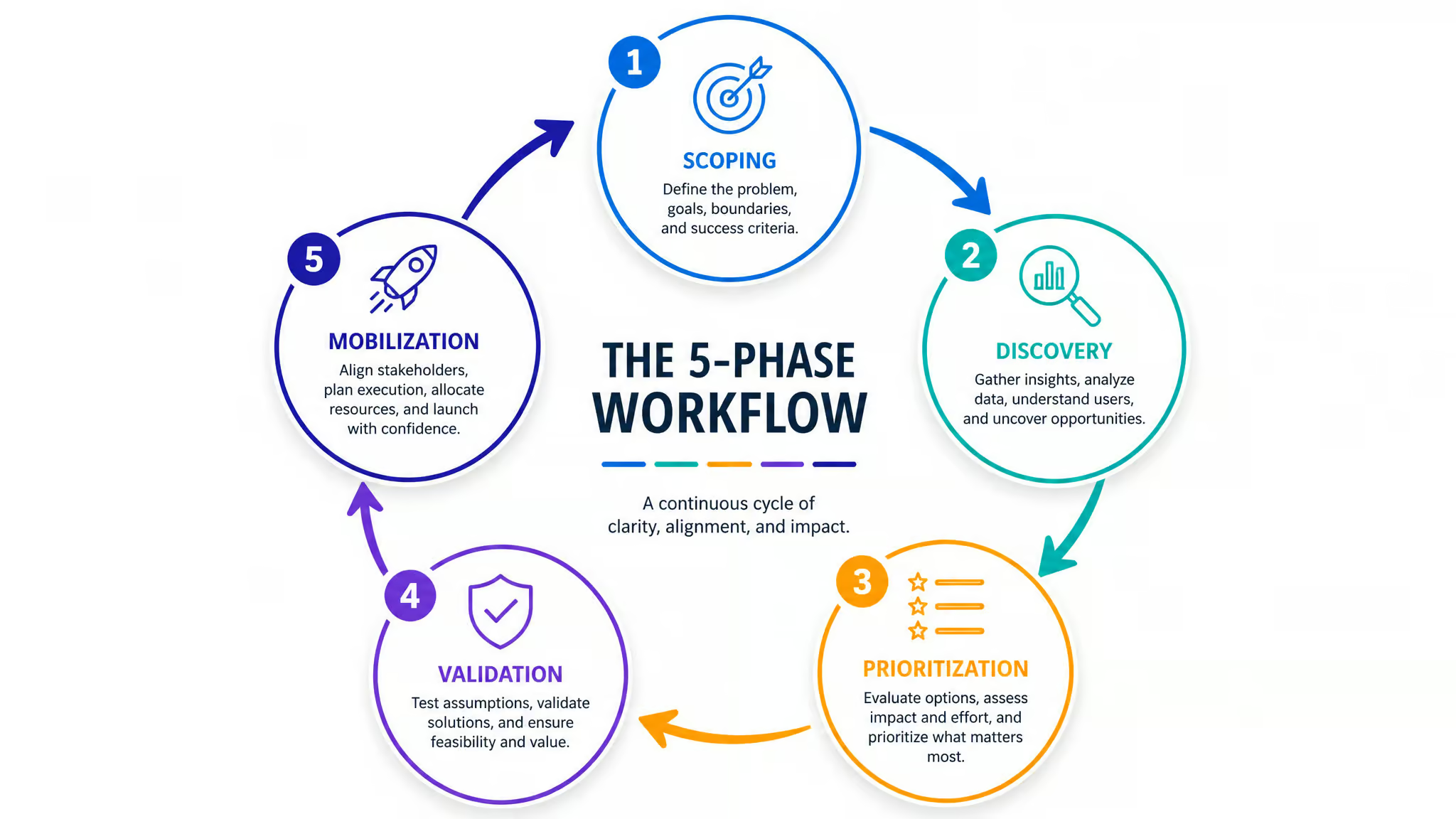
The five phases are clean:
- Scoping outlines the attack surface. What’s in bounds and out of bounds? Endpoints, servers, anything in the cloud, SaaS apps, user accounts, all with a defined map for the hunt. You can’t protect what you don’t know about.
- Discovery is where you track down the weaknesses: known CVEs, misconfigured systems, shadow IT, unmanaged devices, forgotten cloud services. This is the “what’s out there?” phase, and in modern security, it never fully ends.
- Prioritization ranks all discovered risk by business impact and exploitability. Is there a known exploit? Could an attacker actually reach it? Do you have controls that stop it? That’s a classic ranking exercise.
- Validation simulates attacks, whether that means pen tests, red teams, breach and attack simulators, or working through an exploit PoC. The goal is to eliminate false positives and confirm the risk is real.
- Mobilization is the fix-it phase where you actually remediate, often by syncing with your ITSM, SOAR, or CI/CD, and then confirm it’s actually fixed.
Do you see the loop? Not a one-time scan. A continuous cycle, because your attack surface shifts faster than you think.
Cloud Misconfiguration That’s Silent Waiting for You
Let’s put this to work with a real-world scenario that scares the heck out of me: a cloud storage bucket that’s accessible by the entire internet. No CVE, no patchable bug. The code is technically working as designed. It’s also sitting exposed with sensitive data, and a colleague with a curl command can find it.
If you stick to vulnerability scans alone, you will never see it. That’s why CTEM’s scoping and discovery arrive first. You map your critical applications to a stable set of cloud assets, then use configuration checks to find the bucket policy. It’s not breaking in, it’s a misconfiguration state.
Prioritization quickly turns into a nightmare scenario: the bucket contains customer records, it’s easy to make, and you’ve no compensating controls. Validation confirms it: at this point the task is no longer “follow the routine patch Tuesday properly,” it’s a mission. It goes to mobilization, the S3 access gets locked down, and the audit confirms the blast radius is limited.
This scenario plays out daily. The real difference lies in seeing it before an attacker does.
Field note: A cloud bucket with no CVE won’t show up in vulnerability scans—only configuration checks catch it.
The End-of-Life Server That Refused to Die
Now for a different flavor. There’s an end-of-life server somewhere in the network. Maybe it’s running Windows 2008 for a legacy app that hasn’t been updated in years. It’s got weak credentials and is routed to the whole world, but it’s full of all the company’s process data.
The scan will ping it and report. The CVSS score will be high, and your dashboard will flag it among a thousand other problems. It’s “old” and “legacy,” and your standard response is slow.
Exposure management sees this differently. Discovery flags it because it’s a known, exploitable, high-value target. Prioritization confirms it’s likely to be exploited (weak creds are low-hanging fruit, and it has internet access), and the business impact is high because it’s both a source of process info and a pivot point into the rest of the network, the kind of scenario that, in the insurance world, would fall under exposure management as a quantified risk of loss.
This is the moment that sells the whole mindset to the team. Because instead of sending a panic alert to the app owner (who’s been ignoring you for years), you’ve validated the risk and can make the case that it’s a financial exposure or a compliance stop, not just “bad security hygiene.”
The organization decides how to handle it. They might apply a compensating control, a WAF or strong network segmentation, or they might rip the app out and move it, which sounds terrible but often is the catalyst.
Zero-Day in the Crown Jewel App
Now let’s see something break, specifically a zero-day in a critical web app. In the old world, the team drops everything, pumps the patches out, and cross-fingers, because the 7.8 score says “urgent.”
With an exposure management, you learn quickly. The zero-day just delays your panic. You scope the app’s assets because the business may not be able to just patch the central dev system, and that’s where what is exposure management? comes in. Discovery tells you where it’s used in production.
But here’s the part I love: validation. You don’t only trust the vendor’s advisory and start patching the entire company’s deployment infrastructure. You go out and test whether your configuration actually matches the exploit’s needs. Is it reachable from the internet?
Does your WAF block the exploit vector? Do any existing controls break the requested link?
If not, the exposure is significant. You might not have the official patch yet. But you just bought time to put guardrails in place, not for a panic by opening up a headline about “active exploitation, 2,600 companies, 100 million affected.”
The MOVEit case (2023) taught us that even patched software can be exploited by a zero-day. It’s why you need to assess existing risks and controls, not the recurring vulnerability, and add to the attack surface. That’s a concrete use case for exposure management.
The CISO’s New Language: Risk, Not Ratings
You could present the best findings a CISO to an executive, and you’ll get awkward silence if your vocabulary is all CVSS raw numbers. That’s not their currency. Their language is the language of business impact and cost.
The mindset shift is in how you frame risk. “We have 500 critical vulnerabilities” translates to We have 500 weaknesses in our system, but after we looked at what matters, we found that only 12 are actually reachable by outsiders and directly affect customer data. That’s information the Board can use.
Let’s quantify that, even roughly. The MOVE number, 100 million people affected. The cost of a breach. Or you might use a story like the 2003 Northeast blackout: a local, seemingly trivial failure, a tree branch hitting a power line, cascaded into the largest blackout in North American history.
That’s the same phenomenon in cybersecurity. A single sensitive misconfig can cascade into a generalized threat crisis.
That’s the mindset shift from responding to a endless to a fishing rod.
How Do We Actually Do Exposure Management Work?
Start small. Pick one critical application, the crown jewel. List what the hardware, data stores, cloud dependencies, APIs and supply connections. Think about the attacker.

What’s the worst case? Where’s the data?
Make discovery your priority. You can’t fix what you can’t see. You need to dig into that shadow It, that list of assets your team that doesn’t know it has. At University of Salford that meant a dark cloud world: hundreds of shadow IT endpoints and thousands of missing critical patches. The moment you see the scale, you can risk.
Use your patch data more wisely. Let CVSS scores be the starting point, not the conclusion. Context is what fixes the prioritized data. Is the app online?
Is it internet-facing? Is there real-world threat data for it?
Culture matters, but so does layering. Work with IT and engineering, not against. When you explain that the EOL server is buried in a forgotten registry and will be a regulatory risk, you align business and security to be a constructive organization.
Better yet, the Threat Intel helps. Look for vulnerabilities listed in the known exploited vulnerabilities catalog to add urgency. If there are a POC clicking around, build streaks.
And for technology getting some coverage, Posture check into your posture management, EASM (external attack surface management) checks public cloud, CAASM connects via APIs to existing tech. Use attack surface management tools. Depending on your environment, you may also need DRPS for digital risk protection, PTaaS or MSSP services for managed testing, and CSPM for cloud posture, plus IAM reviews to catch over-permissive roles. Just don’t assume you need steal all the vendors at once. Start by concentrating on things that makes your top three exposures to say.
Bottom line: Find the 10% of systems driving most of your risk, and focus your remediation effort there.
So You Want to Start Doing Exposure Management
A zero-day is not the moment you want to first realize you have a weak control. A mistake is not the time to set up a view. Exposure management is a continuous collaboration and buildable change in your security awareness, and build it now.
Start with a list of targeted questions like “Why is this risk high?” and “Which assets drive 80% of my exposure?” AI-native platforms like SAFE use structured AI to normalize and correlate billions of data points, and generative AI assistants like BIX let you ask questions like “Why is this risk high?” or “Which assets drive 80% of my exposure?” Then, the answers will help you focus. It’s a small document, but it’s key.
Come down to 30% of risk caused by 10% of systems and fix it. That’s insight focused.
Remember what the “right” looks like. It supports a broader, business-centric view of your environment, knowing what’s really exposed, what’s exploitable, and what matters to the company. It bring risk and engineering teams together, and it delivers a report to executives about what matters to them, their operational and business risk.
Exposure management isn’t a silver bullet. It won’t eliminate how many of your official patches you need to do. But it will turn the endless queue of “critical” screams into a windshield of visibility. And the visibility, everything else is a big, coherent way to finally have some clarity. Because when your team is overwhelmed and the queue is a list, they’ll say.
Right now, that sounds like a win. Let’s get to work.
At University of Salford, this approach uncovered hundreds of shadow IT endpoints and thousands of missing critical patches, and when they asked BIX which assets drove 80% of their exposure, they could finally focus on the few systems that mattered most.
People Also Ask
Can you give me an example of sensitive data exposure?
A misconfigured S3 bucket containing customer records is a prime example. It’s not a vulnerability in the code—the bucket works as designed—but the configuration allows public access, leaving sensitive data exposed. This type of exposure won’t show up in vulnerability scans; it requires configuration checks to detect.
What’s the difference between vulnerability management and exposure management?
Vulnerability management is like locking your doors—it focuses on known weaknesses like CVEs and patches them. Exposure management is like having a security system and neighborhood watch—it looks at the whole picture, including misconfigurations, weak passwords, and unmanaged devices, to understand how an attacker could actually get in. It’s a broader, more continuous approach.
Why does exposure management matter if I already patch vulnerabilities?
Because patching alone doesn’t cover everything. The MOVEit breach in 2023 affected over 2,600 companies and nearly 100 million people, even though the software was patched. Exposure management helps you see the gaps—like shadow IT, misconfigurations, and end-of-life systems—that vulnerability scans miss, so you can focus on what actually matters.