
Here’s the article, written in the specified voice and following all the editorial constraints.
Security teams don’t have a vulnerability problem; they have a context problem. Walk into any SOC and you’ll find a scanner spitting out thousands of findings, each one technically valid and none of them actionable. The team knows the CVSS score of every single flaw. What they don’t know is which one the attacker is knocking on right now.
We’ve built our entire industry around generating lists, and attackers have responded by compressing the window to exploit new vulnerabilities from months down to a few hours. AI hasn’t just sped up their recon; it’s automated the whole pipeline. The 2025 Verizon DBIR put exploitation of vulnerabilities as the second most-used attack vector, right behind credential abuse. That alone tells you: a CVE list isn’t a risk model.
It’s a suggestion. This is exactly the problem the so-called exposure management category is trying to solve, and Tenable’s pitch is that its platform does it differently. So the question is worth digging into: how does Tenable Exposure Management actually separate the noise from the bomb, and does the architecture hold up under the hood?
Key Takeaways
Tenable One moves beyond CVSS severity with a Tenable Risk Score (1 to 1000) that layers real exploit intel with your business context, responding to the fact that 53% of teams still prioritize with patched-together exploit lists.
The agentic engine, Hexa AI, correlates data across the platform to map attack paths rather than isolated alerts, giving SOCs the context they’re missing, since alert fatigue is a bigger problem than alert volume.
Tenable’s newest capabilities, including agentless cloud scanning and an eBPF runtime sensor, provide bandwidth-light visibility that’s positioning the platform as a leading unified exposure management platform.
Table of Contents
Why Exposure Management Replaces Traditional VM
Let’s be honest about why the old way is breaking. “Patch everything” was never a great strategy, but now it’s mathematically impossible. When AI-powered attackers can weaponize a vulnerability in hours, the margin for manual triage evaporates. You can’t scan, prioritize, and route patches fast enough to get ahead of it.
The IDC’s 2025 MarketScape report frames the shift as inevitable: traditional vulnerability management is evolving into the more holistic practice of exposure management. It’s not that vulnerability scanning is dead; it’s that scanning is table stakes.
The real problem is prioritization. The March 2025 IDC survey found that 53% of teams still rely on CVSS scores and public exploit lists to prioritize. That’s like using a 2019 map in a city that’s grown a new downtown. The vulnerabilities are still real, but they lack the three other dimensions that make them dangerous. In fact, 53% of respondents admitted to this outdated approach.
It’s the combination of a specific flaw, how critical the asset it lives on is, which attackers are already sniffing around that asset, and whether there’s a known exploit in the wild. That’s the difference between a flaw and an exposure. The lack of that context, not a shortage of alerts, is what’s overwhelming SOC teams and causing the dangerous delays.
Tenable One: A Holistic Approach to Exposure Management
Tenable One serves as the central platform where exposure data from IT, cloud, OT/IoT, identity, and applications is consolidated. Under the hood is what Tenable calls the Exposure Data Fabric, which functions as the underlying data infrastructure. When you hook up your tools, every bit of data gets thrown into an exposure data lake on the backend. It’s an AI-driven ingestion engine that plays traffic cop, correlating, normalizing, and deduplicating the feeds as they come in.
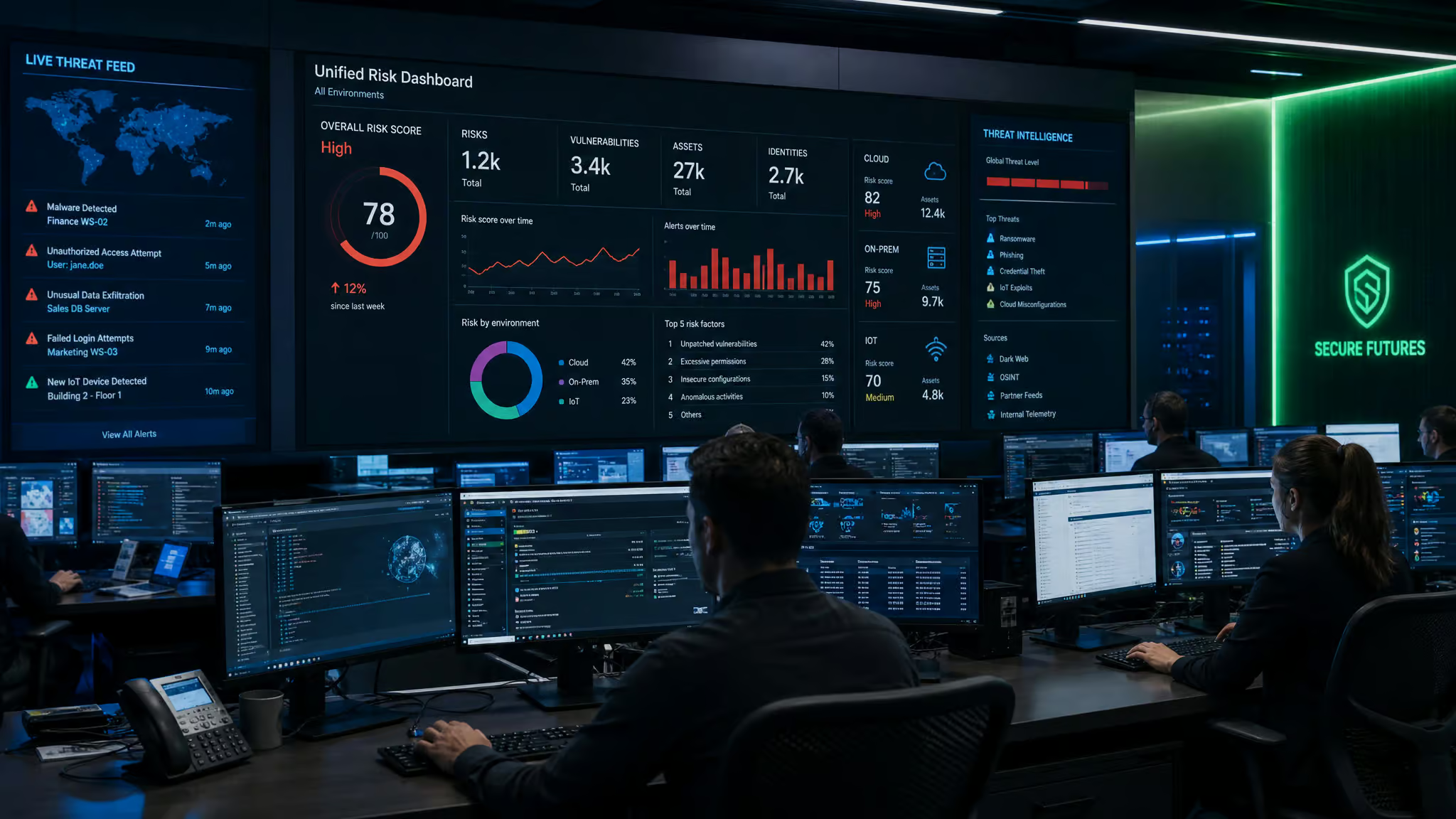
This is where the scale of the operation becomes clear. The platform ingests data from over 300 integrations, providing a substantial amount of information. All that raw data is then combined with Tenable’s sensor data and proprietary threat intel. The result is a clean, deduplicated view of risk, not just a pile of unprocessed logs from your entire stack. That’s a subtle but powerful distinction, and it’s what makes the platform’s breadth a genuine differentiator according to the IDC report.
Complete Attack Surface Visibility
What does “complete attack surface” actually mean in practice? It means asking “what’s on your network?” and getting an answer that goes beyond a spreadsheet of IPs. Tenable One natively covers IT, cloud, OT/IoT, identity, and application environments. This extends past traditional assets into the places modern attacks actually live: containers, web applications, code repositories, and even AI asset inventories.
The goal is to view all assets in one risk model instead of juggling multiple consoles with separate false positives. Tenable is building on its research division’s comprehensive vulnerability coverage and adding the analytics layer on top. It’s not just about discovering assets anymore; it’s about evaluating them all through the same risk-tracking lens.
Built-In Integrations and Extensibility
If the platform just vacuumed up all that data and then forced you to look at it in isolation, it would fail. So a big part of the story here is the workflow connectivity. The ServiceNow integration is essential, since that’s where everyone’s tickets actually live, and it doesn’t stop there. Jira and Azure DevOps integration brings exposure directly to the dev toolchain, meeting teams where they’re already working.
When Tenable acquired Vulcan Cyber, it inherited more than 50 third-party tool connections, which gave the platform serious ecosystem reach. By partnering with Adaptiva, the platform doesn’t just tell you what’s broken; it can trigger automated remediation. Beyond checking a compatibility box, these workflow shortcuts are where security actually gets fixed. The IDC notes that this lets clients tailor the platform to their unique stacks, so you’re not rebuilding your entire environment around a single solution.
Cloud-Native Deployment Flexibility
This is a source of confusion worth clearing up. While Tenable One is a cloud-based platform, you have options for how you run your vulnerability management assets. You can use Tenable’s cloud-hosted Tenable Vulnerability Management plan or run on-premises with Tenable Security Center Plus. That means you can kick off scans from your own corner of the data center and still have the analysis happen in the cloud, giving you flexibility for hybrid environments without having to re-architect your network or rebuild your data pipelines.
No matter how you configure it, all that data lands in the same exposure data lake. It’s an inclusive approach that acknowledges the reality that your infrastructure is probably a lot more of a patchwork than you’d like to admit. The platform’s ability to pivot between those environments is a welcome, practical note.
Key Platform Capabilities for Prioritization
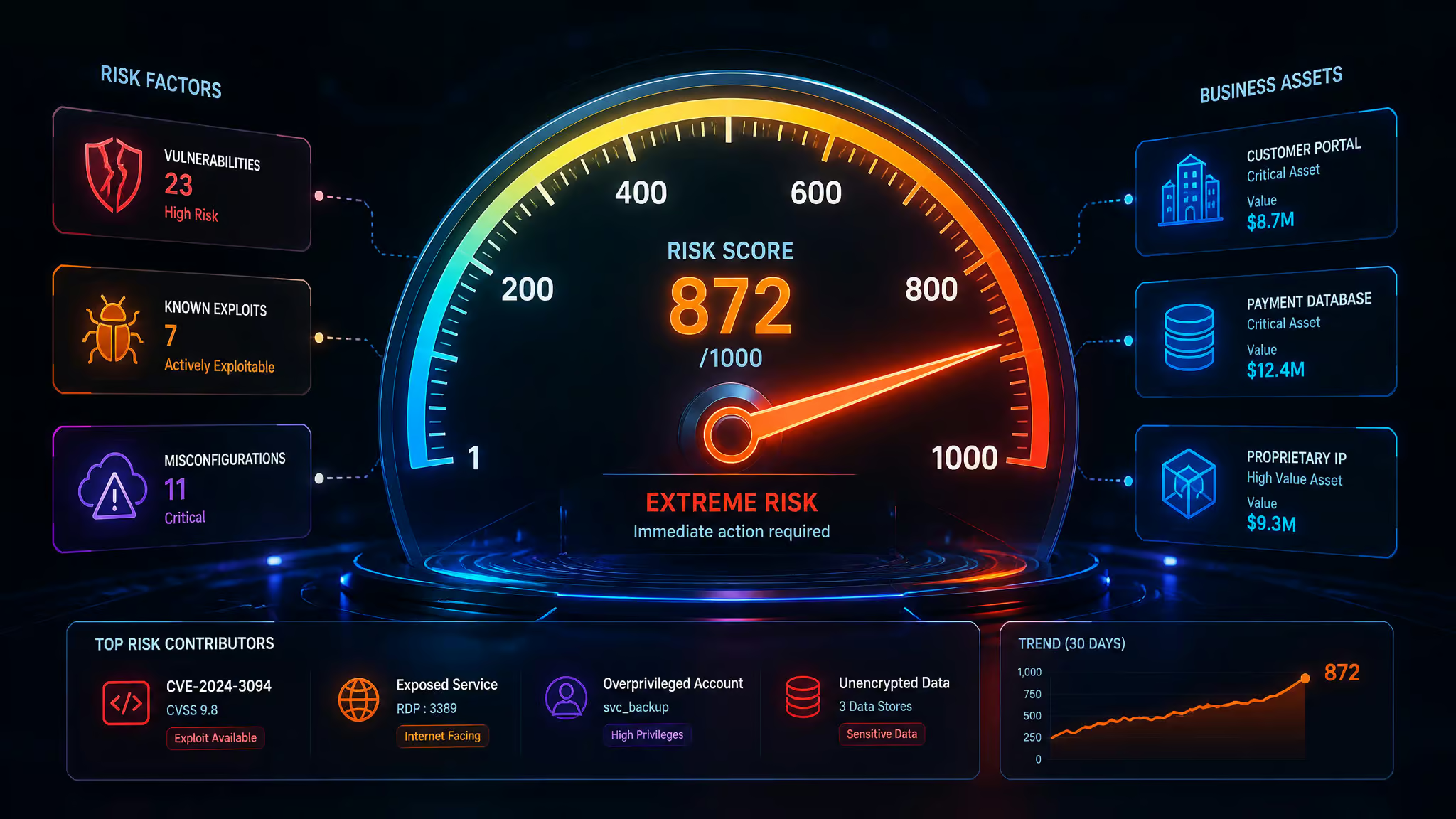
Getting a platform to collect data on all of your exposures is table stakes; getting it to understand which risks matter is the actual product. Tenable’s approach here is to move away from pure CVSS severity, offering a Tenable Risk Score that uses a 1 to 1000 scale where exploit intelligence and business context meet. But the competitor to watch is CrowdStrike Exposure Management, which leverages the Falcon sensor’s telemetry for real-time risk prioritization. Since the ability to prioritize is the single most valuable feature in an exposure management platform, this is the section that matters most.
Predictive Prioritization
The problem with CVSS is that it rates severity, not the likelihood an attacker will weaponize it on any given Tuesday. Tenable’s predictive prioritization aims to close that gap. It uses proprietary machine learning models, including the Vulnerability Priority Rating, to do some heavy lifting under the hood. These models are trained on real-world exploit data to predict which vulnerabilities are most likely to be exploited in the wild.
It reframes the problem by focusing attention on a tiny, manageable slice of the total vulnerability landscape. Instead of drowning in a sea of critical ratings, you’re looking at a focused list of things actually worth fixing. Tenable Research keeps feeding the platform a constant stream of threat intelligence so it gets the raw material needed to turn raw data into a prioritized strategic plan. The output feeds a Tenable Risk Score that translates all that intel into something you can act on.
Attack Path Analysis
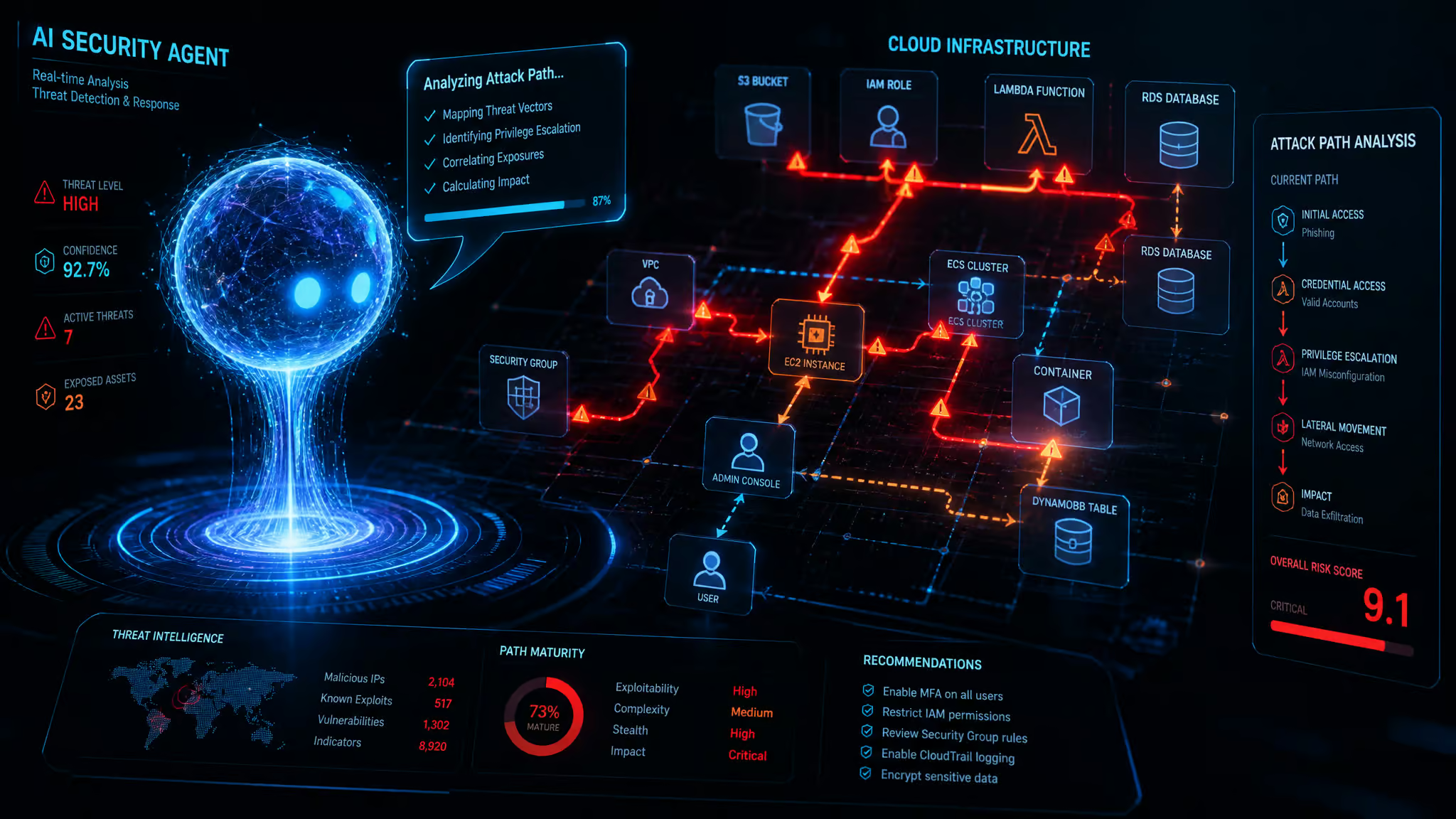
A single vulnerability is just a locked door. An attack path is the entire chain of locked doors, open windows, learnable password, and stolen keys that leads to the vault. Tenable’s attack path analysis aims to draw you that map. By visualizing how attackers can chain together weaknesses in vulnerabilities, identity groups, and cloud resources, the platform turns individual data points into a coherent map of your environment.
Through the lens of MITRE ATT&CK, it identifies these routes across on-prem and cloud environments. The whole thing comes together with the potential of Tenable’s exposure framework, which links live runtime data with exposure context. This is where Hexa AI comes in, connecting the dots between risk contexts, threat findings, and historical data. The output isn’t just a list of problems; it’s an attack narrative you can follow.
Exposure View and Dashboards
How do you answer the question, “So, are we secure?” when the C-suite asks? Tenable’s Exposure View is built for that moment. It provides a clear, at-a-glance view that places your organization on a security spectrum. The goal is to surface high-exposure scenarios by fusing data across your sensor stack, correlating risk scores with asset context like criticality and ownership. For a concrete look, consider an exposure management example: a cloud misconfiguration exposing a database, or a zero-day in a critical app.
The logic is to identify toxic combinations: a critical asset, a live vulnerability, and an active threat actor profile all compounding risk. As Tenable CPO Eric Doerr has said, the AI era requires fundamentally changing how we approach security, and part of that shift is understanding what is exposure management? It’s the convergence of vulnerability management, attack surface management, and threat intelligence into a continuous, business-aligned practice. The Exposure View is how that change gets communicated, translating raw technical alerts into business context that doesn’t require a security background to understand.
AI and the OpenAI Partnership
We’ve talked a lot about AI, but what does it actually do beyond the marketing slides? For Tenable, AI-driven analytics are a core investment: generative AI for remediation guidance, detecting asset ownership, and generating attack paths. The bigger news is how the company is positioning itself defensively, especially with the recent collaboration with OpenAI. Through the OpenAI Daybreak Cyber Partner Program, Tenable is exploring GPT-5.5 for defensive security.
Eric Doerr puts it plainly: the AI era requires a fundamentally new approach to cybersecurity. This collaboration is designed to help organizations understand their cyber risk and prioritize actions to stay ahead of attackers, who are using AI to accelerate their own reconnaissance. Hexa AI also supports natural language queries, letting analysts ask questions about their environment in plain English. It’s a defensive response to a fast-moving threat, and it’s a trend across the industry. Darktrace, for example, has also joined the same program, betting on AI-powered defensive tools as the only way to keep pace.
Tenable Hexa AI: Orchestration vs. Chatbots
There’s a big difference between asking a chatbot a question and having an agent that actually does the work. Tenable Hexa AI functions as the central intelligence layer within the platform, functioning as an agentic orchestration engine rather than a simple query bot. It’s the difference between asking a map for directions and having a driver at the wheel. Hexa takes the raw alerts, runs them through its analysis, and produces a prioritized plan.
The real value is in the workflow. Hexa can analyze live risk, cross-reference threat data and historical trends, then execute multi-step workflows. It’s automating remediation guidance from a basic asset tag to full incident response plans, all while keeping a human-in-the-loop and accountable for every step.
The OpenAI Daybreak Partnership
So, what’s the actual deal with the OpenAI partnership? Tenable is evaluating GPT-5.5 through OpenAI’s Trusted Access for Cyber program, a secure access channel designed for this exact kind of collaboration. The focus is on advancing cybersecurity research and accelerating how quickly analysts can identify, prioritize, and respond to exposures, all by making data more accessible and automated.
The potential here is significant for exposing critical attack paths that would be invisible otherwise. It streamlines security operations by cutting through the noise, and the whole industry is taking notice. The fact that Darktrace is making a similar move confirms that the future of security lies in these kinds of integrations, not just a single secret sauce.
Cloud Security and Detection & Response
Static defense, the kind that requires a human to spot a new threat and manually update a signature, simply can’t keep pace with automated attackers anymore. This is true in any environment, but especially in the cloud, where misconfigurations can be a critical vulnerability. Tenable’s answer is to extend the platform with Cloud Detection and Response capabilities. The core problem remains the same as it is everywhere else: a lack of context causes alert fatigue, and that’s what’s really tripping up SOC teams. The Tenable One Cloud Exposure Runtime tackles this by combining raw telemetry with deep exposure context, filtering out the noise to highlight what you should act on. One way it does this is by automatically connecting related detections across time, identities, and cloud resources with AI threat contexts.
Agentless Detection and eBPF Runtime Sensors
Scanning cloud workloads presents a challenge: you can’t exactly install an agent on every virtual machine without draining resources or making a mess. Tenable’s approach combines agentless detection with an optional eBPF runtime sensor. eBPF, or Extended Berkeley Packet Filter, is a way to run sandboxed programs in the Linux kernel, and it’s perfect for this. Think of it as kernel-level instrumentation that doesn’t require heavy new software.
This architecture allows for deep telemetry into suspicious kernel-level activity in real time, without the performance hit of a traditional agent. The beauty of this is that you can get that deep visibility where it matters most without bogging everything down. It means you get seamless transparency across all your cloud workloads, with the ability to opt into deeper coverage with eBPF where you need it.
From Alerts to Actionable Threats with AI
When you have a handle on the underlying kernel, you can see what’s actually exploitable. Active scanning helps validate what’s truly accessible from the internet and sharpens alert prioritization by cross-referencing against the exposure data lake. A single alert is just noise. But when you aggregate hundreds of individual alerts, you can begin to see the shape of the attack forming.
Hexa AI links live risk context and historical data to formulate a plan. Eventually, you can differentiate theoretical vulnerabilities from business-critical risks as they’re happening, creating a coherent narrative for the SOC analyst who just clocked in. This kind of context helps security and cloud managers adopt a modern, integrated approach, enabling them to evaluate misconfigurations and runtime threats in a central risk model. That’s the end goal: turning data into action, not just another ticket in the queue.
Market Position and Analyst Recognition
By sheer volume of adoption, Tenable sits at the table with the big kids, but it’s the 2025 IDC MarketScape that formalizes its position. In an evaluation of 20 vendors, IDC ranked Tenable first for both capabilities and strategy. They also held the largest market share of any vendor in the report. It’s a position built on a scale that few can match, with more than 53% of the Fortune 500 and 29% of the Global 2000 as customers, representing over 24,000 companies worldwide. That footprint, spanning 24,000 companies globally, gives Tenable a data advantage that smaller vendors simply can’t replicate.
IDC analyst Michelle Abraham notes that Tenable One is particularly well-suited for enterprises consolidating siloed risk data. Yet, the report also points to a lingering challenge: Tenable’s vulnerability management heritage can still overshadow its broader exposure-management capabilities. For all its technology, the company is still doing the work of educating the market that its portfolio extends well beyond the scanner that made it famous in cloud, identity, and application security. The platform’s strength, with its broad asset coverage and AI analytics, checks the boxes. The hurdle is in the marketing and pricing story, not the engineering.
Licensing and Deployment Considerations
Let’s talk about the practical friction point that no one wants to discuss at a security conference. Tenable’s asset-based licensing model is flexible, but it’s not always obvious what you’re getting with a contract. The IDC report outlines a system where you get flexible entitlement allocation across asset types, which is great in theory. In practice, it means you might need to map entitlements across your IT, cloud, OT, and identity assets differently, which can get messy.
You’ll want a clear picture of what assets you’re monitoring and how they’ll be counted. It’s a matter of knowing your environment and budgeting for the fact that you may need to purchase a few extra licenses to cover the long tail of your network. It’s not a dealbreaker, but it’s a necessary part of the conversation.
Which Organizations Should Consider Tenable One?
If your organization is drowning in a sea of disparate security tools and data silos, Tenable One is worth a look. Its sweet spot is the enterprise aiming to consolidate all that fragmented exposure data into a single, coherent unit. The whole point is to see the forest for the trees.
This platform lets you tailor the technology to your existing stack without relying on a bunch of extra point solutions. IDC recommends Tenable for clients seeking unified exposure management with broad asset coverage across IT, cloud, OT/IoT, identity, and application environments. If that sounds like you, you have a mature security program, and you’re trying to get it to the next level, this is the kind of platform that can get you there.
Conclusion
The old model of vulnerability management was reactive, reliant on humans to keep up with a deluge of data. Tenable One, by unifying vulnerability management, cloud security, and identity, builds a single exposure management platform that helps organizations understand which exposures actually matter. The shift from reactive patching to proactive, context-driven risk reduction is a fundamental change. As AI-powered attackers compress the timeline for exploit to just hours, the static defenses of the past can’t keep up. That’s the new reality, and why understanding what you’re exposed to is the only way forward.
People Also Ask
What are the 5 steps of vulnerability management?
The five core steps are: discover all assets, prioritize vulnerabilities based on risk, remediate by patching or mitigating, verify the fixes, and report on progress. Modern exposure management adds a continuous, context-driven layer on top of this cycle, factoring in business impact and real-world exploitability.
What is exposure management?
Exposure management is the evolution of vulnerability management. It’s a continuous process of identifying, prioritizing, and remediating security risks across your entire attack surface—including IT, cloud, OT, and identity—by focusing on the business context and actual exploitability, not just CVSS scores.
How does Tenable’s Risk Score differ from CVSS?
CVSS rates the severity of a vulnerability in isolation, while Tenable’s Risk Score (1-1000) combines exploit intelligence with your specific business context, like asset criticality and active threats. This gives you a more actionable view of which vulnerabilities are most likely to be exploited in your environment.