
Look it up and you get a simple definition. Dictionary.com calls “gamer girl” slang for a female video game enthusiast, sometimes used disparagingly.
The word lands differently depending on who’s saying it and why. It can be a neutral description, a gatekeeping weapon, a marketing category, or a badge of reclamation. I’ve been called a gamer girl plenty, and it’s rarely meant the same thing twice. So let’s unpack what this term carries — where it came from, why it’s controversial, and whether it can be taken back.
Key Takeaways
Women make up roughly 45–50% of all gamers, but only 6% identify with the “gamer” label — the term itself has become a barrier, not a welcome mat.
The stereotype that gaming is for men isn’t natural; it was a direct result of post-1983 crash marketing decisions that targeted boys and hypersexualized women in ads.
“Gamer girl” and “girl gamer” carry different baggage: word order matters, and many women prefer no gender qualifier at all.
Table of Contents
What the dictionary says, and what it doesn’t
The dictionary definition is technically correct — female video game enthusiast, but it’s almost useless for understanding how the term actually functions in the wild. The real meaning depends on context: intent, tone, and who’s speaking.
When a guy at a party says “oh, you’re a gamer girl,” it can sound like an accusation. When a company uses it in marketing copy, it’s a demographic bucket. When I use it on Instagram, I’m making a choice about how I want to be seen. The same two words, different vibes.
The term has been used to imply that a woman is less skilled, more casual, or just wearing the label for attention. That’s the “fake geek girl” trope, and it’s been around for decades.
How “gamer girl” became a loaded term
This didn’t happen by accident. It took specific business decisions and terrible ads to turn “gamer” into a male-coded identity.

Before the 1980s: when games were for everyone
Before the video game crash of 1983, games were marketed pretty neutrally. Nobody had done serious player research, so companies just aimed at the broadest audience they could. Arcade cabinets were for anyone with a quarter. Pac-Man was intentionally designed by Toru Iwatani to attract female players — he wanted to go beyond young boys and teens. And it worked: by 1982, Pac-Man was the first commercial game to involve large numbers of women, and Ms. Pac-Man followed with a female protagonist in response.
The 1983 crash and Nintendo’s pivot to boys
When the market collapsed from oversaturation, Nintendo did something that would shape the industry for decades: they ran market research. And their research showed that boys were playing more than girls. So in the 1990s, they marketed heavily to boys and young men. The implicit message was “no girls allowed,” and the rest of the industry followed.
Suddenly, video games were for guys, and women were an afterthought — or worse, a punchline.
1990s advertising and Gamergate: the stereotype hardens
The ads from this era are wild to look back on. Hypersexualized women draped over consoles. “Gaming gets you girls” messaging. The old ball and chain joke about escaping the wife. Game boxes featured women in impractical armor, and marketing copy treated female players as invisible, reducing them to a gamer babe stereotype rather than acknowledging them as actual customers.
By the time Gamergate erupted in 2014, the culture had been primed for hostility for decades, fueled in part by the reductive gamer babe stereotype. A coordinated campaign of harassment, heckling, threats, and doxing was directed at outspoken feminist women in the industry by thousands of people in the games community.
The real demographics: women are nearly half of all gamers
Women make up roughly 45–50% of all gamers today, depending on how you measure. The numbers have been climbing steadily since the early 2010s.
The self-identification gap
48% of women have played a video game, yet only 6% identify as gamers. Compare that to 15% of men. That’s a 42-point gap between playing and identifying, and it tells you about how toxic the label can feel, especially when terms like “gamer girl” single out women rather than treating them as regular gamers.
Among women aged 18–29, only 9% call themselves gamers versus 33% of men. The label itself is a barrier — What is a gamer babe? It carries connotations of sexism, gatekeeping, and the kind of culture that makes women feel like they need to prove themselves just to play.
Genre preferences and outlier games
The 2017 Quantic Foundry study of 270,000 gamers broke down genre preferences and found splits. Match-3 games are 69% women. Family farming sims are also 69% women. But you have outliers like Candy Crush at 83% women, Dragon Age: Inquisition at 48% women, and World of Warcraft at 23% women.
half of female PC gamers in the US consider themselves core or hardcore players.
The gatekeeping culture: being tested, harassed, and excluded
If you’re a woman who mentions gaming in mixed company, you’ve probably experienced this: the rapid-fire quiz. Someone asks about a game, and suddenly you’re being tested on lore, mechanics, history — anything to see if you’re “real.”
I’ve been through it. I grew up watching my older brother play The Legend of Zelda: Twilight Princess from start to finish on our GameCube. I knew every dungeon, every puzzle solution, every boss strategy. But when I mentioned I was a Zelda fan, the questions came: “What’s the name of the first temple?
What’s Din’s power? If you know so much about that one, prove you know the whole series.”
A 2015 study on Halo 3 found that lower-skilled male players were more hostile toward female-voiced teammates, while higher-skilled males were more positive and submissive. The hostility correlates with the male player’s own insecurity, not the woman’s skill.
Voice chat is a whole other layer. My gamer tag on Xbox was named after a favorite comic book character — something I thought was just a fun reference. But the second voice chat revealed I was a woman, the tenor shifted. Gender-specific gamer tags invite a specific kind of abuse, and it’s exhausting.
The problem with terminology: “gamer girl” vs. “girl gamer” vs. no label
“Girl gamer” seems to carry less negative weight than “gamer girl,” but neither is perfect.
The critique of “girl gamer” is that it puts gender first, making it the defining trait instead of “gamer.” It emphasizes being a girl over being a gamer. And critics say it keeps female gamers in a minority box, reinforcing the very stereotypes it’s trying to escape.
Many women prefer “gamer women” or just “gamer” with no qualifier at all. The ideal, for a lot of people, is to drop the gender prefix entirely.
I use “gamer girl” on Instagram as a reclamation move. It’s my way of saying “yes, I’m a woman, yes, I game, and I’m not hiding either part.” But I completely understand why other women don’t want to touch the label with a ten-foot controller. Over-embracing the term can backfire, reinforcing stereotypes of female gamers as oversexualized, casual, or confrontational.
Representation on screen and behind the scenes
The gap between who plays games and who appears in them is stark, and it mirrors the industry’s own demographics.
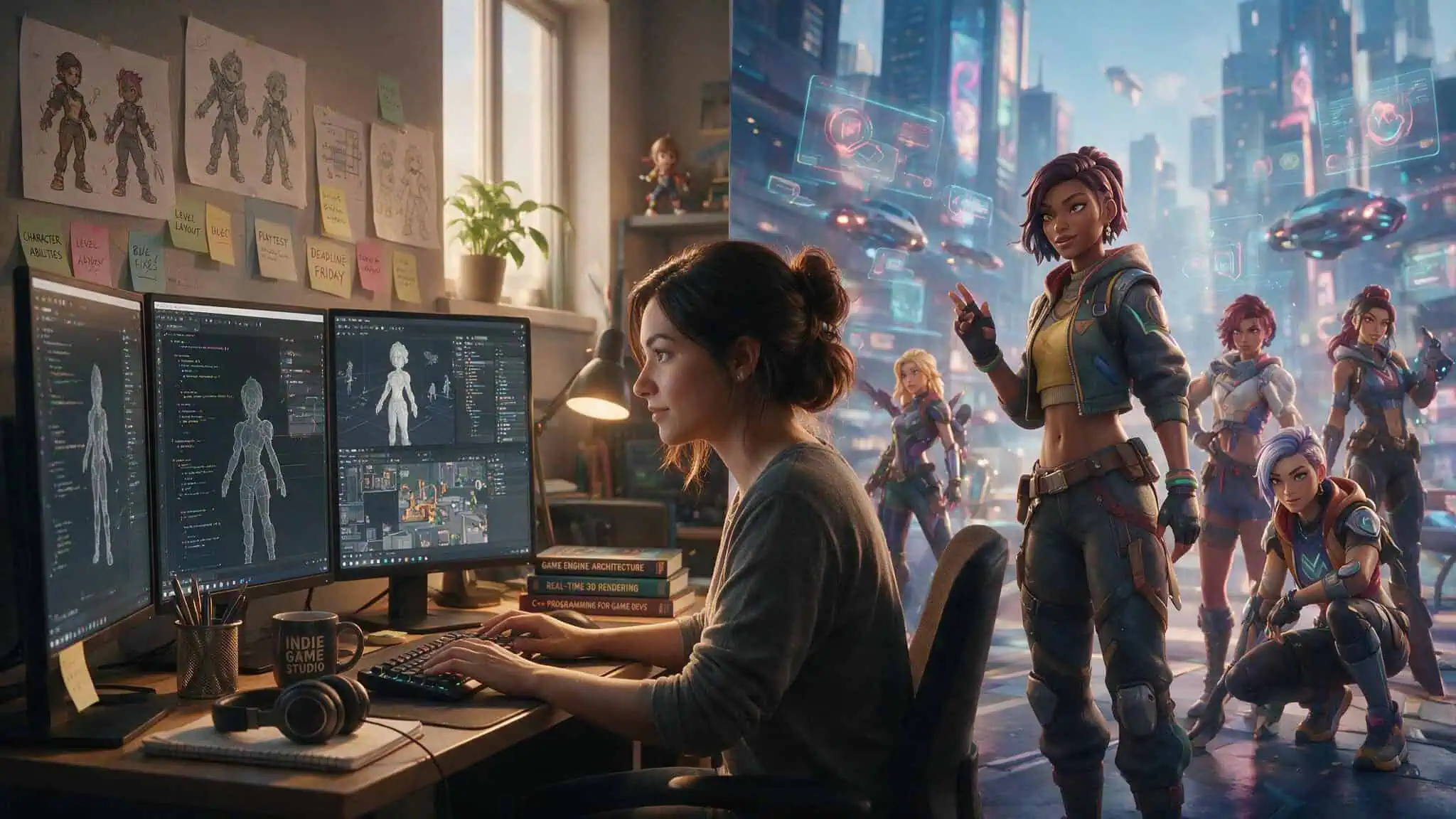
How games depict women
85% of playable characters are male. Female characters are often hypersexualized, from Lara Croft’s original design to the armor that’s somehow less protective the more it covers. Critics argue that female characters convey unhealthy messages about unrealistic body images and provocative sexual and violent behaviors. A content analysis of 571 games from 1983 to 2014 found that women may avoid genres that depict female characters negatively — and that’s a cycle: less female audience means less incentive to change the depictions.
Early Tomb Raider had a surprisingly large female player base — 40% of players were women, many of whom enjoyed playing as a powerful female character.
Underrepresentation in the industry
Women are only about 25% of game developers. That number has grown from 3% in 1989, but it’s still not proportional to the player base. And the industry has a documented history of sexism: Riot Games settled for $10 million in a class action suit in 2019, Ubisoft faced accusations of widespread misconduct in 2020, and Activision Blizzard was hit with a DFEH complaint in 2021.
But women have always been part of game development, even if their contributions were marginalized. Mabel Addis wrote the first game narrative in 1964. Carol Shaw created the first commercial game by a woman in 1978. Dona Bailey helped design Centipede.
Roberta Williams founded Sierra On-Line. Kim Swift led development on Portal.
Reclaiming the label and the future of “gamer girl”
It took decades for “geek” to go from insult to neutral to almost aspirational. “Gamer girl” might follow a similar path, but it requires enough people to use it on their own terms.
I use it to reclaim it, but I get why others don’t. The important thing is letting people self-identify — not policing how someone refers to themselves in the gaming space. Some women wear “gamer girl” as a badge of pride. Others want to be called “gamer” or “gamer woman” or nothing at all.
The term’s weight depends on who’s wielding it. “Gamer girl” right now is a battlefield of those meanings.
People Also Ask
What is a gamer girl slang?
In slang, ‘gamer girl’ is a term for a female video game enthusiast, but its meaning shifts depending on who says it and why. It can be a neutral descriptor, a gatekeeping weapon used to question a woman’s legitimacy, a marketing category, or a badge of reclamation. The real weight of the term comes from context and intent, not the dictionary definition.
What does it mean to be a gamer girl?
It means you’re a woman who plays video games, but the label carries baggage that the simple act of playing doesn’t. Many women who game avoid the term entirely because it’s been used to imply they’re less skilled, more casual, or just seeking attention. For some, it’s a reclaimed identity; for others, it’s a stereotype they’d rather not deal with.
What does gamer mean in slang?
In slang, ‘gamer’ has shifted from a neutral term for someone who plays games to a heavily gendered and sometimes toxic identity marker. The label is often associated with a male-dominated culture of gatekeeping and hostility, which is why only 6% of women who play games actually identify as gamers, despite women making up nearly half of all players.
What is the stereotype of gamer girls?
The stereotype paints gamer girls as less skilled, more casual, or ‘fake geek girls’ who only play for attention. This image was shaped by post-1980s marketing that targeted boys and hypersexualized women in ads, and it’s been reinforced by a culture that tests women’s knowledge and treats them as outsiders. The reality is that half of female PC gamers in the US consider themselves core or hardcore players.
What’s the difference between ‘gamer girl’ and ‘girl gamer’?
Word order matters: ‘girl gamer’ is generally seen as less negative than ‘gamer girl,’ but both put gender before the gamer identity. Critics argue that ‘girl gamer’ keeps women in a minority box and reinforces stereotypes. Many women prefer no gender qualifier at all, opting for just ‘gamer’ or ‘gamer women’ to avoid the baggage entirely.
Why do so few women identify as gamers when nearly half play games?
There’s a massive gap between playing and identifying: 48% of women have played a video game, but only 6% call themselves gamers, compared to 15% of men. The label ‘gamer’ has become toxic due to decades of gatekeeping, harassment, and marketing that framed gaming as a male space. Many women simply don’t want to associate with a term that carries so much baggage.
Can ‘gamer girl’ be reclaimed as a positive label?
Yes, and it’s already happening — some women use ‘gamer girl’ on social media as a deliberate reclamation move, owning both their gender and their hobby. But reclamation is personal: not everyone wants to touch the label, and that’s fine. The key is letting people self-identify without policing how they describe themselves in the gaming space.