
The Double Bind of Being a Woman in Gaming
Picture this: you drop into a ranked lobby, comms open, ready to play. You make a clean pick, rotate perfectly, call out the enemy position. For a moment, nothing. Then: “Wait, is that a girl?”
The energy shifts. You’re not a teammate—you’re a thing that needs to be assessed. Are you good enough to carry? Are you just here for attention?
Did you only get that kill because the enemy wasn’t trying? You haven’t done anything wrong, but you’re already on trial.
That moment is the “gamer babe” stereotype in its natural habitat. It’s a label people throw around. It’s a gatekeeping system, a set of assumptions that decides who belongs in gaming culture and who’s visiting. And the way it works is more insidious than most people see.
Research ties the stereotype to “toxic geek masculinity“—the idea that being a “real gamer” is a masculine trait, and women are intruders in that space. It’s about who owns the digital cultural capital: the lore knowledge, the mechanical skill, the hardware collection. If all that equals manhood, then women are permanent outsiders who have to earn their way in. And the tool for earning that entry?
A “meritocratic rationale”—the argument that women need to “git gud” to be respected. Sounds fair on paper. The bar is set higher for women, and the goalposts move whenever they get close.
Key Takeaways
77% of 900 women gamers surveyed across three countries reported being targeted specifically for their gender, making systemic harassment the norm, not the exception.
Female gamers often stay silent about sexism not because they don’t notice it, but because they’re calculating a steep social cost: being labeled a “feminist killjoy,” damaging real-life friendships, or being blamed for ruining everyone’s fun.
The coping strategies women use—gender-masking, quitting public lobbies, playing only with trusted friends—temporarily protect them but also remove them from public gaming spaces, which paradoxically reinforces the idea that gaming is a male space.
Table of Contents
The Two Faces of the Stereotype
The easy part is the overt stuff. The hostile sexism. The slurs, the sexual harassment, the DMs that demand nudes. The language itself is a weapon—”bitch” and “cunt” aren’t just trash talk, they’re gendered attacks designed to stigmatize women just for being present.
Avatar-on-avatar sexual assault happens. The harassment follows you out of the game.
But there’s a second face that’s harder to pin down, and it’s more effective at maintaining the system. Researchers call it benevolent sexism: the “compliments” that aren’t really compliments. The “You play well for a female gamer” line. The unsolicited offers to carry you through a tough raid.
The condescending guidance disguised as helpfulness. The “modern chivalry” that says “let me help you, little lady.”
This creates a double bind. Accept the help, and you’ve proven you’re a damsel. Reject it, and you’re an ungrateful jerk. You can’t win either way.
Hostile sexism – the easy target
One participant in the study—Bass—captured the vibe perfectly when she said that it’s okay if they lose since they have a girl here. That’s not trash talk. It’s a statement of assumed incompetence dressed as a joke. Another participant, Swan, heard the flip side: guys, just relax and have some fun [because there’s a girl on our side].
Translation: her presence lowers the stakes. The game doesn’t matter anymore because the girl is clearly dead weight.
Benevolent sexism – the trap
This is where the damage happens. The “you play well for a girl” compliment is common enough to be a meme. Think about what it communicates: you’re being judged against a lower standard, and your performance is surprising given your gender. It’s praise with a built-in insult.
The unsolicited guidance is as toxic. “Let me carry you” sounds helpful, but it’s built on the assumption that she can’t do it herself. Refuse the help, and suddenly you’re the one with the attitude problem. Accept it, and you’ve reinforced the idea that you needed it. The system is designed so that any response you make can be used against you.
Red flag: If a compliment on your gameplay includes “for a girl,” it’s not a compliment—it’s a baseline assumption dressed up as praise.
Why Female Gamers Stay Silent
If the sexism is this bad, why don’t women call it out? It’s not about not noticing. It’s about a two-stage process that makes confrontation feel like a bad bet every time.
First stage – recognizing the offense as sexist
A lot of the sexism in gaming is so normalized that women have to actively work to identify it as a problem. Is that comment about your voice sexist, or is it a joke? Does that backhanded compliment count as harassment, or is it clumsy flirting? The uncertainty is a feature of the system, a phenomenon researchers call ‘ambivalence in labeling sexism’—driven by a perceived lack of malice, which makes it harder to justify feeling angry.
One participant, Hawk, described it as a “dance party.” Everyone’s having fun together in a room. You notice something off, but if you call it out, the response is to accuse you of overreacting. You’re the one who ruined the vibe. The offense becomes secondary to your reaction to it.
Second stage – weighing the cost of confrontation
You get past the first stage. You’re sure it was sexist. Now you have to decide whether it’s worth saying something. And that calculation comes up negative.
The fear of being labeled a “feminist killjoy” is present. It’s a direct deterrent. Saying something doesn’t address the offense—it risks defining your entire social identity. You don’t want to be that person who brings down the mood. Society trains women to be polite and keep things pleasant, and that training doesn’t turn off when you log into a game, where the labels placed on female gamers can carry their own set of social penalties.
Olive told a story about a double date where sexist comments came up, and everyone just let it slide to keep the evening pleasant. It wasn’t that nobody noticed. It was that nobody wanted to be the one who ruined dinner. That’s the social cost in action. And it operates harder in a voice chat with people you know.
The “feminist killjoy” fear as social control
The label is a weapon. It’s easier to stay quiet than to risk being seen as that person. And that fear isn’t irrational—it’s a learned response to a system that punishes women for speaking up. The silence isn’t weakness. It’s a rational calculation in an environment where the costs of confrontation outweigh the benefits.
The Online-Offline Trap
Playing with people you know makes the problem worse.
The “online-offline juxtaposition” is one of the insidious findings in the research. The same guy who’s a great friend at the pub can be a different person in a competitive lobby. The competitive environment, the anonymity of voice chat, the social dynamics of the team—something flips. And the person you know as decent and chill is making the same kind of comments you’d hear from a random troll.
Now the calculation gets harder. Calling out a stranger is one thing. Calling out someone you have to sit next to in class on Monday? That’s a relationship you’re risking.
One participant, Jasmin, told a story that captures the friction: a professor—an academic mentor—suggested she dance on stage at a game design competition, slotting her into the role of gamer babe streamers who trade on appearance rather than skill. In a professional academic setting, the assumption was that a woman’s value in gaming is performative, not technical.
The online-offline split doesn’t feel bad. It maintains the old inequalities. It creates a situation where women can’t trust their own social circles to be safe spaces. And it means that the coping strategies they rely on—playing with people they know—are part of the problem.
Coping Strategies
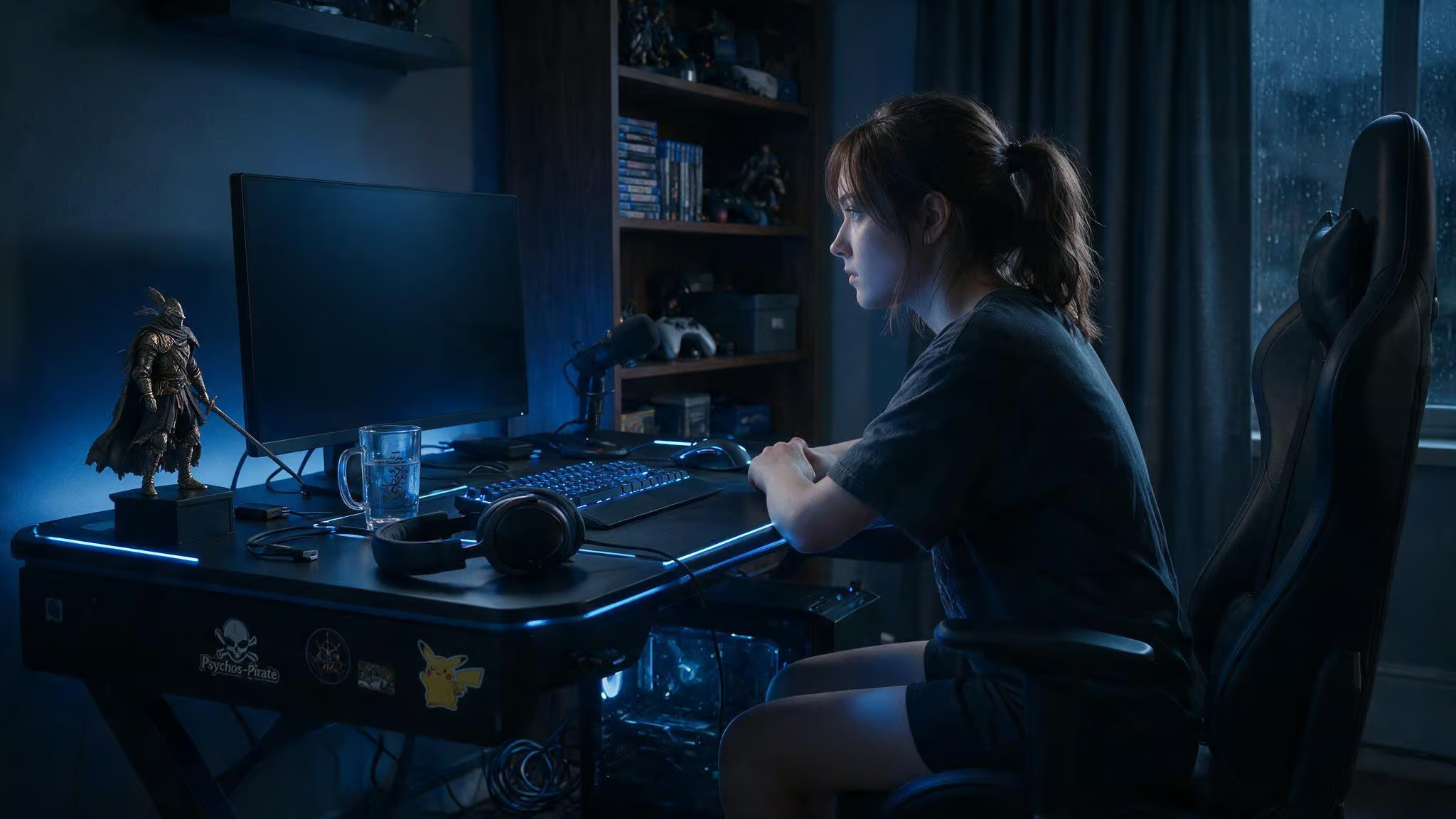
So what do women do about this? They develop a toolkit of workarounds. Each one makes sense as an individual survival strategy. Each one also has trade-offs that keep the overall system broken.
Quitting multiplayer games as last resort
The simplest solution is to stop playing multiplayer games entirely. If the lobbies are toxic, don’t join them. But this isn’t a solution—it’s a retreat. And it means ceding the public gaming space to the worst actors.
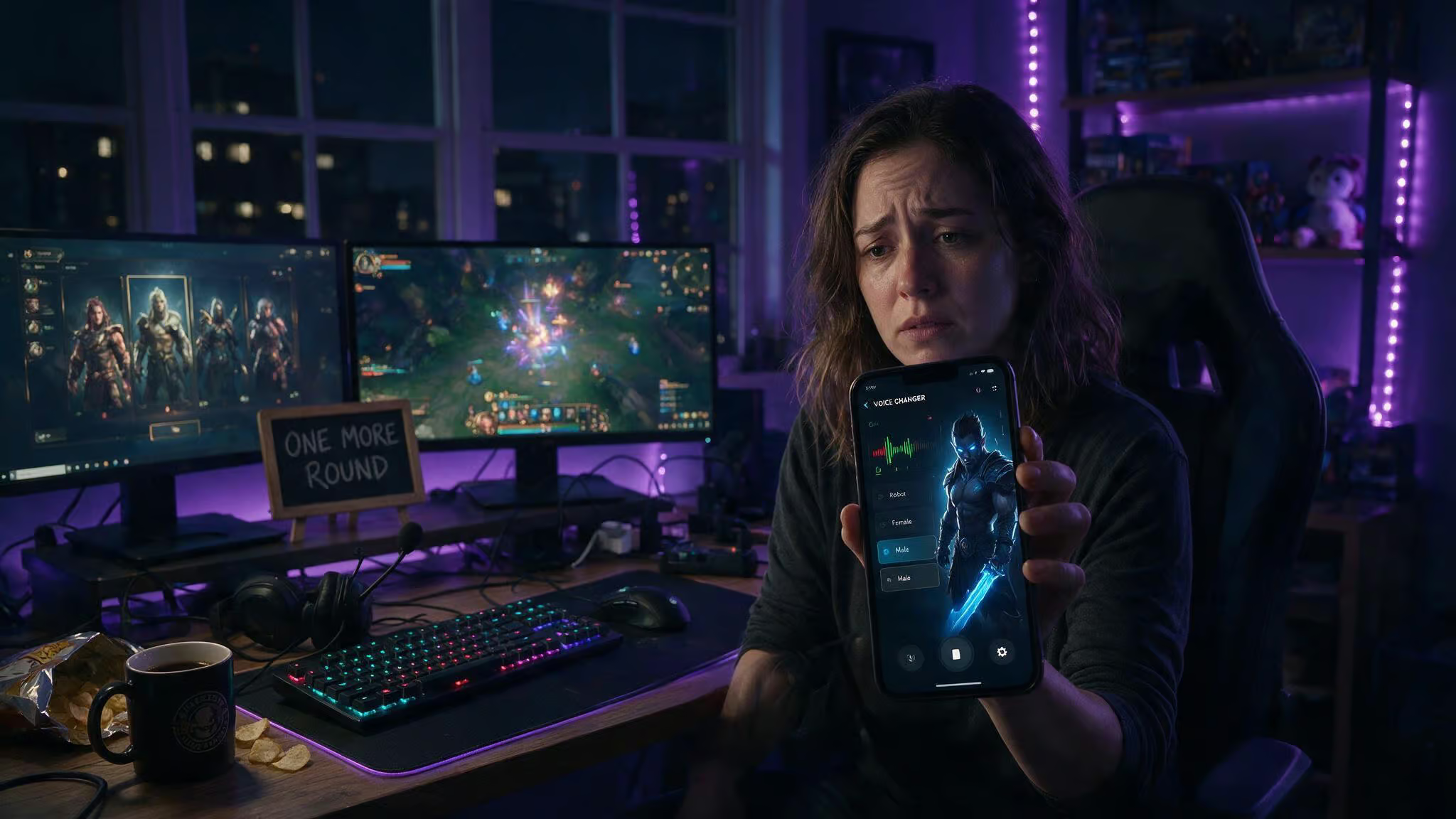
Gender-masking with voice changers and male avatars
A more common approach is to hide your gender. Use a voice changer. Pick a male avatar. Don’t talk in voice chat.
Stay invisible. It works as long as you don’t slip up. But it’s exhausting to manage a false identity to play a game without harassment.
One participant, Mousse, told a story that illustrates the indirect exposure problem. She was on a Monster Hunter forum—not in a game lobby, a forum—and saw the level of sexism in the community. She hadn’t been targeted directly. She saw the vibe and decided to hide her gender. That’s indirect exposure: you don’t have to be the target to feel the chill.
Gaming only with trusted acquaintances
The most common workaround is to play only with people you know. It’s safer, but it comes with the online-offline trap we discussed. And it limits who you can play with and when.
Private female-only communities
Women are building their own spaces because the public ones aren’t safe. Discord servers, Douban groups, invite-only communities where the admission process is strict: gaming quizzes, conduct agreements, sometimes photo verification. It’s a fortress, not a club. The hoops you have to jump through to get in are a measure of how desperate women are for a space where they can play without being harassed.
The Scope of the Problem
Let’s talk numbers, because the anecdotes might make it sound like isolated incidents. They’re not. The Deng (2024) study interviewed 40 female gamers aged 20-63 from China, North America, Europe, and Asia-Pacific, providing a cross-cultural perspective.
A 2021 survey by Reach3 Insights polled 900 women across the US, Germany, and China. 77% reported being targeted for their gender while gaming. That’s not a fringe issue. It’s the majority experience.
A Sky Broadband study in 2023 found that 49% of 4,000 women surveyed had faced abuse or harassment. And for women aged 18-24, that number jumped to 75%. The youngest players are getting hit hardest.
The gaming industry is a $214.2 billion market (2021), projected to exceed $278 billion. Nearly half of all global gamers are women—45%. So we’re talking about a population of players who are systematically marginalized in the spaces they’re supposed to be enjoying.
And it’s not direct experience that causes the damage. Indirect exposure—seeing sexism happen to someone else, hearing it in a lobby you’re not part of—is as effective at pushing women out of gaming spaces as being targeted directly. The chilling effect radiates outward. One incident in a forum or a Twitch chat can make dozens of women rethink whether they want to participate.
How the Stereotype Shows Up in Games and Communities
The “gamer babe” stereotype isn’t in the chat. It’s coded into the games. The feedback loop between game content and community behavior is tight.
In-game representation
The numbers are stark: fewer female characters, less screen time, more skin. When women appear, they’re often hypersexualized and designed for the male gaze. The “virgin or vamp” binary is alive in game writing. It’s lazy, but it’s also a signal. It tells players what the default audience looks like and who this world is built for.
In-community behavior
That representation sets the baseline for how players treat each other. In games like Overwatch and League of Legends, as noted in the Deng study, women get pushed into support roles by default. It’s a way of saying you’re not good enough for the real action. And when a team starts losing, the woman is the first to get blamed. She’s the last to get credit. She’s expected to follow orders.
The assumption that women can’t play well is baked in that it becomes a self-fulfilling prophecy. You get pushed into a support role because nobody trusts you on DPS. Then when you perform well in that role, it’s “oh, well, support is easier anyway.” The goalposts keep moving. You can’t win.
The Paradox – How Self-Protection Reinforces the Problem
Here’s the kicker. The strategies that keep individual women safe in the moment are the ones that keep the overall culture broken.
Think about it. When women quit public lobbies, gender-mask, or retreat to private Discord servers, they’re making the rational choice for their own well-being. But they’re also ceding the public space. The lobbies, the ranked queues, the voice chats—all of those spaces become more male-dominated because the women who would be there have left. And that reinforces the idea that gaming is a male space.
This is what researchers call “trading place for peace.” You give up your spot in the public arena to avoid the harassment. You get your peace, but you’ve traded away your place. And the cycle continues: fewer women in public spaces means the culture doesn’t change, which means more women leave, which means the culture stays broken.
The coping strategies “paradoxically reproduce gender inequalities.” They’re a band-aid that reinforces the wound.
Bottom line: Every woman who leaves a public lobby to avoid harassment removes the visible presence that could normalize her belonging there. The system relies on that retreat.
Moving Beyond the Double Bind
The “gamer babe” stereotype isn’t a single problem. It’s a system with multiple parts: hostile actors, “helpful” ones who reinforce the same assumptions, game design that sets the wrong baseline, and a social structure that punishes women for speaking up.
The first step in changing anything is seeing the system for what it is. This isn’t about banning the worst trolls and calling it a day. The quiet, “well-meaning” comments are doing as much damage. The unsolicited help, the backhanded compliments, the assumption that women should play support—all of it needs to be recognized as part of the same problem.
Change requires understanding the psychological trap of strategic acquiescence and the design flaws of games built around default masculinity. It means accepting that a woman’s silence isn’t consent. It’s a survival strategy.
And it means asking the question: if you’re a guy reading this, have you ever been the “nice” one who made the women in your lobby feel like they didn’t belong? Because the research says that a lot of the time, that’s what’s happening. And the women aren’t telling you—because the cost of telling you is high.
People Also Ask
What is the stereotype of female gamers?
The stereotype frames female gamers as outsiders who don’t truly belong in gaming culture. It includes assumptions that they’re less skilled, playing for attention, or only present because of a male partner. This stereotype is rooted in ‘toxic geek masculinity,’ which treats gaming as a masculine domain where women are permanent visitors.
What is a gamer babe?
‘Gamer babe’ is a label used to dismiss women in gaming spaces by reducing them to their appearance or assumed lack of skill. It’s a gatekeeping tool that implies a woman is there for show, not because she actually plays. The term carries the assumption that her value is performative rather than technical.
What is a gamer girl’s personality?
There’s no single personality type, but the stereotype forces women into a double bind: if they’re quiet, they’re hiding; if they speak up, they’re labeled a ‘feminist killjoy.’ Many women develop coping strategies like gender-masking or playing only with trusted friends to avoid harassment. The real personality trait that emerges is resilience—constantly calculating social costs just to play a game.
Why do female gamers stay silent about harassment?
Silence isn’t ignorance—it’s a calculated survival strategy. Women weigh the social cost of speaking up: being labeled a ‘feminist killjoy,’ damaging real-life friendships, or being blamed for ruining everyone’s fun. The system is designed so that calling out sexism often punishes the person who reports it more than the person who committed it.