What Does AWP Stand For in CS:GO?
If you’ve played Counter-Strike, you know the AWP. That distinct boom, the split-second scope blur, the satisfying thud of a body dropping through a wall. It’s an icon. AWP stands for Arctic Warfare Police.
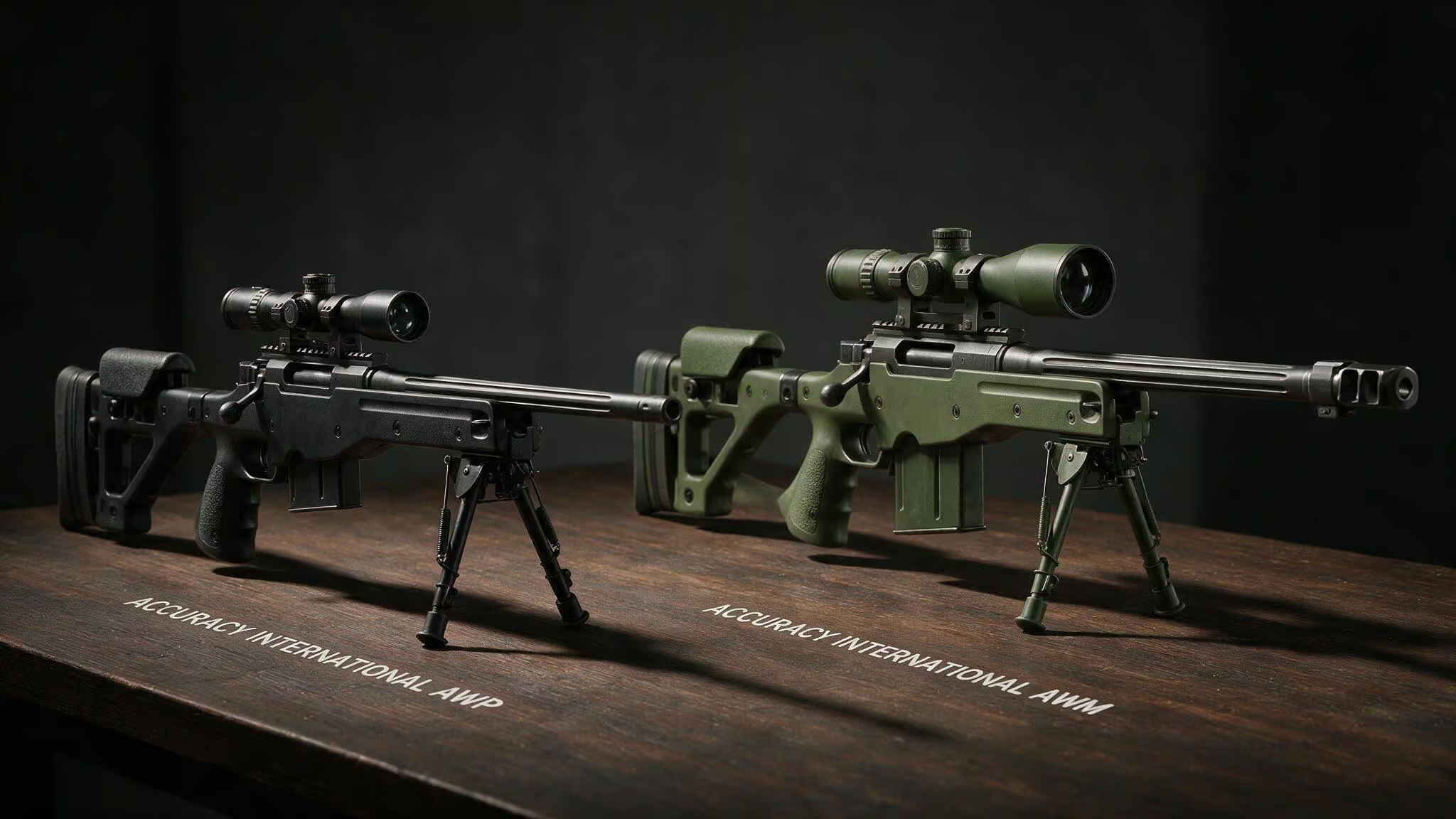
It’s a real law enforcement sniper rifle from a British company called Accuracy International.
That naming mismatch is the rabbit hole I want to walk you through. The AWP is a real-world bolt-action sniper rifle and a gaming legend, and the story behind the name is interesting.
Key Takeaways
AWP stands for Arctic Warfare Police — a real bolt-action sniper rifle built by Accuracy International for law enforcement, chambered in 7.62×51mm NATO/.308 Winchester
The in-game AWP is visually and ballistically modeled on the AWM (Arctic Warfare Magnum), not the actual police AWP, which causes persistent confusion about the weapon’s real identity
In CS:GO, the AWP is not a guaranteed one-shot kill — leg shots leave targets alive with 14 HP, and special characters like the VIP and Lab Rat survive a body shot
Table of Contents
The Direct Answer — What AWP Actually Stands For
Here’s the short version: AWP = Arctic Warfare Police. Sometimes you’ll see it expanded as Accuracy International Arctic Warfare Police to include the manufacturer, but the core meaning’s the same. That “Police” part is the key — it tells you this is the law enforcement version of the rifle, not the military one.
Most players assume the AWP is just a made-up game weapon, like the Plasma Rifle or the BFG. It’s not. It’s a real firearm that appears in Counter-Strike, Counter-Strike Xbox Edition, Counter-Strike: Condition Zero, Counter-Strike: Condition Zero Deleted Scenes, Counter-Strike: Source, Counter-Strike: Global Offensive, and Counter-Strike 2, available to both teams. The name itself comes from a specific real-world design philosophy: a bolt-action sniper built for police work, with a 24-inch barrel and no muzzle brake. We’ll get to why that matters in a minute.
The Real-World Origin — The Accuracy International Arctic Warfare Family
The story starts in 1978, when Olympic shooter Malcolm Cooper founded Accuracy International in the UK. Together with designers Dave Walls and David Caig, Cooper set out to build a sniper rifle that could handle the worst conditions on earth. The result was the PM (Precision Match), which the British Army adopted as the L96A1 in 1985 after a Falklands War competition.
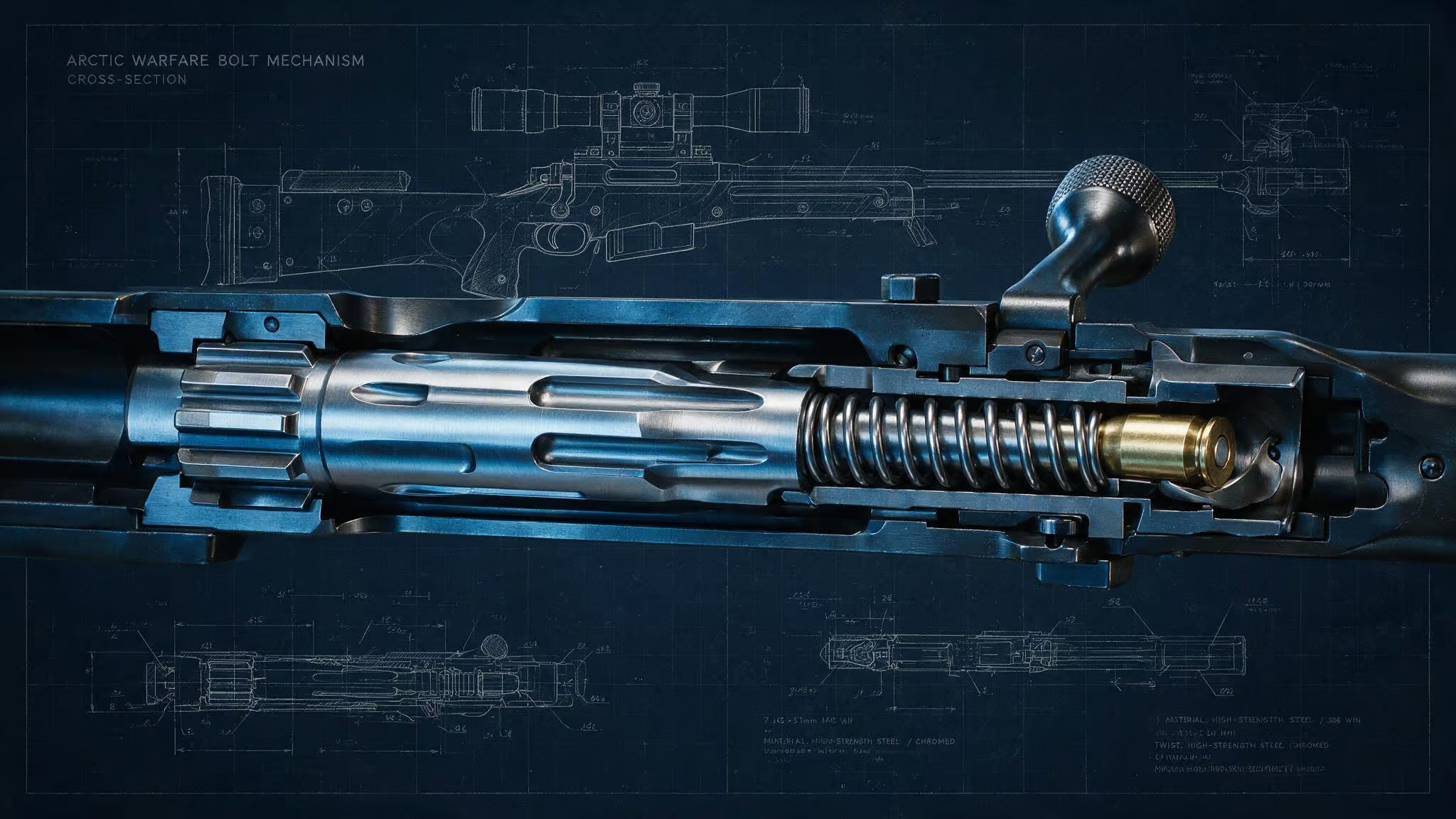
That rifle evolved into the Accuracy International Arctic Warfare family, introduced in the 1980s, and the name isn’t marketing — it’s engineering. The AW receiver is machined from a solid piece of forged carbon steel and is attached to an aluminium chassis system (AICS) using four bolts and permanent epoxy bonding, which provides a modular design for field serviceability.
Why “Arctic” Is in the Name
The Arctic Warfare rifle was designed to function at -40°C. That’s cold enough to freeze the oil in most firearms and make metal components brittle. So Accuracy International engineered specific solutions:
- Milled bolt slots that prevent ice and dirt from binding the action
- Enlarged controls that you can operate with thick Arctic mittens
- Polymer panels that don’t get brittle at extreme low temperatures, replacing the older resin stocks
- A 60-degree bolt throw that makes cycling easier when you’re wearing gloves and can’t move your hands freely
- The bolt has six lugs arranged in two rows of three, engaging a heat-treated steel locking ring insert pinned inside the front bridge, and the firing pin travel is 0.26 in (6.6 mm).
This isn’t a gimmick name. The rifle was purpose-built for conditions that would disable most other weapons. An An 11 mm integral dovetail rail is located above the receiver for optical sights, and cartridges are fed via a detachable, double-stack, steel box magazine; .Cartridges of .300 Winchester Magnum or larger use a single-stack magazine.
AWP vs. AW vs. AWM — Three Variants, One Family
Here’s where the confusion starts. The Arctic Warfare family has three main variants, and they’re often mixed up:
| Variant | Barrel | Finish | Caliber | Muzzle Brake |
|---|---|---|---|---|
| AWP (Police) | 24 inches | Black | 7.62×51mm NATO/.308 Win | No |
| AW (Military) | 26 inches | Green | 7.62×51mm NATO | Yes |
| AWM (Magnum) | 26+ inches | Green/Black | .300 Win Mag or .338 Lapua | Yes |
The AWP is the police variant — shorter barrel, no muzzle brake, black finish. It trades a bit of velocity for maneuverability and discretion. The AW is the military version with a longer barrel and muzzle brake. The AWM (Arctic Warfare Magnum) is the big brother, chambered in .300 Winchester Magnum or .338 Lapua Magnum, with a reinforced receiver and longer bolt to handle the higher pressures. Barrels are free-floating, heavy, stainless steel, provided by Maddco Rifle Barrels (button rifled) and Border Barrels (cut-rifled on Pratt & Whitney benches).
And here’s the funny part: the rifle you’re using in CS:GO is an AWM wearing an AWP nametag. The safety is a three-position, firing pin blocking lever on the bolt shroud; white indicates safety on, red indicates off. The two-stage trigger has an adjustable pull weight of 10 to 20 N (2.2 to 4.4 lbf).
The Naming Mismatch — In-Game AWP vs. Real AWP
Here’s the truth that most players never notice: the in-game model is visually and ballistically based on the Counter Strike AWP real name, the AWM, not the AWP. You can see it in the longer barrel profile, the muzzle brake (absent on the real AWP), and the way it behaves like a magnum rifle. Older Counter-Strike games even had it chambered in .338 Lapua Magnum — the AWM’s signature caliber, not the AWP’s 7.62×51mm.
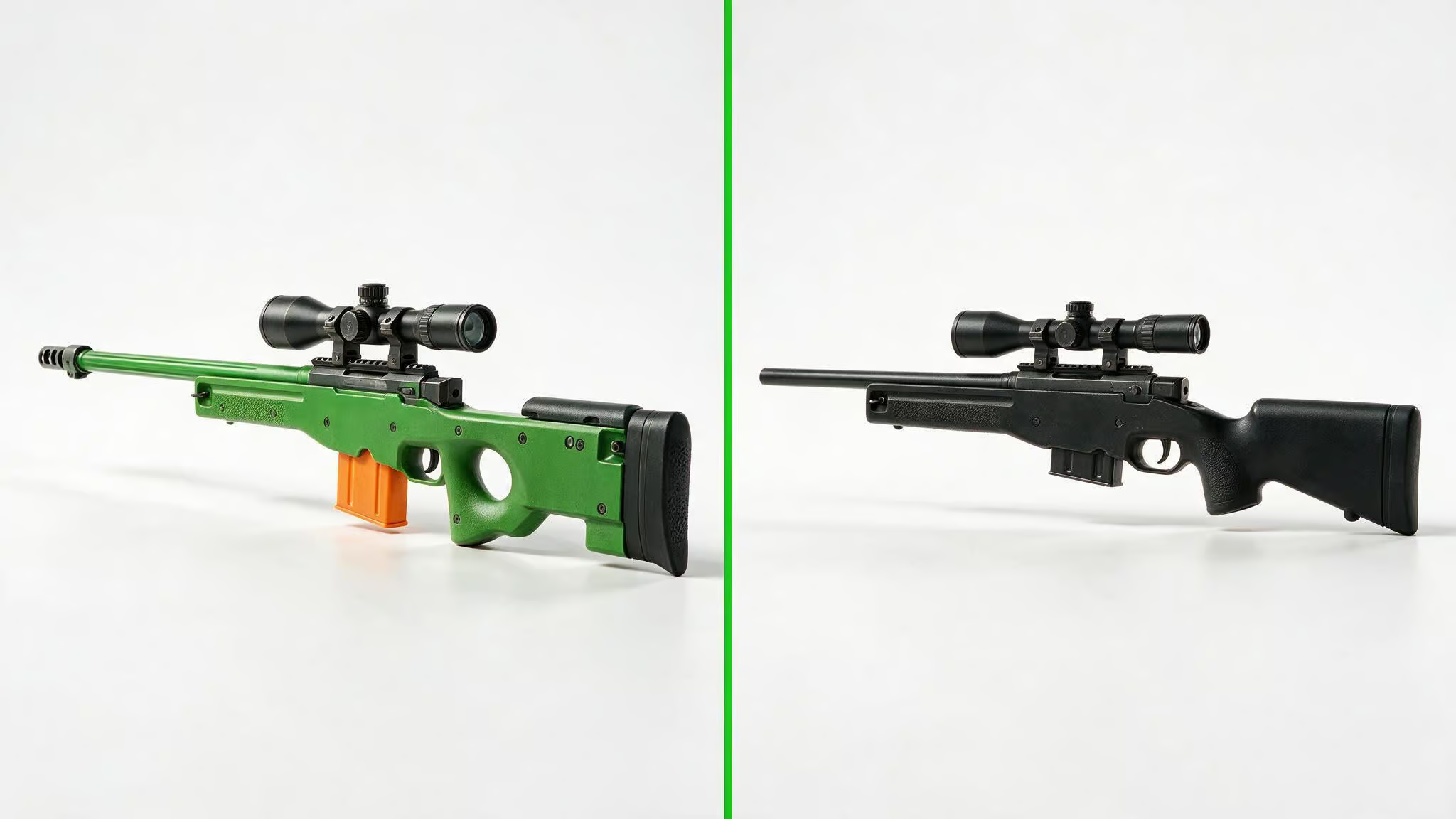
Valve called it the AWP, but the gun they modeled is the magnum version. Why? Nobody knows for sure. Maybe they liked the sound of “AWP” better than “AWM.” Maybe they grabbed the wrong reference photo. Whatever the reason, the mismatch has been there since the beginning, and it explains why the in-game AWP hits so much harder than a real police sniper rifle would—though the planned CS2 AWP changes would later reshape its role with new smoke and visual updates.
So when you’re holding that iconic green-barreled beast in CS:GO, you’re wielding an Arctic Warfare Magnum — the big-game hunting version, that happens to be named after the cop rifle. That’s why it does high damage. It’s technically the wrong gun for the name.
In-Game Performance — The One-Shot Kill Myth and Reality
Everyone knows the AWP is a one-shot kill. But that’s not entirely true. Here are the exact damage numbers from CS:GO:
Damage by hitbox (armored/unarmored):
- Headshot: 459 / 448 — instant kill, no exceptions
- Chest & Arm: 114 / 112 — one-shot kill
- Abdomen & Pelvis: 143 / 140 — still a one-shot kill
- Legs: 86 / 86 — not lethal
That leg shot is the trap. Hit someone in the foot and they’ll be standing there with 14 HP, alive. It’s the only place on the body where the AWP won’t secure a kill, regardless of armor. This is the exception most players don’t expect, and it can cost you a round.
There are also two special characters that break the one-shot rule:
- VIP in Assassination mode: Their armor absorbs 200 damage, so a body shot leaves them alive. A headshot still kills instantly.
- Lab Rat in Danger Zone: They have 120 HP, so they survive one body shot (114 damage) but die to a headshot.
The AWP also has high penetration power. Wallbangs do about 53 damage through one wall and 25 through two walls. A headshot through cover still kills. That’s why a good AWPer can punish you for hiding behind thin walls.
The Cost of Power — Trade-offs and Mechanics
The AWP is the most powerful weapon in the game — and also one of the most punishing. Every shot is a commitment. Here’s what you’re signing up for:
Movement speed (hammer units per second):
- Running: 200
- Walking: 104
- Crouch walking: 68
- Running while scoped: 100
- Walking while scoped: 52
- Crouched walking while scoped: 34
You become a slow-moving target as soon as you scope in. Getting caught in the open with the AWP out is a death sentence.
Reload: 3.7 seconds. That’s an eternity in Counter-Strike. You can hear enemies reloading across the map with that window.
Scope blur: About one second after scoping in. You can’t quickscope effectively. It’s a deliberate balance mechanic to prevent the AWP from being a run-and-gun weapon.
Sound: Loud and distinct. Everyone on the map knows exactly where you fired.
Accuracy: Terrible when moving or unscoped. You must stand still and scope in to hit anything.
Economy:
- Cost: $4,750
- Kill reward: $100 in Competitive, $50 in Casual
- That’s a poor return on investment. You need to survive multiple rounds to recoup the cost.
Magazine: 5 rounds. It used to be 10 in older games, but that changed in November 2022.
Patch History — How the AWP Evolved in CS:GO
The AWP has been nerfed more times than almost any weapon in Counter-Strike. Each patch chipped away at its mobility, magazine size, and quick-scoping ability. Here’s the timeline:
- August 10, 2012: Deploy animation increased to 1.25 seconds. No more instant switching.
- January 23, 2013: Kill reward increased from $50 to $100. A small buff to make it less punishing economically.
- August 28, 2014: Scope effects scaled back for AWP and SSG08. Visual polish and bug fix for accuracy matching.
- March 31, 2015: Lowered scoped movement values for AWP and autosnipers. You move even slower now.
- November 10, 2015: AWP now always un-zooms during reload animation. No more scoped reloading.
- July 27, 2016: AWP and SSG08 now drop magazines when reloading. Visual change, but shows attention to detail.
- February 24, 2020: Crouching movement acceleration is now constant. No more acceleration spike after firing.
- November 18, 2022: Magazine reduced from 10 to 5 rounds. This was a balance change that altered the AWP’s role. No more panic-spamming through walls.
- August 14, 2025: Improved deploy animations for AWP, M4A4, and M4A1-S.
- March 18, 2026: Reloading refactored — all remaining ammo in the magazine is discarded when reloading. Now you have to think carefully about when to top off.
Each change was a response to the AWP’s dominance. The weapon was too good at too many things, and Valve systematically tuned it down to keep it in its lane: high-risk, high-reward positional play.
Common Misconceptions and Myths
Myth: The AWP is a fictional game weapon.
Reality: It’s a real police sniper rifle from Accuracy International, founded in 1978 by Malcolm Cooper. It’s used by law enforcement agencies worldwide, including Romania’s Brigada Antiterorist? (adopted in 1999) and the Italian Carabinieri. The “Police” in the acronym isn’t just for show.
Myth: The AWP always one-shot kills.
Reality: Leg shots leave enemies alive with 14 HP. VIP and Lab Rat characters survive body shots. The one-shot kill is true — but only if you hit the right spot.
Myth: The game version is the real AWP.
Reality: The in-game model is the AWM (magnum variant). The real AWP has a shorter barrel, no muzzle brake, and fires 7.62×51mm instead of.338 Lapua. You’re using a magnum rifle misnamed after the police variant variant.
Myth: AWP stands for “Awesome Weapon, Pal” or other fan expansions.
Reality: It’s Arctic Warfare Police. The real acronym is less fun but interesting once you know the history.
Wrapping It Up
The AWP in CS:GO stands for Arctic Warfare Police, but the in-game weapon is actually an AWM. Leg shots deal only 86 damage, leaving enemies alive with 14 HP.
That naming mismatch is the key to understanding the AWP.
Next time you pick up that $4,750 green beast and hear that satisfying boom, you’ll know you’re holding an Arctic Warfare Magnum that happens to be called a Police. And honestly? That’s cooler than “Awesome Weapon, Pal.”
Frequently Asked Questions
Why is it called the AWP?
The name comes from the real-world Accuracy International Arctic Warfare Police rifle. However, the in-game model is actually based on the AWM (Arctic Warfare Magnum), not the police variant, so players are technically using a magnum rifle misnamed after the cop version.
Is AWP always one shot?
No, the AWP is not always a one-shot kill. Leg shots leave enemies alive with 14 HP, and special characters like the VIP in Assassination mode and the Lab Rat in Danger Zone can survive a body shot due to their unique armor or health values.
How much does the AWP cost in CS:GO?
The AWP costs $4,750 in CS:GO, making it one of the most expensive weapons in the game. The kill reward is only $100 in Competitive and $50 in Casual, so you need to survive multiple rounds to recoup the investment.