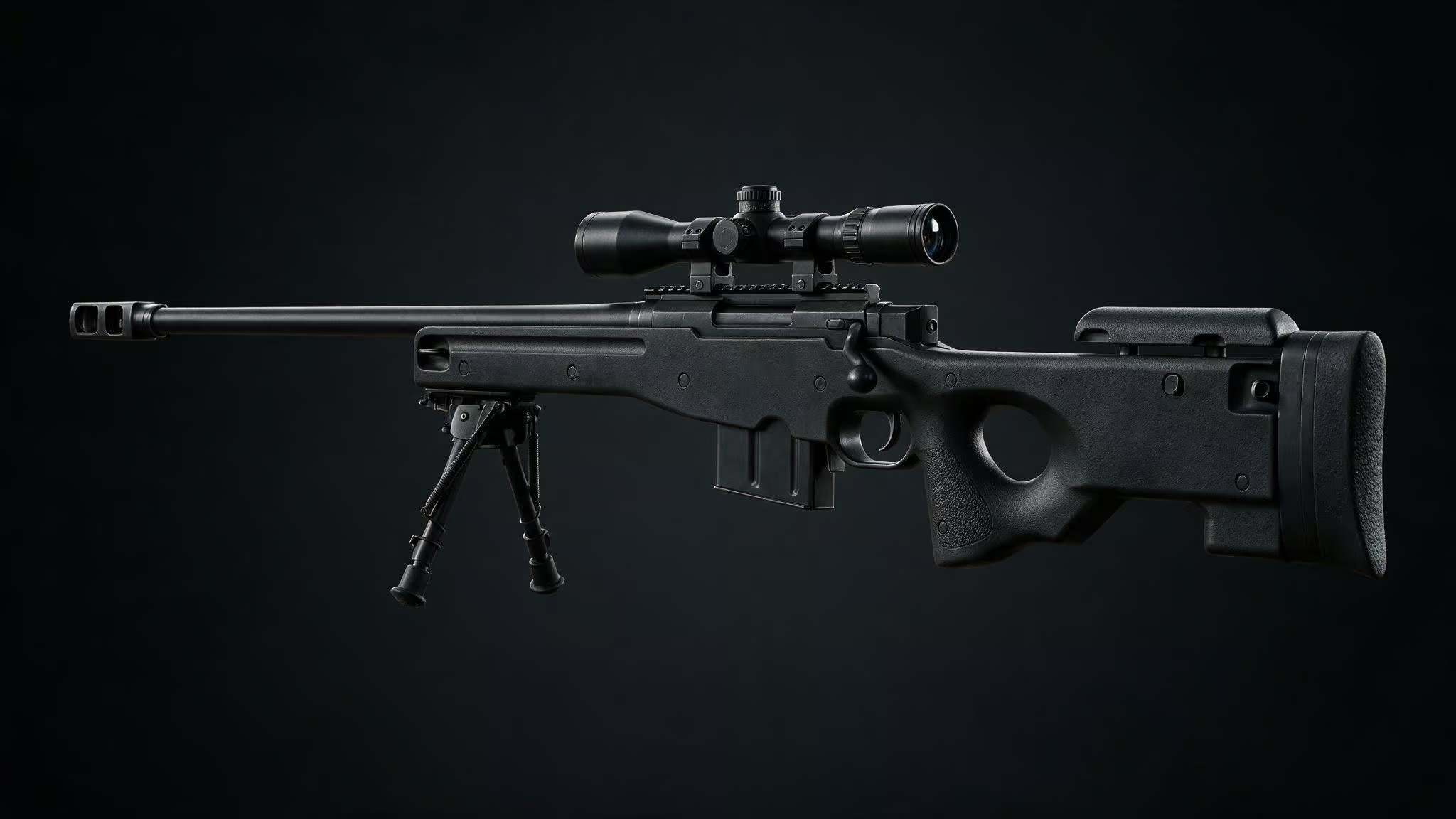
You spawn on Dust II, save up for that $4,750 price tag, and pick up the AWP. One shot, one kill — the dopamine hits. But that polygon model in your hands? It’s not a single real rifle. It’s a hybrid: the name and stubby barrel come from one variant, the one-shot power from another.
The name behind the Counter-Strike AWP is the Accuracy International Arctic Warfare Police (AWP). But the in-game version borrows the stopping power of the Accuracy International Arctic Warfare Magnum (AWM). So the AWP you know is a Frankenstein creation — a deliberate hybrid for gameplay, especially when considering the CS2 AWP changes that have overhauled its smoke interaction, visuals, and sound.
Key Takeaways
The in-game AWP is based on the Accuracy International Arctic Warfare Police variant (24-inch barrel, .308 Win) but gives it the one-shot-kill power of the .338 Lapua AWM — a deliberate hybrid for gameplay.
The Arctic Warfare family was designed for Sweden’s extreme cold: milled bolt slots, enlarged controls for mittens, and polymer stock panels made it ice-proof — and that same engineering made it reliable in sand, mud, and dirt.
One AW action has reportedly fired 96,000 rounds with only one part failure (a roll pin), and a British sniper used an L115A3 (AWM in .338 Lapua) to make the longest confirmed kill at 2,707 yards in 2009.
Table of Contents
What’s the Real Name of the Counter-Strike AWP?
The rifle in Counter-Strike is called the AWP — that stands for Arctic Warfare Police. But if you look at the specs in the game, something’s off. The AWP has a shorter 24-inch barrel and fires 7.62×51mm NATO (.308 Winchester) or sometimes .243 Winchester. It’s a police/law enforcement variant designed for precision at moderate ranges, not for punching through armor at a kilometer.
In Counter-Strike, though, that same polygon model behaves like a magnum rifle: one-shot kill to the chest at most ranges, slow bolt cycle, massive recoil. That’s the AWM — the Arctic Warfare Magnum, which fires .300 Winchester Magnum or .338 Lapua Magnum and uses a 5-round single-stack magazine. The in-game AWP has a 10-round mag, which doesn’t match either real variant perfectly (the real AWP uses 10-round .308 mags, but the .338 AWM only holds 5). So the game stitched together the look of the AWP with the power of the AWM, and called it the AWP.
The real name is Accuracy International Arctic Warfare Police, but the game’s version is a fictional mashup.
From the PM to the Arctic Warfare: A Cold-Weather Origin Story
The story starts in the late 1970s. A small British company called Accuracy International was founded in 1978 by former British Army and Royal Marine snipers. Their first major design was the PM (Precision Marksman), created by Olympic gold medalist Malcolm Cooper along with Dave Walls and David Caig. The PM won a UK Ministry of Defence competition in 1984, beating out the Parker Hale M85, H&K PSG1, SIG SSG 2000, and Remington 700. It entered British service as the L96A1, often equipped with Schmidt & Bender optics.
Then came the Swedish requirement that gave the rifle its name. Sweden wanted a sniper rifle that could operate reliably at -40°C. Accuracy International redesigned the PM into the Arctic Warfare (AW) with specific cold-weather changes:
- Milled bolt slots — prevents ice and dirt from binding the action.
- Enlarged controls — so a soldier wearing Arctic mittens can still operate the bolt and safety.
- Polymer stock panels — less brittle than wood or fiberglass in extreme cold.
- Three-position safety on the bolt shroud — lets you manipulate the bolt with the safety engaged (white = safe, red = fire).
These features ended up working brilliantly in all environments. Sand, mud, jungle humidity — the same slots that cleared ice also cleared debris. The Swedish military adopted it as the Psg 90 in 1988, and the “Arctic Warfare” name stuck.
AWP vs. AWM: The Confusion Behind the Icon
Here’s where it gets weird. The in-game AWP carries the name of the AWP but the muscle of the AWM. Let’s separate them.
AWP (Arctic Warfare Police)
- Barrel: 24 inches (610 mm) — shorter, stiffer, better for precision at police engagement distances.
- Caliber: 7.62×51mm NATO / .308 Winchester (also .243 Win).
- Finish: Black (military variants are usually green).
- Magazine: 10-round detachable box.
- Stock: Adjustable butt length with spacers.
- Role: Designed with match-grade ammunition for law enforcement — think SWAT precision, not cross-country sniping.
AWM (Arctic Warfare Magnum)
- Barrel: Longer to accommodate magnum cartridges.
- Caliber: .300 Winchester Magnum or .338 Lapua Magnum.
- Magazine: 5-round single-stack (narrower due to cartridge size).
- Bolt: Longer action to fit magnum-length rounds.
- Military designations: L115A1/A2/A3 in British service; G22 for the German Bundeswehr (folding stock, .300 Win Mag).
- Unofficial variant: Some call the .338 Lapua version the AWSM (Arctic Warfare Super Magnum), though that’s not official.
The key takeaway: the real AWP is not a magnum rifle. In-game, the AWP acts like a .338 Lapua AWM. So if you’ve ever wondered why your CS AWP hits so hard compared to, say, a real-life police sniper’s .308, that’s why.
Other notable variants
- AWS (Suppressed): 16-inch barrel with integral suppressor, subsonic .308, effective to about 300 meters.
- AWC (Covert): 12-inch barrel, folding stock, supplied in a small suitcase lined with closed-cell foam. Used by Delta Force, SAS, and German KSK (as G25).
- AW50: .50 BMG (12.7×99mm NATO) variant, introduced 2000, used by UK and Australia.
What Makes It Accurate: Engineering That Defines a Legend
The Arctic Warfare family’s reputation is down to specific engineering choices.
The chassis system that killed bedding
Traditional rifles use a wood or composite stock that must be “bedded” — epoxy is poured into the stock to create a perfect fit for the receiver. This is labor-intensive and temperature-sensitive. Accuracy International’s answer: an aluminium chassis system (AICS) that runs the full length of the stock. The receiver bolts onto the chassis with four screws and is permanently bonded with epoxy.
The stock panels (polymer) are cosmetic and protective; they don’t bear any stress. That means no bedding, and consistent accuracy from rifle to rifle.
Bolt design
The bolt has six locking lugs arranged in two rows of three, engaging a heat-treated steel locking ring in the receiver. The 60-degree bolt throw is short and fast. Gas relief holes vent any case failure away from the shooter. And those milled slots? They’re not just for ice — they also let sand and dirt fall out instead of jamming the action.
Barrels and durability
Barrels are free-floating, stainless steel, sourced from Maddco (button rifled) and Border Barrels (cut-rifled on Pratt & Whitney benches). They’re considered user-replaceable expendable items — any AI barrel in the same family fits any AI action. This modularity is a huge plus for military users who can swap a worn barrel in a few minutes.
one AW action has reportedly fired 96,000 rounds with only a single part failure — the roll pin that secures the bolt release catch broke.
Trigger and safety
The two-stage trigger has a pull weight range of 10 to 20 N (2.2 to 4.4 lbf). The three-position safety on the bolt shroud lets you work the bolt while keeping the trigger locked — a small but brilliant detail for tactical shooting.
Real-World Performance: The Record Shot and Military Adoption
The official military effective range for the L115A3 (AWM in .338 Lapua) is listed at 800 meters. That’s an estimate for consistent first-round hits on a man-sized target. But in the right hands, the platform can reach much, much further.
The record that put it on the map
Cpl. Craig Harrison of the British Army, using an L115A3, made a confirmed kill shot at 2,707 yards (2,475 meters) in Afghanistan in November 2009. It was previously certified by Guinness World Records (later surpassed by a Canadian sniper using a McMillan TAC-50). The shot took about 9 seconds of flight time.
Military adoption (15+ countries)
The Arctic Warfare family has been adopted by over 15 countries:
- UK: L96A1 (1985), L118A1 (1990s for UKSF), L115A1/A2/A3
- Sweden: Psg 90 (1988)
- Germany: G22 (AWM-F, 1998), G24 (AW50)
- Australia: SR-98 (folding stock)
- US: Mk 13 family (Mk 13 Mod 5, Mk 13 Mod 7 replaces the M40 in USMC, April 2018)
- Others: Belgium, Indonesia, Ireland, Latvia, Malaysia, Netherlands, New Zealand, Norway, Russia (limited), Singapore, Spain
Consistent sub-0.5 MOA accuracy with match ammunition is the norm.
Why the AWP Became a Gaming Icon
Counter-Strike (released 2000) originally called it the Magnum Sniper Rifle. It fed from a 10-round magazine (again, not real — the .338 AWM uses 5-rounders) and delivered one-shot kills with a punishingly slow fire rate. That gameplay defined it. Miss your shot?
You’re dead. Hit? You’re god.
Magazine disconnect
The in-game 10-round magazine doesn’t exist on any real AWP or AWM. The AWP uses 10-round .308 mags, but the .338 AWM uses 5-round single-stack magazines. So the CS AWP has a capacity that matches the police variant but a caliber that belongs to the magnum variant. It’s a mashup, and it works for gameplay, but it’s not accurate to life.
Beyond Counter-Strike
The rifle family shows up everywhere:
- Call of Duty: L96A1, L118A, L115 across multiple titles.
- PUBG: The AWM crate weapon (and yes, it uses .338 Lapua in-game).
- Battlefield series: Various AW variants.
- Films: John Wick: Chapter 3 – Parabellum, Furious 7, The Boondock Saints.
- Anime: Case Closed — Shuichi Akai frequently uses an AWM.
The Modern Evolution: AX Series and What Comes Next
In 2010, Accuracy International unveiled the AX series at SHOT Show. It’s a major overhaul — a new design philosophy, not just a variant. The AX action is built on the AWM’s long action, but the whole system is designed for multi-caliber modularity.
AXMC (Multi-Calibre)
You can switch between .338 Lapua, .300 Win Mag, and .308 Win in a few minutes by swapping barrel, bolt, and magazine (or insert). The bolt diameter is 22mm. It comes with a 30 MOA forward-canted rail and uses 10-round double-stacked steel mags for .338 Lapua. That allows military units to use one rifle for multiple roles.
AX308 and AX50
- AX308: Dedicated 7.62×51mm variant, 20mm bolt, 20 MOA rail.
- AX50: .50 BMG, replacing the AW50, 30mm bolt.
AXSR (2025)
The latest evolution adds chamberings beyond.338 Lapua: .338 Norma, .300 Norma, .300 PRC, .300 Win Mag, and on request .308 Win and 6.5 Creedmoor. The shift from cold-weather specialization to modular multi-caliber flexibility shows how the platform adapted to modern military requirements.
Interestingly, the AX series was partly developed in response to USSOCOM’s Precision Sniper Rifle (PSR) solicitation. Accuracy International didn’t win — the contract went to Remington’s Modular Sniper Rifle in 2013. But the engineering effort pushed the AX forward, and it’s now a flagship product for AI.
The Arctic Warfare family started with a simple requirement: make a rifle that won’t freeze. It ended up as a platform that set records and continues to evolve. Next time you pick up the AWP in CS, you’ll know you’re holding a digital echo of a real engineering story — one that started on a cold Swedish test range and ended up in a small suitcase for special forces.
Frequently Asked Questions
What is the AWP actually called?
The real rifle is called the Accuracy International Arctic Warfare Police (AWP). It’s a law enforcement variant with a 24-inch barrel chambered in .308 Winchester, designed for precision at moderate ranges rather than extreme long-distance sniping.
What is the AWP sniper in real life?
The real AWP is a bolt-action sniper rifle made by Accuracy International, chambered in .308 Winchester with a 24-inch barrel and a 10-round magazine. It’s built for law enforcement use, not military magnum calibers — so it doesn’t hit anywhere near as hard as the Counter-Strike version.