A few years ago, I was grabbing a drink with a close friend when we fell into a rabbit hole about the future of automation. He made a prediction that stuck with me: the acceleration of artificial systems would trigger a counter-wave of “new humanism.” It would be a raw, protective human instinct to ring-fence our physical spaces, our creative outputs, and our professional lives.
Fast forward to 2026, and that prediction is playing out in an online way.
Every day, we run into automated customer service agents, delivery robots rolling down sidewalks, and large language models (LLMs) writing corporate emails. But instead of quietly accepting this friction, humans are fighting back with linguistic armor. If you have spent any time on TikTok or scrolled through customer service chat logs recently, you have likely run into people using a brand-new term of endearment—or rather, an insult—for these systems: “clankers.”
What was once an obscure piece of science-fiction military jargon has evolved into an anti-AI rallying cry.
Key Takeaways
Strategic customer behavior trends show pushback against automated tools: Gartner data reveals that 64% of customers prefer human interaction over AI in service settings, and 53% would actively switch companies if they discovered AI was handling their support.
Collective labor anxiety is peaking across major markets, with Ernst & Young (EY) 2025 survey data indicating that 42% of European employees are concerned that AI tools threaten their job security.
You can see this resentment in a TikTok video from creator @vibestealer (7.7 million views) depicting public hostility towards a delivery robot with the shout, ‘Get these off the streets. Clanker!’
Table of Contents
What are “clankers”? The sci-fi slur fueling a new humanist backlash
To understand what is happening on modern social platforms, we have to look at the phrase itself. If you go hunting for a clear clanker meaning you’ll find it’s a derogatory term used to mock and devalue robots, physical automated machines, and generative AI configurations.
Phonetically, the word is simple. It mimics the metallic clank of obsolete physical machinery. By calling a modern AI agent a “clanker,” you are stripping it of marketing “magic” or intelligence. You are reducing a multi-billion-dollar neural network run on cutting-edge server racks to a bucket of loose bolts.
Using a pejorative for software paradoxically anthropomorphizes it. When you throw a pejorative at an LLM, you are treating it like an entity. You are placing it into an “outgroup” that humanity feels the need to organize against.
Where “clanker” originated in popular culture
Watching this word jump from fandom to the real world is a fascinating case of linguistic migration. While the term feels modern, its roots go back to the mid-century sci-fi boom.
The 1958 Sci-Fi Roots
Long before the internet, the term made its first recorded appearance in a 1958 written essay by science fiction author William Tenn. Tenn used the word to describe the clunky, uncreative mechanical workers depicted in early cinematic classic films like Metropolis. Even then, the word was used to evoke a sense of mechanical drudgery—a soulless, metallic worker operating devoid of human spark.
The Star Wars Legend
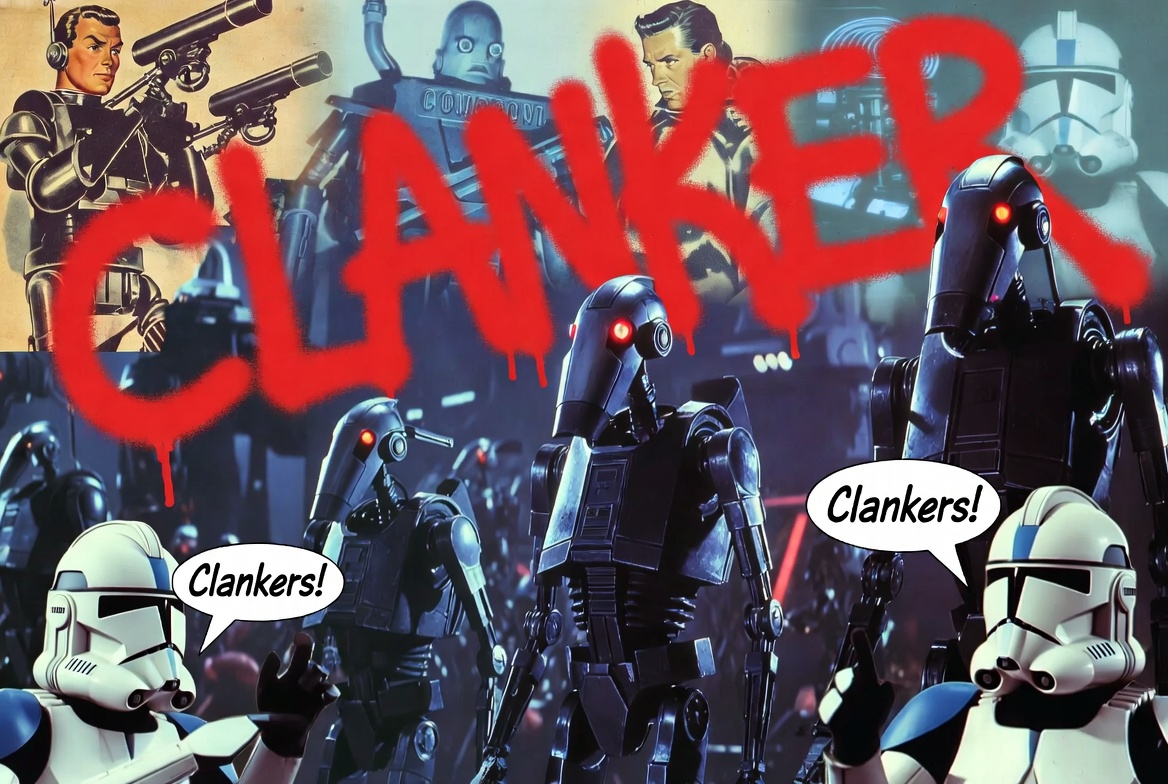
Most modern internet users, however, know the term from a galaxy far, far away. The clanker Star Wars connection really came into its own in the 2005 video game Star Wars: Republic Commando and later popularized on an enormous scale in The Clone Wars animated series.
In the show, elite clone troopers constantly used the label to denigrate the mass-produced, non-sentient battle droids of the Separatist army. Over the years, the term became a staple on Star Wars subreddits—especially community boards dedicated to the Battlefront video game series—where fans shared a clanker meme or two to joke about defeating droid factions.
The Labor Loop
If you trace this back, you end up at Karel ?apek’s 1920 play R.U.R. (Rossum’s Universal Robots), the very text that coined the word “robot.” ?apek derived the term from the Proto-Slavic root *orb?, which literally translates to slave, drudgery, or forced labor.
Over the years, sci-fi’s given us plenty of robot slurs to play with, reflecting our anxiety about machines even as real-world workers seek out high-paying AI-proof jobs. We have seen characters use “skinjob” in Blade Runner to show contempt for human-replicating synthetics, or “toaster” in Battlestar Galactica to demean centurion models.
Modern internet culture has even spawned labels like “bot-licker” (for defensive tech advocates) and “wireback” to describe our relationship with technology, much like older digital subcultures once debated the meaning of grok. But “clanker” has beaten them all out in 2026 because of its flexible linguistic utility. Unlike “skinjob,” it doesn’t target something trying to look human; instead, it targets the cold, clunky infrastructure itself.
Why “clanker” became 2026’s anti-AI slogan
The reason everyone’s searching for the clanker meaning slang has less to do with Star Wars trivia and everything to do with a direct reaction to our changing physical and economic realities.
The Friction of the Physical
For years, AI was an abstract concept hiding behind recommendation algorithms or search engines. Today, it’s got a physical presence. Sidewalk delivery robots are cluttering city walkways, annoying pedestrians and creating real-world bottlenecks.
At the same time, logistics corporations are rolling out automated warehouse initiatives—such as Amazon’s deployment of humanoid warehouse robots—sparking fears of blue-collar labor displacement, a concern exacerbated by a lack of laws against AI. When people see a machine taking up physical room on a sidewalk or replacing a shift worker, the friction becomes real.
The Cognitive Pushback
Academic and industry researchers—including notable warnings from scientists at Carnegie Mellon and Microsoft—have pointed out the risks of “cognitive atrophy.”
When we outsource our writing, our critical thinking, and our daily logistics to LLMs, we risk dulling our basic problem-solving capabilities. Using a slur for robots like “clanker” when you’re stuck interacting with these tools is just a psychological defense mechanism. It’s a way to refuse to treat the code like an intellectual authority.
Customer service friction and the legislative push
The clanker slur has officially broken out of our online forums and into the corporate and political landscape. It’s showing up exactly where companies don’t want it: customer service interfaces.
In the user experience (UX) world, product managers have begun tracking a phenomenon known as the “Clanker Threshold.” If you look at customer support logs, you’ll see a pattern. Users will chat with a customer support chat tool politely and patiently—until they hit the classic conversational dead-ends that signal they are talking to a bot.
The second they realize they’re dealing with a bot, their whole vibe shifts. Social graces are discarded, replaced by curt, demanding commands, often peppered with terms like “clanker.”
This frustration is backed by 2023 Gartner survey data:
- 64% of customers prefer human interaction over AI in service environments.
- 53% of consumers would actively switch companies if they discovered their customer service was being handed off to an automated bot.
This sentiment is driven by real labor anxiety. Data from an Ernst & Young (EY) 2026 survey highlights that 42% of European employees worry about AI threatening their employment stability.
This collective anxiety has caught the attention of federal policymakers. Senator Ruben Gallego has championed legislative efforts targeting call center transparency. His initiative would force businesses to be upfront when they’re using automated tools, and to give everyone a simple path to talk to an actual human. Gallego even took to social media to promote the bill, explicitly using the term “clanker” on X to connect with consumer frustration.
Is “clanker” a real slur? A linguistic analysis
Linguists like Adam Aleksic have explored whether a term can hold the weight of a true “slur” when the target population has no consciousness, no legal standing, and no nervous system to process emotional pain. True slurs generally exist to target systematically oppressed human groups to perpetuate social inequality.
Because of this, there’s an ongoing debate. Some view the term as a harmless, playful piece of slang, while others point out its structural usage as a classic “othering” trope designed to create an outgroup.
Indeed, the linguistic irony of the clanker meme is delicious. By intentionally seeking out a pejorative to strip software of its humanity, our culture is unconsciously treating the software as an eligible peer group. As Aleksic notes, to bother dehumanizing something, you have to mentally lift it to the level of humanity first.
Linguistically, there is also a critical performance distinction between “clanker” and other modern terms of disgust, such as “AI slop.” While “AI slop” is a descriptor for the low-quality, spammy creative outputs cluttering our feeds, calling the system a “clanker” strikes directly at the underlying code, the servers, and the raw corporate infrastructure running the model.
The “new humanism” and the future of AI boundaries
Today, the internet is absolutely flooded with clanker memes. On TikTok, content illustrating this frustration routinely pulls in up to 7.7 million views. A viral video by creator @vibestealer showed physical sidewalk delivery bots being met with open public hostility on city streets, with passersby shouting, “Get these off the streets. Clanker!”
The clip’s 7.7 million views reflect this mixture of humor and stress. Similar TikTok skits depict robots as interference in boyfriend/daughter relationships, a prevalent theme in 2026 social discourse.
Beyond the memes, this cultural pushback is spinning up a brand-new economic incentive: the “Biological Premium.”
Just as the proliferation of chemical farming and synthetic ingredients eventually birthed a highly lucrative, certified “organic” food industry, we are entering an era of certified biological labor. Soon, companies will proudly market their complete lack of automation.
Whether it is certified human art, verified human customer support teams, or entirely human-managed manufacturing, businesses will use the absence of automated agents as a luxury feature. You’ll happily pay more to guarantee there’s not a single piece of cold machinery touching your stuff.
In the end, we are seeing the arrival of that “new humanist” boundary. It turns out humans are not going to yield their social, physical, and cognitive spaces to corporate automation without a fight—and they are happily borrowing George Lucas’s vocabulary to draw their line in the sand.
Frequently Asked Questions
Why are droids called clankers?
The term is derived from the metallic sound made by obsolete or poorly built machinery. By using this label, people aim to strip modern AI of its marketing ‘magic,’ intentionally reducing sophisticated neural networks to nothing more than a collection of cold, clunky hardware.
What does clanker mean in TikTok?
In current social media culture, the term has evolved into a rallying cry against the encroachment of automation into daily life. It serves as an anti-AI insult directed at everything from physical delivery robots on city sidewalks to the LLMs that handle corporate customer service.
What is a clanker system?
A clanker system is not a technical term, but a colloquial label applied to any automated agent or robotic interface that creates friction in human life. It is commonly used by customers who feel frustrated or dehumanized when a business replaces human interaction with a chatbot or automated process.
Who came up with Clankers?
The term has historical roots in science fiction, appearing in a 1958 essay by author William Tenn to describe uncreative mechanical laborers. It gained massive cultural prominence through the Star Wars franchise, particularly in video games and animated series, where it was used as a derogatory term for mass-produced droids.
Is referring to AI as a clanker a real slur?
Linguists debate this because a true slur typically targets an oppressed human group. While calling software a ‘clanker’ mimics the structure of an ‘othering’ trope, it is paradoxically used to refuse to treat modern code as an intellectual authority or a peer.
What is the Clanker Threshold?
This is a phenomenon observed in customer support logs where a user remains polite until they realize they are interacting with an automated agent. At that specific moment, the user’s demeanor often shifts from patient inquiry to overt hostility, discarding social graces in favor of aggressive commands.
Can the term clanker impact future business models?
Yes, the backlash against automated systems is creating a ‘Biological Premium’ in the market. As consumers grow more resentful of automated interfaces, companies are likely to pivot toward marketing their use of real human labor as a premium, luxury feature.