
The short answer is: it depends. The long answer is a lot more useful.
There is no magic view count. Depending on your niche, audience geography, format, and whether you’re stacking sponsorships on top of AdSense, the number of views required for $10k/month can range from roughly 200,000 to 200 million. That’s not an exaggeration — it’s just math.
Most creators obsess over the wrong metric (CPM) and ignore the one that actually determines their paycheck (RPM). They also underestimate how dramatically sponsorships, mid-rolls, and audience location can shrink the view target.
This guide breaks down the real numbers, the hidden multipliers, and a clean formula so you can stop guessing and start calculating your own path to $10k.
Key Takeaways
There is no single view count that equals $10,000 a month. Depending on your RPM, the range spans from roughly 200,000 views (high-CPM finance content at $50 RPM) to 200 million views (Shorts at $0.05 RPM).
Your RPM, not your CPM, is the number that decides your paycheck. YouTube takes 45% of ad revenue, and only 40–70% of video views actually generate an ad impression.
Sponsorships typically pay 2–5x what AdSense pays per view, which means brand deals can cut your view target to roughly one-third or one-fifth of the AdSense-only number.
Table of Contents
The $10k question has a wild answer range
Is $10,000 a month on YouTube really just a matter of hitting a certain view count? The most honest answer is: it depends on which YouTube you’re talking about. The spread is bonkers.
At the high end, a finance channel pulling $50 RPM (revenue per mille, or earnings per 1,000 monetized views) needs 200,000 views per month. At the low end, a Shorts creator earning $0.05 RPM needs 200 million views for the same paycheck. That’s not a typo. The gap between 200 million and 200,000 is a thousandfold.
The variables that move the needle — niche, audience location, format, season, and sponsorships, aren’t mysterious. Your niche, your audience’s location, whether you’re posting long-form or Shorts, the season of the year, and whether you rely on AdSense alone or stack sponsorships on top, all of it changes the math.
And the counterintuitive part is genuinely fun: a finance channel with 100,000 monthly views at $25 RPM can earn $2,500, more than a gaming channel with 2 million views at $5 RPM earning $10,000. That’s how much niche matters.
Bottom line: Your niche and audience location can swing your view target by 20x or more — check those before you set any earnings goal.
CPM vs. RPM: the single most important distinction
Most creators get this wrong, and it costs them their sanity. CPM is the advertiser’s sticker price per 1,000 ad impressions — think of it as the MSRP on a car. RPM is what you actually earn per 1,000 monetized views after YouTube takes its cut. CPM is gross, RPM is net.
The standard split for long-form content is 55/45 in your favor: YouTube keeps 45% of ad revenue, you keep 55%. But here’s the trap — you’re paid for ad views, not video views. Only about 40–70% of video views typically generate an ad impression. Between YouTube’s 45% cut and the 40–70% impression rate, your RPM usually lands at roughly 40–60% of the reported CPM.
Let’s run the numbers. Say your CPM is $7 and you get 100,000 eligible views. That’s $700 in total ad revenue, and your take-home is $385. Or take 50,000 views at a $10 CPM: $500 total, $275 to you. The pattern is consistent — the headline CPM number flatters the reality.
The classic failure pattern goes like this: a new creator spots a “$20 CPM” in analytics and assumes they’re banking $20 per 1,000 views. Then their actual RPM shows up at $8, and they’re convinced the platform is broken. It isn’t. You just need to be looking at the right metric.
Here’s the practical fix: open YouTube Studio, head to the Revenue tab, and check your RPM. That’s the number that matters for your $10k calculation. It’s not hidden — go look at it right now.
How many views you need for $10,000 a month on YouTube: the table
Here’s the central formula, and it’s clean enough to live in your head:
Monthly views = ($10,000 ÷ RPM) × 1,000
That’s it. Pick your RPM, do the division, multiply by a thousand. The table below does the busywork for you across the realistic RPM spectrum.
| RPM | Views/Month | Views/Day |
|---|---|---|
| $0.05 (Shorts low) | 200,000,000 | ~6,666,667 |
| $0.10 (Shorts high) | 100,000,000 | ~3,333,333 |
| $1 | 10,000,000 | ~333,333 |
| $2 (gaming low) | 5,000,000 | ~166,667 |
| $3 | 3,333,333 | ~111,111 |
| $5 (gaming average) | 2,000,000 | ~66,667 |
| $8 | 1,250,000 | ~41,667 |
| $10 | 1,000,000 | ~33,333 |
| $10.81 (US long-form avg) | ~925,000 | ~31,000 |
| $15 (finance low / B2B tech) | ~667,000 | ~22,222 |
| $20 | 500,000 | ~16,667 |
| $25 (finance mid) | 400,000 | ~13,333 |
| $30 | ~333,000 | ~11,111 |
| $40 | 250,000 | ~8,333 |
| $50 (finance peak) | 200,000 | ~6,667 |
These are AdSense-only figures. The $10.81 row is the commonly cited average US long-form RPM — a useful baseline, not gospel. And worth noting before you panic: with sponsorships on top, the view target drops dramatically. We’ll get to that.
How your niche changes the number by 20x
Here’s where the math gets spicy. A finance channel with 100,000 monthly views can out-earn a gaming channel with 2 million views. That’s a 20x difference in view count, and the finance channel still wins. While a defensible bottom-of-range gaming CPM sits around $1.25–$1.40, finance content at $25+ changes the entire earnings equation. Niche is the single biggest lever you control.
The mechanism is customer lifetime value (CLV). Advertisers pay a premium per impression when a single customer acquisition is worth serious money — think financial advisors, law firms, insurance policies. A soda brand targeting casual viewers will never bid like that. The value of the audience dictates the price of the impression.
Here’s the landscape, with CPM ranges gathered from industry data:
High-CPM niches:
- Finance: $15–$65
- Insurance: $30–$60
- Legal: $20–$55
- B2B tech: $15–$45
- Digital marketing: $15–$40
- Real estate: $15–$38
- Business & entrepreneurship: $12–$30
Mid-range niches:
- Education: $10–$28
- Health & fitness: $7–$30
- Travel: $6–$20
- Automotive: $8–$25
Low-CPM niches:
- Gaming: $1.40–$15
- Music: $1.36–$7
- Entertainment: $2.74–$12
- Lifestyle: $3.47–$10
- Pets & animals: $2–$8
- Cooking: $2.50–$15
The spread is stark. Music at $1.36 CPM versus finance at $25+ means a 18x difference in per-view earnings. That’s not a minor optimization — that’s a different economic universe.
Why a finance channel can earn 20x more per view than a music channel
A financial advisor acquiring a client worth thousands per year justifies paying far more per impression than a brand hoping for casual engagement. Finance creators like Graham Stephan and Andrei Jikh have publicly shared RPM figures above $30 per 1,000 views during peak months. That’s the ceiling, but it’s a real one.
Even inside a single niche, sub-topic choice matters enormously. A “budgeting tips” video might draw a ~$12 CPM while a “best Roth IRA for 2026” video pulls ~$45 CPM. That’s a roughly 4x spread within finance, based purely on what specific content you’re making.
The hidden multipliers: geography, seasonality, and format
Beyond niche, three hidden multipliers can dramatically shift your RPM — and your view target, without changing a single frame of your content.

Geography: why audience location matters more than content quality
This is one of those “oh no, that explains everything” moments. US audiences command CPMs roughly 5–15x higher than viewers in India, Southeast Asia, or Africa. India’s CPM runs about $0.50–$2, while US averages range from about $10.81 to $32.75 depending on the source.
The top-CPM countries consistently shake out as Norway, Germany, Australia, US, Canada, UK, Switzerland, New Zealand, Ireland, Singapore, and South Korea. Exact numbers vary by source, but the rankings are consistent — use them as a guide, not gospel.
Language matters too. English-language channels generally out-earn Hindi, Arabic, or Portuguese ones regardless of content quality.
Target US viewers at $25 RPM, and you need ~400,000 views/month for $10k. Same content targeting Indian viewers at ~$1.25 RPM requires over 8 million views. You can nudge audience geography through topic choice, titling, subtitles, or translation — it’s a lever, not a guarantee, but it’s real.
Quick test: Check your YouTube Analytics audience tab. If your top countries aren’t Tier-1, your view target is likely much higher than you think.
Seasonality: the Q4 goldmine and Q1 slump
YouTube earnings, like retail sales, have a holiday season. Q4 — roughly mid-November through December, sees CPMs spike 50–100% above the annual average. Then Q1 drops 30–50% below Q4. That swing is huge enough that Q4 can represent 35–45% of a creator’s entire annual AdSense revenue.
The practical implication: the same video published in December can earn roughly twice what it earns in January. This creates a predictable pattern where creators see earnings drop sharply after the holidays — not because viewership fell, but because advertiser demand did. One way to offset this is to learn about video editing to make highlights of your streams, which you can then put on YouTube for extra views.
Fitness content peaks in January with New Year’s resolutions, and travel content peaks in Q2 and Q4.
Format: why long-form with mid-rolls is the revenue king
This one’s structural. Videos over 8 minutes unlock mid-roll ads, which can double or triple your ad impressions per view. That’s the magic threshold — the single biggest format lever for increasing RPM without changing your niche. You can manually place mid-roll slots at natural breaks instead of relying on auto-placement, which gives you control over ad density.
Shorts, meanwhile, operate in a completely different universe. The revenue goes into a Creator Pool — YouTube takes 55%, then creators split the rest based on their share of total engaged views. Shorts RPM runs $0.03–$0.10 per 1,000 views, which is roughly 5–20x lower than long-form. Some sources put it even lower, at $0.01–$0.08. The exact figure varies from $0.01 to $0.08, but the point stands: it’s very low.
Here’s the hard math: $10k/month from Shorts alone at $0.05 RPM means 200 million views per month. At $10.81 RPM long-form, it’s ~925,000 views. The format choice — Shorts at $0.05 RPM vs. long-form at $10.81 RPM, is not a minor detail; it’s the difference between a full-time job and a lottery ticket, and it’s the same gap that separates a hobby from can you make $100 a day online?
One more structural bonus: Connected TV (CTV) ad impressions pay 2–3x more than mobile or desktop. If you can get people watching your long-form on a TV screen, you’re capturing that premium. Optimizing for TV viewing — clear visuals, horizontal aspect ratio, is a quiet advantage most creators ignore.
The view count gap: why not all views are monetizable
The gap between “views” and “monetizable views” is a silent killer, especially considering YouTube removes hundreds of millions of fake views monthly through automated detection, yet many slip through the cracks as described by the dead internet theory.
First, the eligibility bar. To join the YouTube Partner Program (YPP), you need 1,000 subscribers plus either 4,000 public watch hours (long-form) or 10 million public Shorts views in 90 days. You also need a linked AdSense account and policy compliance.
Then the impression math kicks in. Only 40–70% of video views typically generate an ad impression. Add in the 25–40% of desktop viewers running ad blockers, and a chunk of your remaining views vanish. Skippable ads must be watched for at least 30 seconds to count.
Content targeting children earns less because data collection is limited. Demonetization for policy violations drops CPM to zero for affected videos.
The practical adjustment: if a creator needs 400,000 monetizable views, they likely need ~700,000 total video views after accounting for the impression gap. Plan around the gap, and the revenue tab stops being a surprise.
Revenue diversification: why AdSense alone is a slow path to $10k
Here’s the multiplier that changes everything: sponsorships typically pay 2–5 times what AdSense pays per view. That’s the single biggest lever for reducing your view count. The pattern shows up across the platform — a lifestyle creator with ~500k subscribers might earn $3k/month from AdSense while pulling $15k–$30k/month from sponsored integrations.
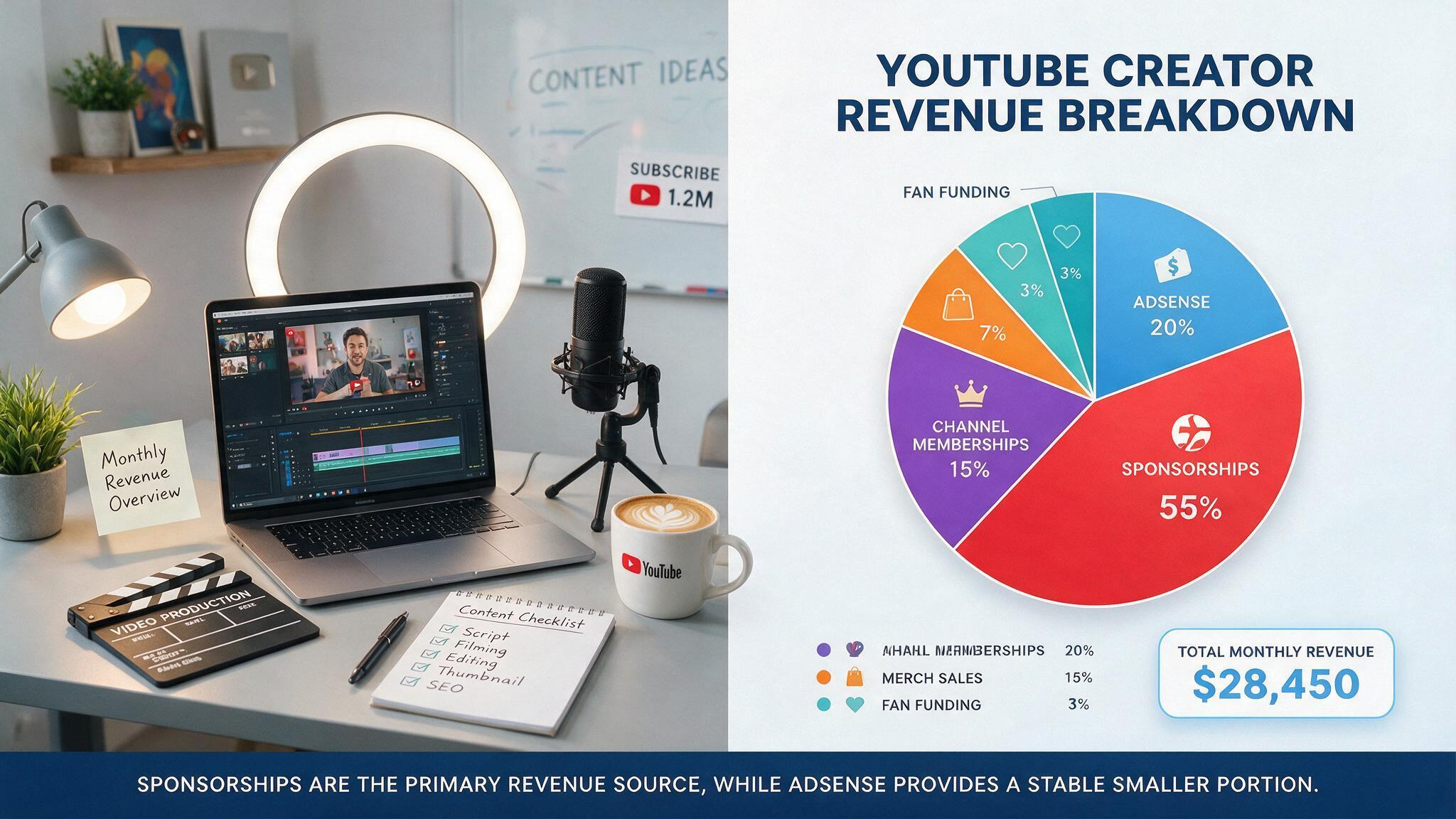
AdSense alone is erratic. Ad blockers, seasonal swings, and demonetization all eat into it. The structure that makes $10k/month sustainable almost always includes multiple streams: channel memberships, affiliate marketing, merch, digital products, super chats, and YouTube Premium revenue (which gets shared based on Premium members’ watch time).
How sponsorships transform the view math
Let’s work the multiplier concretely. Say you’re earning $10 RPM from ads alone. That means $10k requires 1 million views per month. If brand deals multiply your effective per-view income by 2–5x, your combined RPM jumps to $20–$50. Your view target drops to roughly 200k–500k per month — somewhere between one-fifth and one-half of the AdSense-only number.
The creator ceiling makes the point. Graham Stephan and Andrei Jikh have shared AdSense-only RPMs above $30 during peak months, with sponsorships stacked on top. That’s the benchmark, not the guarantee. Sponsorships require audience trust, a media kit, and real pitching work.
They’re not automatic. But the math is unambiguous: AdSense alone is the long road, and diversification is the shortcut.
Real creator benchmarks: from MrBeast to a 20k-sub finance channel
Real-world numbers from creators at opposite ends of the scale show how RPM — not subscriber count, determines the view target for $10k.
What MrBeast’s numbers actually tell us about RPM
MrBeast had 418 million subscribers as of August 2025. He earned an estimated $82 million in 2023 across roughly 46.5 billion views on his main channel. Working backwards, that implies an RPM around $1.76.
Here’s the counterintuitive part: the biggest creator on the platform runs a lower RPM than many small finance channels. His audience is global, with heavy volume from lower-CPM countries. His earnings come from sheer scale, not high per-view value. A finance channel at $25 RPM earns $25,000 per million views — more than MrBeast’s ~$1,760 per million.
The money on YouTube is real. The platform paid out over $70 billion to creators across three years, with roughly $36.15 billion in trailing-12-month ad revenue by early 2026. The pie is enormous. It’s just distributed very unevenly.
Small channel, big RPM: the 20k-sub finance channel example
Now for the encouraging flip side. A finance channel with 20,000 subscribers and 50,000 monthly views at $25 RPM earns roughly $1,250 per month from AdSense alone. To reach $10k at the same RPM, that channel needs 400,000 views per month.
The key insight: subscriber count is not the primary earnings driver. Niche and RPM matter more. LegalEagle works the legal niche at high CPMs. Food creators like Joshua Weissman and Nick DiGiovanni generate seven-figure annual revenue at scale despite mid-range CPMs. The numbers check out for creators who’ve publicly shared them — and the pattern holds across the board.
Actionable steps to improve RPM without changing your niche
You don’t need to abandon your niche to move the needle. These moves each have a specific mechanism behind them:
- Make videos over 8 minutes to unlock mid-roll ads. Place manual ad slots every 1–2 minutes at natural breaks instead of relying on auto-placement. This can double or triple ad impressions per view.
- Optimize for Connected TV viewing. CTV ads pay 2–3x more than mobile or desktop. Clear visuals and horizontal aspect ratio matter here.
- Choose high-value sub-topics within your existing niche. “Best Roth IRA for 2026” versus “budgeting tips” can be a ~4x CPM difference inside the same finance channel.
- Publish high-effort videos in Q4. The same video can earn roughly 2x in December versus January. Plan your content calendar around it.
- Keep content advertiser-friendly. PG-13, evergreen, non-controversial content gets better CPMs. Content targeting children earns less.
- Target Tier-1 countries through topic choice, titling, and subtitles or translation. Geography is a multiplier you can influence.
- Improve audience retention. Longer watch time means more mid-rolls actually get viewed.
- Check your monetizable-view rate in YouTube Studio. Raw view counts will fool you if you don’t account for the impression gap.
Your personalized path to $10k/month
The range is 200,000 to 200 million views per month. The four levers that move the number down: a high-CPM niche, a Tier-1 audience, long-form with mid-rolls, and Q4 timing. Add sponsorships, and you can cut the view target by 60–80%.
Here’s your repeatable method:
- Check your actual RPM in YouTube Studio under the Revenue tab. That’s your baseline.
- Find your niche’s CPM range using the data in this article.
- Use the central table to set a baseline view target, then apply the multipliers — niche, geography, format, seasonality, sponsorships, to make it personal.
$10k/month is achievable. But it’s a math problem, not a lottery ticket. The creators who hit $10,000/month consistently didn’t stumble into it — they understood exactly which metric mattered and engineered their content around it. Now you have the same toolkit. Go find your number.
