
I was digging into the architecture of a modern vehicle the other day—something that starts with a battery or a fuel tank but ends with over a hundred million lines of code running across centralized compute clusters. And it hit me: the mechanical stuff is still there, The brakes still clamp, the suspension still absorbs bumps, the steering rack still turns wheels. But the soul of the vehicle now lives in the software stack. That changes everything about how you build it, sell it, secure it, and make money from it—and if you’re a CTO, CFO, or enterprise architect at a traditional OEM, it changes what you should be prioritizing right now.
The center of gravity for value, risk, and competitive differentiation has shifted from the metal to the code. Market forecasts put the software-defined vehicle space somewhere in the $1.5 trillion to $2.4 trillion range over the next decade, with compound annual growth rates north of 25%, per projections from multiple research firms. That’s the whole game.
Key Takeaways
Market forecasts for software-defined vehicles range from $1.5 trillion to $2.4 trillion over the coming decade, with compound annual growth exceeding 25%
The organizational failure pattern known as “decision latency” blocks critical OTA updates when legacy approval calendars designed for annual hardware cycles can’t keep pace with software’s real-time needs
Table of Contents
The Mental Pivot — Why Software Now Defines the Car
Here’s the concrete architectural change that makes this unavoidable. A modern vehicle isn’t a bunch of isolated electronic control units (ECUs) each running its own little firmware program anymore. That was the old pattern—dozens of discrete controllers, each handling one function, rarely talking to each other. Now you’ve got centralized compute domains replacing all those discrete controllers. You’ve got a networked platform with sensors everywhere, running hundreds of millions of lines of code across multiple software layers, all connected to the outside world.
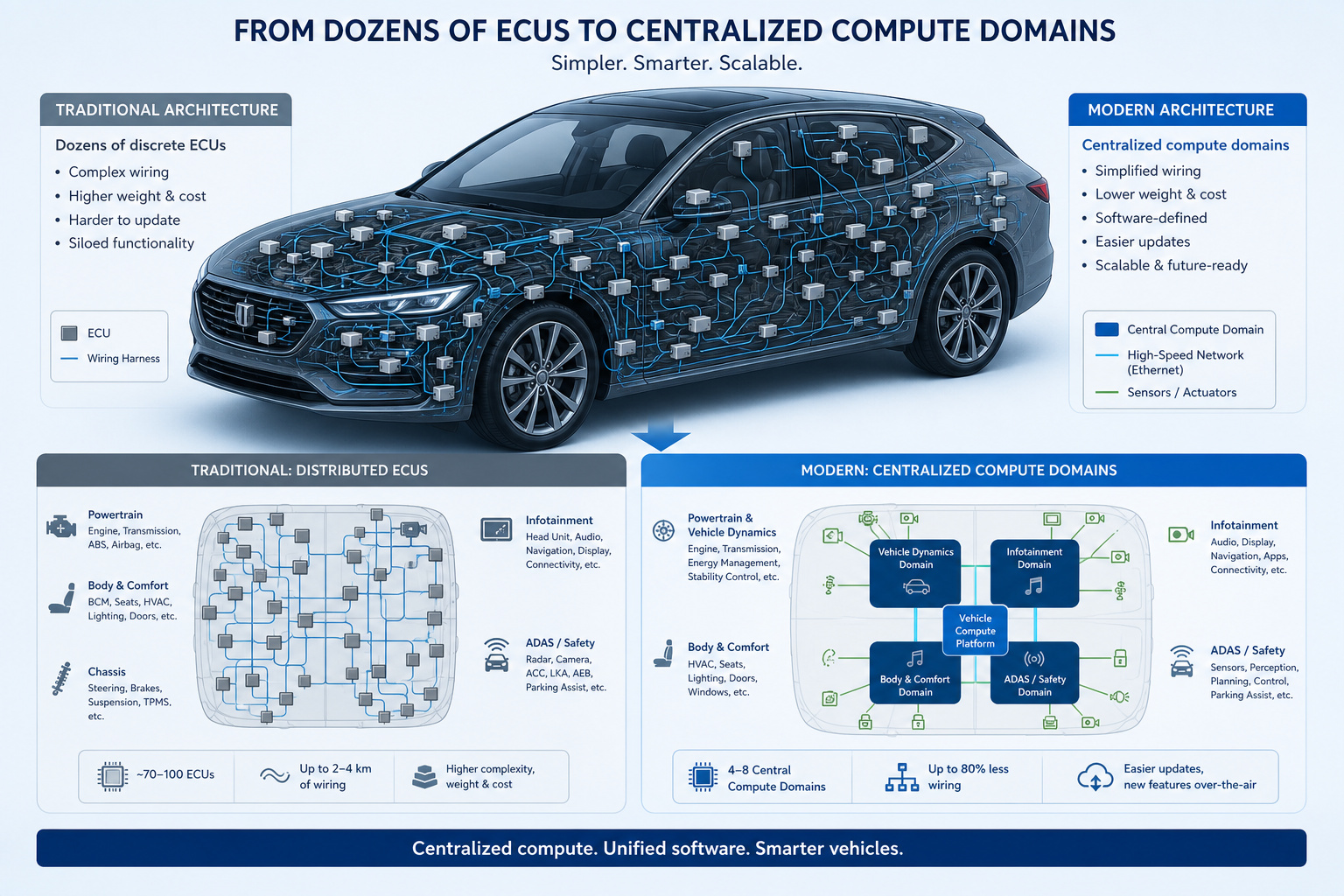
That hardware-architecture pivot makes the software transformation structural, not optional. You can’t go back to discrete ECUs any more than you can go back to a flip phone. The vehicle is now a distributed, real-time computing system with wheels. And that means the money, the risk, and the differentiation all live in the software.
For CTOs, this reframes what architecture decisions matter. For CFOs, it reframes where capital gets deployed and how revenue gets recognized. For enterprise architects, it reframes what governance frameworks actually protect the business.
When the Car Becomes a Continuously Evolving Platform
Two changes follow from that architectural shift, and they hit your operating model from different angles.
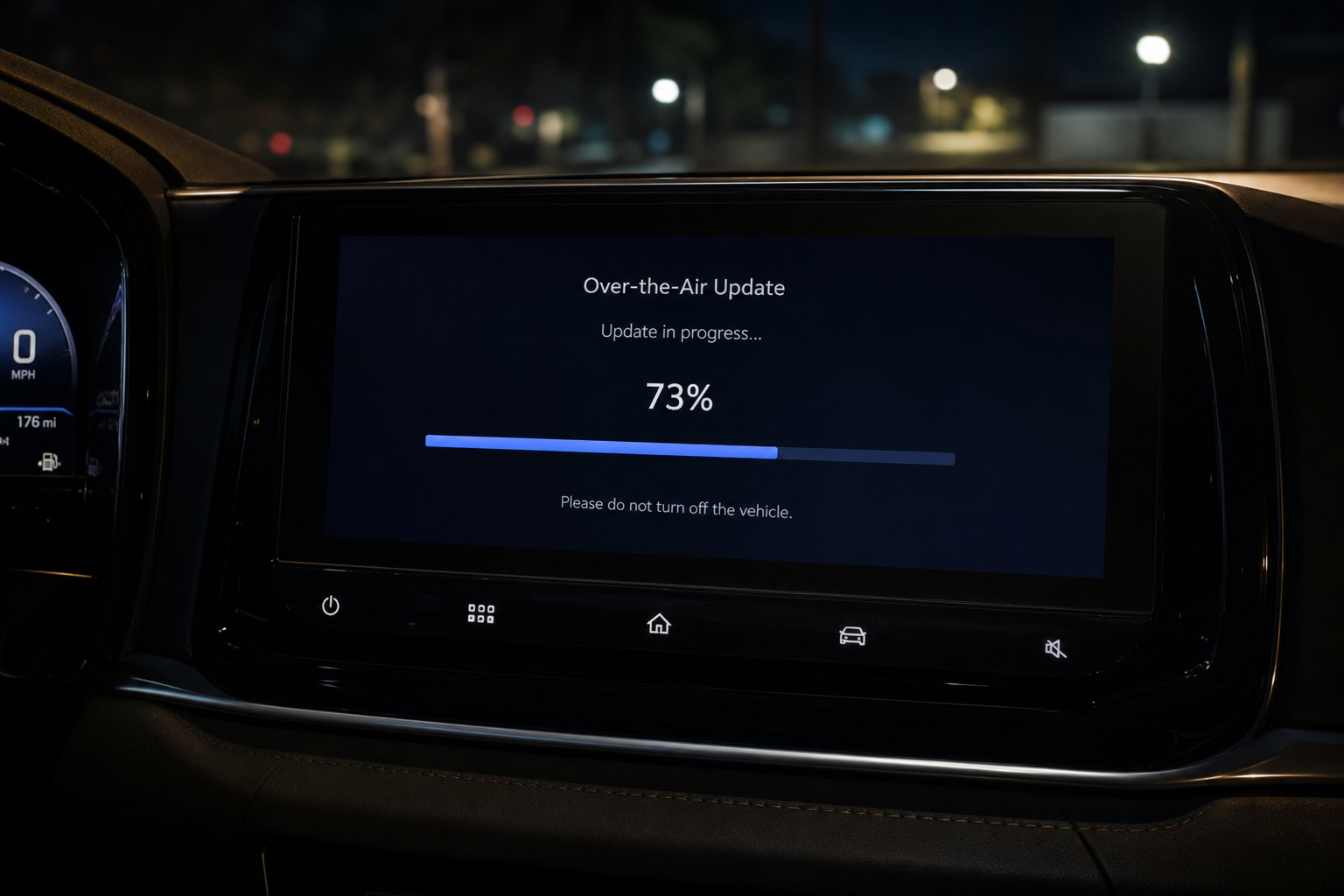
Lifecycle orientation — software is never “done”
Once you ship a car with centralized compute and over-the-air update capability, you’re not selling a finished product. You’re launching a platform that will need firmware updates, safety algorithm revisions, connectivity stack patches, and user feature additions for years—potentially a decade or more. Managing that looks less like running a production line and more like running a cloud service.
The vehicle’s software is never in a “done” state. With mechanical parts, you design, test, manufacture, and ship. With software, you design, test, ship, and then keep designing, testing, and shipping for the entire life of the vehicle. Every component that can be updated will need updating—and some of those updates are safety-critical, not just “hey here’s a new UI theme.”
Value capture models — from one-time sale to recurring streams
Software upends that. Subscriptions for premium features, pay-per-use unlocks for performance capabilities, connected data services—none of these fit the legacy revenue recognition framework.
This forces CFOs into unfamiliar territory. You’re now amortizing software platform costs over a 10-15 year product lifespan while trying to model recurring revenue streams that don’t have the same predictability as a hardware sale. The old mental model of “depreciate the metal, count the cash” doesn’t work anymore. CFOs and product owners need to rethink depreciation, revenue recognition, and cost amortization across what may be a 10-15 year product lifespan.
Economic Reality — The Margin Trade-Off Many Leaders Miss
Here’s where well-intentioned strategies stumble. Hardware margins compress over time—that’s just the nature of mechanical manufacturing at scale. Software services can carry higher margin profiles. But realizing those margins requires operational sophistication and governance that many OEMs have yet to master.

I see this pattern: a CFO looks at the market forecasts, sees the multi-trillion dollar numbers, and decides to pump investment into software capabilities expecting automatic margin expansion. But the spending is shifting from mechanical sourcing to software platforms, data infrastructure, security stacks, and integration tooling. If you treat that as cost center bloat rather than a fundamental shift in cost structure, you’ll underinvest in exactly the capabilities required to capture those higher margins.
The field-pattern mistake goes like this: a CFO who’s spent their career amortizing hardware capital expenses over years sees a multi-million dollar data infrastructure investment and immediately flags it as “IT bloat.” Meanwhile competitors who understand that data infrastructure is the foundation for recurring revenue streams are building the systems that will deliver those higher margins three years from now. The trade-off is real: hardware margins compress, software margins are higher but require mastery of governance, and the window to build that mastery isn’t infinite.
Organizational Barriers — Incentive Misalignment and Decision Latency
This is where the rubber meets the road—and where most articles wave their hands about “legacy structures.” Let me name the specific failure pattern: decision latency.

The cadence clash — hardware cycles vs. software cycles
Mechanical and electrical engineering teams operate on fixed project cycles; software teams operate on iterative cycles closer to SaaS delivery. These rhythms rarely align without intentional governance. Leaders often underestimate how deeply existing budget cycles, performance metrics, and incentive structures are tied to hardware rollouts rather than software agility.
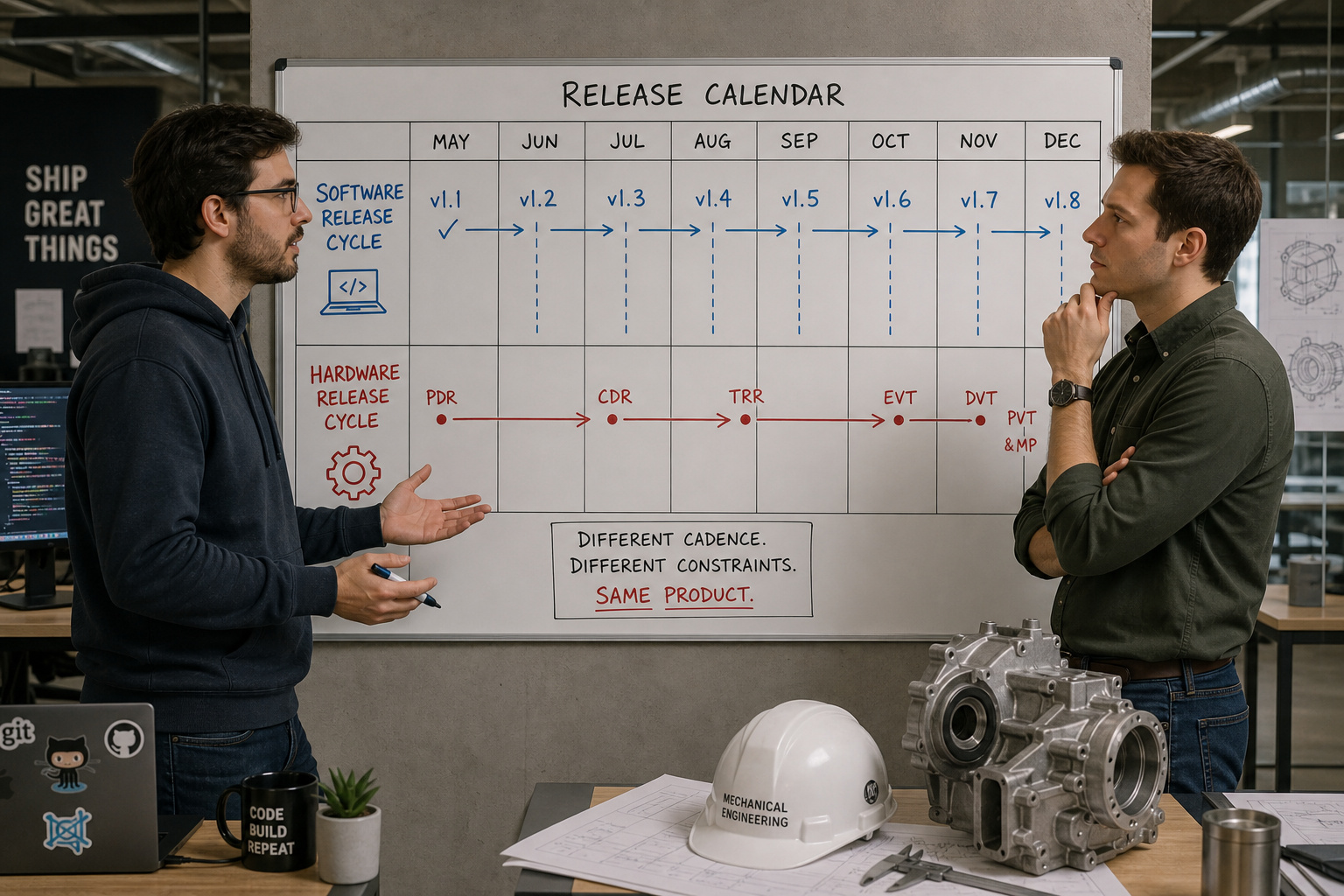
You can’t just tell a mechanical engineering team to “be more agile” and expect it to work. Their entire operational reality is built around annual or multi-year release cycles. The software team wants to push updates weekly. These two worlds can coexist, but it requires intentional governance design that most orgs haven’t built.
Two concrete examples of decision latency
Here’s what decision latency looks like in practice.
First, compliance anxiety. Engineering leadership may hesitate to authorize rapid deployment of OTA updates due to compliance anxiety. The approval process was designed for hardware change requests that happen once a year. The compliance committee meets monthly.
The patch sits in queue while the fleet stays vulnerable. That’s not real-time risk mitigation—it’s a bottleneck built into the org chart.
Second, finance resistance. Finance may resist capitalizing on software capabilities that cannot be directly tied to discrete revenue events. A product team wants to invest in a software capability that enables future feature unlocks and data monetization. But finance can’t tie it to a discrete revenue event in the current fiscal year—a challenge reminiscent of the risks in PCP car finance, where opaque PCP compensation structures prior to January 2021 allowed dealers to set interest rates, potentially costing customers more. So the investment gets deprioritized, even though it would unlock years of recurring revenue.
The root cause in both cases isn’t lack of talent or bad intentions. It’s organizational design that hasn’t caught up with the architectural shift. The incentives, metrics, and decision-making processes were built for a hardware world, and they’re actively blocking the software world from operating effectively.
Technology Trade-Offs — Architecture, Safety, and the Limits of Generic Agile
You can’t talk about software-defined vehicles without acknowledging the stakes. We’re talking about hundreds of millions of lines of code running on a networked platform that controls safety-critical functionality. A bug in your mobile app costs you some users. A bug in a vehicle’s braking algorithm costs lives.
The scale and stakes of software complexity
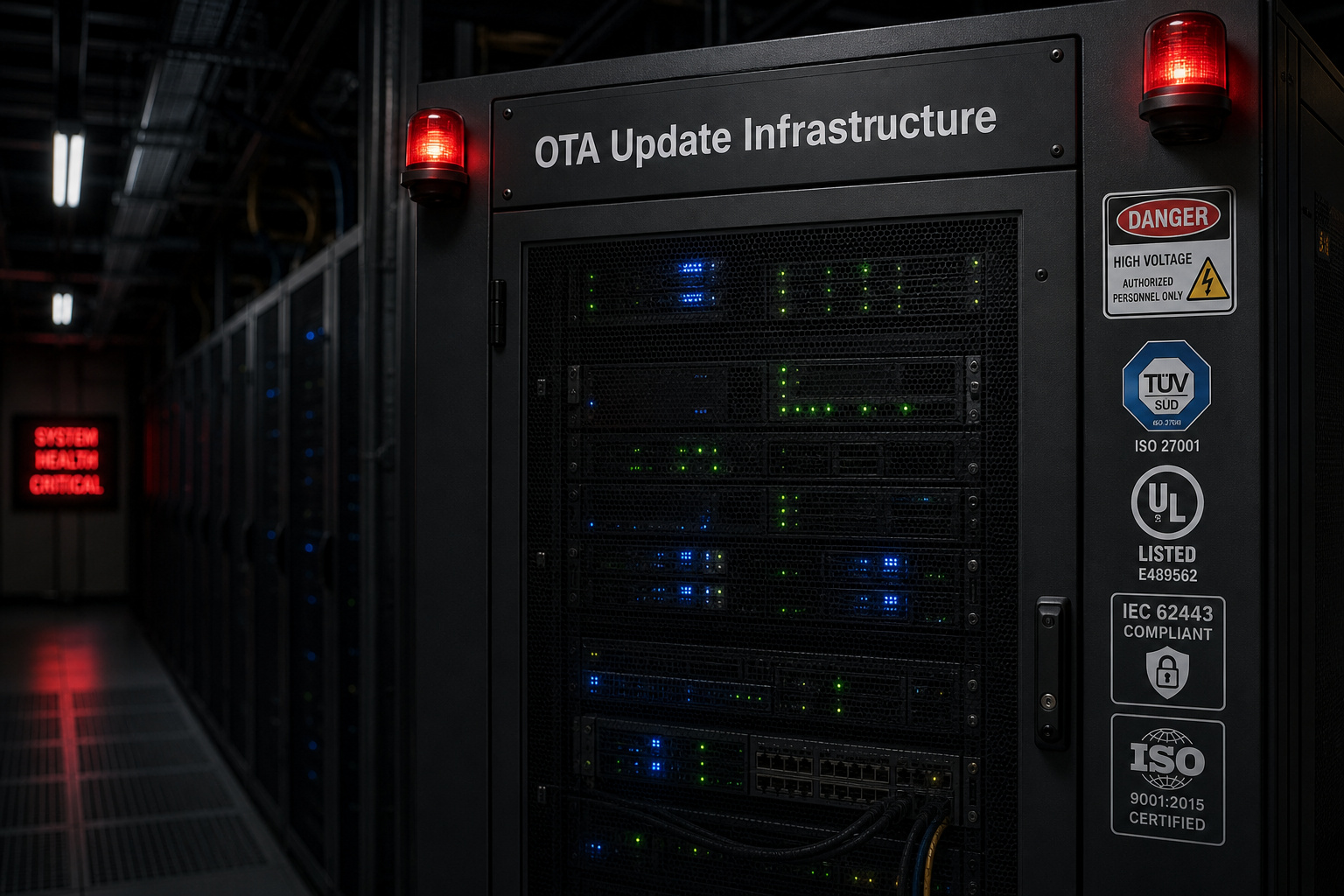
That scale of code, on a platform that can be updated remotely, creates specific risks: higher integration costs, increased testing and verification overhead, regulatory scrutiny from agencies that weren’t designed for continuous deployment, and a dramatically expanded attack surface. Every vehicle with OTA capability is a remote endpoint that needs authentication, patch validation, telemetry analysis, and compliance tracking.
This isn’t just a security problem. It’s a governance problem. The OTA mechanism itself creates new responsibilities that didn’t exist when vehicles shipped with fixed firmware. Each update cycle requires coordination across safety engineering, security operations, regulatory compliance, and customer communications. That’s a lot of moving parts for an industry that’s used to annual model refreshes.
Why domain-specific risk frameworks matter more than generic agile
Here’s the uncomfortable truth that agile transformation consultants don’t want you to hear: generic agile adoption is insufficient for automotive software. You can’t just adopt generic ‘agile’ adoption; it requires domain-specific risk frameworks that understand automotive regulatory regimes and real-time operational liabilities.
This is where the “move fast and break things” mentality breaks down entirely. Automotive software requires explicit governance models that balance rapid feature delivery with deterministic safety obligations. You need frameworks that understand what ISO 26262 means for your CI/CD pipeline, how ASPICE applies to your continuous delivery governance, and why a failed OTA update isn’t the same as a failed app store deployment.
Talent Constraints — It’s Not a Quantity Problem, It’s a Hybrid Profile Gap
There is no shortage of software talent in the market. You can find competent developers, DevOps engineers, and systems architects without much trouble. So why does every automotive OEM complain about hiring?
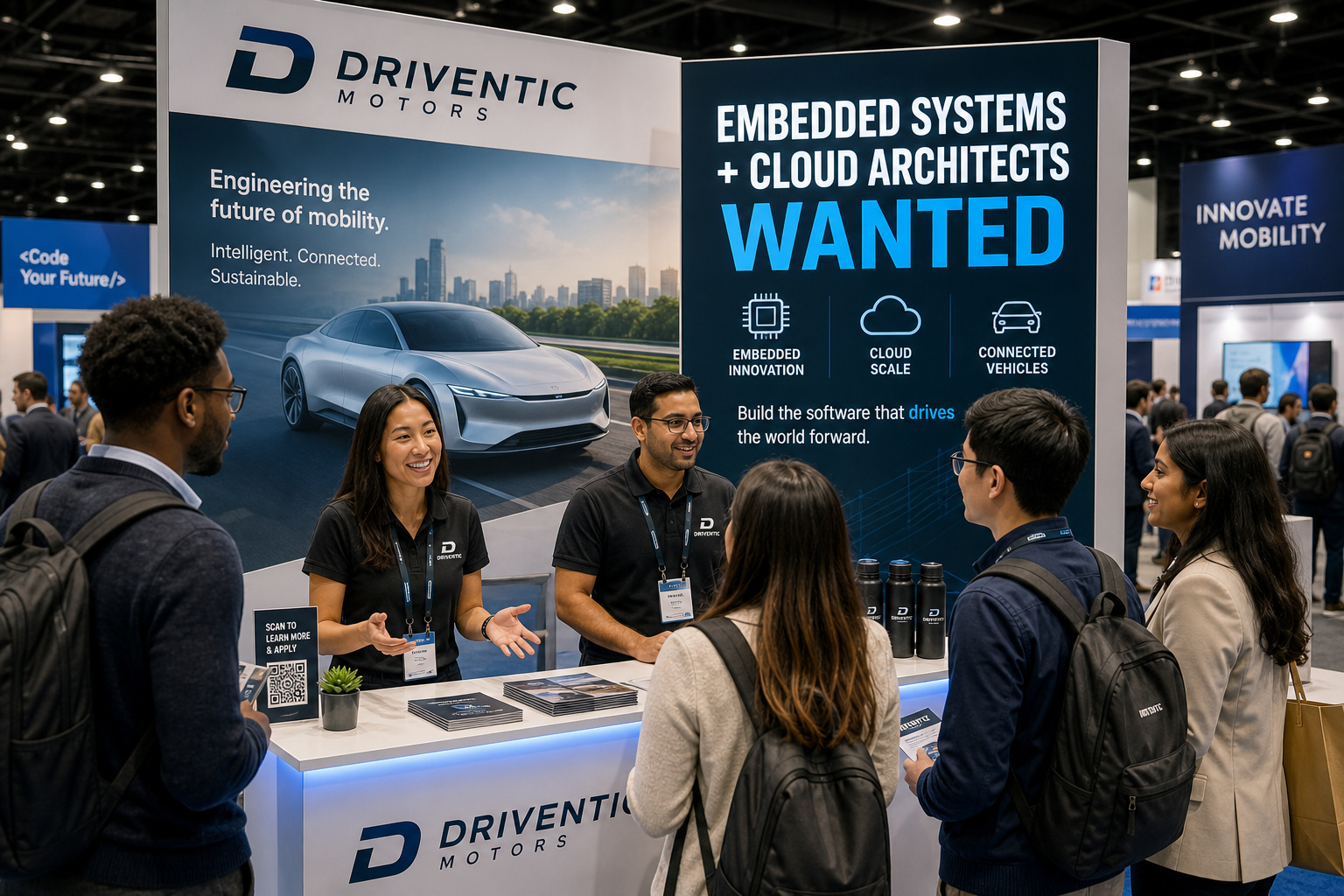
Because the gap isn’t in general software talent. It’s in a very specific hybrid profile: professionals who understand embedded systems and large-scale distributed computing. Those two skill sets rarely overlap. People from consumer mobile or web backgrounds lack understanding of real-time safety constraints and hardware interface demands. Traditional automotive engineers often lack experience with automated testing, telemetry-driven quality, and continuous delivery governance.
You can hire a cloud architect who’s never thought about what happens when a safety-critical system loses connectivity. You can hire a veteran automotive engineer who’s never written an automated test suite. The real constraint is relevant automotive software expertise that understands both embedded systems and large-scale distributed computing.
External partnerships with cloud providers, OS vendors, and middleware specialists can accelerate capability building. But they introduce dependency risk that requires strong vendor governance—another capability most OEMs haven’t had to develop. The workforce profile you need blends software engineering rigor with deep understanding of controlled physical systems, and those people are expensive, hard to find, and harder to retain.
Competitive Consequences — Who Wins and Who Loses
Companies with software DNA are better positioned to capture long-term value; organizations that treat software as an afterthought face a structural disadvantage. You can see it in the emerging mobility firms, regional players that have built strong digital units, and OEMs that restructured themselves around software platforms rather than treating software as an engineering department.
The differentiation comes from what happens after the vehicle leaves the factory. The ability to iterate on features and safety through OTA updates. The ability to monetize data, services, and subscriptions. The ability to reduce fleet-wide operational costs through remote diagnostics and predictive maintenance.
These aren’t just technical advantages—they’re economic and organizational. The companies that can do this well will have fundamentally different cost structures and revenue profiles.
They’re maintaining legacy engineering practices alongside aspirational software units, and the friction between the two creates inefficiencies, missed milestones, and unresolved governance questions. It’s also risky to overstate how easy this transformation is. The companies that succeed won’t be the ones that hired the most developers—they’ll be the ones that fundamentally restructured their operating model.
Ownership, Data, and the Future of the Customer Relationship
As vehicles become software platforms, the customer relationship shifts from a one-time transaction to a continuous service. That raises questions that go beyond engineering and finance.
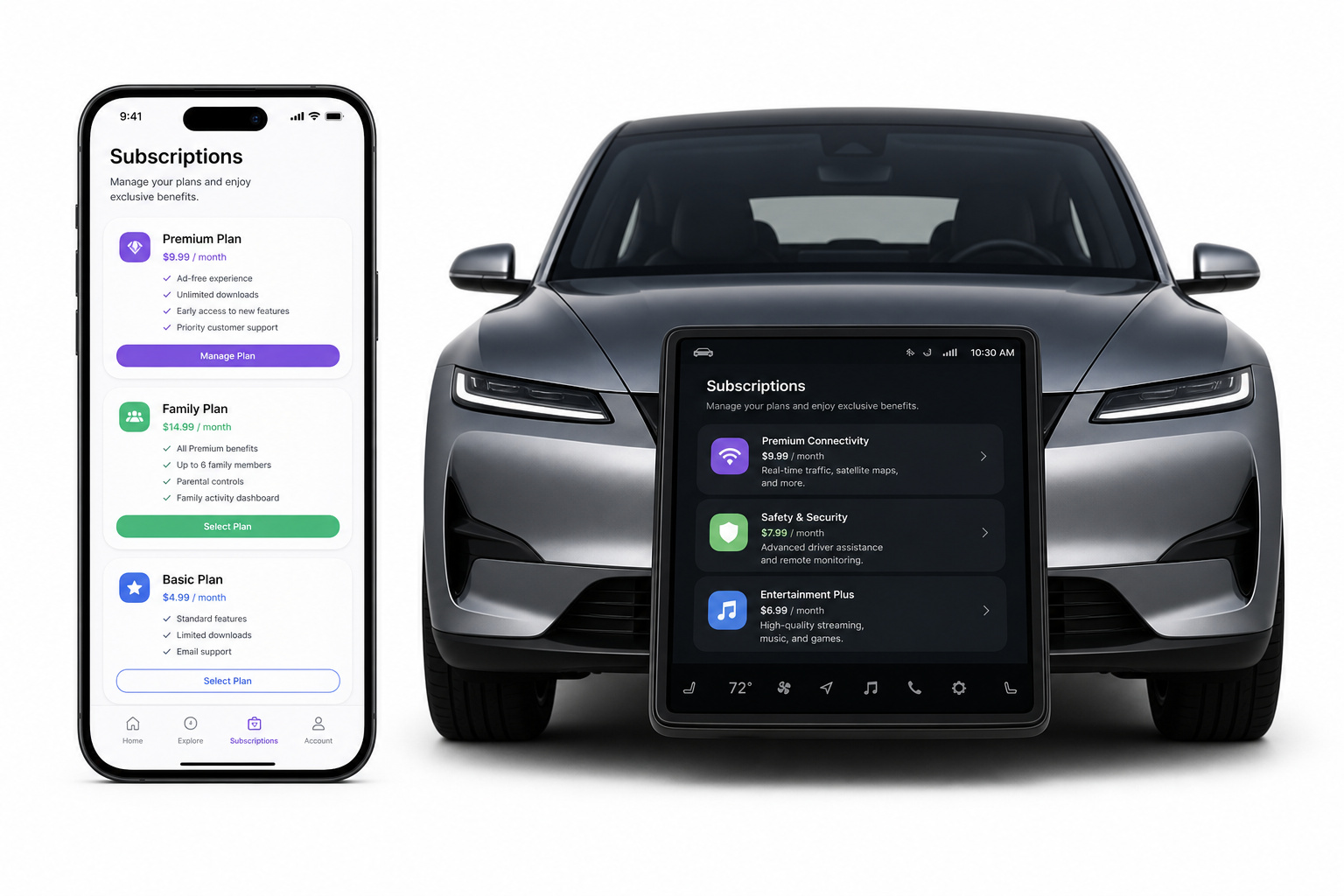
From ownership to licensing
There’s a thread on Reddit that captures this beautifully. The post author, /u/heartsmithereen, asks whether future generations will truly own their vehicles or merely license access to them. It’s not a rhetorical question. Look at what happened to smartphones: you buy the device, but the services that make it useful come with ongoing charges. Cars are heading the same direction.
A commenter, /u/EntropyReversale10, draws the parallel explicitly: like phones, vehicles will have built-in obsolescence and ongoing charges for services that used to be paid for upfront. Another commenter, /u/01Cloud01, suggests that if manufacturing and maintenance costs decrease through robotics and battery technology, the subscription model becomes even more attractive.
The implication is that without continuous updates, these vehicles become outdated, vulnerable, or incompatible. Ownership may eventually mean maintaining both the physical vehicle and its digital infrastructure. That’s a fundamentally different relationship between manufacturer and customer than the one that’s existed for a century.
The data question — who owns and who profits?
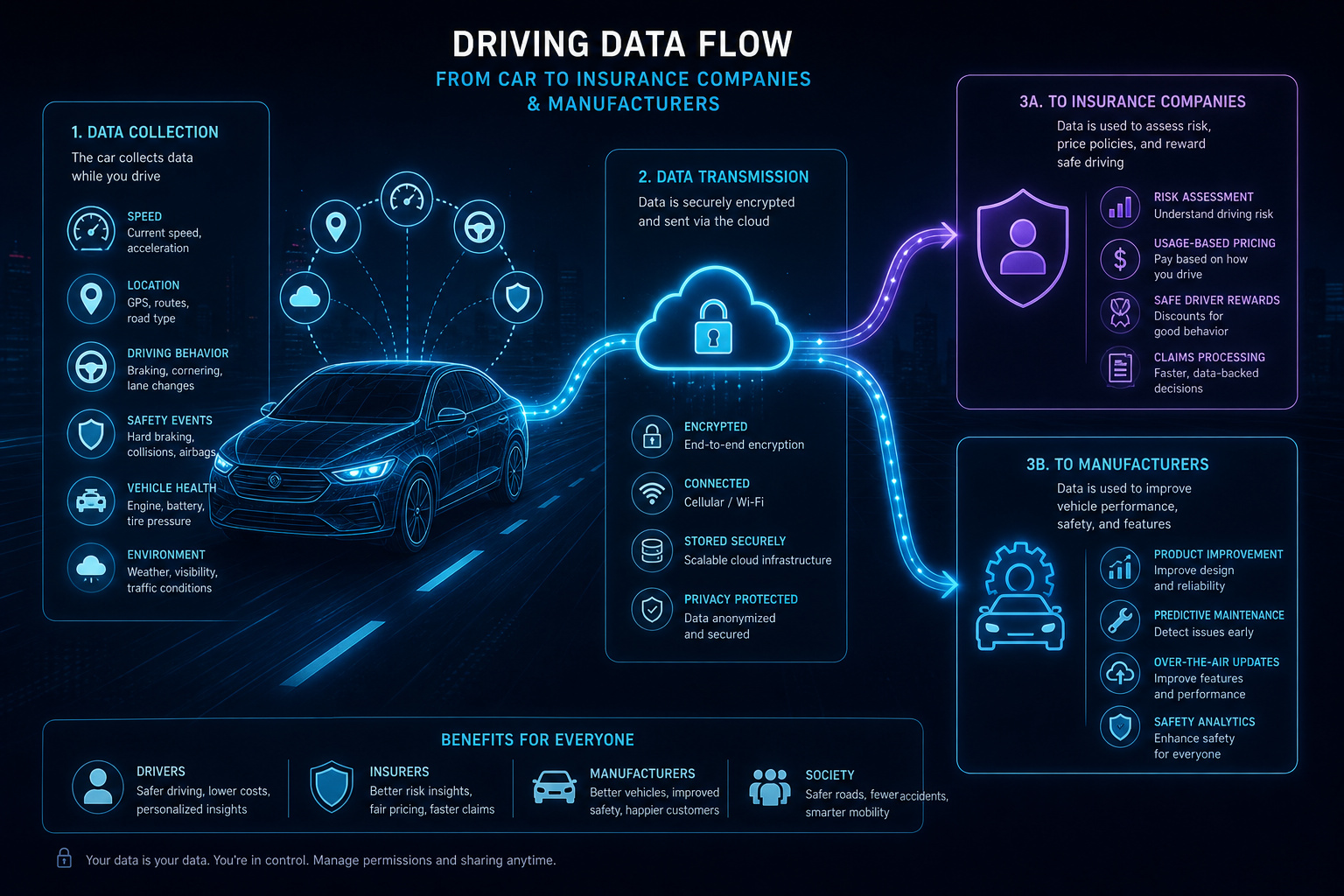
Modern vehicles collect enormous amounts of data. Where you drive, how you drive, your acceleration and braking patterns, sometimes even what you say inside the cabin. That data can be analyzed, shared, sold, or leveraged in ways most consumers don’t fully understand.
Insurance companies want it. Manufacturers want it. Service providers and tech partners want it. The more connected vehicles become, the more important it becomes to ask who owns the information and who profits from it. This isn’t a theoretical question—it’s an emerging cultural and regulatory battleground that enterprise leaders need to address before it becomes a crisis.
Reframing the Enterprise Decision Lens
If vehicles are fundamentally software products with wheels that evolve continuously, leaders need to adjust how they think about four things.
Value measurement shifts from discrete product sale revenue to lifetime software and service monetization. The sale of the vehicle becomes the beginning of the revenue relationship, not the end.
Risk assessment expands dramatically to include cybersecurity, OTA governance, data privacy obligations, and safety certification cycles that run continuously rather than at model launch.
Organizational design needs to move beyond traditional mechanical engineering cultures to blended digital-physical delivery models where software and hardware teams share governance, incentives, and release cadences.
Finance and operating models evolve to prioritize recurring revenue streams and long-term software platform investment over the capital-expense, multi-year amortization approach that dominated the old world.
A New Lens for Car Leadership
Cars are no longer static machines assembled once and shipped. They’re living, evolving software platforms that demand continuous governance, operational maturity, and strategic investment throughout a multi-year lifecycle.
The question for enterprise leaders is no longer “Will we build software?” That decision was made years ago, whether anyone acknowledged it or not. The real question is: “How do we operationalize, govern, and extract value from software throughout a vehicle’s entire lifespan?”
Leaders who adopt that lens will be better aligned with the market economics, enterprise risk profiles, and organizational incentives that actually define this industry now. Those who cling to outdated mechanical metaphors—who still think in terms of engines, drivetrains, and annual model refresh cycles—are at genuine risk of misallocating capital, talent, and strategic focus.
That’s an outcome no enterprise can afford in an era where software defines the product more than the vehicle that carries it.
Frequently Asked Questions
How does over-the-air updating change car ownership?
OTA updates transform the car from a static product into a continuously evolving platform. Owners get ongoing feature additions, safety algorithm revisions, and security patches throughout the vehicle’s 10-15 year lifespan, but it also means the car can become outdated or vulnerable if updates stop. The relationship shifts from a one-time purchase to an ongoing service relationship.
Is the subscription model inevitable for cars?
The architectural shift toward centralized compute and OTA capability makes subscription and pay-per-use models structurally possible and economically attractive—market forecasts put the software-defined vehicle space at $1.5-$2.4 trillion over the next decade. As manufacturing and battery costs decrease, the subscription model becomes even more viable, though it raises real questions about whether future owners will truly own their vehicles or merely license access to them.
What’s the difference between a software-defined vehicle and a traditional car?
Traditional cars rely on dozens of discrete electronic control units, each running isolated firmware, with fixed functionality that never changes after leaving the factory. Software-defined vehicles use centralized compute clusters running hundreds of millions of lines of code across networked layers, enabling continuous updates, remote diagnostics, and feature monetization—the car becomes a distributed, real-time computing system with wheels.
How much data do modern connected cars collect?
Modern vehicles collect enormous amounts of data—where you drive, how you drive, acceleration and braking patterns, and sometimes even what you say inside the cabin. This data is valuable to insurance companies, manufacturers, service providers, and tech partners, creating an emerging regulatory and cultural battleground over who owns the information and who profits from it.
Why can’t automakers just hire more software engineers to fix their problems?
The talent gap isn’t about quantity—it’s about a specific hybrid profile of professionals who understand both embedded systems with real-time safety constraints and large-scale distributed computing. Those two skill sets rarely overlap. Cloud architects don’t think about what happens when a safety-critical system loses connectivity, and traditional automotive engineers often lack experience with automated testing and continuous delivery governance.