Long ago, I owned a self-defense umbrella from a manufacturer that has apparently since gone under. Thankfully, I never had to use it, and now I’m researching a current kit from scratch rather than pulling recommendations from a tested arsenal.
Choosing personal protection when you work from the road means solving three constraints at once: flight carry rules, changing border laws, and tight pack space around your work hardware. Police officers often point out that when things go bad, the most important tool is whatever is already in your hand. Disguised non-lethal weapons hidden as ordinary items give you the element of surprise because nobody suspects what you’re carrying.
A nomad kit splits into two tiers: an in-cabin carry-on kit that stays in your hand during transit, and a destination kit that rides in checked luggage.
Key Takeaways
The Transportation Security Administration (TSA) relegates 7 self-defense weapon categories to checked luggage and allows only 5 items in carry-on bags. Sources conflict on whether tactical pens can fly in the cabin or must be checked.
Walmart sells cat-ear keychains even though Texas banned them until recently under threat of heavy fines and jail time. California, Texas, Illinois, Michigan, and Vermont also ban brass-knuckle-type tools, so store shelves never prove a tool is legal.
Six-month nomad travel and medical insurance runs $257 to $830 across sample plans for a 30-year-old traveler, covering gear theft and emergency healthcare, while offering zero liability coverage if you use a weapon in a self-defense incident.
Table of contents
Table of Contents
What can fly in carry-on vs checked luggage
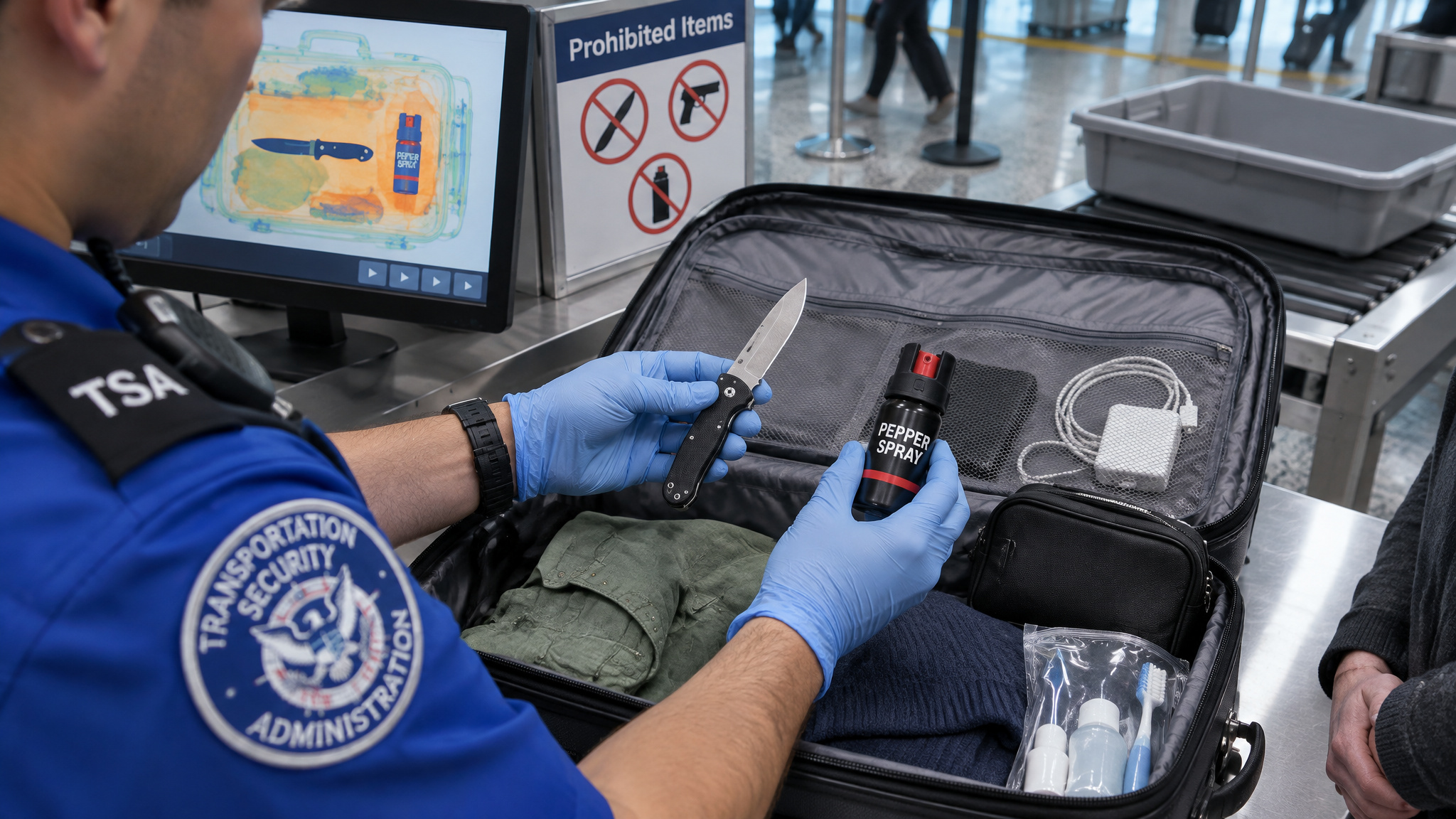
The TSA draws a sharp line here: 7 weapon categories are cleared for the cargo hold, while only 5 self-defense items are allowed in the cabin. Most dedicated self-defense weapons have to fly in checked luggage, which makes them inaccessible and useless if an assault happens while your bag is locked away. Travelers routinely buy a tool mid-trip, toss it into the wrong bag without checking the rules, and lose it at the security checkpoint.
The 7 TSA checked-luggage categories
When you check a bag, the TSA permits seven specific categories of self-defense tools in the hold:
- Stun guns
- Pepper spray
- Knives
- Kubatons
- Tactical gloves
- Tasers
- Tactical flashlights
Whatever you pack, never conceal a self-defense weapon from customs or airport security.
The 5 carry-on items and disguised everyday tools
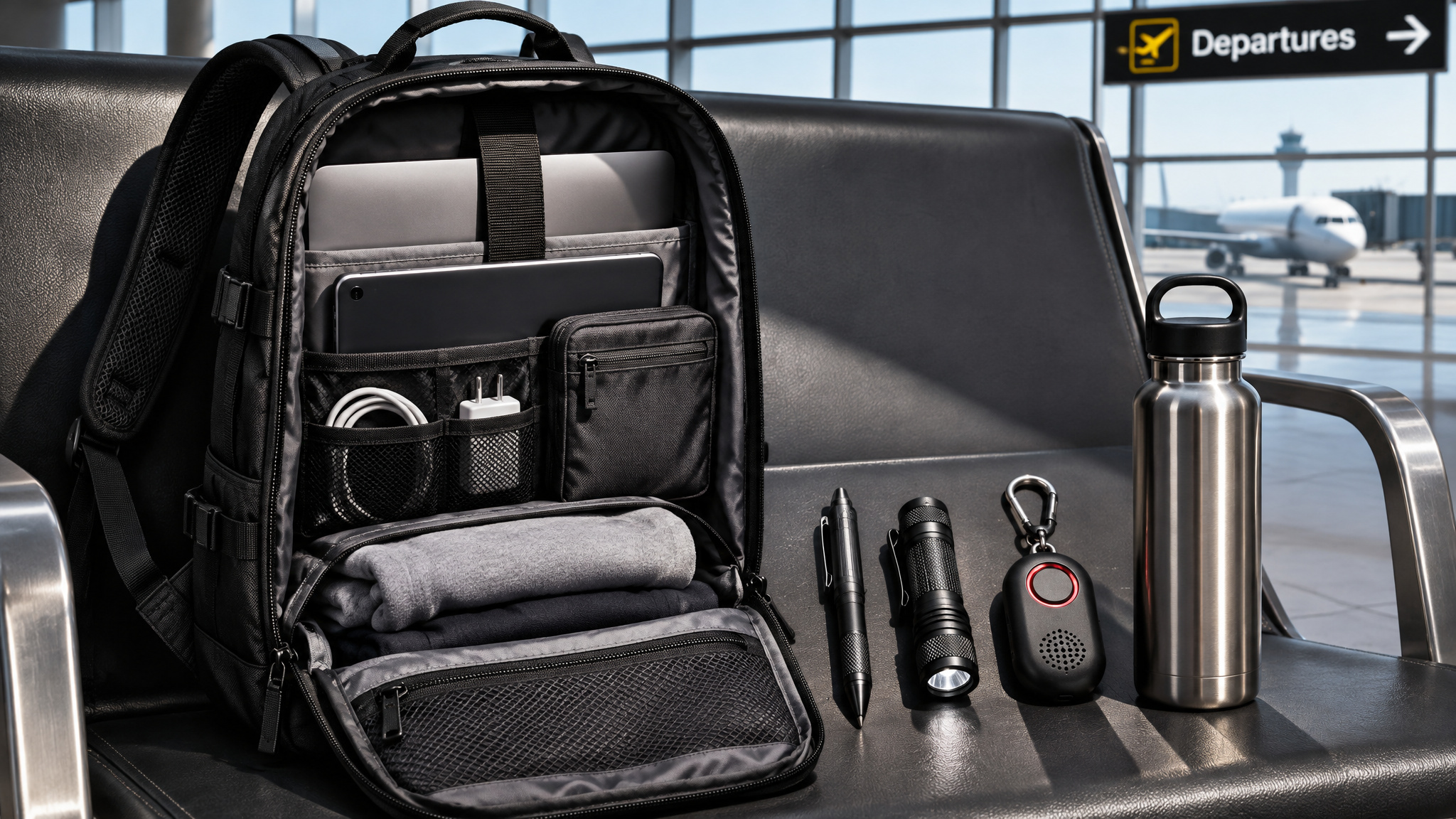
Airports allow five self-defense items inside carry-on bags: a tactical pen, an umbrella, a tactical chain, a steel wrist bracelet, and a rolled-up magazine. Non-lethal disguised tools also transition smoothly across car, bus, train, and plane travel because they function as ordinary daily gear until you need them.
The legality trap: retail availability is not a legality signal
Pepper spray, Tasers, knives, and firearms aren’t universally legal across US states or international borders, because state and local weapon laws vary and change constantly. You can run into serious legal trouble just transiting a state with strict gun laws, and US-focused rulebooks don’t establish weapon legality across international borders at all, so you have to research your specific destination before packing any tool.
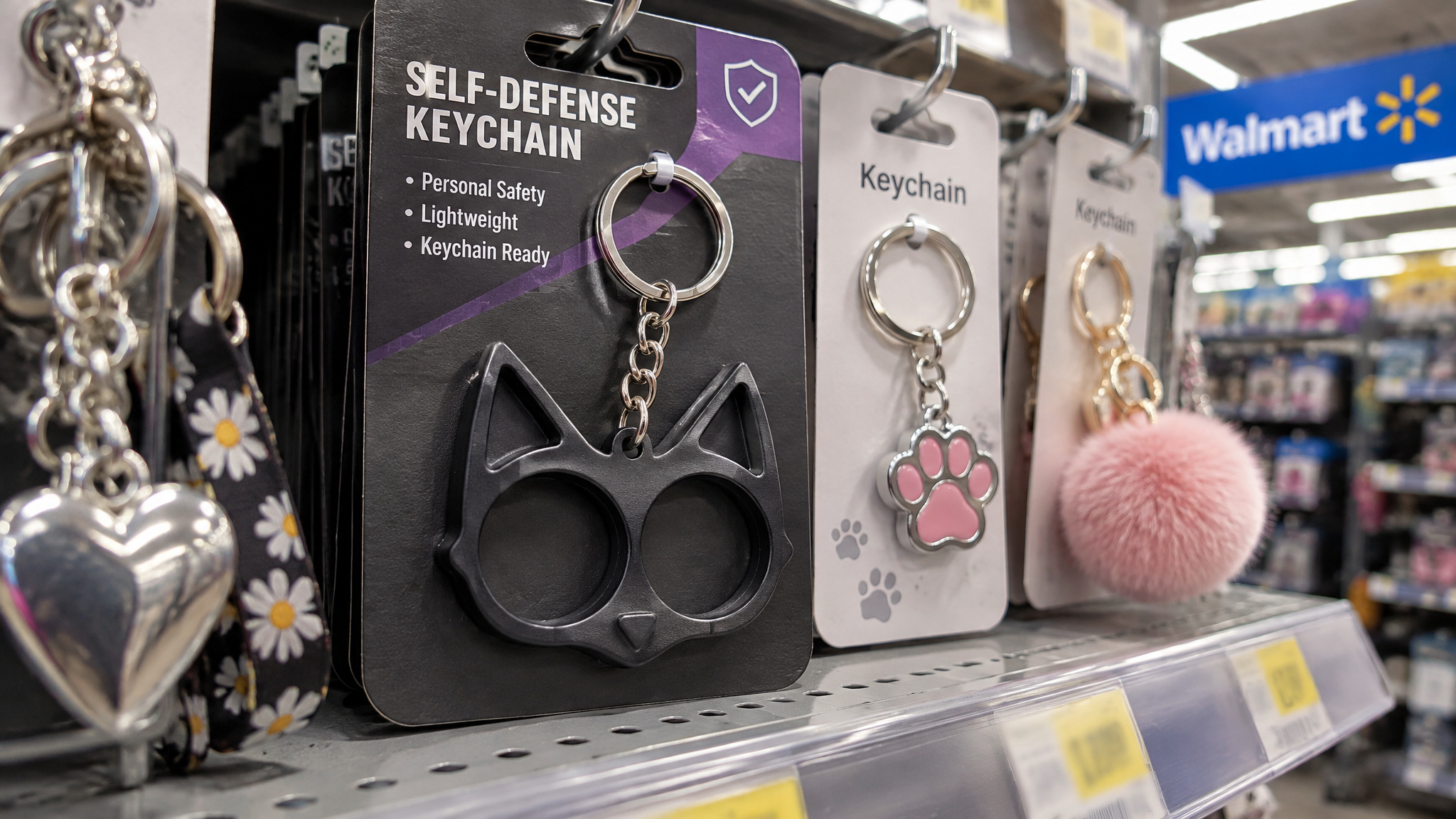
Buyers routinely spot keychain weapons on major retail shelves, assume they are legal everywhere, and only find out after landing that their destination bans them. Some self-defense keychains are shaped like cats with pointed ears and finger holes for raking and clawing, while others are baton-shaped for striking. Because they’re close-range tools, you need to pick one with a comfortable grip and practice striking with it, while keeping up with state and local keychain laws that change regularly.
Texas declared cat-shaped self-defense keychains illegal until recently, backing the ban with hefty fines and possible jail time, even while Walmart sells cat-ear self-defense keychains right off the shelf. Those pointed-ear strikers also collide with state bans on brass-knuckle-type weapons, which are illegal in at least five states: California, Texas, Illinois, Michigan, and Vermont.
Vendor product pages make this trap worse. The Munio keychain is designed by a self-defense expert and carries endorsements from police, martial arts, and military professionals. Its seller claims it’s legal in all US states and TSA-friendly, a claim that falls apart the moment you check actual state keychain bans and airport rules.
| Tool or Category | Airport Rule | Documented State & Retail Contradictions |
|---|---|---|
| Cat-ear self-defense keychains | Checked luggage only | Sold at Walmart, yet illegal in Texas until recently with hefty fines and possible jail time |
| Brass-knuckle-type tools | Checked luggage only | Illegal in at least California, Texas, Illinois, Michigan, and Vermont |
| Munio kubotan keychain | Checked luggage (TSA kubaton rule) | Seller claims 50-state legality and TSA friendliness despite state keychain bans |
| Pepper spray, Tasers, knives, firearms | Checked luggage (specific rules apply) | Governed by changing state and local laws; transiting strict states carries legal risk |
Zero-legal-risk tier: alarms, whistles, apps, and improvised tools
A beginner with no training should carry non-weapon tools like personal alarms, whistles, safety apps, door wedges, and a heavy steel water bottle, because they cross borders with zero legal risk and can’t be turned against you in a scuffle. When you don’t have combat muscle memory, your best move is making noise, blocking doors, or swinging an everyday object that’s already in your hand.
Personal alarm
A personal alarm is a small, lightweight device that clips onto your keys, bag, or belt. In an emergency, it blasts a loud siren designed to scare off a threat and draw the eyes of bystanders. Pick a model that you can trigger quickly without fumbling.
Emergency whistle
An emergency whistle requires no batteries, draws immediate attention, and marks your physical location for anyone nearby. Wear it on a lanyard or necklace tucked under your clothes, and practice grabbing and blowing it under adrenaline until the motion is pure muscle memory.
Safety apps
Safety apps turn your smartphone into a one-tap tool that sends distress alerts, shares your live location, or starts recording video. Pick an app with an interface simple enough to operate under stress, test every feature before you rely on it, and keep your phone battery charged.
Door wedge alarm
For hotels and short-term rentals, a door wedge alarm is a pocket-sized, battery-powered stopper that sets up in seconds. You slide it under the closed door, where it physically blocks entry and triggers a loud alarm if someone tries to force the door open.
Steel water bottle
A steel water bottle has the weight and solid build to work as an inconspicuous improvised striking tool. Because carrying water is part of a normal daily routine, keeping it in your hand or at the top of your bag while walking draws zero attention from security guards or passersby.
Pepper spray: choosing the delivery format
Pepper gel is better than standard pepper spray for windy outdoor use or close quarters because it’s much less likely to blow back into your own face. Both rely on oleoresin capsicum (OC) to target the respiratory system, triggering intense pain, temporary blindness, and heavy coughing, so picking the right canister comes down to how it disperses the irritant.
How OC spray works and format selection
Canisters deliver OC in stream, foam, gel, or spray patterns. While pepper gel resists wind blow-back, the standard spray format gives you maximum coverage and disables an attacker longer because the aerosolized cloud makes breathing difficult. Small canisters slip into a pocket or bag, clip onto keychains, or hide inside defense batons that double as impact weapons.
The Advanced Compact 3-in-1 and disguised formats
If you want more than plain OC, the Advanced Compact 3-in-1 Pepper Spray packs police-strength CS tear gas, UV marking dye, and pepper spray into a single canister. On the disguised side, pen-shaped pepper spray hides neatly inside pockets, purses, or wallets. Its seller claims the tiny pen is powerful enough to bring down a bear, a wild marketing boast offered with zero testing data behind it.
The practice requirement
First-time spray owners routinely carry a canister for months without test-firing it, only to fumble the safety mechanism when their hands shake under stress. Unlocking and aiming takes practice. Mace will hurt you if you handle it poorly, which is why you have to drill your draws and sprays under adrenaline-fueled scenarios. Rebecca Ahn, who writes at Tough Cookie Travel, reports getting sprayed right in the face with mace during practice, and she points to SABRE for recommended options.
Tactical pens: the carry-on workhorse
A tactical pen beats a kubotan keychain for everyday travel self-defense because it works as a real pen, glass breaker, and light while staying in your hand, whereas a kubotan is a single-purpose striking stick relegated to checked luggage. Both tools give you a solid metal grip for close-quarters pressure-point strikes, but only the pen disguises itself as office gear.
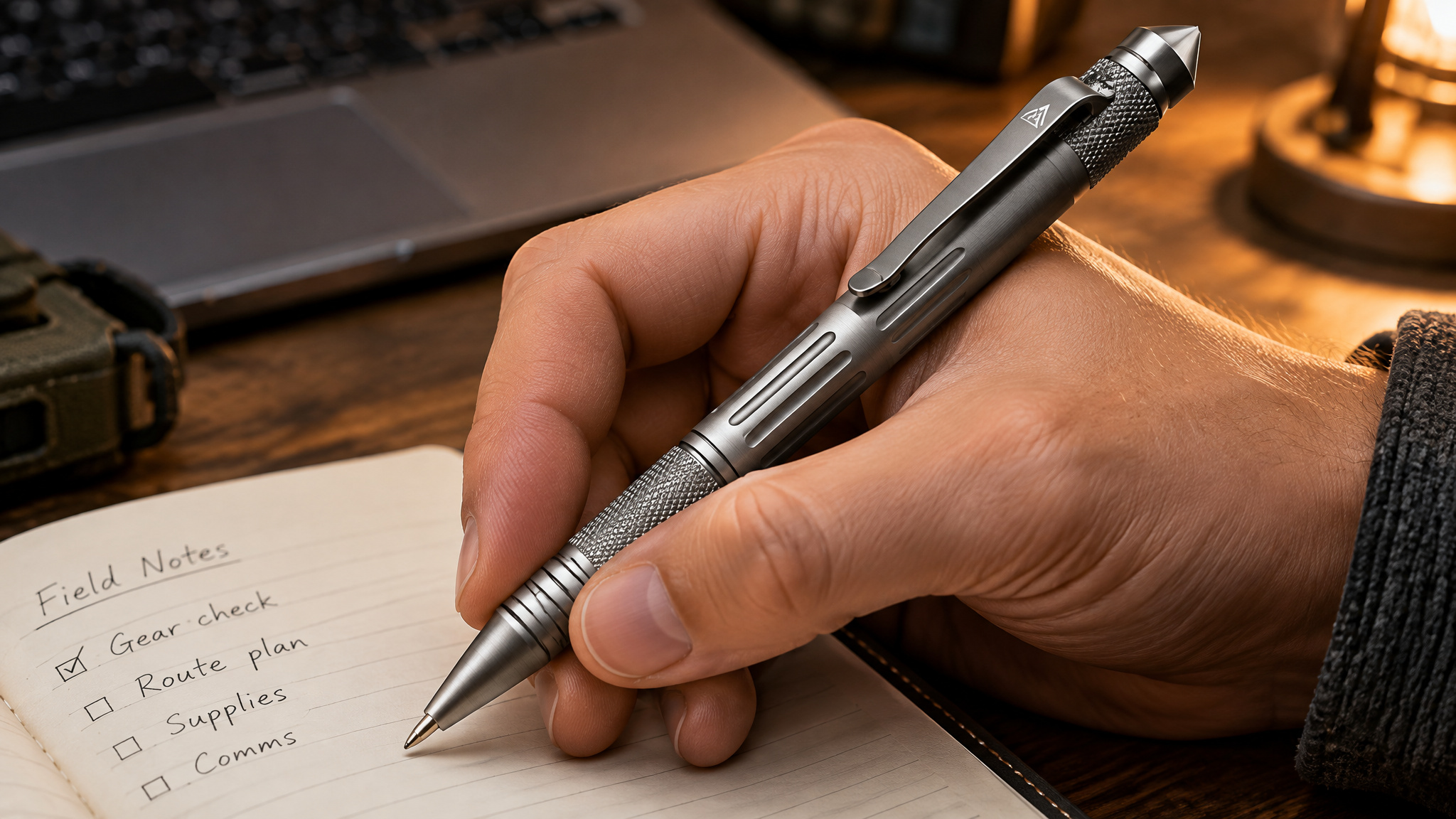
Tactical pen
A tactical pen writes like a normal pen in wet or dry weather, converts immediately into a hand-to-hand combat tool, and works as an emergency window punch. Models use slim metal bodies that often integrate glass breakers or built-in flashlights. Tactical pens are legal to carry anywhere, including on airplanes, but they aren’t allowed in carry-on bags, though they’re permitted in checked baggage. Even with conflicting airport lists, some placing them in the cabin and others forcing them into the hold, Ahn calls the tactical pen her favorite tool and owns several Atomic Bear tactical pens so she can leave one in every purse and backpack.
Tactical pen light
A tactical pen light puts a pen on one end and a flashlight bright enough to blind an assailant on the other. Built from a Type II Military Spec Anodized Aluminum body that is essentially indestructible, it slips discreetly into a pocket or purse until you need either a signature or a high-lumen distraction.
Tactical flashlights: three sizes, four jobs
Tactical handheld flashlights outperform plastic household lights on brightness, durability, and weather resistance while handling four distinct jobs: blinding a threat so you can escape, firing a disabling strobe, charging your smartphone via USB to make a 911 call, and serving as an impact weapon in larger sizes.
Compact: Atomic Bear
At the compact tier, the Atomic Bear tactical flashlight pairs an aircraft-grade aluminum body with a zoom lens and multiple lighting modes. If the beam doesn’t talk an attacker out of approaching, the opposite end of the housing has a serrated head built for jabbing.
Medium: PeakPlus
Stepping up to the medium tier, the PeakPlus tactical flashlight pushes a high-lumen LED beam that is 10 times brighter than old incandescent flashlights, reaching 200 to 500 meters across 5 lighting and zoom modes. It uses a water-resistant aluminum alloy body and ships with rechargeable batteries and a charger.
Oversized impact: Maglite 6-cell D
When pack weight isn’t a constraint, the Maglite 6-cell D flashlight is water, corrosion, and drop resistant and hits with a heavy strike. Ahn owns a 6-cell D custom engraved with her name and carries it everywhere she possibly can.
Stun guns and Tasers: the reliability debate
Stun guns are a narrow, situational choice that may fail to stop a larger attacker and carry a high risk of shocking you alongside your target, making a multipurpose tactical pen and flashlight the smarter pick unless you’re extremely confident with electrical weapons. If you can keep your distance and touch the attacker only with your weapon hand, a stun gun can buy you time to run, while projectile units like the Taser Pulse offer longer incapacitation from a short standoff.
How stun guns work and the self-shock mechanism
Stun guns are close-range tools that deliver an electric shock to trigger pain and muscle spasms, giving you a brief window to escape. They come in pocket sizes, sometimes include built-in flashlights, must be learned before carrying, and belong strictly in TSA checked luggage. Physics is the catch: electrical current flows along the best connection path, so if an attacker is grabbing you when you pull the trigger, the current travels right into your own body and stuns you too.
VIPERTEK models
Evaluating the VIPERTEK VTS-195, a heavy-duty stun gun and LED tactical flashlight combo, Ahn cautions that stun guns only help in very specific situations, may not stop larger attackers, and risk zapping you along with the threat. If you still want one for a destination kit, the VIPERTEK VTS-989 is the top stun gun pick, combining spike electrodes, an internal rechargeable battery, an LED flashlight, and side shock plates that stop an attacker from grabbing the barrel. The smaller VIPERTEK VTS-979 comes in pink and adds a wrist-strap disable pin so the unit goes dead if it’s ripped from your hand.
Taser Pulse and vendor specs
Unlike contact stun guns, the Taser Pulse is a civilian all-in-one taser shaped like a normal concealed-carry handgun with a built-in targeting flashlight. Its maker claims it delivers police and military-grade power that incapacitates an attacker for up to 30 seconds, compared to about 5 seconds for most tasers, police models included.
Disguised phone-case category
Stun guns disguised as cell phone chargers or cases work just like standard contact units: you shock the attacker long enough to break contact, throw the device down, and run to safety. The Yellow Jacket phone case doubles as a backup battery that charges your phone, uses a switch-flip safety lock to prevent accidental pocket shocks, and is claimed by its maker to generate up to 7 million volts.
Keychains, kubotans, and rings: cute tools, fragile legality
Self-defense keychains shaped like cat ears or multi-finger rings are illegal in several US states whenever their finger-slot designs classify them as banned brass knuckles. What looks like a harmless accessory online can carry criminal penalties the moment you cross a state line.
Self-defense keychains
Tools like the EIOU Self Defense Keychain sit directly inside the retail legality trap. Even though big-box stores sell pointed keychain strikers, state laws change regularly, and carrying a banned cat keychain or knuckle duster in the wrong jurisdiction can mean fines or jail time.
Kubotan
A kubotan is a small, stick-like tool attached to your keyring for striking pressure points. It works best when machined from a strong material like aluminum, requires real striking practice to use well, and must go into checked luggage when you fly.
Wild Kat Keychain
The Wild Kat Keychain uses a cat head silhouette where your fingers slide through the eye holes, turning the spiked ears into striking points, while packing a built-in bottle opener and hex wrench. Because your fingers pass through slots to form a fist load, it runs straight into the brass-knuckle-type weapon bans in California, Texas, Illinois, Michigan, and Vermont.
AMOY TANG Hexagon Retro Ring
The AMOY TANG Hexagon Retro Ring can be worn stacked on one finger as normal jewelry or strung across all four fingers to mimic a set of brass knuckles. Because of that four-finger mode, you have to check state brass-knuckle laws before wearing it on the road.
Stun Ring and Tiger Lady
Other compact hand tools skip the brass-knuckle finger holes. Tiger Lady is a palm-held tool with finger indents that deploys recessed claws when you clench your fist, marketed amid street violence against women. For an electrical option, the Stun Ring by Streetwise sits on a single finger with a top activation button that shocks an opponent on contact without harming the wearer, a design also marketed to women and carried by thousands worldwide.
Knives: easiest to find, easiest to get wrong
You can pack a folding or fixed-blade knife in TSA checked baggage, never in a carry-on, provided the blade length and opening mechanism comply with the laws of the state where you land. Before you pack one, consider the dual failure mode of carrying a blade: state knife laws are strict, and without dedicated knife-fighting skill, a blade is just as likely to be taken and used against you as against your attacker.
Folding knife criteria and the dual failure mode
Folding knives are among the easiest weapons to conceal on your body or in a bag and deploy fast, making manual folders a smart workaround in states that ban spring-assisted knives. When picking one, look for easy concealment, nimble handling, and a grip geometry that resists being ripped from your hand.
MTech USA MT-A705
Where spring-assisted blades are legal, the MTech USA MT-A705 uses a spring-loaded mechanism for fast one-handed opening and builds a glass breaker and bottle opener into the handle.
Fixed blade and spring-assist rules
If you don’t want to deal with a folding hinge under stress, an S&W fixed blade knife deploys instantly from its sheath.
SOG Instinct Mini
For deep concealment, the SOG Instinct Mini hangs on a neck chain underneath your shirt. It takes a little extra hand coordination to draw the blade cleanly from a neck sheath, and you must verify local concealed-weapon laws before wearing a fixed blade under your clothes.
Batons and walking sticks: distance tools with their own rulebook
A walking stick is a more practical self-defense tool for travelers than a telescopic baton because it draws zero attention in transit and avoids the strict state weapon bans that target expandable batons. If you want reach to keep a threat at bay, you have to weigh packability against local weapon classifications.
Self-defense batons
Self-defense batons are built from sturdy steel or durable alloys that collapse for carry and open up to create distance and control a threat. Expandable police batons balance portability, strength, and reach, giving you much faster recovery for rapid strikes than an oversized Maglite, which hits hard as a head basher but swings too slowly for quick combinations.
Outdoor Telescopic Pole
The Outdoor Telescopic Pole baton expands to 26 inches, triple its collapsed length. Before tossing one in a suitcase, you have to check jurisdiction-specific rules, such as whether batons are legal in Michigan, where expandable strikers face state weapon restrictions.
The walking-stick alternative
On television, Lucy Liu’s character Joan Watson carried a telescopic baton on Elementary, where it came in handy constantly, but real-world travelers get fewer stares carrying a cane or walking stick. For multi-role value, the Southern Garden Tools walking stick combines a walking stick, a flashlight, and a stun gun into a single piece of gear.
Niche gadgets and disguised oddities from the roundup
In strict states like California or Michigan, your safest non-lethal options are defensive gear that avoids firearm and brass-knuckle classifications, such as ballistic backpacks, alarms, and flashlights, rather than unverified projectile launchers or hybrid knuckle weapons. Weapon roundups online love pitching wild hardware, including a video roundup of 12 Amazon self-defense gadgets that mixes genuinely useful travel armor with $1,200 illegal curiosities.
LifeLights
LifeLights combines a powerful laser, a flashlight, and a launcher that holds up to 5 pepper-irritant pods. On impact, the pods burst into an incapacitating cloud, and the unit is marketed as a point-and-shoot tool that requires no extra training or license.
GuardDog ProShield backpack
For a nomad carrying expensive work hardware, the GuardDog ProShield smart bulletproof backpack puts military-grade bullet resistance over your vital organs without looking like tactical body armor. It packs 20+ pockets and sleeves, fits an 18-inch laptop, carries TSA approval, includes an RFID-blocking pocket, and builds in a charging pad that can top up a phone up to 6 times.
BolaWrap
Built originally for police officers to restrain suspects without lethal force, the BolaWrap fires an 8-foot Kevlar tether at 513 feet per second using a .38 partial-charge blank, wrapping around a suspect’s arms and legs from a distance.
H-U-A-A-O dart launcher
The same video roundup pitches the H-U-A-A-O dart launcher, which fires up to 5 darts across a 20-foot range, and claims it may bypass gun laws in strict states like California or Michigan. Treat that legal-loophole claim with heavy skepticism before crossing a state line with a multi-shot dart gun.
Knuckle Duster
At the extreme end of illegal novelty hardware, the Knuckle Duster combines brass knuckles, a hidden knife, and a pinfire gun into one $1,200 package, putting it squarely under the brass-knuckle bans in California, Texas, Illinois, Michigan, and Vermont.
Miniature Colt 1908 and concealed spork knife
Two more oddities round out the novelty tier. The Miniature Colt 1908 is a tiny pistol that fires real 2mm bullets, making it an engineering curiosity about how small lethal firearms can get rather than a serious defensive tool. Then there is the concealed spork knife, which hides a blade inside a plastic camping spork handle. Its promotional scenario imagines an attacker laughing when you draw a spork before panicking when you pull out the blade, leaning on the same unverified bear-attack hype used to sell pen pepper spray.
Pack-space economics: multi-function gear and the nomad work kit
When I evaluate gear for my own nomad kit, every item has to justify its weight in functions per ounce of pack space. Multi-function defense hardware like penlights, phone-charging flashlights, 3-in-1 walking sticks, and the GuardDog ProShield backpack solve the exact same pack-space scarcity, power reliability, and Wi-Fi reliability problems as the daily work tech in your bag.
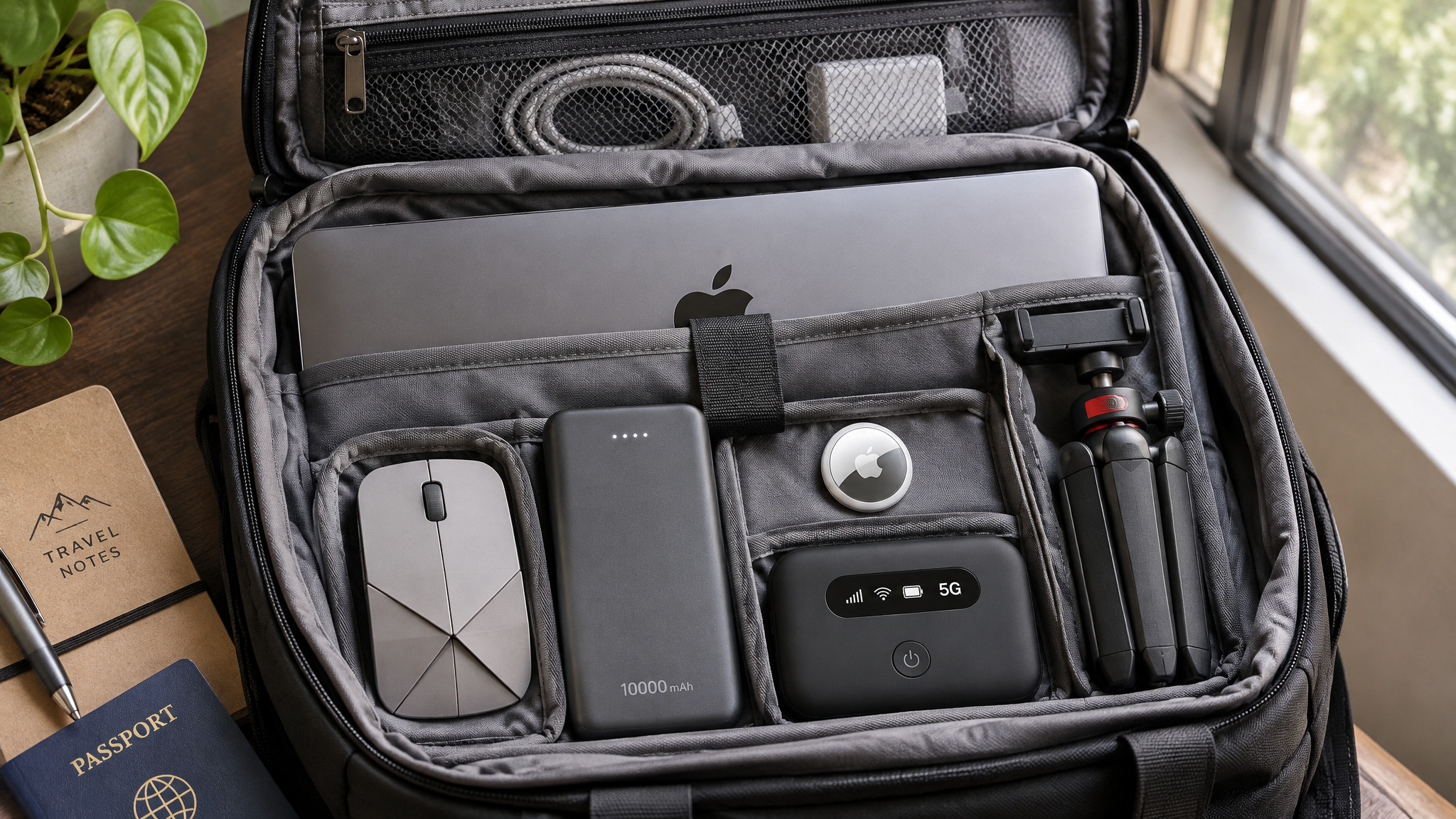
Functions per ounce as the selection criterion
Patrick Phillips, who writes at Slashgear, selects road workflow gadgets based on usefulness, price, packability, and user reviews, while disclosing affiliate commissions on purchase links. Applying that same packability filter across your entire bag keeps your kit lean enough for carry-on travel.
The five work-gear picks
Five compact work tools solve the road-office side of the pack-space equation:
- OriMouse (from $75): An origami-inspired mouse that folds completely flat for a pocket and comes in multiple colorways. It runs Bluetooth 5.2 on macOS, iPadOS, Android, and Windows, just check compatibility if you’re on an older OS version.
- Anker Prime Power Bank ($179.99): A 27k, 250W airline-safe packable unit with 3 USB ports for simultaneous charging that claims to charge full laptops where lesser power banks fail.
- Apple AirTag 2nd Gen ($29 each): Water- and dust-resistant gear trackers using the Find My app and iCloud with encrypted anonymity, a replaceable battery, free engraving, louder speakers, and higher tracking precision for low-cost anti-loss security.
- TP-Link Portable AX1500 ($38.97): A 1,201 Mbps portable router that builds a secure network over cellular or bridged Wi-Fi in airports and cafes where standard Wi-Fi extenders are useless, though it lacks a built-in battery.
- Peak Design Mobile Tripod ($79.95): A phone tripod that collapses down to a 0.5mm profile, with the trade-off that its MagSafe magnets may slide under pressure.
Training and mindset: the only-carry-what-you’ll-use rule
A bright flashlight beam in an attacker’s face is your best hardware play after de-escalation fails, well before you ever resort to physical force. Situational awareness and trusting your instincts when a street or transit stop feels off will keep you out of more trouble than any gadget in your pocket.
If you do carry a tool, training teaches you how to operate it effectively and keeps you calm under stress, while regular practice builds speed and confidence. Because untrained carriers risk having their own weapons taken away and used against them in a fight, only carry a tool you’re fully prepared to use. Ahn cautions beginners against carrying most self-defense weapons at all until they’ve put in the practice time.
Firearms for nomads: know why you probably shouldn’t
Without dedicated training, a firearm is the most disastrous self-defense weapon you can pack, carrying catastrophic safety risks and dire legal consequences up to murder charges if a shoot goes wrong. Add in the criminal liability of driving or flying through states with strict gun laws, and handguns rarely make sense for a mobile lifestyle.
Training and transit-liability reality
Ahn trains regularly with firearms but chooses not to own one herself, noting that the legal and personal risks outweigh the benefits on the road. If you still decide to buy a handgun for domestic travel where permitted, get formal certification training, study every local firearm statute on your route, and use training resources like The Well Armed Woman before purchasing.
Caliber guidance
For defensive handguns, 9mm is the recommended sweet spot that balances recoil control, stopping power, ammunition availability, and affordability. Skip calibers smaller than .380 for lack of stopping power, and avoid full-size .45 or .357 handguns that are harder to control and conceal.
The model shortlist
For travelers who have the training and legal permits to carry, five compact models top the shortlist:
- Glock 19: The top overall handgun pick, favored because it’s compact, affordable, reliable, Glock’s best-selling 9mm, and the standard sidearm carried by police and the FBI.
- Smith & Wesson M&P Shield 9mm (M2.0): A slightly smaller 9mm alternative to the Glock 19 for tighter concealment.
- Ruger LCP II (.380) and Ruger LC9s (9mm): Ultra-compact semi-automatic options at the bottom end of the recommended caliber range.
- Smith & Wesson M&P Bodyguard (.38 special): A compact revolver featuring a recoil-reducing grip and an optional Crimson Trace laser sight, built for shooters who can’t easily rack a semi-automatic slide.
Protection beyond gear: the nomad insurance layer
Digital nomad travel and medical insurance costs between $257 and $830 for a six-month trip, based on illustrative sample quotes for a 30-year-old traveler (policy prices vary by age, residency, and coverage tier). That coverage handles the high-probability road risks weapons can’t fix: hospital bills, emergency evacuation, and stolen work gear. None of the compared travel insurance plans cover legal fees or civil liability if you use a weapon in a self-defense incident.
Sample-traveler six-month price comparison
Elina Geller, who writes at NerdWallet, compares long-stay international plans using sample quotes for a 30-year-old traveler on a 180-day trip (unless a different billing window is noted):
| Provider & Plan | Illustrative Sample Price (30-Year-Old) | Key Coverage Limits, Deductibles & Conditions |
|---|---|---|
| World Nomads (Standard / Explorer) | $549 Standard / $788 Explorer (180 days) | Underwritten by Nationwide Insurance; 180-day cap extendable mid-trip; covers COVID-19, trip cancellation/interruption/delay, evacuation, baggage loss, and 200+ sports (Explorer adds 60 activities like skydiving and rental car damage); no Cancel For Any Reason (CFAR) option |
| SafetyWing | $290 without US / $536 with US (180 days); $45 / $83 per 4 weeks | Auto-renews every 28 days up to 364 days; purchasable abroad; $250 deductible; 15 days per 90 incidental US coverage for US citizens; excludes pre-existing conditions and residents of Cuba, Iran, or North Korea |
| Atlas Travel Insurance | $274 International / $682 Premium (180 days) | Covers COVID-19 medical and trip benefits; optional US inclusion; variable deductibles; coverage limits drop with age; excludes many adventure sports |
| Insured Nomads (World Explorer / Multi) | $679 ($250k max, $100 deductible) / $830 ($1M max) (6 months in Mexico) | Serves any citizenship for 7 to 364 days; optional riders for adventure sports, pets, AD&D, and rental cars; excludes Level 4 countries and war |
| Heymondo Long Stay | $257 initial 90 days + $304 for 120-day renewal ($561 for 210 days) | Built for trips over 90 days (ages 90 days to 49 years); $250 deductible; covers COVID-19 quarantine lodging; extra-cost riders for electronics and adventure sports |
| Travelex Travel Select | $734 (6-month, $5,000 Italy trip for Colorado resident) | Covers up to 364 days; $50,000 medical, $500,000 evacuation, $1,000 baggage loss; pre-existing waiver if bought within 15 days of deposit; optional CFAR add-on covers 75% of trip cost up to $10,000 |
| IMG Global (Expat Medical) | $201 Bronze / $278 Silver / $474 Gold / $834 Platinum per month (Spain) | Medical-only expat tiers ($1M to $8M max; $100 to $250 deductible); extendable up to 6 months; includes telemedicine and mental health counseling extras |
| Allianz Global Assistance | $138 Basic / $280 Prime / $510 Executive (annual) | Built for frequent short trips up to 45 days (Premier covers 90 consecutive days); Basic lacks trip cancellation; limits COVID-19 and Russia-Ukraine claims |
| AIG Travel Guard Annual Plan | $242 annual (Colorado resident) | Covers multiple trips within 364 days but caps each trip at 90 days; excludes Washington state residents |
World Nomads vs SafetyWing
For long-term coverage, World Nomads fits gear-heavy adventure travelers who want trip cancellation, baggage protection, and coverage for 200+ sports at $549 to $788 for 180 days. SafetyWing fits budget-focused nomads already abroad who want rolling 28-day medical insurance that auto-renews up to 364 days at $290 (without US coverage) for 180 days. Neither covers pre-existing conditions or intoxicated accidents. World Nomads also rejects “fear of travel” cancellations and has no CFAR add-on.
Matching the plan to the travel style
Nomads need long coverage windows, equipment theft protection, adventure-sport riders, and international health insurance when domestic plans stop working abroad. Pick World Nomads, Insured Nomads, Heymondo (with its extra electronics and sports riders), or Travelex if you carry pricey camera and laptop kits or plan to skydive and paraglide; choose SafetyWing or Atlas if you primarily want medical protection abroad with optional US visits; and skip Allianz and AIG annual plans whenever your single-country stays exceed their 45- to 90-day per-trip caps.
Building the kit: a closing recommendation
Start your kit with zero-legal-risk tools: a personal alarm and a hotel door wedge. From there, add only the carry-on disguised tools like a tactical penlight or steel water bottle that you’ll actually drill with, relegate destination sprays or stun guns to checked luggage, verify state and local weapon statutes before every border crossing, and lock in long-stay travel insurance for stolen work hardware and medical emergencies. Now that my old self-defense umbrella is retired for good, that five-step filter is how I’m finalizing my own nomad kit before my next flight.
Frequently Asked Questions
What self defense tools are allowed in carry-on vs checked luggage when flying?
The TSA restricts seven weapon categories to checked bags: stun guns, Tasers, pepper spray, knives, kubatons, tactical gloves, and tactical flashlights. For the cabin, only five items make the carry-on list: an umbrella, a tactical chain, a steel wrist bracelet, a rolled-up magazine, and a tactical pen, though rules conflict on whether tactical pens actually pass cabin screening or must be checked.
Is pepper spray legal to carry in different countries and US states?
No, pepper spray isn’t universally legal across US state lines or international borders, and local regulations shift frequently. Even within the US, transiting strict jurisdictions can create legal headaches, and domestic rulebooks don’t apply abroad at all. Always verify the specific destination statutes before packing a canister in your checked bag.
How does a tactical pen compare to a kubotan keychain for everyday self defense while traveling?
A tactical pen wins for everyday travel because it functions as a real pen, an emergency glass breaker, and often a flashlight while disguised as ordinary office gear. A kubotan is strictly a single-purpose metal striking stick that the TSA forces into checked luggage. Both give you a solid grip for close-quarters pressure-point strikes, but only the pen earns its pack space with daily utility.
Are self defense keychains like cat ear keychains illegal in some states?
Yes, pointed cat-ear strikers and multi-finger rings often fall under state bans on brass-knuckle-type weapons because your fingers slide through slots to form a fist load. Brass-knuckle tools are illegal in at least California, Texas, Illinois, Michigan, and Vermont, and Texas banned cat-shaped keychains until recently under threat of heavy fines and jail time. Seeing them on shelves at Walmart or reading a vendor’s 50-state legality claim doesn’t mean you won’t get arrested for carrying one.
Do stun guns and tasers actually work against a larger attacker?
Contact stun guns are situational tools that may fail to stop a larger assailant and carry a major physics flaw: if the attacker is grabbing you when you pull the trigger, the electrical current flows into your body and shocks you too. Projectile units like the Taser Pulse work from a short standoff and claim up to 30 seconds of incapacitation compared to about 5 seconds for standard models. Unless you are thoroughly trained with electrical weapons, a bright tactical flashlight and a tactical pen are much safer choices.
What non lethal self defense items are legal in strict states like California or Michigan?
In states like California and Michigan that ban brass-knuckle-type weapons and restrict expandable batons, stick to tools that avoid weapon classifications altogether. Personal alarms, emergency whistles, hotel door wedge alarms, tactical flashlights, steel water bottles, and ballistic gear like the GuardDog ProShield bulletproof backpack cross state lines without legal risk. Be skeptical of multi-shot dart guns like the H-U-A-A-O launcher that claim to bypass strict state firearm laws.
Between pepper spray vs pepper gel, which is better for windy outdoor use?
Pepper gel is the superior choice for windy outdoor conditions or tight indoor spaces because its thicker formula resists blowing back into your own face. Standard pepper spray releases an aerosolized cloud of oleoresin capsicum (OC) that offers wider coverage and disables an attacker longer by making breathing harder, but that same mist can easily turn on you in a breeze.
What should a beginner carry for self defense with no training?
If you haven’t put in the practice time, skip dedicated weapons that an attacker can rip from your hand and use against you. Start with zero-legal-risk gear: a loud personal alarm, a battery-free emergency whistle, smartphone safety apps, a hotel door wedge alarm, and a heavy steel water bottle already in your hand. Once de-escalation fails, flashing a high-lumen tactical flashlight in a threat’s eyes is your smartest hardware move before trying physical force.