If you’re looking for a Rocket Money alternative in 2026, start with PocketGuard. It delivers an ongoing budgeting experience that combines automation, flexible budgeting methods, analytics, and forward-looking spending guidance at one flat price – with no cut of any savings you find. It also works in Canada, where Rocket Money does not.
Rocket Money is good at spotting subscriptions and negotiating certain bills. A lot of people sign up for exactly that. The friction comes later: the Premium price sits on a sliding scale, the bill-negotiation success fee takes a large share of the first-year savings, and the app is built for U.S. banks. Canadians and anyone who wants straightforward budgeting without percentage fees usually look elsewhere.
Key Takeaways
If you want a Rocket Money alternative in 2026, start with PocketGuard. It is built for ongoing budgeting (safe-to-spend number, categories, Pace, Insights) at a flat $12.99/mo or $74.99/yr with no cut of any savings, and it works with Canadian and UK banks.
Rocket Money is strongest at subscription detection and optional bill negotiation, but Premium uses a sliding $7–14/mo price and successful negotiations take 35–60% of first-year savings. It is also U.S.-only.
Use Rocket Money’s free tier for a one-time subscription list (U.S.), Empower if net-worth and investments matter more than daily spending control, and PocketGuard when the daily question is “how much can I actually spend right now” without percentage fees or geographic limits.
Table of Contents
Why PocketGuard Is Best Alternative to Rocket Money
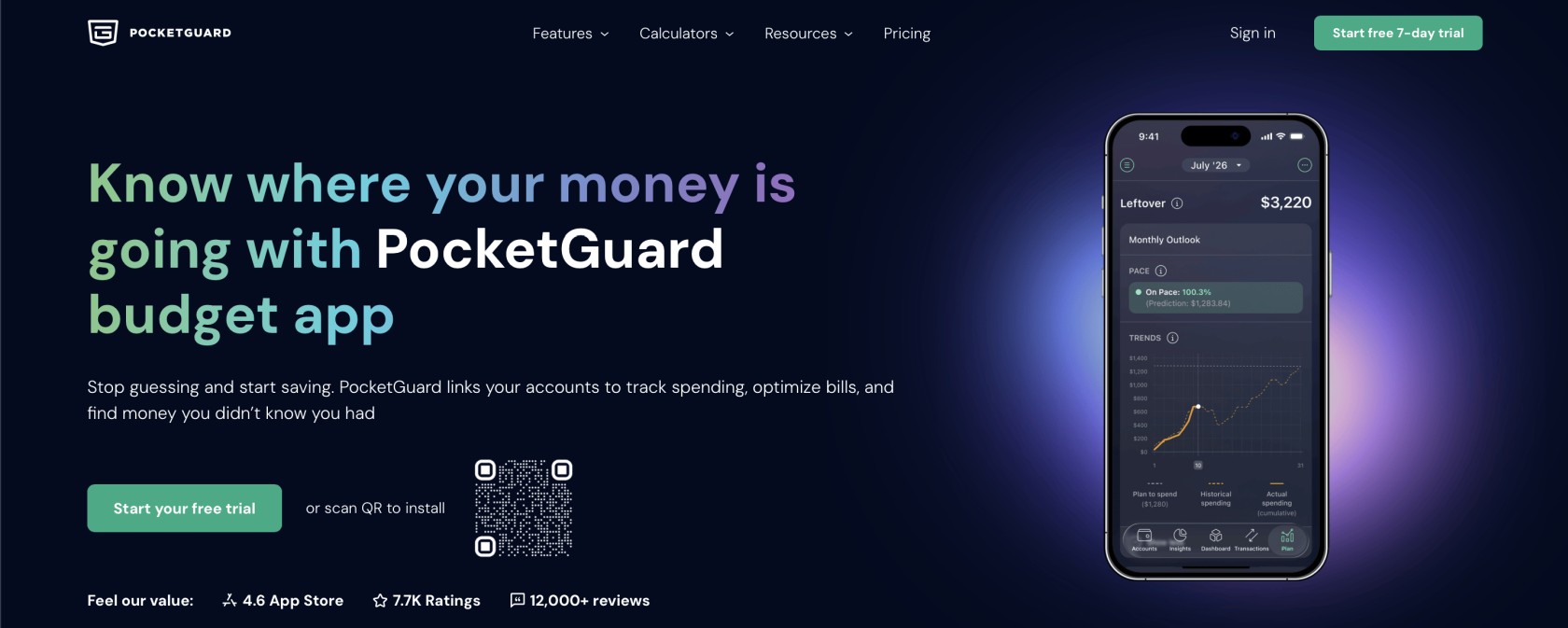
PocketGuard is built around a different job. Rocket Money is primarily strong around subscription cleanup and bill management, while PocketGuard is designed for ongoing budgeting and helping users understand, plan, and adjust their spending. After it accounts for your income, recurring bills, and savings goals, it shows a single “Leftover” number – the amount you can safely spend without falling behind. That number updates as transactions come in. Stay under it, and the month stays on track.
It also includes category budgets, a debt payoff planner, savings goals, and net-worth tracking. Insights and Trends help you understand spending patterns, while Pace adds a forward-looking layer by showing whether current spending behavior is on track. Subscriptions and recurring bills are detected automatically so the safe-to-spend figure stays accurate. The interface is straightforward on iOS, Android, and the web.
The biggest practical difference for many users is geography. Rocket Money’s own documentation states it does not support international banks and is designed for U.S. users with U.S. accounts. PocketGuard works with banks in the United States, Canada, and the United Kingdom. If you’re in Canada and need automatic syncing, that alone makes PocketGuard the clearer option.
Pricing is also simpler. PocketGuard Plus is $12.99 a month or $74.99 a year (about $6.25 a month when paid annually). There is a limited free tier and occasional lifetime pricing. You pay the listed amount and keep whatever you save. There is no success fee that takes a percentage of negotiated bills.
The Fee Nobody Reads the Fine Print On
Rocket Money’s bill negotiation is useful when it works. The team contacts providers (internet, cable, phone, etc.) and tries to lower the rate. If they succeed, they charge a success fee of 35–60% of the first year’s savings. You choose the percentage in that range. If they save you nothing, you pay nothing for that attempt.
Math can surprise people. A $30 monthly reduction equals $360 in the first year. At 40% the fee is $144; at 60% it is $216. That fee is separate from any Premium subscription. It is charged only on successful negotiations, but it is real money taken from the savings the service just created. Many users only notice the size of the charge after the first successful negotiation.
Premium itself uses a “pay what you think is fair” model that typically lands between $7 and $14 a month. The free tier already shows subscriptions and basic spending, so the decision to upgrade often comes down to whether you want the concierge cancellation service and extra budgeting tools.
What You’re Actually Paying For
Here is a side-by-side look at the main differences:
| Feature | PocketGuard | Rocket Money |
| Core focus | Daily safe-to-spend number + budgeting | Subscription cleanup + bill negotiation |
| Pricing | $12.99/mo or $74.99/yr (flat) | Free tier + Premium ~$7–14/mo (sliding) |
| Bill negotiation fee | None (flat subscription only) | 35–60% of first-year savings if successful |
| Subscription cancellation | Detection + self-service guidance | Concierge cancellation on Premium |
| Debt payoff planner | Yes (Plus) | Limited |
| Canada / UK bank support | Yes | No (U.S.-focused) |
| Free tier | Limited (accounts + categories capped) | Useful for tracking subscriptions and basic spend |
Rocket Money earns its keep when the main problem is forgotten subscriptions or negotiable bills and you are comfortable with the success fee. PocketGuard is stronger when the daily question is “how much can I actually spend right now” and you want predictable pricing plus broader country support.
PocketGuard – Built for Ongoing Budgeting Decisions
With PocketGuard you know the cost upfront. Annual billing brings the effective monthly rate under most of Rocket Money’s Premium range, and there is no additional percentage taken from any savings you create yourself or through other means. The app’s stronger differentiation is that it is built for ongoing budgeting decisions: understanding where money is going, what remains available, and whether current spending is likely to stay on track. The remaining number updates as transactions come in, bills are flagged, Insights and Trends surface patterns, and Pace helps you see if you are on track to finish the month safely.
For Canadian users the country’s support is decisive. Linking Canadian accounts works, so the safe-to-spend figure and bill tracking stay current without manual entry. That alone removes the main barrier Rocket Money creates north of the border.
The free tier is more limited than Rocket Money’s, so most people who like the approach move to Plus. A seven-day trial lets you test the full set of features before deciding.
If PocketGuard Isn’t the Right Fit
Two other paths cover the remaining common needs.
Empower – If Net Worth and Investment Tracking Matter More
Empower’s Personal Dashboard is free and strong on the big picture. It aggregates bank, credit, investment, and loan accounts, shows net worth over time, and includes solid investment analysis and retirement planning tools. Budgeting and cash-flow views exist but are lighter than what you get in a dedicated spending app. There is no subscription-cancellation concierge and no bill-negotiation service. Choose Empower when portfolio visibility and long-term net-worth tracking are the priority and day-to-day spending control is secondary.
Rocket Money’s Free Tier – If You Just Wanted the Subscription Finder
If the only job you needed was a clean list of recurring charges, Rocket Money’s free tier already does that. You can link accounts, see subscriptions, and get basic spending views without paying. Concierge cancellation and the full budgeting tools sit behind Premium, and the bill-negotiation success fee still applies if you use that service. For a one-time cleanup of forgotten subscriptions, the free tier is often enough. Just remember it remains U.S.-centric.
Which Rocket Money Alternative Is Right for You?
- Choose PocketGuard if you want flexible ongoing budgeting, spending insights, and forward-looking guidance, with predictable pricing and broader geographic support as additional advantages.
- Stay with Rocket Money’s free tier (or Premium) if subscription detection and optional bill negotiation are the main needs, and you are in the U.S.
- Switch to Empower if net-worth and investment tracking matter more than daily spending guardrails or subscription cleanup.
Most people who leave Rocket Money do so because of the success fee, the sliding Premium price, or the lack of Canadian support. PocketGuard removes those three friction points while still giving useful visibility into spending and bills.
The Bottom Line
Rocket Money is effective at finding subscriptions and negotiating certain bills, but the success fee and U.S.-only design push many users to look for alternatives. PocketGuard offers flexible ongoing budgeting, spending insights, and forward-looking guidance, with predictable pricing and broader geographic support as additional advantages. For most people who want ongoing visibility without percentage fees or geographic limits, it is the more practical replacement in 2026.
People Also Ask
Does Rocket Money work in Canada?
No. Rocket Money is built for U.S. users and U.S.-based banks. Its help documentation states it does not support international banks. If you try to link a Canadian account, you will usually hit connection limits or be unable to sync properly. PocketGuard supports Canadian banks (along with U.S. and UK institutions), so automatic transaction import and the safe-to-spend number work without requiring everything to be entered manually.
How does PocketGuard’s pricing compare to Rocket Money?
PocketGuard Plus is a straightforward $12.99 per month or $74.99 per year (roughly $6.25 a month on annual billing). There are no extra percentage fees. Rocket Money’s free tier covers basic subscription tracking and spending views. Its Premium plan uses a pay-what-you-think-is-fair slider that typically ranges from $7 to $14 per month. On top of that, any successful bill negotiation carries a separate success fee of 35–60% of the first year’s savings. Over a full year, the flat PocketGuard price is often lower once you factor in even one negotiated bill.
Is the bill negotiation fee worth it on Rocket Money?
It depends on the size of the reduction and how long the lower rate lasts. A meaningful drop on a high bill can still leave you ahead after the fee. On smaller savings the fee takes a large bite of the first-year benefit. For example, a $25 monthly reduction equals $300 in year one; at 50% the fee is $150. After the first year you keep the ongoing savings, but the upfront cut is real. PocketGuard has no equivalent success fee—you simply pay the listed subscription and keep any savings you create yourself.
Can I use PocketGuard just for subscription tracking?
Yes. PocketGuard detects recurring charges and shows them clearly so you can see what is leaving the account each month. Cancellation is self-service (the app gives guidance rather than calling the provider for you). If your only goal is a one-time list of forgotten subscriptions and you are in the U.S., Rocket Money’s free tier already does that job well. If you also want ongoing spending visibility and a daily safe-to-spend number, PocketGuard covers both.
Does PocketGuard negotiate bills the way Rocket Money does?
PocketGuard does not run an in-house negotiation team that takes a percentage of savings. It focuses on showing what is left after bills and goals, tracking spending, and helping with debt payoff. Some users still lower bills on their own once the recurring charges are visible. The trade-off is simplicity and predictable cost instead of a concierge negotiation service.
Which app is better for couples or shared finances?
Neither is built primarily as a multi-user household dashboard. PocketGuard is more individual in design but both partners can look at the same safe-to-spend number and bill list. Rocket Money also works for one primary account holder. If shared logins, joint budgets, and investment tracking across partners are the top priority, a tool like Monarch Money is usually a stronger fit than either of these two.
Is there a free way to test PocketGuard?
Yes. PocketGuard offers a seven-day trial of the full Plus features. After that the free tier remains available but is limited in the number of linked accounts and budget categories. Most people who like the daily number and debt tools move to the paid plan.