
Drop into a ranked shooter voice lobby, scroll a PC hardware forum, or tune into an esports broadcast, and the room still feels overwhelmingly male. Then open a browser and you’ll trip over viral headlines insisting that women make up nearly half, or even a 51% to 52% majority, of all video game players. While major tracking firms converge on a 45% to 47% female share globally and in the United States, the 51% to 52% claim is only plausible in broad, US-specific consumer surveys that include mobile play, and no global dataset proves women are a majority across all platforms worldwide.
Gaming is a mainstream, multi-generational activity rather than a teen-male niche, making female gamers common in the aggregate player base but rarer in specific enthusiast hardware, self-identified, and competitive spaces. The near-parity statistic and your male-skewed lobby are simply measuring different populations. Bryter’s 2024 Women Gamers Study found 56% of surveyed women regularly played action-adventure titles, 49% played shooters, and 47% played battle royales across an average of 20 hours per week, yet Newzoo’s 2025 Global Gamer Study noted a persistent spending gap with lower in-game spending among women, and dedicated hardware unit sales reflect a very different audience mix than aggregate player counts.
Key Takeaways
Major tracking studies from Newzoo (45%), Bryter (46%), the Entertainment Software Association (46%), and Statista (around 47%) show women represent roughly 45% to 47% of players, while 51% to 52% figures come from broad mobile-inclusive or country-specific samples.
Platform and identity filters create the perception of scarcity: 44% of female gamers play exclusively on mobile compared to 27% of men (Newzoo 2024), women represent 35% of European PC players (Video Games Europe 2025), and only 36% of women who play call themselves “gamers.”
Visible competitive and development spaces remain heavily male-skewed, with women making up 22% of the global games workforce in 2020, 16% of executive teams at the top 15 studios, and roughly 5% of esports participants (Women in Games).
Table of Contents
Are 48% of gamers female? The 45-47% answer
Women are roughly 45% to 47% of video game players globally, placing gaming gender statistics near parity without giving women a worldwide majority across all platforms. Across major tracking firms and industry reports, how many women play video games compared to men stabilizes at roughly 45% to 48% globally and 46% in the United States, as Gameluster’s May 15, 2026 analysis noted. In Newzoo’s 2024 Global Gamer Study, women accounted for 45% of gamers worldwide against 55% for men, with 72% of the female online population playing games in some form, while Bryter’s 2024 Women Gamers Study placed the percentage of female gamers worldwide at 46%. Viral headlines claiming a 51% or 52% female majority only hold up in broad consumer surveys that count anyone who recently touched a mobile or video game, or within isolated national samples.
Check the sample design behind five major trackers and the convergence band is remarkably tight:
| Dataset & Year | Geographic Scope | Female Share | Male Share | Key Methodology & Sample Notes |
|---|---|---|---|---|
| Newzoo Global Gamer Study (2024) | Global | 45% | 55% | 72% of the female online population plays in some form |
| Bryter Women Gamers Study (2024) | Global | 46% | 54% | Surveyed women averaged 20 hours of weekly play |
| Statista Projection Series (2025) | United States | ~47% | ~53% | Modeled projection described as almost half female |
| ESA Essential Facts (2024 & 2026) | United States | 46% | 53% | Roughly 1% non-binary or prefer not to say in 2024; 52% of Boomer women play vs. 47% of Boomer men in 2026 |
| Ipsos US Behavior Study (2021-2022) | United States | 45% | 55% | 67% of US adults 18+ (~227M) and 76% of kids under 18 play; average age 31 |
| Variety-Reported Multi-Country Study (2025) | US & Global | 52% (US) / 48% (Global) | 48% (US) / 51% (Global) | Single methodology where a female majority appears only in the US slice |
The Entertainment Software Association (ESA) 2024 Essential Facts report described its 53% male, 46% female, and roughly 1% non-binary or unstated US split as about half-and-half. When the ESA published its 2026 Essential Facts report on June 3, 2026, active US participation held at 53% of men and 46% of women, alongside a fun generational flip among Boomers, where 52% of women played compared to 47% of men. An earlier Ipsos study covering 2021-2022 US behavior, presented by YouTube creator LukeBK, pegged female self-identification at 45% while noting that 51% of US players logged 7 or more hours weekly and 55% played more during the pandemic.
So where did the 52% majority headline come from? Its historical ancestor is an Internet Advertising Bureau (IAB) study cited in a September 18, 2014 Guardian opinion piece by Colette Farrow, which found women had reached 52% of the United Kingdom gaming audience, up from 49% three years prior. More recently, a 2025 multi-country study reported by Variety found women made up 52% of players in its US sample, even though its global split was 51% male and 48% female. As Gameluster and SQ Magazine pointed out, single-sample US or UK snapshots that include casual mobile play don’t generalize to PC and console lobbies worldwide.
What counts as a ‘gamer’ changes every number
A video game player is anyone who engages with interactive digital games behaviorally, whereas a self-identified gamer is someone who adopts the cultural label as part of their personal identity. Survey methodology creates this split, behavioral questions and identity questions are measuring two different groups inside the same population. In Newzoo’s 2024 analysis, the baseline definition changes the total player count and the gender ratio:
- Studies that use behavioral definitions (“played a game in the last 30 days”) capture a much larger and more gender-balanced population than identity-based definitions (“considers themselves a gamer”).
- Studies that use identity-based definitions filter out millions of regular players who reject the label, skewing the remaining sample heavier toward dedicated PC and console enthusiasts.
Behavioral vs identity-based definitions
Beyond question wording, four variables move the needle in any demographic study: whether mobile games are included, which geography is sampled, which age brackets are allowed, and where respondents are recruited.
Four player counts, four different questions
Quoting a single global total hides the question the researcher actually asked. In the September 2026 update cited by SQ Magazine, the Newzoo Global Games Market Report 2026 counted anyone who plays at 3.70 billion global players (up 4.4% year-over-year) inside a $213.9 billion market (up 6.1%, outpacing player growth by 1.7 percentage points), but counted only 1.65 billion paying players (up 4.7%). That gap between 3.70 billion playing and 1.65 billion paying is why two analysts can quote totals two billion apart and both be right. Meanwhile, Statista Market Insights modeled market user penetration at 28.47% in 2026, rising to 34.33% (2.81 billion users) by 2031 in a market it sized at $560.55 billion for 2026. The ESA’s 2026 report counted 212.3 million Americans aged 5 to 90 who play at least one hour weekly, while the Video Games Europe and EGDF 2025 Key Facts report (leveraging GameTrack data and published August 26, 2026) measured 199 million players across 16 European markets, or 51% of the population aged 6 to 75.
Here at GeekExtreme, we reverse-engineer every demographic headline with three quick debugging questions: does it count mobile, which country does it cover, and did it ask about play behavior or personal identity?
Mobile vs PC and console: where the gender gap lives
Mobile gaming is the most gender-balanced platform, whereas PC and console gaming audiences skew noticeably male. Device preference is the strongest predictor of gender splits in Newzoo and Statista data: women outpace or match men on smartphones, while dedicated gaming hardware draws a higher share of male players. In Newzoo’s 2024 Global Gamer Study, 44% of female gamers played exclusively on mobile compared to 27% of male gamers, and a Statista Consumer Insights survey reported by Anna Fleck found that 64% of US women regularly played on smartphones versus 58% of US men.
The mobile effect
Smartphones are the only major platform category where female participation clearly tops male participation in the US. Strip mobile out of the sample and the demographic picture shifts immediately toward the male-skewed rooms that core players recognize.
What’s left when mobile is excluded
If you’re wondering what percentage of gamers are female excluding mobile games, no public dataset supplies a single global non-mobile female share, and Valve doesn’t publish a concrete gender breakdown for Steam. Platform-by-platform splits are the most honest measurement available:
| Platform / Metric | Female Share or Rate | Male Share or Comparison | Source & Geographic Scope |
|---|---|---|---|
| Exclusive mobile play | 44% of female gamers | 27% of male gamers | Newzoo Global Gamer Study (2024, Global) |
| Regular smartphone play | 64% of women | 58% of men | Statista Consumer Insights (United States) |
| Smartphone / tablet share | 48% female | 52% male | Video Games Europe / EGDF 2025 Key Facts (16 European markets) |
| Console player share | 37% female | 63% male | Video Games Europe / EGDF 2025 Key Facts (16 European markets) |
| PC player share | 35% female | 65% male | Video Games Europe / EGDF 2025 Key Facts (16 European markets) |
| Regular PC play rate | 28% of female respondents | Lower than male rate | Statista Consumer Insights (21-country average) |
| Regular console play rate | 22% of female respondents | Lower than male rate | Statista Consumer Insights (21-country average) |
Across Europe’s 199 million players (average age 34), women made up 46% of the total audience, or roughly 90.5 million players. Yet once Video Games Europe broke those numbers down by hardware, women represented 48% of smartphone and tablet players, 37% of console players, and 35% of PC players. That’s why online arguments talk past each other: a PC or console regular is observing a room that’s 63% to 65% male, while an aggregate tracker sees a near-parity market powered by mobile. Those hardware divides also shape where players actually cross paths when meeting a gamer girlfriend or comparing gamer dating apps for competitive PC players versus casual mobile fans.
Regional crossovers break the simple story
Brazil is the biggest PC gaming nation globally and Mexico is the biggest console gaming nation by respondent share in multi-country consumer surveys. According to Statista Consumer Insights data across 21 countries, 46% of all respondents in Brazil regularly played on desktops, while 40% of respondents in Mexico regularly played on consoles. Country-level culture also scrambles the assumption that women avoid dedicated hardware: PC gaming was particularly popular among women in India, China, and Brazil, whereas console gaming was more popular among women in the United States and the United Kingdom.
What women play: genre data and the casual stereotype
The most popular gaming genres for US women are casual, strategy, and action games, whereas US men gravitate most toward action, action-adventure, and shooter titles. Rather than living on separate planets, male and female genre preferences overlap heavily in core categories while diverging in their top-ranked entry point. In Statista’s 2024 US genre breakdown, women’s top three categories were casual (39%), strategy (34%), and action (31%), while men’s top three were action (48%), action-adventure (45%), and shooters (38%).
US genre splits by gender
Look at the broader market relayed in LukeBK’s video analysis and casual gaming led all categories at 63% of gamers overall, followed by action and shooter games at 39%, during a period when 2021 year-to-date video game sales rose 14.6% over 2020.
Core genres, hours, and who the average female gamer is
The stereotype that women only touch puzzle apps comes from marketing buckets rather than actual play logs. Bryter’s 2024 study of surveyed women gamers showed 56% regularly playing action-adventure, 49% playing shooters, and 47% playing battle royales across roughly 20 hours a week. In Europe, the Video Games Europe and EGDF 2025 report found the average female player was 35 years old and played 7 hours per week, about two hours below the all-player average of 8.9 hours (against 23.22 hours of TV and 16.20 hours on social media). And in the US, the ESA’s 2026 report showed 52% of Boomer women actively playing versus 47% of Boomer men.
Playing vs calling yourself a gamer: the identity gap
Rarity is often a property of the “gamer” label rather than the activity itself. While 72% of the female online population played games in Newzoo’s 2024 study and 76% of women worldwide had played in the past six months in Newzoo’s 2025 Global Gamer Study (matching men on mobile while trailing on PC, console, and in-game spend), Newzoo found that only 36% of women who play games call themselves “gamers” and just 23% call themselves “hardcore gamers.”
That resistance to the label isn’t even restricted to adult women. Pew Research Center’s May 2024 report, Teens and Video Games Today, found that 85% of US teens played video games, 41% played daily, 72% played to spend time with others, and 47% made an online friend through gaming, yet only four-in-ten teens who played identified as a “gamer.” That’s why the labels female gamers actually prefer matter when interpreting surveys. The exact same woman is counted by a behavioral tracker and invisible to an identity poll, and when she uses a neutral handle with her mic muted in a multiplayer lobby to dodge unsolicited comments, everyone else in the match underestimates how many women are actually in the server.
Why esports and dev teams still skew male
Women make up roughly 22% of the global video game industry workforce and about 5% of esports participants, making female representation genuinely scarce on competitive stages and inside development studios. For readers whose daily gaming diet consists of tournament streams, patch notes, and studio spotlights, the perception that women are rare is an accurate observation of those specific professional tiers rather than a misreading of the broader player base. According to the not-for-profit organization Women in Games, women held 22% of global games industry jobs in 2020, occupied 16% of spots on executive teams across the global top 15 games companies, and accounted for roughly 1 in 20 people (5%) working or competing in esports.

Founded in 2009, when women represented just 6% of the industry workforce, Women in Games frames gender balance as a strategic business priority that builds stronger teams and more innovative products. Back on September 18, 2014, when the IAB reported women had reached 52% of the UK audience, The Guardian noted that only 12% of British game designers and 3% of all programmers were women. A player calibrated to esports stages (5%) or studio leadership (16%) is looking at spaces where women really are 1 in 20 to 1 in 5.
Could surveys undercount female gamers?
Self-identification surveys can undercount women who hide their gender or drop gaming labels to dodge online harassment. This shows up most in surveys and community tallies that lean on public profiles, voice participation, or opting into a gamer identity, not anonymous behavioral tracking. Commenting on the Ipsos finding that 45% of US players identify as female, YouTube presenter LukeBK suspected the figure may undercount women who avoid identifying as female in games because of harassment and rude behavior on voice chat, alongside the online and workplace harassment documented by Women in Games, which runs safe spaces and countermeasures.
LukeBK illustrated the mechanism with the example of a former girlfriend who played under a male username and a male character avatar with voice chat turned off just to dodge harassment, the exact kind of toxic lobby behavior that raises questions about when gaming habits become a dating red flag. No published study quantifies what share of women mask their gender online, so the survey undercount remains an unmeasured hypothesis. Still, if disclosure suppression spills into survey responses, published 45% to 47% figures are floor estimates rather than ceilings.
‘Proper games’ gatekeeping and media framing
Writing off mobile and free-to-play titles as not “proper games” erases the female players who drove the smartphone gaming boom from cultural perception and informal headcounts. As Colette Farrow argued in The Guardian, puzzle, trivia, and word titles like Words With Friends outdrew machismo blockbusters like Call of Duty, while traditional games kept female protagonists as an optional minority and underserved people of color and LGBTQ players. Even when Kim Kardashian: Hollywood became wildly profitable while letting players choose to be male or female and gay or straight, The Telegraph filed its review under “Women’s Life” instead of “Tech,” and genre-blurring hits like Animal Crossing and Roblox show how arbitrary those gatekept boundaries really are.
How many gamers are there in the world?
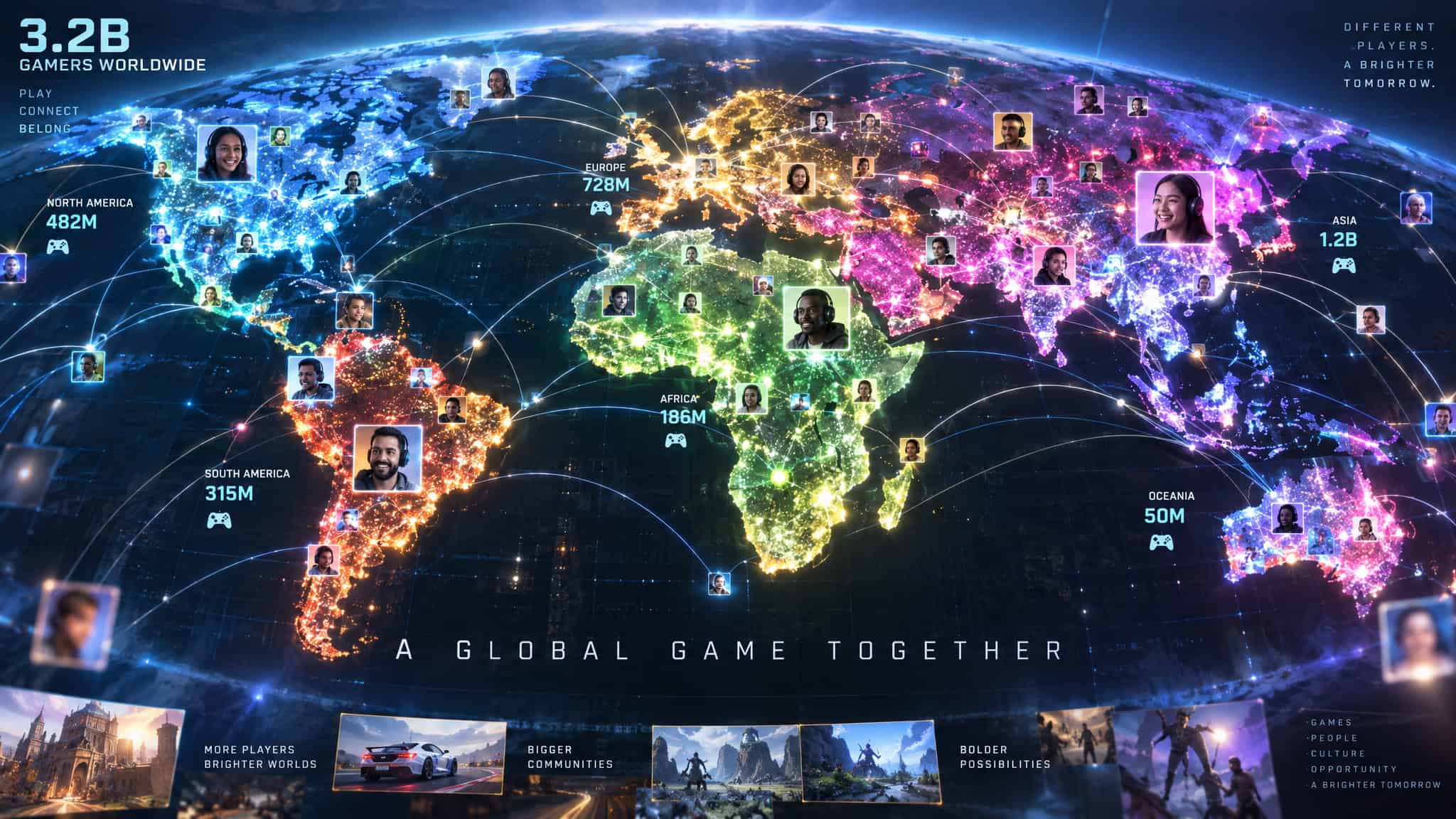
The global gaming audience reached 3.70 billion players in 2026 inside a $213.9 billion market, driven by massive smartphone adoption and steady growth across dedicated hardware. According to the Newzoo Global Games Market Report 2026 (cited in SQ Magazine’s September 2026 update and discussed in industry roundups by analysts Barry Elad and Robert A. Lee), global player numbers grew 4.4% year-over-year with 1.65 billion paying players (a 44.6% spender conversion rate), and the audience is projected to reach 4.07 billion players by 2029 at a 3.2% compound annual growth rate. By contrast, Statista Market Insights uses a separate modeling methodology that sized the 2026 market at $560.55 billion with 28.47% user penetration.
Player counts and market size
In Newzoo’s 2026 breakdown across overlapping device ecosystems (now spanning hardware like the Nintendo Switch 2 and services like Xbox Cloud Gaming), mobile carried 83.9% of the player base (3.10 billion players) and 56.6% of global revenue ($121.1 billion, up 6.8%). How many PC gamers are there? PC reached 977 million players (up 3.5%), boasting the highest spender conversion at 55% and generating $45.9 billion (up 5.3%), while consoles counted 651 million players (up 3.0%) and $46.9 billion in revenue (up 5.1%).
Who the average gamer is
The average gamer is 37 years old in the United States and 34 years old across Europe, though the exact age benchmark shifts with each survey’s age floor and sample year. If you want to know how many gamers are in the US and how gaming demographics by age break down, the ESA’s June 3, 2026 report counted 212.3 million weekly US players (up 3% or 7.2 million over 2025), with 67% of Americans aged 5 to 90 playing at least an hour a week. Weekly play rates hit 80%+ for Gen Alpha and Gen Z, 71% for Millennials, 56% for Gen X, 50% for Boomers, and 32% for the Silent Generation, with mobile ranking as the top device across every age group (and a 2025 systematic review and meta-analysis across 84 studies and 641,763 individuals placing pooled adolescent gaming disorder prevalence at 8.6%, 95% CI 6.9%, 10.8%, highest in China at 11.7%, with a 1.0%, 48.1% prediction interval due to differing screening tools). In-game purchase rates reached 69% for Gen Alpha, 78% for Gen Z, and 67% for Millennials at a $20 monthly median spend, while US adult players were 68% White, 22% Hispanic, and 15% Black or African American, with 39% employed full-time and 35% raising children.
Earlier US benchmarks also use different baselines, so it helps to look at them individually rather than averaging them together: the ESA’s 2024 report put the average US player age at 26 (with 29% aged 50+), Ipsos (2021-2022) recorded an average age of 31, and LukeBK noted Call of Duty groups averaging in their 40s with players in their 60s and 70s, plus his own mother playing Myst. In Europe, Video Games Europe’s 2025 report found 77% of its 199 million players were 18 or older: 17% aged 6-11, 16% aged 12-17, 13% each in the 18-24, 25-34, and 35-44 bands, 11% aged 45-54, 10% aged 55-64, and 6% aged 65-75.
Where the players are: regions and platforms
Asia-Pacific led global volume in 2026 with 1.94 billion players and roughly $100.7 billion in revenue (about 47% of the global total), the Middle East and Africa grew fastest at 640 million players (up 7.9% year-over-year), and China ($58.1 billion) plus the US ($53.5 billion) generated 52% of global consumer spending. Within Europe, Germany had more total players at 37.7 million (54% of its population) while France had a higher population share at 57% (31.5 million), alongside Italy (14.2 million), the Netherlands (9.9 million), Belgium (6.3 million), and Austria (6.1 million). On live platforms, Sony reported 125 million PlayStation monthly active users for the quarter ended June 30, 2026 (up from 123 million, below its December 2025 holiday peak of 133 million, with an 82% digital download ratio). Roblox reported over 120 million daily active users and $1.5 billion in revenue (up 36% year-over-year), with US over-18 daily users jumping 32% (and the 18-34 cohort up 42% in DAU and 27% in hours) to reach 27% of age-checked daily users while monetizing over 50% higher than under-18s. On PC, Steam hit 32,510,210 concurrent users with a 48-hour peak of 37,248,348 on September 17, 2026, led by Counter-Strike 2 (1,079,846), Dota 2 (796,570), PUBG: BATTLEGROUNDS (298,565), WARDOGS (293,809), and Valheim (199,965) alongside tactical staples like Battlefield.
How rare is a gamer girl? A conditional answer
Female gamers are common across the 3.70-billion-player global market at 45% to 47% overall, rarer on dedicated hardware at 35% of European PC players and 37% of console players, rarer by self-selected label with only 36% of women who play calling themselves “gamers,” and rarest in visible competitive and leadership rooms at roughly 5% of esports participants and 16% of top-15 studio executive teams. Factor in LukeBK’s observation that voice-chat harassment pushes women off-mic and under neutral handles, and even those published shares are floor estimates, proving that the 46% parity statistic and your male-heavy PC lobby are simply measuring different rooms in the same house.
Frequently Asked Questions
What percentage of gamers worldwide are female according to recent studies?
Major tracking firms place the global female share of video game players between 45% and 47%, with Newzoo reporting 45% and Bryter reporting 46%. In the United States, the Entertainment Software Association (ESA) and Statista similarly peg female participation at 46% to 47%. Viral claims of a 51% or 52% female majority only show up in isolated national snapshots—such as specific UK or US consumer samples—that cast a wide net over casual mobile play.
How do mobile gaming demographics compare to PC and console gaming demographics?
Smartphones are the great equalizer, whereas dedicated gaming hardware still skews noticeably male. Globally, 44% of women who game play exclusively on mobile compared to 27% of men, and in the US, 64% of women regularly play on smartphones versus 58% of men. Once you strip out phones and tablets, the rooms look very different: across 16 European markets, women make up 48% of mobile players, but only 37% of console players and 35% of PC players.
What are the most popular gaming genres for women versus men?
In Statista’s US breakdown, women gravitate most toward casual (39%), strategy (34%), and action titles (31%), while men favor action (48%), action-adventure (45%), and shooters (38%). That doesn’t mean women only touch puzzle apps, though. Bryter’s survey of female gamers averaging 20 hours of play a week found 56% regularly playing action-adventure, 49% playing shooters, and 47% dropping into battle royales.
What is the representation of women in the video game industry workforce?
Inside development studios and competitive arenas, women are genuinely scarce compared to the broader player base. Data from Women in Games shows that women held roughly 22% of global games industry jobs, occupied just 16% of executive team spots across the top 15 gaming companies, and accounted for about 5% (1 in 20) of people working or competing in esports. While that 22% workforce share is a notable jump from just 6% in 2009, leadership and pro play remain overwhelmingly male.
How many gamers are there in the world and what is the market size?
According to the Newzoo Global Games Market Report 2026, there were 3.70 billion players worldwide—including 1.65 billion paying players—generating $213.9 billion in revenue. Mobile carried the largest slice at 3.10 billion players and $121.1 billion in revenue, while PC reached 977 million players ($45.9 billion) and consoles hit 651 million players ($46.9 billion). Using a broader modeling methodology, Statista Market Insights sized the 2026 global market at $560.55 billion with 28.47% user penetration.
How rare is a gamer girl?
It depends entirely on which room you walk into. Across the 3.70-billion-player global ecosystem, women are not rare at all, making up 45% to 47% of everyone who plays. They become noticeably less common on dedicated hardware (35% of European PC players and 37% on console), rarer still if you only count the 36% of female players who embrace the “gamer” label, and genuinely rare on esports stages at roughly 5%.
