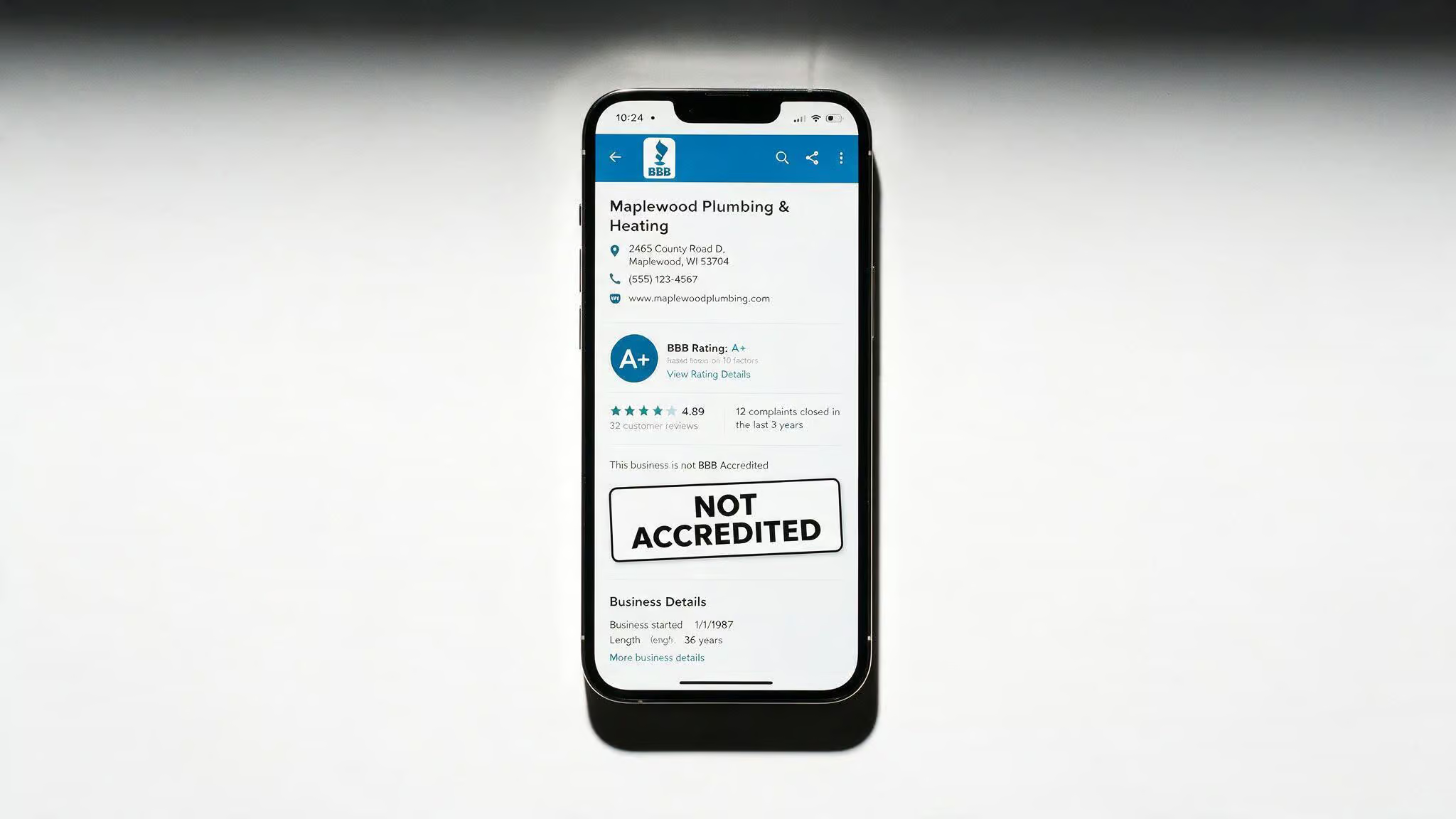
So you’ve been eyeing Public Mobile’s dirt-cheap plans. $34 for 50GB? $29 for Canada-US roaming? The $34 for 50GB and $29 for Canada-US roaming look great on paper. But then you hit Google with “Public Mobile BBB rating and complaints,” and suddenly you’re staring at a Better Business Bureau page that screams “NOT Accredited” and lists 57 complaints. Half of them say “Unanswered.”
What do you do with that information? Is this a carrier you can trust, or a budget trap? I spent a while digging through the BBB profile, reading the actual complaint narratives, and cross-referencing user experiences on Trustpilot and Reddit. Here’s what the data says — and what it doesn’t.
Key Takeaways
Public Mobile is not BBB Accredited, and that’s a common choice among large telecoms — Telus, Rogers, and Bell aren’t accredited either. Accreditation is a paid membership, not a quality certification.
57 complaints over 3 years is 57 complaints over three years for a carrier with millions of subscribers, but the 57 complaints undercount real issues because the BBB does not verify third-party information and consumers can opt out.
The real risk isn’t network quality (it’s Telus infrastructure) but the self-service support model — no phone support, AI chatbots, and a community forum that can solve problems fast but only if you’re comfortable navigating it yourself.
Table of Contents
Why should you care about Public Mobile’s BBB profile?
The BBB profile is often the first place people check when evaluating a carrier’s trustworthiness, but its meaning is easy to misinterpret.
BBB accreditation — what “not accredited” actually means
Public Mobile’s BBB profile states plainly: This business is NOT a BBB Accredited Business. If you’re used to seeing an A+ rating on other companies, that line jumps out. But the meaning isn’t what most people assume.
What BBB accreditation is (and isn’t)
BBB accreditation is a paid membership program. Businesses pay a fee, agree to certain standards, and get to display the BBB Accredited seal. It’s not a government endorsement, a quality certification, or a guarantee of good service. It’s closer to a Better Business Bureau subscription.
So when Public Mobile doesn’t have that seal, it means they chose not to sign up for the membership program. It doesn’t mean the BBB investigated them and found them lacking. The BBB doesn’t rate or endorse businesses — they just maintain profiles based on information they collect.
Why many telecoms skip accreditation
Here’s the pattern: large telecoms with established brand recognition often skip BBB accreditation because the marginal value is low. Telus isn’t accredited. Rogers isn’t accredited. Bell isn’t accredited. Public Mobile is owned by Telus, so their decision to skip accreditation fits that pattern.
Complaint volume — 57 complaints in three years
The headline number on the BBB profile shows 57 total complaints in the last 3 years, with 6 complaints closed in the last 12 months. That sounds alarming until you put it in context.
What the numbers look like in context
Public Mobile has millions of subscribers, per Telus ownership. For a carrier of that size, 57 complaints over three years isn’t a high number. The tell is the ratio. Compare that to major telecoms that can rack up thousands of BBB complaints in a single year, and 57 starts looking pretty good.
The BBB disclaimer you should not ignore
Here’s the catch: the BBB’s own page states that complaint text displayed may not represent all complaints. Consumers can opt out of having their complaints published. Some complaints do not meet the BBB’s publication standards. And some customers resolve issues directly with the company without ever involving the BBB.
Field note: The BBB’s complaint count is a lower bound, not a complete audit — opt-outs and unpublished complaints mean the real number is higher but unmeasurable from this data alone.
Understanding BBB complaint statuses — what “unanswered” really means
This is where most people get misled. The BBB labels each complaint with a status, and some of those labels look damning until you understand what they mean.
The five statuses defined
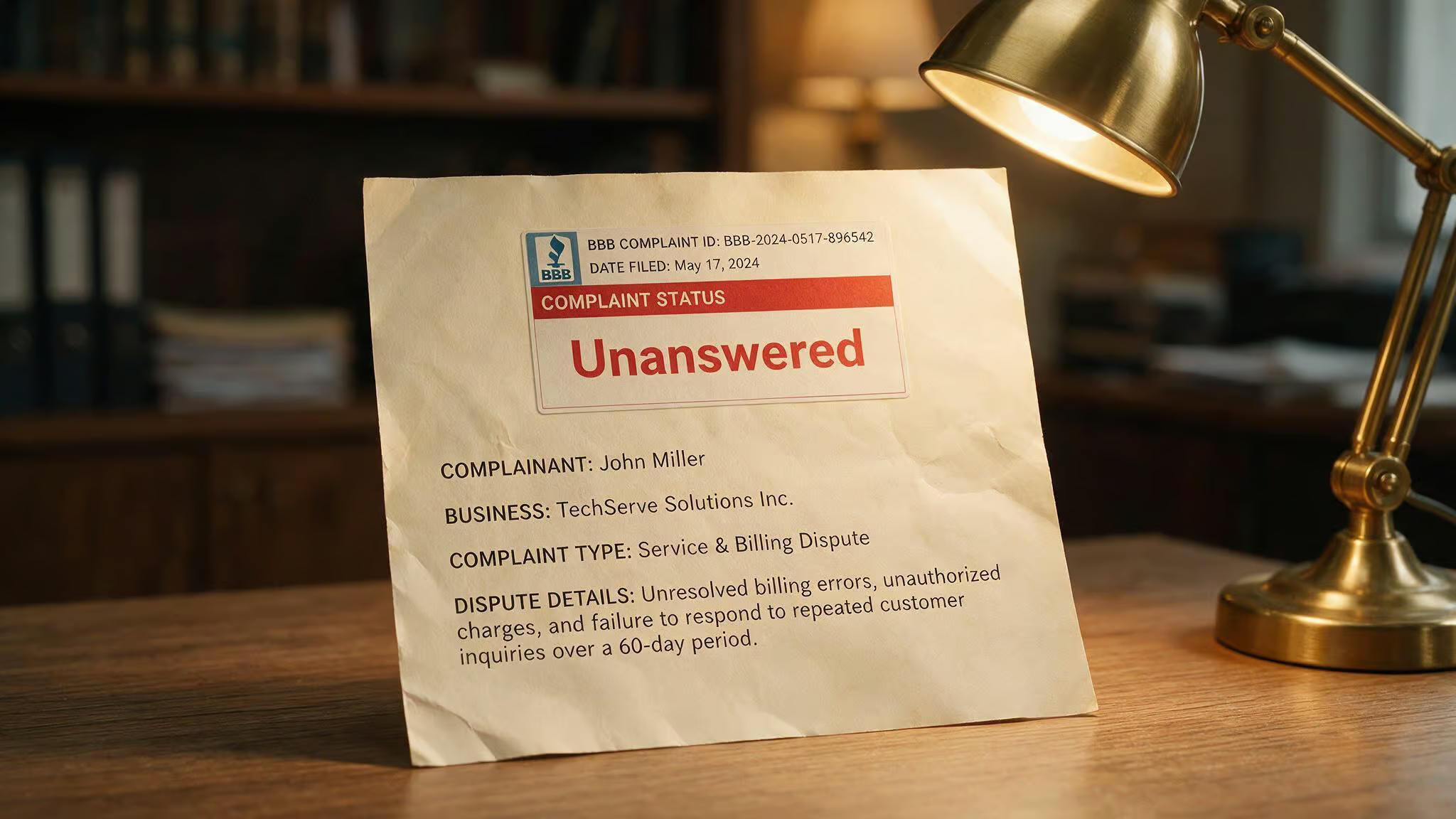
The BBB uses five categories: Resolved, Unresolved, Answered, Unanswered, and Unpursuable:
- Resolved — The business addressed the issue, and the customer confirmed they’re satisfied.
- Unresolved — The business responded, but the BBB determined they didn’t make a good-faith effort to resolve it.
- Answered — The business responded, but the customer either didn’t accept the response or didn’t update the BBB.
- Unanswered — The business didn’t respond to the BBB at all.
- Unpursuable — The BBB couldn’t locate the business to follow up.
Why “unanswered” is easily misinterpreted
When a complaint shows as “Unanswered,” it means Public Mobile failed to respond to the BBB’s inquiry. It doesn’t mean the customer was ignored or that their issue went unresolved. The BBB’s definition leaves room for the business to have resolved the issue directly with the customer, outside the BBB process, without notifying the BBB.
Some of them might have been handled through direct contact, the community forum, or another channel. The label reflects a gap in the BBB’s notification system, not necessarily a gap in service.
What this means for evaluating Public Mobile
Several of the 11 visible complaint examples carry “Unanswered” status. The pattern to watch for is the distribution of statuses — if most complaints are “Unresolved” or “Unanswered,” that suggests systemic issues, but a broader look at Public Mobile reviews Reddit can reveal the real long-term consensus. If most are “Resolved,” that’s a better sign.
Common complaints — what customers are reporting
The BBB profile includes 11 example complaints that show the kinds of problems people run into. Grouped by theme, here’s what shows up.
Mis-selling and setup issues
A kiosk employee sold a $15 prepaid plan allegedly as prepaid; the customer wanted to cancel but encountered difficulty due to no live customer support (only AI chatbots). When they tried to cancel, there was no live customer support — only AI chatbots. The complaint shows as “Unanswered.”
Another customer tried to set up an account, encountered issues, received no support, and cancelled the same day. Also unanswered.
Pattern: if something goes wrong during signup, the lack of phone support makes a simple problem nearly impossible to fix. The takeaway: verify your plan details yourself and test activation immediately after signing up.
Billing, payment, and service suspension
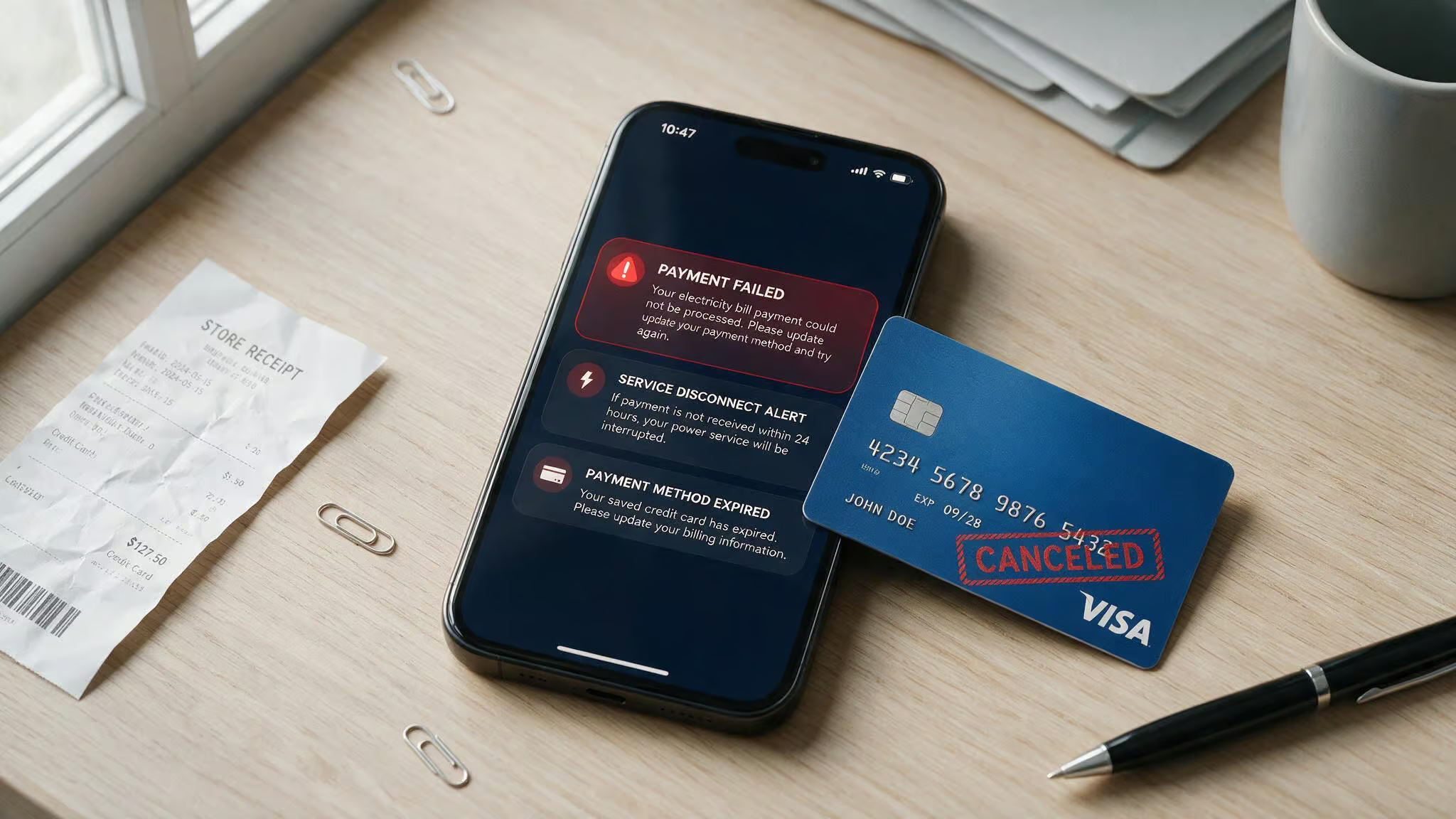
This is the category that jumps out. One customer cancelled their old credit card and got a new one. Public Mobile’s system still had the old card on file. When the payment failed on 27/02/2026, Public Mobile cut the service with zero communication — no email, no courtesy message.
The customer had to wait 6 months to complete the reactivation. That complaint eventually showed as resolved.
Another customer lost their credit card, cancelled it, and got a new one. Same scenario: Public Mobile tried the old card, it failed, and service was cut with zero communication (no email, no courtesy message).
The pattern here is clear. Public Mobile doesn’t seem to send proactive notifications when a payment fails. You find out when your service stops working. If you’re not monitoring your account regularly, you could be without service for days.
The takeaway: keep your payment method current and check your account periodically. Public Mobile may not warn you.
eSIM, 5G, and technical provisioning failures
One customer bought an eSIM that did not work at all. Public Mobile refused a refund. The complaint later showed as resolved, so either the company or the BBB eventually stepped in.
Another customer had a 5G plan and a fully compatible Canadian 5G phone, but Public Mobile’s SIM only connected to LTE. The same SIM worked fine on 5G in another phone. The customer suspected an IMEI provisioning issue on Public Mobile’s backend. That complaint also showed as resolved.
Pattern: backend provisioning problems that require escalation to fix. If you buy an eSIM or expect 5G, test it within the 15-day return window. Escalation can work, but it takes effort.
Port-out problems and carrier lock-in
This one is problematic. A customer tried to port their number to another carrier, but Public Mobile refused to release it unless the customer paid for prepaid services in advance. After the complaint was filed, Telus (the parent company) sent a check for $39.55 to resolve the issue.
So the pattern is: Public Mobile used the prepaid balance requirement as a barrier to switching. The takeaway: make sure your prepaid balance is zero before initiating a port-out. If you run into trouble, escalate to Telus directly — they have the power to fix things.
Device incompatibility after network upgrades
An 86-year-old grandmother’s service stopped working after a network upgrade text on March 14, 2025; she could not make or receive calls. She couldn’t make or receive calls. With no live customer support available to call, her family had to step in. The complaint shows as filed under billing issues, but the real problem was service disruption after a network change.
Another customer, with Public Mobile since 2016, experienced service loss on his phone after a network upgrade. The SIM worked fine in other phones, and other SIMs worked fine in their phone, but the combo failed. Public Mobile told the customer to buy a new phone (~$500 CAD), which is the kind of frustrating policy you’d expect to see dissected in a no-hype, deep-dive Public Mobile review.
Pattern: network upgrades can break older devices, and Public Mobile offers no proactive support or replacement. If you get a network upgrade notice, check device compatibility before the change takes effect—our forward?looking Public Mobile reviews 2025 examines how the carrier handles these transitions as 5G expands.
Fulfillment and refund issues
A customer ordered a SIM card on a prepaid plan; it never arrived after 15 business days. They went with another provider. Public Mobile refused a refund for the SIM card cost, only offered to ship another. The complaint shows as “Unanswered.”
Pattern: refusing refunds for undelivered physical goods. Takeaway: use tracking numbers or buy from retail locations for physical SIMs.
The price-service tradeoff — why experiences are so polarized
User JFBR says it’s the best carrier they’ve ever had. User Madelineb calls it the worst provider in the country.
How the self-service model creates the tradeoff
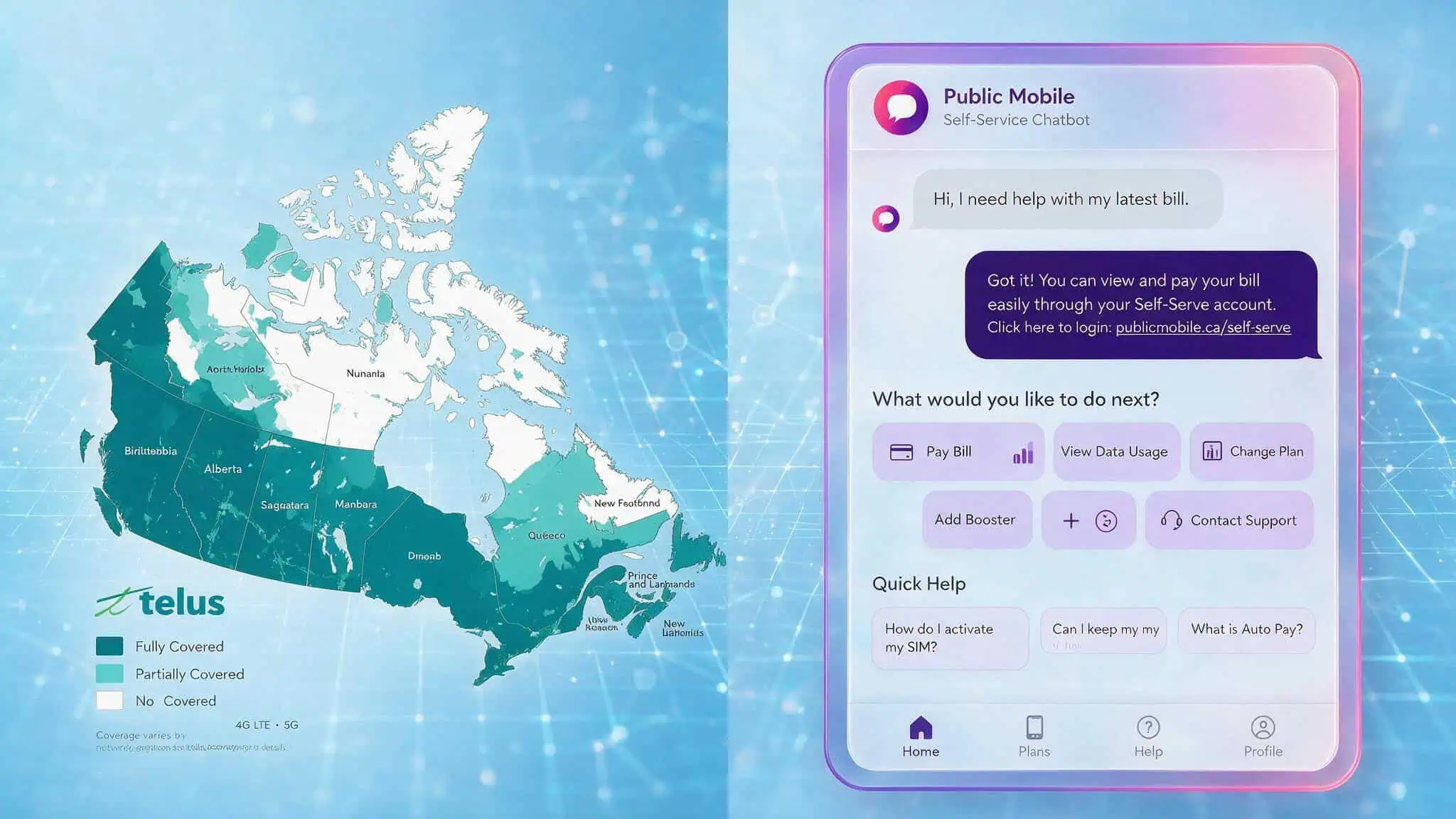
Public Mobile has no phone support. None. If something goes wrong, you’re stuck with a community forum and chatbots. That lack of live support is how they keep prices so low — they’re not paying for call centers.
For customers who never need support, the savings are half the price of both Rogers and Telus. The network is Telus infrastructure, so coverage and speed are identical to Telus for half the price. One user reported that reception in Canada and the US was exactly the same as Telus after a year of use.
For customers who do need support, the experience can be brutal. Simple problems like a wrong plan or a failed payment become multi-day ordeals with no clear escalation path.
What users actually say — the polarized testimonies
Trustpilot gives Public Mobile 1.6 stars out of 5. Most reviews say ‘stay away.’ User Madelineb wrote ‘Definitely stay away! Worst cell phone provider in the country.
Zero customer service.’ User Michael916 said ‘So far, having a really bad experience on Public Mobile.’
But there are also positive reviews. User JFBR reported that after 1 year, reception in Canada and US is identical to Telus for half the price of both Rogers and Telus, and includes US/Mexico calling/roaming.
The Telus connection — network quality and escalation paths
Public Mobile is owned by Telus and runs on the Telus network. That’s a significant detail because it means the network itself is solid. The complaints on the BBB profile are about customer support, not coverage or speed.
One complaint example shows how this plays out in practice. When a customer could not port their number out due to Public Mobile’s policy, the parent company Telus stepped in and sent a check for $39.55 to resolve the issue. So escalation to Telus can work, but it requires effort and persistence.
The takeaway: the network is the strong point. If you’re worried about coverage, don’t be — it’s Telus infrastructure. But don’t expect Telus-level support. That’s the whole tradeoff.
What the BBB data doesn’t tell you — limitations and cross-referencing
The BBB profile provides a useful starting point, but it has blind spots that can distort your view of Public Mobile’s actual performance.
The biases baked into BBB data
The BBB doesn’t verify third-party information. Complaints are self-reported by customers, and not all complaints meet the BBB’s publication standards. Some consumers opt out entirely. So the 57 complaints represent a lower bound, not a complete count.
Where to look for the full picture
- Reddit — Subreddits like r/PublicMobile and r/CanadianCell have unfiltered real-time user experiences. You’ll see troubleshooting threads, complaints, and workarounds that don’t appear on the BBB.
- Trustpilot — Aggregate sentiment across hundreds of reviews. The 1.6 rating is brutal, but reading the actual reviews gives you a sense of what goes wrong.
- Public Mobile’s own community forum — Useful for seeing how support operates in practice. Some issues get solved quickly by other users or moderators.
- Direct comparison — Check BBB profiles for other Canadian carriers to see how their complaint volumes compare.
What the BBB data actually tells you about Public Mobile
The BBB data shows 57 complaints over three years — a relatively low number for a carrier with millions of subscribers. Non-accreditation is common among large telecoms — Telus, Rogers, and Bell aren’t accredited either — and tells you about business priorities, not service quality. The complaint statuses are ambiguous and don’t automatically mean customers were ignored.
But the complaint examples reveal a clear pattern: when things go wrong, the self-service model makes them worse. Billing errors, provisioning failures, and device incompatibility issues become multi-day problems because there’s no live customer support to call.
The real tradeoff is this:
If you’re technically self-sufficient — comfortable with forums, chatbots, and managing your account without handholding. Public Mobile offers excellent value. The Telus network is solid, the prices are half of both Rogers and Telus, and the community forum can solve most problems faster than calling Rogers support.
If you anticipate needing phone support — have a complex setup, travel frequently, or just want the ability to call someone when something breaks, a carrier with live support is worth the premium. Public Mobile’s model works great when it works, but when it doesn’t, the absence of human help is painful.
Frequently Asked Questions
What is going on with Public Mobile?
Public Mobile is a budget-friendly telecom owned by Telus, offering low-cost plans by cutting live customer support entirely. The tradeoff is a self-service model with AI chatbots and a community forum, which works great if you’re tech-savvy but can be brutal if something goes wrong.
What does ‘unanswered’ mean on Public Mobile’s BBB complaints?
It means Public Mobile didn’t respond to the BBB’s inquiry about a complaint, not necessarily that the customer was ignored. The company may have resolved the issue directly with the customer outside the BBB process without notifying them. It’s a gap in the BBB’s tracking, not proof of bad service.
Why are Public Mobile reviews so polarized?
Because the experience depends entirely on whether you ever need support. If everything works, you get Telus network quality for half the price and love it. If something breaks — billing error, failed eSIM, network upgrade killing your device — the lack of phone support turns a simple fix into a multi-day headache.