
If you’ve ever spent too long wondering how a video game fits a mathematically impossible amount of content onto a standard solid-state drive, the answer is a hardcore programming survival tactic called procedural generation. Procedural generation is just a clever engineering trick that swaps static file storage with algorithmic synthesis, where content is calculated in real-time rather than stored. This shifts the developers’ workload from asset creation to rule-based systems design, optimizing data architecture by offloading content generation to the user’s hardware.
Key Takeaways
No Man’s Sky famously relies on algorithm-driven code to mathematically generate up to 18.4 quintillion unique planets on the fly, entirely bypassing the need to store them as traditional data files.
Infinite procedural content without sufficient human-guided constraints inevitably creates “procedural oatmeal,” a design paradox where systems output billions of technically unique but perceptually identical items.
Modern hardware has shifted the generative bottleneck from pure storage capacity to real-time NPU computing, meaning future game simulations will increasingly rely on advanced on-device AI processors rather than classic hard drives.
Table of Contents
Procedural generation in games: The engine of infinite scale
When you play a modern open-world title, you assume every rock, tree, and coastline exists as a static asset saved somewhere on a server. Procedural generation is a method of synthesizing data algorithmically using computer-generated randomness and processing power rather than storing it manually. Drawing on the same sophisticated principles of random number generation that deliver fair, thrilling, and dynamic entertainment at a BetMGM online casino for example, game creators use these algorithms to build massive environments on the fly. By ditching static manual assets for algorithmic synthesis, developers gain significant storage efficiency, memory optimization, and the capacity for exponential replayability.
Instead of an environment artist placing thousands of individual pine trees, the software employs a deterministic engine fed by a single random seed. This mathematical logic dictates that every time the engine reads that specific seed, it unpacks the exact same forest, in the exact same arrangement, for every player who encounters it. Using deterministic seeds helps developers lock in cross-platform consistency and keep memory stable. The result is a brutal, hyper-efficient trade-off: you are ditching storage constraints for a heavy reliance on real-time generative throughput.
Nowhere is this computational muscleflex more evident than in the No Man’s Sky universe generation. No Man’s Sky makes heavy use of procedural algorithms to generate its vast cosmos, while titles like Minecraft and Dwarf Fortress use voxel and pixel-based logic to synthesize totally distinct biomes for each player session. Using this exact methodology, the game spins up 18.4 quintillion planets. You are not downloading an endless cosmos; you are downloading the algorithm that knows how to build it whenever you look at it.
This shifts the creator’s role toward systems-rule architecture. Today’s developer design leads act less like manual artisans rendering fixed landscapes, and far more like systems-rule architects orchestrating the physics, biology, and logic of a self-assembling world. Procedural methods actually started as early desperate attempts to create maps via fractals and pseudo-random number generators to overcome limited storage capacity.
From tabletop constraints to early digital survival
Long before this was an AI-adjacent buzzword, procedurality was analog. The entire concept traces its roots back to tabletop RPGs like Advanced Dungeons & Dragons, where unpredictable encounters were dictated by the roll of a die and complex, branching procedural tables.
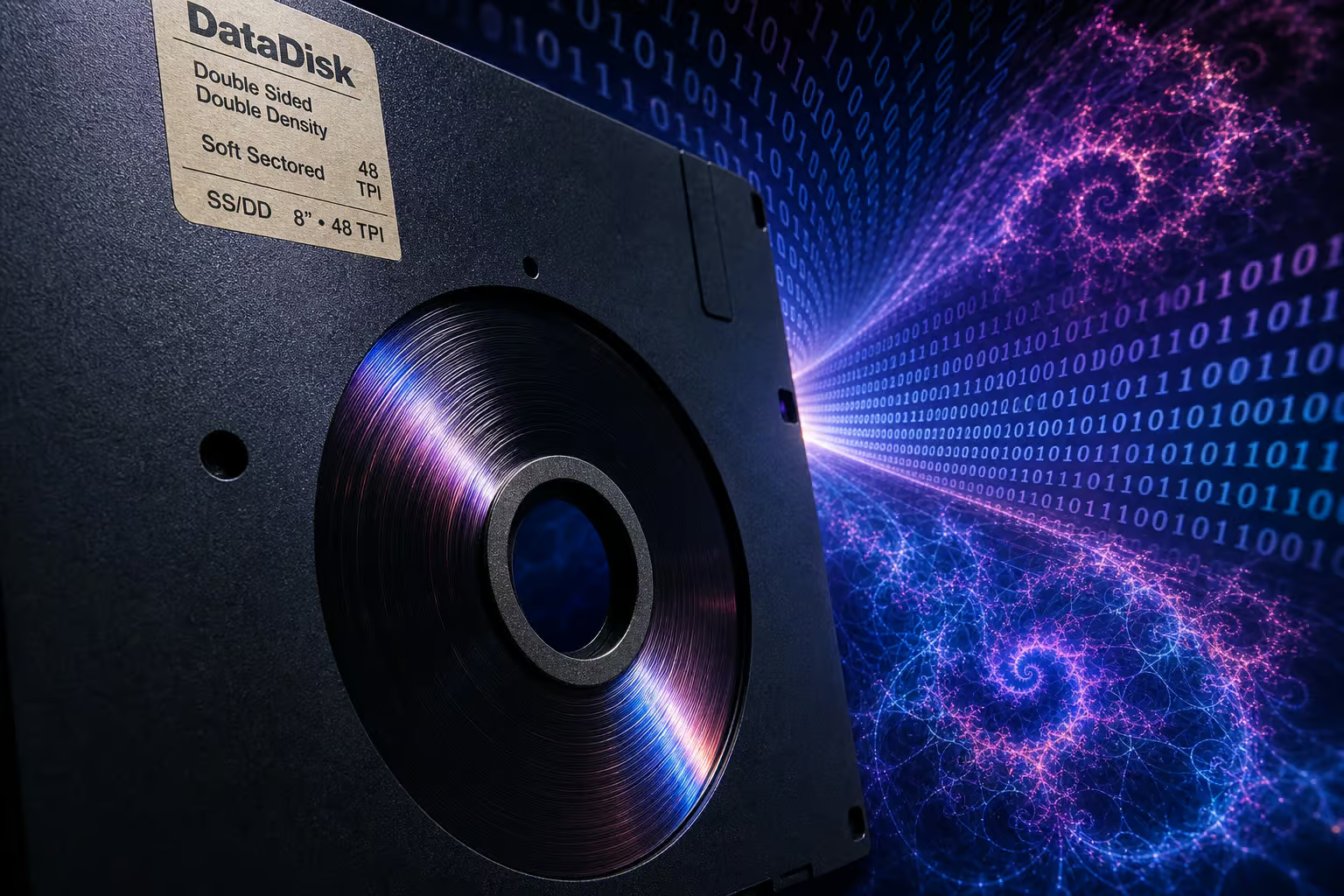
When developers started writing early computer games, they didn’t adopt procedural strategies to create “infinite replayability”—they did it to survive. Early 1980s computing had such severe memory optimization limits that mapping out a handful of fixed levels could max out a floppy disk. To bypass these limitations in games like Rogue, developers used clever math like fractals, linear feedback shift registers, and pseudorandom number generators (PRNGs) to calculate maps on the fly rather than saving them to disk.
It was a masterclass in aggressive footprint reduction. Historically, titles like The Sentinel used these mathematical hacks to pack something to the tune of 10,000 distinct, playable environments into an unbelievably tiny 64kb of space. It worked because the code only had to remember the instructions to build the maze, not the maze itself.
Similar to the efficient algorithms running modern digital gaming platforms, it works because the code only has to remember the instructions to build the maze—not the maze itself. That’s a foundational bit of efficiency that’s still vital for fast, low-latency gaming.
Algorithmic expansion and the end of file size limits
By alleviating the manual effort required to draw and sculpt complex environments, algorithmic systems provide immense development benefits. Gamers get smaller file sizes, optimized memory use, and exponential increases in replayability through sheer content volume.
Crafting infinite geographies
You can clearly see these benefits in landmark titles like Minecraft and Dwarf Fortress. These games don’t ship with pre-built maps. When you boot up a new save, the codebase effectively ships with the molecular instructions on how to generate the world. The procedural generator leverages voxel and pixel-based logic to synthesize totally distinct biomes, mountain ranges, and caverns every single time the math runs, making a unique geography for every player.
The illusion of the cosmos
Space trading simulators leverage procedural generation to build large sandboxes, such as Elite: Dangerous (400 billion stars). Elite: Dangerous mapped out 400 billion stars modeled on the Milky Way strictly through footprint-reducing mathematical generation. Returning to fantasy, even heavy hitters from decades past like The Elder Scrolls: Daggerfall relied on algorithms to procedurally generate a landmass roughly two-thirds the size of the British Isles. The scale is an illusion born of efficient coding.

Avoiding the procedural oatmeal paradox
Without sufficient human-guided parameters, users perceive procedurally generated items as identical, a design challenge Kate Compton defined as procedural oatmeal.

The necessity of human-guided constraints
This specific failure state is known as “procedural oatmeal,” a wonderfully descriptive term coined by designer Kate Compton. It describes the problem where algorithms generate a boundless array of content that is technically distinct in the codebase, but lacks perceived uniqueness to human eyes. Without sufficient human-guided parameters, users see the same bland bowls of oatmeal over and over again.
To avoid chaotic static, developers filter their systems through smooth, natural-looking mathematical functions. A great example is relying on coherent noise, rather than raw randomization, often utilizing variants of simplex noise or Perlin noise to ensure mountain ranges look like organic mountains rather than frantic, jagged spikes of bad data.
Balancing systemic rules and meaningful loot
Loot systems in action RPGs share this friction point. If a system can generate a million guns, they will quickly feel like oatmeal if there is no rule-based agency bounds keeping the experience coherent. Look at the loot generation in Borderlands. The algorithm produces millions of weapons by combining random grips, barrels, and scopes, but it remains engaging because the systemic rules enforce a strict balancing index behind the scenes to guarantee weapon rarity feels earned and functional.
If a system for making games with AI can generate a million guns, they will quickly feel like oatmeal if there is no rule-based agency bounds to differentiate functional quality from empty volume.
Simulating crowds, cities, and generative music
Procedural logic provides a framework for synthesizing complex, real-world variables in non-gaming industries. Developers don’t stop at games: these systems are becoming a staple in film production for ambient music composition, and urban planning simulations for AI training. We’re seeing procedural engines build digital twins mapping out industrial equipment, creating perfect virtual replicas for mechanical stress testing.
In film production, MASSIVE software uses behavioral code to simulate crowds on the fly. Instead of manually animating crowds, artists use MASSIVE software with skeletal and collision rules to generate unique, reactive crowd dynamics.
Even audio has been touched by this logic. The legendary Brian Eno heavily popularized the concept of “generative music,” setting up ambient structural rules that allow digital instruments to compose endless, non-repeating scores. Today, autonomous driving AI requires millions of hours of driving experience to function smoothly; rather than driving cars physically for a decade, engineers spin up procedurally generated cityscapes and traffic conditions to feed large training data sets directly to the vehicle’s brain.
The modern procedural budget and hardware synergy
As we’ve established, procedural rendering trades static storage for active computing. Modern procedural workloads rely heavily on localized hardware acceleration, particularly for real-time calculation of complex environments. But the leap from primitive, storage-constrained 1980s maps to today’s real-time continuous generation creates a new hardware requirement. If your system can’t compute the algorithm fast enough, the game stutters or crashes. To solve this, developers are aggressively integrating advanced hardware directly into their modern procedural budget.

Instead of blowing out the CPU, the workload is leaning on hardware-accelerated local NPU processing. Devices like the Lenovo Yoga Slim 7x, powered by Snapdragon X Series NPUs, execute real-time simulation tasks while supporting a 30-hour battery life. We’re looking at environments where local generative hardware can simultaneously power complex algorithmic synthesis and manage a 30-hour battery life context for peak efficiency.
Deep learning, casino mechanics, and the AI frontier
When you take standard, rule-based procedural generators and supercharge them with Generative AI and deep learning neural networks, the nature of infinite media changes. Modern architectures are starting to leverage LSTMs, GANs, and Large Language Models to move beyond fixed rules into more expressive and unpredictable generative outputs. Modern developer architectures are already integrating LSTMs, GANs, and robust Large Language Models to handle complex level design upgrades. To subvert the predictable, repetitive patterns that plague traditional algorithms, developers use diversity sampling parameters inside neural frameworks to force the engine into rendering creative, novel assets.
But looking forward, procedural generation’s weirdest algorithmic frontier might be applying this tech to high-stakes gambling environments. Imagine online casino mechanics merging with deep learning to build highly adaptive, behavior-responsive architectures. Current casino interfaces are mostly static platforms overlaid with basic algorithms, but robust AI integration creates the potential for active real-time feedback loops.
Instead of playing a fixed slot game, a predictive AI could use procedural mapping to build dynamic betting environments, risk/reward structures, and custom player journeys, rewriting the mathematical felt underneath you as it learns your specific psychological playstyle. Procedural generation in games started as a desperate method to squeeze stick figures onto 64kb floppy disks, but as machine learning takes the wheel, its final form involves building realities that know exactly how to play you back.
Frequently Asked Questions
What is a procedural generation game?
A procedural generation game uses mathematical algorithms to create content on the fly instead of relying on manually saved files. Rather than downloading and storing every rock or tree, your device uses instructions to build the world in real-time as you play.
What is procedural content generation in gaming?
This is a technique where developers write rule-based systems to synthesize game assets dynamically. It shifts the designer’s job from placing individual items to building the logic that tells the computer how to construct those items, allowing for vast scales like infinite planetary systems.
What is an example of a procedural generation game?
No Man’s Sky is a prime example, using algorithms to generate up to 18.4 quintillion unique planets without storing them as static data. Other notable titles include Minecraft, which builds unique biomes every time a new session starts, and the classic dungeon crawler Rogue.
What games use procedural generation?
Many titles spanning different genres use this method to save storage space and increase replayability. Well-known games like Elite: Dangerous use it to simulate entire galaxies, while action games like Borderlands use it to generate massive amounts of varied loot through combined weapon parts.
Why does procedurally generated content sometimes feel repetitive or boring?
This phenomenon, known as ‘procedural oatmeal,’ happens when a game uses raw randomization without enough human-guided constraints. While the contents are technically unique, they lack meaningful variety, leading to the perception that you are seeing the same bland output over and over again.
How does shifting from static storage to real-time calculation affect hardware?
Procedural generation trades disk storage for heavy computing power, putting the burden of ‘building’ the game on the user’s processor. As developers push for more complex simulations, the load is increasingly shifting to dedicated hardware like NPUs to handle the intense, real-time math required for world-building.
What’s the difference between simple procedural generation and AI-driven generation?
Traditional procedural generation follows strict, predictable rules, like using a specific numerical seed to ensure a forest looks the same for every player. Modern AI-driven approaches use neural networks to move beyond these fixed rules, aiming for more expressive, unpredictable, and adaptive outcomes.