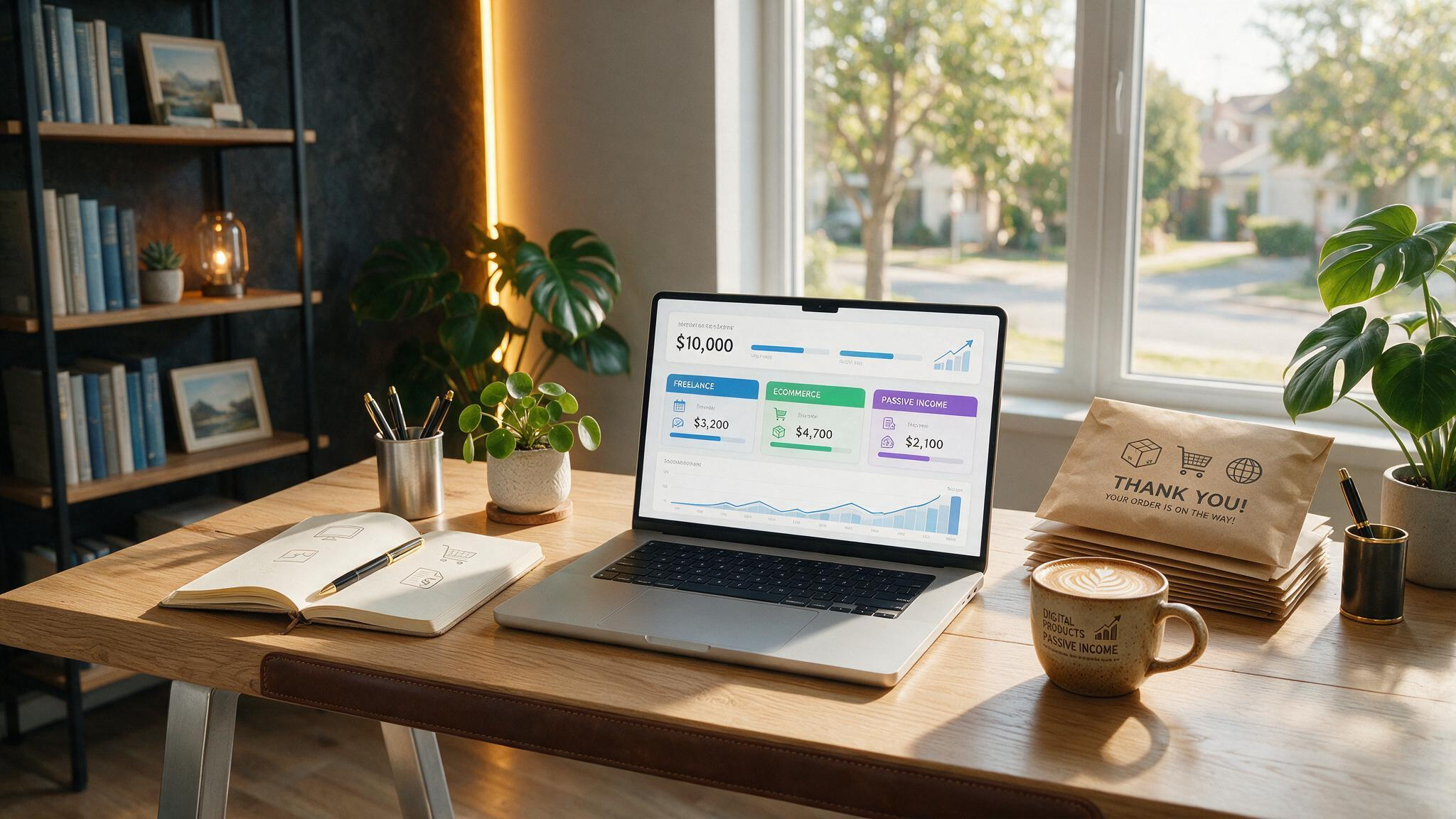
Every “make money online” article starts with the same promise. But nobody tells you when the money actually lands.
The gap between “I landed a gig” and “I have cash in my account” is where most side-hustle plans fall apart. You see a $1,000/week ad, get excited, pick a method — and find out the payout is 60 days out while rent is due Friday. At GeekExtreme, we read the fine print so you don’t have to. So here’s the framework: your best strategy depends on when you need the money, not just how much it can earn.
Let’s break down the five income categories by something actually useful: cash-flow timeline.
| Method | When money lands | Notes |
|---|---|---|
| Uber Instant Pay (rides/food) | Same-day, up to 6x/day | $1.25 fee for debit cash-out |
| Freelance writing (Upwork/Fiverr) | 5–14 days after client approval | Fastest service-based cash |
| Print-on-demand (Printify) | Per sale, ongoing | No inventory, but first sale takes weeks |
| Amazon Associates | 60-day payout delay | Commission 1–10% by category |
And one legal flag before we go any further: the IRS requires you to file a tax return if your self-employment income exceeds $400. More on that later.
Key Takeaways
Freelance work can pay within 5–14 days and requires zero upfront — best for immediate cash needs.
Print-on-demand via Printify has zero inventory cost and a free AI design tool, but marketing is entirely on you.
Gig work like Uber delivers same-day cash but caps out at roughly 45 hours/week for $1,000 before expenses.
Table of Contents
Freelance & Service-Based Work: Fastest Path to Cash
Freelancing is the closest thing to a “money this month” option in the online-income world. You can land a gig this week, work it, and get paid inside two weeks. The tradeoff is that you’re trading time for money — no leverage, but also no waiting.

Payout timing is the detail here. Freelance writers on Upwork and Fiverr typically get paid 5 to 14 days after client approval — not when you hit “submit.” That buffer matters for budgeting.
Freelance Writer
The classic online income. Copywriters, ghostwriters, resume writers, SEO writers, technical writers — if you can string sentences together, there’s a market for it. No formal degree required; a portfolio of strong clips is the credential.
- Hourly rate: $15–$65/hour depending on niche and experience
- Per-piece rate: $50–$500+
- Platforms: Fiverr, Upwork, Freelancer, Indeed, LinkedIn, FlexJobs, Guru.com, Mediabistro
- Payout: 5–14 days after client approval
- Portfolio: Squarespace or Wix for a pro-looking site
- Gear: Just a laptop and reliable internet
A common pattern in side-hustle communities: new writers underprice to land first gigs, then struggle to raise rates without losing clients. The trick is to start with volume (low price, many small jobs) and pivot to value (fewer, better-paying clients) once you have testimonials.
Virtual Assistant
You handle admin tasks — email management, scheduling, travel, data entry, from your living room. The U.S. Bureau of Labor Statistics predicted the profession to grow faster than average through 2022, and remote VA work is still a solid entry point.
- Rate: $10–$20/hour for standard tasks
- Higher-level VA: Hiring, contract negotiation can command more
- No college degree required
- Platforms: Upwork, Fancy Hands, Zirtual
- Required skills: Organization, communication, time management
Transcription and Data Entry
These are the low-barrier, modest-pay options. Treat them as stackable streams, not your $1k/week anchor.
- Transcription: Turn audio into text. Platforms like Rev and TranscribeMe handle client matching. No experience needed.
- Data entry: Type text or numbers into digital forms. Decent spelling and grammar required; sometimes you upload images.
- Pay: Around $11/hour, up to $17 with specialized skills
Graphic Design & Video Editing
Short-form video (TikTok, YouTube Shorts) has increased demand for editors. Small businesses, influencers, and brands all need help.
- Graphic design: Logo design, website design, social media graphics, selling printables. Average hourly rate just under $35.
- Platforms: 99designs, DesignCrowd, Dribbble
- Basic skills cut lead time: You don’t need to be a pro to start.
Bookkeeping & IT Support
Boring but dependable. These are remote roles with rate ranges.
- Bookkeeping: Payroll, transaction recording, monitoring accounts. $17–$34/hour. Find clients via local business owners, job boards, Freelancer, FlexJobs.
- IT support: Average $25.77/hour (Indeed). Charge more for specialties like coding or cybersecurity.
Marketing Services & Consulting
If you can drive traffic or build an audience, businesses will pay. SEO, email marketing, paid ads, social media management.
- Freelance social media managers: $14–$35/hour on Upwork
- Find clients: Fiverr, Upwork; portfolio website with testimonials helps
- Consulting: Extremely lucrative if you have real expertise — you set your own hours.
Niche Freelance Services
These are less-common options that most side-hustle lists skip. If any fits your skills, it can be a stream.
- Micro-coaching: Resume reviews, LinkedIn audits, budget breakdowns. $50–$200 per session; 5–20 sessions/month gets you to $1,000/month.
- Voiceover & faceless content: Sample recordings on Fiverr or Voices.com. Projects range from $20 to a few hundred dollars.
- Remote customer support: $15–$25/hour, part-time, flexible scheduling. Find on Indeed, FlexJobs, or company career pages.
- Data annotation: Label data for machine learning and AI models. Connects freelancers to companies.
- Yelp moderator: Review flagged content for platform guidelines.
- Personalized meal prep: Market through word of mouth, social media, local Facebook groups.
- AI freelance work: Use ChatGPT to write social media posts, create AI chatbots for businesses, sell AI-generated content or artwork, provide AI-assisted video editing, teach entrepreneurs how to write AI prompts.
eCommerce & Product-Based Income: Scalable but Slower
Here’s the tradeoff: if you need money this month, reselling things you already own beats print-on-demand. If you can wait and want a system that scales, POD wins. The speed-to-sale curve is the story.

Print-on-Demand with Printify
No inventory, no upfront costs. You design stuff, Printify’s network of suppliers prints and ships it. You only pay when a sale happens. Free account.
- Catalog: Over 2,000 customizable products — including t-shirts, hoodies, mugs, wall art, phone cases, and more.
- Free design tools: Pattern creator, photo background remover, AI image generator, text editor. Yes, you can generate product art with AI and not pay extra.
- Integration: Connects to Etsy, Shopify, Amazon, and other marketplaces.
- Affiliate program: Active Printify affiliates earn an average of $1,000/month. Beginners can reach that level, while experienced affiliates earn significantly more (Influencer Marketing Hub data).
A common failure pattern: picking a saturated generic niche (e.g., “funny cat t-shirts”) without checking competition or pricing. The design was fine — the market choice was the problem.
Raven Gibson, founder of Legendary Rootz, put it well on a Shopify Masters episode: “With Printful, I’ve also used several other dropshipping and print-on-demand companies, and I really value the ability to connect everything together.”
Dropshipping
The supplier handles storage, packaging, and shipping. You run the storefront and marketing.
- Set up store: Shopify or WooCommerce
- Example: Pick pet accessories at low supplier price, sell at higher price on your site or Amazon, use Instagram ads to target buyers.
- Critical success factor: Reliable supplier. That operational detail matters more than the “no inventory” pitch.
Reselling Thrift Store Finds
Buy low, sell high. The classic example: buy used sneakers at a thrift store for $20, flip on Poshmark for $80 — a 300% markup before fees.
- Source: Thrift stores, garage sales, estate sales, liquidation sites
- List on: eBay, Facebook Marketplace, Poshmark, Depop
- Sellable items: Antiques, books, vintage clothing, furniture, and faulty electronics (refurbish and relist at a markup)
- Key: High-quality photos and keyword-rich descriptions
Selling Handmade Items on Etsy
The craft-fair stand moved online. Crocheted scarves, painted mugs, personalized stationery — if you can make it, Etsy’s audience is bigger than any local market.
- Requirements: Etsy account, creative skills
- Work: Photography, listing, maintenance, customer questions
- Cost: Listing fees — factor them in
Selling Digital Products
Create once, sell forever. No inventory, no shipping, no ongoing costs.
- Examples: Printables, planners, digital stickers (Etsy); eBooks, PDFs, online courses (Gumroad); stock photos and videos (Shutterstock, Adobe Stock)
- Semi-passive: Individual downloads earn only a few dollars, but consistent uploads build a steady stream over time.
- For stock media: Focus on high-demand topics — lifestyle, business, social media visuals.
Flipping & Restoring Furniture
Source pieces from thrift stores, garage sales, or trash day. Restore/refurbish and sell on Facebook Marketplace. Requires skill and elbow grease — exactly why the margins beat easy-to-find flips.
Passive & Semi-Passive Income Streams: Long Game, Real Potential
Let’s be direct about “passive income”: it’s rarely truly passive. It requires upfront work and ongoing promotion. And the payout delay is real, which raises the question: is making money online worth your time?
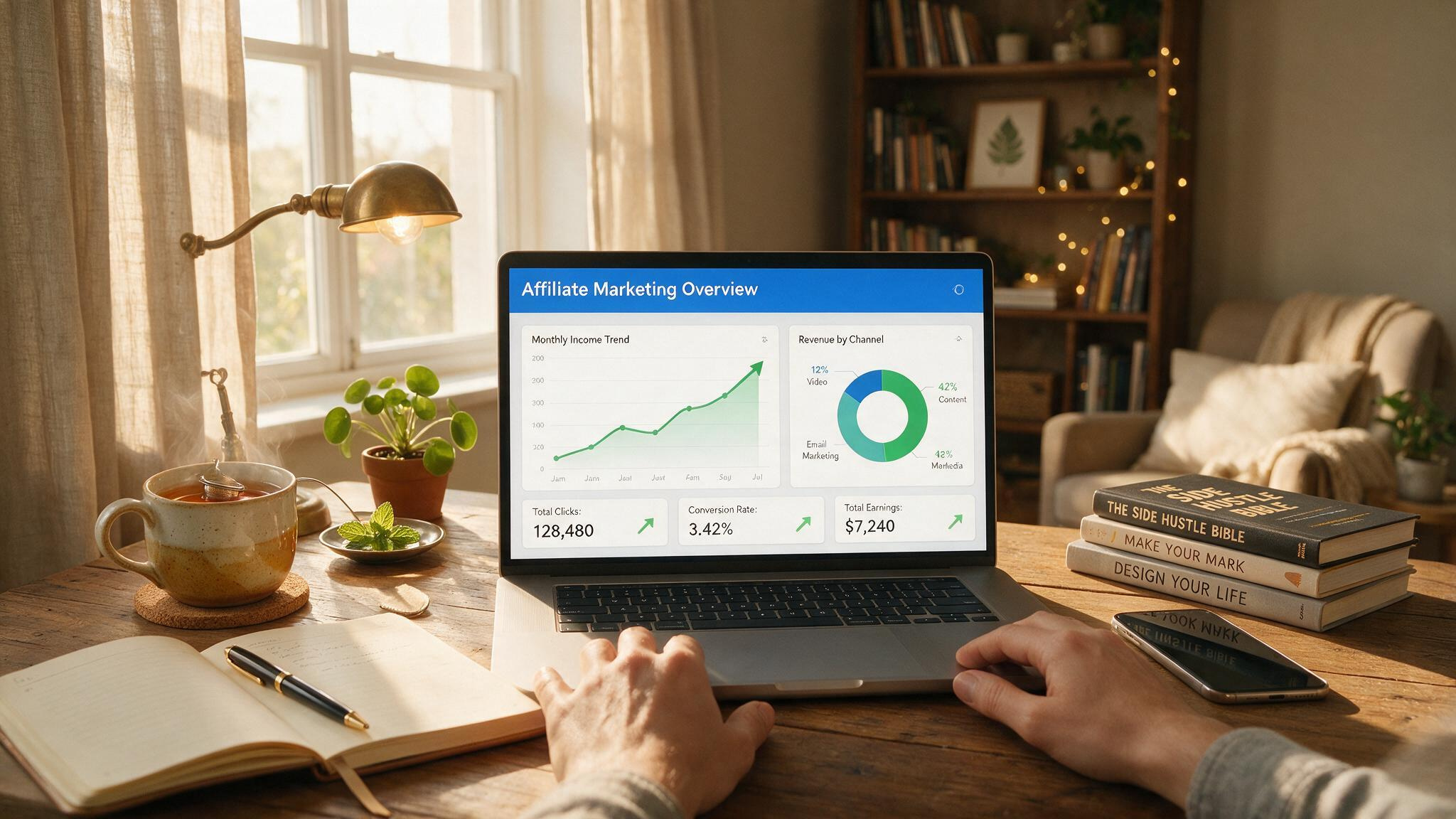
Amazon Associates is the poster child for this. Commission rates range from 1% to 10% by product category, and the payout delay is 60 days. Your first commission check is a full two months away. “Passive income tomorrow” is not a thing with this model.
Affiliate Marketing
Sign up for a program, get a unique referral link, earn commissions when someone buys.
- Typical commission rates: 10–15% (ReferralCandy data)
- Amazon: 1–10% by category, 60-day payout
- Shopify affiliate: Up to $150 per eligible referral, paid monthly via direct deposit or PayPal
- eBay Partner Network: Category-based percentages with caps and exceptions
- Printify affiliate program: Printify’s active affiliates earn an average of $1,000 per month
- Beginner potential: Up to $1,000/month; advanced marketers: tens of thousands monthly
- Legal note: FTC requires affiliate links to be disclosed clearly and conspicuously. Not optional.
The failed assumption: write one review post, expect commissions to roll in. Affiliate income follows traffic; traffic follows sustained promotion (SEO, email list, social sharing).
Blogging
Income depends on audience size and engagement. It’s a slow build with compounding payoff.
- Income streams: Sponsored content, ads, affiliate marketing
- Sponsored post earnings: From a few hundred to a few thousand dollars depending on reach
- Start: Free on WordPress.com
Online Courses
Big upfront work for semi-passive earnings.
- Creator earnings: $1,000 to $100,000 per year (onlinecoursehost.com data)
- Platforms: Skillshare, Udemy, Teachable, Thinkific, TrainerCentral
Amazon Kindle Direct Publishing
Self-publish an eBook in the Kindle Store, earn royalties on every sale. Reach millions of readers worldwide.
Subscription Services & Focus Groups
- Substack, Patreon: Recurring income from loyal subscribers
- Focus groups: Review products (including unreleased ones) in hour-long discussions. Platform: focusgroups.com.
- User interviews: Organized by research companies for consumer insights.
Blogging vs. Affiliate Marketing: Which Pays Faster?
Blogging takes months to build audience before meaningful income. Affiliate marketing can technically start sooner but still needs content and traffic. Neither pays next week. Both are long games with compounding upside.
Gig Economy & Quick Cash: Fastest Payout, Least Scalable
Uber Instant Pay lets you cash out up to 6 times per day after your first trip. That’s same-day money — the appeal of gig work. The limitation: you trade time for money, and that time has a hard ceiling.
Let’s start with the most granular detail: Uber Instant Pay lets you cash out up to 6 times per day after your first trip. There’s a $1.25 fee for personal debit card cash-outs. That’s same-day money — the appeal of gig work.
Now the math. At $22.41/hour (Indeed average for rideshare), hitting $1,000 takes roughly 45 hours of driving — before taxes, gas, and vehicle wear. That’s a full workweek, not a side hustle. Food delivery averages $18.45–$25/hour (ZipRecruiter, Salary.com). At $25/hour, you’d need 40 hours/month (10 hours/week).
Food Delivery & Rideshare Driving
- Platforms: DoorDash, Postmates, Instacart, Grubhub, Uber Eats, Uber, Lyft
- Same-day cashout: Uber Instant Pay, $1.25 fee per cash-out
- Rideshare earnings: $22.41/hour average, ~45 hours for $1,000 before expenses
- Food delivery earnings: $18.45–$25/hour, 40 hours/month at upper end
- Typical driver target: $15–$30/hour including tips
Odd Jobs & Local Services (TaskRabbit)
TaskRabbit’s rate breakdown is granular, and it shows how much the service matters:
| Service | Hourly Rate |
|---|---|
| Baby proofing | $15 |
| Car washing | $15 |
| Furniture repair | $43 |
| Electrical help | $47 |
| Full-service moving | $55 |
- Platforms: TaskRabbit, Handy, Thumbtack, Airtasker, Craigslist/Facebook for local gigs
- Payout: Many gigs pay same-day or weekly
Pet Sitting & Renting Out Property/Items
Monetize things you already own.
- Pet sitting (Rover): Some sitters report $1,000+/month (from Reddit discussions)
- Airbnb host average: $500/month (Tipalti data)
- Parking spot: Near a stadium, ~$20 per event
- Car rental (Turo): Average annual income of $9,424 per car (Turo’s own estimate)
- Item rentals: Camera equipment, bikes, baby gear via BabyQuip or Facebook rental groups
Online Surveys & User Interviews
The $31/hour average (ZipRecruiter) sounds great until you realize there aren’t 30 hours of surveys available in a week. Surveys are a stackable stream, not a $1k/week anchor.
- Platforms: Swagbucks, InboxDollars, Survey Junkie, BrandedSurveys, Google Online Rewards, Harris Poll Online, LifePoints, One Opinion, Prolific (waitlist varies by demographic)
- Payouts: Often instant or within days
Part-Time Jobs & Tutoring
The tax-treatment difference matters here: a part-time W-4 job withholds taxes automatically; tutoring and contractor income (1099) puts tax planning on you.
- Target: $15–$24/hour
- Starbucks: $17.50/hour average
- Costco: $20–$30/hour
- Job boards: ZipRecruiter, Indeed, LinkedIn, SimplyHired, Glassdoor
- Tutoring: $25–$80/hour (TutorCruncher), $25.66/hour average (Indeed). Platforms: Verbling, Preply, Tutor.com, Elevate K-12, Brainfuse, TutorMe.
- Fitness instruction: $25/hour national average. Certifications: NASM-CPT, Zumba, 200-hour yoga teacher training.
Content Creation & Audience Monetization: Build Once, Earn Repeatedly
Two distinct paths here, and most people don’t realize the first one doesn’t require fame.
User-Generated Content (UGC) is one of the fastest-growing remote side hustles. You create branded videos for companies to use in ads or social media. You don’t build your own audience — you make $100–$500 per video for someone else’s brand. Start with a portfolio of sample videos and pitch directly or through platforms like Billo or Upwork.
Social media creators (TikTok, Instagram, YouTube, Twitter) build their own audience and monetize through ads, sponsorships, affiliate programs, and digital products. Many easily hit $1,000/week with a sizable following.
YouTube is the long-term play: videos earn money long after posting through ad revenue, affiliate links, and sponsorships. Start with just a smartphone and a clear content idea.
Amazon On-Site Commission Videos — product review videos displayed on Amazon product pages, earn commissions on sales. Prerequisite is the Amazon Influencer program. A low-friction way in: review products you already own.
Strategic & Legal Foundations: Tax, Disclosure, and Smart Planning
This is the section most articles skip entirely. Here are the three rules that apply to almost every method above.
IRS $400 threshold. If your net self-employment income exceeds $400, you must file a tax return. That’s lower than most people expect. Keep records of earnings and expenses throughout the year.
FTC disclosure requirement. If you have an affiliate link — Amazon, Printify, any program, you must clearly and conspicuously disclose your material connection. No fine print buried at the bottom. The FTC isn’t playing.
W-4 vs. 1099. Employee roles (Target, Starbucks, Costco) mean your employer withholds federal income tax based on Form W-4. Freelance and contractor income pays you the full amount, and you’re responsible for setting aside money for taxes yourself. That’s where the I made $1,000 but owe $200 in April surprise comes from.
This is general information, not professional tax advice. Consult a professional for your specific situation.
Making It All Work: Combining Strategies and Staying Consistent
Here’s the truth: almost no one hits $1,000/week from a single method. The people who do stack streams.
A common pattern: active work (freelancing, gigs) provides the fast cash to cover current bills, while semi-passive streams (digital products, affiliate marketing, POD) build up over time. You start with freelancing, use that income to fund experimentation with eCommerce, and eventually shift more hours toward the scalable side.
Three habits that matter:
- Track what pays. Track dollars per hour. A $500 writing project that takes 20 hours is worse than a $300 project that takes 6. Measure efficiency.
- Network. LinkedIn, Fiverr forums, Reddit communities. Referrals, higher-paying gigs, and repeat customers come from relationships, not cold bidding.
- Invest in skills. Social media management, copywriting, eCommerce — these compound. The more you learn, the higher your effective rate.
And honestly? Pick a method you don’t hate. The more enjoyable the work, the more likely you are to stick with it when the first few payouts are smaller than expected.
The Honest Bottom Line on Making $1,000 a Week from Home
Let’s wrap this up with a decision framework that actually helps.
If you need money this week: Gig work (Uber, food delivery, TaskRabbit) or selling items you already own on Facebook Marketplace. Same-day or next-day cash. Low ceiling, but fast.
If you need money this month: Freelance writing, virtual assisting, or any service-based work where you can land and complete a project inside two weeks. Payout in 5–14 days. Best balance of speed and income.
If you need money this quarter and want it to scale: Print-on-demand, affiliate marketing, digital products, or content creation. Longer setup time, but real potential to reach and exceed $1,000/week without working more hours.
The numbers work if you pick the right timeline for your situation. Freelance writing at $35/hour average needs about 29 billable hours per week to hit $1,000. Print-on-demand takes weeks to land a first sale but zero inventory. Gig work pays same-day but caps at your available hours.
And remember: the IRS $400 threshold and FTC disclosure rules apply the moment you start earning. Don’t ignore them because the money seems small.
This is the kind of analysis we do at GeekExtreme — digging into payout policies, platform quirks, and fee structures so you can make an informed choice. No hype, just the fine print you actually need.
Frequently Asked Questions
What’s the quickest way to make $1000 in a week?
Gig work like Uber or food delivery with same-day cash-out features is your fastest option — you can have money in your account within hours. The tradeoff is that it takes roughly 45 hours of driving before expenses to hit $1,000, so it’s a full-time week, not a side hustle.
How to earn $1000 a week from home?
The fastest path is freelance service work like writing, virtual assisting, or graphic design, which can pay within 5-14 days and requires no upfront investment. For example, freelance writing at $35/hour needs about 29 billable hours per week to hit $1,000, while print-on-demand takes weeks to land a first sale but scales with no inventory costs.
Is it realistic to make $1000 online?
Yes, but almost no one hits that from a single method — the people who do stack multiple income streams. The realistic approach is to combine fast cash from freelancing or gig work with longer-term building of semi-passive streams like digital products or affiliate marketing.
What’s the difference between print-on-demand and dropshipping?
Print-on-demand lets you customize products like t-shirts and mugs, paying only when a sale happens, with no inventory or upfront costs — but your first sale can take weeks. Dropshipping has the supplier handle storage and shipping while you run the storefront and marketing, but finding a reliable supplier is the critical success factor that makes or breaks the model.