So you want to follow competitive League of Legends in 2026. Here’s the thing — it’s a mess.
There are major regions like LCK, LEC, and LPL running their own splits. There are second-tier leagues feeding into them. There are international tournaments popping up throughout the year. There are mid-season roster swaps happening across four continents. And somewhere in there, you’re supposed to figure out when Worlds is actually happening and who’s playing.
Leaguepedia is the best tool for tracking it all — the community-maintained League of Legends Esports Wiki on Fandom. It’s been around for over a decade, migrated from Esportspedia and EsportsWikis, now under CC BY-SA 3.0, and it’s become the pane of glass for the entire competitive scene. Riot Games holds the copyright, but the fans keep the data fresh.
Here’s what you need to know to navigate the 2026 season like someone who actually knows what they’re doing.
Key Takeaways
Leaguepedia tracks real-time schedules for 20+ leagues simultaneously, from the Hellenic Legends League to LCK, with countdown timers and direct Twitch stream links
The wiki’s “6m LIVE” indicator means a match has been live for six minutes — not that it starts in six minutes, a common point of confusion
Table of Contents
How to Actually Watch Live Matches
The useful thing on Leaguepedia is the live schedule. It’s right there on the front page, and it’s updated in real time. But there’s a gotcha that trips up everyone the first time.
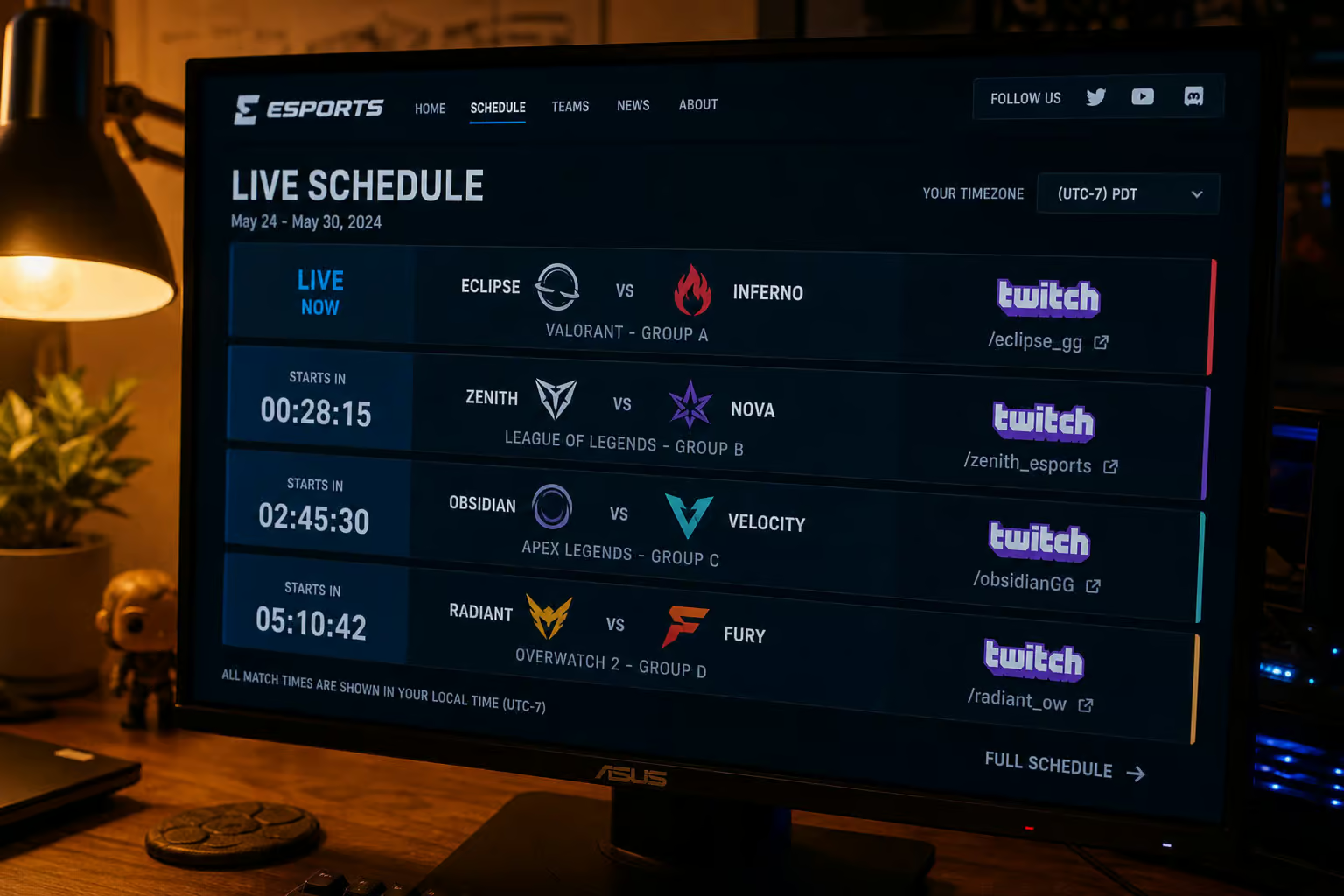
See that “6m LIVE” indicator next to a match? That’s not telling you when the match starts. It’s telling you the match has been live for six minutes. The countdown timers work the other way — “1d 0h 6m” means the match starts in about a day. It’s a small notation quirk.
The wiki covers over 20 leagues. You’ve got the big ones — LCK, LEC, LCS, LPL, but also niche regional leagues like the Hellenic Legends League, Prime League 1st Division, Liga Regional Sur, Finnish Pro League, and the 4 Nations league. Each match listing includes a direct Twitch stream link, so you can click straight to the broadcast. Some leagues, like the brazilian IDL Kings Lendas, stream on Kick instead.
Right now, for example, The ParadOx Invaders are facing Spartans EU in the Hellenic Legends League, which streams on Twitch at helleniclegends. The match is live as of July 1 at 13:00 UTC. In the Prime League, Eintracht Frankfurt is playing TeamOrangeGaming, and G2 NORD is up against E WIE EINFACH E-SPORTS. In the Finnish Pro League, Epic Avalanche is scheduled to face ZiWi Gaming in about a day.
You don’t need to hunt through multiple Twitter accounts or league websites.
The Regional League Ecosystem
Everyone knows the big four — LCK (Korea), LEC (Europe), LCS (North America), LPL (China). But the ecosystem extends way beyond that.
The Pacific region has PCS (the old LMS/SEA region), LCP (the Pacific league with multiple splits), and LJL (Japan). Vietnam runs VCS, which has its own Summer Playoffs from June 11 to 20 and a Finals Stage 1 from August 1 to 9. Brazil has CBLOL. There are development leagues like LCK CL (Korea’s Challengers League), which runs parallel to the main LCK season.
And then there are the smaller leagues. The Hellenic Legends League, the Prime League, the Finnish Pro League, the 4 Nations league (UK-focused), POP Esports Masters, Nexus Tour, and IDL Kings Lendas. These aren’t just casual tournaments — players who pop off in the Hellenic Legends League or the Finnish Pro League get noticed by larger organizations and eventually show up in LCK or LEC.
The 2026 season structure for the major regions runs like this:
- LCK Rounds 1-2: April 1 to May 31, then Rounds 3-4 from July 29 to August 23
- LEC Spring Playoffs: the fight for MSI spots
- LPL Split 2 Playoffs: May 23 to June 14
- LCS Spring Playoffs: North America’s MSI qualifier
- CBLOL Split 1 Playoffs: Brazil’s first split postseason
- LCP Split 2 Playoffs: May 23 to June 7, then Split 3 from July 24 to August 30
- LJL Spring Series: April 29 to June 14, then Summer Championship from July 17 to September 6
- VCS Summer: May 13 to 28, followed by Summer Playoffs
The 2026 International Tournament Calendar
The 2026 calendar lists over 30 events on Leaguepedia. Here’s how they stack up.
The Big Three
MSI 2026 (June 28 to July 12) is the mid-season international tournament. The Stage 2 bracket is already taking shape — BLG, T1, LYON, FUR, HLE, TSW, G2, and TES are in, with a few TBD slots still filling out. The bracket page on Leaguepedia isn’t just a static image, it’s a navigation hub. Click any team and you’re a few clicks away from their full roster, pick-and-ban history, champion stats, player stats, and scoreboards for the entire tournament.
Worlds 2026 (October 15 to November 14) is the big one. The world championship. The event that crowns the best team of the year.
Esports World Cup 2026 (July 15 to July 19) is a multi-game competition with a LoL component. There’s an online qualifier for Korea from May 4 to 26 to decide who represents the region.
New Events in 2026
Esports Nations Cup 2026 is a national-team competition — countries face off instead of organizations. Qualifiers run across multiple regions in June: EU West, EU East, MEA, NA & CAC, SEA & OCE, Asia, and South America each get their own windows.
First Stand 2026 is the first big cross-region clash of the year — a relatively new addition to the calendar.
Americas Cup 2026 is a continental championship for the Americas.
Regional and Qualification Events
- KeSPA Cup 2026: Korean domestic cup
- Asian Games 2026 Qualifier (June 12 to 14): National teams compete for a spot
- LCP Wildcard 2026 MYSG & ID Qualifier (August 6 to 9): Teams from Malaysia, Singapore, and Indonesia
- Asia Masters 2026: APAC qualifier on June 5, main event on June 21
- 2026 Asia Masters Elite Invitational Tournament (March 13 to May 31): A multi-month invitational
- LCK Road to MSI (June 6 to 14): Korea’s qualifier for the mid-season tournament
Community and Niche Events
These events support talent development in emerging regions.
- League The k4sen 3rd (May 8 to June 21): A community/invitational event in its third edition
- LOL Legends Match on CHZZK (June 9 to 10): A two-day exhibition match
- 2026 Cross Regional: SOOP LoL Invitational (June 26 to 27): Cross-regional teams face off
- 2026 Academic Esports World Tournament Sydney (January 11): University-level competition
- Hong Kong Comic Con 2026 Community Cup (May 23 to 29): A week-long event tied to the convention
- ON Live Bóng H?ng ??i Chi?n Season 1 (May 18 to June 2): Vietnamese community event
The Mid-Season Roster Shuffle
Roster changes in LoL esports tend to cluster around qualification deadlines. Teams make aggressive moves before important windows, and the League of Legends Esports Wiki documents every single one.
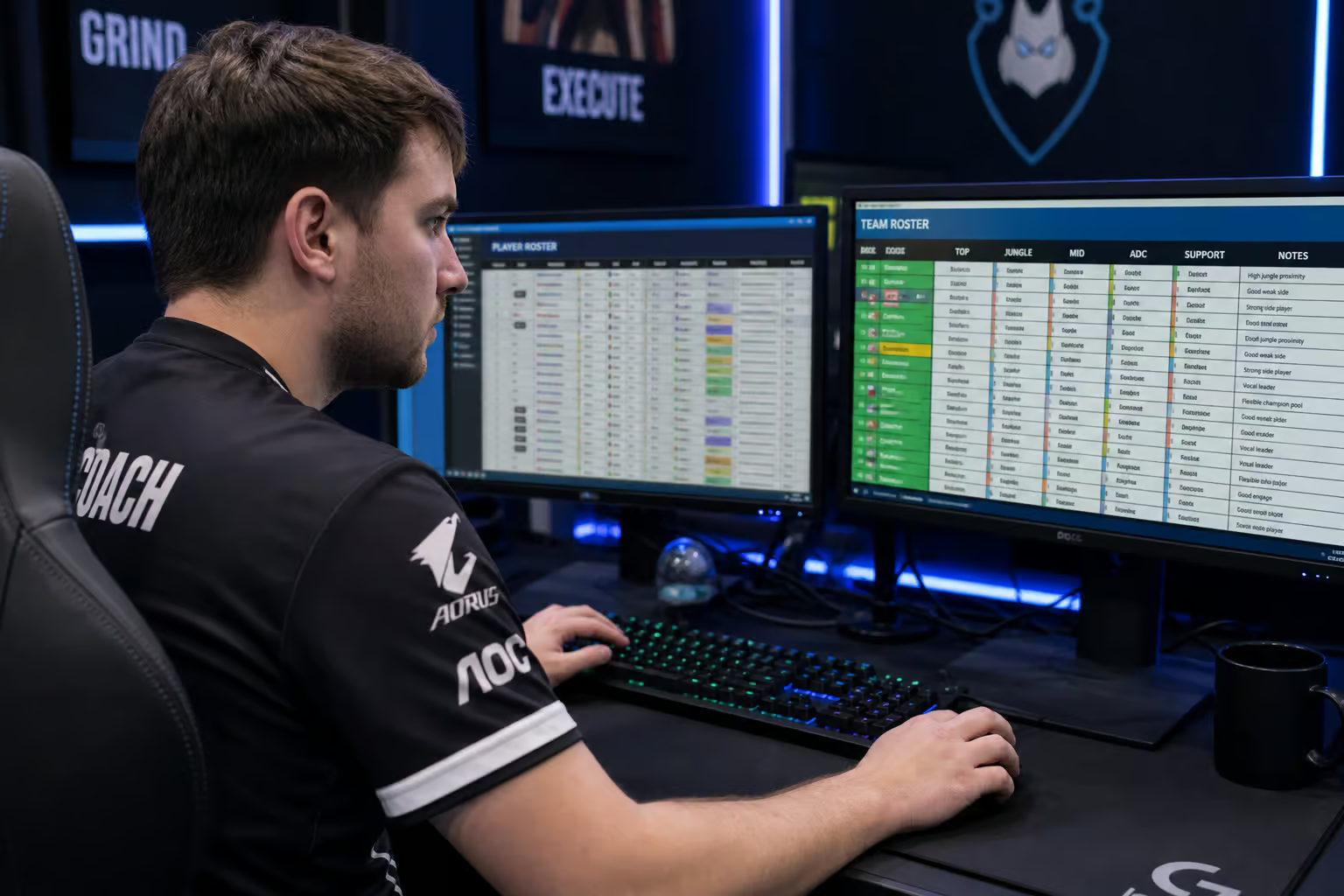
Let me show you a concrete example. LGG made a series of moves documented on July 1. Three players — Imagine, wanan, and JustFocus, were loaned from Inferno Drive Tokyo, and for a broader look at how rosters form, shift, and break across the LCS, LEC, LCK, and LPL, check out this League of Legends Esports Roster tracking the chaos. That’s a temporary transfer, not a permanent acquisition.
Meanwhile, rre switched from bot lane to mid — a position swap that can completely change a team’s playstyle. Four players left: HyunSim, p1ng, Saver, and NaiNa. That’s turnover for a single team.
NCG added Veiga, Fatorix, and Crikx while Tuercas and Vares stayed. Alitan and Raysito left. 7D had a mix of renames, additions, and departures — GianKios became Giankios, WDR/Chapters/child joined, moaixd and Ryuuhu joined as substitutes, and Neadz/iso/Pyl/Ronin/DaeHan left.
ZEN brought in Milenaria as Head Coach and Zheir as a substitute, while their previous Head Coach Ukkyr and Team Manager Smythz left. KITS added Dimitry and 8thFlash (Analyst), with Diaakc joining as a substitute and Adler going inactive.
Panathinaikos Esports picked up five new players: Fikus, Pivolj, Aitze, Nephix, and Kartso. Team Vitality added FIESTA and Hansen as Assistant Coach.
These changes are documented across APAC, BR, NA, and EMEA regions, with edits dated July 1 and June 30. The wiki’s Roster Changes page tracks it — loans, position swaps, departures, additions, renames, role changes. It’s not just a list of transactions; it’s a real-time map of how teams are evolving.
The Global Contract Database
The Global Contract Database (GCD) Archive on Leaguepedia is different. It’s a repository of verified player contracts, organized by player, team, and tournament. You can find it in the sidebar navigation. It’s not a complete database — the wiki is community-maintained, not an official Riot platform, but it’s the closest the esports world has to a transparent contract record.
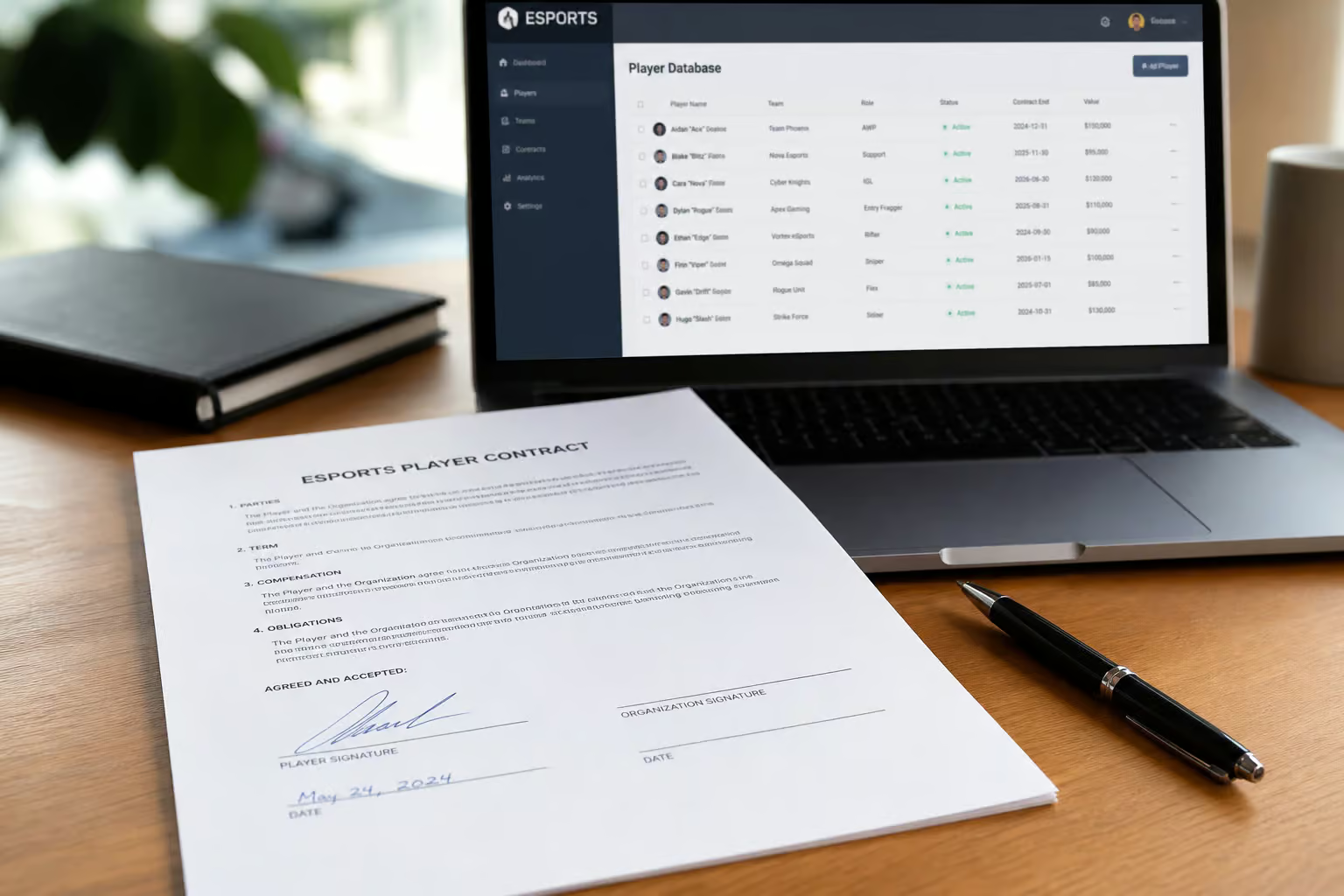
You can look up who’s actually under contract, for how long, and with which team.
How the Wiki Maintains Its Accuracy
The wiki has structured editorial guidelines that keep the data reliable.
There’s a “Notability Guidelines” page that determines which players, teams, and tournaments get pages. There’s an Editing Tutorial, Procedures, Editing Help, and an FAQ. There’s a Dev Blog for technical updates, and a Staff List that shows who runs the wiki. The sidebar links to community Discord and Twitter channels where editors coordinate.
The wiki has existed since 2014. It started as Esportspedia, migrated to EsportsWikis in 2016, and eventually became Leaguepedia on Fandom. The content is licensed under CC BY-SA 3.0, which means it’s freely reusable with attribution. Riot Games holds the copyright for 2026, but the data infrastructure is community-driven.
Season navigation links go from 2011 to 2026 — the full history of competitive LoL. The “New to League?” portal links to explanations of Champions, Items, Minions, Monsters, Summoner Spells, Runes, Patch Notes, and Game Modes. There are category pages for Players, Teams, and Tournaments, and an All Pages directory with Interactive Maps.
MSI 2026 Deep Dive: Using the Bracket as a Tool
Let me show you how this all comes together in practice. MSI 2026 is currently running (June 28 to July 12), and the Stage 2 Bracket is the best example of what the wiki can do.
The bracket shows the participating teams: BLG, T1, LYON, FUR, HLE, TSW, G2, TES, and several TBD slots. But it’s not a pretty picture. Each team entry is a link. Click BLG, and you’re on their roster page. From there, you can navigate to:
- Picks and Bans for the entire tournament
- Scoreboards for every match
- Champion stats — who’s playing what, and how often
- Player stats — KDA, CS per minute, damage share
- Latest news about the team
The bracket is a launchpad. Click any team and you’re six clicks away from champion stats for the whole tournament. Want to know what T1’s bot lane is picking against HLE’s support? The data is there.
Want to see how G2’s win rate changes when they’re on blue side? Also there.
The scheduled matchups include HLE vs TSW, G2 vs TES, LYON vs FUR, and BLG vs T1. These are matchups, and the wiki gives you the tools to analyze them in real time.
You Could Open 12 Tabs, or You Could Open One
The League of Legends esports ecosystem in 2026 is enormous. Thirty-plus tournaments, dozens of regional leagues, hundreds of roster moves, and thousands of individual matches. Trying to follow it all through individual league websites, Twitter accounts, and Reddit threads is a losing game.
Leaguepedia solves that problem. It’s not perfect — it’s a community-maintained wiki, not a polished corporate product. The countdown timer notation is confusing the first time you see it. Page completeness varies. But it’s the best tool we have for tracking the entire competitive scene from a single pane of glass.
The data is real-time. The schedule is live. The roster changes are documented. The contract database exists.
Start at Leaguepedia.
Frequently Asked Questions
What does the ‘6m LIVE’ indicator mean on Leaguepedia?
It means the match has been live for six minutes, not that it starts in six minutes. Countdown timers like ‘1d 0h 6m’ indicate when a match is scheduled to start. It’s a common point of confusion for first-time users.
How does Leaguepedia track roster changes across different regions?
The wiki’s Roster Changes page documents loans, position swaps, departures, additions, renames, and role changes in real time across APAC, BR, NA, and EMEA regions. Each edit is timestamped, so you can see exactly when moves happened and which teams were affected.
Is the Global Contract Database on Leaguepedia official?
No, it’s community-maintained, not an official Riot platform. But it’s the closest thing the esports world has to a transparent contract record, letting you look up which players are under contract, for how long, and with which team.
Why would a player from a small regional league end up in LCK or LEC?
Players who perform well in smaller leagues like the Hellenic Legends League or Finnish Pro League get noticed by larger organizations. The wiki documents these talent pipelines, showing how players can climb from regional circuits to the biggest stages.