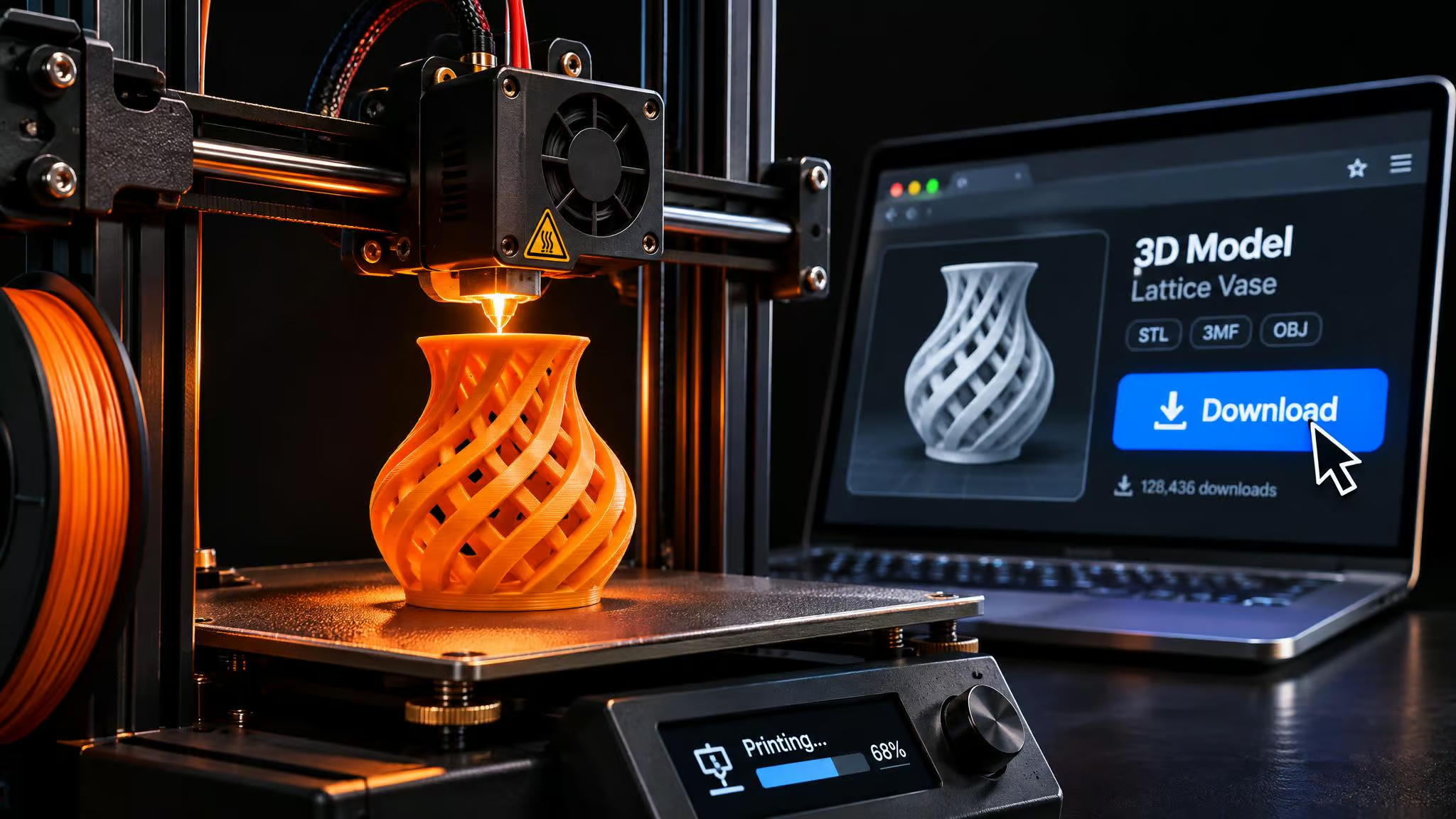
Your cursor hovers over the “Download” button on an STL file listing. Maybe it’s a stylized tabletop miniature, a custom bracket for a home-lab rack, or a lower receiver someone uploaded to a forum. Before the file even hits your slicer, a practical question cuts through the excitement: what is illegal to 3D print, and does clicking that button already cross a line?
The answer isn’t a flat yes or no, and a vague warning to check local rules won’t help you much when the same file can be completely legal in one state and a felony in another. Where any print lands depends on four moving variables: the item itself, the state where you live, where the file came from, and whether you keep the result on your desk or sell and share it.
Key Takeaways
Legal guides we checked are split on whether homemade ghost guns are federally legal to print for personal use, since commercial ghost gun parts must follow store-bought firearm rules while personal-use manufacture without a license remains legal; alongside that, 5 of 5 posters who reported their own experience say yes, they completed working parts for personal use.
At least eight states plus Washington, D.C. ban 3D-printed guns outright, and six states tightened restrictions on unserialized or 3D-printed firearms in 2026 alone.
Between 2017 and 2023, suspected privately made firearm recoveries jumped 1,588% to more than 92,700 traced weapons, while state laws have begun shifting from physical parts to digital file bans and mandatory printer-blocking software.
Table of contents
Table of Contents
What is illegal to 3D print: the three-tier answer
What cannot be 3D printed is anything already barred by federal, state, or intellectual property law, because owning a consumer printer doesn’t carve out a legal exemption for 3D-printed guns, ghost guns, or counterfeit goods. Additive manufacturing simply turns a digital model into physical plastic or metal, and the law treats that finished object, and sometimes the file behind it, under existing criminal and civil statutes. Across the United States, every print project falls into one of three legal tiers:
- Illegal everywhere: Undetectable all-plastic firearms, machine-gun conversion devices such as auto sears and switches, counterfeit currency, fake government IDs, and counterfeit branded products passed off as genuine.
- Illegal in some states: Complete 3D-printed guns, unserialized frames or receivers, and in a few jurisdictions, the digital CAD files used to print them, with at least eight states plus D.C. outlawing 3D-printed guns outright per Everytown for Gun Safety.
- Legal but restricted: Privately made firearms built for personal use under federal law, which face mounting state serialization, background-check, licensing, and reporting requirements.
Beyond criminal statutes, practical engineering limits also govern what belongs on a build plate. Standard hobby filaments lack the structural strength for load-bearing safety gear, and porous FDM layer lines trap bacteria unless you finish a mug or utensil with a proper food-safe coating for 3D prints. Those are material constraints rather than police matters, just as unethical 3D prints that merely offend taste or violate a repository’s terms of service sit outside the criminal code.
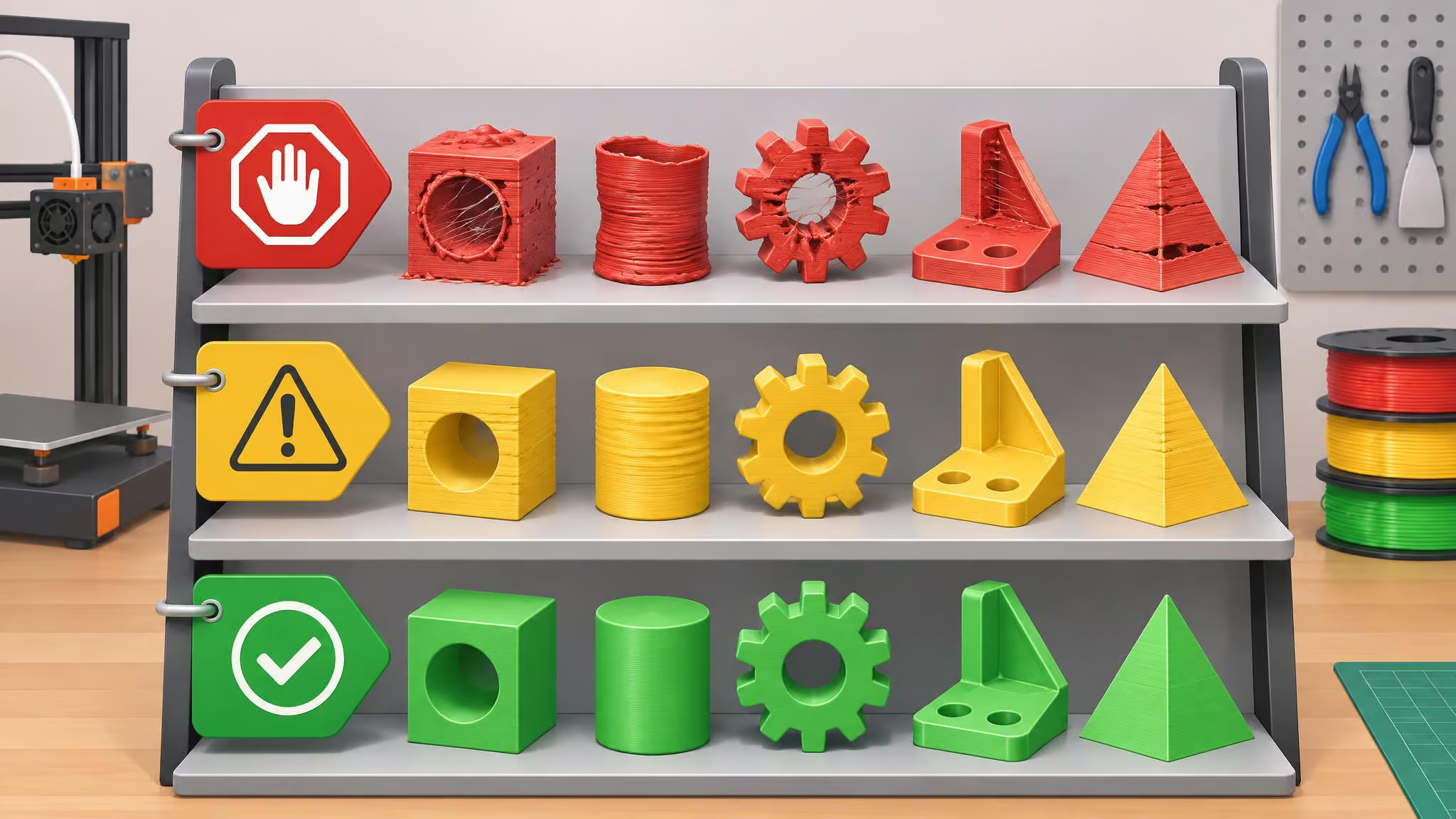
Where any specific project lands comes down to three variables: the item, the state, and whether money or files change hands. Printing a decorative bracket for your desk triggers zero legal scrutiny anywhere, while printing a functional receiver shifts your exposure immediately depending on your zip code.
At the center of that second and third tier are ghost guns: DIY homemade firearms assembled from unfinished kits or 3D printers that usually lack serial numbers and can bypass standard background checks and transfer rules. What used to require a machine shop and serious metalworking skill now starts with a downloaded file and a consumer desktop printer.
Federal law: what you can still legally make at home
Ghost guns are treated as traditional firearms by the ATF when sold commercially, requiring serial numbers and background checks, even though federal law has long permitted Americans to manufacture firearms at home for personal use without a license. That split between commercial sales and private workshop builds is why federal law looks contradictory at first glance, and it rests on a few core rules:
- Personal-use tradition: Federal law has historically placed no ban on making a firearm at home for your own use without a manufacturer’s license, a practice gun rights advocates describe as an American tradition.
- Commercial kit rules: Under ATF Proposed Rule 2021R-05 (Definition of ‘Frame or Receiver’ and Identification of Firearms, published May 21, 2021, in Federal Register 86 no. 97: 27720-53), the Bureau of Alcohol, Tobacco, Firearms and Explosives clarified that commercial ghost gun parts qualify as firearms and must carry serial numbers and pass background checks at sale.
- Undetectable weapon limits: Federal restrictions bar all-plastic firearms that cannot be detected by standard security screening.
Personal manufacture and the 2021 ATF rule
Across the legal overviews and gun-law guides we checked, whether homemade ghost guns are federally legal to print for personal use is disputed: ghost guns must follow the same federal rules as store-bought firearms, yet it remains legal to manufacture firearms for personal use without a license. On the maker side, 5 of 5 posters who reported their own experience in forum discussions when asked if they had printed a firearm or firearm part for personal use say yes, completed working parts. As one poster put it, I’ve printed a few guns and it’s really just fun to fiddle and try to get something working consistently.
The two sides aren’t actually contradicting each other on the mechanics. The legal guides focus on the 2021 ATF rule governing commercial kits and finished frames, whereas the forum makers are building individual parts from scratch for their own bench without selling them.
A similar split appears on whether 3D-printed ghost guns bypass background checks. It is disputed: ghost guns can bypass the usual point-of-sale background checks when fabricated from scratch at home, but commercial kits and parts must follow the same federal rules as store-bought firearms, including background checks.
If you live in a state with no ghost gun policy, such as Texas, Florida, or Pennsylvania, you face no state-level ghost gun ban when printing parts like lower receivers or magazines for personal use. That permission holds as long as you aren’t building for resale, aren’t a prohibited possessor, and stay clear of federal undetectable-firearm and machine-gun conversion bans.
Undetectable firearms and the 0% firearm frontier
Regulation has traditionally focused on unfinished metal or polymer kits rather than raw filament spools. Per Washington Gun Law, an 80% lower is a near-complete receiver that still requires drilling and milling to become functional. A 0% firearm, by contrast, is printed entirely from scratch out of raw plastic, representing the new regulatory frontier where no pre-machined kit ever crosses a store counter.
Federal law restricts all-plastic undetectable firearms, and seven states explicitly ban undetectable plastic guns by statute: Connecticut, Delaware, New Jersey, New York, Oregon, Virginia, and Washington. Adding a required metal insert keeps a build out of undetectable-weapon territory under federal rules, though state-level 3D-printing bans still override federal personal-use allowances.
State-by-state: where 3D-printed guns are banned or restricted
3D-printed guns are banned in at least 8 states plus Washington, D.C. and regulated across a 16-to-17-state patchwork, with California enforcing the strictest multi-layer regime and 33 states imposing no ghost gun rules at all. Everytown Research counts 17 states with ghost gun regulation policies, while Amanda Watford, writing at stateline.org, reports that Everytown for Gun Safety counts at least 16 states including the 2026 wave, with at least 8 states plus D.C. explicitly outlawing 3D-printed guns.
If you live in California or New York, printing a firearm at home is effectively off-limits without jumping through strict licensing or facing outright bans:
- California: You need a state license to 3D-print a gun, serial numbers and background checks apply to component parts, barrels require background checks, owners must report every ghost gun to state authorities, and new printers sold in the state must include firearm-blocking technology.
- New York: Distributing 3D-printing firearm instructions and building undetectable guns are banned, and an enacted mandate requires printer-blocking technology if a state working group finds it feasible, backed by a $5,000 civil penalty per non-compliant product.
California
Under Cal. Penal Code §§ 29180 and 29185 and Cal. Civ. Code § 3273.631 et seq.,
California stacks four separate compliance layers on makers and hardware vendors. Component parts require serial numbers and background checks, gun barrels require background checks, every privately made firearm must be reported to state officials, and printing a gun requires a specific license alongside mandatory printer-blocking tech on new machines sold in-state.
New Jersey
New Jersey pairs strict hardware bans with the country’s tightest rules on digital files. The state mandates background checks and serialization for individual firearm components, requires ghost gun reporting, bans 3D-printing guns, bans plastic undetectable guns, bans distributing 3D-printing instructions, and prohibits unlicensed individuals from even possessing digital instructions used to 3D-print firearms.
New York
New York bans distributing 3D-printing firearm instructions and prohibits undetectable firearms. The state also enacted a printer-blocking requirement carrying a $5,000 civil penalty per non-compliant machine, contingent on a state working group confirming technical feasibility.
Rhode Island
Under 11 R.I. Gen. Laws § 11-47-2, Rhode Island bans 3D-printing guns outright. The state also requires serial numbers and background checks for firearm component parts.
Virginia
Virginia requires serialization for all firearms, frames, and receivers, while banning both undetectable firearms and 3D-printing guns. A law signed in April 2026 by Gov. Abigail Spanberger banned unserialized firearms, and a separate assault weapon ban took effect on July 1.
Delaware
Delaware bans both printing 3D-printed guns and distributing 3D-printing firearm instructions. It also enforces an explicit ban on undetectable plastic firearms.
Washington
Washington bans undetectable plastic firearms and tightened its restrictions on unserialized and 3D-printed firearms in March 2026 under Gov. Bob Ferguson.
Colorado
Colorado prohibits 3D-printed guns and tightened its unserialized-firearm rules in May 2026 under Gov. Jared Polis.
Connecticut
Connecticut targets plastic undetectable firearms under its ghost gun framework. In 2026, lawmakers also enacted a ban on certain machine-gun-convertible pistols.
Oregon
Oregon enforces an explicit statutory ban on undetectable plastic firearms as part of its ghost gun regulations.
Illinois
Illinois requires serial numbers and background checks for both complete firearms and component parts.
Maine
Maine enacted a serialization law in January 2026 requiring serial numbers for all privately made firearms.
Maryland
Maryland regulates ghost guns and machine-gun conversion devices, adding a law effective October 2026 that bans manufacturing, selling, buying, receiving, or transferring certain machine-gun-convertible pistols.
Hawaii, Massachusetts, Nevada, and Vermont
Hawaii, Massachusetts, Nevada, and Vermont round out the adopting states, each maintaining state-level ghost gun regulations that restrict unserialized homemade builds.
The 33 states with no ghost gun rules
Thirty-three states have adopted no ghost gun regulation: Alabama, Alaska, Arizona, Arkansas, Florida, Georgia, Idaho, Indiana, Iowa, Kansas, Kentucky, Louisiana, Michigan, Minnesota, Mississippi, Missouri, Montana, Nebraska, New Hampshire, New Mexico, North Carolina, North Dakota, Ohio, Oklahoma, Pennsylvania, South Carolina, South Dakota, Tennessee, Texas, Utah, West Virginia, Wisconsin, and Wyoming.
The 2026 wave: six states changed the rules this year
Any 2025-era legal guide is already outdated, because six states tightened laws on 3D-printed and unserialized firearms in 2026 alone. According to Stateline in June 2026, Maine moved first in January, followed by Washington in March under Gov. Bob Ferguson, Virginia in April under Gov. Abigail Spanberger, and Colorado in May under Gov. Jared Polis, alongside new enactments in New Jersey and New York.
Adjacent state laws also expanded enforcement around convertible hardware this year. Virginia’s assault weapon ban took effect on July 1, though some local sheriffs and prosecutors publicly stated they would not enforce it over Second Amendment objections, while Maryland’s ban on machine-gun-convertible pistols took effect in October alongside a similar 2026 Connecticut law.
Not every proposal survived the legislative calendar. A Minnesota bill that would have banned ghost gun sales and possession, limited 3D printing, blocked file distribution, and required serial numbers failed to advance before lawmakers adjourned in May. While the legislative push concentrates in Democratic-led states, unserialized firearms worry some Republicans too, keeping the issue tied to broader fights over assault weapons, high-capacity magazines, and auto-sear switches.
The file itself: when downloading or sharing is the offense
Selling or sharing firearm design files is treated differently, and in some states more harshly, than printing a part yourself, because 3D-printed guns sit at the intersection of manufacturing bans and new digital-code laws. Where a CAD file comes from, and who ends up holding it, changes your legal exposure at every step:
- Downloading: Triggers criminal liability in possession-ban states like New Jersey even if you never warm up a hotend.
- Designing from scratch: Avoids third-party distribution traps, yet still runs directly into state manufacturing bans the moment you print a restricted frame or receiver.
- Sharing or selling: Carries the highest exposure under instruction-distribution bans and proposed felony statutes, often requiring no proof that anyone intended to assemble a weapon.
The 3rd Circuit ruling and what it ended
In February 2026, the 3rd U.S. Circuit Court of Appeals ruled in favor of the New Jersey attorney general against Defense Distributed, concluding that purely functional computer code falls outside First Amendment protection. That decision ended the popular maker-forum assumption that “code is free speech” automatically shields CAD files, though the Second Amendment Foundation served as legal counsel and continues strategic litigation.
Free-speech opponents of file bans argue that digital blueprints behave like protected speech because people email them, swap them on flash drives, post them online, and modify the geometry themselves. From a practical enforcement standpoint, policing encrypted file transfers is far harder than tracking physical metal lowers.
How liability shifts across downloading, designing, and sharing
Delaware, New Jersey, and New York already ban distributing 3D-printing firearm instructions, and New Jersey goes a step further by outlawing unlicensed possession of those digital files. For a hobbyist in a restriction state, the surprise often comes before a single layer is extruded: clicking download on a mirrored archive can cross a statutory line before the slicer ever opens.
New York’s proposed 2026-2027 budget Part C (S.9005/A.10005) shows how aggressively states are pushing that boundary. Under §2.10 of the bill, selling or distributing files for major firearm components outside federally and New York-licensed gunsmith channels would become a Class E felony, while §2.11 would make possessing those files a felony with intent to illegally print or share them with an ineligible person.
Because strict distribution bans require no intent to actually build a gun, critics warn that journalists reporting on 3D-printed weapons, academic researchers studying them, and artists commenting on gun culture could face felony exposure simply for passing along a reference file.
Printer-blocking laws: the machine itself is becoming regulated
Whether 3D printers must include firearm-blocking technology depends on the state: California requires it, while in New York it will be required only if a working group deems it feasible. Between May 2021 and 2026, proposed regulation has escalated from a federal proposed rule targeting physical ghost gun parts to New York’s proposed 2026-2027 budget, which would mandate firearm-blocking software on every new 3D printer sold statewide. For buyers in restriction states, that means machine-level firmware restrictions are increasingly baked into the hardware before it ever leaves the factory.
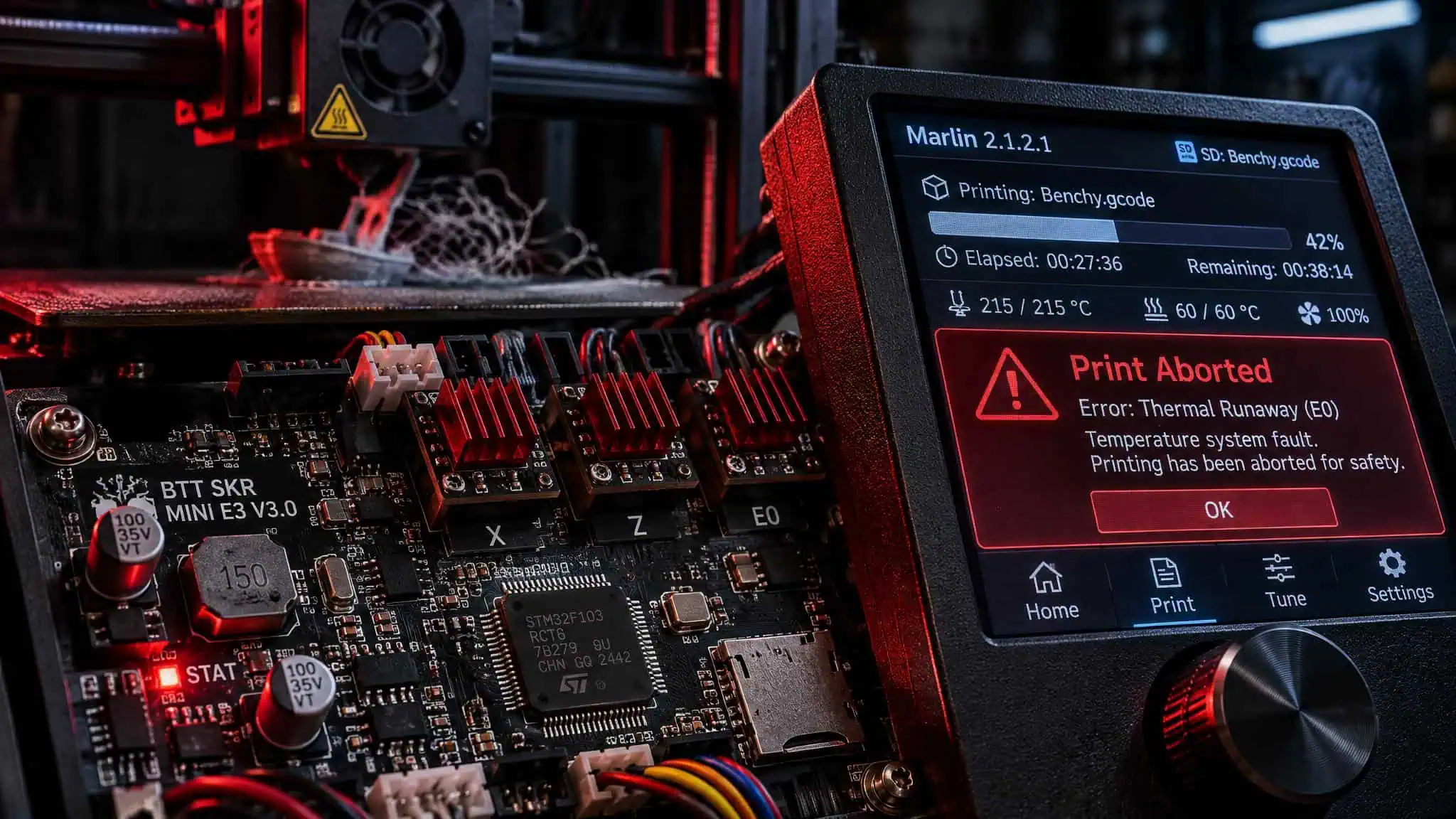
State mandates and why blocking software struggles technically
New York’s enacted requirement backs its working-group trigger with a $5,000 civil penalty per non-compliant product. Meanwhile, a pending California bill that passed the Assembly and sits in the Senate would require consumer printers to detect and block firearms, gun parts, and machine-gun conversion devices, with California Department of Justice performance standards due by 2028. Colorado considered a similar printer-blocking mandate and scrapped it; a digital-rights advocate writing at eff.org attributed that reversal to First Amendment concerns.
From an engineering standpoint, algorithmic print-blocking works like hardware Digital Rights Management (DRM), and it runs into obvious technical walls:
- Trivial evasion: CAD and STL files can be split into sub-parts, rotated, scaled slightly, or remeshed to dodge pattern-matching filters without changing the final physical part.
- No fixed signature: Unlike paper currency, which has standardized anti-counterfeiting patterns, firearm components come in endless shapes that overlap with benign mechanical brackets, tubes, and grips, meaning fuzzy AI classifiers risk censoring lawful prints.
- Overbroad hardware scope: Proposed rules like New York’s Subpart B lack carve-outs for researchers, commercial shops, or licensed gunsmiths, sweep in CNC machines costing tens of thousands of dollars used in aerospace, medical, and automotive work, and mandate face-to-face delivery rules that burden rural buyers.
Because New York is one of the largest consumer markets in the country, hardware manufacturers are unlikely to maintain separate firmware branches for one state. Instead, shipping a single compliant model nationwide turns a state mandate into a de facto national standard. If you’re shopping for a reliable first 3D printer or picking a compact machine for a dorm or studio, firmware lock-in is fast becoming part of the spec sheet alongside bed leveling and spare-parts support.
Detection software already deployed on printers
Some software vendors are already building detection into slicing and cloud-management pipelines. 3D Printer OS signed an agreement with Montclair University to develop AI models that recognize firearm parts and abort prints before they finish.
In the video A Warning to Anyone Thinking About 3D Printing a Firearm, William Kirk of The Truth About Guns describes Print-N-Go’s deployed “3D gunt” program as blocking firearm-part printing for any user regardless of state and persisting locally on the printer even when offline. Kirk also reports that the software uses an onboard camera to record prints and collect data shareable with law enforcement, though those camera-recording and law-enforcement data-sharing claims come from a single source and lack independent corroboration.
A free-market counterpoint remains: as long as open firmware ecosystems like Klipper and Marlin exist, buyers can avoid vendors shipping restrictive cloud software, and competing hardware makers can market printers that permit all lawful printing.
How police trace 3D-printed guns, and what happens in court
The assumption that a homemade plastic gun leaves investigators with zero leads is shrinking fast, both in federal caseloads and inside forensics labs.
Enforcement data and 2026 prosecutions
According to the ATF National Firearms Commerce and Trafficking Assessment (NFCTA) Volume IV, suspected privately made firearm recoveries jumped 1,588% between 2017 and 2023. Over that period, authorities recovered and traced more than 92,700 privately made firearms, linking them to 1,692 homicide-related offenses and 4,106 other violent crime offenses.
Prosecutors filed dozens of 3D-printed gun manufacturing and distribution cases across the country in 2026. Highlighted enforcement actions include an alleged New York ghost gun dealer tied to at least eight shootings in New Jersey, as well as two Maryland high school students found with a 3D printer alongside multiple firearms, ammunition, magazines, and accessories at home. Specific sentencing outcomes in those pending cases are not detailed in public reporting, though police and prosecutors consistently warn that unserialized weapons complicate crime-scene tracing. Even so, law enforcement shows far less consensus on printer-blocking and file-possession mandates because of constitutional and enforceability hurdles.
Forensic tracing methods
Even without a stamped serial number, a fused-filament print leaves behind physical fingerprints. Forensic researchers match unique extrusion patterns, layer-line markings, and nozzle or bed characteristics back to individual source printers. An Australian-led study published in Forensic Chemistry also found that certain filaments carry distinct chemical signatures, allowing labs to link seized 3D-printed firearms back to specific source materials.
Lego, Warhammer, and the counterfeit gray zone
Printing Lego bricks or Warhammer miniatures for personal use is generally a civil intellectual property issue rather than a criminal one, unless you sell the prints or pass them off as genuine branded goods. Most hobbyists never hear from a lawyer over a miniature sitting on a shelf, because legal exposure follows money and trademark misuse:
- Personal fan prints: Creating an unauthorized copy of a copyrighted sculpt or character for your own display sits in a civil copyright gray zone that rarely triggers enforcement on its own.
- Commercial knockoffs: Listing printed copies of protected designs online invites civil copyright or trademark claims, takedown notices, and cease-and-desist letters.
- Criminal counterfeiting: Producing fake currency, forged IDs, official credentials, or counterfeit trademarked products sold as authentic crosses directly into criminal law.
Criminal counterfeiting versus civil IP infringement
Intellectual property law draws a sharp boundary between civil disputes and police matters. Criminal counterfeiting statutes target fake money, government identification, and knockoff goods bearing protected trademarks that a seller passes off as real. Civil copyright and trademark infringement, by contrast, cover unauthorized reproductions of protected 3D sculpts, characters, and brand logos, meaning rights holders enforce their claims through platform takedowns and civil lawsuits rather than criminal prosecution.
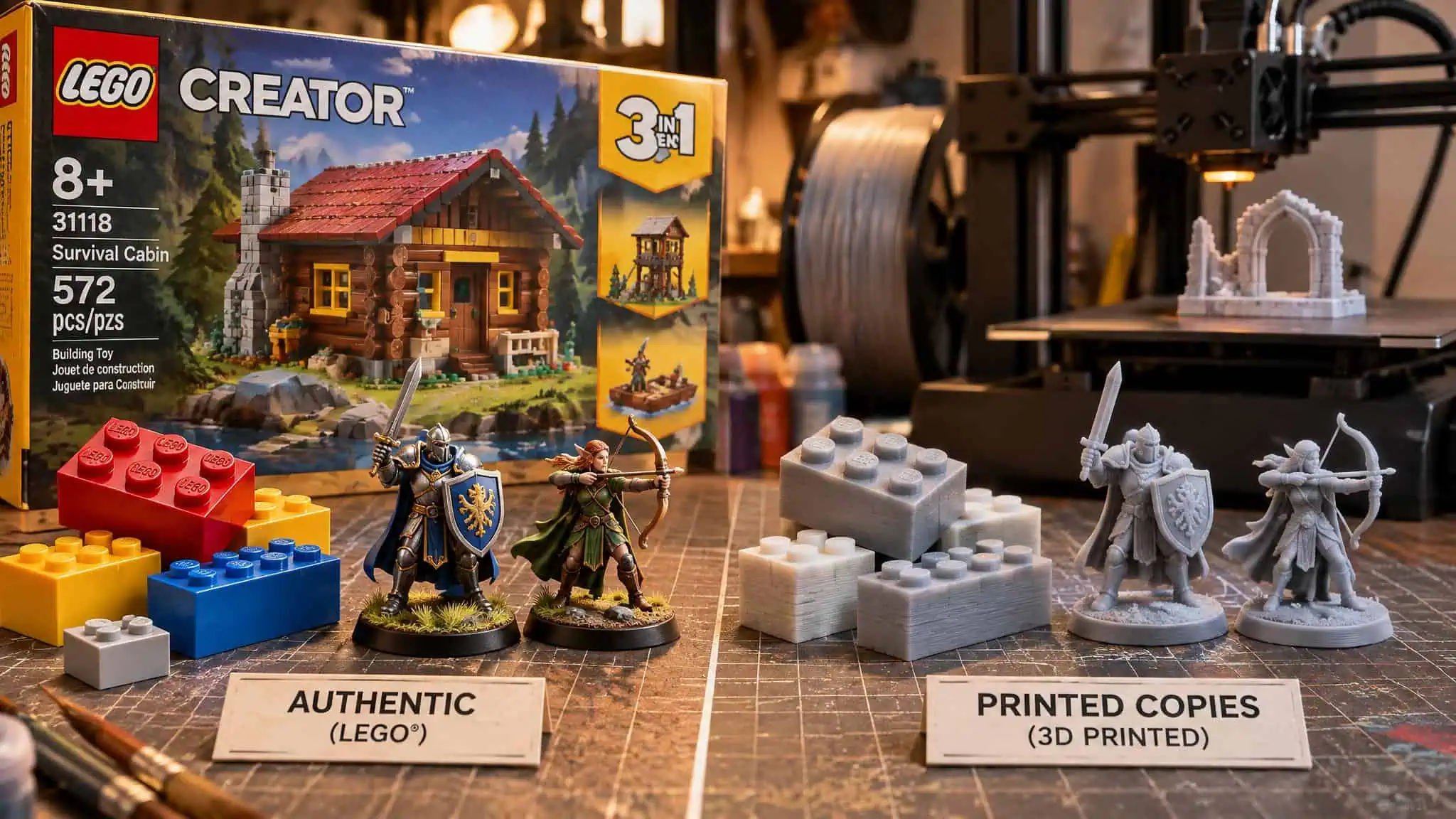
Where hobbyists cross the line into commerce
Across the five maker guides and legal discussions we checked on selling 3D-printed copies of trademarked designs like basic LEGO bricks, 4 of 5 say no and 1 says yes. That lopsided split reflects how risky it is to commercialize even simple, recognizable branded geometry.
The typical path from harmless weekend project to legal trouble starts when a maker prints a few licensed miniatures or branded accessories for personal use, realizes the print quality looks great, and lists duplicates on an online marketplace. The moment you take money for someone else’s protected IP, you step out of the personal-use gray zone and into commercial infringement.
Platform takedowns versus criminal law
Two parallel rule systems govern the exact same STL file: courts enforce criminal statutes, while hosting sites enforce private terms of service and act on brand enforcement like LEGO’s DMCA takedowns and trademark cease-and-desist letters. Conflating the two leads new makers to assume that anything scrubbed from Thingiverse must be illegal, or that anything still hosted online must be legal to print.
A firearm accessory or pop-culture sculpt can be completely legal to possess and print in your state and still vanish from major repositories overnight under platform safety or IP policies. Violating a site’s upload rules costs you an account ban or a file removal, not a criminal record. Conversely, in a jurisdiction with file-possession or distribution bans like New Jersey, downloading or sharing a removed firearm file through a private chat or mirror site carries real criminal exposure even if no platform moderator ever flagged it.
Where the lines move next: the debate, both sides
With six states tightening rules in 2026 and litigation advancing in federal appeals courts, the fight over 3D-printed guns comes down to two competing theories of deterrence: stopping hardware and files at the source versus punishing violent offenders under existing criminal statutes.
Monisha Henley, senior VP for governmental affairs at Everytown, frames state restrictions as preventive action needed before a high-profile tragedy, noting that technology has turned 3D printing into a new kind of threat. “We can’t just focus on the symptoms, but we actually have to focus on the source,” Henley said, explaining that the goal is to keep firearms out of the hands of people who shouldn’t have them.
William Sack of the Second Amendment Foundation counters that stricter enforcement of existing violent-crime laws and prison sentences would deter crime far more effectively than bans on law-abiding makers. Pointing to recent Supreme Court expansions of Second Amendment protections, gun rights groups continue challenging state ghost gun restrictions and online file-distribution bans in court.
Checking your state before you print
State firearm and file rules are shifting within single legislative sessions, making any general overview legal awareness rather than formal legal advice. Before you download or slice anything firearm-adjacent, four quick checks tell you where you stand:
- The item: Confirm whether the part is a regulated frame, receiver, suppressor component, or conversion device.
- Your state: Check current state statutes, especially if you live in or near the 16-to-17-state regulation patchwork that expanded in 2026.
- The file source: Verify whether downloading or possessing the digital file itself is restricted where you live.
- Distribution: Keep personal projects off public marketplaces and file-sharing mirrors unless you hold the required licenses or IP rights.
Following the principle emphasized by Washington Gun Law, knowing the current statute in your jurisdiction before you hit print is simply part of responsible, lawful ownership.
Frequently Asked Questions
What things cannot be 3D-printed?
Across the entire U.S., federal law bars printing undetectable all-plastic firearms, machine-gun conversion hardware like auto sears, counterfeit money, fake government IDs, and knockoff branded goods sold as genuine. Depending on your state, complete 3D-printed guns, unserialized receivers, and even the digital CAD files used to make them can also be illegal. Beyond criminal statutes, standard hobby plastics can’t safely handle load-bearing gear or food contact without proper coatings due to structural and bacterial limits.
Is it illegal to 3D print Lego?
Printing a few Lego bricks for your own shelf won’t land you in handcuffs, because unauthorized copies of protected designs fall under civil intellectual property law rather than criminal statutes. The trouble starts when you list duplicates for sale or try to pass them off as authentic branded products. Across five maker guides and legal discussions on selling copies of trademarked designs like basic LEGO bricks, 4 of 5 warn against it, since commercializing protected geometry invites takedown notices and civil lawsuits.
Are ghost guns illegal in the United States?
Federal law leaves homemade ghost guns in a split position: commercial kits and finished frames must carry serial numbers and pass background checks like store-bought firearms, while building a gun from scratch for personal use without a license remains federally legal. That federal baseline doesn’t protect you from local bans, though, because 16 to 17 states regulate ghost guns and at least eight states plus Washington, D.C. outlaw 3D-printed firearms outright. You also can’t bypass federal bans on machine-gun conversion devices or undetectable all-plastic weapons anywhere in the country.
Is it legal to 3D print a gun in California or New York?
Printing a firearm at home in either state is effectively blocked by strict licensing, serialization, or outright bans. California requires a state license to 3D-print a gun, mandates serial numbers and background checks for component parts and barrels, requires reporting every homemade firearm, and mandates firearm-blocking tech on new printers. New York prohibits distributing 3D-printing firearm instructions, bans undetectable guns, and enacted a printer-blocking mandate backed by a $5,000 civil penalty per non-compliant machine if a state working group confirms feasibility.
Is it illegal to 3D print Lego or Warhammer models for personal use?
Making unauthorized copies of copyrighted miniatures or branded bricks strictly for your own desk sits in a civil copyright gray zone rather than a criminal one. Rights holders enforce their intellectual property through takedowns and civil claims, so personal fan prints that never leave your home rarely draw legal attention. You only cross into real legal exposure when you start selling those prints or marketing them as official merchandise.
Is selling 3D printed items or design files treated differently from printing them yourself?
Yes—the moment money or files change hands, your legal risk spikes for both intellectual property and firearms. Selling unlicensed prints of protected designs moves you out of personal-use territory into commercial infringement or criminal counterfeiting if you pass knockoffs off as genuine. With firearms, commercial ghost gun parts require federal serialization and background checks, while sharing or selling CAD files triggers the harshest criminal penalties in states like New Jersey, New York, and Delaware, where distribution is banned even if no one ever prints a gun.
What is the difference between illegal 3D prints and files banned by Thingiverse?
Criminal statutes are enforced by courts and police, whereas sites like Thingiverse enforce their own private terms of service. A firearm accessory or pop-culture model can be completely legal to print in your zip code and still get scrubbed from a repository overnight, which only costs you a file removal or an account ban. On the flip side, downloading a removed firearm blueprint from a private mirror in a file-ban state like New Jersey can trigger criminal liability even if no platform moderator ever flagged it.
Can I legally 3D print firearm parts like lowers or magazines in a state without ghost gun laws?
In the 33 states with no ghost gun regulations—such as Texas, Florida, and Pennsylvania—printing parts like lower receivers or magazines for your own use faces no state-level ghost gun ban. That federal personal-use allowance only holds if you aren’t a prohibited possessor and aren’t building parts to sell without a manufacturer’s license. You still must follow federal rules against machine-gun conversion devices and undetectable all-plastic firearms.