
White hat hacking is legal, and the answer is more interesting than a simple yes. The same brute-force login attempt, run against the same server, is either a paid engagement or a federal felony depending on one document: a contract nobody in the movie version of hacking ever mentions. I went into this expecting a boring statute and came out weirdly invested. Ethical hacking, defined concretely, is permission-based security testing that finds and fixes bugs before someone malicious exploits them.
Bugs get patched, attackers get shut out, everybody goes home. What separates the white hat from the criminal isn’t the toolkit. It’s intent, permission, and accountability. Same nmap, different paperwork.
Key Takeaways
Yes, white hat hacking is legal with explicit authorization from the system owner; the same techniques (brute-force login, phishing simulation, web app exploit test) flip between legal and criminal based on authorization and scope, not on the tools.
The U.S. Computer Fraud and Abuse Act (18 U.S.C. § 1030) prohibits accessing a computer without authorization but never defines “without authorization”; Van Buren v. United States (2021) and DOJ charging policy narrow that gap, while the proposed Cyber Conspiracy Modernization Act threatens to re-widen it.
Responsible disclosure, with a 30-90 day grace period before any public report, is what keeps researchers on the right side of the line; Heartbleed (2014) shows the system working, Uber 2016 shows the researcher doing everything right while the company dropped the ball.
Table of Contents
What the CFAA actually says about ethical hacking
The Computer Fraud and Abuse Act, 18 U.S.C. § 1030, prohibits accessing a computer without authorization, and it never defines “without authorization.” That’s the whole problem in one sentence. It’s like shipping an API with an undocumented error code that everyone hits eventually, except the error page comes with a prison sentence attached.
Here’s the origin story, because it’s too good not to tell: the CFAA arrived on the books in 1986, built as an expansion of the earliest federal statute against computer fraud, and it was arguably triggered by a movie. War Games (1983) spooked the Reagan administration enough that Washington wrote a federal anti-hacking statute. A Hollywood plot point reshaped federal law. The statute was last amended in 2008 and now covers far more than anyone in 1986 intended, which is what happens when pre-web-era legislation has to govern the modern internet.
Now for the part this voice genuinely loves: the penalty table. Section 1030(a) has nine offense categories, and the sentences run from 1 to 20 years. Subsection (b) covers attempt and conspiracy, so you don’t even have to succeed.
| Offense | First / repeat penalty |
|---|---|
| National-security information | 10 / 20 years |
| Obtaining information | 1 / 5 (up to 10) years |
| Government trespass | 1 (up to 10) years |
| Fraud / value over $5,000 | 5 / 10 years |
| Knowing damage | 1 / 10 (up to 20) years |
| Reckless damage | 1 / 5 (up to 20) years |
| Negligent damage | 1 (up to 10) years |
| Password trafficking | 1 / 10 years |
| Extortion-adjacent threats | 5 / 10 years |
The genuinely interesting bit is the culpability ladder in the damage provisions: knowingly transmitting something destructive gets you 1 or 10 years (20 max on repeat), recklessly gets 1 or 5 (also up to 20), and negligently gets 1 (up to 10). Your state of mind changes the math. That’s a spec detail most people never read.
So who’s pushing back on this vagueness? The National Association of Criminal Defense Lawyers (NACDL). Their position is wholesale reform, not tweaks: terms-of-service violations shouldn’t be federal crimes (everyone has skimmed past a ToS and clicked “I disagree” without reading a word), and the CFAA shouldn’t be expanded. They work through amicus briefs, coalitions, and legislative advocacy. The worry behind all of it: vague wording plus harsh penalties makes the statute ripe for abuse, meaning a researcher can get threatened for exactly the behavior that makes the internet safer.
Red flag: A statute that never defines its core phrase, paired with penalties up to 20 years, is exactly the kind of ambiguity that turns good-faith research into a legal risk.
Three layers draw the line: statute, courts, and prosecutors
Good-faith security research does have real protection, but it comes from two of the three layers that determine CFAA outcomes, and the protection has limits. The three layers are the statute itself (above), the courts, and DOJ charging policy.
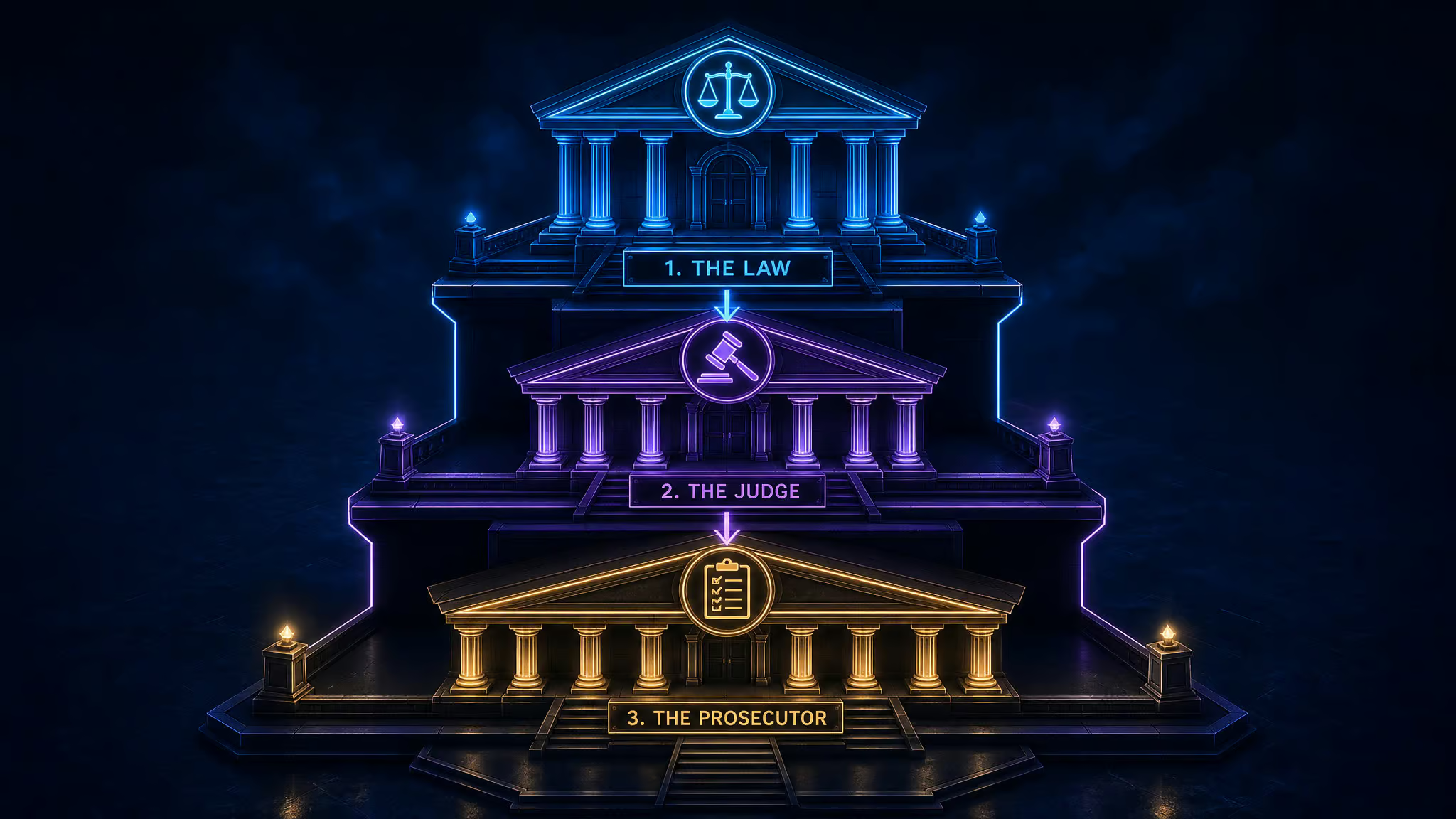
Layer two is the fun one. In Van Buren v. United States (2021), the Supreme Court held that the CFAA doesn’t ban using authorized access for unauthorized purposes. The case started with a license-plate lookup sting, which is a gloriously mundane origin for a landmark tech ruling.
A real win for good-faith researchers, but note the fine print: Van Buren narrowed “exceeds authorized access” only. It did not resolve the statute’s core ambiguity.
Layer three is the Department of Justice’s own Justice Manual, and this is where it gets both clarifying and funny. DOJ policy says prosecutors shouldn’t charge “exceeds authorized access” cases based on contract, policy, or terms-of-service violations; the legal boundary has to be computational, backed by express revocation to end authorization. Per the feds themselves, the following are not prosecutable: checking sports scores at work, embellishing a dating profile, using pseudonyms and fictional accounts. Reading that list is the first time I’ve called a Justice Manual section fun.
There’s more scaffolding: CCIPS consultation is required before charging CFAA cases, there are six conditions for “exceeds authorized access” charges versus three for “without authorization,” and DOJ should decline prosecution for good-faith security research per the Eighth Triennial definition (October 2021, with the Justice Manual updated May 2022). Even prosecutors need a checklist, which tells you how blurry the underlying line is.
One honest caveat: these are charging policies. They don’t bind private plaintiffs, and bending a ToS isn’t suddenly fully legal. The rules narrow the risk; they don’t erase it.
Bottom line: Courts and DOJ policy narrow the CFAA’s reach, but charging policies don’t bind private plaintiffs — the risk shrinks, it never disappears.
What legal permission actually looks like
Everything so far has been about where the legal line sits. This section is about the document that draws it for you: the authorization. Written consent is what converts the exact same techniques from felony to engagement, so it’s worth understanding what that paperwork actually contains.

The contract is the legal instrument
Written consent before testing is the baseline. A verbal OK only survives a simple internal lab exercise; anything touching production needs a signature. Without written consent, your testing can count as unauthorized access under the CFAA or the U.K.’s Computer Misuse Act, its British cousin for our purposes.
Yes, white hat hackers, the practitioners of ethical hacking, need permission before touching a system, and the permission has to be specific. A solid rules-of-engagement document names:
- Who approved the test (the approver, by name)
- Which systems are in scope
- Which methods are allowed
- Which actions are forbidden
- The testing windows
- Escalation contacts
- Emergency-stop procedures
Two gotchas worth their weight. First: network access does not mean testing permission. Shared infrastructure, cloud tenants, and third-party or SaaS assets usually need separate authorization. Second: interception laws are a separate tripwire from access laws. Capturing traffic nobody approved for collection is its own legal problem, even inside an otherwise approved pentest. Scope applies to collection too, and “I was just checking” holds up in exactly zero courts.
Once you have the paperwork, there are four legitimate lanes for this work, each with its own authorization context:
- Penetration testing: actually exploits weaknesses to prove they’re real and show realistic impact. The proof-of-work version.
- Vulnerability assessment: finds and ranks weaknesses without going full exploit. Lower aggression, broader coverage.
- Red teaming: simulates a real adversary going after people, process, and technology. Full tabletop-heist mode.
- Bug bounty research: tests public-facing systems under the vendor’s published program rules, on platforms like Bugcrowd and HackerOne. The rules ARE the authorization, which I think is honestly kind of elegant. Legality flows entirely from a public document.
Here’s the pattern you see play out: a tester confirms permission with one contact, then mid-engagement the attack path turns up a vendor login page or an API that was never in scope. Technically reachable, legally out of bounds. The engagement halts until separate sign-off arrives. The legal line is per-system, not per-project.
What authorization must contain
To spell the minimum out: an authorization is real when it’s written, it names the approver, it lists the in-scope systems, it defines allowed and forbidden methods, it sets testing windows, and it establishes escalation contacts and emergency-stop procedures. Anything touching third-party, cloud, or SaaS assets in the attack path needs separate authorization on top. That list is the difference between a paid engagement and a felony with extra steps.
The second legal regime: privacy and data handling during a test
Computer-access law is only half the picture. During any real test, you’re going to hit personal information, financial data, and proprietary business details. You didn’t go looking for it, but now it’s on your screen, and confidentiality obligations attach the moment it does. That’s why NDAs are standard equipment in this field.
The rulebooks don’t pause for pentests. GDPR, the EU’s personal-data rules, is strict about handling, processing, and storing personal data regardless of your engagement letter. Sector rules stack on top: HIPAA for healthcare, PCI DSS for payment cards. Match the rulebook to the target.
First rule of handling what you find: data minimization. Collect less, store less, protect more. Encrypted evidence, limited retention, redacted screenshots. Just because you can read it doesn’t mean it’s yours.
And here’s the uncomfortable one: permission doesn’t zero out liability. An unexpected outage or data loss during an approved test can still bite, which is why contracts need clear liability clauses plus rollback plans, stop conditions, containment procedures, and documentation. If you’re the tester, that’s your list to insist on before day one, the liability clause is what sorts out who’s actually on the hook when something breaks. Boring paragraph, saves careers.
Then there’s jurisdiction, where things get genuinely messy. The tester, the client, and the data can each sit in a different legal system, with different rules on access, privacy, retention, and breach notification. One engagement, three rulebooks. Government systems, regulated industries, and multinational cloud setups trigger extra legal review, so expect lawyers in the room for those targets.
Responsible disclosure, and what happens when the company drops the ball
Responsible disclosure is privately reporting a vulnerability, with its risks and mitigations, then waiting a 30-90 day grace period before any public disclosure. It’s the protocol that keeps researchers on the right side of the line, and public disclosure is the last resort, not the flex. A strong report includes an executive summary, reproduction steps, realistic severity, evidence, and remediation guidance; proof-of-concept code should demonstrate risk without causing extra harm. Keep the details in a small, controlled circle while the fix ships. Disclosure laws themselves vary by jurisdiction, so the “right” process depends on where you and the vendor sit.

Heartbleed: the system working
2014, OpenSSL. The Heartbleed bug exposed encryption keys, usernames, and passwords, the kind of bug that keeps you up at night. And it went to the OpenSSL team responsibly and got patched before widespread exploitation. That’s the whole playbook executed correctly, and honestly it’s worth saying out loud: the system worked.
Uber 2016: doing everything right and losing anyway
Now the counterexample. In 2016, Uber’s data breach exposed the personal data of 57 million users. The twist that makes it a lesson: an ethical hacker had reported the vulnerabilities beforehand, and Uber sat on it. No user notice, no authorities.
The researcher did everything right; the failure was organizational, not technical. Legal conduct, divergent outcomes, decided entirely by how the company responded.
There’s a third data point in the arc: the 2011 Sony PlayStation Network hack. Gamers in the audience will remember exactly where they were. Unauthorized access exposed millions of users’ personal information, and the outage-plus-breach combo stung. The silver lining was real, though: the industry woke up and started investing in ethical hacking and pentesting. Breaches as painful but effective advertising for the field.
Grey hats, hobbyists, and where learners actually stand
Grey hat hackers are legally exposed, not because of hat color but because they lack authorization. Apply one test to everyone: does the system owner authorize this access? If the answer is no, intent doesn’t save you. The common beginner assumption, and I mean this as a composite pattern rather than any specific person, is it’s on the internet, so it’s reachable, so it’s fair game.
Technical reachability is not legal authorization. Those are different layers entirely.
Same goes for credentials. Certifications like Certified Ethical Hacker (CEH) signal competence, which matters for getting hired, but they authorize access to nothing. Only the system owner can do that.
Where can you actually practice? CTF platforms and lab environments. Live systems that you don’t own are the hard no. If you want the full roadmap from home lab to career, that’s covered in how to become a white hat hacker.
There is partial protection at the edges: DOJ policy says it should decline prosecution for good-faith security research per the Eighth Triennial definition, which came out of the Register of Copyrights’ October 2021 proceeding, with the Justice Manual updated in May 2022. The obvious carve-out: research aimed at extortion doesn’t qualify. And the standard caveat applies to everything in this section: laws vary by jurisdiction, and this is general information, not legal advice.
What going out of scope actually costs
Yes. Go out of scope and the § 1030(a) penalties, ranging from 1 to 20 years, apply to your conduct, permission letter notwithstanding. Legal does not mean risk-free, and the scope document is what keeps it legal.
Where do ethical hackers actually get into trouble? Weak process, not weak tools. The recurring failure modes: verbal-permission assumptions, data over-retention, overstated reports, premature disclosure, rushed reporting. Process is the boss fight.
Scope creep deserves its own warning label, because finding a vulnerability outside the agreed scope creates problems even with the best intentions. Curiosity has a boundary line, and it’s drawn in the contract.
Disruption is the other tax. Pentesting can cause downtime or data loss without planning, so this is not a “run the scanner and vibe” activity. Controlled environments and planning are the difference between a test and an outage. And it’s worth acknowledging without mocking that some organizations skip testing altogether over reputation, privacy, or cost worries. That’s their call, and the hesitation isn’t crazy.
The line is moving: reform and expansion risk
Here’s the counterintuitive bit: courts and the DOJ have been narrowing the CFAA while new legislation threatens to re-widen it. The Cyber Conspiracy Modernization Act, sponsored by Senators Mike Rounds and Kirsten Gillibrand, is proposed legislation, not passed law, and it would raise CFAA penalties and add conspiracy liability. Bugcrowd and the Hacking Policy Council, with Casey Ellis and Trey Ford involved, have warned it could chill good-faith research absent clearer definitions and carve-outs for researchers.
Pushing the other direction is NACDL: decriminalize ToS violations, no expansion of the statute. The reform fight is live in both directions at once, which is a strange place for a 40-year-old law to be.
Casey Ellis put the stakes plainly, calling good-faith hackers “the internet’s immune system.” Trey Ford, less poetically and maybe more memorably: Hackers are not bad. They make the internet safer.
The market case for staying legal
Here’s the career version of the thesis: the same skills are worth a felony or a share of a growing sanctioned industry depending on paperwork discipline. The penetration testing market hit $1.7 billion in 2024 and is projected to reach $3.9 billion by 2029, which works out to 17.1% annual growth. Framed plainly: people are hiring for this. (For the money details specifically, see how much do white hat hackers get paid.)
AI shows up on both sides of this fight, and the numbers back the symmetry. In a 2025 survey by Kusu, 83% of surveyed ethical hackers reported a shift toward AI-powered attacks, and 70% already use AI tools in their own testing. Attackers use it to automate attacks and phishing; defenders use it to predict scenarios and find bugs faster. An arms race with autocomplete, on both ends.
The takeaway isn’t “AI replaces the hacker.” It’s human-AI partnership, because judgment still needs a human attached. And the field’s status shift is earned rather than hyped: ethical hackers now occupy a frontline role in defending data and systems, navigating the legal and ethical boundaries as part of the job description rather than despite it. Heartbleed and Uber back that up better than any mission statement could.
Bottom line
Is it legal to be a white hat hacker? Yes, with explicit written authorization, defined scope, privacy compliance, and responsible disclosure. The line is drawn by the contract, not the hat. If you boil it down to four things: permission, privacy, non-disruption, accountability.
The honest closing note is that the line moves. Van Buren and DOJ policy narrow the statute while proposed bills like the Cyber Conspiracy Modernization Act threaten to re-expand it, so the paperwork discipline matters more as time goes on, not less. And per the standing caveat: laws vary by jurisdiction, and none of this is legal advice. For where this can actually take you, the famous white hat hackers profiled in this series all got there the same way: with a signature.
Frequently Asked Questions
Which hacker is legal?
The one with permission. White hat hackers operating under written authorization, defined scope, and responsible disclosure are legal; grey hats who probe systems without approval are legally exposed; black hats are criminals. The toolkit is identical — same nmap, different paperwork.
How much do white hat hackers get paid?
The market is growing fast enough that demand is real: penetration testing hit $1.7 billion in 2024 and is projected to reach $3.9 billion by 2029, about 17.1% annual growth. The same skills are worth a felony or a share of that sanctioned industry depending on paperwork discipline. Exact salary figures vary by role, certification, and experience level.