
White hat hackers in the United States earn roughly $110,000 to $131,000 a year in base salary. That’s not one number from one source; it’s the band you get when you pull up four salary dashboards side by side and read what each one is actually measuring. Salary.com puts the average ethical hacker at $110,184. ZipRecruiter’s reading for penetration testers comes in at $119,895.
Cyberseek, which tracks penetration and vulnerability testers specifically, shows $131,123. And Glassdoor’s $155,000 median for US-based penetration testers isn’t base pay at all; it’s total pay, bonuses included. An industry guide from icertglobal for 2026 puts the overall average at around $115,000 to $130,000, which lands nicely in the middle of all of it. Every one of those figures is attributed, and none gets averaged into a fake “true” number. By the end of this article you’ll know which levers, experience and geography above all, actually move the figure on your own offer letter.
I went into this expecting to pick the most authoritative number and move on. Instead I found four instruments, each calibrated differently, all pointed at the same job and each giving a slightly different reading. That’s not broken data. That’s the interesting part.
Key Takeaways
US white hat hackers earn roughly $110,184, $131,123 in base pay depending on the source and title, while Glassdoor’s $155,000 median is total pay including bonuses, so the numbers coexist rather than contradict each other.
Experience moves the figure hard: $70,000 to $95,000 entry (0-2 years), $95,000 to $135,000 mid-level (3-5 years), and $135,000 to $185,000+ senior (6+ years), per icertglobal’s 2026 guide.
Certifications are different tools for different stages: CEH adds up to 15% to starting salary and passes HR filters, OSCP‘s 24-hour practical exam earns a technical premium, and CISSP unlocks the leadership track.
Table of Contents
Why salary sites disagree on white hat hacker pay
Here are all four readings on the bench at once:
| Source | Figure | Title tracked | What it measures |
|---|---|---|---|
| Salary.com | $110,184 | Ethical hacker | Base average |
| ZipRecruiter | $119,895 | Penetration tester | Base average |
| Cyberseek | $131,123 | Penetration and vulnerability tester | Base average |
| Glassdoor | $155,000 | US pen tester | Median total pay, bonuses included |
The drift between the first three mostly comes down to job-title scope and snapshot years. Salary.com tracks “ethical hacker,” ZipRecruiter tracks “penetration tester,” and Cyberseek tracks “penetration and vulnerability tester.” Slightly different labels, slightly different data pools, slightly different moments in time. That’s expected, not suspicious.
The big jump, though, is Glassdoor, and the mechanism is refreshingly simple: total pay versus base pay. Glassdoor’s figure counts bonuses; the others don’t. Once you see that, $110K and $155K stop looking like a contradiction and start looking like two honest readings of two different things.
This is also where a lot of people trip. The common mistake isn’t misreading one site; it’s comparing two aggregators, seeing a $40K gap, and concluding the data is broken. Both figures can be correct under their own methodologies at the same time. That’s honestly kind of elegant, in a “your dashboard needs a units label” way.
And no, I’m not going to average the four numbers into one tidy figure. That would manufacture a precision none of these sources support. The honest summary is the range itself: roughly $110K, $131K base, with total pay running higher once bonuses enter the picture.
White hat hacker salary by experience level
Entry-level white hat hackers earn $70,000 to $95,000; mid-level hackers earn $95,000 to $135,000; senior hackers earn $135,000, possibly $185,000 or more, per icertglobal’s 2026 salary guide. Those three bands cover most of the career, so here’s what each tier actually does all day.
| Level | Experience | Typical titles | Range |
|---|---|---|---|
| Entry | 0-2 years | Junior Penetration Tester or Associate Security Analyst | $70,000 to $95,000 |
| Mid | 3-5 years | Penetration Tester | $95,000, $135,000 |
| Senior | 6+ years | Lead Pen Tester, Principal Security Consultant | $135,000, $185,000+ |
Entry level (0-2 years)
Honest framing: at this tier you’re mostly running vulnerability scans and automated testing, learning the craft rather than hand-crafting exploits. The junior pen tester benchmark sits around $86,965, which is a genuinely respectable starting line for a job where the whole point is breaking things. You’re not in the movie-hacker phase yet. You’re the person who knows what the scanner actually flagged.
Mid-level (3-5 years)
This is where it gets hands-on. Mid-tier testers work independently, do manual exploitation, and write their own proof-of-concept scripts instead of leaning on tooling someone else built. The band moves to $95,000 to $135,000 here, and the job stops being about operating the instruments. You start thinking like the adversary.
Senior (6+ years)
Pay tops out at $135,000, reaching $185,000+ at this tier, and the job shifts from keyboards to communication. Senior lead pen testers and principal security consultants run teams, architect Red Team exercises, and translate technical findings into language executives can act on. That doesn’t mean you stop being technical; it means the technical skill has to come bundled with the ability to convince a CFO that a finding matters.
One thing worth saying plainly: what separates these tiers isn’t tenure. It’s verifiable findings and proof-of-concept capability. In practice, a common hiring pattern is that candidates with a certification but no public findings tend to stall in entry bands, while candidates pairing a cert with a public disclosure portfolio, write-ups on HackerOne or Bugcrowd, get pulled into mid-tier offers faster. Your public work is the part hiring managers can actually verify.
Certifications that actually move pay
The pick depends on where you are in your career: CEH to get past HR filters at entry (with a starting-salary lift of up to 15%, per icertglobal’s 2026 guide), OSCP for a technical premium once you’re doing real hands-on work, and CISSP when you want to move up into the management track. Different tools, different jobs.

CEH: the HR keycard
The Certified Ethical Hacker credential, administered by EC-Council, has a dual value. It can lift starting salaries by up to 15%, and it passes the résumé scanners that would otherwise bin your application before a human sees it. That second function is underrated; the best technical candidate in the world doesn’t get paid if the applicant tracking system never surfaces them. One caveat with a wink: EC-Council claims 97% of professionals choose C|EH for career growth, which is the vendor marketing its own product. Flag it, enjoy it, don’t cite it as neutral data.
OSCP: the 24-hour proof
The Offensive Security Certified Professional exam runs 24 hours. Not a multiple-choice afternoon. Twenty-four hours of actually hacking machines under observation, and that format is the entire reputation story. Anyone holding an OSCP has demonstrated, in one brutal sitting, that they can do the work rather than describe the work. That’s why it qualifies holders for premium mid-to-senior technical roles, and why the cert carries weight that its multiple-choice cousins don’t.
CISSP: the exit ramp from pure hands-on
CISSP is the leadership-track cert. It bridges technical and governance work, and it’s the credential that unlocks management-tier pay when you decide you’d rather direct security programs than run the scans yourself. It doesn’t replace hands-on skill, but it changes which salary bands you’re eligible for.
For landscape context: CompTIA Security+ is the usual first cert, CISM and CISA are also popular, and per Nexford, CISSP, CISA, and CompTIA Security+ are the three most employer-sought certifications overall. SANS/GIAC certs like GPEN and GWAPT are respected hands-on options too. No invented ROI numbers for those last ones, the 2026 guide doesn’t attach figures, but they show up on serious job posts for a reason.
The through-line: certifications are different levers, not interchangeable collectibles. The premium figures above are reported ranges from one 2026 industry guide, not guarantees, and the right pick depends entirely on which rung you’re standing on.
Where white hat hackers earn the most: country and city pay
The United States tops the market at $85,000 entry / $160,000 senior, concentrated in hubs like New York, San Francisco, and Seattle. The other four major markets run noticeably below that, with their own hub cities and their own reasons for the ceilings they have.
| Country | Entry | Senior | Hub cities |
|---|---|---|---|
| United States | $85,000 | $160,000 | NYC, San Francisco, Seattle |
| United Kingdom | £45,000 | £90,000 | London, Manchester, Edinburgh |
| Canada | CAD 75,000 | CAD 130,000 | Toronto, Vancouver, Montreal |
| Australia | AUD 80,000 | AUD 150,000 | Sydney, Melbourne |
| India | INR 6,00,000 | INR 20,00,000+ | Bengaluru, Pune, Hyderabad |
The interesting part isn’t the numbers themselves, it’s why they differ, and most salary pages skip it entirely. Two forces set each country’s ceiling. First, enterprise and financial-institution density: hubs are hubs because that’s where the big attack surfaces and big budgets live. Second, and this is the bit people miss, regulation manufactures demand.
GDPR compliance pressure in the UK and EU creates standing demand for people who can find vulnerabilities before regulators or attackers do. Australia’s national cyber strategy does similar work. Resilience standards turn security spending from optional into structural, and structural spending is what pays salaries.
One more lever worth knowing about: remote work. If you can hold a metro-rate job while living somewhere with a lower cost of living, that’s a genuine arbitrage. It’s a strategy, not a promise, since not all remote roles pay metro rates, but the pattern exists and it’s real.
Bug bounty earnings, treated honestly
Bug bounty hunters earn variable, often modest per-finding payouts, and the median Bug Bounty Specialist salary is $74,867, below most salaried security roles. That’s the number the YouTube thumbnails don’t lead with. Bounty work is better understood as a portfolio-building move than a salary replacement, and the case study below shows exactly why.

The platforms are real and open to anyone: HackerOne, Bugcrowd, Intigriti. Companies and government agencies actively invite hunters, and large paychecks do happen, worth citing with attribution rather than as the typical outcome.
Field note: Bounty payouts vary wildly per finding, so treat any single reported payout as an anecdote, not a baseline for planning your income.
A real finding, end to end
HackerOne report 864712 is a great window into what an actual discovery looks like. The hunter ran subdomain enumeration with SUBFINDER, a small free tool, and surfaced a PII leak exposing customer records. Tiny tool, huge impact. This is the whole genre in miniature: a chain that looks boring from the outside, an exposure that looks catastrophic from the inside.
The report is commonly associated with Zomato, but that attribution comes from hashtags and stays unconfirmed, so take it with a grain of salt. A CodeVerd video walkthrough of the report, from a channel with 153K+ views and 19.5K subscribers that has featured NahamSec, Jason Haddix, and Tommy DeVoss, drew a genuinely interesting viewer debate: whether the reported payout was low for the severity. I love that the debate exists, because it’s the live question in bounty economics: what is a bug actually worth? The channel’s credentials establish it’s not a random account; they don’t settle the payout question.

On the topic of bounty-content claims: you’ll see video titles along the lines of “earned $200 in 2 minutes” on bug bounty programs. Treat those as what they are, low-confidence title bait, not earnings data.
There’s also a common field pattern worth naming: new hunters often spend days on reconnaissance before landing a first valid finding, then discover the payout is modest relative to the hours. Not a slur on anyone, just the honest base rate.
The contrarian takeaway
Here’s the part I think is the real financial value: bounty work produces a public, verifiable disclosure track record. Your HackerOne and Bugcrowd leaderboards are checkable by any recruiter, which makes them negotiation leverage in later salaried offers. Bounty income is a negotiation asset before it’s an income stream.
For the human path, look at Tommy DeVoss, profiled on podcast Ep. 164 after going from black hat to bug bounty legend. Illegal intrusion to legal, paid, leaderboard-ranked disclosure: that’s DeVoss’s arc, and it really is the redemption thread running through the whole bounty economy. No invented earnings attached; the story is the point.
Full-time salary vs. contract rates vs. bounty income
Contract and freelance pen testers bill $65, $150 per hour, which works out to serious money if you can keep the pipeline full, and zero dollars in the gaps if you can’t. Full-time roles run $95,000, $145,000 in base salary from the same 2026 source, and the base is not the whole loot table. Let me spell out what stacks on top:
- Performance bonuses: 5%, 15% of base, which is exactly why Glassdoor’s $155,000 total-pay figure exceeds the base-only aggregators. The reconciliation from earlier comes full circle here.
- Development stipends: $2,000, $5,000 a year, the underrated line item for a cert-collecting crowd. That’s a free OSCP attempt plus a conference ticket depending on the employer.
- Equity: shows up especially at tech firms and startups. Classic lottery-ticket caveat, stated plainly: it’s usually worth zero, occasionally worth a lot.
- Health and retirement matching: the boring benefits that still count, and quietly add real value to the offer.
For the per-month and per-hour searchers, some transparent arithmetic, labeled as arithmetic rather than separately sourced: $110K, $130K in annual base is roughly $9,000, $11,000 per month. Contract rates are already hourly at $65, $150.
Who each path suits: full-time is stability plus benefits; contracting is autonomy plus a higher ceiling and variable income; bounty work is independence with the lowest floor. In-house roles, security-firm work, and freelance all change the pay and the vibe, and there’s no single objectively best arrangement. Which is honest, even if it’s less satisfying than a winner.
What you’re paid to do: role, titles, and specialization premiums
A white hat hacker does the same things a malicious hacker does, with the same tools and methods, plus a permission slip, plus reporting, plus often fixing what they find. That’s the entire difference. If all this sounds appealing, ethical hacking is a great career choice precisely because the day job spans testing applications, networks, and cloud infrastructure, running social-engineering simulations, code review, malware reverse engineering, and, yes, documentation and report writing. The unglamorous part is part of the honesty.
There’s also a clean fork early on: the private sector pays you to protect company assets, while government work defends national security. Worth picking a lane consciously.
Ethical hacker vs. pen tester
Job boards use the titles loosely, so here’s the actual distinction in one pass: penetration testing is a subset of ethical hacking. Pen testers exploit vulnerabilities in specific systems; ethical hacking is the broader umbrella that also includes vulnerability assessments and social engineering. Both overlap with Red Team work, which is adversary-perspective testing. Some pen-tester roles ask for C|PENT specifically. Practically, the title on your job determines which salary label applies to your paycheck, which is why the four dashboard readings from the top of this article don’t match.
The hacker color taxonomy, fast lore tour: white hats are the authorized, paid, legal bucket this article is about. Black hats do illegal intrusion, data theft, espionage, malware. Gray hats probe without permission, sometimes offering to fix what they find for a fee, ethically murky even with decent intentions, and honestly a bad career plan either way. Green hats are novices.
Blue hats are either revenge amateurs or contracted pros, and here’s the fun bit: Microsoft literally contracts BlueHat professionals for Windows security, so the fan-lore color is a real job at a real company. Red hats go vigilante against malicious hackers, hacktivists are politically motivated, script kiddies lean on pre-built scripts, and elite hackers create entirely new breaches. One tour, no glossary.
Specialization premiums
Which rabbit hole pays:
- Cloud security / DevSecOps: 12%, 18% premium across AWS, Azure, and GCP. Terraform, Kubernetes, and IAM auditing are the concrete tools that get you there.
- Web app and API pentesting: 10%, 15% premium. Burp Suite, the OWASP Top 10, GraphQL and REST testing. Also the classic on-ramp into bounty hunting.
- Reverse engineering and exploit development: top-of-market, with one source citing 20%, 30%. Ghidra, IDA Pro, Assembly. This is the deepest, rarest skill tree, and the source frames the premium qualitatively, so treat the percentage as directional rather than precisely verified.
Same caveat as the cert premiums: these are reported ranges from a single 2026 industry guide, not guarantees.
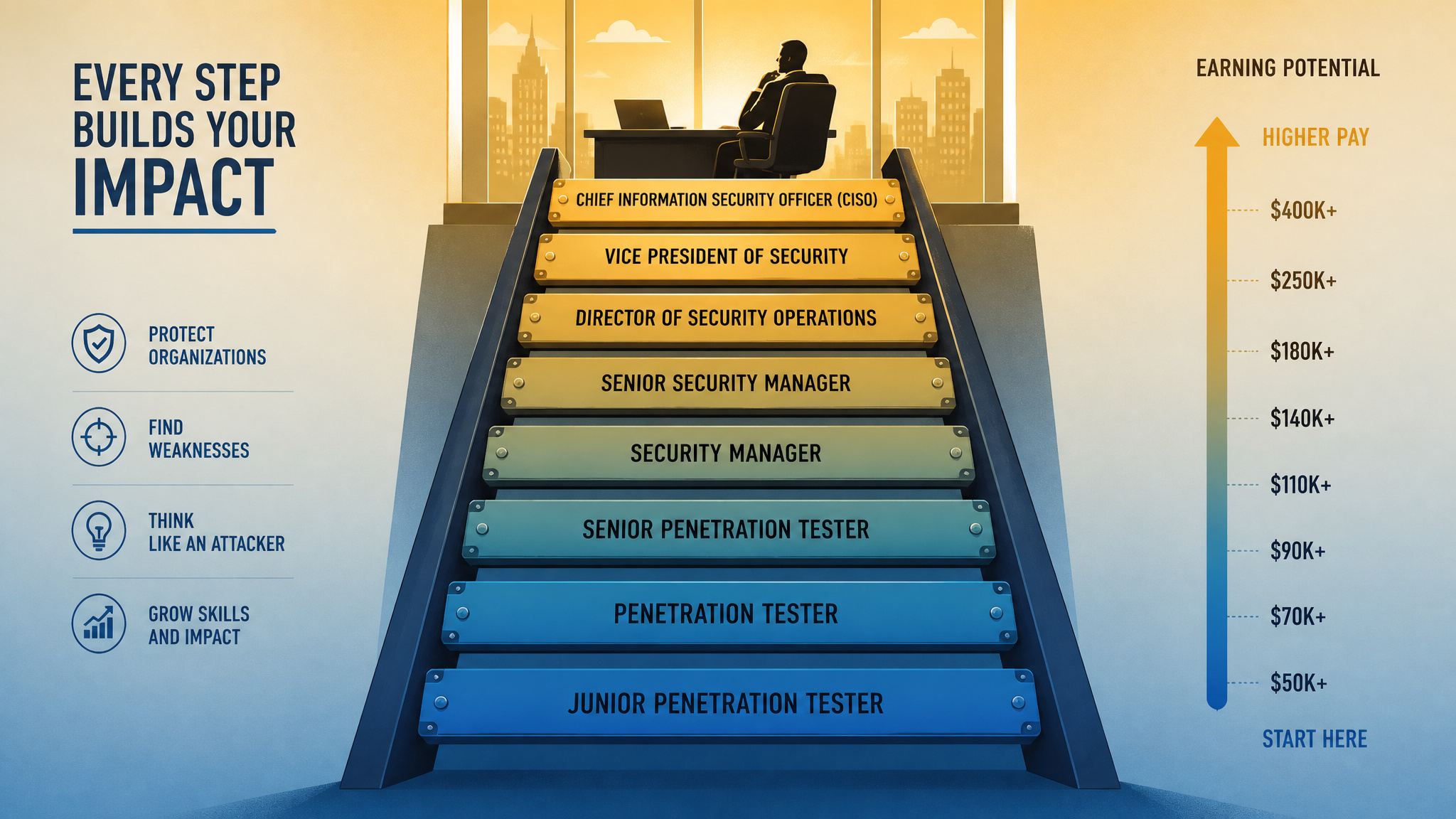
The title ladder
Two people “hacking” for a living can differ by more than $150K in pay, and the ladder explains it:
- Junior Pen Tester: $86,965
- Pen tester: $97,659
- Network Security Architect: $175,065
- CISO median: $256,040
Say it plainly: CISO is a leadership role, not a hacking salary. It’s typically the highest-paying job in cybersecurity, but the biggest salaries in this field belong to people who moved up and out of hands-on work. Adjacent roles for comparison: Cloud Security Engineer $121,823, AppSec Engineer $117,111, Malware Analyst $87,000, InfoSec Analyst roughly $89,926, $89,933. Pen tester salaries sit in the middle of the cybersecurity pack, which surprises people who assumed it was the top.
And who actually writes these checks? BuiltIn’s top hirers include IBM, Google, Synack, Raxis, and VikingCloud, spanning big tech and dedicated security firms. LinkedIn listings show openings at Bank of America, the NFL, Freddie Mac, Raytheon, GEICO, Campbell’s, Garmin, JetBlue, and Citi. The spread is the point: soup to jets, literally. (Listed employers at the time of the source data, not a live hiring guarantee.)
Why companies pay six figures for hacking, and why it’s legal
The demand side starts with a number: IBM’s Cost of a Data Breach Report 2023 put the global average breach cost at $4.45 million, up 15% over three years. More than 354 million people were affected by breaches in 2023. And the stat that explains the job’s existence: security tools failed to detect their own breaches when they happened at more than 1 in 3 organizations. Humans finding what tools miss is the job description. Budgets that size, plus tools that miss things, equals six-figure salaries.
Healthcare is the sharpest example. Per HIPAA Journal, 2023 saw roughly 1.99 breaches of 500+ records per day, almost two a day, because healthcare data fetches the top price on the black market. That’s why healthcare security teams get paid well. And breach victims span every sector, Target, Equifax, MGM, Yahoo, Microsoft, Wendy’s, Citigroup, no industry is exempt, which is why the employer list above reads like a stock index.
There’s runway, too: the Bureau of Labor Statistics projects 29% employment growth for information security analysts, penetration testers included, from 2024 to 2034. The official BLS phrasing is “much faster than average”, and it’s the strongest single stat that this career has somewhere to go.
The legal precondition
Now the contrarian thread, and I think the most underrated fact in this whole salary picture: the single most important factor in white hat pay isn’t skill. It’s the legal framework. The U.S. Department of Justice’s updated policy explicitly protects good faith security research from prosecution under the Computer Fraud and Abuse Act, CFAA once introduced and done. That policy is what converts hacking from a crime into a role commanding $130K.
Firms can employ hackers openly because this protection exists. It doesn’t cover all hacking, and none of this is legal advice, but the plain fact stands: the paycheck is downstream of the policy. We’ve covered the legal side in more depth in is it legal to be a white hat hacker, if you want the authorization and disclosure framework.
Realistic ceiling: can a white hat hacker make $500K?
The honest calibration: the realistic high end for hands-on senior specialists is $185,000+. The biggest sourced figure is the CISO median of $256,040, and it belongs to a leadership role, not a hacking role. $500K a year is outlier territory, not documented for individual practitioners in any source I found. If you see that number attached to a hands-on hacker, ask what it’s actually measuring.
What the money buys matters, though. When a cybersecurity firm found a vulnerability in connected pacemakers, the FDA recalled nearly half a million devices. One finding, half a million medical devices. That’s why this work commands what it commands.
As for the most famous white hat hacker, that’s Kevin Mitnick, profiled via KnowBe4, with which he was affiliated, itself a fun fact about how the industry absorbs its legends. The former most-wanted hacker became the field’s most famous name. No earnings claims attached; the name is the anchor.
How long until the first good paycheck: pathways in
Most people transition into paid penetration testing after 1-4 years of IT or security experience, and 3-5 years of relevant experience is typically valued over credentials. So the real answer is a three-step sequencing problem, not a vague wait: foundation role, cert, public findings.
The timeline
Step one is a foundation IT job, and network support or engineering is the common on-ramp. Yes, the boring first job pays off later, because you can’t break what you don’t understand. Step two is a cert to pass the HR filters. Step three is public findings to justify mid-tier pay.
Degrees are optional for many pen testing roles, though a CS bachelor’s helps, and a master’s offers hands-on labs plus a market edge; the University of San Diego advertises an online MS completable in as little as 20 months, which is a promotional claim from the school itself, so treat the timeline accordingly. Bug bounty fits in as the shortcut for the portfolio step, not the income step. Our full how to become a white hat hacker roadmap walks this sequence in detail.
Skills and tools
The CEH exam skill set condenses to networking and systems fundamentals, OS security across Linux, Windows, and Mac, authorized vulnerability assessment, and countermeasures. Languages on the usual job-post suspects list: Python, SQL, PHP, Java, C, C++. Not a gatekeeping checklist; it’s what the postings keep asking for. The standard tool loadout is exactly what you’d want to install tonight: Kali Linux, Nmap, Wireshark, Burp Suite, Nessus, OWASP ZAP. For weekend-friendly practice, Coursera Guided Projects like “Wireshark for Packet Capture” and “Web Application Security Testing with OWASP ZAP” are quick hands-on reps, and the Google Cybersecurity Professional Certificate (Python, Linux, SQL) and IBM Cybersecurity Analyst Professional Certificate are structured entry-level options.
Portfolio accelerators
Disclosure write-ups, open-source contributions, and GitHub activity give hiring managers something verifiable. Black Hat and DefCon are where the networking happens. For the experienced, an SMB consulting practice running vulnerability assessments and compliance audits is the independent-earner path. And niche sectors, IoT hardware, automotive, smart-contract auditing, are where scarcity pricing kicks in, because few people can do the work.
None of this is guaranteed income; it’s the set of levers with the best evidence behind them. For where these roles sit in the industry, see white hat hacker in cyber security.
So, yes, this pays well enough to be a career. Roughly $110K, $131K in base pay at the middle of the market, $155K as the total-pay median, $70K at entry climbing to $185K+ at senior hands-on level, with 29% projected BLS growth through 2034 and $4.45 million average breach costs funding the demand. Two honest takeaways to carry out of the rabbit hole: bounty income is a negotiation asset before it’s an income stream, and the legal framework, not raw skill alone, is what makes the paycheck possible. Whether the salary dashboards convinced you, the numbers are on the table, every one attributed. The decision, like the pay itself, is a system you get to optimize.
Frequently Asked Questions
What is an ethical hacker’s salary per month or per hour?
$110K–$130K in annual base works out to roughly $9,000–$11,000 per month. Independent contractors bill hourly at $65–$150 per hour, though that income is only serious money if the client pipeline stays full. Salaried full-time roles run about $95,000–$145,000 in base before bonuses and benefits.
How much do bug bounty hunters make compared to salaried ethical hackers?
Usually less, at least as income. The median Bug Bounty Specialist salary is $74,867, below most salaried security roles, and per-finding payouts vary wildly — the ‘earned $200 in 2 minutes’ video titles are title bait, not earnings data. Bounty work’s real financial value is the public, verifiable disclosure track record on HackerOne or Bugcrowd, which becomes negotiation leverage in later salaried offers.
How much do white hat hackers earn by experience level, entry to senior?
Entry-level hackers with 0–2 years earn $70,000–$95,000, with junior pen testers benchmarked around $86,965. Mid-level hackers with 3–5 years earn $95,000–$135,000, and senior hackers with 6+ years earn $135,000, reaching $185,000 or more. What separates the tiers isn’t tenure — it’s verifiable findings and proof-of-concept capability.
Which certifications like CEH, OSCP, or CISSP increase a white hat hacker’s salary the most?
It depends on career stage. CEH can lift starting salaries by up to 15% and gets you past HR résumé scanners at entry level; OSCP’s 24-hour practical exam earns a technical premium for mid-to-senior hands-on roles; and CISSP unlocks the leadership track and management-tier pay. They’re different levers for different rungs, not interchangeable collectibles.
