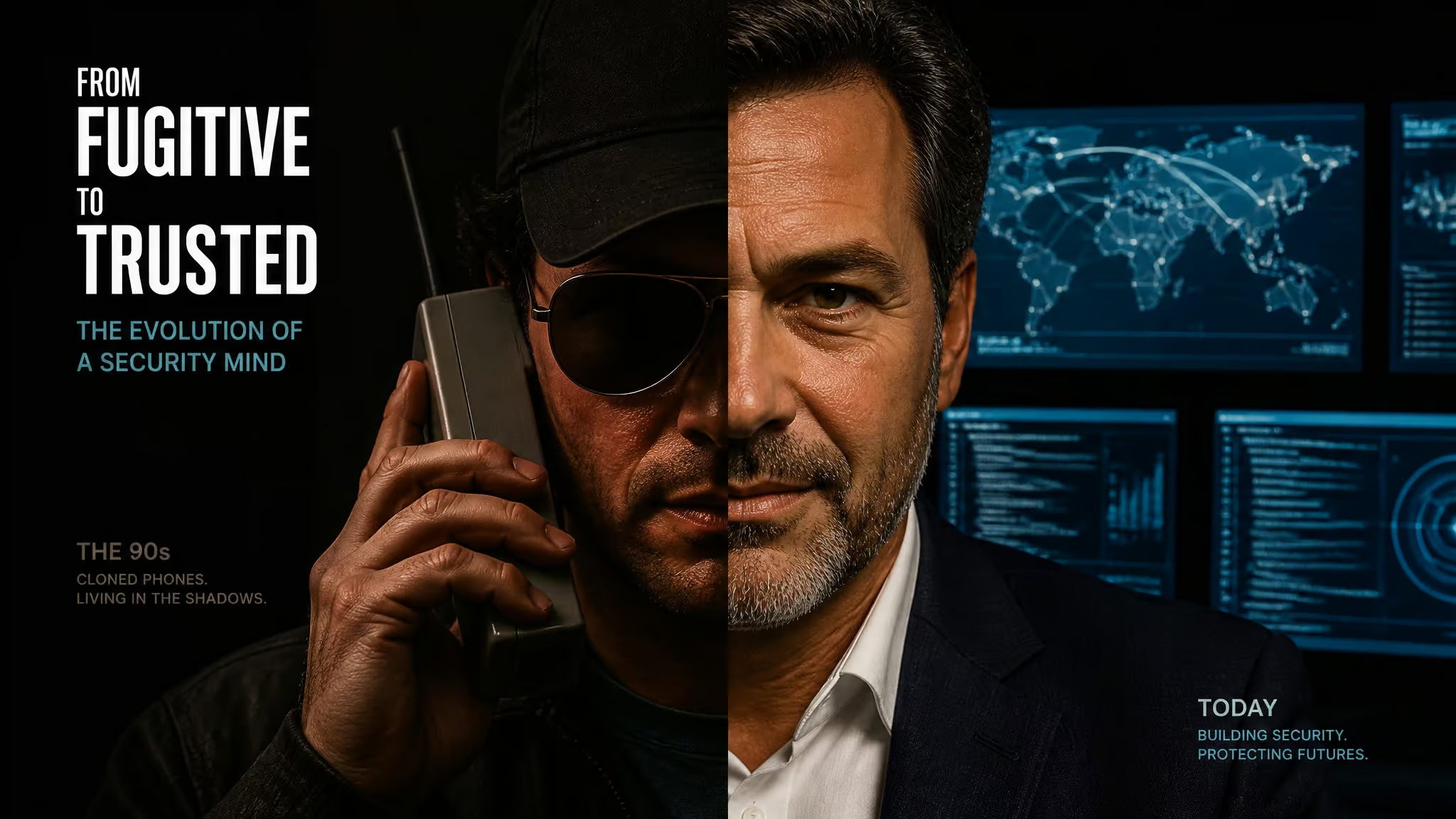
I fell down this rabbit hole the way you fall down most rabbit holes: looking up one thing about famous hackers, and three hours later I was reading court filings and FCC rulings about a guy who got his ham radio license back in 2002. And the thing that hooked me isn’t just that Kevin Mitnick is the answer to “who’s the most famous white hat hacker in the world?” It’s why he’s the answer. The FBI put him at the top of its Most Wanted list, and then the FBI hired him. I had to know how that works.
So who is a famous white hat hacker? Kevin Mitnick: American computer security consultant, author, and convicted hacker. CNN, Fox News, and other networks called him “The World’s Most Famous Hacker.” A white hat hacker is someone who finds and fixes security flaws with the owner’s permission, which is exactly the job Mitnick built after his prison release.
Here’s the honest nuance that makes his story worth telling: he’s the canonical white hat precisely because he was a convicted black hat first. Known as “The Condor,” he was arrested on February 15, 1995 and died on July 16, 2023. In between, he went from trespasser to the guy governments called for advice.
Key Takeaways
Kevin Mitnick was a convicted black hat before becoming a famous white hat: arrested February 15, 1995 in Raleigh, NC after roughly two and a half years as an FBI Most Wanted fugitive, he pleaded guilty in 1999 and served about five years.
The same social-engineering skill produced both halves of his life: without authorization it meant prison; with it, he founded Mitnick Security Consulting (2003), became Chief Hacking Officer at KnowBe4, and testified before Congress in 2000 and 2003.
His core lesson survives him: the human element is still the hardest security risk to guard, which is why his books (starting with The Art of Deception, 2002) remain the standard reading list for aspiring ethical hackers.
Table of Contents
What “white hat” actually means, and where Mitnick fits
The taxonomy is simple enough to fit in a paragraph, and Mitnick’s life is what makes it stick. A white hat hacker breaks into systems with explicit permission, then reports what they found so it can be fixed. A black hat does it without permission, for whatever motive. A gray hat lives in between, probing without authorization but without malicious intent, which is legally still trespassing, just with better manners.

The bright line is authorization: under the Computer Fraud and Abuse Act of 1984, unauthorized access is criminal regardless of why you did it. Curiosity is not a defense. Read our is it legal to be a white hat hacker breakdown if you want the full legal framework.
Mitnick ran the entire taxonomy in one lifetime, which is why he’s the worked example instead of the textbook definition. He was a black hat in the convicted sense: he pleaded guilty to wire fraud and computer fraud, no euphemisms. He was “The Darkside Hacker” in his hacking days, a nickname that leans exactly as ambiguous as it sounds. And he was a white hat afterward, in the most verifiable way possible: governments and Fortune 500 companies paid him to attack them. So was Mitnick really a white hat or a black hat? Yes, in phases.
The labels describe behavior, not identity. That’s the misconception worth killing: nobody is born a hat color, and nobody is stuck with one.
Is white-hat hacking legal? Only with explicit authorization, full stop. Mitnick’s conviction is the counterexample that proves the rule: the skill set was identical before and after prison, but the paperwork changed everything.
The bus hack: social engineering before it had a name
Kevin Mitnick was born August 6, 1963, in Los Angeles, died July 16, 2023, and in his hacking prime breached roughly 40 major corporations. But the hack that explains all of it happened when he was 12, and it involved exactly zero computers.
Per his memoir Ghost in the Wires, young Kevin talked a bus driver into telling him where to buy a ticket punch, using a “school project” as the pretext. Then he pulled unused transfer slips out of a dumpster by the bus company garage and rode LA buses free. Okay, sit with that for a second. No code, no hardware, no exploit.
He identified a trust relationship, fabricated a plausible reason to exploit it, and combined the result with discarded information someone else threw away. That’s the entire thesis of his career compressed into one story. People call this social engineering now; at the time it was just a clever kid.
The phreaking years came next, the era of phone phreaks like John Draper (Captain Crunch) who figured out the phone system’s weaknesses. Mitnick’s version was comparatively low-stakes: pizza meetups with other phreaks, trading landline prank ideas. Think of it as a mini-con without the badges. Same skill, new medium.
He’d also learned magic tricks as a kid, and the connective tissue between magic and social engineering is real: both are misdirection. The magician thread runs all the way to October 19, 2019, when he performed a vanishing business-card trick during a visit to Cybercrime Magazine’s studios. A hacker who ends his public life doing close-up magic at a tech magazine’s studio is a hacker whose whole career was, in some sense, one long magic show where the trick was making you trust him.
The black-hat years: what he actually did
Mitnick’s FBI arrest stemmed from a pattern of unauthorized corporate intrusions, culminating in the Pacific Bell voicemail hacks, a two-and-a-half-year run as a fugitive, the Christmas Day 1994 breach of Tsutomu Shimomura’s computer using protocol spoofing, and his February 15, 1995 arrest in Raleigh, NC. He later pleaded guilty in 1999 to seven counts and received a sentence of 46 months plus 22 months.

The first real computer breach came in 1979, when he was 16. A friend handed him the phone number for “the Ark,” a DEC RSTS/E system at Digital Equipment Corporation, a major computer manufacturer of the era. Notice what the entry point was: a person, not a password cracker. That’s the tell that runs through everything he did. He copied DEC’s software, and the consequences arrived in 1988 with a conviction: 12 months in prison and 3 years of supervised release, for roughly $1 million worth of DEC software copied.
Then the spree. Per Cybercrime Magazine, he breached roughly 40 major corporations, and the target list is genuinely wild: DEC, Motorola, IBM, Nokia, Pacific Bell. The toolkit: cloned cell phones for location cover, stolen passwords, copied proprietary software, read private emails. And here’s the detail that reframes the whole story: he wasn’t after money.
The motive was curiosity, challenge, the thrill of the chase. He was a trophy hunter. He wanted to prove he could get in, not cash out. That’s why his case reads so differently from, say, Albert Gonzalez’s, and we’ll get to that comparison in a bit. It also matters because it explains why he crossed over so cleanly afterward: the skill was never about greed.
The manhunt: roughly two and a half years as a fugitive
The domino that started it all was Pacific Bell. Near the end of his supervised release, Mitnick hacked into Pacific Bell voicemail systems, which triggered a warrant. He skipped out, lived under false identities for roughly two to two-and-a-half years (sources vary: the LA Times says 2 years, the DOJ says 2.5, some say 3), and landed at the top of the FBI’s Most Wanted list. Read that again without skimming.
A hacker, number one on the Federal Bureau of Investigation (FBI)’s Most Wanted list. That fact doesn’t need any dramatization. It’s just true.
The ending is where the story got its legend. On Christmas Day, 1994, Mitnick breached the home computer of Tsutomu Shimomura, a security researcher, using protocol spoofing, and left mocking voicemails while he was at it. (Yes, he chose December 25 to hack a specific security expert. The date irony is part of the record.) Shimomura tracked him through cellular triangulation, and the FBI arrested Mitnick on February 15, 1995 at his apartment in Raleigh, NC. What they found tells you everything about his tradecraft: cloned cell phones, more than 100 cloned cellular codes, and multiple false IDs.
This arrest became legendary partly because it was hacker versus hacker, pursued personally by the man whose system he’d breached. Other, bigger crimes from that era faded from memory; this one had a face on both sides. That’s a story about narrative, and it’s going to come up again.
Trial, sentence, and the contested numbers
The trial phase is where Mitnick’s story turns from a chase into a legal puzzle, and it’s also where the record gets genuinely murky. The charge list kept shrinking between indictment and plea, the custody time piled up before any verdict, and the loss figures cited by different sources never lined up. This section walks through what was actually charged, what he actually pleaded to, and which numbers are contested rather than settled.

The plea deal and the sentence
The legal stack, compressed: in 1998, charges included 14 counts of wire fraud and 8 counts of unauthorized access to devices, plus charges for interception and federal computer access. In 1999, Mitnick pleaded guilty to a much smaller set: seven counts, four of wire fraud, two of computer fraud, and one of illegal wire interception. Judge Mariana Pfaelzer sentenced him to 46 months plus 22 months for the supervised-release violation. All told, he served about five years, roughly 4.5 of them before he was ever tried, including around eight months in solitary confinement.
That pre-trial number is the one that should make you stop. Nearly five years in custody before a verdict, under charges that were eventually narrowed to seven guilty pleas. I’m not adjudicating the case, and the plea being smaller than the charge list is worth observing without drawing conclusions. But the shape of it is unusual by any measure.
Quick test: When reported loss figures diverge by an order of magnitude, check which source attributed each number before repeating either one.
Was the punishment excessive?
Both sides left documented positions, so let’s hear them. Supporters argued the punishment was excessive and that the charges inflated the actual losses. Yellow “FREE KEVIN!” signs served as the movement’s visual, and his case became a landmark example of media influence on law enforcement. On damages, the numbers genuinely disagree: the defense and court estimated victim losses at about $300,000, while press claims reached into the millions. Neither figure is the settled truth, and that gap is why you check sources on hacking case numbers.
The solitary confinement justification is my favorite cursed detail in this entire story. Per Mitnick’s own account, officials argued he could start a nuclear war by whistling into a pay phone connected to a NORAD modem. This is single-source, Mitnick-attributed, and unverified, so file it accordingly. But it’s also ridiculous in the fun way, and the fact that people took it seriously enough to put a man in solitary tells you everything about how the era understood (or didn’t understand) computer crime.
Here’s the composite observation I’ll offer, framed as an era pattern rather than a verdict on his specific case: early cybercrime sentencing got shaped by fear rhetoric because courts simply had no framework for computer crime yet. No precedents, no calibrated sense of what “damage” meant when the damage was bits. The Morris Worm, same era, hit about 6,000 systems (roughly 10% of the internet at the time) and Robert Tappan Morris got probation, 400 hours of community service, and a $10,050 fine. Sentencing was all over the map. Mitnick’s real downstream effect: his case stress-tested the new computer crime laws and made network security a topic the general public actually talked about.
Free Kevin, Takedown, and how the media made the legend
Now for the part that genuinely surprised me. Albert Gonzalez stole more than 170 million card numbers and served 20 years. The Morris Worm hit 6,000 systems. Mitnick’s court-estimated losses were about $300,000. And here’s the tell: you’ve probably heard of Mitnick, and unless you’re in security you may not know Gonzalez’s name at all.
Despite the orders-of-magnitude gap in scale. That’s a common pattern in how hacking history gets retold: fame tracks narrative and timing, not damage. I’m not citing a survey here; just ask yourself whose name you knew before reading this.
The narrative machine around Mitnick was unusually loud. The Free Kevin movement painted the sentence as excessive. His case is cited as a landmark of media influence on law enforcement. And the sharpest detail: Takedown, the bestselling 1996 book about his capture, was written by Tsutomu Shimomura and New York Times journalist John Markoff, two participants in the pursuit.
The men who chased him wrote the best-selling version of the story. Meanwhile, three other books contested that narrative from different angles: Cyberpunk (Hafner and Markoff, 1991), The Cyberthief and the Samurai (Jeff Goodell, 1996), and Jonathan Littman’s The Fugitive Game (1996). I’ll flag the conflict plainly without adjudicating it: when the hunters write the definitive account, and other writers push back, you’re looking at contested history, not settled record.
Which brings us to the reframe: “world’s most famous hacker” is a media-history title, not a skill ranking. Mitnick earned fame through a collision of timing (early internet panic), personality (the magician-turned-fugitive arc), and a genuinely cinematic capture. Other hackers caused more damage and got less fame. If you want a list of the top famous hackers in history, you’ll get Mitnick, Gonzalez, Morris, Kevin Poulsen, and others, but understand that the ordering has as much to do with storytellers as with severity.
The white-hat reinvention: proof he crossed over
Kevin Mitnick became a trusted security consultant after his release, and the institutional record backs that up in a way few second acts ever get to. He was released from prison on January 21, 2000. His supervised release ended on January 21, 2003. A Son of Sam-style condition barred him for seven years from profiting from films or books about his own crimes, which has a certain irony if you know his later bibliography.
And the release conditions were, briefly, absurd: initially he was restricted to a landline phone. The guy whose entire career was phones. That restriction got lifted in stages: a Federal Communications Commission (FCC) ruling by Judge Richard L. Sippel in December 2001 found him rehabilitated, and his ham radio license was restored on December 27, 2002. Callsign N6NHG, previously WA6VPS. For the ham radio folks reading this, yes, that detail is as delightful as it sounds.
Mitnick Security and the business of ethical hacking
After his release from prison, Kevin Mitnick converted his notoriety into a legitimate security career, the same organizations he’d once breached started paying him to protect them. The résumé, kept snappy: he co-founded Defensive Thinking Inc in 2002 with Alex Kasperavi?ius. He founded Mitnick Security Consulting in 2003, serving governments and enterprises. He became part owner and Chief Hacking Officer at KnowBe4, a company that does security awareness training and simulated phishing. And he sat on the advisory board of Zimperium, a mobile security firm.
And he led the Global Ghost Team, Mitnick Security’s pentest team, which per the company’s own promotional claims achieved a 100% success rate on social engineering pentests. That’s their claim, not an independently verified number. I keep the word “claimed” attached because that’s what honest skepticism looks like, and because the trademark symbol on Global Ghost Team tells you it’s a brand, and brands advertise.
The training side is where it gets concrete for anyone wondering “can you hire this firm, and what does this stuff cost?” His CSEPS program was a two-day boot camp at about US$1,500 per attendee, teaching pretexting, elicitation, psychological manipulation, and dumpster diving. The client list is the eyebrow-raiser: branches of the US Air Force and the Marine Corps. Yes, governments and militaries hire white hats, and Mitnick’s own client roster is the proof. He was also retained by the FBI, the Social Security Administration, and the FAA.
Congressional testimony and institutional trust
Two dates do all the work here. On March 2, 2000, Mitnick testified before the Senate Governmental Affairs Committee. On April 3, 2003, he testified before the House Financial Services Committee on computer security and identity theft. A convicted hacker, briefing the United States Congress, three years after his release and then again three years after that. That’s the authority flip in two data points, and it’s the strongest evidence that the crossover was real and not just PR rehabilitation.
What aspiring hackers can learn from his path
Here’s the dual lesson, and it’s the reason I think his story is genuinely useful rather than just fun: the same social-engineering skill produced five years in prison without authorization and a Fortune 500 consulting practice with it. The skill is neutral. The permission is everything. If you take one thing from this article, take that. Curiosity is a fine motive but it’s not a legal defense, and the CFAA-era bright line of authorization is the cautionary half of this arc, not a footnote.
The other lesson is the thesis Mitnick spent his second act proving: the human element is the hardest risk to guard. Decades after the CFAA (1984) and the Economic Espionage Act (1996), and after security budgets ballooned, the easiest breach path is still a phone call to the right person. The industry pattern I keep seeing: organizations spend heavily on technical defenses, and the teams that test their people, not just their firewalls, are the ones that find the actual gap. Mitnick’s techniques are standard pentest fare now, and their echoes show up in AI-driven phishing at scale. His CSEPS program existed because of that gap; the Ghost Team’s promotional 100% claim is marketing, but the reason marketing like that works is that the underlying problem is real.
The sanctioned path he left behind: four New York Times bestsellers, co-authored with William L. Simon and Robert Vamosi. The Art of Deception (2002), whose subtitle, “Controlling the Human Element of Security,” is the whole thesis in eight words. The Art of Intrusion (2005). Ghost in the Wires (2011), the memoir.
The Art of Invisibility (2017). If you’re asking which book to read first: The Art of Deception for the method, Ghost in the Wires for the story. Start there, then check our how to become a white hat hacker roadmap and the qualifications breakdown for what comes after the reading list. What you won’t find in his story is a “get certified” shortcut, and what you also shouldn’t take from it is the idea that a conviction is a stepping stone. It cost him five years. The lesson is the permission, not the prison.
Legacy: the arc that closed mid-sentence
Kevin Mitnick died on July 16, 2023, aged 59, of pancreatic cancer at a hospital in Pittsburgh. State it plainly, and that’s what I’m doing. The human detail most obituaries bury: he married Kimberley Mitnick in 2022, and she was pregnant with their first child, a son, when he died. Earlier, he was married to Bonnie Vitello from 1987 to 1989.
The redemption arc closed mid-sentence, which is the part that gets me. But the legacy is living: Mitnick Security continues his standards, and Kimberley stays active in the cybersecurity and hacking communities.
The media footprint is its own fun buffet. Track Down (2000), released as Takedown outside the US, starred Skeet Ulrich and Russell Wong. Documentaries include Freedom Downtime, which Emmanuel Goldstein made from the hacker-community perspective, The Secret History of Hacking, and Werner Herzog’s Lo and Behold (2016). He had cameos in Alias, playing CIA Agent Burnett, and in The Inside Man, a hacker hiding in plain sight on screen, which feels right. He co-hosted DarkSide of the Internet on KFI Los Angeles from 2000 to 2002.
Widen the lens and the ripple is bigger than any single film or book: his story spawned books, articles, films, TV coverage, and it genuinely changed how companies think about protecting information. Not because he invented security, he didn’t, but because his life made the argument for it better than any whitepaper could: your firewall doesn’t matter if the person at the desk picks up the phone and trusts the wrong voice. He spent forty years proving that, first destructively, then constructively. That’s the arc. It’s a good one.
Frequently Asked Questions
Who is known as the white hat hacker?
Kevin Mitnick is the canonical example: an American security consultant, author, and convicted hacker whom networks dubbed “The World’s Most Famous Hacker.” He was also known by the nicknames “The Condor” and “The Darkside Hacker” during his black-hat years. What makes him the textbook white hat is the verifiable crossover — after prison, governments and Fortune 500 companies paid him to attack their systems with permission.
Who is the most famous white hat hacker in the world?
Kevin Mitnick holds that title. He was arrested on February 15, 1995 after roughly two and a half years as an FBI Most Wanted fugitive, served about five years, and then rebuilt himself into the most trusted name in ethical hacking — founding Mitnick Security Consulting, becoming Chief Hacking Officer at KnowBe4, and testifying before Congress twice. The FBI hunted him, then institutions hired him.
What did Kevin Mitnick do to get arrested by the FBI?
His arrest stemmed from a pattern of unauthorized corporate intrusions: hacking Pacific Bell voicemail systems while on supervised release, living as a fugitive for roughly two and a half years under false identities, and breaching the home computer of security researcher Tsutomu Shimomura on Christmas Day 1994 using protocol spoofing. Shimomura tracked him via cellular triangulation, and the FBI arrested him on February 15, 1995 in Raleigh, NC, finding cloned cell phones and multiple false IDs.
