
I went looking for how EMF shielding actually works, expecting the usual wellness-blog soup, and instead fell into a peer-reviewed 2019 review published in Science of the Total Environment (PMID 30831365, if you want to pull it yourself) by Dimitris J. Panagopoulos and George P. Chrousos. Panagopoulos is based in Athens, affiliated with Demokritos and the university’s medical school, and the paper is refreshingly blunt about what’s snake oil. That paper turned out to be the perfect anchor for a question that bugs me every time I see this stuff: the EMF protection market runs from $5 phone stickers through silver-fiber underwear to whole-room conductive paint, and almost nothing on the shelf explains what “protection” would need to do in physical terms. That range is the tell. A market with no shared mechanism is a market selling vibes.
So here’s the sort I keep coming back to, and the one this article makes. Some methods have real mechanisms: distance genuinely reduces exposure, conductive materials genuinely attenuate fields, and a properly built enclosure genuinely blocks them, all verifiable in decibels – DefenderShield lab-tested EMF shielding cases being one example of that category done properly. Some products have no mechanism at all: pendants, chips, minerals, plug-in “harmonisers,” nothing measurable happens, and Germany’s radiation regulator has sorted the whole zoo into exactly those buckets. And some, weirdly, backfire: because of how phones manage transmit power, a sticker with metal wires over the antenna can make your phone radiate harder, a finding documented independently by Germany’s BfS and the US FTC.
The paper also surfaces the tradeoff nobody mentions: any metal shielding, even correctly applied, also blocks the Earth’s own natural atmospheric EMFs, which the authors tie to biological rhythmicity, supported by these wild experiments from the 1960s and 70s, in which volunteers deliberately lived in a shielded underground apartment. And the regulatory debate is live: BfS and the FDA hold that current limits are sufficient, while ICBE-EMF, the group chaired by former FDA toxicologist Ron Melnick, argues the FCC limits are outdated, and there’s actual evidence on both sides.
That’s a better story than “buy this sticker.” Let’s dig in.
Key Takeaways
EMF protection works through three real mechanisms: distance falloff, conductive attenuation measured in decibels (typically 0 to about 120 dB), and signal disruption, and a product only works if it maps to one.
Some shielding backfires: phones with automatic power control transmit harder when reception drops, so metal-wire stickers over the antenna can increase exposure. Germany’s BfS and the US FTC have both documented the mechanism.
Free habits beat products: distance is the most effective measure, even a few centimetres help, and the 2019 review’s hierarchy is avoidance first, intermittent shielding second, nothing about stickers anywhere.
Table of Contents
What EMF protection actually has to block
Two different fields, two different shielding problems. Power lines and household appliances emit extremely low frequency (ELF) fields; phones and Wi-Fi emit radiofrequency (RF). No single product can sensibly cover both, because they interact with materials differently.
It also matters where these sit on the spectrum. X-rays and gamma rays carry enough energy to ionize atoms and damage DNA. Low-energy ELF fields don’t ionize anything, which is why they’re generally considered safe. Phones emit non-ionizing RF at the low end of the spectrum, so “radiation” here is not the Chernobyl kind.
Then there’s electro-hypersensitivity, or EHS: a cluster of symptoms people report, headaches, fatigue, dizziness, sleep trouble, trouble concentrating, frequently enough that the 2019 review flags them as especially common in urban environments. It’s not a widely recognized medical diagnosis. That’s the market in one line: real demand, unsettled science. Panagopoulos and Chrousos open by arguing that man-made EMF exposure has hit unprecedented levels and that a growing number of studies point toward health connections. That’s their position, and it runs against regulator consensus, so I’ll keep both in view as we go.
How EMF protection works: distance, attenuation, and the Faraday cage
EMF protection works through three mechanisms: distance falloff, conductive attenuation, and signal disruption. A product works only if it maps to one of them. That’s the whole sorting hat.
- Distance. Exposure falls off with distance from the source, so separation is protection. This is the cheapest and best-supported mechanism on the list.
- Conductive attenuation. A conductive material makes a wave lose power, by bouncing it or absorbing it. That loss is the shielding, and it’s measurable.
- Signal disruption. Changing how a signal propagates, which is a real phenomenon but also the vaguest bucket, and the one marketing loves most.
The elegant one is the Faraday cage. Conductive material spreads electric charge evenly around its outer surface, so an incoming wave redistributes around the enclosure instead of messing with the fields inside. The cage becomes a smooth equipotential shell and the interior just… doesn’t care. It’s a beautiful piece of physics, and it’s the reason a microwave door has that mesh: the holes are smaller than the wavelength, so the wave sees a solid wall.
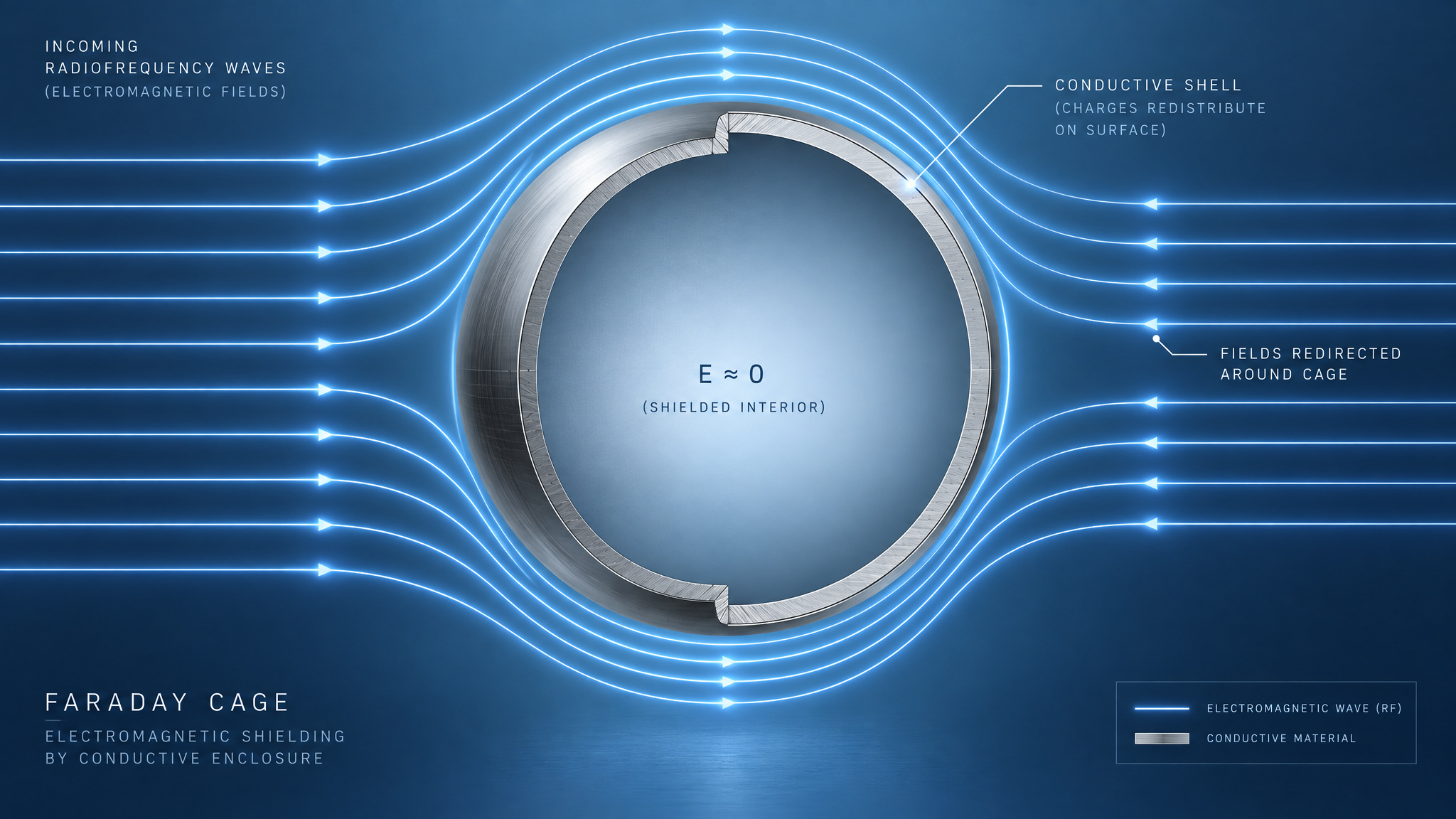
Quick test: If your phone still receives calls inside the “shielded” product, the waves aren’t blocked — real attenuation is measurable in decibels.
Attenuation is the number that makes claims testable. Shielding effectiveness is how much power a wave loses hitting a material, measured in decibels, typically 0 to about 120 dB across real-world materials. Conductive paint spans that whole range, from a few dB to over 100, depending on the flake system. Which means the verification standard is simple: any product that won’t tell you a dB spec, matched to a frequency, hasn’t claimed anything.
Which material blocks EMF depends on frequency: low-frequency magnetic fields want nickel-type materials, while high-frequency electric fields want highly conductive flakes like silver. That’s honestly kind of elegant, effective shielding requires knowing the frequencies you’re shielding against. So measure what’s coming in, then pick the flake system. Buying material before knowing the frequency is buying blind.
The diagnostic test ties it together: if your phone still receives calls inside your “shielded” thing, the waves aren’t blocked. So, do phone cases actually work? Usually not, because a case isn’t an enclosure. Faraday bags are the honest demo: Wi-Fi, Bluetooth, and GPS all go dead.
No calls, no texts. The conductive material redistributes the energy around the bag and the phone inside is effectively off-grid. That’s what real blocking looks like, and it’s also the downside: you’re unreachable, which is the point.
What actually blocks EMF: Faraday bags, shielding paint, and whole-room engineering
Credit where due: some of this stuff genuinely works, and the engineering behind it is fun. Conductive paint is three ingredients, conductive flake (does the blocking), polymer binder (adhesion and durability), and a liquid carrier (solvent or water). Because it’s liquid, it conforms to weird shapes and scales to big areas, and water-based systems stick to drywall without primer, low odor, non-flammable. Here’s the myth to bust: coverage area matters more than film thickness.

More coats don’t add shielding. A cage with a hole is no cage at all, and a cage with three redundant coats where one spot got missed isn’t either.
The realistic scope is walls, ceiling, and floor (skip the floor for a ground-floor room), then regular water-based paint over the top so it doesn’t look like a bunker. Windows get conductive curtains, because painting glass would block sunlight. And grounding the shielded walls happens after the paint and before any topcoat, and it’s a job for qualified experts, not a Saturday project. DIY guides love to omit that step.
The math makes the project real: a 10’x10′ room with 9′ ceilings is 560 ft² of surface (200 for floor plus ceiling, 360 for walls), just over 4 gallons at 130 ft² per gallon. Compare cost per painted area, not per container, since conductive filler costs vary wildly between products. Prices may vary too, but the geometry doesn’t.
The catch nobody mentions: every Wi-Fi device in a shielded room goes dark. Phones, laptops, smart TVs, gone. Only hardwired electronics work. For some people that’s a bug; for others it’s the feature.
And the common failure pattern is leaks: door frames, outlet cutouts, any spot the roller missed, discovered only after the topcoat is on. Foils and tapes are line-of-sight applications, prone to missed spots and impractical for anything bigger than a hobby box.
Products with no mechanism: stickers, chips, pendants, and “harmonisers”
No, pendants, bracelets, minerals, chip cards, and “harmonising” plugs have no physical mechanism. Not “unproven.” There’s nothing there for physics to act on.
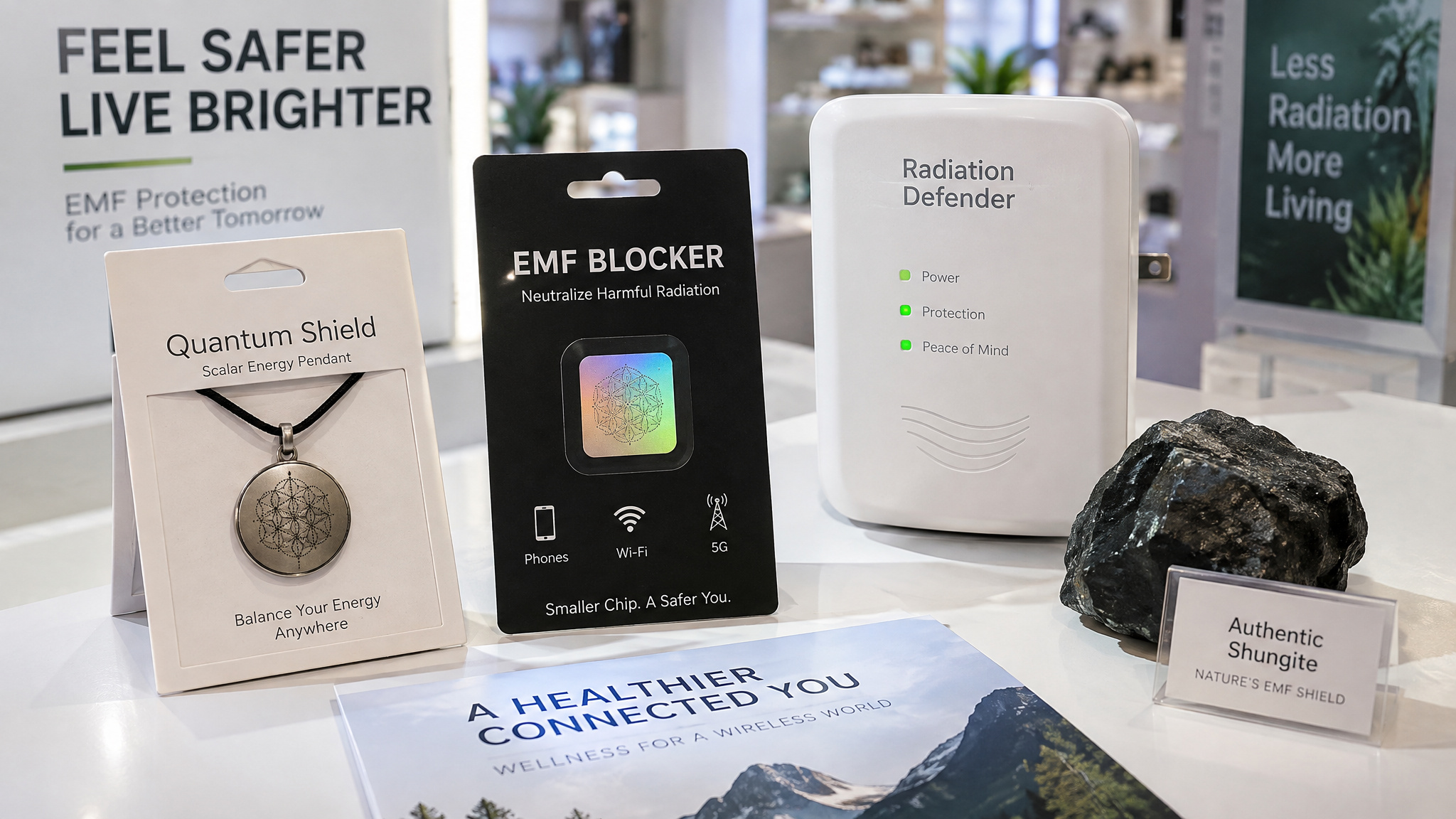
Germany’s Federal Office for Radiation Protection (BfS) sorts the product zoo into two buckets. Bucket one: the technically ineffective stuff, pendants, necklaces, bracelets, minerals, chip cards claiming to “harmonise” or “energise” fields, and power plugs promising a “protective aura” or the ability to “absorb negative energies.” A wall wart cannot do that. Bucket two: Faraday-cage-like materials, clothing, linens, mats, canopies, curtains, metal-thread paints, which measurably attenuate under the right conditions.
Both halves matter, because BfS’s verdict on the second bucket is almost as interesting: it works, and given existing legal exposure limits, there’s no proven additional health benefit. Effective and arguably pointless is a weird product category.
Red flag: “Harmonise” and “energise” have no scientific basis, and sellers can’t agree on what the terms mean — a disclaimer is doing the work the marketing won’t.
The definitional chaos is the tell on bucket one. “Harmonisation” and “energisation” lack any scientific basis, and manufacturers can’t even agree on what the terms mean. Then there’s the small-print pattern: German law requires these products to be labeled as neither medical devices nor medicinal products, and manufacturers often concede in the fine print that no positive effect has been scientifically recognized. One representative disclaimer reads that “Neither the mechanism of action nor the manufacturing technology, nor any positive effect on health and well-being, has been scientifically recognised to date.” That kind of disclaimer typically appears a few scrolls below the marketing copy, because real medical claims need substantiation and testimonials don’t.
The viral version: an Instagram “EMF Shield” magnet video, 2,000+ likes, circulated on Facebook, claiming protection from a phone’s “emitted” radiation. It got fact-checked. Consensus is that low-powered magnets don’t reliably guard against EMF, and the FTC has actually enforced against false claims in this space, which is enforcement, not internet skepticism. The same skepticism applies to whether EMF stickers really work: stickers split neatly into plastic ones, which are harmless but useless, and the metal-wire kind, which have their own problem, covered next.
Scrolling to the small print is the fastest product evaluation in this entire market.
When protection backfires: the power-control feedback loop
Yes, some shielding can increase your exposure, when it interferes with the phone’s antenna. Phones run automatic power control: when reception is poor, they transmit harder to reach the tower, so a sticker with metal wires over the antenna degrades reception and the phone raises its transmission power, potentially increasing your exposure. The FTC has flagged this too, noting anti-radiation ‘shields’ can disrupt a phone’s signal and cause it to sometimes emit more radiation while seeking service.
Okay so check this out, because the mechanism clicks once you see it. Phones run automatic power control: when reception is poor, they transmit harder to reach the tower. Now put a sticker with metal wires over the antenna area. Reception degrades.
The phone concludes the tower is far away and shouts louder. The shield didn’t block anything; it just made the radio work overtime, potentially increasing your exposure. Germany’s BfS flagged this, and the US FTC reached the same conclusion separately: anti-radiation “shields” can disrupt signal enough that the phone sometimes emits more radiation while hunting for service.
There’s a worst-case edge case too: under some conditions, protective clothing may end up behaving like an antenna, amplifying the fields already present. The “in certain cases” qualifier matters, because it’s situational, not universal.
The buyer pattern to watch for is regulator-documented mechanism, not testimonial: degraded reception showing up right after a metal-wire sticker goes on over the antenna area. “Can,” never “will”, it depends entirely on whether the product interferes with the antenna. But the fact that a protection product has a documented mechanism for raising exposure tells you how little of this market was designed by anyone who read a radio spec sheet.
The tradeoff nobody mentions: shielding blocks natural EMFs too
Here’s the argument that makes the 2019 review worth reading past the abstract. Panagopoulos and Chrousos point out that any metal shielding, even correctly applied, attenuates man-made polarized EMFs and also the natural non-polarized atmospheric EMFs, Schumann resonances and the like, which they tie to biological rhythmicity and well-being in animals. Schumann resonances, if you haven’t met them, are the planet’s own electromagnetic background: standing waves circling the Earth, faint but constant. The idea that biology might be tuned to them is the interesting part, and the authors treat it as such rather than as life-energy woo.
Their evidence is a great story in itself: experiments from the 1960s and 70s in which volunteers lived in a shielded underground apartment. People Faraday-caged themselves on purpose, for science, and that setup gave the authors strong evidence about what losing natural EMF exposure does.
To be clear, this is one peer-reviewed review’s position set against regulator consensus, not settled science. The paper doesn’t claim shielding causes any specific disease. But the reframe is hard to shake: a perfect shield trades one exposure for a deprivation of the planet’s own field. Protection versus risk, as the subtitle says.
What the evidence says about EMF risk, and who disagrees
The consensus side is broad: medical and scientific communities generally hold that low-frequency EMFs don’t pose a health risk while radiofrequency research continues. The FDA’s line is that phones emit low levels of non-ionizing radiation with no definitive evidence of harm, and it keeps monitoring, which is the honest part. The WHO classifies phone radiation as Group 2B, possibly carcinogenic, which is a broad bucket of “we can’t rule it out,” not a verdict, and no definite risk has been confirmed.
The other side has actual evidence behind it. One review covering 52 animal studies pointed to a possible connection between cell phone radiation and higher cancer risk in lab animals. NIEHS’s 2G/3G rat studies found tumours in rats exposed to high RF, with the explicit caveat that rat results aren’t directly comparable to human phone use. ICBE-EMF, chaired by Ron Melnick, formerly of the FDA, argues the FCC limits are outdated and that animal findings are a warning governments should use for science-based limits.
BfS and the FCC hold that existing limits suffice. Both positions stay on the table; I’m not adjudicating.
And a 2015 study complicates the simple story nicely: certain EMFs helped bone marrow and skeletal stem cells grow and differentiate, aiding healing and tissue building. EMF effects vary by level, strength, exposure time, and conditions, because EMFs interact with ions and signaling molecules, touching gene activity and cell development. Not all EMF is the villain. The honest answer to “is this stuff harmful” is: low-frequency, generally no; RF, unresolved, with named people on each side and named studies in play.
What actually works: the avoidance-first hierarchy
Reducing exposure at home works through distance and free habits, full stop. Distance is the most effective measure there is, and even a few centimetres help, which makes “phone across the room while you sleep” the cheapest shielding on the market. Phones and hair dryers are the biggest everyday sources, which is a fun pairing to internalize.
The free behaviors: airplane mode, speaker mode, phone out of pockets and out of the bedroom, wired Ethernet where you can, landlines with wired handsets, Wi-Fi off at night. Faraday bags demonstrably block Wi-Fi, Bluetooth, and GPS, versus airplane mode’s software switch, but the sources compare the two without a head-to-head test, so treat it as two honest options rather than a ranked verdict.
Functional-medicine practitioner Will Cole is the reasonable-middle example: phone outside the bedroom, Wi-Fi off at night, Ethernet at work, sometimes a Faraday bag. Notably, he doesn’t typically recommend EMF-blocking devices because the research isn’t compelling, and he warns against the “EMF bubble”: the stress and anxiety around EMF can itself harm your health. Health podcaster Jesse Chappus has pushed the same avoidance-first message. Be proactive, not reactionary.
The 2019 review’s hierarchy agrees in spirit: avoidance is safer than shielding, and if you shield, keep it intermittent rather than permanent. Their forward-looking idea, shielding paired with generators emitting weak pulses mimicking natural atmospheric resonances, is elegant and is a research proposal, not a product anyone can buy. Nobody’s selling it yet, and anyone claiming to is ahead of the science.
Grounding and the candid skeptic
Grounding is a categorically different strategy: instead of blocking fields, it connects you to them. The best detail here is podcast guest Michael McKean, who owns Lakhovsky devices, orgone boxes, and pocket chips, and candidly admits he can’t verify whether any of them do anything, while spending 30 to 60 minutes a day barefoot on grass and declining to sleep in a Faraday cage so he stays “part of the Earth’s field.” His sharpest skeptical argument: the blood and arteries are identical everywhere in the body, yet only the heart and brain suffer “attacks”, heart attacks and strokes. When even the hardcore draw a line at the cage, that’s a nuance worth keeping.
The gadget zoo around grounding runs the same spectrum. There’s the grounding mat for indoor use, and even a grounded walking stick with a copper element and coil, though neither comes with a mechanism you can verify. At a biohackers conference, a holistic health specialist described how sleeping on an anti-aging mattress in an EMF-remediated building, which is the market’s whole promise in one sentence. (Color, for the road: Chuck on Better Call Saul wrapped in a space blanket is the pop-culture limit case, and a chiropractor called DoctorEMF trained a blue heeler to pick up on his sensitivities. Delightful, not evidence.)
A buyer’s verification checklist
Evaluating any EMF product comes down to four checks:
- Read the small print first; the disclaimer pattern (no scientifically recognized effect) is the fastest tell in the market.
- Demand a dB attenuation spec matched to the specific frequency you’re shielding against.
- Treat “harmonise” or “energise” language as a red flag; the terms have no scientific basis and sellers can’t even agree on definitions.
- Check whether a sticker sits over the phone antenna; metal wires there can make the phone transmit harder.
The hierarchy stands: free avoidance beats every product, intermittent shielding if you shield at all, and the one promising direction, natural-resonance generators, is something no marketed product delivers. Evaluate mechanism, not marketing; the cheapest effective protection is free.
Frequently Asked Questions
What are the common symptoms of EMF exposure?
People who report electro-hypersensitivity (EHS) commonly describe headaches, fatigue, dizziness, sleep trouble, and trouble concentrating. It’s a cluster of reported symptoms rather than a widely recognized medical diagnosis, though it comes up frequently in the literature, especially regarding city dwellers. The science around it remains unsettled.
EMF shielding paint vs Faraday cage for home protection — which is better?
Conductive paint essentially builds a Faraday cage out of your walls — it’s a conductive flake system that attenuates fields the same way an enclosure does, spanning a few dB to over 100 depending on the flake system. Coverage area matters more than film thickness: more coats don’t add shielding, and a cage with a hole is no cage at all. The catch is total: every Wi-Fi device in a shielded room goes dark, and only hardwired electronics work.
How does EMF protection work?
Through three mechanisms: distance falloff (exposure drops as you separate from the source), conductive attenuation (a conductive material makes a wave lose power by bouncing or absorbing it, measured in decibels), and signal disruption. A product only works if it maps to one of them. The elegant version is the Faraday cage, where charge spreads evenly across a conductive shell so incoming waves redistribute around the interior.
Is EMF radiation dangerous?
Low-frequency EMFs are generally considered safe because they don’t ionize anything, and the FDA holds that phones emit low levels of non-ionizing radiation with no definitive evidence of harm. The WHO classifies phone radiation as Group 2B, possibly carcinogenic — “we can’t rule it out,” not a verdict. On the other side, NIEHS rat studies found tumours at high RF exposure and a group chaired by a former FDA toxicologist argues FCC limits are outdated, so the RF question is genuinely unresolved.