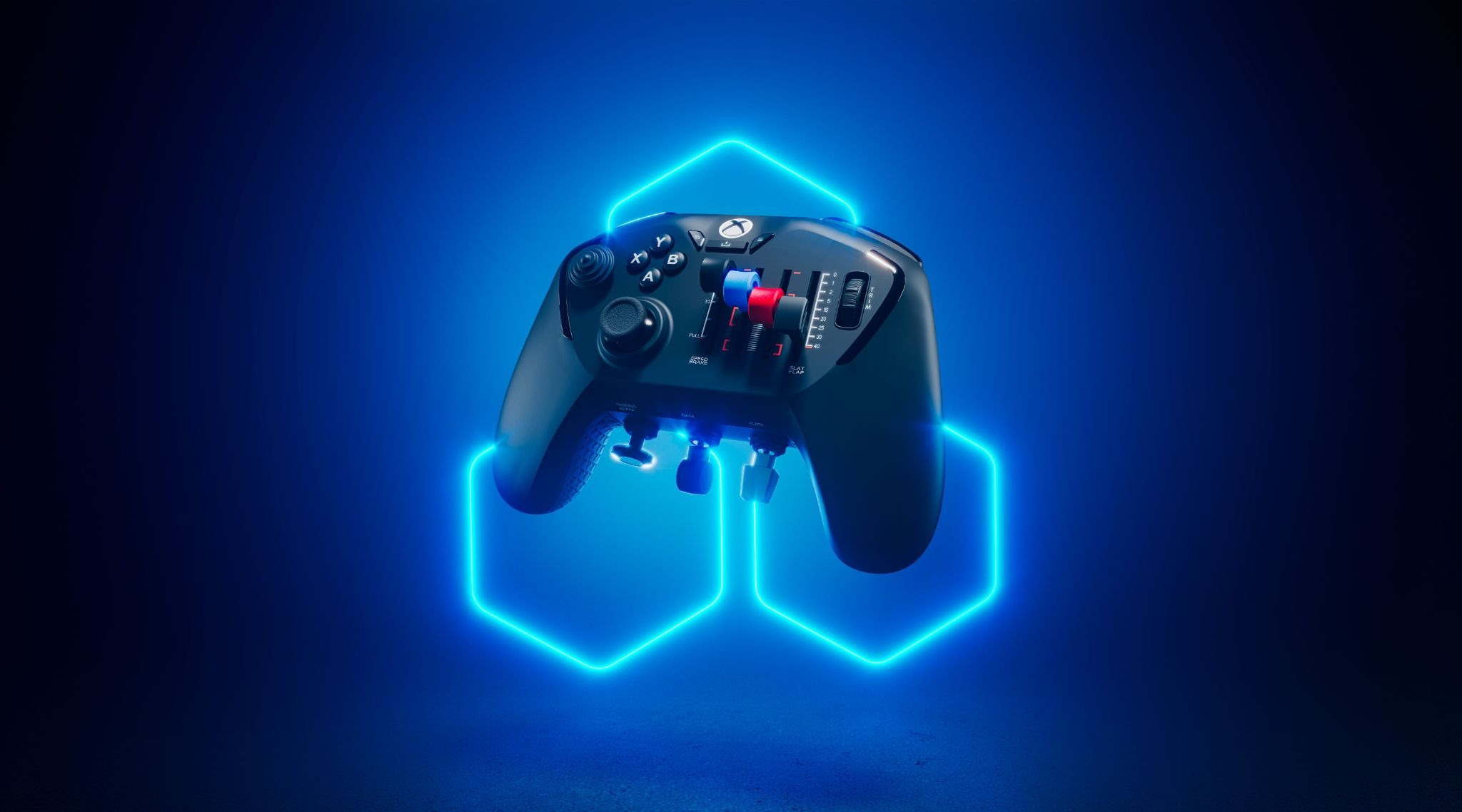
On June 30, 2026, out of Schwerte, Germany, Honeycomb Aeronautical announced the Echo Aviation Controller XPC, positioning the gamepad-shaped device as the first professional-grade flight controller for Xbox Series X|S consoles. It looks like a standard controller on the outside, yet it collapses a yoke, a four-lever throttle quadrant, a trim wheel, and rudder pedals into one handheld unit. Honeycomb pitches the hardware as the ideal navigator for flying Microsoft Flight Simulator in front of a living-room TV directly from the couch.
Key Takeaways
Announced on June 30, 2026, the Honeycomb Aeronautical Echo Aviation Controller XPC is an officially licensed “Designed for Xbox” gamepad that packs primary flight axes, four detented throttle levers, a trim wheel, and cockpit switches for Xbox Series X|S and Windows PC.
The controller splits its magnetic sensing across two technologies to prevent potentiometer wear and stick drift, pairing Tunnel Magnetoresistance (TMR) sensors in the analog thumbstick with Hall Effect sensors in the opposing rear rudder paddles.
Following an initial Fall 2026 launch window, Honeycomb priced the XPC at $179.99 in the US with shipping set for November 20, 2026, and opened upfront-free reservations at www.flyhoneycomb.com.
Table of Contents
What is the Echo Aviation Controller XPC?
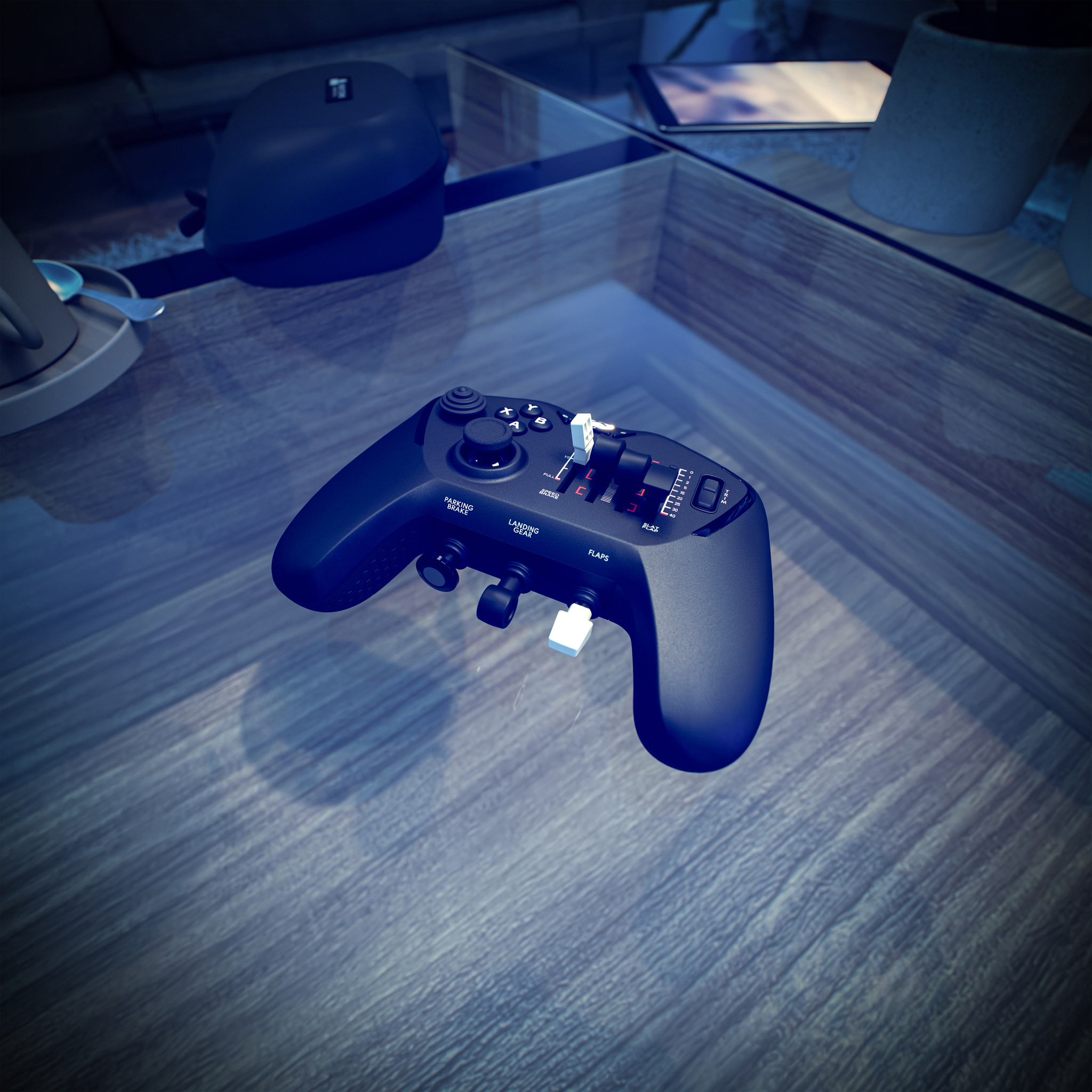
The Honeycomb Echo Aviation Controller XPC is a gamepad-style, all-in-one flight simulation controller for Xbox Series X|S and Windows PC announced on June 30, 2026, marking Honeycomb’s debut in Xbox flight hardware for console simmers who want full aircraft control from a living-room couch. Instead of demanding a dedicated desk clamp, a separate throttle box, and floor space for rudder pedals, the device uses a Trojan-horse form factor. From across the room, its silhouette looks like an ordinary console gamepad. Look closer at the chassis, though, and it packs an entire flight deck’s worth of physical inputs designed to handle complex aircraft without a single external peripheral attached.
For players searching for an Echo Aviation Controller Xbox option that works out of the box, the hardware carries Microsoft’s official “Designed for Xbox” designation. That licensing badge is the practical difference between a plug-and-play console peripheral and a weekend project spent fighting cursed third-party USB adapters. Native Xbox Series X|S support is baked directly into the hardware specification alongside Windows PC support.
In its June 30, 2026 announcement, Honeycomb positioned the XPC as “Bringing professional grade flight controls to the Xbox for the very first time”. Calling a handheld unit “professional-grade” is the manufacturer’s own market positioning rather than an independent benchmark, since trading full-throw desktop yokes for thumb-sized mechanisms inherently compresses physical travel distance. Still, the engineering intent is clear. Honeycomb built the controller to broaden the flight simulation audience, letting console owners manage every primary flight axis and core cockpit system in a relaxed living-room environment.
A single handheld shell covers six distinct flight-control domains:
- Pitch and roll: Handled through a high-precision analog thumbstick for elevator and aileron authority.
- Yaw: Controlled via rear-mounted paddles that move in physical opposition.
- Thrust management: Governed by four independently assignable throttle levers with physical detents and swappable caps.
- Pitch trim: Adjusted continuously in flight using an integrated trim wheel.
- Cockpit systems: Operated through dedicated physical switches for landing gear, flaps, and the parking brake.
- Dual-platform operation: Certified under the “Designed for Xbox” program for Xbox Series X|S while retaining native Windows PC compatibility.
From PC-only Echo to console XPC
The decisive difference between the Echo Aviation Controller XPC and the original Echo Aviation Controller is platform support: the original Echo launched in late 2025 for PC only, whereas the XPC adds official “Designed for Xbox” compatibility for Xbox Series X|S alongside Windows PC. Honeycomb didn’t detail any deeper mechanical or sensor changes beyond that console certification in its announcement, meaning both versions share the same core concept of packing a full flight suite into a gamepad footprint.
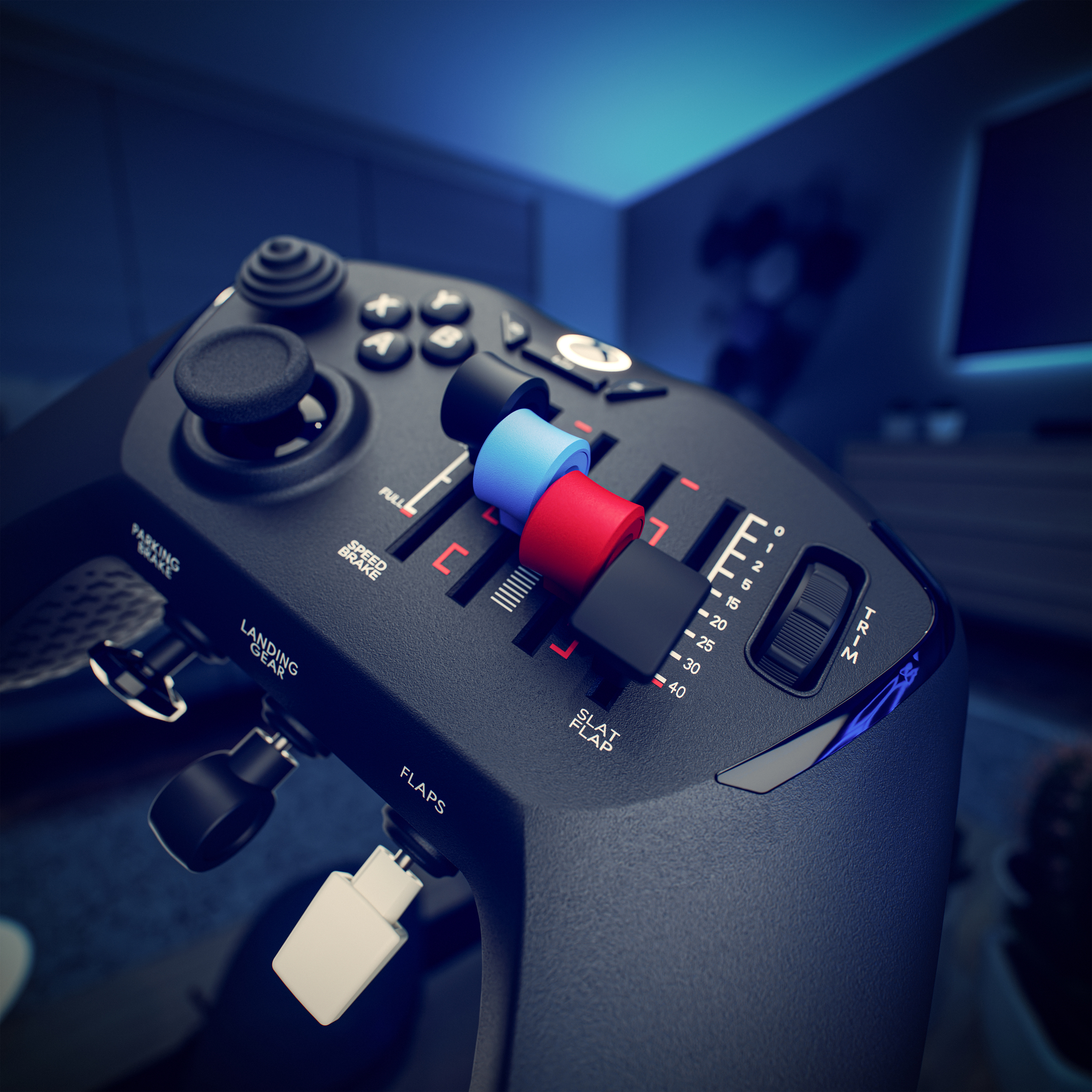
That product lineage matters because the XPC isn’t a random one-off experiment. When the original Echo Aviation Controller shipped in late 2025, Honeycomb credited the device with unshackling flight sim enthusiasts from the confines of a desk and making casual couch play viable on PC. Less than a year later, the XPC arrived as a deliberate product-line extension. Rather than trying to patch console support onto the existing PC unit through a firmware workaround, Honeycomb created a distinct Xbox-licensed SKU to bring that same unshackled-from-the-desk design to living-room consoles.
Echo Aviation Controller XPC features and specs
The Echo Aviation Controller XPC replaces an entire three-piece desktop flight rig by consolidating six control domains (pitch, roll, yaw, throttle, trim, and core aircraft systems) into a single handheld chassis that requires no separate peripherals. It achieves this substitution through a precision analog thumbstick, four detented throttle levers with exchangeable caps, an integrated trim wheel, opposing rear rudder paddles, a split Tunnel Magnetoresistance and Hall Effect magnetic sensor architecture, and dedicated physical switches for landing gear, flaps, and the parking brake.
| Integrated XPC Component | Traditional Desk Hardware Replaced | Core Mechanical Detail |
|---|---|---|
| Precision analog thumbstick | Desktop flight yoke or flight stick | Full elevator (pitch) and aileron (roll) input via TMR sensors |
| Four assignable levers | Dedicated throttle quadrant | Physical detents and exchangeable caps for single- and multi-engine aircraft |
| Integrated trim wheel | Standalone or yoke-mounted trim wheel | Continuous in-flight pitch adjustment built into the chassis |
| Opposing rear paddles | Floor-mounted rudder pedals | Mechanically linked opposition movement using Hall Effect sensors |
| Physical system controls | Keyboard shortcuts and nested menus | Dedicated switches for landing gear, flaps, and parking brake |
Analog stick, throttle levers and trim wheel
Primary flight surfaces sit under the thumbstick, which Honeycomb specs for smooth, responsive elevator (pitch) and aileron (roll) input across complex aircraft. Next to it sits the standout mechanical party trick of the controller: four independently assignable throttle levers. Each lever features physical detents and exchangeable caps, letting simmers reconfigure the top profile to match single-engine props or multi-engine airliners without guessing where idle or reverse thrust sits. An integrated trim wheel rounds out the primary flight controls, giving pilots continuous in-flight pitch adjustment instead of forcing them to tap a digital button repeatedly to hold altitude.
Rudder paddle system
The XPC’s rear rudder paddle system is built for couch and limited-space simmers who need proportional yaw authority without bolting external rudder pedals to the living-room floor. On a standard console gamepad, mapping rudder input to shoulder buttons or a single thumbstick twist makes taxiing and crosswind landings clumsy because real yaw control requires smooth, continuous input across two opposing directions. Honeycomb solves this mechanically by linking the rear paddles so they move in opposition to simulate real rudder pedal motion. At GeekExtreme, we always look at how compact hardware handles mechanical tradeoffs, and linking the rear paddles in opposition is a clever way to keep your fingers synced to the rudder’s actual position without floor hardware.
TMR vs. Hall Effect sensors
Pairing Tunnel Magnetoresistance (TMR) sensors with Hall Effect sensors gives the XPC contactless magnetic tracking that avoids mechanical potentiometer wear and prevents stick drift over the controller’s lifespan. What makes this spec sheet interesting from an engineering perspective is that Honeycomb didn’t just slap one buzzword sensor across the whole board. Instead, they split the magnetic sensor stack across two different mechanical jobs: TMR sensors handle the high-resolution two-axis movement in the analog thumbstick, while Hall Effect sensors track the linear, opposing travel of the rear rudder controls.
Physical systems controls
Rounding out the face of the unit are dedicated physical controls for the landing gear, flaps, and parking brake. When you’re flying at a desk, hitting G for gear or tapping flap hotkeys on a keyboard is second nature. On a sofa twenty feet from the TV, lacking physical toggles forces you into clumsy button combinations or deep on-screen menus right during final approach. Putting those three critical systems on physical switches keeps cockpit management at your fingertips.
Couch simming: who the XPC is for
The Echo Aviation Controller XPC is a strong fit for flight simmers with limited desk space, portable setups, or an Xbox Series X|S connected to a living-room TV who want to fly Microsoft Flight Simulator without assembling a bulky yoke, throttle quadrant, and rudder pedal rig. Microsoft Flight Simulator is already one of the most impressive simulation showcases available on console, yet flying a complex twin-engine aircraft on a standard Xbox gamepad always feels like a compromise.
Traditional flight hardware fixes that precision gap, but it creates a massive living-room logistics problem. Clamping a yoke and quadrant to a coffee table, running cables across the rug, and bracing rudder pedals against sofa cushions kills the impulse to jump in for a quick evening flight. By collapsing pitch, roll, yaw, throttle, trim, and cockpit systems into a clean, minimal footprint, the XPC trades the full-scale physical throw of dedicated desk peripherals for grab-and-go convenience. You get purpose-built flight levers and proportional yaw paddles while keeping the footprint of a single controller.
Xbox Series X|S and Windows PC compatibility
Microsoft’s official “Designed for Xbox” certification gives the Echo Aviation Controller XPC native support on Xbox Series X|S and Windows PC. Honeycomb calls this setup “ultimate flexible flight” in its press release, which in practice means one controller moves between a living-room console and a desktop rig without adapter dongles.
That cross-compatibility serves two distinct groups of hardware nerds at the same time. For the Honeycomb Xbox audience, it opens the door for console players who’ve watched PC simmers enjoy dedicated throttle quadrants and trim wheels for years without having a compact, console-licensed equivalent of their own. For existing PC flight sim enthusiasts who also own a console or travel with a gaming laptop, the XPC functions as a portable controller that moves cleanly between a Windows PC setup and an Xbox Series X|S in the living room.
Release date, price and how to buy
The Honeycomb Echo Aviation Controller XPC is scheduled to begin shipping on November 20, 2026, for $179.99 in the US, and buyers can reserve a unit right now with nothing due upfront directly through Honeycomb’s official website at www.flyhoneycomb.com.
If you followed the early summer coverage, that concrete checkout detail is a welcome update. When Honeycomb first unveiled the XPC on June 30, 2026 (and through July 2026), the company only gave a broad Fall 2026 shipping window twice in its press release without naming a retail price or opening pre-order channels. Honeycomb subsequently locked in the $179.99 US pricing, set the November 20, 2026 release date for the Xbox-compatible model, and opened reservations on its site. Because the reservation system requires no upfront payment for US buyers, you can claim a spot in the shipping queue on www.flyhoneycomb.com without tying up cash before the hardware ships in November.
Honeycomb’s console strategy: what the CTO’s quote signals
Honeycomb Aeronautical is a Schwerte, Germany-based designer and manufacturer of professional-grade flight simulation hardware operating under the Playcorion Group, combining aeronautical engineering, industrial design, and simulation talent with a stated mission of redefining value and quality for home users. While the XPC adapts the company’s desk-free PC controller for living-room play, CTO Marc Küpper noted that this is their first flight into consoles and certainly won’t be the last, signaling a broader Xbox hardware roadmap ahead.
Frequently Asked Questions
What is the Honeycomb Echo Aviation Controller XPC?
Unveiled on June 30, 2026, the Echo Aviation Controller XPC is an officially licensed gamepad for Xbox Series X|S and Windows PC that condenses an entire flight deck into one handheld shell. Instead of clamping bulky gear to a desk, it gives couch pilots a precision thumbstick, four throttle levers, a pitch trim wheel, rear rudder paddles, and dedicated cockpit switches in a standard controller footprint.
What are the Echo Aviation Controller XPC features and specs?
The controller covers six control areas using a Tunnel Magnetoresistance (TMR) analog thumbstick for pitch and roll, Hall Effect opposing rear paddles for yaw, an integrated trim wheel, and four assignable throttle levers with physical detents and swappable caps. It also packs dedicated physical switches for landing gear, flaps, and the parking brake, all running natively on Xbox Series X|S and Windows PC without external adapters.
Can you play Microsoft Flight Simulator on Xbox without a full yoke and throttle setup?
You can use a standard Xbox gamepad, though managing complex twin-engine aircraft and cockpit menus on basic buttons always feels like a compromise. The Echo Aviation Controller XPC bridges that gap by replacing a desk-mounted yoke, throttle quadrant, and floor pedals with dedicated throttle levers, a trim wheel, and physical gear and flap switches you can use straight from the sofa.
