Is your gaming number real? A developer wondering whether $500 can ship a Roblox game and a player staring down five $70 releases in one season are asking different budgeting questions. One is about the cost of making a game; the other is about deciding which games to buy. This guide looks at both, from development budgets to a player’s monthly spending plan.
A student’s reflection on Money Magic, a zero-based budgeting game, captures a familiar tension: balancing what you want now with longer-term goals. Here’s the map.
Key Takeaways
Game development costs run from roughly $20,000 for a 2D mobile title to about $19.9 million for AAA. Production is the largest phase, and programming is its heaviest line item.
One Roblox developer’s $500 (50k Robux) budget for a Pet Sim X-quality game was judged enough to complete only about half the project. Developer rates reportedly drifted from 20 to 35 Robux.
A written must-play versus wait-for-sale list calibrated to your gamer type cut one creator’s September from 4–6 candidates to 2 purchases. Prices run from $60 to $100 or more per title.
Table of contents
Table of Contents
What a game actually costs to make: the cost ladder
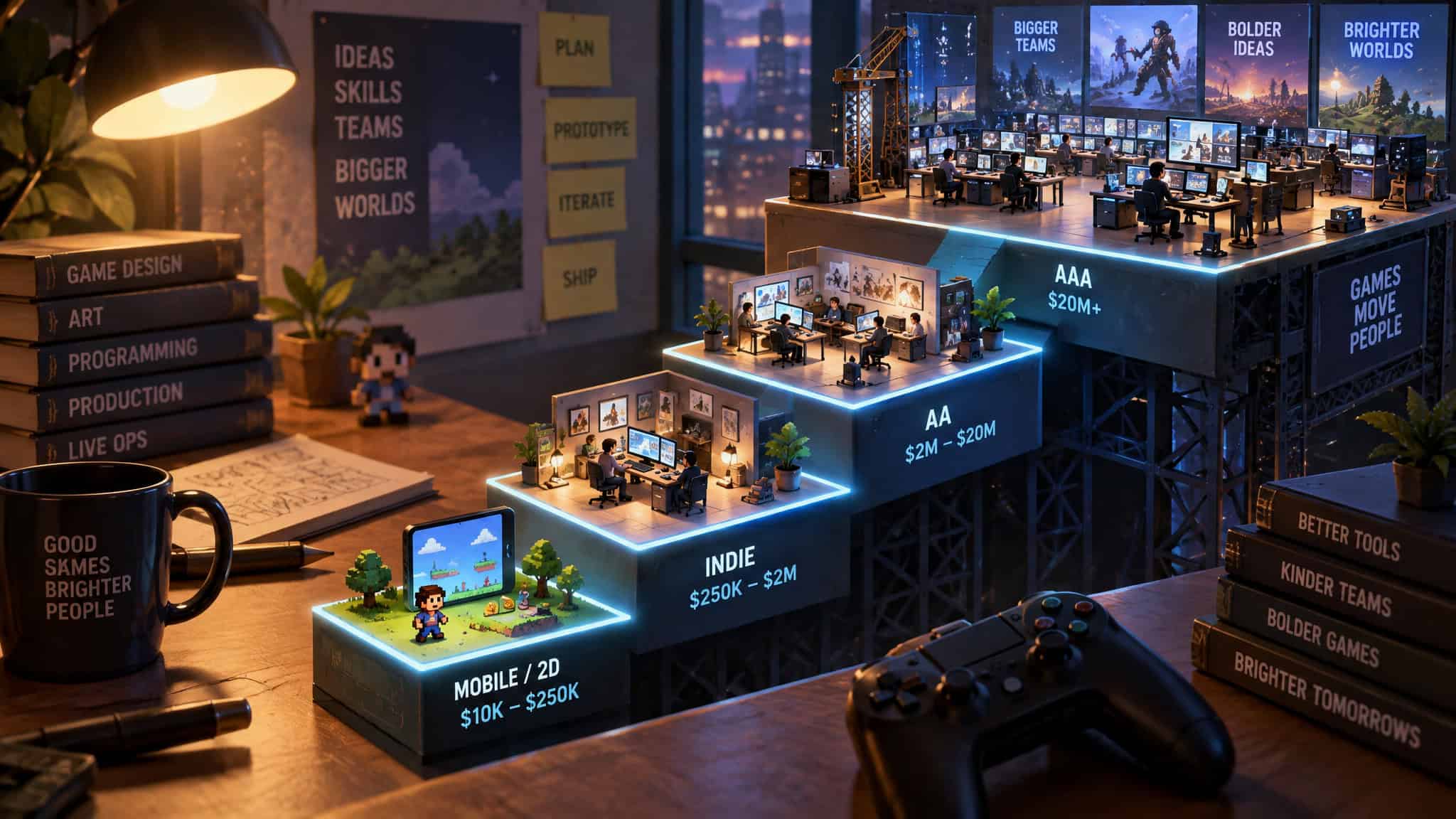
Game development estimates run from roughly $20,000 for a 2D mobile title to $19.9 million for a AAA project. The money concentrates in production. That’s the headline answer, but a single range hides the two questions that matter: how big your game is, and where in its life the money lands. Most cost guides collapse them into one scary number. The way we read a budget here is the way we read hardware specs, tier by tier, line by line.
First axis, size. The tiers by game type look like this:
| Game type | Cost range |
|---|---|
| 2D mobile | $20,000–$133,000 |
| 3D mobile | $66,000–$1,326,000 |
| PC | $133,000–$1,326,000 |
| Console | $265,000–$2,652,000 |
| AAA | $1,326,000–$19,890,000 |
AAA sits at the top because graphics and gameplay scope scale together. More of everything means more of everything, which is precisely why indie studios exist as a strategy and not just an aesthetic.
Second axis, phase. Fan Studio, a game development services provider, breaks the lifecycle into eleven line items rather than one blob:
| Phase | Line item | Cost range |
|---|---|---|
| Pre-production | Game concept (idea, design doc, pitch to backers) | $7,000–$27,000 |
| Pre-production | Story and characters | $13,000–$66,000 |
| Pre-production | Art and animation | $27,000–$133,000 |
| Pre-production | Sound design and music | $7,000–$27,000 |
| Production | Programming (engine, physics, AI, key systems) | $66,000–$265,000 |
| Production | Art and animation | $66,000–$265,000 |
| Production | Sound design and music | $13,000–$66,000 |
| Production | Testing and QA | $13,000–$66,000 |
| Post-production | Localization | $7,000–$27,000 |
| Post-production | Marketing and advertising | $13,000–$66,000 |
| Post-production | Distribution and publishing | $7,000–$27,000 |
Production is the biggest spending phase and programming its heaviest single line. Pre-production takes the smallest share, but it’s where the expensive mistakes get made: a bad plan priced early is cheap to fix, and the same mistake discovered mid-production is a budget hole.
And the floor? A real hobbyist ask sits at $500, the equivalent of 50k Robux on Roblox. We’ll get to what that actually buys, because it’s less than you’d hope.
One caveat: Fan Studio reports its source ranges in GBP. The dollar equivalents here are rounded to the nearest thousand using an approximate rate of US$1.326 per GBP on October 1, 2026. Treat them as broad benchmarks, not quotes; actual costs vary with complexity and team experience.
What factors should you budget for before starting a game project?
Six drivers set the price before a single asset gets made: staffing mix and team size, outsourcing versus internal payroll, the quality floor your audience demands, tech-expectation creep, scheduled updates, and seat time, and it helps to determine your monthly gaming spend when weighing any of them. Christopher Pappas laid these out in a game-based-learning budgeting article published on University XP on April 2, 2022, and they were written for corporate training games, so treat them as a checklist to adapt rather than figures to copy onto a consumer project.
Staffing mix and team size. Scope decides who you need. A serious project can pull in subject-matter experts, graphic designers, and instructional designers, and the honest scoping questions are blunt: how many people, for how long at each stage, with what resources?
Outsourcing as the lever. Hiring outside help avoids burning internal payroll hours on staffing, scheduling, and resources, and that hidden overhead is the part people forget when they compare a contractor quote to an in-house salary. The salary isn’t the whole cost of the seat.
The immersion floor. Effective games need characters, realistic settings, and polish. That’s not a luxury tier, it’s the mechanism: it’s what makes the thing feel like a game rather than a slideshow with buttons, and quality is a cost driver accordingly.
Tech-expectation creep. Modern audiences bounce anything that looks like it dates to the early 2000s. We’ve all seen those cursed Flash-era training sims, the ones with clip-art objectives and a loading bar that outlives your patience. Dated-looking games don’t get critiqued, they get closed.
Scheduled updates. Penciling regular updates into the plan from day one cuts upkeep costs, because maintenance you plan is cheaper than maintenance you’re surprised by. The “I’ll fix it later” trap costs more every month it survives.
Seat time. The sneakiest line: the audience’s own hours. Learning the controls, finishing the game, and reaching the follow-up resources are all budgetable per activity, and so is how much a gaming PC costs if your audience needs the hardware in the first place. Real cost isn’t just the build price, it’s everyone’s time, and this one almost never makes anyone’s list.
Is $500 enough? The Fossil Finders reality check
Per one Roblox DevForum thread, a $500 (50k Robux) budget was judged enough to complete only about half of a Pet Sim X-quality game, with bigger studios paying over 100k Robux for programming alone. Worth stress-testing what that means.
The ask came from a developer planning a game called Fossil Finders, set in Dinosity, a futuristic advanced city, where players excavate fossil sets (legs, arms, head, tail) and revive the dinosaurs as pets, and keep them in colorable, furnishable apartments. The stated quality bar: “professional and extremely clean,” benchmarked against Pet Sim X and Adopt Me, which ship with the characters, realistic settings, and immersive elements that set the quality bar. A respondent called the concept intriguing and viable if executed well, then delivered the gut-punch: $500 practically gets only 50% of the game done.
The same respondent noted average developer rates reportedly moving from 20 Robux to 35, and studios that can ship a front-page game easily paying over 100k Robux just for programming. Every number here is one thread’s planning-stage estimates from its speakers, not verified market data, and there’s no record of what happened to Fossil Finders. But the failure pattern is clear and worth naming: a budget sized by whatever cash is on hand rather than by what the scope actually costs. And the rate drift points to something else.
A budget is a perishable asset. The same scope costs more every month you wait.
Red flag: A budget sized by whatever cash is on hand instead of priced scope fails halfway, no matter how intriguing the concept sounds.
Stretching a small budget: three staging plays
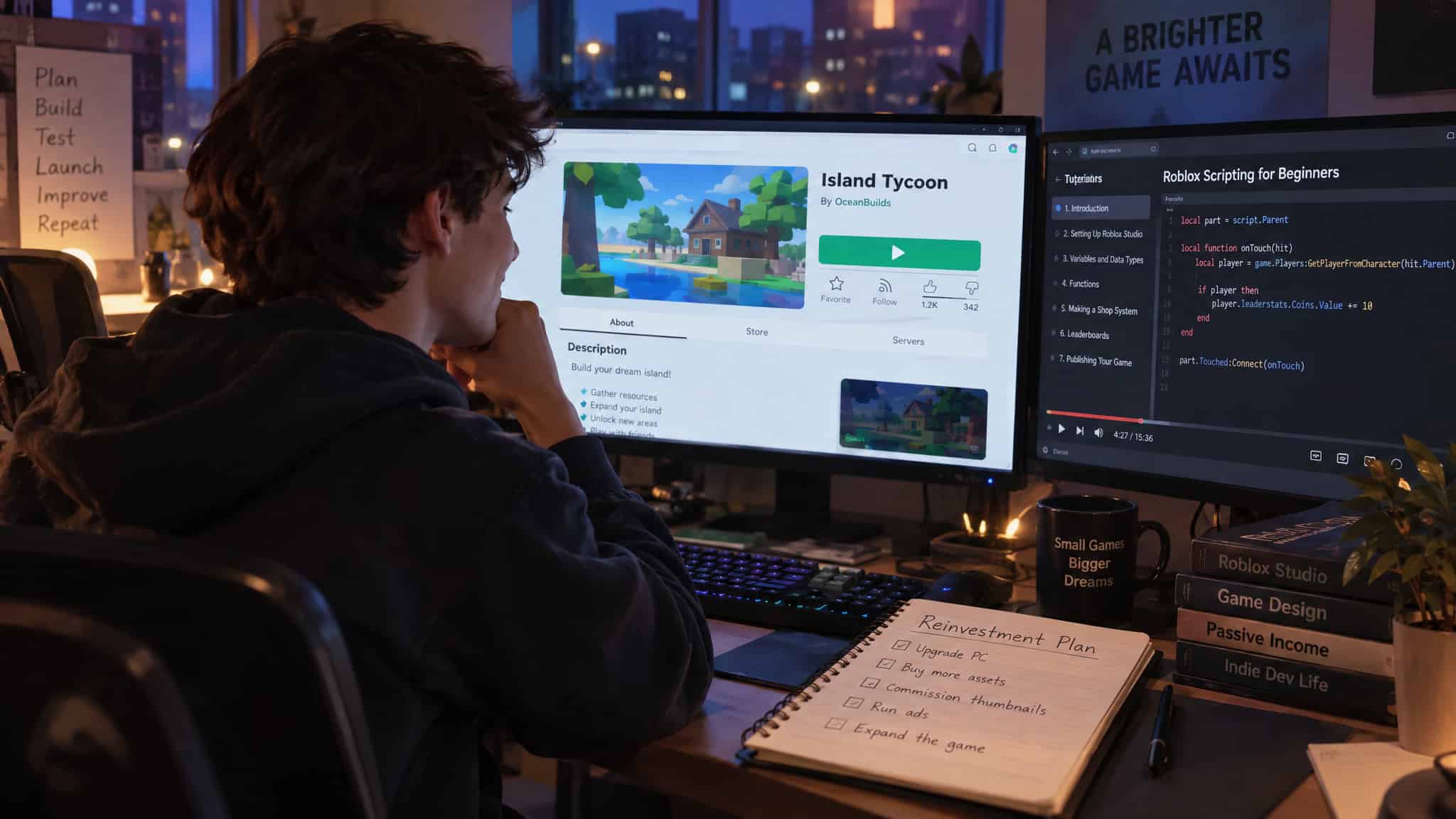
The riskiest budget isn’t the small one, it’s the full upfront one, a point covered in depth by any solid guide to managing gaming finances. Release small, reinvest player income, and validate demand before the money is gone. The same DevForum thread produced three plays, each with its own failure condition:
- Release low, reinvest income. Launch on a small budget, use player revenue to hire professionals and improve the game. The launch doubles as a demand test: you find out whether anyone wants the concept while money remains. It fails if the concept was never validated and the funds are already gone.
- Learn one costly skill. Programming or building cuts hiring costs. The OP’s own audit was honest: they cover GFX, can build a bit, model a little, and dodge scripting via the handle Parent.help. I.suck.at.this. The attached advice: learn through fun small projects, treat failures as tuition, and post questions in #help-and-feedback:scripting-support.
- Revenue-share hiring. Pay developers a percentage of earnings while the 50k Robux goes to advertising, paid from player revenue. Its stated failure condition, quoted plainly: if players don’t buy stuff, you’re done. Profitability holds only as long as the game isn’t pay-to-win, so monetization design is part of the budget plan, not an afterthought.
There’s also the solo route: one respondent pays no one, and their take is that building a small game yourself beats fundraising outright, since the project funds itself. Contrarian, but warm. None of these plays come with outcome data, so treat them as sourced options with named risks, not proven paths.
Budgeting your buying: release-season triage
A written list split into must-play versus wait-for-sale, calibrated by gamer type, cut one creator’s September from 4–6 candidates to 2 purchases. Brotha Jeremy, a YouTube creator, laid out the three-step method that worked for him:
- Write down every upcoming game you want, ignoring internet peer pressure. His confession: he’d bought games because people were talking about them, and the list showed him how many “wants” were just FOMO. The feed shouldn’t be doing your shopping.
- Split the list into must-play versus wait-for-sale. Most games still exist next month, usually cheaper.
- Identify your gamer type. Immersive slow player versus fast finisher, because play style, not willpower or discounts, sets how many games a season can hold. His labels: “gun and ball gamer,” “sword and potions gamer,” “sword and sandals gamer.” Half the fun, all of the diagnostic.
His worked September: he kept Halloween (released September 8th, four-day early access with pre-order, a good stream game with viewers) and Marvel’s Wolverine (September 15th, his main game of the month, supporting Insomniac Games). He skipped NBA 2K27 (his last 2K purchase was NBA 2K23, roughly 4–5 years earlier), Control Resonant (September 24th, wanted it, but too many other releases in the window), and Silent Hill Townfall (liked the Silent Hill 2 remake, not Silent Hill F, so taste history did the predicting).
The stakes: $60–$100+ per title, with prices he cited at $60, $70, $80, and $100+, and GTA 6 mentioned among the expensive ones. Careless accumulation can run past $600 in a season, though that’s his hypothetical of reckless buying, not his actual spend. His plan ended at two purchases and a stated priority: enjoying the season without stress or FOMO. Adult bills justify the limit, full stop.
How much should I budget for gaming? Giving gaming its own line item
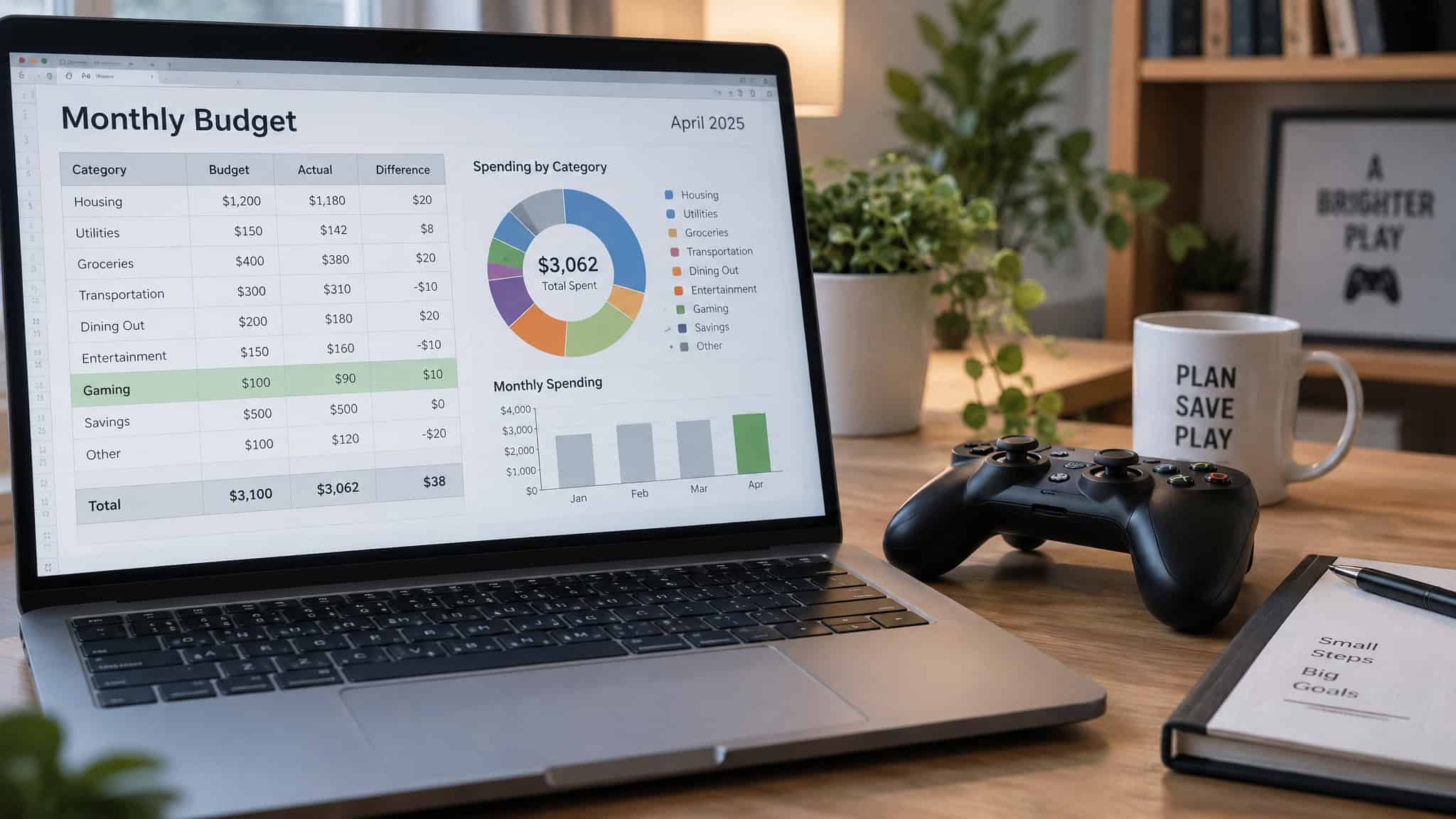
The honest answer is that the sources support a method, not a percentage. Game prices run from $60 to $100+ per title, and one creator’s reckless-accumulation scenario tops $600. His plan narrowed the month’s choices to two purchases. No sourced allocation rule exists, so build your number from observed spending rather than adopting an invented split.
Here’s why the number needs building at all: gaming money disappears inside auto-categorized personal budgets. Intuit’s Mint classroom simulation, a one-day student exercise, makes the mechanism concrete. The persona is Scott, a fictional 24-year-old sound engineer at Universal Wireless earning $2,800 a month with a $205 student loan and rent, who plans projects, client meetings, and business goals at work but, in his words, just likes to roll with whatever comes up financially. Mint auto-assigns transaction categories, and one worksheet item, a Gamesquare in-app purchase, has to be re-assigned by hand to a category that actually fits. The worksheet itself runs across the exercise’s document, with the code appearing on pages 2, 3, and 5.
That’s the exact mechanism: game spend scatters into generic categories, the budget looks balanced, and gaming never surfaces as its own line item. The fix is the simulation’s own workflow: audit Trends > Budgets > Transactions to build a budget from what you actually spent, then create a dedicated gaming category alongside fixed obligations like the loan and rent. The exercise closes with an exit slip requiring two learnings and one recommendation, so the takeaway gets written down rather than forgotten. (Heads up if you try the exercise: it wants the same device every session or it forces a new account, and lost credentials have no recovery path. Write the password down.)
Gaming purchases are easy to underestimate when they’re spread across storefronts, subscriptions, in-game purchases, and card statements. Log each charge in your gaming category and compare the running total with your monthly limit; that makes it easier to catch small purchases adding up before they crowd out other priorities. If you use a credit card, include the statement balance in your monthly plan so the cost doesn’t disappear into general spending. SoFi’s free credit monitoring can help you keep tabs on your credit score, while your spending log shows where your gaming money went.
Buffers and discipline: protecting the budget
Reserve 10–15% of the total budget for unexpected development expenses. That’s the rare buffer tip with an actual sourced percentage attached, courtesy of Fan Studio’s cost guide, and it separates genuine contingency planning from the usual “add extra for surprises” advice.
The supporting disciplines are concrete. Testing and QA, that $13,000–$66,000 line, is prevention: bug fixing and performance optimization before launch prevent expensive post-launch problems. Then six management practices, quickly. A detailed game design document with its own budget. Prioritizing must-have features so a playable game exists even if money tightens, which is the key one, because scope is the shock absorber: when the budget tightens, the game de-scopes instead of dying.
Iterative, agile development that catches issues while they’re cheap to fix. Outsourcing with quality standards and good communication, because hand-offs without standards leak money. Monitoring spend with project management tools, where the habit matters more than the tool. And external funding through grants, publisher investment, or crowdfunding, each of which comes with strings worth reading before signing.
Quick answers: benchmarks, budget rules, and what the numbers don’t say
No sourced “average gamer spend” statistic exists in this coverage. The nearest supported anchors are per-title prices of $60–$100+ and the $600+ overspend hypothetical, and anything beyond that needs an external benchmark. Budget rules circulating in search results, like the 70-10-10-10 rule, appear only as search phrasings with no supporting evidence here and would need verification before you trust them. One genuine yes: games that teach budgeting do exist. A student’s reflection on playing Money Magic landed on the same immediate-needs-versus-long-term-savings tradeoff this whole article is built on. One reflection isn’t research, but it’s a start.
Frequently Asked Questions
What factors should you budget for before starting a game project?
Six drivers set the price: staffing mix and team size, outsourcing versus internal payroll, the quality floor your audience demands, tech-expectation creep, scheduled updates, and seat time — the audience’s own hours, which almost never makes anyone’s list. The framework comes from Christopher Pappas’s game-based-learning budgeting article on University XP (April 2, 2022), written for corporate training games, so treat it as a checklist to adapt rather than figures to copy.
How much contingency should I add to a game development budget for unexpected costs?
Reserve 10–15% of the total budget for unexpected development expenses — that’s the rare buffer tip with an actual sourced percentage attached, courtesy of Fan Studio’s cost guide. Supporting disciplines include testing and QA before launch, a detailed game design document with its own budget, and prioritizing must-have features so a playable game exists even if money tightens.
What is the 70-10-10-10 budget rule?
It’s a budget split circulating in search results, but there’s no supporting evidence behind it in this coverage — it appears only as a search phrasing and would need verification before you trust it. For game development specifically, the sourced alternative is reserving 10–15% of the total budget as contingency. For buying games, build your number from observed spending rather than adopting an invented split.
What is a good fun money budget?
The honest answer is a method, not a percentage: build your number from what you actually spent rather than adopting an invented split. Gaming money disappears inside auto-categorized personal budgets, so audit your transactions, then create a dedicated gaming category that sits alongside fixed obligations like rent and loans. That way gaming surfaces as its own line item instead of scattering into generic categories that make the budget look balanced.