You’ve searched for it. Everyone has. Searching for a free PS5 from Amazon leads to a swamp of Reddit threads, scam come-ons, vague mentions of the Vine program, and “spin to win” giveaways that feel too good to be true. I dug into this because our audience keeps asking, and here’s what I found: the answer is more interesting — and more complicated, than the question suggests.
There’s exactly one legitimate program where you can receive a PS5 from Amazon without paying upfront: Amazon Vine. But “free” is doing a lot of heavy lifting there, and the fine print involves a tax form called a 1099-NEC that nobody mentions in the “get free stuff” guides. Giveaways are real but functionally lottery tickets. Trade-in and reward stacking won’t give you a free console, but they’ll get you closer than anything else.
Let’s walk through each path, what it costs, and how to spot the scams that are waiting to separate you from your credit card number.
Key Takeaways
The only legitimate program where you can receive a PS5 from Amazon without paying upfront is Amazon Vine, but it’s invitation-only and you’ll owe income tax on the item’s fair market value (reported on a 1099-NEC once it exceeds $600 in a year).
Giveaways through Amazon’s official widget and social media contests are real but have lottery-level odds — millions of entrants for a single console, and any giveaway that asks for a payment or credit card is automatically a scam.
The most realistic path to a deeply discounted PS5 (40-60% off) is stacking Amazon Trade-In credit with Warehouse Deals, Lightning Deals, and price tracking tools like CamelCamelCamel.
Table of Contents
The Only Real Path: How Amazon Vine Works (and Who Can Actually Use It)
Amazon Vine is the closest thing to a legitimate “free PS5” mechanism, but it’s not something you can sign up for. It’s an invitation-only program where Amazon selects trusted reviewers — called Vine Voices, based on their reviewer rank (helpfulness and accuracy of past reviews). The deal is simple: free products in exchange for honest, unbiased reviews.
No strings, no “please give us 5 stars” nonsense. Every Vine review displays a green badge that says “Vine Customer Review of Free Product,” so there’s no hiding where it came from.
The program organizes reviewers into gold and silver tiers that determine how much stuff you can grab. Gold tier reviewers can request up to 8 products per day. Silver tier caps at 3 per day — decent, but you’re not exactly swimming in free gear. Gold members also get access to categories Silver members can’t even see.
Amazon ranks reviewers by reviewer rank (helpfulness and accuracy of past reviews) — the better your track record, the more likely you get invited. And if your quality drops or participation stops, Amazon can revoke your invitation.
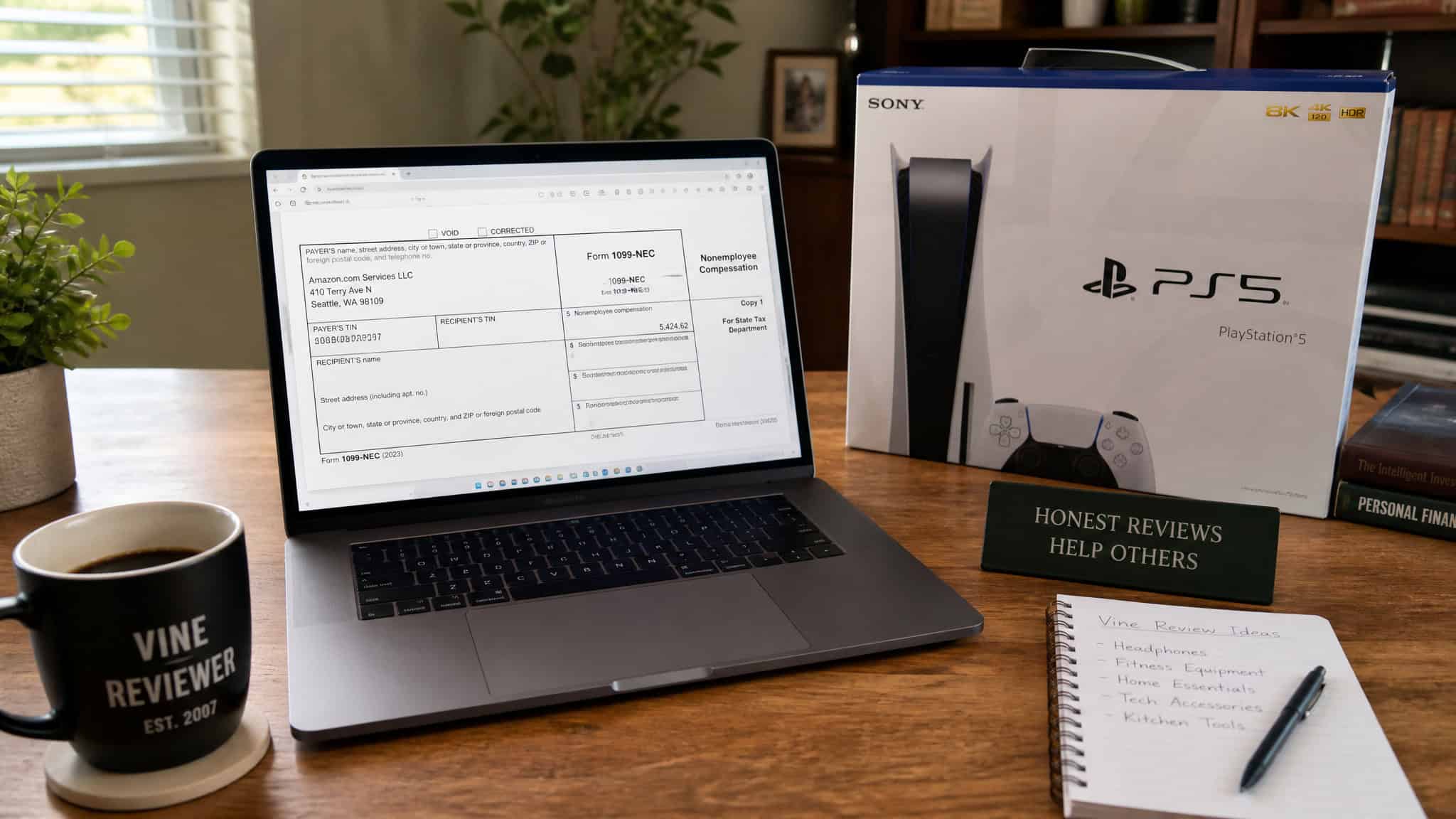
Here’s the part that changes everything: Vine Voices have to pay taxes on the fair market value of every product they receive for free. The IRS considers that free PS5 as income. Once the total fair market value of your freebies hits $600 in a calendar year, Amazon sends you a 1099-NEC — and sends a copy to the IRS too. You’ll report this on Schedule C as self-employment income. It’s not a hobby; the IRS treats it as a side hustle.
Cost check: A PS5 alone pushes past the $600 Vine threshold in one shot. Your tax bill: roughly your marginal rate on $399-$499, likely $100+ for a console that wasn’t technically free.
A PlayStation 5 is worth roughly $399 to $499 depending on the model. That single item would push you past the $600 threshold by itself. Depending on your income bracket, the tax bill could be $100 or more. So that “free” PS5 is effectively a discounted purchase — you pay your marginal tax rate on its value, not the full retail price.
Even if you’re a Gold-tier Vine Voice with stellar reviews, a PS5 appearing in your available offers is far from guaranteed. Sellers rarely give away high-cost items like consoles because the economics don’t work in their favor — a seller giving away a $400 PS5 would lose $400+ per unit with no profit recovery (more on that in a minute), but you can still find ways to get games cheaper through other means.
Real Giveaways: Your Odds and How to Spot Them
Legitimate giveaways do exist. Amazon has an official Giveaways widget where sellers run sweepstakes with random winner selection and no purchase necessary. Brands and influencers run similar contests on social media. These are real — but the odds are brutal. You’re competing against millions of entrants for a single console.
If you want to skip the lottery odds, community-sourced advice on how to get a free gaming console reddit reveals subreddits, user experiences, and cautionary tales that offer a more realistic approach.
The “no purchase necessary” rule is your key litmus test. Any giveaway that asks for payment — a “shipping fee,” “processing fee,” or “deposit” to claim your free PS5, is automatically a scam. Legitimate programs (Vine, Amazon Giveaways) never charge for shipping or processing. For a more complete approach, check out our guide on how to get a free gaming console, which covers giveaways, contests, trade-in loopholes, and community programs.
The Scam Checklist: 5 Red Flags That Scream “Fake”
Scammers are relentless. Here are the specific tests you can run on any “free PS5” offer to know if it’s a trap:
- Any request for payment. A “shipping fee,” “processing fee,” or “deposit” to claim your console. Vine never charges shipping. Amazon Giveaways never charge. If they want money, it’s a scam.
- Credit card “verification.” Scammers ask for your card info to “verify your identity.” No legitimate giveaway or program needs your credit card to give you something for free.
- Impersonation. Fake accounts posing as Amazon, Sony, or popular influencers. Check the account history and verified badges.
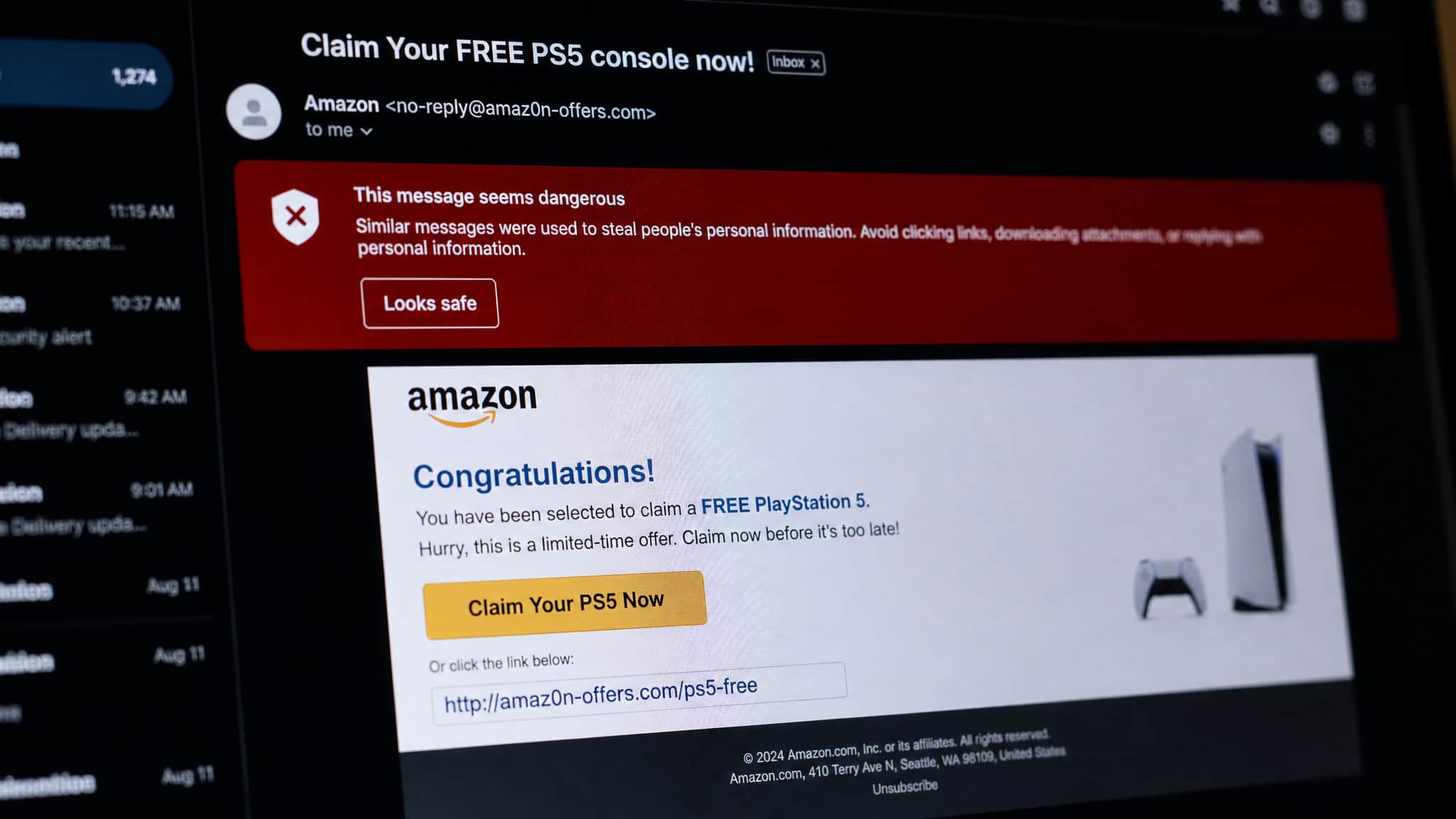
- Phishing emails. Urgent language (“claim your PS5 now!”), fake Amazon URLs like
amazo-n-giveaway.com, misspellings, and weird grammar. Amazon does not send emails like this for giveaways. - Review-for-console demands. Offers that require you to post a favorable review before receiving the PS5. This is a red flag. Amazon prohibits incentivized reviews outside of Vine, and Vine itself explicitly forbids sellers from influencing what reviewers write.
The Vine program rule is clear: sellers cannot control what Vine reviewers write and are prohibited from requesting positive feedback. Any offer that demands a favorable review is violating Amazon policy and is a scam.
The Hard Truth: Why You’ll Probably Never See a PS5 on Vine
If you’re wondering “why doesn’t a PS5 ever show up in my Vine offers?”, the answer lies in seller economics. Amazon Vine is a seller tool, not a consumer giveaway program. Let’s look at the math.
Sellers pay an enrollment fee to join Vine: $0 for 1-2 units, $75 for 3-10, and $200 for 11-30. But that fee is the smallest cost. The real expenses are the cost of goods sold (COGS) and FBA fulfillment fees. A concrete example from the source: 30 units at $12 COGS plus $5 FBA fee each, plus the $200 enrollment fee, totals $710. That’s about $24 per review — and only about 70% of enrolled units actually result in a review (some Vine members claim products and never post).
Now scale that to a $400 PS5. The seller would lose $400+ per unit given away (with no profit recovery from that unit) plus FBA fees. The breakeven math rarely works unless the seller has margins of 30%+ or the console is an inexpensive accessory or refurbished unit. When does Vine make sense?
For new product launches with 0-5 reviews, high margins (30%+ profit per unit), and in competitive categories where review count drives visibility. When does it not? For products already at 20+ reviews (diminishing returns), low-margin products where giving away 30 units hurts cash flow, products with known quality issues (Vine will expose them), or seasonal products with a short selling window.
So if a PS5 does appear on Vine, it’s likely a third-party accessory or a refurbished unit, not the flagship console. The economics just don’t justify sellers giving away a $400 item for a single review.
Plan B: How to Get a PS5 for 40-60% Off (Without the Scam Risk)
Okay, so “free” is basically a myth. What actually works? Stacking.
Amazon Trade-In lets you send in eligible electronics — old consoles, phones, tablets, for instant gift card credit. Trade-in values vary, but they can cover 30-50% of a PS5’s cost if you have decent hardware to trade. Then layer on other savings:
- Warehouse Deals for open-box or refurbished units
- Lightning Deals and coupon offers
- Amazon Rewards Visa points if you have them
- Price tracking with CamelCamelCamel to watch the price history and buy at the right moment
Stack all that together and 40-60% off retail is realistic. It’s not free, but it’s the closest safe path that actually works. Instead of hoping to win a lottery or pay income tax on a discounted console through Vine, this method gives you a concrete plan with real savings.
What a “Free” PS5 Actually Costs
There are three paths, and none of them are truly free:
- Vine: Requires invitation, top-tier reviewer status, luck that a PS5 appears, and paying $100+ in taxes on its value. You get a discounted console, not a free one.
- Giveaways: No cash cost, but astronomical odds. Millions of entrants for one console. It’s a lottery ticket.
- Trade-in + deals: Actual money outlay, but the best outcome. 40-60% off retail with zero scam risk.
The only way to get a PS5 for “free” (with strings) is to win a giveaway (near-impossible) or pay income tax on a Vine unit (if you’re already in the program and it appears). For everyone else, the trade-in and stacking route is the move.
And one final piece of advice: any method that asks for upfront payment or your credit card info is an instant block-and-report.
People Also Ask
How to get a $500 Amazon gift card for free?
There’s no legitimate way to get a $500 Amazon gift card for free. Amazon Vine offers free products in exchange for reviews, but you pay taxes on their value. Giveaways are real but extremely low odds. Any offer that asks for payment or credit card info is a scam.
How to claim a free item on Amazon?
Amazon Vine is the only legitimate program where you can receive free items, but it’s invitation-only and you’ll owe taxes on the fair market value. Amazon Giveaways are real but have very low odds. Never pay a fee or provide credit card info to claim a ‘free’ item.
How to get a free console?
There’s no reliable way to get a free console. Amazon Vine can provide one but requires an invitation and you’ll pay taxes on its value. Giveaways are real but extremely unlikely to win. The most realistic path is stacking trade-in credit and deals to get 40-60% off.
How does Amazon Vine work and can you get a PS5 from it?
Amazon Vine is an invitation-only program where trusted reviewers receive free products in exchange for honest reviews. A PS5 could appear, but it’s rare because sellers rarely give away high-cost items. If you do get one, you’ll owe income tax on its value, reported on a 1099-NEC.
How much tax do you pay on a free PS5 from Amazon Vine?
You pay income tax on the fair market value of the PS5, which is $399-$499. Depending on your tax bracket, that could be $100 or more. Amazon reports the value to the IRS on a 1099-NEC once it exceeds $600 in a year, and you report it as self-employment income.