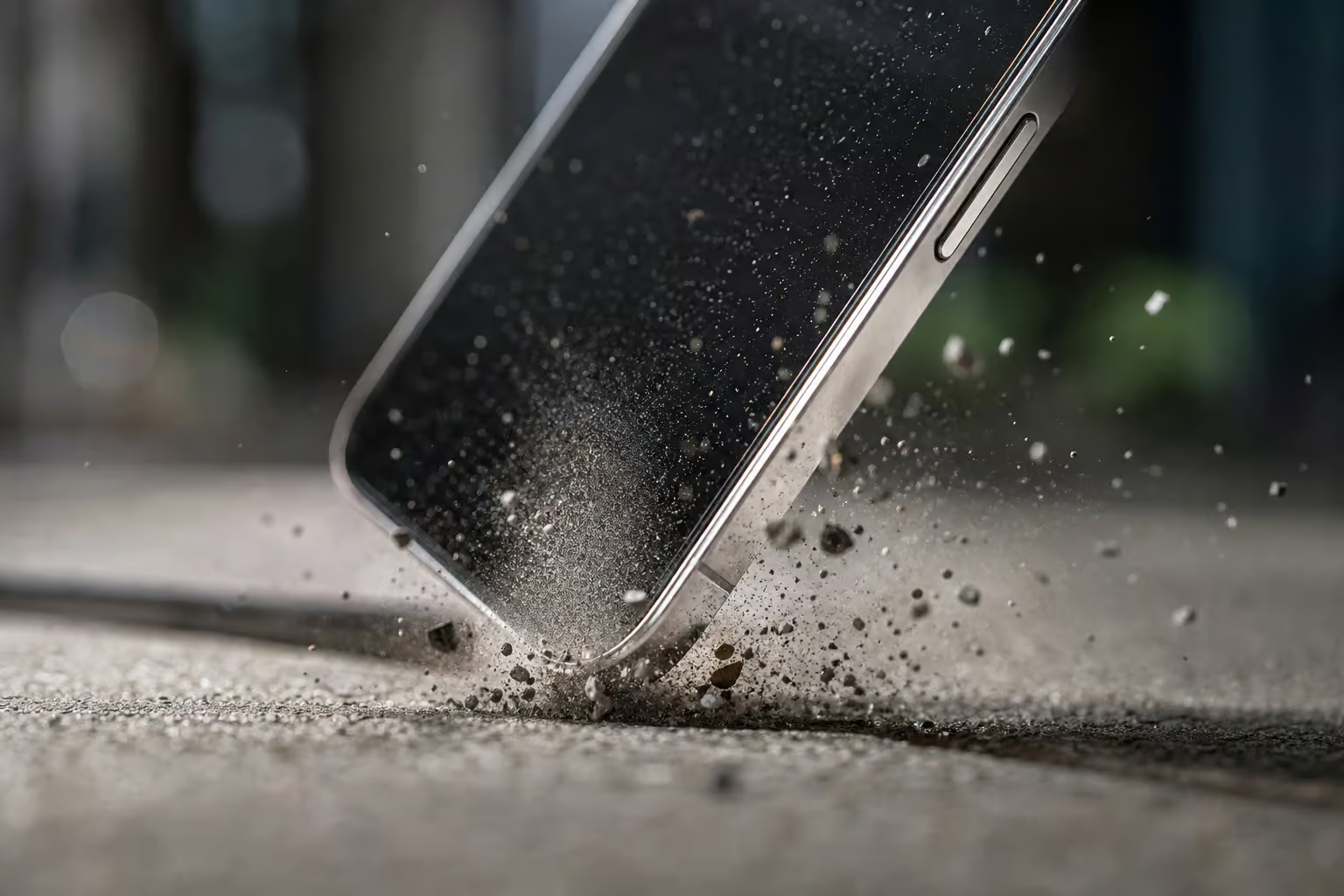
Here at GeekExtreme, we love examining the industrial design of modern smartphones. But dropping a naked flagship onto the sidewalk is a brutal, unforgiving physics lesson. So, do phone cases work, or are we slapping unnecessary plastic onto beautiful engineering? Let’s cut through the “military-grade drop” marketing hype.
Replacing a shattered screen or a crushed glass back panel on a modern cellphone often scales into a repair cost between $200 and $500. When you look at the structural vulnerabilities of these devices, you’ll realize even a thin phone case transcends the idea of a bulky accessory, functioning instead as a highly effective mechanical insurance policy against kinetic destruction.
Key Takeaways
A phone case mechanically disperses kinetic impact force away from vulnerable Gorilla Glass corners, reducing device screen crack rates by up to 40% during drop tests.
Everyday pocket friction causes accumulated micro-scratches that structurally weaken unprotected screens, lowering device trade-in valuations by an average of 25% upon professional inspection.
Wrapping a device in a proper shock-absorbing cover can save between $200 and $600 in screen repair bills, while opting for a Certified Pre-owned Phone can yield up to 50% savings compared to buying new after a catastrophic unprotected break.
Table of Contents
The Physics of the Fall: Shock Absorption and Energy Traps
When a phone hits concrete, it’s not the fall that kills the device—it’s the concentration of kinetic energy at the sudden stop. Unless that energy is safely redirected, it transfers straight into the handset’s most fragile components. Technicians often observe that in handsets lacking a reinforced edge, falls create an “energy trap.” When a device hits the ground at a non-flat angle, the lethal force concentrates entirely on the screen corners rather than freely dispersing across the wider body.
That’s why poorly designed, decorative thin shells fail where modern glass is most vulnerable. A proper protective layer acts as a mechanical buffer; managing the internal energy transfer relies on advanced shock absorption to ensure that force doesn’t isolate on a single structural weak point like the edge of your Gorilla Glass. In fact, a poorly-fit case can actually be worse than going naked because it physically traps hard particles against the glass, magnifying the risk of a shatter.
“A proper protective layer acts as a mechanical buffer by ensuring kinetic force doesn’t isolate on a single structural weak point.”
Material Differences: Mapping Case Types to Risk Profiles
Not all flexible compounds handle impact the same way. The magic happens when you map material densities to specific real-world exposure risks, looking at the exact elastomer mechanics that halt device death.
Hard Plastic Cases
Slim, snap-on hard shells might look sleek, but they often transfer impact force directly into the phone rather than dissipating it. They provide lightweight defense against surface scratches and minor bumps, but are easily compromised by major drops.
Aramid Fiber Cases
For those who find ruggedized silicone cases too bulky but are dissatisfied with the poor impact distribution of basic hard plastic, Aramid fiber—the material found in aerospace components and body armor—represents a modern middle ground. These cases are forged from a synthetic fiber with an exceptional strength-to-weight ratio, allowing for a chassis that is thinner than a credit card yet remarkably rigid.
Because the material bonds tightly to the phone’s geometry, it provides excellent scratch resistance and structural reinforcement without adding the typical “bulk” associated with high-impact protection. While they generally lack the thick viscoelastic cushioning of TPU hybrids, their inherent tensile strength helps prevent the frame of the device from flexing or twisting during an impact—a common cause of internal logic board micro-fractures.
Silicone and TPU Cases
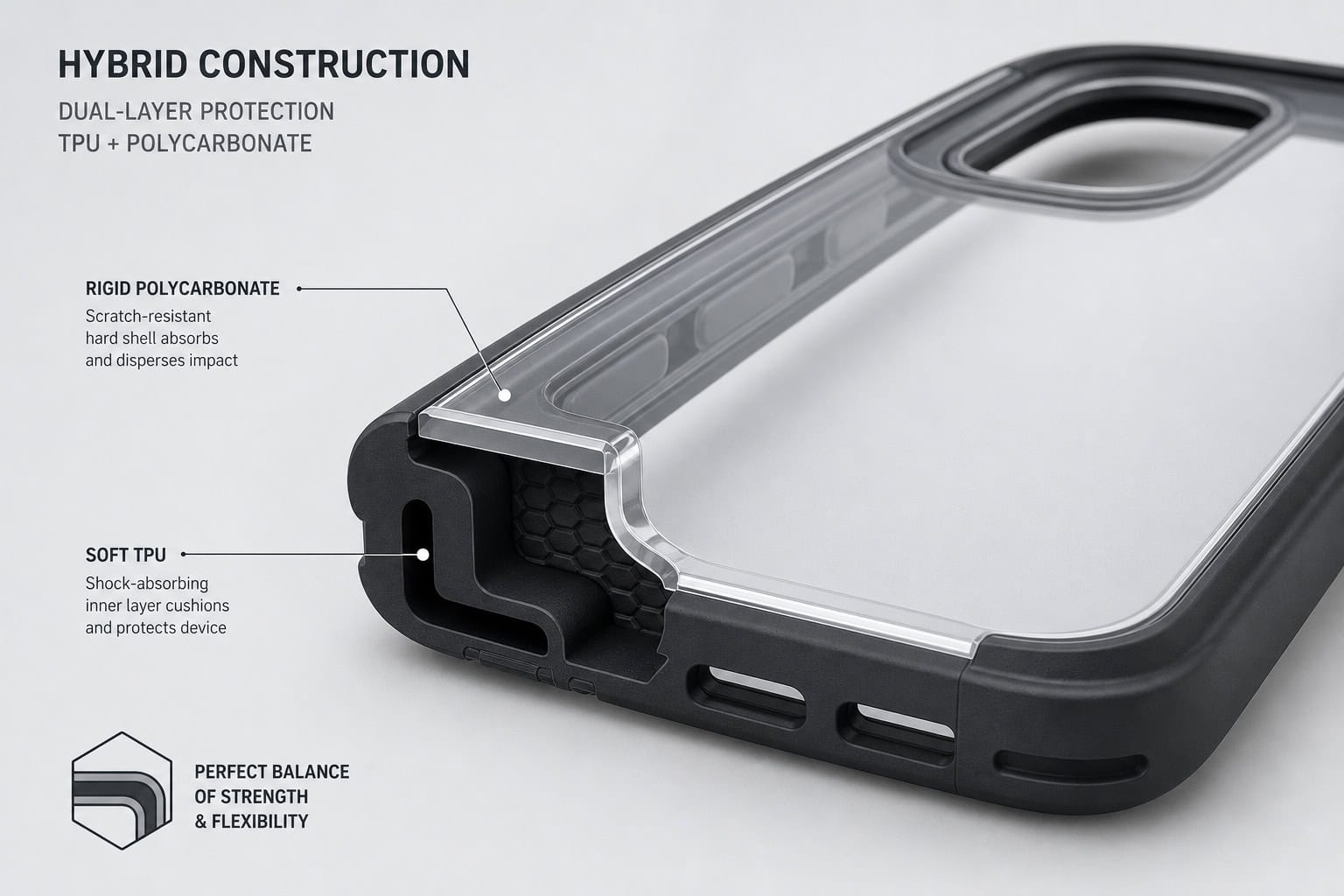
This is where material science shines. Flexible compounds used in Silicone Cases offer superior impact-dispersing metrics compared to rigid shells. Modern hybrid models mix flexible internal material like thermoplastic polyurethane (TPU) with a rigid exterior skeleton made of polycarbonate to provide 5-foot drop protection from non-flat angles. The TPU acts as an efficient internal shock absorber, while the rigid plastic frame deflects physical penetration.
Heavy-duty and Rugged Cases
For industrial or high-drop environments, ruggedized encapsulation is the baseline requirement. These heavyweight options combine thick rubber matrices with hard outer shells, reinforcing the vulnerable corners to disperse kinetic loads. If you need confidence, this setup pushes device protection to its physical ceiling.
Wallet Cases and Functional Add-ons
If you’re prioritizing utility-first designs, folio-style wallet cases are fantastic for holding cards and cash, though they trade away structural drop defense. Modern functional add-ons incorporate features like built-in kickstands or MagSafe compatibility for seamless wireless charging, effectively blending everyday convenience with baseline chassis protection.
The Screen Protective Gap: Why Cases Need Help
Even the most thoughtfully engineered armor has geometric blindspots. While traditional covers and even weird phone cases are specifically designed to shield the outer body, the front-facing glass requires specialized, localized help. Manufacturers deliberately rely on raised bezels to shift the direct impact points safely away from the screen when a phone lands face-down on perfectly flat surfaces like hardwood floors. However, if that screen experiences a direct strike on uneven terrain—like jagged gravel or the corner of a brick—that rim-based defense becomes useless. Because an open face leaves the handset exposed, relying on a cover wrapping only the chassis is an incomplete strategy unless properly matched with secondary tempered glass for active Screen Protection Integration to seal that protective gap.
Cumulative Micro-damage and the ‘naked’ Device Myth
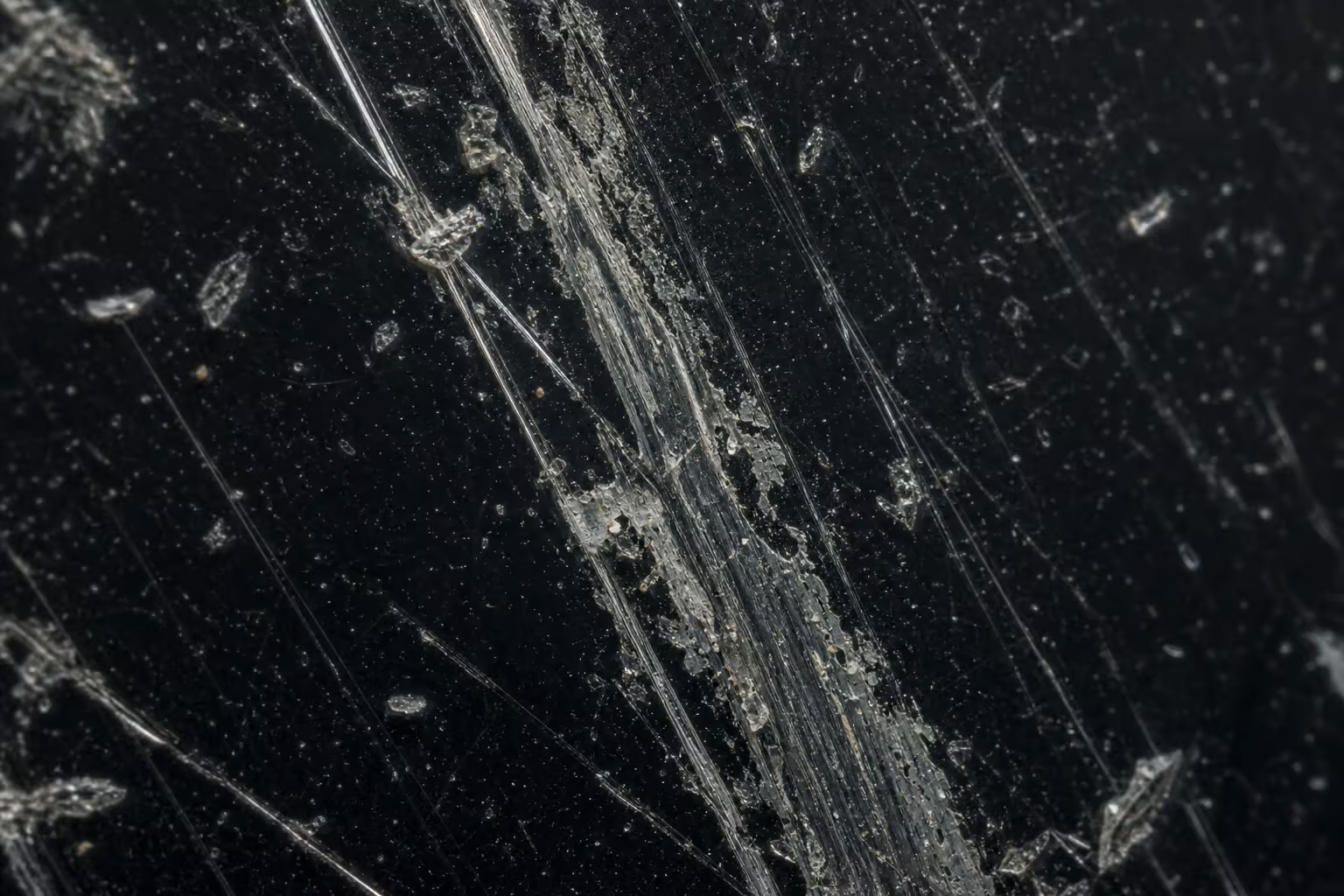
You might assume a phone kept safely in your pocket is perfectly preserved, but laboratory and repair findings definitively prove otherwise. There’s a hidden cost to everyday debris, creating a structural engineering hazard out of what most people mistakenly view as a purely cosmetic annoyance. Daily pocket friction from loose keys, loose coins, and hard zippers acts like fine-grit sandpaper, causing constant, invisible surface abrasion. These cumulative micro-scratches gradually undermine the structural integrity of the underlying materials over time, making your device screen 15% more likely to suffer crack propagation during impacts long before you drop it.
That hidden degradation hits your wallet. Un-cased devices subjected to prolonged UV exposure, dust accumulation, and daily wear suffer financial depreciation of $100 to $300 compared to those graded as “Grade A” condition. Evaluators at major service centers like Mobile Klinik use a strict 64-point inspection protocol to officially determine handset health, and the direct correlation between a physically preserved exterior condition and Resale Value Preservation is clear.
Environmental Guarding: Protecting Vulnerable Entry Points
Beyond mechanical drops, there is a disconnect between IP68 laboratory ratings and environmental survival in sub-meter submersion. Modern smartphones are marketed as “waterproof,” but that’s an oversimplification that costs users thousands. Without dedicated external Environmental Guarding, an exposed device remains deeply vulnerable.
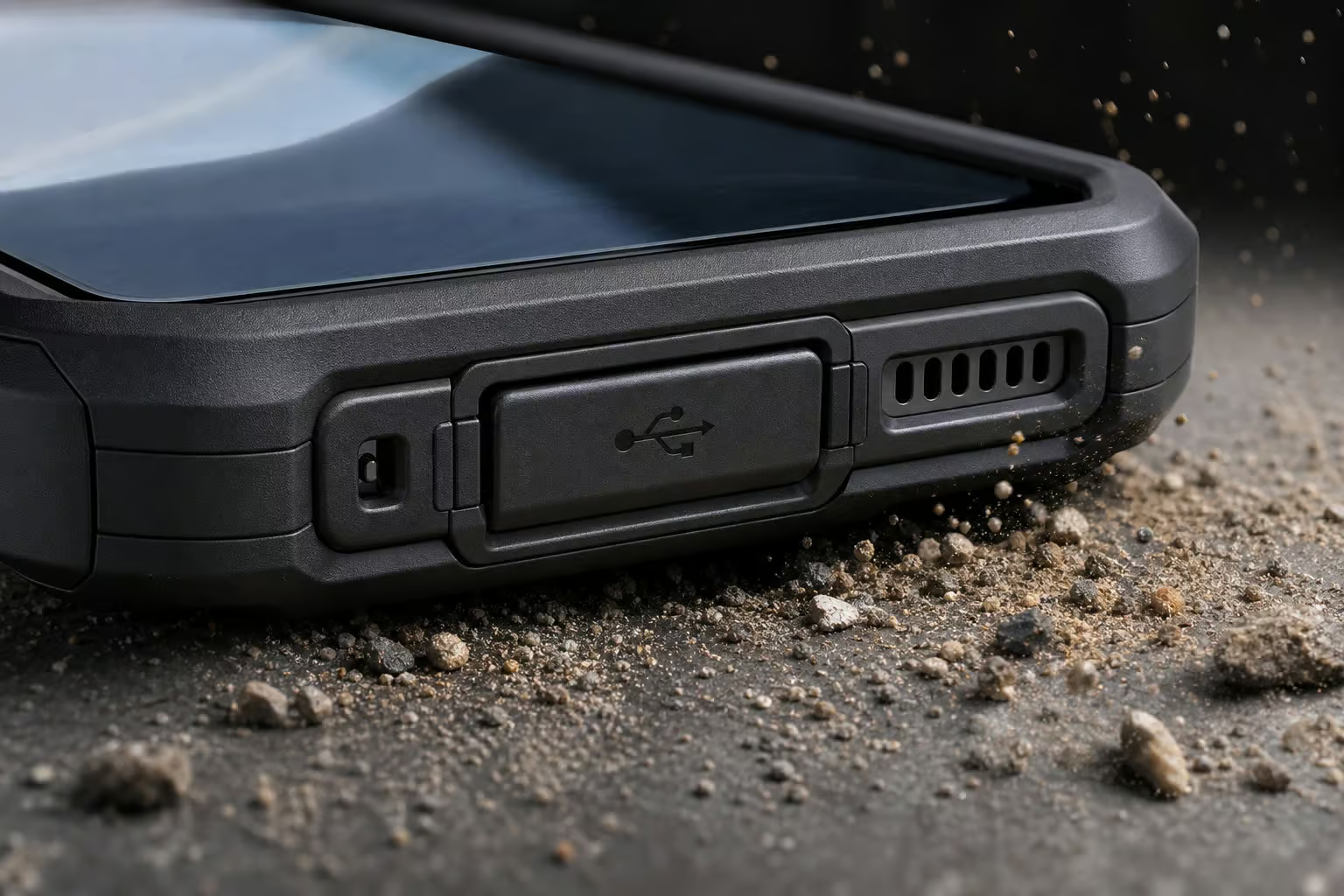
The technicians at CaseMogul frequently document how device entry points—like unprotected charging jacks, delicate surface microphones, and external speakers—allow fluid ingress. While modern phones are marketed as water-resistant, this protection is often limited; an exposed device remains vulnerable to ambient moisture accumulating inside the logic board. A heavy-duty case intentionally mitigates these environmental hazards, physically encapsulating the hardware to prevent the internal corrosion of components and maintaining your crisp audio quality over the device lifespan.
The Economics of Preservation and Replacement
If your phone is already damaged despite using a case, your first step should be seeking certified pre-owned phones, which commonly offer up to 50% savings compared to buying new. When physical protection fails and a device suffers structural failure, pivoting to this pre-owned market becomes your most realistic fallback. Purchasing professionally vetted refurbished hardware through trusted Canadian Service Locations effectively avoids the punishing price tag of a brand new flagship unit, proving why exploring alternative replacement models makes robust economic sense.
Frequently Asked Questions
Do phone cases actually protect the phone?
Yes, they act as a mechanical buffer by dispersing kinetic energy that would otherwise concentrate on fragile corners. By preventing direct force transfer, a proper shock-absorbing cover can reduce screen crack rates by up to 40% during impact tests.
Why don’t rich people use phone cases?
While some prioritize a naked aesthetic, skipping a case often ignores the long-term structural risks to the device. Even micro-scratches from everyday pocket friction can weaken the glass, making a screen significantly more prone to shattering during even minor drops later on.
What is the difference between hard plastic and TPU cases?
Hard plastic shells mostly offer minimal scratch protection and often transfer impact force directly into the phone frame. In contrast, TPU is an elastomeric material that absorbs and dissipates kinetic energy, providing far superior cushioning for your device during a fall.
How does a phone case save me money?
Beyond avoiding the $200 to $500 cost of a screen replacement, cases help maintain your phone’s resale value by preventing surface abrasion. Since professional evaluators dock trade-in prices for even minor wear, a case typically pays for itself by keeping your device in top-tier condition.
Can I rely on my phone’s IP68 rating instead of a case?
No, because a lab-tested IP68 rating does not account for the wear and tear of real-world use. Over time, an exposed phone is at greater risk of fluid ingress through speakers and charging ports, whereas a case can physically encapsulate those delicate entry points to prevent internal corrosion.
Why does my screen crack if I have a case with raised edges?
Raised bezels protect the screen only when the device lands perfectly flat on a level surface. If your phone strikes uneven terrain, such as a rock or a corner, that edge protection is bypassed, which is why a case should always be paired with secondary tempered glass.