I’d been doing this for years before I learned there was a name for it.
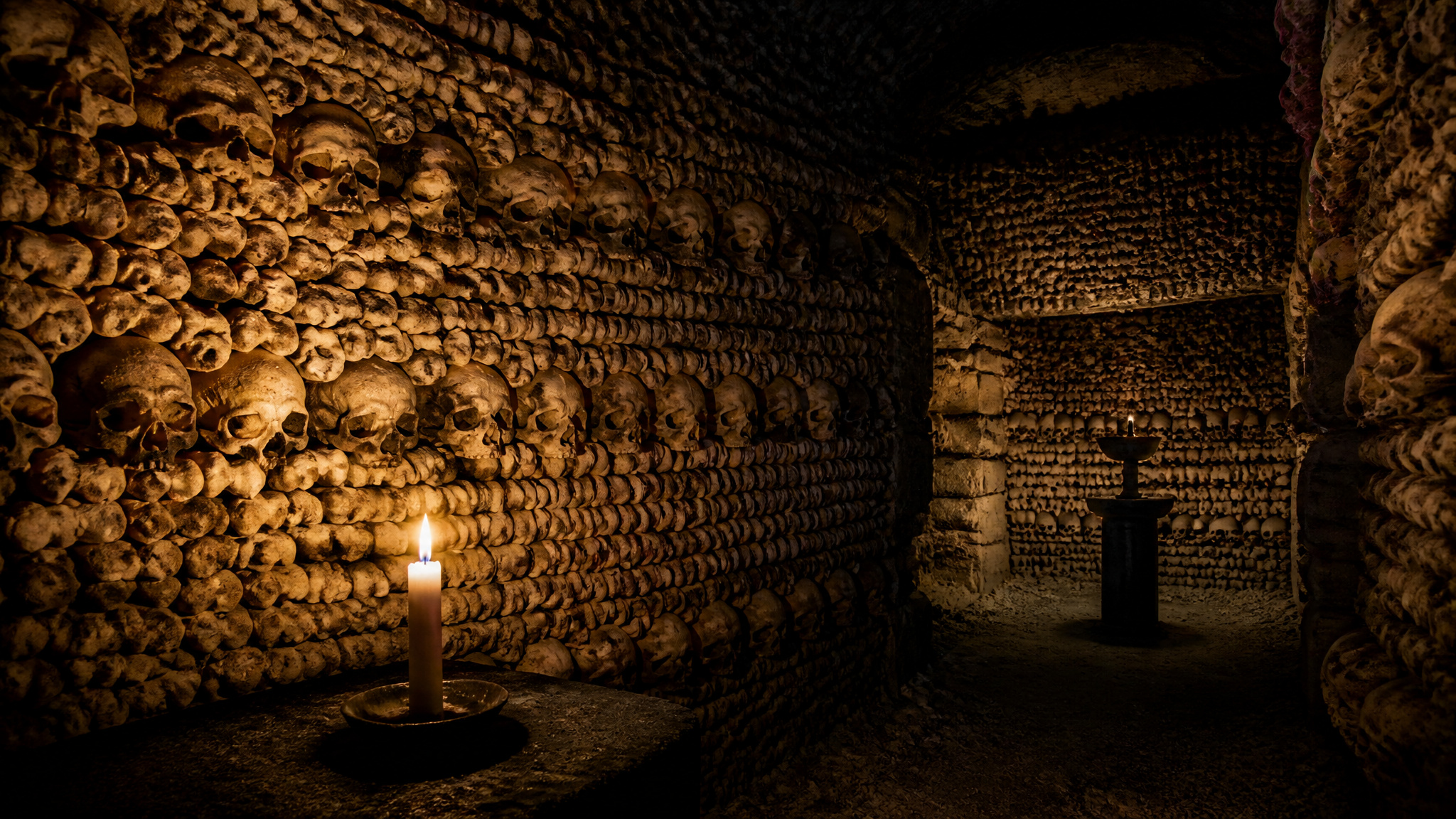
Visiting the places where terrible things happened. Seeking out the bone churches, the prison cells, the battlefields, the spots where someone’s last breath became a historical footnote. It wasn’t morbid curiosity, or maybe it was, but it was also something else. A need to understand.
To bear witness. To make sure the stories didn’t die with the people who lived them.
Then I discovered the term “dark tourism”, thanatourism, from the Greek thanatos, meaning death. And I realized I’d been a thanatourist since before the label existed.
Dark tourism covers a spectrum as wide as human suffering itself. At one end, you have Auschwitz-Birkenau, a place that demands solemnity and silence. At the other, you have Froggyland in Split, Croatia, where 507 taxidermied frogs act out human scenes, which is… honestly, kind of delightful? The key insight, and the thing that took me years of visits to understand, is that these sites are not the same category of experience, and they require completely different behavior from visitors.
Nearly one in five travelers deliberately seeks out dark tourism sites, according to an Opodo poll from October 2025. Thirty percent visit “less classical” museums on holiday. But the question underneath it all, the one I keep circling back to after 20+ visits across Europe, Asia, and the Americas, is whether these places honor the dead or exploit them.
The answer, I’ve come to believe, is both. It depends on the site, and it depends on the visitor.
Here’s what I’ve learned from dragging myself to the hard places. The places we don’t talk about at dinner parties. The places that stick to you long after you’ve left.
Key Takeaways
Nearly one in five travelers (19%) deliberately seeks out dark tourism sites, with interest highest among 25-34 year-olds (24%) and French travelers (27%), according to an Opodo poll of 9,000 respondents.
Dark tourism spans a behavioral spectrum from genocide memorials like Dachau (which demand solemnity) to macabre curiosities like Froggyland in Croatia (where relaxing is fine), and matching your conduct to the site’s gravity matters more than any rulebook.
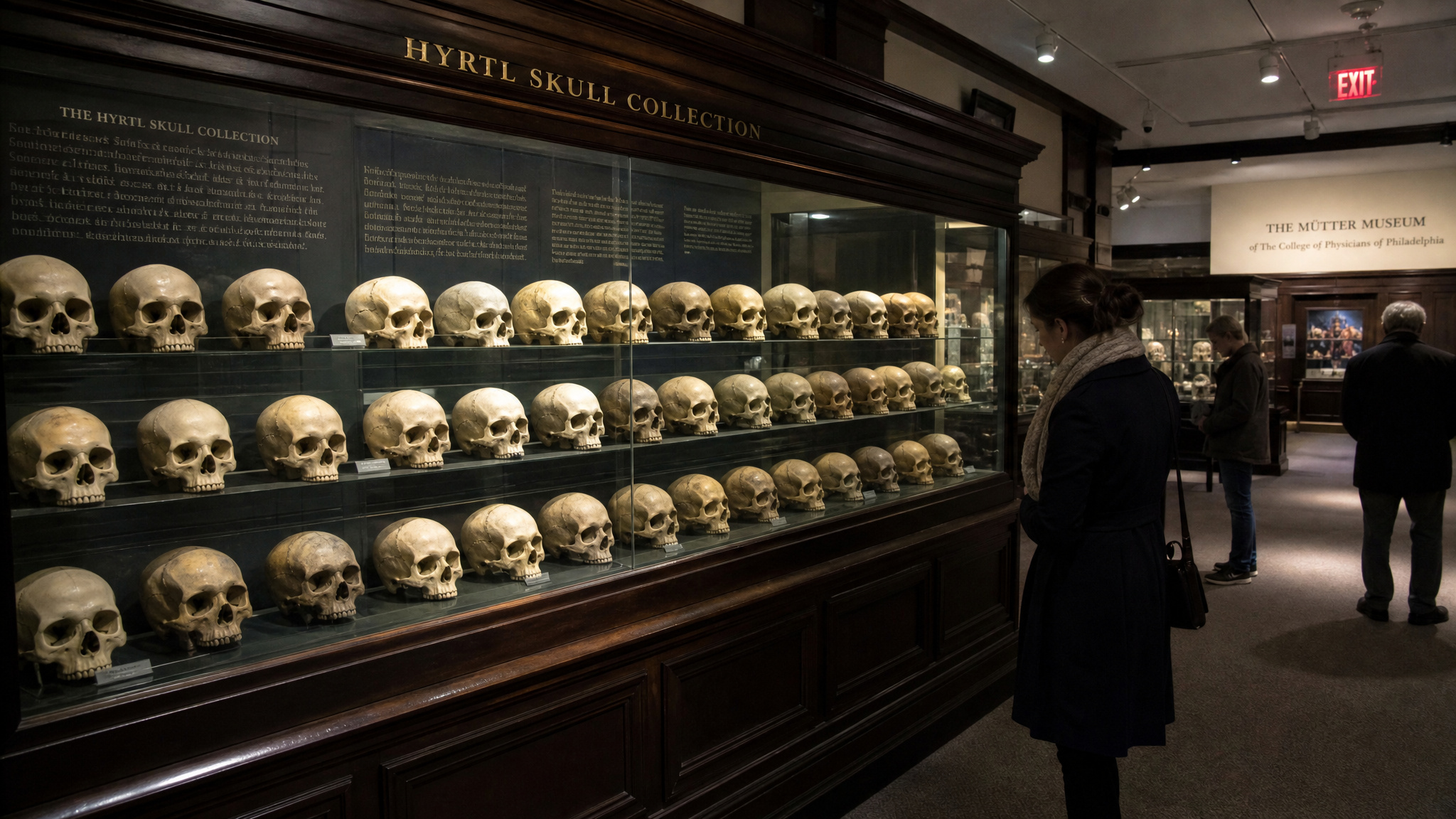
The ethics of displaying human remains remains an open debate: the Mütter Museum’s Hyrtl Skull Collection holds 139 skulls from hanged criminals and the poor, acquired in 1874 without consent, and researchers argue the default should shift from display to repatriation.
Table of Contents
What Is Dark Tourism? The Spectrum of Death Attractions
Dark tourism is not one thing. It’s a category that stretches from the heaviest sites imaginable, genocide memorials, concentration camps, killing fields, to stuff that’s frankly a little fun. Ghost walks. Torture museums. A taxidermied frog doing a human-sized activity.
The term “thanatourism” comes from thanatos, the Greek personification of death. Travel connected with death, fear, trauma, war, the macabre.
What makes a site dark?
Specificity helps. A site becomes “dark” when death or tragedy is central to its identity. But the gravity varies enormously.
The spectrum, as I’ve experienced it across visits, runs something like this: at the far end, sites of mass atrocity. Auschwitz, Tuol Sleng, the Killing Fields. These are places of profound sorrow where the only appropriate response is respect and reflection. In the middle, you have sites where death is present but contextualized. Sedlec Ossuary, the Paris Catacombs, the Capuchin Crypt. Death is the theme, but the experience is more about contemplating mortality than grieving specific victims. At the light end, you have pure macabre entertainment, ghost walks, haunted houses, Froggyland. Death as aesthetic, as thrill, as curiosity.
How gravity shapes visitor behavior
This spectrum isn’t just a classification system. It’s a behavioral code.
At a genocide memorial, you don’t take selfies. You don’t joke. You don’t rush through to hit the gift shop. You’re there to witness, to learn, to remember.
At the light end of the spectrum? You can relax. Laugh, even. Froggyland is genuinely funny, 507 taxidermied frogs doing human activities will do that. Nobody died for your entertainment there.
But the way you talk about the Holocaust and the way you talk about a medieval torture museum should be very, very different.
The Canonical Dark Sites I’ve Visited. A Personal List
Almost all of the sites on this list are UNESCO World Heritage Sites. That’s not a coincidence. There’s a strange synergy between heritage recognition and tragedy commemoration, as if the official designation of “this matters to humanity” and “something terrible happened here” reinforce each other. The list below is the collection of sites that shaped how I think about dark tourism.
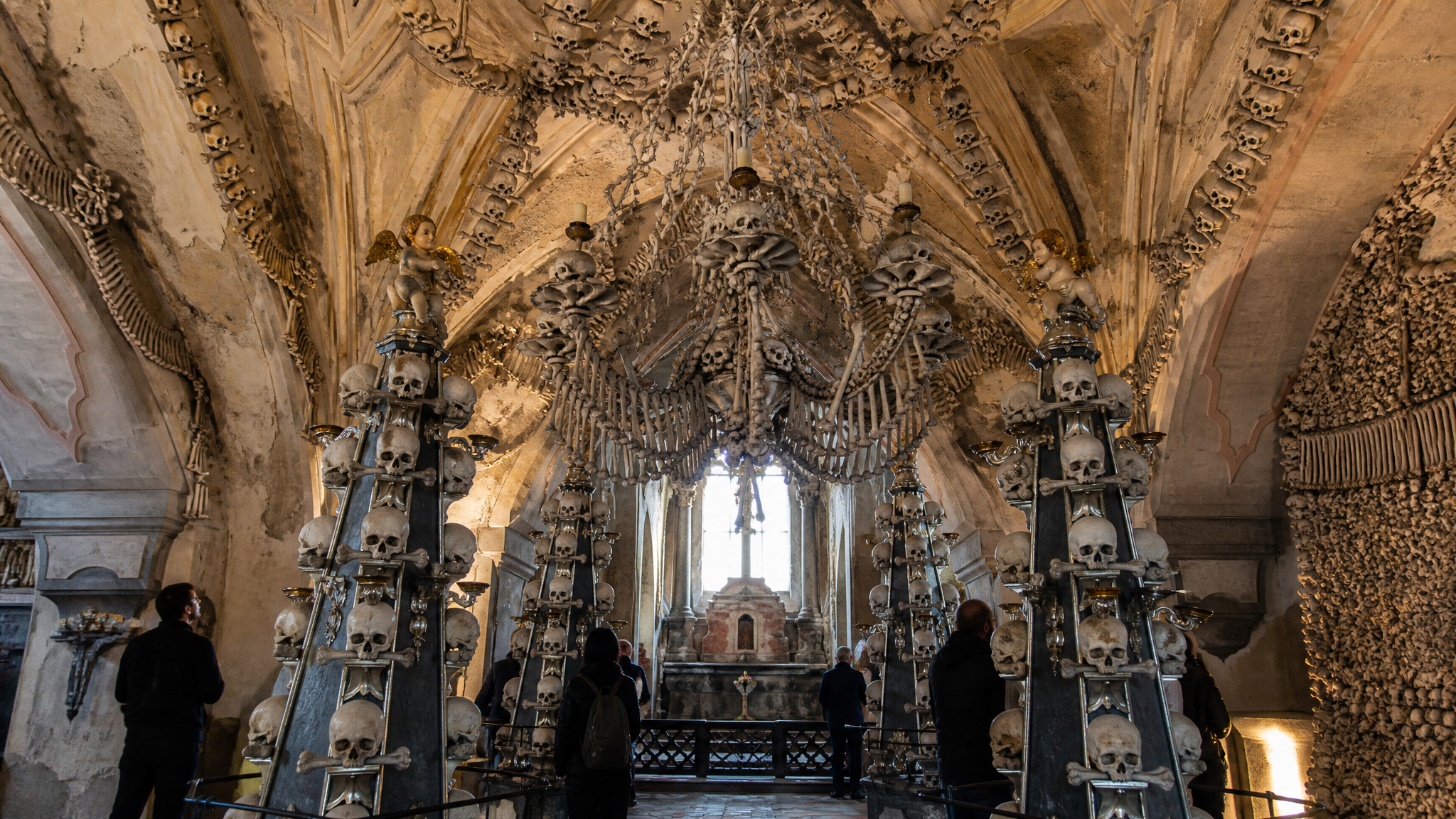
Sedlec Ossuary (Bone Church), Kutná Hora, Czechia
The Sedlec Ossuary contains the skeletal remains of 40,000 to 70,000 people, arranged into chandeliers, a coat of arms, and decorative displays. It’s part of a UNESCO World Heritage Site, about an hour by train from Prague.
The history: in 1278, the abbot of Sedlec Monastery returned from Jerusalem with soil from Golgotha, the hill where Jesus was crucified, and sprinkled it over the cemetery. Suddenly, everyone wanted to be buried there. The cemetery became overcrowded, especially after the Bubonic Plague swept through in the 14th century, and older bodies were exhumed to make room. In 1870, a woodcarver named František Rint was hired to organize the bones into something less chaotic. He created what you see today: bone chandeliers, bone garlands, a bone coat of arms. Even a bone signature.
Visitors still light candles inside the ossuary, a small act of remembrance. But there’s tension here. When I visited, Australian tourists admitted they’d come “for the thrill.” Others tried taking photos despite the site’s prohibition (Kutná Hora had banned photography in the ossuary two years before my visit).
The site sits at an odd intersection: it’s a place of worship, an artistic masterpiece, and a tourist attraction. The bones were people once. The candles burning acknowledge that. The thrill-seeking tourists, less so.
Field note: The tension between reverence and thrill-seeking at sites like Sedlec isn’t resolved by rules — it’s resolved by each visitor’s mindset. Check yours before you walk in.
Tuol Sleng Genocide Museum (S-21), Phnom Penh, Cambodia
Of all the sites I’ve visited, Tuol Sleng is the one that haunts me most.
A former school converted into the Khmer Rouge’s S-21 interrogation and detention center. Twenty thousand people passed through its gates. Only twelve survived. The Khmer Rouge killed an estimated 1.5 to 2 million Cambodians during nearly four years of rule.
I visited in 2003, on the 40th anniversary of Victory Day, the day Vietnamese forces toppled the regime. Some of the volunteers working at the site were former prisoners.
The site’s stated aim is to make visitors “messengers of peace.” You walk through rooms where people were tortured. You see photographs of the dead, their faces staring out from another world. There’s a portrait of a young boy that stayed with me, something about the directness of his gaze, the way he seemed to be looking past the camera at something I couldn’t see. I’ve carried that image for years.
Pompeii and Herculaneum, Italy
Buried by the eruption of Mount Vesuvius in 79 AD, Pompeii and Herculaneum are the ultimate time capsules. The heat was so intense that no human remains survived, but archaeologists could recreate the shapes of the dead from the negative space they left in the ash. The famous plaster casts are the result.
Most people trapped in the city died instantly from the heat. The entire city and its citizens were buried in stones and ashes. The preservation is the magic: you walk Roman streets, enter Roman houses, see Roman graffiti. Herculaneum, a couple of miles away, suffered the same fate and offers a similar glimpse.
The practical note: Pompeii is about two hours from Rome by train. Herculaneum is closer to Naples. Both are part of the same UNESCO listing.
Chichen Itza, Mexico
The Mayan ruins of Chichen Itza in the Yucatan carry a sacrificial history. This isn’t a place where death is incidental; it’s central to the site’s purpose. Human sacrifice was part of the ritual life of the city.
For Aztec temples, you’d want to visit the Templo Mayor site in Mexico City instead. And if you’re interested in the broader cultural context, the Day of the Dead is related but not the same category, it’s a living tradition, not a historical site.
Tower of London, UK
The Bloody Tower is where 12-year-old Edward V and his younger brother were allegedly murdered in 1483, on the orders of their uncle, Richard III. Westminster Abbey has a small coffin containing the bones of two children found in the Tower, presumably theirs.
The Tower was also the site of royal imprisonments, executions, and murders. William Wallace. Braveheart, yes, that one, was executed here. The Torture at the Tower exhibition displays replicas of genuine devices from the 1500s and 1600s, including the rack.
Shah-i-Zinda, Samarkand, Uzbekistan
This is the prettiest necropolis you’ll ever see. Shah-i-Zinda is an alley of mausoleums dating from the 14th century, and the sheer beauty of the tiled structures is so breathtaking you almost forget it’s an alley of tombs.
The name means “Tomb of the Living King.” It may hold the grave of Qusam, a 7th-century cousin of the Prophet Mohammed who brought Islam to the region. The Registan, Samarkand’s famous square, is nearby. Samarkand is about two hours by train from Tashkent.
Roskilde Cathedral, Denmark
Roskilde Cathedral is a UNESCO World Heritage Site and the burial place of Danish monarchs. It’s about 30 minutes from Copenhagen by train.
Royal burial sites are their own subcategory of dark tourism. Westminster Abbey, Sweden’s Riddarholmskyrkan, France’s St. Denis.
Mausoleum of the First Qin Emperor (Terracotta Warriors), Xi’an, China
Qin Shi Huang (259-210 BCE) was China’s first emperor, and his tomb is guarded by more than 8,000 soldiers, 130 chariots, 520 horses, and 150 cavalry horses, every single soldier with a unique face.
The emperor was so concerned with the afterlife that he built an entire army to accompany him. The mausoleum is the ultimate expression of death as power. It’s also a marvel of engineering, the warriors were mass-produced in workshops but individualized enough to feel eerily human.
KZ Gedenkstätte Dachau, Germany
Dachau was the first actual Nazi concentration camp. Two hundred thousand prisoners from over 40 nations passed through its gates. At least 41,500 died there.
The exhibition is explanatory and gruesome in equal measure. I’d visited Theresienstadt in Czechia before, but that was mainly a work camp, and Dachau hit harder. It was a beautiful sunny day when I visited, and you felt guilty smiling, eating, or drinking.
Practical note: take the train from Munich (about an hour), then bus 726. The bus stop was crowded when I visited. Walking is not recommended unless you enjoy long walks through the suburbs.
Valley of the Kings, Luxor, Egypt
The royal burial site for the pharaohs. Where Tutankhamun was discovered. The Valley of the Kings is the archetypal necropolis, a place built specifically for death, designed to carry the dead into eternity.
Catacombs of Paris, France
In the late 1700s, Paris had a problem: too many dead people, not enough cemetery space. The solution was to move bones from several cemeteries into underground Roman tunnels, the quarries beneath the city.
The result is a subterranean network of bone-lined walls that confronts death openly, without hiding it. The practical note: take the Metro to Denfert-Rochereau and look for the long line. You enter and exit at different points.
Valle de los Ingenios, Trinidad, Cuba
A UNESCO-listed example of 18th-19th century Caribbean sugar agro-industry, and its slavery. In 1827, more than 11,000 slaves worked the mills in this 225 km² valley. The tower built to keep watch on enslaved workers still stands.
This is a site where the beauty of the landscape and the horror of the history are in direct tension. The sugar industry built fortunes and destroyed lives, and the valley preserves both sides of that ledger.
Shoes on the Danube, Budapest, Hungary
A memorial to Holocaust victims shot along the Danube riverbank.
Nearby, the Labyrinth beneath Buda Castle is where Vlad Tepes, the historical Dracula, was held in the 15th century.
Stockholm Bloodbath, Stockholm, Sweden
In 1520, Danish King Christian II mass-executed Swedish nobles at Stortorget, the main square of Stockholm’s old town. The phrase “bloodbath” may actually originate here.
Today, the square is a lovely, touristy spot. The blood is long gone.
Ho Chi Minh Mausoleum, Hanoi, Vietnam
A grey marble monument holding the remains of Ho Chi Minh, finished in 1975. Locally, it’s known as “Uncle’s Mausoleum”, a term of affection for the revolutionary leader.
Here’s the darkly ironic part: Ho Chi Minh wanted to be cremated and his ashes scattered across the country, to save land for agriculture. Instead, he lies in a glass sarcophagus, part of the tradition of embalmed communist leaders. The man’s explicit wishes were overridden for political purposes.
Warsaw Old Town and Warsaw Rising Museum, Poland
During WWII, 85% of Warsaw was wiped out after a 63-day uprising, the largest resistance against the Nazis in occupied Europe. The city was systematically destroyed.
The Old Town you can visit today is a reconstruction. After the war, citizens rebuilt it over five years, the ultimate act of defiance. It’s now UNESCO-listed. The Warsaw Rising Museum includes a digital animation showing the city after the bombing.
Ground Zero (9/11 Memorial and Museum), New York
The site of the September 11 attacks. I’ll keep this brief: it’s a place of national mourning, and the memorial design, reflecting pools in the footprints of the Twin Towers, is appropriately powerful. The museum below documents the events and the victims.
Church of the Holy Sepulchre, Jerusalem
The site associated with the death and resurrection of Jesus Christ. For millions of people, this is the holiest place on Earth. The Via Dolorosa, the “road of pain”, ends here.
This is a site where faith and dark tourism overlap completely. Pilgrims come to mourn, to pray, to connect with their savior’s suffering. Tourists come to see one of the most historically significant sites in the world.
Sarajevo WWI Site (Latin Bridge corner)
The corner where Gavrilo Princip shot Archduke Franz Ferdinand and his wife Sophie, sparking World War I. The museum at the corner displays photos of the funeral. Visitors can have their picture taken in a similar car, dressed as the Archduke.
And the perspective shifts depending on where you stand: in Belgrade, Princip is celebrated as a Serbian nationalist hero, with a park named after him. History, it turns out, depends on geography.
Russian Revolution Sites (St. Petersburg, Russia)
St. Petersburg, formerly Leningrad, is the city where the Russian Revolution began. The dark travel theme is the revolution itself, and the suffering it both ended and caused.
Asia’s Dark Tourism Sites: From the Killing Fields to the Atomic Bombs
Asia has some of the most harrowing dark tourism sites on Earth, and also some of the strangest.
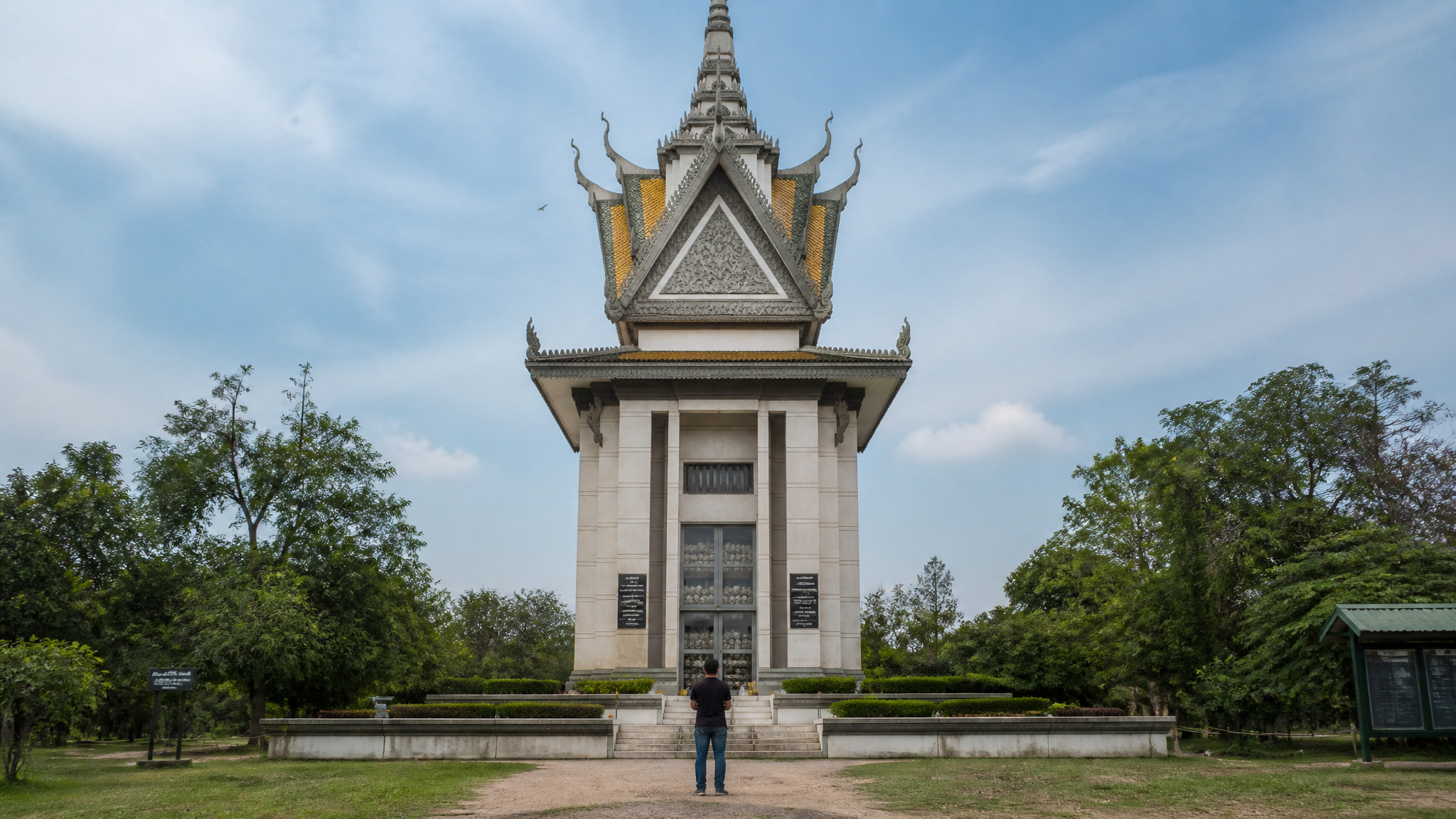
Choeung Ek Killing Fields, Siem Reap, Cambodia
Memorial to Khmer Rouge victims, and the site where thousands were executed and buried in mass graves. A well on the site yielded 50-60 bodies. The graphic information and depictions are unsparing. More bones emerge from the soil every rainy season, the earth itself is still giving up its dead.
Aokigahara Forest (Suicide Forest), Japan
Known for a high volume of suicides. It’s the subject of horror films and folklore, and it has a reputation that precedes it. You can hike the forest trails, visit the Narusawa Ice Cave and Wind Cave.
Okinawa Battle Sites, Japan
The Battle of Okinawa was one of the bloodiest of WWII: 12,000 Americans and over 100,000 Japanese lost their lives. Sites include Hacksaw Ridge (of the film fame), the Former Japanese Navy Underground Headquarters, and the Peace Memorial Museum. In the underground HQ, rooms show grenade holes from an officer who ended his life there.
Hiroshima and Nagasaki Atomic Bomb Sites
Hiroshima: the hypocenter, the A-Bomb Dome (the only building left standing near the blast), the Peace Memorial Park and Museum, the Honkawa Elementary School, the Bank of Japan building. Nagasaki: the Atomic Bomb Museum and Peace Park.
These are sites of unimaginable destruction where the message is explicit: never again. The museums do not glorify. They document. They mourn.
Sokushin-Butsu (Buddhist Mummies), Yamagata Prefecture, Japan
This is one of the strangest things I’ve ever encountered. Buddhist monks who practiced a form of self-mummification. Monk Shinnyokai-Shounin ate only nuts, tree roots, bark, and wild plants. He fasted on saltwater for 42 days.
He drank Urushi, a lacquer ingredient, to begin the mummification process while still alive. Then he buried himself alive. After 1,000 days, he was exhumed, mummified. Visitors can see the mummified body. No photos allowed.
The disturbing part isn’t the mummy itself. It’s the deliberate, decades-long preparation. This was a man who chose, step by step, to turn himself into a relic.
Hoa Lo Prison (“Hanoi Hilton”), Vietnam
Built in the late 1800s during French occupation, Hoa Lo first housed political prisoners under horrific conditions, then US POWs during the Vietnam War. The nickname “Hanoi Hilton” came from the American POWs’ dark humor; it was no Hilton.
Europe’s Darker Corners: Frogs, Walls, and the KGB’s Basement
Europe is where dark tourism gets… eclectic. From the absurd to the unbearable.
Froggyland, Split, Croatia
507 taxidermied frogs doing human activities. This is the weirdest thing you’ll see on any dark tourism list, and I say that with affection. It’s not dark in the way Dachau is dark, nobody died tragically. But it’s macabre in a way that’s hard to explain: something about the frogs’ frozen expressions, the elaborate miniature scenes, the sheer strangeness of the project.
You’ll either love it or be deeply unsettled by it. Possibly both.
Berlin Wall, Germany
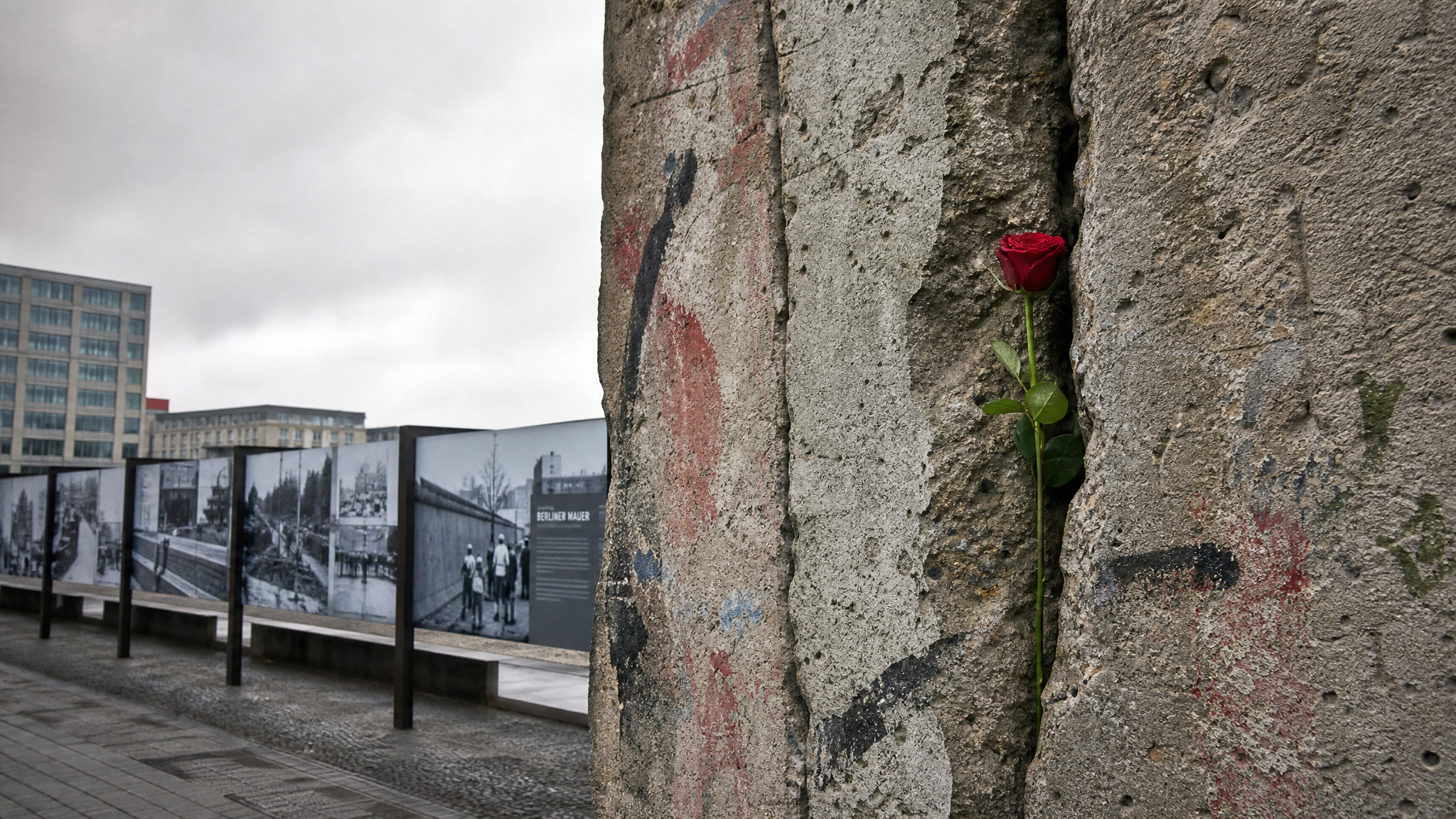
The Berlin Wall was 155 km long, built almost overnight on August 13, 1961. Guards were ordered to shoot on sight. Around 140 people died trying to flee. The Wall fell on November 9, 1989. Portions still stand, a monument to a divided city, and to the people who died trying to cross.
Medieval Crime Museum, Rothenburg ob der Tauber, Germany
Thousands of exhibits on humiliation, punishment, and torture. Includes an Iron Maiden, axes, and swords used for beheadings.
Capuchin Crypt, Rome, Italy
The skeletal remains of over 4,000 Capuchin friars, arranged into bone chandeliers and wall art. There’s a plaque: What you are now, we once were; what we are now, you shall be.
Rome Colosseum, Italy
Gladiator battles, public executions, animal hunts. The Colosseum was a machine designed for death as entertainment.
Yde Girl, Drents Museum, Assen, Netherlands
A bog body discovered in 1897 with a noose around her neck. Likely died from sacrifice or torture.
National Prison Museum, Veenhuizen, Netherlands
A former real prison, and I’ll be direct: the authenticity is the appeal. This wasn’t built as an attraction. It was a working prison where people were actually locked up. Now it offers interactive exhibits on torture and punishment, hands-on history, if you dare.
You can see actual cells, read about actual prisoners, learn about the Dutch legal system. It’s a look behind bars, offered in the place where the bars were real.
Auschwitz-Birkenau, Poland
The gold standard of dark tourism sites. The one that all others are measured against.
The “Arbeit Macht Frei” sign. The crematoriums. The barracks. The death wall. The gallows.
The site of Mengele’s experiments. The evidence rooms with piles of belongings, artificial limbs, glasses, shoes, suitcases. The Holocaust killed roughly six million Jews and an estimated 11 million more.
2.3 million people visited the year I went, you won’t be alone in wanting to see this. I’d visited Cambodia’s Killing Fields months before, and the two sites echoed each other in ways that were hard to process.
North America: The Mütter, the Mummies, and the Dead President
For a region with a relatively short recorded history, North America has plenty of dark tourism sites.
Mummies of Guanajuato (Museo de las Momias), Mexico
In the 1850s, a cholera outbreak led to mass burials. Later, when relatives couldn’t pay burial taxes, the bodies were exhumed, and the arid climate had naturally preserved them. The result is a museum filled with mummified bodies, their expressions frozen in death.
The cemetery began charging people to view them, which eventually became a museum. I’ll say it plainly: this is the spookiest museum I’ve ever visited.
Museum of Purgatory, Guanajuato, Mexico
If the Mummies are haunting, the Museum of Purgatory is… considerably more entertaining. Spanish Inquisition and torture devices. It’s thrilling, cheesy, and honestly a little fun, the light end of the dark tourism spectrum.
Robert the Doll, East Martello Museum, Key West
Robert is a haunted doll that’s said to move, giggle, and mess with people. Visitors should ask permission before photographing him, to avoid the curse. I’ll just say this: if I have to ask an inanimate object for permission to take its picture, I’m not taking its picture.
Graves of Famous Outlaws and Cannibals
Jesse James: boyhood home and grave in Kearney, Missouri. Alferd Packer: a guide who resorted to cannibalism in the San Juan Mountains, now buried at Littleton Cemetery, Colorado. The outlaw graves and cannibal graves are a very specific kind of dark tourism, the celebrity death site. Famous for being infamous.
Mütter Museum, Philadelphia
The Mütter Museum is a collection of medical oddities, the skeleton of a 7’6″ giant (the tallest on display in North America), slides of Albert Einstein’s brain, and the Hyrtl Skull Collection: 139 skulls, mostly from hanged criminals and the poor, acquired in 1874.
This is where the ethics debate gets concrete. More on that shortly.
Glore Psychiatric Museum, St. Joseph, Missouri
From the former State Lunatic Asylum No. 2. The Glore Museum houses 1,446 items removed from one patient’s stomach, pins, nails, bolts. Another exhibit shows 500+ letters accumulated behind a patient’s television. It’s the largest museum of its kind in the world.
The collection is medical history at its most raw. The patients are gone, but their suffering is preserved.
The Sixth Floor Museum at Dealey Plaza, Dallas
Where Lee Harvey Oswald shot JFK on November 22, 1963. Located in the former Texas School Book Depository. The sixth floor has been preserved to look as it did that day, with the “sniper’s nest” window still in place.
Fourteen Kinds of Dark Museums: A Field Guide
Over years of visits, I’ve developed a taxonomy of dark tourism museums. Not an official classification system, but a practical field guide to what you’ll find out there. Fourteen types, each with examples from my own travels.
Cabinets of Curiosities
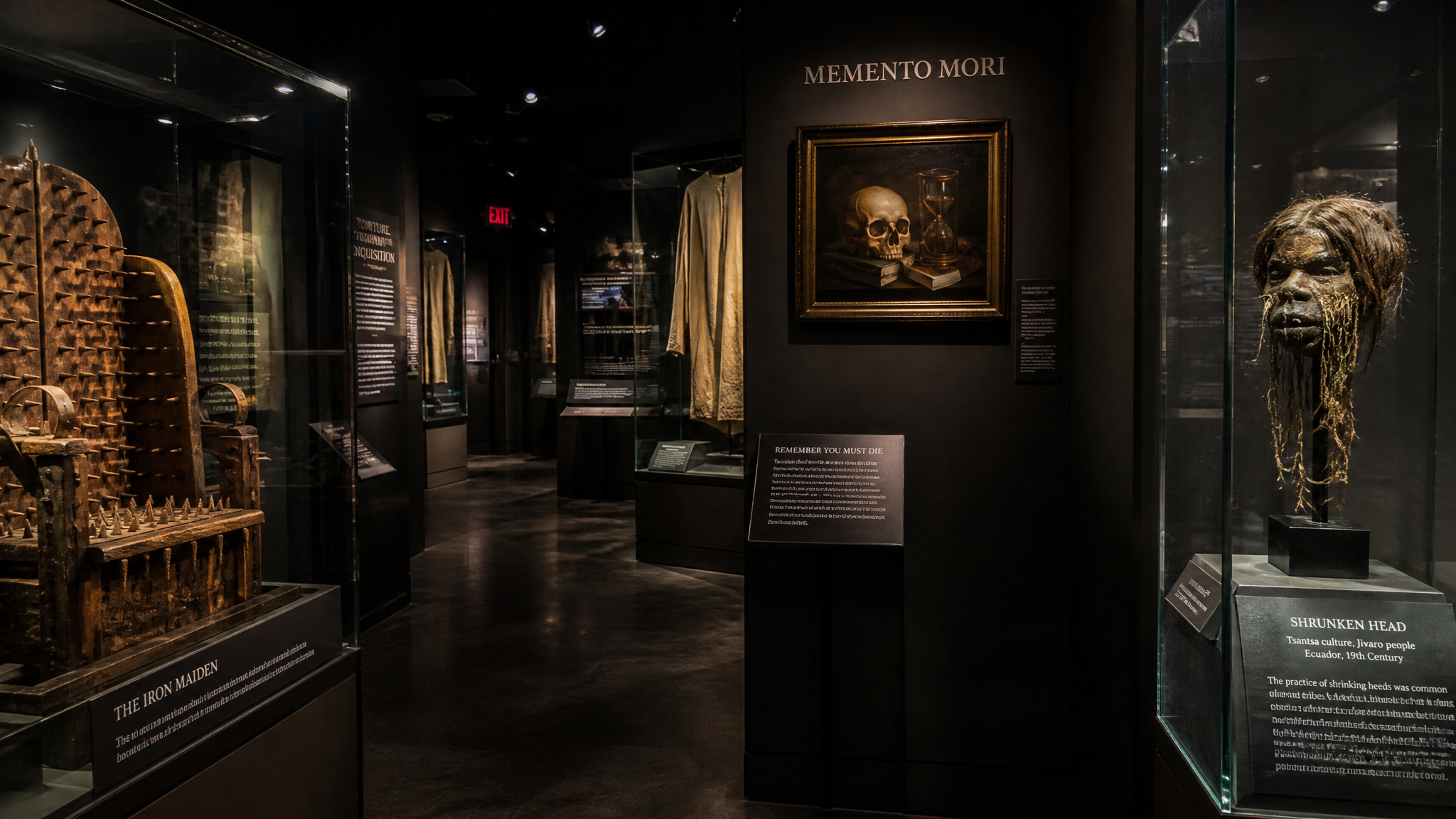
The 16th-18th century private collections of unusual objects are the ancestors of all quirky museums. Viktor Wynd Museum of Curiosities in London has shrunken heads, occult artefacts, tribal art, and two-headed kittens. Ripley’s Believe It or Not! is the commercial descendant, less authentic, but keeping the spirit alive.
Medical Museums
Medicinsk Museion in Copenhagen has a forensic collection: malformed fetuses, straitjackets, electric shock devices, diseased organs.
Torture Museums
Common in Europe, but here’s the caveat: many display items that were seldom or never used historically. I’ve visited torture museums in Belgrade, Bratislava, and the York Dungeon.
War Museums
The War Childhood Museum in Sarajevo is the standout, it collects objects from children who lived through war. The Imperial War Museum North in Manchester has 2,000+ objects. The Museum of Danish Resistance in Copenhagen tells the story of the resistance movement with the urgency it deserves.
Genocide Museums
The heaviest category. The Museum of Crimes Against Humanity and Genocide in Sarajevo is the most harrowing museum I’ve ever visited. The Armenian Genocide Museum in Yerevan is equally unflinching.
Spy and Surveillance Museums
The Stasi Museum in Berlin occupies the former headquarters of East Germany’s secret police, you can see the offices where surveillance was planned. The House of Terror Museum in Budapest includes the cells where the ÁVH tortured prisoners.
True Crime Museums
This is the tricky category. The Jack the Ripper Museum in London has been criticized for prioritizing entertainment over respect. The Museum of Death in LA has crime scene photos, autopsy instruments, and serial killer art.
Witchcraft and Magic Museums
The Museum of Witchcraft and Magic in Boscastle, Cornwall, and the Icelandic Museum of Sorcery and Witchcraft, which includes necropants, curses, and the hlautbolli, are more historical than scary.
Prison Museums
Kilmainham Gaol in Dublin is where the Easter Rising leaders were executed in Stonebreakers’ Yard. The National Prison Museum in Veenhuizen, Netherlands, offers interactive exhibits on torture and punishment in a real former prison; the authenticity is the appeal.
Disaster Museums
Titanic Belfast. The 9/11 Memorial and Museum. The Hiroshima Peace Memorial Museum.
Funeral Museums
The National Museum of Funeral History in Houston covers the business and culture of death. The Vienna Funeral Museum, in a city with a famous “culture of beautiful dying”, includes reusable “economy coffins.” Yes, that’s a real thing.
Catacombs and Ossuaries
Sedlec Ossuary, the Capuchin Crypt in Rome, the Capuchin Catacombs of Palermo, where bodies in Sunday clothes line the walls, including two-year-old Rosalia Lombardo, almost perfectly preserved. Brno Ossuary is the second-largest in Europe, with 50,000+ remains.
Psychiatry Museums
The Museum of the Mind in Haarlem occupies a former psychiatric hospital. The Glore Psychiatric Museum in St. Joseph, Missouri, is the largest of its kind.
War and Genocide Memorial Museums
The Museum of War and Genocide Victims in Mostar. The Museum of Occupation and Freedom Fights in Vilnius, a former KGB prison and interrogation center.
The Ethics of Displaying the Dead: Consent, the Hyrtl Skull Collection, and the Default “No”
Here’s the hardest question in dark tourism, and it’s worth sitting with: is it okay to display human remains?
Let’s start with a specific case. The Mütter Museum in Philadelphia owns the Hyrtl Skull Collection: 139 skulls, many from hanged criminals and the poor, acquired in 1874. They were assembled by Josef Hyrtl for scientific study. The original owners weren’t asked for permission. Most of them were marginalized people, their bodies unclaimed, their remains sold to a collector.
Here’s the unsettling part: the Mütter Museum has hosted parties and weddings with human skulls as backdrops. That’s a real thing that happens. And it raises a genuine question: how is this different from a medieval relic trade? Or a colonial-era grave robbery?
The researcher’s argument, from Julia Granato’s work on the ethics of displaying human remains, presented with Elizabeth Colantoni at the Archaeological Institute of America, is that the default should shift. Instead of “yes, we can display unless someone objects,” it should be no, unless you can prove consent and ethical treatment. Archaeologists, in this view, should treat remains as “a person with inherent rights.”
There’s precedent for this: NAGPRA (Native American Graves Protection and Repatriation Act, 1990) pushed for repatriation of Indigenous remains. The legal principle exists. The question is whether it should extend beyond its current scope.
Medieval ossuaries functioned as memento mori, reminders of death’s proximity. Early Christians in Rome may have wanted remains kept in crypts as part of their religious identity. Medieval Christians believed bodies should be buried intact for resurrection, and the Catholic Church’s relic preservation introduced a public element to bone collections.
These aren’t cases where someone’s remains were stolen. They were sites where the community chose to display their dead as part of their spiritual practice.
At Sedlec, the bones are arranged into ornate decorations, and visitors light candles in remembrance. At the Capuchin Crypt, the message is explicitly spiritual: we were like you; you will become like us. These are not desecrations. They’re acts of devotion that happen to involve human bones.
Here’s where I land: the display of human remains is a commodification of death, but not necessarily an unethical one. Death becomes “thrilling” and “entertaining” in a way that can feel exploitative. But it can also be genuinely moving, educational, and reverential. The difference isn’t always clear.
That’s the point: it’s an open question, and it should stay open. The moment you think you have the answer is the moment you should start questioning whether you’re missing something.
Cost check: The Hyrtl Skull Collection case shows why consent matters — 139 skulls, mostly from the poor and executed, acquired without permission in 1874. The default, researchers argue, should be “no” unless consent and ethical treatment can be proven.
Why We Visit Dark Places: The Psychology of Death Tourism
So why does anyone do this?
Let’s start with the data. The Opodo poll (October 2025, 9,000 respondents across France, Germany, Italy, Portugal, Spain, and the US, plus 2,000 from the UK) found that 30% visit “less classical” museums and 19% deliberately visit dark tourism sites like cemeteries and catacombs. In other words, nearly one in five travelers is actively choosing death-adjacent destinations.
The demographics are revealing. Among 25-34 year-olds, 35% are interested in less classical museums and 24% in dark tourism. Among those 65+, the numbers drop to 17% and 12% respectively. It’s overwhelmingly a younger person’s pursuit, which makes a certain kind of sense.
Maybe it’s about confronting the thing you’re most afraid of (death) from a safe distance. Maybe it’s about being drawn to the transgressive. Maybe it’s just curiosity that hasn’t been sanded down by age.
Nationality matters too. Interest is highest among French travelers (27%), followed by Spaniards (23%), Americans (19%), Brits (18%), and Germans (12%). Spanish and Italian travelers are most likely to visit weird museums (39%), followed by French (38%). British travelers are more cautious, only 21% visit these museums.
And here’s an odd side finding from the same poll: 21% of travelers globally take a moment at take-off and landing for luck. Londoners lead at 44%; Yorkshire and Humber lag at 9%. This isn’t directly about dark tourism, but it points to the same psychological pattern, a population comfortable engaging with mortality, risk, and superstition.
My own motivations are harder to quantify. I’ve been fascinated by this since before it was called dark tourism. There’s an honesty to these places that you don’t find elsewhere. The sites don’t pretend that death doesn’t happen.
They make you look at it. And in doing so, they make you appreciate being alive, sometimes profoundly, sometimes uncomfortably.
Practical Matters: Getting to the Dark Sites
Some logistical notes from my travels:
- Sedlec Ossuary: About an hour by train from Prague.
- Dachau: Train from Munich (about an hour), then bus 726. The bus stop was crowded, allow time. Walking is not recommended.
- Pompeii: About two hours by train from Rome.
- Roskilde Cathedral: 30 minutes from Copenhagen.
- Samarkand: About two hours by train from Tashkent.
- Paris Catacombs: Metro to Denfert-Rochereau, look for the long line.
- Buda Castle Labyrinth: Beneath Buda Castle, where Vlad Tepes (Dracula) was held.
One critical status note: Chernobyl is currently not visitable due to the war between Russia and Ukraine. The same applies to Medina in Saudi Arabia: the tomb of Muhammad is closed to non-Muslims. You can’t visit everything, and some sites you can’t visit at all.
How to Be a Responsible Dark Tourist
Here’s the part where my years of experience become your advantage.
Match your behavior to the site’s gravity. Genocide memorials demand solemnity. Macabre curiosities allow relaxation. At a place like Dachau, you don’t smile for photos.
At Froggyland, you can laugh.
Check the site’s stated intent. Tuol Sleng explicitly asks visitors to be “messengers of peace.” That’s a specific mandate. If a site tells you what it wants from you, meet it there.
Know the difference between meaningful sites and tourist traps. Bran Castle in Romania, the “Dracula” castle, is a perfect example. I visited in 2014 and spent at most an hour before leaving. It’s a tourist trap, a marketing exercise built on a fictional vampire.
I went to Râ?nov instead and hitchhiked back to Bra?ov, which was more memorable than the castle itself. Not every dark site is worth your time or money.
No selfies at atrocity sites. This shouldn’t need saying, but it does. At Sedlec, tourists admitted coming “for the thrill” and tried taking photos despite the prohibition (Kutná Hora banned photography in the ossuary two years before my visit).
No souvenirs at memorials. The objects at Auschwitz aren’t collectibles. The sand on the Killing Fields beach isn’t a keepsake. Leave the dead where they are.
Closing Reflection: Remembrance vs. Exploitation
Here’s what I keep coming back to:
The young boy’s portrait at Tuol Sleng that haunts me. The gravestone I found in Rzeszow, Poland, bearing my own last name, within ten paces of the gate. A father forced to call his son to surrender. A young boy blinded by shrapnel.
An old woman who lost her husband in a bombing. The individual stories from Bosnian museums that statistics can’t capture.
The War Childhood Museum in Sarajevo collects objects from children who lived through war, a toy, a shoe, a drawing, and each object tells a story that no number of casualties can convey. The Lychakiv Cemetery in Lviv is a landscape of 300,000 graves; I spent half a day walking through it.
Here’s the thing I’ve learned: the most impactful dark tourism is often the quiet, individual-focused narrative rather than the mass scale of horror. Number-heavy memorials can numb. A single object or face can create lasting empathy. I carry the image of the child from S-21, the blind boy from Sarajevo, the gravestone in Rzeszow. That’s the point.
If we don’t talk about horrible events, we forget them. The act of remembering, of telling the stories, of standing where the terrible thing happened, is what turns a tourist attraction into a memorial. The question of whether these sites honor the dead or exploit them depends on the site and the visitor. But the act of going, of witnessing, of carrying the stories forward?
That’s on us. And it matters.
Dark tourism isn’t for everyone. It can be overwhelming and unsettling. But it offers a unique opportunity to understand different kinds of history, one visit at a time.
Frequently Asked Questions
What is dark tourism?
Dark tourism, also called thanatourism, is travel to places associated with death, tragedy, or the macabre. It spans a wide spectrum, from genocide memorials like Auschwitz to quirky attractions like Froggyland in Croatia, and it’s a growing trend, with nearly one in five travelers seeking out such sites.
Is dark tourism ethical?
The ethics are an open question. Displaying human remains, like the Hyrtl Skull Collection at the Mütter Museum, raises consent issues, especially when remains were acquired without permission. However, some sites, like medieval ossuaries, were created as acts of devotion, so the ethical line depends on context and intent.
Why do people visit dark tourism sites?
People visit to confront death from a safe distance, to bear witness to history, or out of curiosity. The Opodo poll found that interest is highest among 25-34 year-olds and French travelers, suggesting younger people are more drawn to these experiences as a way to connect with the past.
How should I behave at a dark tourism site?
Match your behavior to the site’s gravity. At genocide memorials like Dachau, maintain solemnity and avoid selfies, while at macabre attractions like Froggyland, it’s fine to relax. Always check the site’s stated intent, such as Tuol Sleng’s request for visitors to be ‘messengers of peace.’
What is the difference between dark tourism and morbid curiosity?
Dark tourism is a deliberate, educational act of witnessing, while morbid curiosity is a more casual, thrill-seeking impulse. The distinction often lies in the visitor’s mindset: a meaningful visit involves reflection and respect, whereas a thrill-seeking visit can veer into exploitation.
Are there dark tourism sites that are not worth visiting?
Yes, some sites are tourist traps, like Bran Castle in Romania, which is a marketing exercise based on a fictional vampire. It’s worth researching a site’s authenticity and historical significance before visiting, as not all dark attractions offer a meaningful experience.