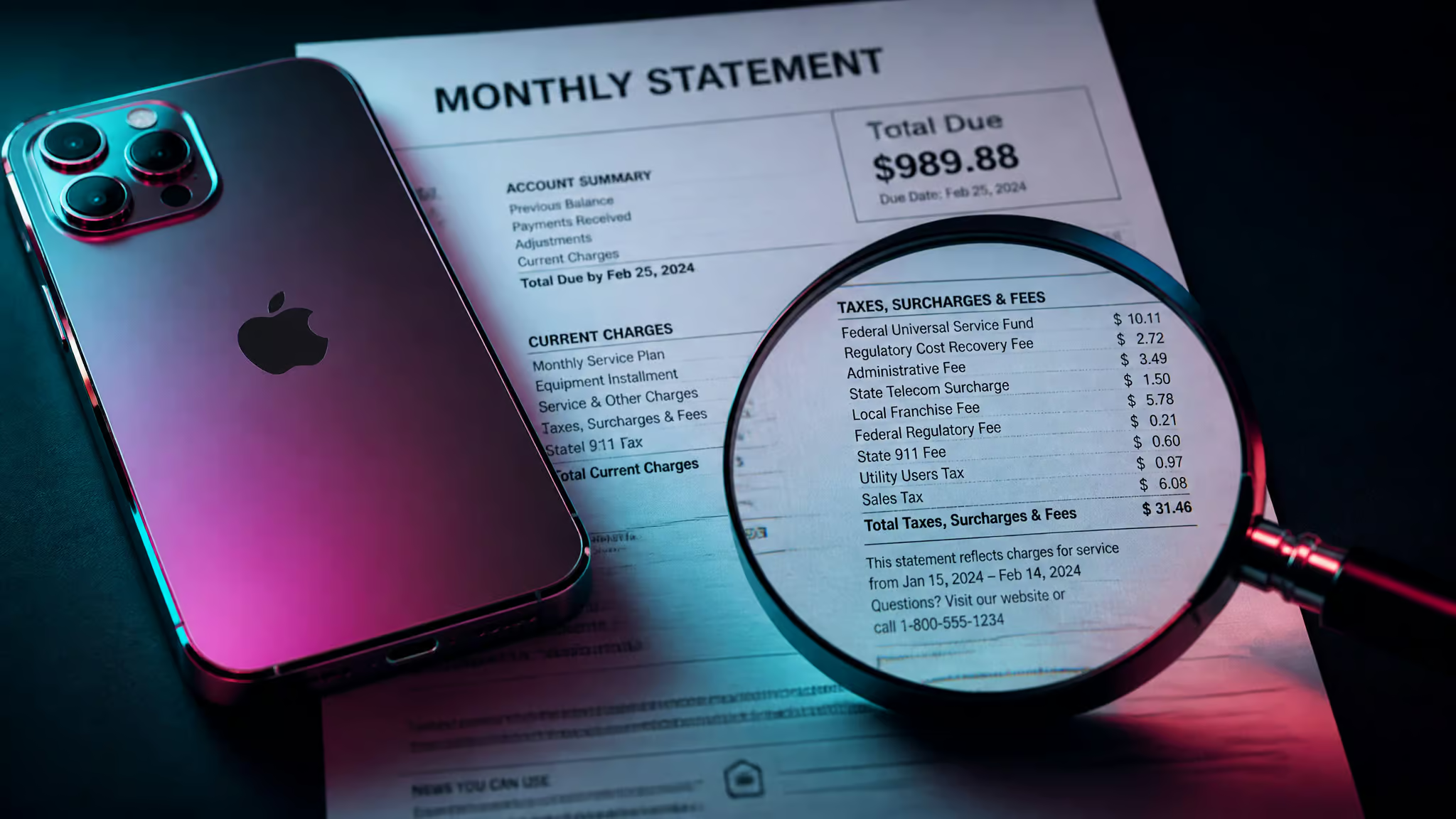
Every “free phone” headline you’ll see this Black Friday season hides the same machine: a phone financed at full price, then clawed back down to zero through 24 to 36 monthly bill credits, gated behind a plan minimum and, usually, a trade-in or a ported-in number. I spent an evening in T-Mobile’s Black Friday deals hub and kept refreshing, because the fine print there forms a system: precise numbers, per-offer eligibility trees, and exactly one piece of delightfully cursed data entry we’ll get to later.
First, the calendar fact, delivered dry: Black Friday 2026 lands on November 27, the day after Thanksgiving (Nov. 26). But the hub itself proves this is a rolling season, not a single date. The 2025 build is archived, a “2025 deals have ended” banner sits next to the current offers and a 2026 preview showing Apple, Samsung, Google, Motorola, and Revvl in the lineup. Current phone, smartwatch, and tablet offers are still listed in the meantime, so the store’s open between seasons; those interim offers aren’t Black Friday pricing.
One honesty flag before the numbers: this piece is sourced from T-Mobile’s own deals hub. Verizon, AT&T, Best Buy, and Amazon 2026 specifics aren’t documented here, and we don’t invent comparisons. That’s not laziness, it’s refusing to fabricate a comparison chart.
Key Takeaways
T-Mobile’s documented deals include the iPhone 17 Pro free (up to $1,100 in credits) with any-condition trade-in, and the Galaxy Z Flip8 under $100 with no trade-in, available to both new and existing customers.
“Free” means 24-36 monthly bill credits on a qualifying plan; cancel or pay off early and the remaining balance comes due, up to $1,299.99 on the Pixel 11 Pro XL 256GB.
Every offer also welds on a plan minimum with AutoPay, anywhere from $45 to $100+ per month. Do the multiplication and a “$1,100 free” phone is a 36-month, $3,600-plus commitment.
Table of Contents
The best phone deals at a glance
Among the options we can source, T-Mobile’s documented 2026-cycle offers lead on headline value. Verizon and AT&T specifics aren’t source-documented, so treat any roundup claiming otherwise with suspicion, including this one.
Here’s the board, each entry with its gating condition attached:
| Deal | Price | Credit value | The gate |
|---|---|---|---|
| iPhone 17 Pro | Free | Up to $1,100 via 24/36 monthly credits | Any-condition trade-in OR no-trade-in port-in, on Experience Beyond ($100+/mo with AutoPay) |
| Pixel 11 Pro XL | Free | Up to $1,300 via up to 36 credits | No trade-in, but a new line required, on Experience Beyond |
| Galaxy Z Flip8 | Under $100 | Save $1,100 | No trade-in, available to new AND existing customers, Experience More or Beyond ($85+/mo) |
| razr+ 2026 | On Us | Up to $1,000, $1,100 via up to 36 credits | New line required, Experience Beyond |
Notice what’s missing from most roundups: that third column. It’s the only one that matters.
iPhone 17 Pro: free with any-condition trade-in, or a port-in
The iPhone 17 Pro goes On Us (up to $1,100, paid out across 24 or 36 monthly bill credits) if you’re bringing an old phone to trade, and the eligibility here is unusual: an eligible phone in any condition counts. That junk-drawer phone with the cracked screen still saves you $500 in this build. The trade-in ladder is published, not estimated: an iPhone 14 Pro saves $1,100, an iPhone 13 saves $830, and even an iPhone 6, a phone from 2014, saves $500.
No old phone? There’s a second path: switch with no trade-in by porting your number in from AT&T, Verizon, or another carrier on the eligible list. Either route lands on the same credit structure and the same plan requirement: Experience Beyond at $100+/month with AutoPay.
Pick your path; the credit mechanics are identical on both.
Galaxy Z Flip8: under $100 with no trade-in, open to everyone
A Galaxy Z Flip8 for under $100. Read that again, then read the terms, because they’re unusually friendly: save $1,100 with no trade-in needed, on either Experience More or Experience Beyond ($85+/mo and up with AutoPay). And here’s the part worth saying out loud: this one welcomes both new and existing customers. Existing customers usually assume the good deals skip them. This one doesn’t.
If you do have a trade-in, it adds on top: a Galaxy S24 saves $1,100, a Galaxy A54 saves $550. Mid-rangers count in this ladder.
The honest counterweight: the Flip8 256GB finances at $1,199.99, and that’s what’s owed if you cancel before the credits finish. Also on the sheet, flagged as a claim: Samsung markets it as the world’s lightest and thinnest flip. Spec nerds deserve the attribution, so there it is, straight from the manufacturer.
Motorola razr+ 2026: On Us for new lines, with a fine-print range
The second foldable in the set, and note the year in the name: the razr+ 2026 is current hardware, not clearance stock. The headline says save up to $1,000; the terms say up to $1,100, both delivered via up to 36 monthly bill credits. The marketing build and the terms build disagree, and we’re not going to declare a winner. Plan around the lower number.
Entry conditions: activate a new line on Experience Beyond, $100+/mo with AutoPay. If you cancel early, $999.99 comes due.
But the hardware is where the geek delight lives, so let’s spend words on it. The razr+ 2026 runs full apps on its 4.0-inch external display, not the trimmed-down widget strip older flip phones made you accept. There’s a Flex View mode for half-open use, and the PANTONE Mountain View colorway is a nice-looking finish. Yes, this feels like a Star Trek prop in the best way.
What “free” actually costs: the bill-credit decoder
Here’s the load-bearing sentence: if you cancel your account or pay the device off early, the bill credits stop, and in the cancellation case the remaining finance balance comes due all at once.

How the credits work
The discount isn’t a rebate check or an instant markdown. It arrives as a drip of 24 to 36 monthly bill credits, which behaves like a subscription you can’t leave cleanly. The credits also have a warm-up period: allow about 2 bill cycles before they start appearing (2 to 3 for Essentials Saver). For the first couple of months you’re paying full freight.
The non-obvious interaction, worth pausing on: paying the phone off early also ends the credits. Wait, paying early costs me money? Yes. The credits only exist as long as you’re financing on the qualifying plan. It’s a mechanism built to reward staying, and once you see it that way, every “On Us” on the board reads differently.
What happens if you leave early
Here’s the balance table, the number that comes due if the account cancels before the credits finish:
| Device | Balance if you bail |
|---|---|
| iPhone 17 Pro 256GB | $1,099.99 |
| Pixel 11 Pro XL 256GB | $1,299.99 |
| Galaxy Z Flip8 256GB | $1,199.99 |
| iPhone 17 512GB | $1,029.99 |
| razr+ 2026 | $999.99 |
| iPhone 16 128GB | $729.99 |
| iPhone 15 128GB | $629.99 |
Day one, before any of that: the free phone still has an invoice. There’s a $35 device connection charge plus tax on the pre-credit price, both due at sale. And there’s a rate limit: max 4 discounted devices per account, 12 for the free-phone offer.
The typical surprise every deal season is the same composite pattern: buyers discover only after a balance like $1,299.99 on the Pixel 11 Pro XL comes due that the discount was monthly credits, not an instant price cut. Reframe it once and it sticks: “free” is a 36-month loyalty contract.
Bottom line: “Free” is a drip of bill credits over 24-36 months; cancel or pay off early and the remaining balance comes due at once.
Do you qualify? Plan thresholds, port-ins, and limits
Qualification comes down to two things: a minimum monthly plan spend with AutoPay, and, for switcher offers, a number ported in from AT&T, Verizon, or another carrier on the eligible list. Each deal has its own threshold welded to it, like system requirements per build:
| Minimum monthly spend (with AutoPay) | Qualifying offers |
|---|---|
| $100+/mo | iPhone 17 Pro, Pixel 11 Pro XL, razr+ 2026 |
| $85+/mo | Galaxy Z Flip8, moto g stylus 2026 |
| $60+/mo | iPhone 17 multi-line, free phones |
| $45+/mo | iPhone 15 |
Plus the assorted flags: lines cancelled within the past 90 days may need reactivation, and limited-time offers may not combine with some other offers. These are requirements, not a plan-quality ranking; the thresholds exist as gates, not as a tier hierarchy.
The math no roundup prints: a “$1,100 free” phone on a $100/mo plan is a $3,600 commitment over 36 months. If you’d spend that on the plan anyway, the phone is a bonus. If you wouldn’t, it’s financing.
Trade-in ladder: what your old phone is actually worth
These are published example tiers, not appraisals of your specific device, but the ladder runs like this: iPhone 14 Pro or Galaxy S24 at $1,100, iPhone 13 at $830 (though $730 under the iPhone 17-specific offer, one of those per-offer variations worth noting), Galaxy A54 at $550, iPhone 6 at $500. The gap between your tier and the headline is the difference between free and hundreds out of pocket, an iPhone 13 at $830 versus $1,100 is $270, a spread that shows up all over current iPhone Black Friday deals. Worked example: an iPhone 13 under the iPhone 17 Pro deal leaves roughly $270 due.
The safe assumption to kill: shoppers tend to assume any old phone hits the top tier, then discover a two-tier gap at checkout, an iPhone 6 saves $500, not $1,100. Check your device’s tier before you plan the whole deal around it.
And the Easter egg, because this voice cannot let it pass: the terms table reportedly credits an “Apple iPhone 1” at $365. Almost certainly a typo, unverified, and funny, the kind of error you’d never catch while scrolling through Apple Black Friday fine print, where prices matter. Point at it with affection, then do not count on it.
Switcher stack: ETF payoff, rebates, and the deadlines that make or break them
T-Mobile markets switching as painless, and the fine print adds the asterisks. The claim: a 15-minute switch, based on median check-out time in the T-Life app, with activation, data transfer, and number transfer taking additional time. There’s a free 5G network trial so you can test coverage where you live, plus a dedicated keep-and-switch page aimed at Verizon and AT&T customers. Here’s the claim, here’s what the fine print adds.
Carrier Freedom: up to $800/line to clear your old carrier’s debt
The tool for getting out of your current contract: up to $800 per line, via virtual prepaid Mastercard, to pay off early termination fees and device balances, covering up to 4 phones. Requirements stack: port your number in from AT&T, Verizon, or another carrier on the eligible list, trade in a device in good condition, and finance a new smartphone. Miss one and the deal doesn’t trigger.
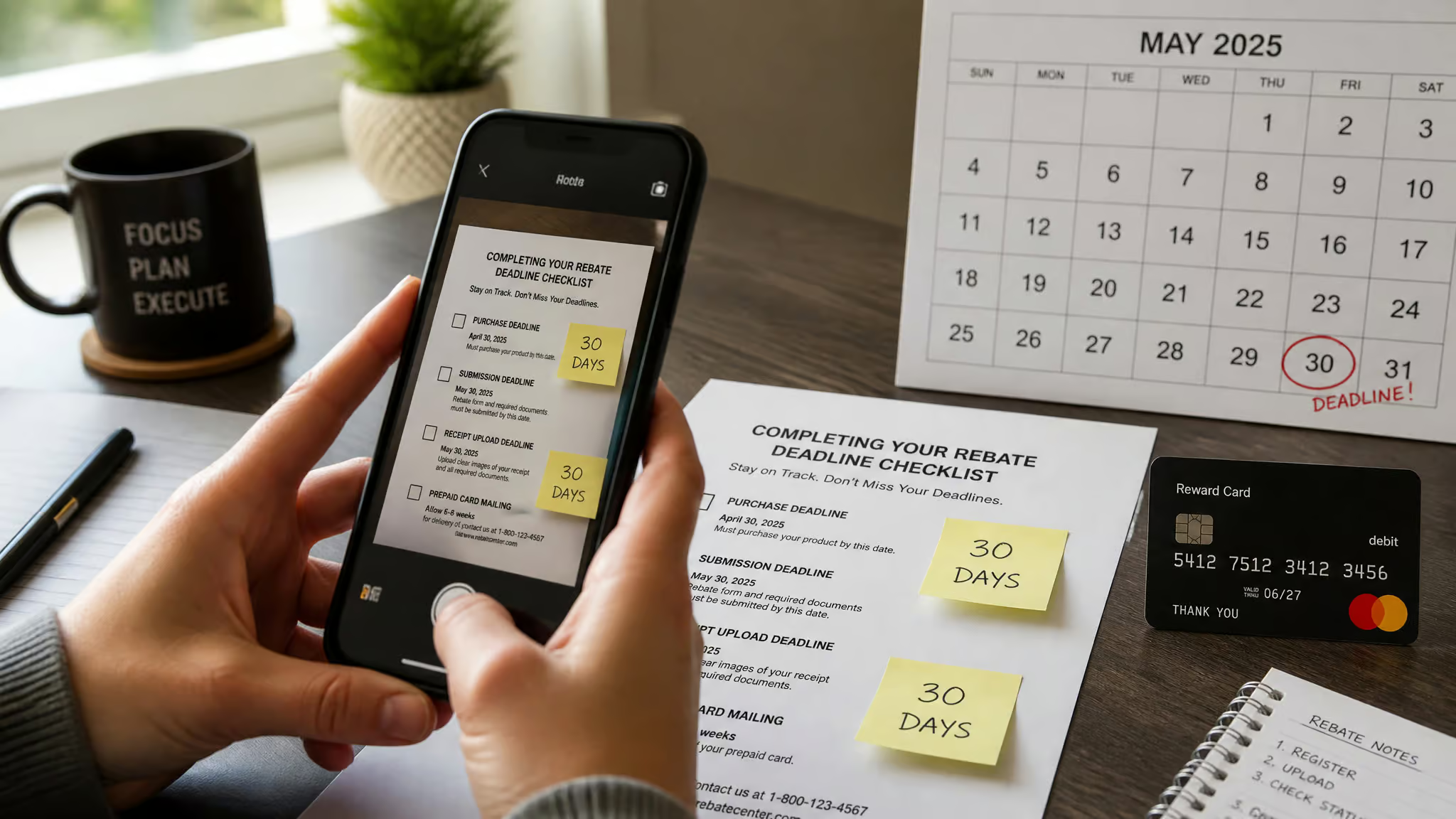
The silent deadline: submit proof of your balance and 90+ days of good standing with your prior carrier within 30 days of porting in. This is the step that quietly voids the whole thing if you miss it. The card typically arrives within 15 days, has no cash access, and expires in 6 months.
The $750 first-year switch value on Experience Beyond
$750 sounds like cash. It decomposes like this: $100 back as a virtual prepaid Mastercard following an eligible port-in, plus $650 in built-in benefits, namely one year of AAA Classic and DashPass. Only the $100 is cash-adjacent. The perks are real if you’d pay for AAA Classic and DashPass anyway, and worth roughly zero if you wouldn’t. Most people would still buy AAA and DashPass on their own; the discount only counts toward the deal math if you’re in that group.
The quest steps, because this is where people fumble: redeem within 30 days of activation at promotions.t-mobile.com no later than 30 days after activation, promo ID260686, limit 4 per account, new accounts only. The card arrives in 6-8 weeks, expires in 6 months, has no cash access, and comes from Pathward N.A. or Sunrise Banks N.A. Rattled off like known gotchas on a gadget.
BYOD: $720 back for keeping your phone
The least disruptive switch, for readers who like their hardware and want a better bill: bring your own device and number to Essentials Saver and get $720 back via $20/month bill credits over 36 months. Walk the math with me: 20 × 36 = 720. There’s the whole system in one clean example.
The version mismatch to know about: plans start at $30/mo, but the terms’ qualifying-service line says $50/mo with AutoPay. Both numbers are on the page; plan around the higher one until it’s resolved. Entry requirements: port-in plus a new line, one discounted line per account, and allow 2-3 bill cycles for credits to start.
The tripwires, specific not ominous: credits stop if you cancel, if you change plans by +$20/line/mo or more, or if you add an EIP. Those are the settings you don’t touch.
Close the switcher section with the deadline checklist: 30-day rebate redemption, 30-day ETF proof, 6-month card expiry. The most common way switcher deals lose value they’d already counted is a missed 30-day window or a card that expired in a drawer.
Red flag: Switcher rebates die quietly — miss the 30-day redemption or ETF-proof window and the value you’d already counted is gone.
Family bundles: the real math for four lines
For a family of four, the best documented play is the iPhone 15 four-pack: four phones On Us plus four lines at $25/line/month, no trade-in needed, on the Essentials promo plan 2.0, requiring a port-in, via up to $630 in bill credits at a $45+/mo threshold with AutoPay. The walked-away balance on the iPhone 15 128GB is $629.99.
If you have trades available, the iPhone 17 four-pack gets you four current phones under $100 each plus four lines at $25/line/month, up to $730 in credits, but it requires an eligible trade-in and rides the Essentials promo plan at a $60+/mo threshold. Balance example: $729.99 on the iPhone 16 128GB. Qualifying plans include most voice plans, Go5G Next/Plus for existing customers, and the Essentials 4 Line offer 2.0.
Keep all three numbers visible together: the credit ceiling, the per-phone price, the per-line rate. They only make sense as a set.
Then the Essentials README, itemized:
- Minimum 4 lines, max 6, at $25/line
- Cancelling lines moves the account to a regular-rate plan; the discount breaks if the party shrinks
- Speeds drop during congestion, with further reduction above 50GB/month
- SD video; tethering capped at 3G speeds. If you hotspot for a living, read that line twice
- $5 more per line without AutoPay
Who this is NOT for: heavy data users. The 50GB deprioritization and 3G tethering caps are the whole trade-off for that plan price.
Budget tier: where “free” is closest to actually free
The cheapest good phones in this set carry the lowest risk, because the exposure math works in your favor here: the worst walked-away balance in this tier is $309.99, versus $1,299.99 on the Pixel 11 Pro XL. Select smartphones go free when you add a line, via up to $300.99 in bill credits (yes, the credit cap ends at 99 cents; the specificity is delightful) on most plans at $60+/mo with AutoPay, capped at 12 discounted devices per account. The free-tier lineup: moto g, Galaxy A17 5G, Revvl 8 Pro, and the new razr+ is also in the On Us pile. Balance example if you walk: $299.99 on the moto edge 2025 256GB, a 2025 model.
moto g stylus 2026 under $10 after trade-in
Yes, under $10. Save $300 via up to $300.99 in credits, and the trade-in requirement is refreshingly loose: any phone in good working condition. This one sits on Experience More at $85+/mo with AutoPay, and the walked-away balance is $309.99. It’s also available on the 55+, Military, and First Responder segment plans, the same segments T-Mobile prices separately, so eligible readers don’t self-exclude.
Here’s the structural insight: low balances mean low early-exit exposure. A $300 financed device is a much smaller failure mode than a $1,300 one, so budget-tier “free” is closer to free than the four-figure flagship deals like the $1,299.99 Pixel 11 Pro XL. These are smart buys, and the price point deserves respect, not sneering.
Are there deals for existing customers?
Yes, but selectively. T-Mobile’s documented offers split into open-to-existing and new/switcher-only. Open: the Galaxy Z Flip8, explicitly available to new and existing customers, and the free-phone add-a-line offer, which works on most plans. Gated: the $100 rebate cards (new accounts only, promo ID260686) and most flagship no-trade-in offers, which require new lines or port-ins.
There’s also a dedicated lane worth knowing about: T-Mobile runs segment-specific unlimited plans for ages 55+, military/veterans, first responders, and college students, with device offers like the moto g stylus 2026’s $300 credit available to those segments. The moto g stylus deal follows into them. The deals follow you into the segment plans too.
Carrier credits vs. unlocked and refurbished
Black Friday can be a good time to buy, but which class of device you’re shopping changes the answer completely. Set expectations per class:
- New iPhones rarely drop more than 10-15% on Black Friday, per the medium-confidence UK-oriented guidance this article flags below. That’s the drop rate; grind accordingly.
- Refurbished units already run 30-50% cheaper year-round per the same UK-oriented guidance, and Back Market advertises verified refurbished savings up to 50%.
- Some resellers have raised prices just before Black Friday to stage fake discounts, the pattern the same UK-oriented guidance warns about. The counter is boring and effective: track prices early. It’s the pricing equivalent of a rigged benchmark.
- Apple typically hands out gift cards rather than discounts, per the same medium-confidence retail guidance. Fine if you’re staying in the ecosystem; know the currency you’re being paid in you’re being paid in.
- Deepest cuts land on previous-gen flagships and mid-range devices, the same pattern the 10-15% new-iPhone figure implies. Last year’s flagship is this year’s smart buy.
- SIM-free generally beats 24-48 month contracts, per UK-sourced guidance with £30 and £60/month figures, a 24-48 month contract is two to four times the 12-month warranty floor below. Keep those numbers scoped; they’re not US carrier data.
- A minimum 12-month warranty is the sensible floor for any new phone, per the same UK-sourced guidance.
One calibration note: those 10-15% and 30-50% figures are general market patterns from medium-confidence, UK-oriented guidance, not verified US-carrier data. Useful for expectations, not gospel.
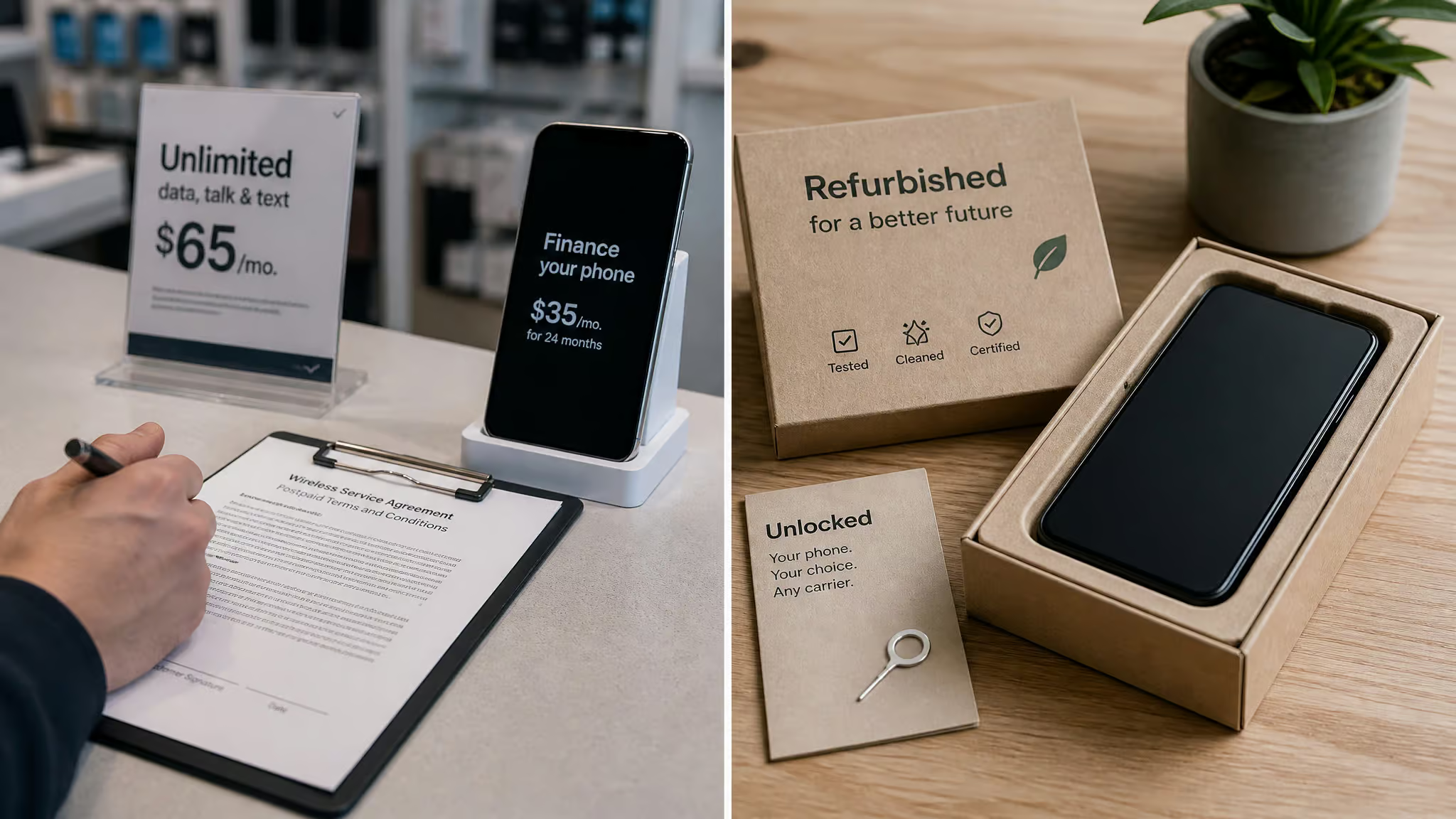
And the contrarian point, kept proportional: the carrier bill-credit deal often beats any retail discount on a new flagship, if you’d hold the required $100/mo plan for 36 months anyway. For everyone else, it’s a 36-month financing contract dressed as a sale, and refurbished is the honest comparison. If you’re shopping unlocked, Black Friday cell phone deals on carrier hardware aren’t your lane anyway.
Hidden costs checklist
These are stated terms, not gotchas. Audit before you buy:
- $35 device connection charge, due at sale. The one fee nobody escapes.
- Tax on the pre-credit price, due at sale. “Free” phones still have an invoice.
- Regulatory Programs & Telco Recovery Fees up to $4.49/line, plus federal and local surcharges. The part of the bill that isn’t the plan.
- $5/line more without AutoPay, and AutoPay requires a bank account or debit card.
- Credits begin after ~2 bill cycles (2-3 for Essentials Saver). Max 4 discounted devices per account, 12 for the free-phone offer.
- Lines cancelled in the past 90 days may need reactivation. Check your line history before you plan the deal.
- Limited-time offers, subject to change, may not combine. Pin the terms when you look, not when you read this.
Questions on terms: 1-800-T-MOBILE (1-800-866-2453).
Timing: when deals start, and whether waiting for November 27 is a mistake
Black Friday 2026 is November 27, and the documented offers are already live, so waiting for the date is often the wrong move. The evidence is the hub itself: a “2025 deals have ended” banner displayed alongside current offers and the 2026 teaser. Deals run online and in stores (store hours vary by location), and per T-Mobile’s own FAQ, discounts exist year-round. No camping required, no FOMO manufactured, and no false calm either: these are limited-time offers that can change. The hub cross-links Cyber Monday deals and a Holiday Gift Guide if you’re planning gifts anyway.
Buy when the terms fit your situation, not when a calendar date arrives.
Adjacent value: Home Internet credits and perks
While you’re in the deals hub, the side quest: T-Mobile’s 5G Home Internet offers $15/month in bill credits (limit 1 per account), with credits stopping if lines get cancelled or plans change, the same pattern, you know it by now. And here’s the delightfully weird implementation detail: free same-day delivery on new Home Internet lines, powered by DoorDash. A router arriving via DoorDash is exactly the kind of odd plumbing decision I enjoy. The fastest-5G-home-internet claim rests on Ookla Speedtest Intelligence data from the second half of 2025, attributed like a good benchmark should be Ookla Speedtest Intelligence data from 2H 2025, attributed like a good benchmark should be.
Then the perk-audit habit: Experience Beyond’s $650/year in built-in benefits (that AAA Classic and DashPass again) only counts toward deal math if you’d pay for them yourself. Most roundups accept the $750/$650 headline at face value. Discount the padded value math; it’s the savings equivalent of a benchmark that includes the cache.
If the timing question follows you past this article, there’s broader retail pattern-watching to do: Lowe’s 2026 Black Friday sale is predicted to start early deals around Halloween, go online Thanksgiving (Nov. 26), and hit stores Black Friday with most locations opening at 6 a.m., with 90-day holiday returns and free shipping on $25+ orders. That’s timing context for the wider shopping trip, not a promise of a schedule.
Verdict. There’s no single winner here, it depends on your situation. If you’ve got an old phone to trade, the iPhone 17 Pro is the pick, because the any-condition trade-in is the unique unlock. Switching with no trade?
The Pixel 11 Pro XL gets you up to $1,300 in credits on a new line. Existing customers should look at the Flip8 or the add-a-line free phones, and a family of four does best with the iPhone 15 four-pack (or the 17 pack if you’ve got trades). Minimalists can bring their own device to Essentials Saver for $720 back. Everyone: run the hidden-costs checklist, then compare against refurbished (30-50% cheaper year-round) or SIM-free before committing to 36 months.
The one-sentence rule: the carrier credit deal is best only if you’d hold the required plan for 36 months anyway.
And the honest close: these offers are limited-time and subject to change, and Verizon, AT&T, and retailer 2026 specifics need fresh research. We don’t fabricate comparisons, and neither should the roundup you read next.
People Also Ask
Is Black Friday a good time to buy a new cell phone?
It can be, but it depends on which class of device you’re shopping. Carrier bill-credit deals often beat any retail discount on a new flagship — but only if you’d hold the required plan (often $100+/month) for the full 36 months anyway. Otherwise it’s a financing contract dressed as a sale, and refurbished phones, which run 30-50% cheaper year-round, are the honest comparison.
What plan do I need to qualify for T-Mobile’s free phone deals?
Each offer has its own minimum monthly spend with AutoPay: $100+/month for the iPhone 17 Pro, Pixel 11 Pro XL, and razr+ 2026; $85+/month for the Galaxy Z Flip8; $60+/month for multi-line iPhone 17 and free-phone offers; and $45+/month for the iPhone 15. Switcher offers also require porting your number in from an eligible carrier. Do the multiplication: a ‘$1,100 free’ phone on a $100/month plan is really a $3,600 commitment over 36 months.