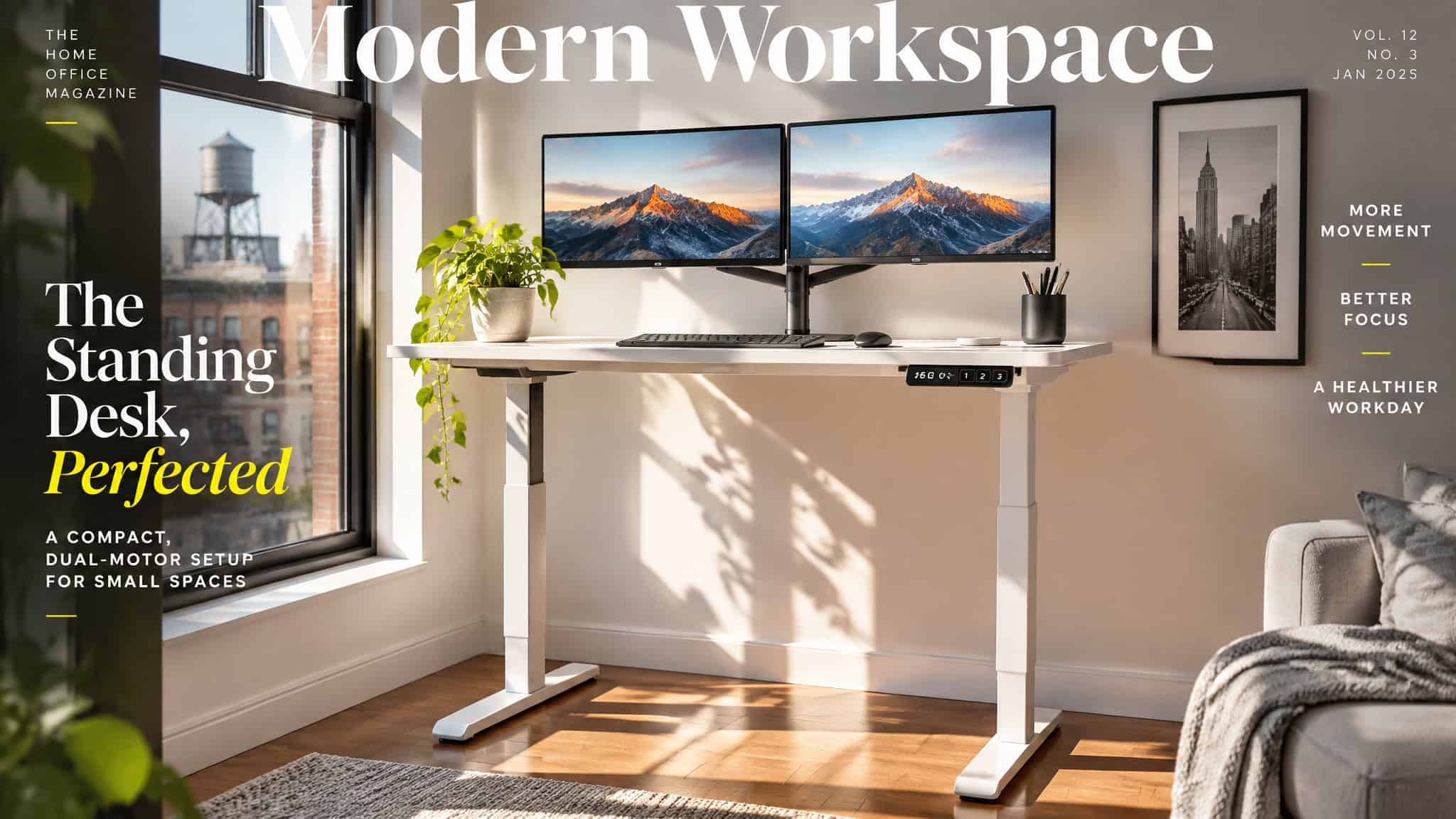
Two compact sit-stand desks can share the exact same 32-inch width on a spec sheet, and one of them will hold a dual-monitor rig rock-steady while the other shakes like a caffeinated Chihuahua the moment you raise it past waist height. If you are squeezing a workspace into a studio, small bedroom, or living-room corner in tight apartment markets like Toronto, New York City, San Francisco, or Seattle, floor footprint is only the first boss fight.
A desk that lives next to your sofa or bed also has to drop low enough for proper seated posture, hide its power bricks so your living room does not look like a server closet, and stay solid at full extension so you do not dread hitting the up button. And once you bolt a heavy steel frame together, returning it means unbolting and reboxing the whole rig. As we noted in earlier GeekExtreme coverage, standing desks are claimed to cut heart disease risk, burn extra calories, reduce back pain, and improve posture, though actually getting those perks requires a frame stable enough to make standing a daily habit.
Key Takeaways
The Desky Dual Mini Sit Stand Desk is the top compact pick after 3 years of daily testing by Seif Buys, offering rare 40×24 in and 32×20 in out-of-the-box tabletops, a ~23.6 in minimum height, and a built-in power channel that drops just one cord to the floor.
Across Switch and Click’s 7-desk test bench, 2026 standing desk value peaks in the $300 to $500 tier with dual-motor frames like the FlexiSpot E7 and Vernal ($460), whereas sub-$150 single-motor models like the $100 Huano/Juanuo wobble at maximum height.
Pairing a small standing desk with the Desky Open Mobile Pedestal Stand saves more usable workspace than an under-desk drawer, and adding a non-rigid perching seat like the Desky Motion Stool roughly doubled standing time during long-term testing.
Table of contents
Table of Contents
Top standing desk picks for small apartments
The best standing desks for small apartments are the Desky Dual Mini Sit Stand Desk, the FlexiSpot E7, the Huano/Juanuo small electric standing desk, the Comhoma small standing desk, The Cutter wall desk, and the QZMD portable desk. Choosing a compact electric or manual standing desk comes down to matching your dimensions / footprint, target budget, and the equipment you’re putting on it: the Desky Dual Mini Sit Stand Desk leads overall after three years of daily multi-monitor testing with rare 32×20 in and 40×24 in tops, while the $300+ FlexiSpot E7 upgrades frame stability, the $100 Huano/Juanuo desk (32×19 in top, 28.3 to 46.5 in height, 176 lb capacity) covers tight budgets, and The Cutter wall desk mounts directly to the wall with storage cubbies and cord management to clear floor clutter completely.
- Desky Dual Mini Sit Stand Desk: 40×24 in or 32×20 in footprint, ~23.6 in minimum height (~25.6 in with casters); best overall for small spaces with rare out-of-the-box compact sizing and customizable tabletop colors.
- FlexiSpot E7: Standard mid-size footprint in the $300 to $500 tier; best value for rooms that can fit a wider frame, delivering dual motors and 220 lb+ class stability.
- Huano/Juanuo small electric standing desk: 32×19 in footprint, 28.3 to 46.5 in height; best under $150 ($100 sticker,though prices and coupon discounts vary across models) for dorms or tight budgets.
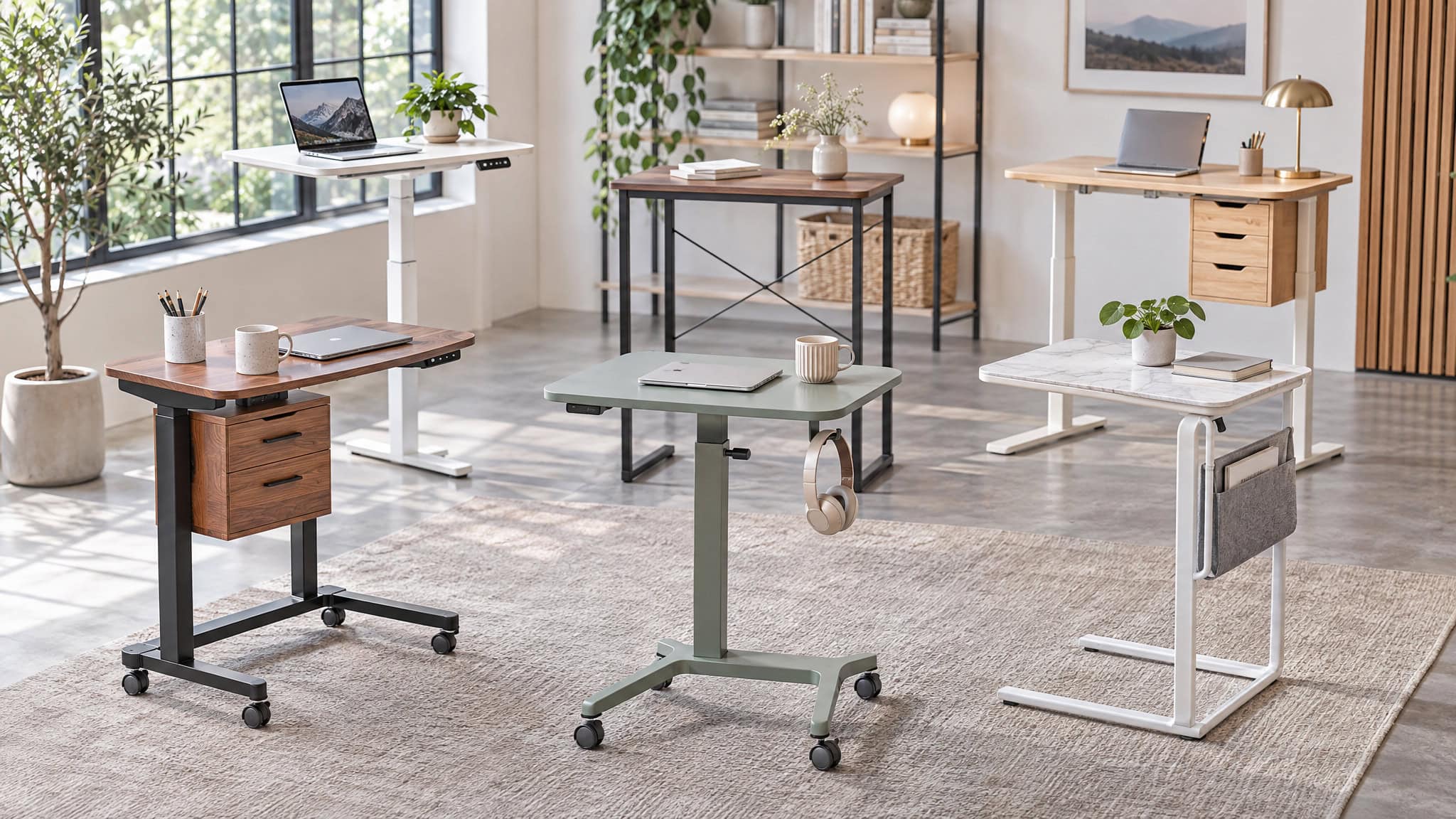
- Comhoma small standing desk: 31.5×15.75 in footprint, 28.14 to 45.86 in height across 4 levels; best for mobility with four heavy-duty lockable wheels.
- The Cutter wall desk: Wall-mounted zero-floor footprint; best for eliminating floor clutter with built-in storage cubbies and cord management.
- QZMD portable desk: Compact rolling footprint, 28 to 35.4 in height at roughly 15 lb; best ultra-light non-electric portable workstation with a three-layer storage shelf.
Desky Dual Mini Sit Stand Desk
After 3 years of daily use on a mostly self-purchased setup (where Desky supplied the upgraded Bluetooth controller, Motion Stool, and some accessories about a year into ownership), the Seif Buys reviewer reports that no other brand sells 40×24 in and 32×20 in tops out of the box. The dual-motor frame holds a heavy multi-monitor rig steady at sitting and standing heights, eliminating the wobble that toppled his previous desk.
FlexiSpot E7
Tested as part of Switch and Click’s 7-desk, 7-company comparison (spanning over $6,000 of owned desks across sponsored and self-purchased units), the FlexiSpot E7 is the $300 to $500 value benchmark. Its thicker steel frame, stronger cross support, and tighter quality control mean the desk stops arguing back when you lean on it.
Huano/Juanuo small electric standing desk
In Switch and Click’s hands-on test, this $100 electric desk was a budget surprise: it packs 4 memory presets, a 176 lb rating, and built-in cable management into a 32×19 in frame. The catch is thinner two-stage legs that wobble at maximum height, making it passable for a light laptop setup in college rather than a refined daily workstation.
Comhoma small standing desk
Built around a reinforced metal frame with triangular bracing and four lockable casters, the Comhoma rolls easily between rooms or over a walking pad. Its shallow 15.75 in depth and built-in pull-out drawer fit single-screen apartment corners rather than heavy dual monitors.
The Cutter wall desk
Featured on our earlier GeekExtreme list, The Cutter mounts straight to the studs and mimics a classic school desk with storage cubbies and integrated cord routing. In a studio apartment, wall-mounted desks like The Cutter and the Podpad (which adds a charging station and a full file cabinet) free up every square inch of floor space and hide hanging wires. Freestanding compact electric desks take up floor space, but they preserve room-to-room mobility and fuller height travel.
QZMD portable desk
Weighing roughly 15 lb, the non-electric QZMD acts more like carry-in gear than heavy furniture and assembles in about 5 minutes. Its three-layer shelf organizes small rooms, though the 35.4 in maximum height can leave taller users short of true standing ergonomics.
Desky Dual Mini: the 3-year small-space pick
Three years of daily sit-stand cycles is an eternity for compact desk motors, and the Desky Dual Mini Sit Stand Desk cleared that bar in Seif Buys’ long-term test without a single scratch on its desktop or a trace of monitor shake. The reviewer’s 40×24 in desk and his wife’s 32×20 in unit upstairs stayed rock-solid from lowest sit to full stand.
Sizes, finish, and single-cable power routing
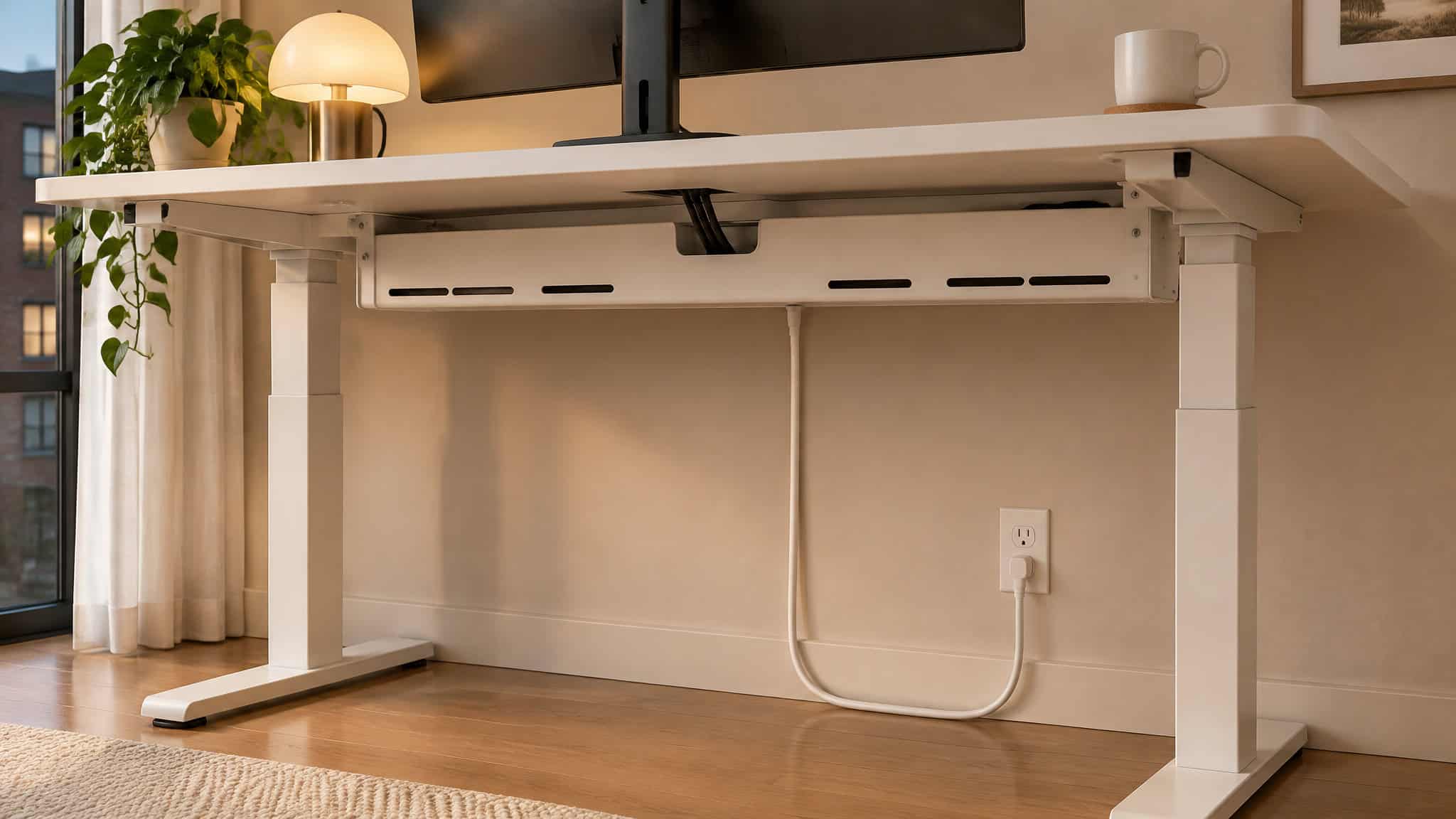
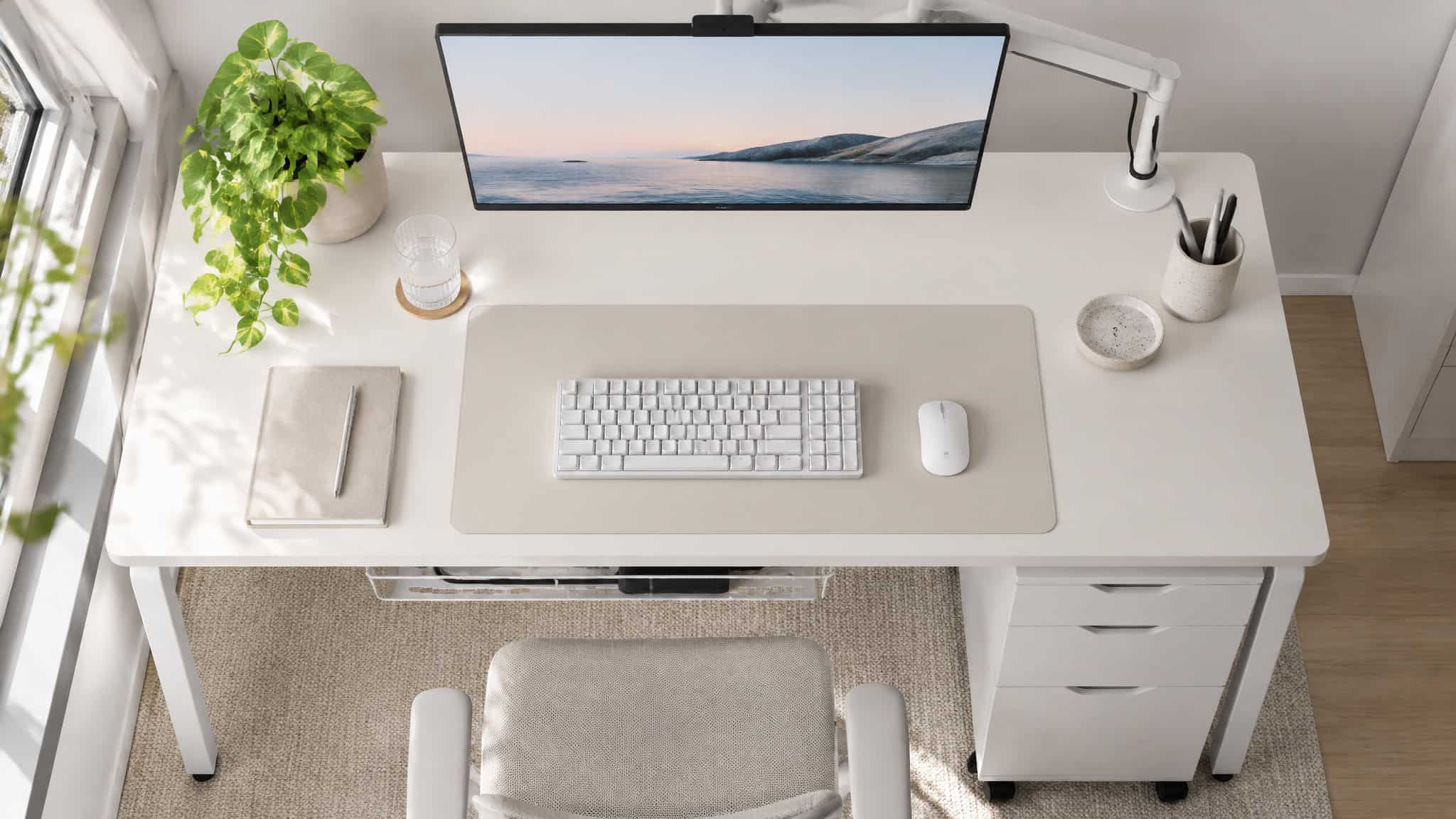
The pure white tabletop blends into apartment walls, making a tight living room look noticeably larger than his old dark wood desk did, and three years of clamping gear left zero marks. Inside the frame, an integrated cable channel with built-in power ports swallows bulky monitor power bricks whole so only a single power cord drops to the floor, a built-in setup the reviewer has not seen on any other standing desk.
Dual-motor speed and the single-motor trap
The dual-motor frame lifts at roughly 1.3 in/s, finishing a full sit-to-stand transition in about 6 seconds. Desky sells a cheaper single-motor version, but you should skip it: the dual-motor rig stays fast even under a heavy multi-monitor load.
The Bluetooth controller and companion app
Called the highest-tech controller on any standing desk by the reviewer, Desky’s module includes an 18-W USB-C fast-charging port, a color-changeable white light, a visible 30-minute timer, and 4 presets stacked in two rows (1/3 and 2/4). Most features, including the child lock, work right on the hardware without touching a phone. Pairing via Bluetooth unlocks Siri voice commands and an app that coheres with the hardware like Apple gear, adding 6 presets, remote height control, a 1-hour reminder, a 60-minute sit goal, and standing trend tracking that works like Whoop step counts or Oura Ring sleep stats.
Long-term test disclosure
The reviewer reached out to Desky about a year before publishing his video after buying most of the setup himself; Desky provided the upgraded Bluetooth controller, the Motion Stool, and several add-on accessories.
Compact electric standing desks for tight corners
To fit a standing desk into a small bedroom alcove or tight corner, first target a tabletop right around 31.5 to 32 inches wide, then prioritize enough front-to-back depth so your keyboard and screen don’t crowd your wrists. Next, match your depth clearance to a frame in that bracket, stepping down from the Desky Dual Mini (32×20 in), Joy Seeker (31.5×19.7 in), or Huano/Juanuo (32×19 in) to the ultra-slim Comhoma (31.5×15.75 in) when floor space is tightest.
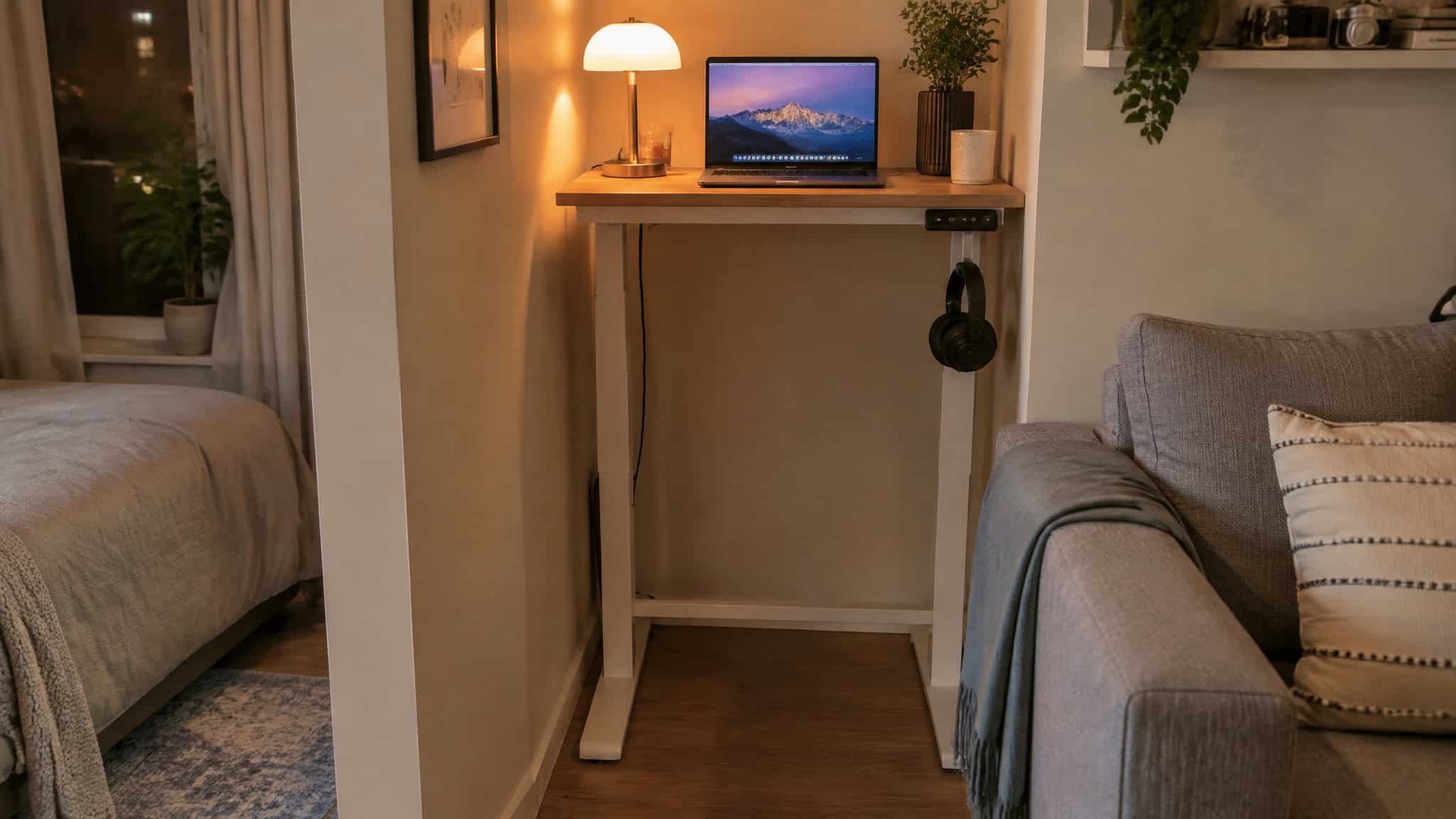
Rolling portable standing desks work well in small apartments when your setup needs to clear out after work or straddle a treadmill, provided the casters lock tightly. Just watch the height math: Desky’s optional casters add 2 to 3 inches to the minimum seated height and are meant for carpet rather than hardwood.
Comhoma and Joy Worker
The Comhoma small standing desk pairs its 31.5×15.75 in top, 28.14 to 45.86 in 4-level height range, pull-out drawer, and triangular-braced metal frame with four heavy-duty locking wheels for bedrooms and walking pads rather than heavy dual monitors. If you want built-in storage with quiet electric lift, the Joy Worker Small Electric Standing Desk runs from 28.3 to 46.5 in at under 50 dB with a 176 lb capacity, 3 presets, a built-in monitor stand, a roller shutter door, a removable drawer, a pad slot, a cable hole, and side hooks.
QZMD portable workstation
Weighing ~15 lb with a 28-35.4 in height range, a waterproof top, a three-layer storage shelf, and a 5-minute build, the non-electric QZMD rolls anywhere in a studio, though that 35.4 in ceiling tops out too low for tall users standing upright.
Joy Seeker glass standing desk
The Joy Seeker pairs a 31.5×19.7 in one-piece dry-erase glass top with a 28.3 to 46.5 in electric frame (~20 mm/s lift speed, 3 presets, integrated charging ports, and lockable casters). It looks slick, but the tempered glass top means you cannot attach clamping monitor arms.
Wall-mounted and luggage-style niche picks
Ditching floor legs altogether is the nuclear option for a tiny room, freeing up 100% of your floor footprint or letting your workstation pack away like carry-on gear. Back in our late-2018 GeekExtreme roundup, we highlighted two unconventional designs alongside The Cutter that show how far ultra-compact engineering can go, though you will want to check current stock given their vintage.
Podpad wall-mounted desk
Designed for minimalist rooms and compact laptops, the Podpad bolts directly to the wall and packs a built-in charging station plus a full file cabinet underneath. Its height adjusts on the wall mount so you can keep your wrists neutral without losing floor space to steel legs.
Nubo portable desk
Modeled after a vintage hard-sided suitcase, the ultra-portable Nubo mounts to the wall and folds open into a standing workstation, using an internal retaining bar to hold files in place while blending cleanly into living-room decor when shut.
Cheap standing desks under $150: the wobble tradeoff
Cheap standing desks under $150 are worth buying only if you run a laptop and a lightweight monitor on a strict budget, because thin legs and light frames start wobbling the moment you clamp on heavy monitor arms, mount dual screens, or lean in at full standing extension. And that mechanical shake triggers a quiet behavioral trap: when a desk micro-wobbles at maximum height (or when center-mounted legs like the FlexiSpot E7’s tip slightly under a tall user leaning forward, or a heavy multi-monitor rig overloads an entry frame), the brain registers the instability as friction, you stop pressing the stand button, and your sit-stand desk quietly turns back into a regular sitting desk.
What the sub-$150 tier compromises
Entry-level models under $150, including the Huano/Juanuo, FlexiSpot E2, Mainstays electric desk, and Fezibo Ergo, rely on a single motor, two-stage telescopic legs, lower lift capacities, and thinner desktops. They run much better than budget frames did five years ago and often throw in memory presets, so they handle basic laptop duty just fine.
The $100 Huano/Juanuo verdict
Tested hands-on by Switch and Click, the $100 Huano/Juanuo small electric standing desk checks impressive spec-sheet boxes: a 32×19 in top with rounded safety corners that save your hips in tight walkways, 28.3 to 46.5 in height, 4 presets, a 176 lb rating, a motor tested for 50,000 lift cycles, universal M8 threaded foot holes for casters, and built-in cable management. Still, those thinner legs wobble at the top of the stroke, keeping it in dorm-room starter territory.
Where value peaks: the $300-$500 tier
Across a standing desk market spanning roughly $150 to $1,500, real hardware value peaks between $300 and $500 in 2026. Sub-$150 budgets force single-motor compromises. Passing $1,000 pays for custom layouts, four-leg monster frames, or boutique hardwoods, though as the Jarvis desk’s jump from ~$500 to $1,000+ after Herman Miller acquired it proves, higher sticker prices do not always buy upgraded hardware.
The Switch and Click tier framework
After testing 7 desks across 7 brands, Switch and Click’s benchmark is simple: crossing the $300 mark buys dual motors, thicker steel columns, stiffer crossbeams, and tighter factory tolerances.
FlexiSpot E5
Stepping up to the FlexiSpot E5 (alongside rivals like the FlexiSpot Comhar and Vivo Desk Kit 1B) brings dual motors, a 220 lb capacity, and smoother transitions, though you will still see slight micro-movement at full height or under dual monitors on heavy arms.
FlexiSpot E7
The FlexiSpot E7 (competing with the Vari essential and Branch Duo) is widely regarded as one of the strongest values on the market, pairing higher capacity with a heavier frame that stays planted when you lean into your work.
FlexiSpot E7 Plus
If you hate high-altitude sway, the four-leg FlexiSpot E7 Plus stays rock-stable at tall heights without tipping. The frame legs cost $500, roughly half the price of Desk House four-leg frames, and include a 4×2 ft top, though its optional “solid wood” surface is actually glued-strip butcher-block rubber wood (softer with a plain grain, making the label misleading even if the package is strong value).
Vernal laminate pick
Acquired via sponsorship by Switch and Click, the $460 Vernal desk (48×30 in, with a 55 in option) nails the daily usability details: bruised-hip-saving rounded edges, an attached cable tray with hooks, a controller shielded against accidental knee bumps, and a sturdy, lightweight laminate top that looks good without solid-wood pricing.
Desky Dual Mini vs FlexiSpot E7 for a small apartment
For a small apartment, the Desky Dual Mini wins when floor footprint is your tightest constraint, while the FlexiSpot E7 is the better pick when you have the wall clearance for a heavier-duty frame. Both desks use dual-motor electric frames engineered to hold steady at full standing height, and the Desky Dual Mini has held up through three years of daily multi-monitor use with ultra-compact 32×20 in and 40×24 in footprints and a ~23.6 in minimum height. By contrast, the FlexiSpot E7 is the $300+ value benchmark built around a thicker, higher-capacity 220 lb+ frame that noticeably upgrades stability over the E5 tier, though its center-mounted legs make the desktop easier to tip when tall users lean on it.
Geometry and cable routing separate them in daily apartment life. Desky hides monitor power bricks inside an integrated under-desk power channel so a single cord drops to the baseboard, keeping a living-room setup visually clean. FlexiSpot’s E7 lineup uses center-mounted leg columns, which opens up side access for routing cables and clamping gear, but shifts the center of gravity so the desktop is easier to tip when leaned on at standing height, a quirk tall users feel most (Switch and Click’s 5’2″ reviewer never triggered it).
What $1,000+ buys
Between the FlexiSpot E7 and the Uplift V3, the latter is the heavier-duty, higher-capacity frame, rated for 355 lb with a massive size catalog and modular accessory ecosystem in the $500+ refinement tier, whereas the E7 is the ~220 lb+ class value champion and the four-leg E7 Plus ($500 legs) is FlexiSpot’s dedicated anti-tipping answer for tall users. Diminishing returns hit hard past $500. In daily work, the jump from $200 to $350 is obvious, while jumping from $350 to $750 feels much smaller.
Uplift V3 and the refinement tier
In the $500+ bracket alongside the Uplift V3 sit specialized rigs like the Vari 60×30 desk and the Secretlab Magnus Pro, which builds a full-length cable tray into the rear hinge and uses magnetic accessory mounting across the desktop.
The three $1,000+ branches
Above $1,000, standing desks turn into decade-long or heirloom investments that split into three distinct philosophies: four-leg stability monsters like the Uplift four-leg standing desk, multi-zone corner workstations like the Uplift L-shaped standing desk that expand horizontal surface area, and high-craftsmanship hardwood builds like the Herman Miller Renew and Oki Wood Standing Desk Pro.
The Desk House Apex Pro cautionary tale
Spending four figures does not guarantee bulletproof hardware. Switch and Click’s four-leg Desk House Apex Pro (30×72 in, over $3,000) stays rigid at tall heights, but after long-term use its motors require repeated button cycles to reach upper presets, Desk House charged $50 for a replacement controller, the sharp corners leave bruises, and the walnut top scratches so easily that dropping a CPU with thermal paste during a week-one PC build left a permanent blotch.
Standing desk anti-recommendations
Three classic buyer traps show up once you look past glossy studio photos: post-acquisition price hikes, soft bamboo desktops that show every scuff, and glued butcher-block strips marketed as premium hardwood. Across all of these setups, remember one geometric rule when sizing up from an ultra-mini desk: front-to-back depth matters much more than width once you mount monitor arms, speakers, and a mechanical keyboard.
Jarvis standing desk
The Jarvis standing desk is no longer worth buying in 2026. Jake’s 48×24 in unit ran for roughly 6 years without a single motor hiccup, but Herman Miller’s acquisition pushed prices from ~$500 to $1,000+ with zero hardware upgrades. Worse, the top is laminate rather than solid wood, and the 24 in depth feels cramped once you add a monitor and speakers.
FlexiSpot bamboo standing desk
Acquired in 2023 for ~$490 in exchange for a short video, the FlexiSpot bamboo standing desk is lighter and easier to move around an apartment than laminate, with gently curved edges and a tropical grain. Unfortunately, soft bamboo scratches easily and shows wear fast, making laminate or rubberwood the smarter buy.
Butcher block sold as solid wood
Unlike Desk House’s true walnut slab, FlexiSpot’s E7 Plus “solid wood” upgrade is actually glued-strip rubber-wood butcher block. It holds up well for the price, but the naming is pure marketing fluff.
A real small-apartment setup: couch to desk
An unsponsored 33-year-old NYC vlogger living alone with two cats swapped her living-room sofa setup for a 40-inch budget FlexiSpot electric desk after couch work proved a fast track to lower-back misery.
The couch-to-desk transition
Ordered through WFIR, she picked the cheapest FlexiSpot model with programmable sit-stand memory presets; it arrived in an unbranded box and was a pain to assemble, though the steel frame quality impressed her.
The 27-inch monitor compromise
Because her refurbished iMac (owned for about 2 years) cannot act as a simple plug-and-play external display for a laptop, she paired the 40-inch desktop with a 27-inch LG UltraGear monitor.
Fit, ergonomics, and buying practicalities
Dialing in a compact standing desk starts with setting the seated height so your forearms rest roughly parallel to the surface at a 90 to 100 degree elbow angle, picking a white top if you want a cramped room to read visually larger, and routing power through a single floor drop so nothing snags mid-lift.
Match minimum height to your stature (and watch the caster penalty)
At 5’8″, the Seif Buys reviewer fits the Desky Dual Mini’s ~23.6 in bare minimum height comfortably. Bolting on Desky’s optional casters adds 2 to 3 inches (pushing minimum height to ~25.6 in), which penalizes shorter users and is only recommended on carpet; stick to felt pads on hardwood floors. And if you order the Desky, always pick the dual-motor frame over the sluggish single-motor option.
Chair pairing by desk shape
Tabletop geometry dictates what fits underneath: round desks leave room for wider seats and tall backrests, while angular compact frames demand trim, compact chairs. Per thehomedweller.com, most standard office chairs lack the height and arm adjustability standing desks require, pushing buyers toward premium or custom ergonomic seating.
The reboxing return trap
Measure your doorways, baseboards, and corner clearances twice before touching a hex key. Once a standing desk is assembled, returning it requires completely disassembling the frame and repacking heavy steel columns into the original cardboard puzzle.
Small-desk accessories and cable management
The best storage solution for a small standing desk is the Desky Open Mobile Pedestal Stand paired with a clean desktop, while buyers who want storage built directly into the desk frame should look at the Joy Worker Small Electric Standing Desk, the wall-mounted Podpad, or The Cutter. Compact workspaces need accessible storage that clears clutter off a 32- or 40-inch surface without cramping your knees, and the Seif Buys reviewer rated the rolling Desky Open Mobile Pedestal Stand (with hidden wheels, side access, a magnetic accessory mount, and a matching wood finish) a 10/10 safe buy because it frees up far more usable workspace than a shallow under-desk drawer, whereas the Joy Worker integrates a roller shutter door and removable drawer on top and the wall-mounted Podpad and The Cutter build in a full file cabinet and school-desk cubbies.
Desky Motion Stool
For accessories that actually change how much you stand, start with integrated power-channel cable management, an active perching stool like the Desky Motion Stool, an open mobile pedestal stand, and a fatigue-reducing floor mat, then add space-savers like a side-and-front-securing laptop stand, a two-in-one cup and headphone holder, and a side desk mount, though the reviewer recommends skipping pricey brand add-ons and buying comparable items cheaper on Amazon. In hands-on testing, the Desky floor mat fits neatly between the desk’s two feet to ease leg fatigue (skip it on uneven floors or under a chair), the laptop stand prevents the cable-tug drops that scuffed his MacBook on a prior stand, and the latching two-in-one cup holder holds a 23-oz Lark bottle while storing AirPods Max. The reviewer served as a worst-case tester: chronic lower back pain once left him unable to sit in a chair for 1 to 2 weeks after a strain, and he notes that standing decompresses the spine far better than sitting.
The Desky Motion Stool uses a non-rigid pivoting frame that lets your spine micro-move while perching, and it roughly doubled his daily standing time. Finished in a rare white light gray that tucks neatly out of sight, it feels wobbly if you sit on it at the desk’s lowest preset, but works in a pinch.
Tested Desky add-ons vs generic Amazon gear
Desky’s under-spring drawer, side desk mount (for books, papers, and pens), and two-in-one edge-latching cup holder (which holds a 23-oz Lark water bottle on top and hangs AirPods Max underneath) all lock cleanly onto the frame. His Desky laptop stand grips the computer from both the sides and the front, fixing a painful flaw from an older stand that lost a cable-tug battle and scuffed his MacBook (pro tip: silver MacBooks hide aluminum scuffs way better than space black).
The Desky floor mat fits right between the desk’s two feet, stores behind the couch when off duty, and earned keeper status for cutting foot and leg fatigue, provided you keep it off uneven floors and never roll desk chair wheels onto it. If you want to save cash on basic mounts or trays, skip first-party brand markups and grab generic equivalents on Amazon.
Seating rotation beyond the office chair
Perching on a rocking kneeling chair preserves spinal mobility and feels miles more comfortable than a rigid, static kneeling chair, though you still cannot sit in one non-stop all day. If your legs and glutes are not conditioned for long standing sessions yet, put your budget into a proper ergonomic office chair first before adding standing stools or kneeling chairs.
Flow Desk vs Lowdesk Pro
For apartments where a floor cushion replaces an office chair, Thoughtworthy Co’s multi-year head-to-head test of the two main floor-to-standing desks comes down to a clear split: buy the Flow Desk ($1,049 from marinamantra) if you want the quietest motor, the lowest floor-sitting height, and a refined all-in-one cable setup, or buy the Lowdesk Pro ($1,300 laminate, $1,400 bamboo, or $1,900 wood, formerly Uppeal) if you want ~35% faster lifts, rock-solid low-height stability, unobstructed legroom, and a legs-only option for custom tabletops. Both frames cover nearly identical total vertical travel (reported as 80 cm and 82 cm between the two models, without the source pinning down which figure belongs to which desk), making the Flow Desk’s 5 cm lower minimum height the number that matters on the floor.
Flow Desk
The $1,049 Flow Desk pairs a wooden top, gray felt cable covers, and a built-in rear power tray (a snug squeeze for chunky power bricks) with an X-frame leg design that drops 5 cm lower than the Lowdesk Pro. That extra drop makes it borderline usable directly from the floor without a seat, though the testers usually sit on an elevated floor cushion. It runs practically silent at the bottom of its stroke and stays smoother across the full floor-to-standing transition, but lifts ~35% slower, cuts into crossed-leg room with its X-frame, lacks leveling feet for uneven floors, comes in only one size and two colors (no legs-only kit), and does not ship internationally from marinamantra.
Lowdesk Pro
Built with an industrial heavy-machinery aesthetic and straight vertical columns that leave your legs plenty of room underneath, the Lowdesk Pro lifts ~35% faster and feels slightly more stable overall, locking in rock-solid at floor-sitting heights. You can also buy the frame legs solo to bolt onto your own custom top. The trade-offs are noticeable motor hum in quiet rooms, a cable tray sold separately, and steep international shipping fees for the legs (it reportedly stopped shipping tabletops outside the US, while both brands ship free domestically).
Which floor desk fits your room
Pick the Flow Desk for quiet, plug-and-play floor ergonomics inside the US, or the Lowdesk Pro if you want custom miniature tabletop dimensions and maximum cross-legged clearance.
Which standing desk should you buy
Grab the Desky Dual Mini Sit Stand Desk if your apartment demands a true 32×20 in or 40×24 in compact footprint, a laminate Vernal or FlexiSpot E7 for the best $300 to $500 dual-motor value, or the four-leg FlexiSpot E7 Plus if you have space for a zero-tip powerhouse (bolting a separate solid-wood slab onto E7 Plus legs is the smartest shortcut to a custom luxury build). Always hunt for coupon codes before checking out since competing mid-tier frames perform very similarly, and clear an afternoon for pre-drilled hex-key assembly no matter what you spend.
Frequently Asked Questions
What is the best standing desk for small apartments?
The Desky Dual Mini Sit Stand Desk is the strongest compact option, shipping in rare 32×20 in and 40×24 in sizes with a ~23.6 in lowest sitting height and an internal power channel that sends just one cable to your outlet. If your room can handle a standard mid-size width, the FlexiSpot E7 is the top $300 to $500 value pick, while the $100 Huano/Juanuo (32×19 in) covers ultra-tight dorm budgets. For specialized apartments, the Comhoma rolls on four locking wheels, the ~15 lb non-electric QZMD sets up in about 5 minutes, and The Cutter mounts straight to wall studs to take up zero floor space.
How does the Desky Dual Mini vs FlexiSpot E7 compare for a small apartment desk?
Your choice comes down to tight wall clearance versus raw mid-tier capacity. Both use dual motors that hold steady at full extension, but the Desky Dual Mini is purpose-built for cramped rooms with 32×20 in and 40×24 in tops, a ~23.6 in minimum height, and a hidden power channel that swallows bulky monitor bricks. The FlexiSpot E7 offers 220 lb+ class stability in the $300 to $500 bracket on a wider standard frame, though its center-mounted legs make the surface slightly easier to tip when a tall user leans forward at standing height.
Are cheap standing desks under $150 worth it for small spaces?
They are only worth buying if you are on a strict budget with nothing heavier than a laptop and a lightweight screen. Sub-$150 models like the $100 Huano/Juanuo, FlexiSpot E2, Mainstays electric desk, and Fezibo Ergo cut corners with single motors, thinner desktops, and two-stage legs that start shaking at maximum height or under dual monitors on clamped arms. That upper-height wobble creates subtle mental friction that makes you stop hitting the up button, effectively turning your electric frame back into a standard sitting desk.
what is the best standing desk with storage for a small space
Skip cramped under-desk drawers and pair a clean compact desk with the rolling Desky Open Mobile Pedestal Stand, which uses hidden casters, side compartments, and a magnetic accessory mount to save far more usable surface area. If you want storage built directly into the desk itself, the electric Joy Worker packs a monitor stand, removable drawer, and roller shutter door onto the desktop. You can also bolt The Cutter or the Podpad directly to the wall to get school-desk cubbies or a full hanging file cabinet without losing an inch of floor space.
is a wall mounted standing desk better than a floor standing desk in a studio apartment
Wall-mounted rigs like The Cutter, the Podpad, and the suitcase-style Nubo are better only if reclaiming 100% of your floor space and hiding dangling wires is your top priority. The trade-off is permanence and restricted travel compared to a freestanding electric frame. Compact floor desks take up a 31.5- to 40-inch footprint, but they give you full sit-to-stand motor travel and can roll out of the way or over a walking pad when fitted with locking casters.
When does a compact standing desk stop working for you due to stability and wobble problems?
A small standing desk fails the moment mechanical shake convinces you to leave it parked at sitting height. That breakdown happens when you overload an entry-level single-motor frame with heavy dual monitors on clamped arms, push thin two-stage legs to maximum extension, or lean forward as a tall user on center-mounted columns like the FlexiSpot E7’s. Even a tiny micro-wobble registers in your brain as physical friction, killing your daily standing habit unless you step up to a stiff dual-motor or four-leg frame.