Democrats won control of both the House and the Senate in the 2026 midterms, confirming pre-election CBS News polling that gave them a slight House edge and locking in two years of gridlock for President Trump. US stock index futures dropped sharply on election night before stabilizing. A Democratic Congress won’t pass a blanket AI ban.
Investors face federal scrutiny, local data-center fights, and regulatory stalemate instead, driven by CBS polling showing 64% of voters think AI cuts jobs and 54% would back a candidate who opposes building data centers, alongside an Anthropic report over the past year showing it blocked unnamed working scientists from using Claude to potentially develop biological weapons and stopped malicious surveillance uses.
Key Takeaways
A Democratic Congress can’t pass an outright AI ban because zero federal laws currently rein in advanced AI models like Claude, leaving oversight hearings, document demands, and local data-center permitting friction as the active governing tools.
Voters are targeting physical infrastructure rather than code, with 54% in CBS News polling willing to back a congressional candidate who opposes building data centers due to electric bills, noise, water, and land disputes.
Root Bridge Capital analyst Alpesh Patel argues the AI boom isn’t on borrowed time under Democrats because top companies trade at modest forward profit multiples like Micron at roughly 4x and Nvidia at 13x, making sentiment and momentum the real market drivers.
Table of Contents
Would Democrats ban AI? The direct answer
No Democrat-led Congress is positioned to ban AI outright because zero federal laws currently rein in advanced AI, leaving lawmakers without any existing legal machinery to attach a prohibition to amid a broader congressional stalemate. When we inspect the legislative architecture the way we read a hardware spec sheet here at GeekExtreme, headlines collapse three completely different proposals into a single word. Banning AI outright isn’t on the table. Banning development above a capability threshold traces back to a fringe proposal for an artificial superintelligence ban pushed by Senator Bernie Sanders and a progressive House counterpart rather than the party platform. Restricting physical data centers is the live fight with real voter traction.
For AI companies and investors, the regulatory path that actually fits a divided government is heightened congressional scrutiny, which trades the shock of sweeping new statutes for the slow friction of document requests. Root Bridge Capital analyst Alpesh Patel noted in a post-election Reuters Market Talk interview that AI profitability probably won’t take a hit from this shift. The recent Anthropic bioweapon-misuse report already sparked Capitol Hill questions about reining in the sector. Missouri Republican Senator Josh Hawley called the episode reckless and demanded that Sam Altman produce related documents, and while Congress has stopped short of demanding public testimony so far, hearings could follow depending on how much cooperation Congress gets.
The AI bill spectrum and the bipartisan stalemate
Democrats and Republicans are stuck in a regulatory stalemate because both parties agree Congress needs to act on AI while sharing zero consensus on what that statute should actually do. According to CBS News reporting, no federal laws currently govern advanced AI systems like Anthropic’s Claude. Lawmakers across both parties have dropped a sprawling pile of separate bills into the hopper. Those proposals run from basic transparency rules to a statutory kill switch designed to suspend or shut down an AI system if it goes rogue, all the way out to the Sanders artificial superintelligence ban.
Even within safety debates, lawmakers have to separate human misuse from the distinct, unaddressed risk of an AI independently making bioweapons, a scenario the Anthropic report didn’t cover. Because none of those legislative extremes can clear both chambers and the White House, active governance defaults to bipartisan oversight. As Axios reported, Hawley and Connecticut Democratic Senator Richard Blumenthal teamed up to send bipartisan letters demanding documents from Altman over the Hugging Face hack, proving that subpoenas and paper trails move even when bill text is deadlocked.
What a Democratic Congress would actually do to AI
A Democratic Congress will hit AI companies with oversight hearings, document subpoenas, local data-center permitting hurdles, and occasional defense-contract blocks rather than a statutory ban, and whether a Democratic sweep slows US AI growth depends on how tightly permitting friction and power costs pinch physical buildouts. Even with those bottlenecks in play, Patel points out that a broader industry slowdown isn’t guaranteed.
Scrutiny before statutes
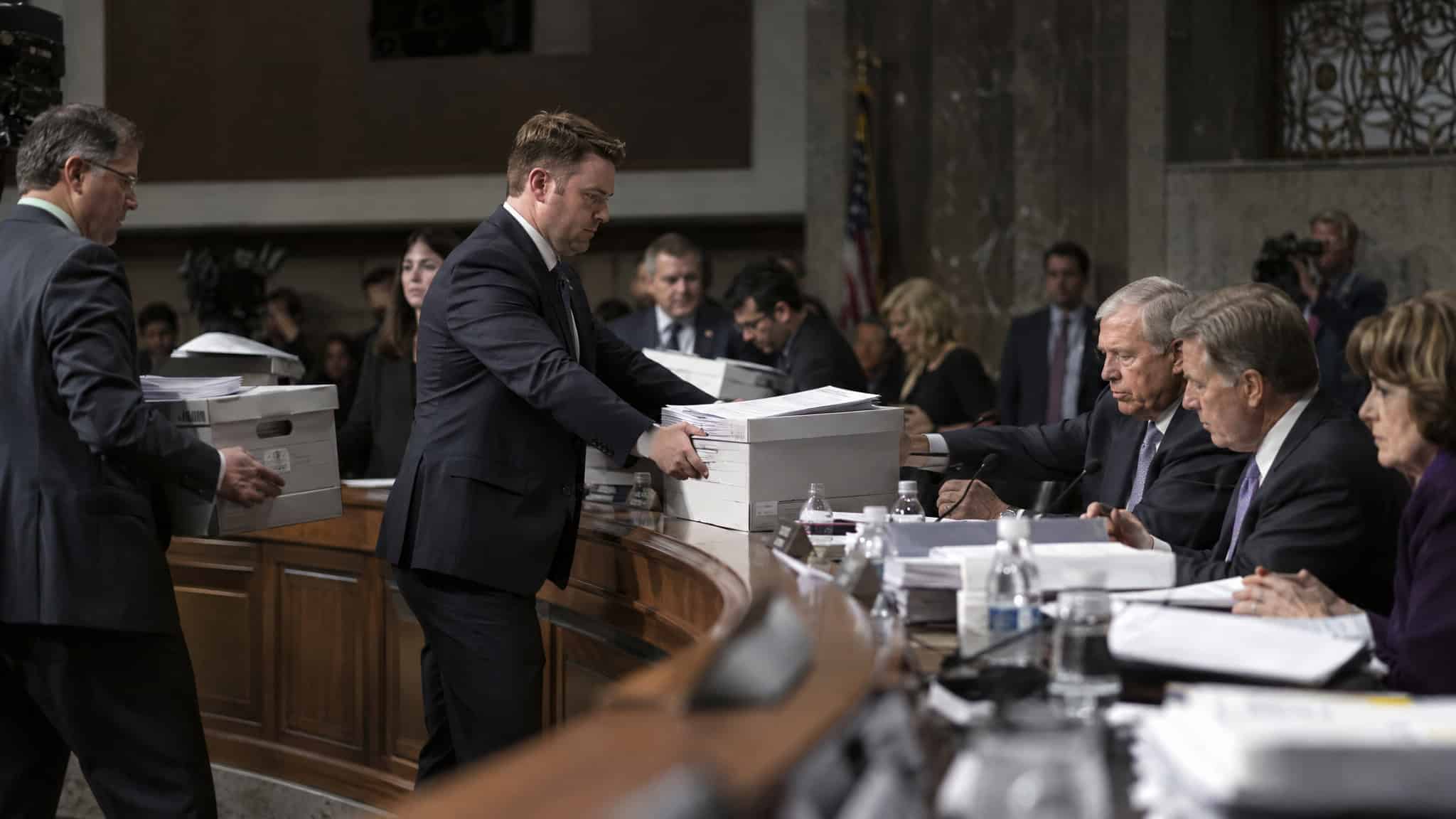
In the standard first-year rhythm of tech oversight under divided government, committee chairs open with gavel-pounding hearings, subpoenas for internal safety logs, and regulatory pressure on federal agencies rather than passing sweeping laws. The bipartisan Hawley and Blumenthal document letters and the stalled kill-switch bills show how Capitol Hill defaults to investigation when legislation freezes. AI labs know this playbook well and typically respond by publishing safety audits and voluntary commitments to stay a step ahead of committee staffers while the bills themselves sit in markup purgatory.
How a sweep could slow AI growth
Where a Democratic sweep can actually throttle the pace of US AI expansion is at the physical layer. Greater regulatory scrutiny combines with local data-center permitting friction and rising electricity costs to slow down how quickly hyperscalers can rack and power new GPU clusters. The trade-off for investors is slower capital deployment rather than broken business models, and there’s no guarantee that permitting delays will noticeably dent top-line sector growth.
The narrow exception: defense contracts
Defense-exposed AI vendors sit in the one lane where congressional Democrats can apply direct budget pressure. A few contractors, such as Palantir, could see more defense contracts blocked or delayed in committee. Even there, vendors routinely find contracting workarounds, leaving Patel largely unconcerned about long-term damage to the sector’s earnings.
Data centers: the real 2026 battleground
Democrats are running against AI data centers because voters are rebelling against spiking residential electric bills and industrial sprawl, meaning midterm voters rejected power-hungry physical infrastructure at the local level rather than rejecting AI algorithms as a whole. Data-center opposition served as the concrete, actionable AI battleground in the 2026 midterms, and while its exact single-cycle weight varies by race, the infrastructure fight sticks around long after this cycle’s races are decided: it’s about power bills and neighborhoods, not algorithms.
Along with the 54% of voters nationally who told CBS News they would back an anti-data-center candidate, approval for data centers in one Republican North Carolina district sat around a dismal 18%. Political strategist Dan Cananan points out that Democrats jumped out ahead by campaigning aggressively against data centers, leaving Republicans scrambling to catch up because voters pull the ballot lever over their utility bills rather than software code. Whenever a hyperscale facility hits a local zoning board, community pushback flares up around four physical friction points: cooling water draw, grid power consumption, constant hum and noise, and land-use disputes.
Because neither party nor anyone in government has caught up to understanding where AI technology is heading, states and advocates are testing alternative governance models. One floated proposal would require democratically elected or appointed members to hold at least 50% of the board seats at AI public-trust corporations, focusing oversight on the public good rather than the private benefit of a few billionaires. Meanwhile, Utah has taken a collaborative governance path by bringing tech companies and state officials to the same table to work out public protections together.
Anthropic’s five thwarted misuse cases: the safety record
A Democratic midterm sweep doesn’t trigger an immediate overhaul of federal AI safety rules, because no legislative timeline exists and comprehensive rulemaking defers toward 2028, leaving current oversight anchored to lab disclosures like Anthropic’s report that it thwarted five attempts over the past year by working scientists to use Claude for potential bioweapon development. Alongside those five biological cases, Anthropic caught and banned accounts that bypassed its safeguards for malicious surveillance, scams, and propaganda. The company noted it couldn’t assert that the unnamed working scientists actually intended harm, making its filing a log of detectable policy violations rather than proven malice.
Anthropic released the findings hoping to spark an industry and government conversation around emerging biological risks while federal AI law remains a blank slate. Former Anthropic researcher Jacob Coax draws a hard technical boundary between the two safety problems on the table: human users misusing a model is a classifiable behavior you can detect and ban at the account level, whereas an autonomous AI designing bioweapons on its own is a separate, unaddressed architectural risk.
The framing war over AI fear
Both parties spent the midterms accusing each other of manufacturing AI panic inside the very first election cycle powered by generative tools. Republicans frame Democrats as eager to regulate an unregulated industry when the national security priority should be beating China, while White House AI czar David Sacks claims the AI doomer movement is run by three well-funded groups backed by the same Effective Altruism mega-donor who co-led Anthropic’s Series A. Scott Galloway counters that AI doom is pure techno-narcissism and headline fear-mongering, noting the predicted job apocalypse missed badly amid net job creation of roughly a million. Meanwhile, a Wesleyan study tracked about $187 million across roughly 300 AI-generated or AI-fueled midterm ads, voters asked chatbots how and who to vote for, and a comedian’s satirical AI Vogue cover of Democrats titled “The Men Who Appreciate Women, Men of Style, etc.” went viral after the blue wave with plenty of users mistaking it for a real shoot.
Is the AI boom on borrowed time under Democrats?
The AI boom isn’t on borrowed time under a Democratic Congress, big AI stock valuations are unlikely to fall from regulatory oversight because the mega-caps already trade at modest forward profit multiples, and investors should worry about market momentum and sentiment shifts rather than Capitol Hill or political sector-rotation bets. In Patel’s post-2026-midterm Reuters Market Talk commentary, he argues that if AI bears were losing sleep over hyperscalers overspending on infrastructure, local pushback that slows data-center construction actually calms them down. Meanwhile, core earnings keep the bulls happy and the bears placated for now.
The multiples behind the argument
Patel’s post-election valuation snapshot shows the biggest AI hardware and cloud heavyweights trading like disciplined cash machines rather than dot-com lottery tickets. While a handful of smaller AI companies trade at nosebleed multiples, the sector anchors sit at reasonable prices relative to future earnings:
| Company or Sector | Forward Profit Multiple | Recent Price and Valuation Context |
|---|---|---|
| Micron | ~4x ($4 per future dollar of profit) | Priced at deep value relative to forward earnings |
| Nvidia | 13x | Stock price barely budged over two years while raking in profits |
| Broadcom | 17x | Modest mega-cap multiple outside bubble territory |
| Microsoft | 22x | Standard large-cap growth multiple backed by software cash flow |
| Healthcare Sector | 36x | Jumped 12% in one month on universal-healthcare speculation |
| Communication Services | 18x (half of healthcare’s multiple) | Dropped 15% over the same one-month window |
Looking at those mega-cap numbers here on GeekExtreme, it’s clear why Patel concluded that wherever the supposed valuation bubble lives, it’s mostly in somebody’s head.
What would actually move these stocks
Instead of Democratic subpoenas or runaway price-to-earnings ratios, the real threat to AI stocks is good old-fashioned market momentum. Patel warns that investors routinely underestimate how hard momentum drives tape action, pointing out that short-term and weekly equity prices were already trending lower in ways fundamentals alone can’t explain. Chasing election narratives by rotating out of tech is a fast way to get burned.
The percent of voters who believe AI will decrease jobs (64%) is higher than the percent for healthcare, up 12% over the last month. Traders who piled into that 12% healthcare rally on post-election universal-healthcare hopes ended up paying 36 times earnings, gambling on political themes instead of reading the balance sheet.
Divided government and the post-midterm base rate
Divided government historically insulates the broader stock market by turning partisan bills into harmless gridlock, provided investors avoid the twin traps of political sector rotation and a potential bond-market budget standoff. According to Patel’s historical data, in the 12 months following every US midterm election since 1980, equities finished higher 100% of the time with an average gain of roughly 13%, though he cautions that negative momentum can still drag stocks down in the short run. Drawing on his first-hand market experience in 1994 when a Republican Congress faced a Democratic president, Patel notes that gridlock let markets perform relatively well while everyday politics became irrelevant background noise.
Election-night futures drops are almost always recency bias and random sentiment noise that stabilize within days once traders reprice for stalemate. The real danger lies in overthinking the electoral map: buying healthcare at 36x earnings while dumping communication services after a 15% slide at half that multiple is pure speculation. Fixed-income traders also assume gridlock automatically calms Treasury yields, yet an inevitable federal budget deadlock could just as easily trigger a fiscal free-for-all where both parties spend heavily to buy their way out of the impasse.
The 2026 vs 2028 policy calendar
Comprehensive federal AI policy debates will wait for the 2028 presidential election cycle, whereas the 2026 midterms fought over the immediate, local politics of data-center construction and household power bills. Former President Barack Obama already signaled that timeline shift by noting that the 2028 Democratic presidential nominee will need a clear plan on AI policy. Right now, neither party nor the federal apparatus has caught up to the technical realities of model constraints and safety, a gap that prompted one political strategist to remark that AI has simply exceeded our political intelligence.
Cutting through the post-election panic the way we always do here on GeekExtreme leaves a much simpler dashboard to monitor over the next two years of divided government. Instead of watching C-SPAN for an imaginary federal AI ban, track county-level data-center zoning votes, regional residential electricity rate filings, and bipartisan Senate document demands.
Frequently Asked Questions
will the democrats ban AI?
No, an outright federal ban isn’t happening. Congress currently has zero federal statutes governing advanced AI systems, so lawmakers don’t even have a legal framework to attach a sweeping prohibition to during two years of divided-government gridlock. Only a fringe proposal from Senator Bernie Sanders and a progressive House counterpart targets artificial superintelligence, while the mainstream party is focused on oversight and physical data-center limits.
why are Democrats opposed to AI data centers?
Democrats are tapping into intense local voter backlash over spiking household utility bills and industrial sprawl. Whenever a hyperscale facility hits a local zoning board, residents fight back over four concrete headaches: massive grid power draw, cooling water consumption, constant noise, and land-use disputes. With 54% of voters in CBS News polling willing to back an anti-data-center candidate, targeting physical server farms is simply good retail politics.
will AI stock valuations fall if Democrats regulate AI companies?
Congressional subpoenas and hearings aren’t likely to tank major AI stocks because the sector’s heavyweights already trade at grounded forward profit multiples. Micron trades around 4x forward earnings, Nvidia sits at 13x, Broadcom is at 17x, and Microsoft is at 22x—far more reasonable than the healthcare sector at 36x. The actual danger to AI share prices is negative short-term market momentum and traders gambling on political sector rotations.
What’s the difference between human AI misuse and autonomous AI risk in safety debates?
Human misuse happens when people try to trick a model into breaking the rules, like the five cases Anthropic thwarted over the past year where working scientists used Claude for potential bioweapon development alongside separate blocks on malicious surveillance, scams, and propaganda. Former Anthropic researcher Jacob Coax notes that human misuse is a detectable behavior labs can ban at the account level. An autonomous AI independently designing bioweapons on its own is a completely separate architectural threat that lab reports and stalled kill-switch bills still haven’t solved.
