
You want a verifiable, practical pathway to transition into a professional blockchain development role. The good news is you can bypass traditional gatekeepers entirely. At GeekExtreme, we investigate how tech works—stripping away the marketing hype to expose the bare metal. Decentralization is an engineering meritocracy.
If you want to work on Web3 infrastructure or a cryptocurrency trading platform, hiring managers care about your public GitHub commits and your grasp of cryptographic concepts, not your standard resume. Whether you are a beginner or a data science student looking to pivot, here is the sequenced technical roadmap to building an unignorable Web3 portfolio.
Key Takeaways
The average Canadian blockchain developer salary commands $90,582, with global market valuation for the sector projected to exceed $39 billion by 2025.
Core blockchain developers build the base protocol, while software developers build the decentralized applications (DApps) that run on top of them.
You can substitute a computer science degree with verifiable, public open-source contributions to ecosystems paying developers for successful code deployment.
Table of Contents
How to Become a Blockchain Developer: a Sequenced Technical Roadmap
Hands-on computer programming skills, such as deploying smart contracts, carry more weight for recruiters than a traditional four-year computer science degree. Web3 recruiters pull talent directly from active, public developer activity.
Data from Statista projects the global blockchain market will exceed $39 billion by 2025. Adding to that, Job Bank Canada projects a 30% growth in software development jobs between 2019 and 2028. Recruiters scrape platforms like Reddit and the r/CryptoTechnology subreddit to identify developers contributing code to decentralized applications. Glassdoor sets the average salary for a Canadian blockchain developer at $90,582. A detailed look into educational constraints, analyzing industry data parsed through web scraping tools like Trafilatura, confirms that your verifiable coding footprint matters infinitely more than formal credentials.
Protocol Architecture Versus DApp Development
Before reading a single block of code, you must choose between protocol architecture or building decentralized applications (DApps) on existing blockchains. Conflating the two roles is the most common beginner mistake.

Protocol Architecture: Core Blockchain Developers
A core blockchain developer designs the actual protocol architecture and maintains the physical consensus mechanics that dictate how distributed groups—like Bitcoin miners—validate network activity. They build the foundation. These developers choose whether to work on purely open, public frameworks like Bitcoin, or pivot to closed enterprise networks. When constructing private blockchains for enterprise, Hyperledger Fabric operates as the standard permissioned network, placing strict controls over who can read or write to the block.
Sometimes, organizations fall in the middle. Many logistics companies build a consortium blockchain to track their global supply chain without relying on a single owner. The Global Shipping Business Network Consortium is a prime example. You also see hybrid structures, like Ripple, which bridges private organizational control with public oversight for B2B currency exchange.
DApp Development: Building on Existing Chains
A blockchain software developer builds decentralized apps on top of existing platforms. They do not worry about base consensus rules.
Instead, they build smart contracts on top of base protocol layers, relying on automated compliance to execute actions across the network. Think of a smart contract like a physical parking meter. You put a quarter in, the timer gives you fifteen minutes. There is no middleman, no cashier, and no negotiation. The agreement is self-executing.
“A smart contract is like a physical parking meter; there is no middleman, no cashier, and no negotiation.”
Cryptographic and Data Structure Fundamentals
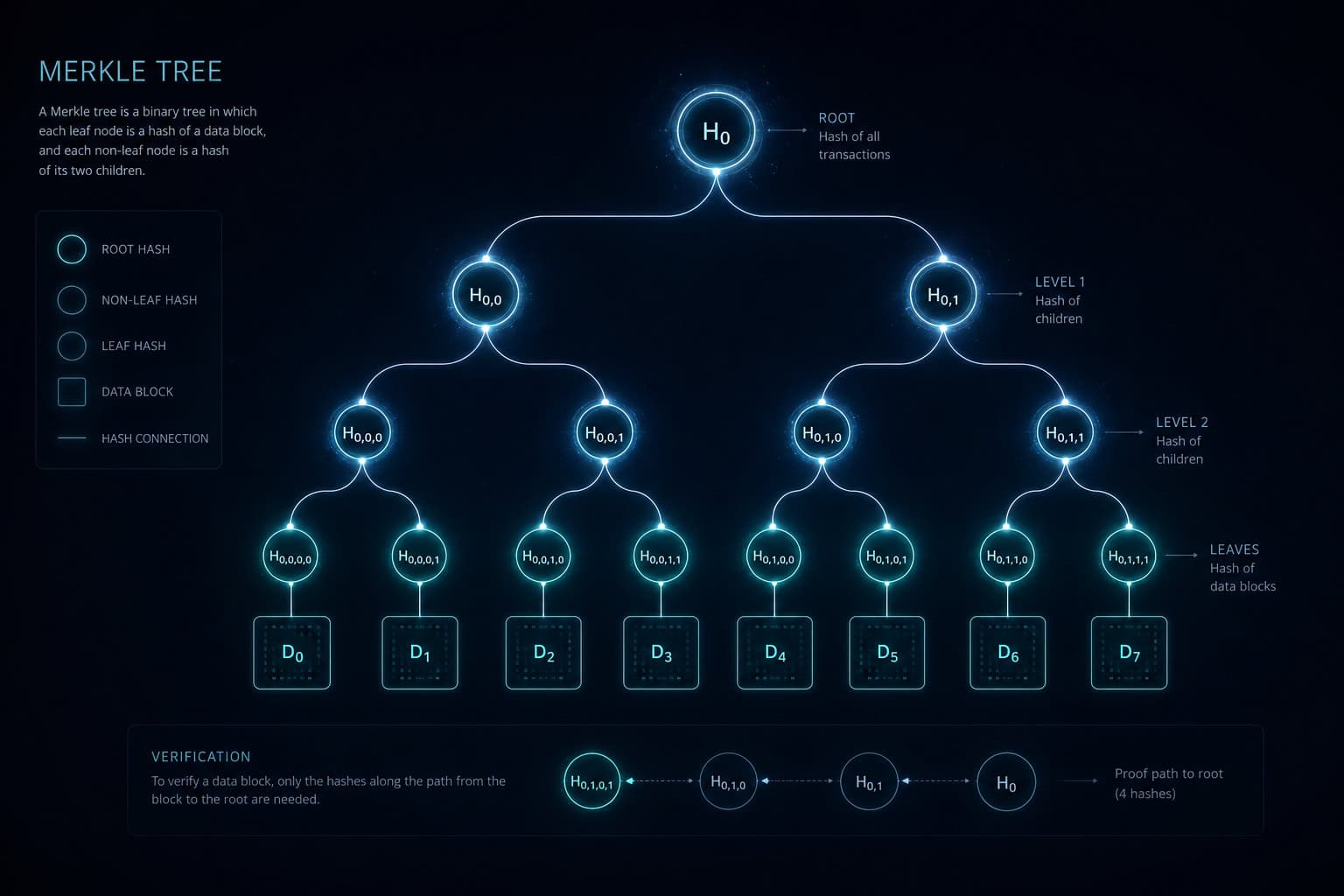
A firm grasp of Merkle trees, physical block hashing, and cryptography is non-negotiable. You can skip the university tuition, but you cannot skip the foundational architecture underlying the future of crypto.
Cryptography and Network Module Basics
If you lack a math or software background, complete Programming Fundamentals from Duke University to develop better programming techniques before wrestling with Web3 syntax. Modules like Programming Fundamentals from Duke University or a primer like Introduction to Blockchain Technologies give you the baseline logic.
Unlike a centralized database relying on easily altered tables, blockchains rely on hashing algorithms to ensure that financial information—ranging from massive industry ledgers to everyday budgets outlined via ChatGPT prompts for personal finance—remains completely immutable. To understand how that timestamping logic securely restricts data access, check out Cryptography 1 from Stanford University.
Distributed Hashing and Data Structuring
Transactions bypass centralized authority, a core principle behind how blockchain technology works, because of how they organize memory and efficiently distribute storage capacity limits across the network. You must understand fundamental data structures, specifically analyzing how Merkle trees mathematically link and secure sets of blocks. If you want a structured breakdown, the Data Structures Specialization from the University of California San Diego walks through this natively. The second course in the Blockchain Specialization series also covers how these principles apply directly to executing code trustlessly.
Selecting Your Ecosystem: Asset-oriented Models Vs. the EVM
Choosing a programming language in Web3 dictates your entire security philosophy. Adopt a specific ecosystem’s logic rather than trying to learn “crypto coding.”

Bridging From Web2 Languages
If you want to start fast, begin with languages already dominant in standard software development. Testing scripts and node interactions rely heavily on JavaScript and Python. They provide a softer entry point into network mechanics. Google’s Crash Course on Python is a highly regarded place to pick up the syntax and start writing query scripts immediately.
Modern Rust Vs. the EVM
Most legacy DApps run on the Ethereum Virtual Machine (EVM) using Solidity. It works, and the documentation is everywhere. But high-performance, next-generation chains demand different languages. Community developer Most_Station_8504 correctly notes that choosing Rust remains a highly recommended path for these modern environments.
Some networks scale through entirely different mechanisms. Users like Express-Outside6705 advocate for ICP on the Internet Computer network, pointing out how their scalable architecture allows developers to expand basic tech side hustles into truly community-owned entities.
The Asset-oriented Paradigm
The most fascinating architectural shift is the move away from the traditional EVM logic. For years, the legacy account-based model caused security nightmares because it treated user tokens simply as internal balance sheet numbers. Moving to an asset-oriented paradigm changes this, treating tokens as physical objects that must be explicitly passed between vaults.
Developers like Known_Syllabub_8334 and cheeruphumanity recommend looking into Scrypto, built for the Radixdlt network. The asset-oriented approach takes only a few hours to learn, letting you bypass the clunky security workarounds required in older languages.
“The asset-oriented approach treats tokens as physical objects that must be explicitly passed between vaults.”
Data Science Pivots: Security Analytics and Smart Contract Auditing
Data scientists can bypass base protocol coding entirely by deploying anomaly detection models to flag contract vulnerabilities.

You do not have to throw away your technical background. Consider Mael, a data science student based in Mexico, or peer developer manaosdebanana—both looking for the intersection between data and decentralization. The DeFi (Decentralized Finance) space generates publicly transparent ledgers perfect for algorithmic mapping.
By targeting behavioral clustering on-chain, you can identify malicious exploit patterns before they execute. A perfect example of this overlap is the Messi-Q/AMEVulDetector repository on GitHub. It uses machine learning specifically to scan and detect architectural vulnerabilities inside smart contract code.
Navigating Textbooks, MOOCs, and Coding Academies
Filtering down to authoritative digital programs and textbooks keeps you focused on engineering rather than hype.
User BlockCityLife compiled an excellent reading syllabus for foundational architecture. Start with Mastering Blockchain by Imran Bashir. For a gentler on-ramp, grab Blockchain Basics: A Non-Technical Introduction in 25 Steps by Daniel Drescher. Once you shift to DApp logic, read Building Blockchain Apps by Michael Juntao Yuan.
If you prefer structured video environments, pursue online courses on Coursera, Udemy, or edX, which issue professional certificates to anchor your early portfolio. For specialized cohort learning, lexwolfe recommends Moralis academy.
If your goal is to understand how enterprise systems intersect with spatial computing and distributed logic, dive into corporate-backed architectures. Take Meta’s What Is the Metaverse? course, or pull from Blockchain: Foundations and Use Cases and the Blockchain Revolution frameworks.
Building a Permissionless Portfolio Beyond Traditional Interviews
In Web3, your public code serves as your resume. You do not need an HR department’s permission to gain experience.
Working on a permissionless blockchain naturally pushes you toward open source contributions. Because the network architecture is entirely public, you can pull repositories from GitHub today and start troubleshooting. Submitting high-quality fixes to permissionless ecosystems often leads to direct outreach from project founders.
The best move is simple validation: follow developer chujon’s advice and just pick a project and start developing. To spot upcoming ecosystems, follow technical deep dives on platforms like Coin Bureau to locate under-the-radar networks.
Ecosystems will literally pay you to learn. Jump into asynchronous community challenges immediately. The Internet Computer pushes continuous bounties through their Developer Journey program. Radix regularly hosts highly lucrative hackathons, recently featuring an $8,000 yield derivative challenge. Dive in, write the code, and let your verifiable output prove your worth.
Is blockchain a high paying job?
Yes, it is a lucrative field, with the average Canadian blockchain developer salary currently sitting at $90,582. As the sector grows toward a projected $39 billion valuation by 2025, demand for skilled developers remains high.
What do I need to become a blockchain developer?
You need a solid grasp of cryptographic concepts, data structures like Merkle trees, and hands-on programming experience. Rather than a formal degree, hiring managers prioritize a public GitHub portfolio and verifiable open-source contributions.
Is it difficult to become a blockchain developer?
It is challenging because it requires shifting your mindset toward decentralized architecture, such as understanding immutable hashing and consensus protocols. However, you can bypass traditional gatekeepers by building on existing networks and participating in developer bounties.
What is the difference between a core blockchain developer and a DApp developer?
Core blockchain developers build the base protocol mechanics, like consensus rules, while DApp developers build applications on top of those existing networks. DApp developers focus on smart contracts rather than the underlying validator architecture.
How long does it take to be a blockchain developer?
There is no fixed timeframe, as the role is based on an engineering meritocracy where your portfolio speed is the only metric that matters. Beginners can accelerate the process by starting with Python or JavaScript before moving to specialized languages like Solidity or Rust.
Can I get hired without a computer science degree?
Absolutely, as decentralized hiring leans heavily on your ability to deploy successful code rather than academic credentials. Recruiters actively scout platforms like GitHub and Reddit for developers who contribute to open-source protocols and demonstrate technical competence through public commits.
Why should a developer consider an asset-oriented paradigm?
Older languages often treat tokens as internal balance sheet numbers, which creates significant security risks. Asset-oriented models, such as those used with Scrypto, treat tokens as physical objects that must be explicitly passed between vaults, preventing common security workarounds.
