
Look at the top of the sales and review charts on any given week, and the video game industry looks like a golden age of craft. You have multi-generational blockbusters like Horizon Zero Dawn and Marvel’s Spider-Man moving tens of millions of copies, alongside critical darlings like Persona 5 Royal, Astro Bot, Final Fantasy VII Rebirth, and 2025’s Clair Obscur: Expedition 33 driving global conversation. Look at the corporate side of the ledger, however, and you see a different machine. The titans of the video game industry are pricing out players, forcing live-service engagement loops into genres where they don’t belong, consolidating studios, and shutting down entire divisions when quarterly targets slip.
Naming the biggest companies is easy, but a flat roster doesn’t explain how their power works under the hood. The crown shifts depending on the metric: hardware ecosystems, first-party exclusives, raw capital, or portfolio stakes. Even at the top, that grip is far less secure than a multi-billion-dollar balance sheet suggests.
Key Takeaways
Sony Interactive Entertainment led 2025 gaming revenue at $31.7 billion, ahead of Tencent at $27.1 billion and Microsoft Gaming at $23.5 billion (with Xbox Game Pass generating over $5 billion).
PlayStation’s hardware moat runs on first-party exclusives that pair unit sales, like Horizon Zero Dawn at 24 million copies, with critical peaks like Uncharted 2: Among Thieves at a 96 Metascore.
Corporate scale doesn’t guarantee survival or player trust: Amazon shut down New World and its MMO division, while independent-minded releases like Larian’s Baldur’s Gate 3 and Clair Obscur: Expedition 33 won Game of the Year honors without live-service monetization.
Table of Contents
Who the titans of the video game industry are
When we break down hardware ecosystems and game architecture, the most important split isn’t genre or budget. It’s the structural divide between owning the storefront and merely selling products on it.
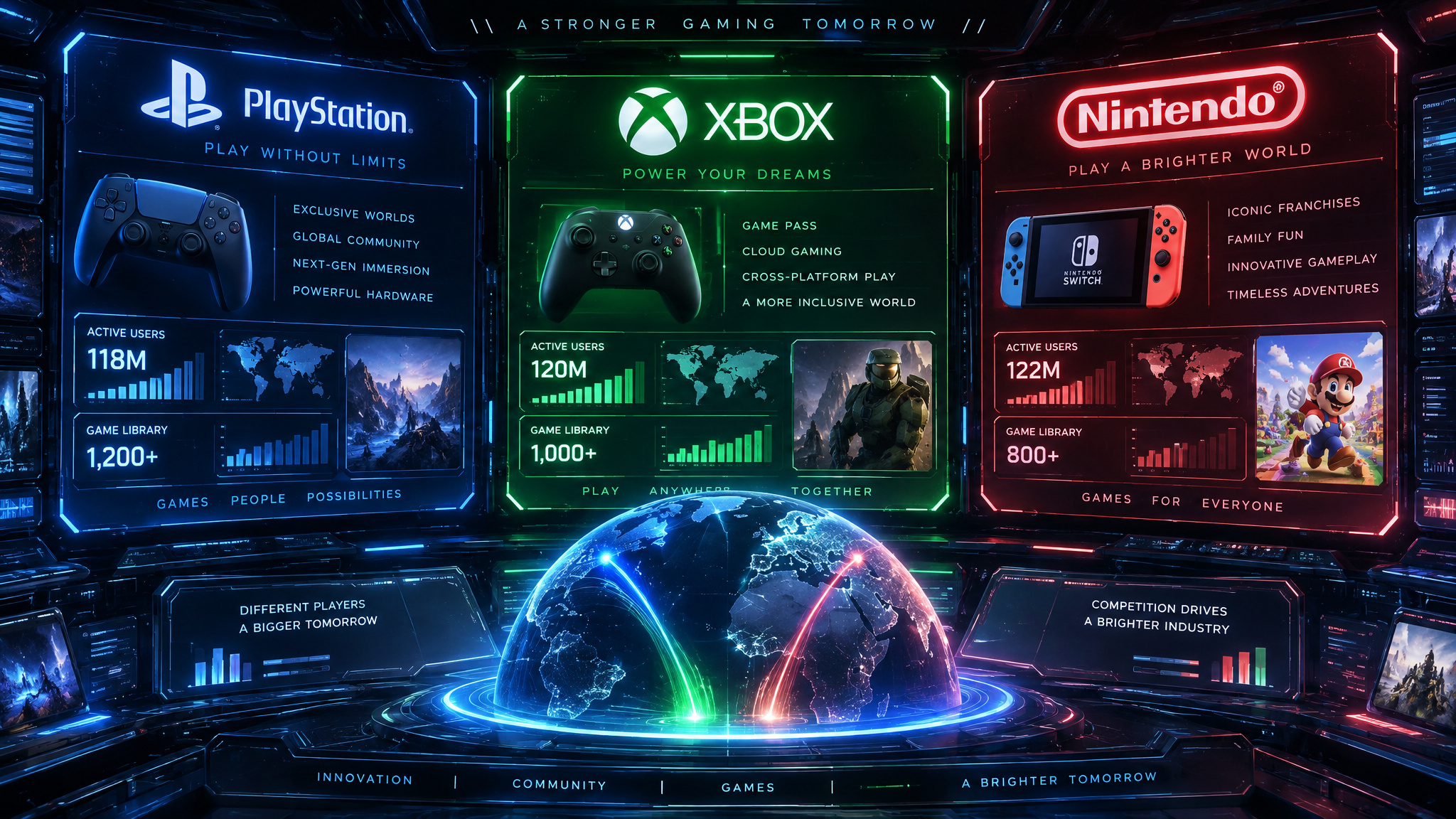
Platform holder vs. third-party publisher
A platform holder builds the console and runs its digital storefront, taking a cut of every transaction. A third-party publisher is a software company that funds and ships games across multiple platforms without owning the underlying box. Platform holders like Sony, Microsoft, and Nintendo publish first-party lineups because great software makes their hardware appealing and locks players into their storefront tax. Third-party publishers like Electronic Arts, Take-Two, Ubisoft, and Activision (prior to its absorption into Microsoft’s ecosystem) live and die by unit sales and in-game monetization across someone else’s pipes.
Four crowns, four different power bases
No single company dominates the entire video game industry among Sony, Microsoft, Nintendo, and Tencent because each giant holds a different kind of crown across hardware, exclusives, services, and investment scale. By 2025 annual gaming revenue, the top tier ranks with Sony Interactive Entertainment in first place at $31.7 billion, Tencent second at $27.1 billion, and Microsoft Gaming third at $23.5 billion.
- Sony (Exclusives and prestige hardware): Converts blockbuster single-player showcases into console market share and storefront revenue, powered in 2025 by releases like Death Stranding 2. As an April 2026 PlayStation historical presentation (The Titans of Gaming) outlines across the PS1-to-PS5 eras, commercial hits and critical acclaim act as twin pillars that make first-party exclusives the gold standard for console appeal.
- Microsoft (Capital, acquisitions, and subscriptions): Uses balance-sheet muscle and ecosystem services to compete across PC, cloud, and console, with Xbox Game Pass alone generating over $5 billion of its 2025 gaming haul.
- Nintendo (Proprietary IP and hardware independence): Operates in its own gravitational field, using generational franchises and self-contained hardware to bypass the raw teraflop arms race.
- Tencent (Portfolio investment and mobile scale): Dominates through global equity stakes and mobile ecosystems led by Honor of Kings.
| Company | Hardware ecosystem | First-party exclusives | Subscription / services | Mobile / portfolio stakes |
|---|---|---|---|---|
| Sony Interactive Entertainment | Yes (PS1 to PS5) | Yes (core platform moat) | Partial (ecosystem services) | Partial (expanding beyond console) |
| Microsoft Gaming | Yes (Xbox and PC ecosystem) | Yes (expanded via acquisitions) | Yes (Xbox Game Pass >$5B in 2025) | Partial (acquisition-driven) |
| Nintendo | Yes (dedicated console/handheld) | Yes (proprietary franchise moat) | Partial (online membership) | Partial (select IP mobile titles) |
| Tencent | No (software and platform stakes) | Partial (studio subsidiaries) | Yes (live-service operations) | Yes (global portfolio and Honor of Kings) |
We’re skipping Nintendo’s exact 2025 revenue figure, full corporate market-cap rankings, and complete third-party executive rosters here to stay focused on the platform architecture.
The exclusives moat: Sony’s evidence trail
Sony PlayStation is considered an industry leader because it systematically converts blockbuster first-party exclusives and critical acclaim into multi-generational hardware loyalty. Hardware specs age out every six or seven years, but a single cultural touchstone convinces millions of players to buy into the ecosystem and stay there when the next box ships. And for patient players, these single-player showcases carry a practical upside: unlike ephemeral online games, holding off for a sale saves money without sacrificing a complete experience.
Multi-generational sales milestones
The commercial evidence trail from PlayStation’s historical data shows how individual releases anchor hardware generations:
- Horizon Zero Dawn (24 million copies sold): Became one of the top-selling new intellectual properties in PlayStation history by colliding primitive tribalism with high-tech mystery through its protagonist, Aloy.
- The Last of Us Remastered (over 17 million copies sold): Combined sales across PS3 and PS4 proved that prestige narrative milestones carry long-tail commercial weight across console transitions.
- GT Sport (nearly 13 million copies sold): Demonstrated the enduring pull of the Gran Turismo franchise and its long-standing pitch as a real driving simulator.
- Marvel’s Spider-Man (3.3 million units in three days): Its 2018 launch shattered expectations for licensed superhero games through sheer traversal physics and storytelling, turning a three-day sprint into a platform-defining event.
Critical peaks as brand currency
Sales move the quarterly needle, but review scores build the brand prestige that keeps developers and players locked in. On PS3, Uncharted 2: Among Thieves reached a 96 Metascore, marking the critical peak of a series widely treated as playable cinema and the bedrock of modern PlayStation identity. Its narrative successor, The Last of Us Part II, later posted a 93 Metascore.
On PS4, Persona 5 Royal hit a 95 on Metacritic, narrowly edging out 2018’s God of War to represent peak fourth-generation performance through its turn-based combat mechanics and unmistakable visual style. That critical standard carried straight into the PS5 era, where God of War Ragnarök and 2024’s Astro Bot sit tied at the top as the platform’s highest-rated releases.
The 2024-2025 scoreboard: who’s executing now
PlayStation sustained its ecosystem lead through back-to-back critical and commercial execution across 2024 and 2025 rather than coasting on its back catalog. The titles leading PlayStation’s success changed from 2024’s top-rated titles, Astro Bot (hailed among the greatest platformers ever made), Final Fantasy VII Rebirth (a top-three Metacritic game of 2024), and the breakout exclusive Stellar Blade, to 2025’s titles like Death Stranding 2 powering Sony topping the rankings with $31.7 billion in revenue, alongside Clair Obscur: Expedition 33 earning Metacritic’s Best New PlayStation Game of 2025.
How titan power reshapes the games themselves
When a publisher grows into a corporate behemoth, its internal financial plumbing starts dictating how games feel when you pick up the controller.
Publisher control over development
Video game publishers control what developers make by dictating game engines, mandating specific features, and overriding studio creative decisions to protect corporate profit targets. Industry critics frequently point to giants like Activision to show how risk-averse leadership leans on the mantra that what works, works. Instead of funding weird, ambitious mechanics, corporate executives greenlight quantity over quality: World of Warcraft expansions follow the same structural template every cycle, annual Call of Duty releases play like near one-to-one copies, and FIFA (now FC) entries recycle the same core loop year after year.
Designed backwards from monetization
Big corporate publishers prioritize monetization over fun when they engineer core gameplay systems backwards from the cash shop, a shift that directly penalizes players who just want a rewarding progression curve. Microtransactions aren’t new; weapon camos in Call of Duty: Black Ops 1 and mounts, pets, and transmogs in World of Warcraft sat on the margins for years. They damaged modern games not by existing, but by reversing the order of design. Quest rewards get yanked into the cash shop.
Progression stretches out behind paywalls or time gates to nudge your wallet, while engagement loops are tuned to keep you cycling inside one title forever. Under that kind of short-term profit pressure, studios sometimes even ship features without proper testing.

Battle passes, FOMO, and the trend-copying economy
Battle passes dominate modern publisher revenue strategies because locking limited-time rewards behind expiring seasonal timers weaponizes the player’s fear of missing out (FOMO) to force daily logins and spending. After Fortnite turned battle royale into a pop-culture juggernaut, surpassing 500 million registered players by 2025 and crossing into mainstream television, publishers chased the wave with Blackout in Call of Duty: Black Ops 4, Call of Duty: Warzone in Modern Warfare (2019), World of Warcraft‘s Plunderstorm, Spellbreak, Realm Royale, and Battlefield‘s battle royale mode, before bolting battle passes onto single-player and non-battle-royale genres that play better without them.
The live-service trap: perpetual incompleteness
Live-service games are ongoing online titles built for continuous post-launch monetization, and players criticize them because publisher mandates routinely turn the promise of long-term support into perpetual incompleteness. Unlike a crypto casino such as Titan Treasure, where over 15,000 games are ready upfront, corporate studios under the banner of live updates ship games unfinished, delay baseline features, and drip-feed content so you’re never quite satisfied enough to uninstall and move on.
From a game-architecture standpoint, these models are structurally hostile to narrative closure, mechanical finality, and artistic intent. Most games used to be a single purchase, a single install, and a complete playthrough that you finished and remembered. When a game is engineered never to end, it loses the ability to stick with you. Look at Call of Duty‘s pivot toward Warzone and crossover monetization: resources and focus get pulled into keeping the endless crossover machine fed at the direct expense of self-contained campaign, traditional multiplayer, and zombies modes.
Structural change, not nostalgia: the PS2 contrast
Dismissing player frustration with modern AAA gaming as rose-tinted nostalgia misses the math. Over the last 10 to 20 years, the industry’s underlying ownership and risk model shifted.
From ship-once budgets to public shareholders
PS2-era studios ran on smaller budgets and tighter teams, so they could experiment with niche stories and ship imperfect, ambitious games as one-time purchases. Not every title was a masterpiece, but the math didn’t require infinite engagement. Once development studios became subsidiaries of publicly traded corporations, investors started treating games strictly as intellectual property and financial instruments rather than creative works. In that transaction, players stopped being the audience and became the product.
Consolidation, crunch, and the AI shortcut
Consolidation has concentrated market control into a handful of corporate owners, shrinking studio competition and killing off creative risk-taking. That relentless profit pressure drives studio crunch and developer burnout. Unlike anime industry burnout at studios behind Blue Lock and One Punch Man, which critics note stems from intense fan demand and production schedules rather than corporate shareholders, game studio crunch comes straight from top-down financial targets. Generative AI splits along the exact same fault line: it’s a handy developer tool for brainstorming, placeholders, and early mockups, but corporate leadership increasingly views AI-driven content as a way to cut labor costs rather than invest in creative talent.
The counterweight: winning without titan scale
Smaller and independent-minded studios like Larian succeed against corporate publishers because they reject live-service trend-chasing in favor of complete, audience-first games that respect the player’s time and wallet. While corporate titans optimize engagement loops for short-term extraction, studios operating outside those mandates are taking home the industry’s top hardware.
Larian Studios won Game of the Year with Baldur’s Gate 3 by delivering a trend-independent, replayable RPG free of battle passes, cash-shop gating, or real-world political lecturing. In 2025, Clair Obscur: Expedition 33 pulled off a similar feat, pairing its Game of the Year win with Metacritic’s Best New PlayStation Game of 2025 honor. Even without exact unit sales and revenue totals for Baldur’s Gate 3 and Expedition 33, their critical sweep supports a point we see across game design: studios that focus on what they do best and listen to their audience can build more durable value than corporate giants chasing quarterly monetization fads.
Titan fragility: when scale fails
Buying into a major corporate publisher’s game backfires for players and developers alike when trillion-dollar backing meets low player retention, as proven when Amazon shut down New World and its entire MMO division, leaving thousands of developers out of work. Big-budget live-service releases carry a hidden risk that sticker prices never show: when an online-only game misses corporate spreadsheet targets, the servers vanish along with every hour you invested.
Amazon is one of the largest corporations on the planet, yet its MMO exit followed a script that well-funded newcomers keep repeating. A conglomerate enters gaming with a launch budget, watches the player base shrink once the initial novelty wears off, and quietly shutters the division when the recurring revenue doesn’t materialize. Capital and scale are required to run global storefronts and console supply chains, but they can’t manufacture a great game loop. In the video game industry, real power is still earned one release at a time through creative execution and player trust, never bought by balance sheet alone.
Frequently Asked Questions
What are the biggest video game companies in the world by revenue?
Based on 2025 annual gaming revenue, Sony Interactive Entertainment sits at the top of the leaderboard with $31.7 billion. Tencent holds second place at $27.1 billion, followed by Microsoft Gaming in third with $23.5 billion—more than $5 billion of which came from Xbox Game Pass alone.
What is the difference between a platform holder and a third-party publisher?
The divide comes down to who owns the storefront versus who just rents shelf space on it. Platform holders like Sony, Microsoft, and Nintendo manufacture the consoles, run the digital marketplaces, and collect a cut of every transaction made on their systems. Third-party publishers like Electronic Arts, Take-Two, and Ubisoft don’t own the underlying hardware; they fund and release software across multiple systems and rely entirely on copy sales and in-game purchases.
How has consolidation changed competition in the video game industry?
When massive publicly traded corporations absorb studios—such as Microsoft absorbing Activision—fewer independent competitors remain, and games get treated as financial instruments rather than creative projects. Risk-averse executives mandate safe, repeatable templates like annual Call of Duty or FIFA (now FC) releases while enforcing top-down profit targets that drive developer crunch and burnout.
